https://doi.org/10.21022/IJHRB.2021.10.1.17 High-Rise Buildings
www.ctbuh-korea.org/ijhrb/index.php
From Fragmented Development to Three-Dimensional and Coordinated Development - Research on Renewal Strategies of
Existing Underground Commercial Space in Harbin
Minghui Xue
1†, Yiming Su
2, and Jiayu Hu
21Associate professor, School of Architecture, Harbin Institute of Technology, China; Key Laboratory of Cold Region Urban and Rural Human Settlement Environment Science and Technology,Ministry of Industry and Information Technology, China
2Graduate student, School of Architecture, Harbin Institute of Technology, China; Key Laboratory of Cold Region Urban and Rural Human Settlement Environment Science and Technology,Ministry of Industry and Information Technology, China
Abstract
In Harbin, a network of underground commercial spaces has been developed to occupy spaces that were originally created as civil defense shelters. With the gradual extension of the local metro rail system, the existing underground commercial space is no longer an isolated regional development, but a space that represents “three-dimensional city” and coordinated development taking place in many Chinese cities. Based on the analysis of the unique development process taken in underground space of Harbin, this paper summarizes three characteristics of its early model of “fragmented development” of underground space. By conducting a comprehensive field research and survey, the researchers analyzed 472 questionnaires related to the development trend, and proposed multi-level synergistic elements for the renewal and development of underground commercial space. The paper concludes by discussing the trend of “three-dimensional and collaborative development,” suitable for the development needs of the new era, and the corresponding development strategies for the renewal of underground space.
Keywords: Harbin, Existing underground commercial space, Fragmentation, Three-dimensional, Collaborative renewal
1. Introduction
Harbin, the capital of Heilongjiang Province, is located in northeast China and has a uniquely cold climate region and distinct, multicultural characteristics. As an area that was vigorously developed in the early years of the People’s Republic, a large number of underground civil air-defense projects were built; after the reform and opening-up period of the 1970s and 1980s, most of them were used as com- mercial streets, which made a positive contribution to the urban economy. However, with economic and societal changes, these “hot” underground commercial streets, although most of them occupy a good location in the city's com- mercial core, are still in decline. Spatial constraints, with age and dilapidation playing roles, the network has become a forgotten corner of the city, urgently needing renewal and transformation.
The arrival of metro rail transport is bringing new opportunities for renewal and transformation, and the underground network can play a greater role in the new phase of urbanization. The future of urban underground commercial space would be an important part of the development of a synergistic city in three dimensions,
and will serve more than a single function. Therefore, the process of combing through its development history, looking at the past and the present, and transforming these existing “forgotten corners” into vibrant places in the urban core adapted to the regional character, has become the focus of a distinctly demand-driven urban renewal program (Tong 2012; Qian 1998).
2. The Past and Present of the Existing Underground Commercial Space
2.1. The origin - based on the construction of civil air defense projects
Harbin's earliest history of underground space development can be traced back to the late 1960s. In 1969, China and the Soviet Union engaged in several border clashes centering on Zhenbao (Treasure) Island in the Ussuri River between the two countries, and relations began to deteriorate. To resist the threat from the Soviet Air Force and missiles, major cities in northeast China began to plan and build a large number of civil air-defense projects, and Harbin was among them. Most of the construction at that time was distributed at important nodes in the central areas of the city, under the main streets or the public squares, at a depth of about 30 meters. These early civil air-defense projects did not take later use into account, projects were unevenly distributed throughout the city, and they were
†Corresponding author: Minghui Xue, Tel: +86-186-4505-5125, Fax: 0451-86281135 E-mail: [email protected]
not integrated with urban space; but this had laid the pattern of the development and utilization of underground space in Harbin. As of the end of 2017, the total area of underground facilities in Harbin amounted to 3.312 million square meters, and the development of underground commercial streets reached more than 300,000 square meters (Nanjing Huilong City Planning and Design Co., Ltd. and Underground Space Branch of Chinese Society of Rock Mechanics and Engineering 2018). The total development of underground space in Harbin still ranks at the forefront of major cities in China.
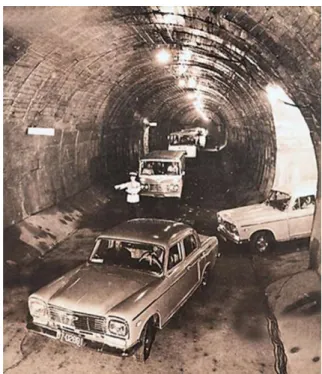
2.2. Process - batch conversion of underground businesses After the reform and opening up in 1978, in response to the CPC Central Committee's call for a “combination of peace and war”, a large number of civil air-defense projects began to be converted into underground commercial streets in batches, in order to fully develop and utilize the underground civil air defense space to promote economic development. For example, part of the underground shallow space of the “7381” civil air defense project (see Figure 1), which was built in 1973, was gradually transformed into an underground business district; in 1987, the Golden Street Mall was built at the intersection of Dongdazhi Street and Gogol Street, known as “First National Civil Defense Underground Commercial Street” (see Figure 2);
in 1996, the traffic project of the Museum Square, an important urban node area, was fully opened to traffic above and below ground. The following year, in the square of St. Nicholas Church, Hongbo Shopping Plaza, a large underground business center covering an area of nearly
50,000 square meters, opened (see Figure 3). By then, the underground business in Nangang District had expanded to a significant scale.
With the influx of international trendy goods after the reform and opening-up, the underground commercial street became very popular and crowded. Many Russian businessmen also came here to purchase clothing, forming a unique business atmosphere; especially in winter, the integrated underground space allowed citizens to travel freely without going up to the ground, becoming in effect an “underground city” for cold protection, leisure, entertain- ment, and shopping. During this period, the phased transfor- mation of civil air-defense projects into underground commercial spaces changed the lifestyle of Harbin citizens greatly, and provided worthwhile lessons for the reuse of underground spaces in other cities.
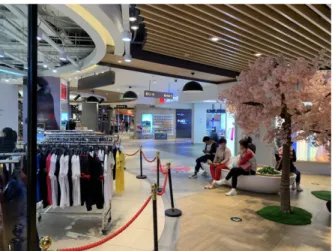
2.3. Status quo - development dilemma facing the new era After entering the 21st century, the underground street business pattern in Harbin has gradually declined, losing a large number of customers (see Figure 4). This is partly
Figure 1. Underground civil air defense project “7381” in Harbin.
Figure 2. The Golden Street Mall.
Figure 3. Hongbo Shopping Plaza.
because of the rise of above-ground commercial complexes, the upgrading of people's consumption habits, and the increasing popularity of online shopping. The lack of unified planning of the underground commercial street itself, and the poor environmental quality inside also contributed to this. Newly built commercial complexes, while meeting the needs of different levels of consumers in the new era, also integrate with different urban spaces, attracting a large number of customers. However, due to the irreversible development of the underground commercial space, its relationship with urban space has gradually become more tenuous. The golden period of underground business has gradually become history, and the existing underground commercial space is declining. The internal space has become monolithic, and is partly separated from underground rail traffic. Thus, a new development model is urgently needed to change this situation.
3. Fragmented Development - The Way of the Times
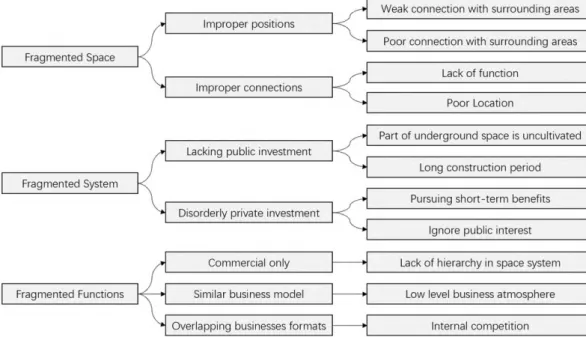
A look at the early development of underground commercial space in Harbin could be summarized as a history of “fragmented development”. This “economical and applicable” model was suitable to the prevailing national conditions and could quickly attract private investment for development, provide a large number of employment and commercial benefits to the surrounding area in the short term, and make full use of existing civil air defense projects for the benefit of civilian use. However, in the long term, there are also drawbacks. The irreversible development of underground space makes it difficult to resolve the contradiction between the development of the early focus on economic benefits and the modern society, which brings about some problems (see Figure 5).
3.1. “Fragmentation” of the space - phased development of “underground enclave”
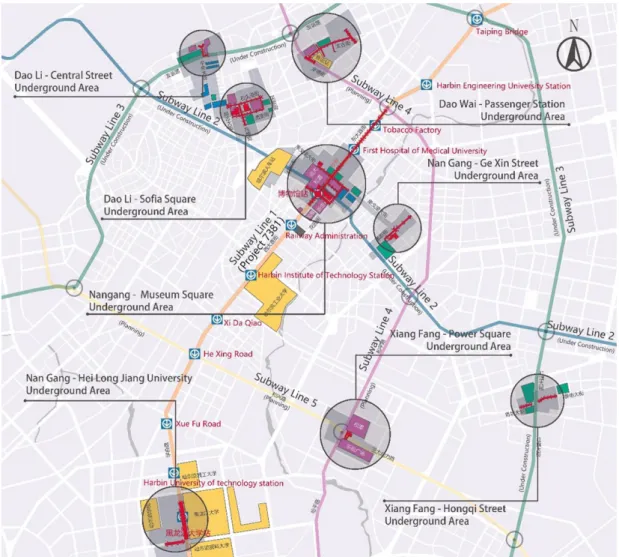
“Fragmentation” of the space refers to the “underground enclave” state characterized by the scattered distribution of the existing underground space in the urban spatial environment and its poor connectivity as a result of phased development. The different objectives of different develop- mental stages have resulted in discontinuous and limited development. For example, in terms of the connection between underground space and the city, the underground com- mercial space in Nangang District is connected to rail transit, adjacent to the surrounding commercial complexes and civic plazas, and has a large underground parking lot, which is closely connected to the city in various ways. But beyond this, other districts have a more homogeneous connection between underground space and the city. (see Figure 6).
Figure 4. Underground commercial space in Daowai District.
Figure 5. the problems brought about by the fragmented development of existing underground space in Harbin.
3.2. “Fragmentation” of the system - separate developers
“Fragmentation” of the system refers to the state in which developers have their own interests and compete with each other under the early investment and development system. From the 1980s onwards, the Government, based on the principle of “who develops, who benefits”, had been attracting investment, and the renewal and use of existing underground commercial space was mostly led by private investment. Although this kind of “fragmented development”, which is dominated by private interests, has considerable efficiency and high economic returns in the short term, it is difficult to conceal its neglect of sustainable urban development strategies and long-term public interests.
Each development subject pursued commercial benefits and filled the underground space with many shops, but few parking lots and underground public spaces. In the long run, it is very unfavorable to the development of urban underground space, and begins to become an obstacle.
For example, the Songlei Shopping Plaza in the Nangang core district mainly sells luxury goods. Although its under- ground commercial space is adjacent to Hongbo underground shopping plaza, due to differences in investment and
commercial grade, the high-grade underground commercial space in Songlei is actively isolated from the lower-grade commercial space in Hongbo, in order to maximize its own economic benefits (see Figure 7,8). This results in the discontinuity of underground functions and ignores Figure 6. Distribution of existing underground commercial space in Harbin.
Figure 7. Hongbo underground commercial space.
the possibility of the overall sustainable development of the urban underground space in the long-term public interest.
3.3. “Fragmentation” of the function - purely business- oriented single transformation
“Fragmentation” of the function refers to the lack of multifunctional underground space because of singly- focused business development. Due to the diversified shop owners, the business methods in the underground space are mostly retail, wholesale, etc., and the commercial formats are mainly low-end commerce, such as wholesale clothing, catering, kitchen utensils, underground supermarkets, and vegetable markets, and there is a general lack of coordinated consideration of urban public life. Most of
the shops have similar business models and overlapping business formats, creating a situation of mutual competition.
Under the regulation of the market economy, the huge economic benefits are brought about by the inherent disadvantages of the development model. As shown in the table below, the major underground space patches in Harbin have different types of businesses, but they lack public-facility-oriented diversification (see Table 1).
4. Problem-based Survey of Underground Space Development Trends
The current primary issue is how to explore the renewal mechanism of “same frequency and common resonance”
between underground space and urban development based on the current situation, and thus reduce fragmentation.
Thus, the authors conducted a question-oriented investigation and research.
4.1. Research framework
The survey was conducted on three levels: “macro”,
“meso” and “micro”, based on the results of the investigation and analysis of underground commercial space in Harbin and the terminology collection of the network cloud.
Then, 20 influencing factors of underground space renewal and the space-renewal influencing factor framework (see Figure 9) were summarized, considering the three dimensions of urban spatial environment, business operation mode and social life and culture. The purpose of the survey was to clarify the common elements and importance of the existing underground commercial-space renewal influencing Figure 8. Songlei underground commercial space.
Table 1. Investigation on the function of existing underground commercial area in Harbin
Area S CC CS UK CP UT CW UR US FM CR WK
Museum Square Underground
Area, Nan Gang District □ □ □ □ □ □ □ □ □ × □ ×
Heilongjiang University Underground Area, Nan Gang District
□ □ × × □ × □ □ □ × □ ×
Ge Xin Street Underground Area,
Nan Gang District × × □ × □ × □ □ × □ □ ×
Sofia Square Underground Area,
Dao Li District × □ □ × □ × □ □ × × □ ×
Central Street Underground Area,
Dao Li District × □ □ × □ × □ □ × × □ ×
Passenger Station Underground
Area, Dao Wai District × × × × □ × □ □ □ □ □ □
Power Square Underground Area,
Xiang Fang District × □ □ × □ × □ × × × □ ×
Hongqi Street Underground Area,
Xiang Fang District × × □ × □ × □ × × × □ ×
(S: Subway; CC: Connecting Complex; CS: Connecting Square; UK: Underground Parking; CP: Crossing Passage; UT: Underground Tunnel; CW: Clothing Wholesale; UR: Underground Restaurant; US: Underground Supermarket; FM: Food Market; CR: Commodity retail; WK: Wholesale of kitchenware.)
factors in a quantitative way, and to compare and analyze the situation in Harbin.
4.2. Research process
A total of 472 questionnaires were collected: 420 general questionnaires, of which 406 were valid; and 52 expert questionnaires, all of which were valid.
The weight ratio of the questionnaires was divided into 5, 4, 3, 2, 1, and 0 points, according to the topics of
“knowledge of underground commercial space” and
“frequency of visits”. The weighted average obtained by scoring was used as the questionnaire weight coefficient.
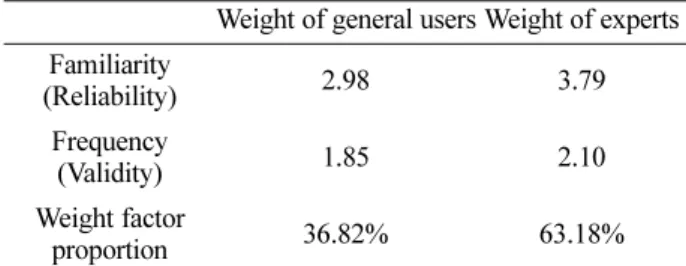
After calculation, the weight of the general questionnaire was 36.82%, and the weight of the expert questionnaire was 63.18% (see Tables 2, 3, 4).
4.3. Results and analysis
First, by conducting an importance evaluation survey of 20 influencing factors, the importance of the factors influencing the collaborative regeneration of underground commercial space was calculated by weighting them into 5, 4, 3, 2, 1 and 0 points respectively (see Table 5). It can be seen that the most urgent and important factors are concentrated at the physical space level, while the influence of the urban economy and society is relatively weak.
Some of these factors have a higher weight, for example,
“underground space planning”, “current situation of existing underground space”, “connection of existing public buildings”,
“connection of existing public space”, “internal flow line”
and “physical environment of internal space”, etc. This is because these factors are more relevant to people's daily use, and are the basis for the integration of urban underground space. Then, from the perspective of the urban economy and business model, “the current situation of block business”
and “internal operation” have a greater impact, because the formation of shopping districts has a deep influence on the overall drive of underground commercial space, and the internal business conditions affect its renewal while the impact of surrounding commercial buildings is relatively small. Also, in the society and culture aspect, it is urgent to improve the policies and regulations related to under- ground space and the distribution of property rights, as they have been inadequate up to now, which has resulted Figure 9. Proposed framework of influencing factors for
renewal of existing underground commercial space in Harbin.
Table 4. Weight calculation of questionnaires
Weight of general users Weight of experts Familiarity
(Reliability) 2.98 3.79
Frequency
(Validity) 1.85 2.10
Weight factor
proportion 36.82% 63.18%
(The final calculated value only retains two decimal places.)
Table 2. User’s familiarity with Harbin underground commercial space
Table 3. User’s visit frequency to Harbin underground commercial space
in restricted development and poor operation of underground space. As to “characteristics of crowd behavior”, which is directly related to the service targets of underground business, these have an indirect effect on the renewal of the underground space, because the needs of the users are always first and foremost.
Secondly, the questionnaire was based on the needs of users and was conducted in a hierarchical manner from the perspectives of city, architecture and public space.
Three dimensions of synergistic development, namely, business model, space optimization and socio-cultural development, were proposed in a predictive manner, and 18 points of need for urbanization and synergistic development were summarized and surveyed. The questionnaire for the general public focused on “breadth,” and uses multiple- choice questions, while the questionnaire for experts pointed to “depth”, and used single-choice questions, so the data are more discrete, which is normal (see Table 6).
Among them, the demand for the coordinated development
of existing underground commercial space is mainly focused on the physical space level, such as “integration with urban spatial structure”, “compound with public buildings and space”, “integration with three-dimensional traffic space”, because the current urban space has not yet reached a relatively perfected level, and the fragmentation of underground space in many areas is not tightly integrated with other parts of the city. This is also a problem that is urgently needed to be resolved in the underground space of Harbin at present. Meanwhile, it can be seen that the main trend of future development is to link up the major business districts with metro rail traffic and public transport- oriented developments (TODs), which have broad potential to bring huge passenger flows and economic benefits to the region. At the level of society and culture, the first priority also comes to the improvement of the relevant laws and regulations of underground space; and secondly, integration of underground walkway system with citizens’ cultural life should be prioritized.
Table 5. Importance evaluation of 20 influencing factors Table 6. User’s needs for existing underground commercial space
4.4. Analysis of the findings
Based on the above findings and analysis, it can be seen that the first and foremost target for the renewal of the existing urban underground commercial space is to combine the construction of three-dimensional traffic with the functional complex and spatial integration of urban space, in the case that the scale of the underground development is in line with the current level of urban development generally. Secondly, underground commercial space should further seek synergistic development with the urban economy and cultural industries on this basis.
Therefore, in response to the urgency of the physical space dimension, this paper proposes a three-dimensional and collaborative urban development strategy, which aims to provide effective ideas and guidance for the renewal of the existing underground commercial space, not only for
Harbin, but also other areas.
5. Stereoscopic Synergy - A Renewed Strategy for the Future
5.1. Multi-scale synergistic urban three-dimensional transport system-TOD mode activating underground space One of the important functions of the underground space is to address urban public transport, which is also a driving force for urban development (Shen 2019). In the early 20th century, the “modern city” ideal proposed by architect Le Corbusier in his book City of To-morrow and its Planning pointed out the development of large urban elevated and underground multi-layer three-dimensional transportation systems (Corbusier and Li 2013), which is also gradually being validated today (see Figure 10,11).
Figure 12. Underground city of Montreal, Canada.
Figure 10. Underground commercial street, Sapporo, Japan. Figure 11. Underground complex of Optical Valley Plaza, Wuhan, China.
In the process of urbanization, underground commercial space, underground pedestrian systems, rail transit systems and underground vehicular systems are organically synergized to form the transportation system of the three-dimensional city. The combination of a multi-level urban transportation system and underground commercial space is not only conducive to the promotion of regional commercial develop- ment and urban operational efficiency, but also provides convenient access and a comfortable living environment for cities with regional characteristics. Montreal Underground City (see Figure 12), Canada, integrates 10 subway stations, dozens of urban complexes, two train stations and cinemas, and a university, to facilitate climate-controlled pedestrian circulation in the winter, and contributes to the prosperity of thousands of shops in the surrounding area.
Harbin is currently in the stage of the rapid development of rail transportation (refer back to Figure 6). This time should be seized to construct different levels of a three- dimensional transportation system in synergy with rail transportation based on the location and status of the underground space. For example, the largest underground shopping district in Nangang should take advantage of the construction of the Museum Station, the interchange hub of Subway Line 1 and Line 2, to build a three- dimensional city-level commercial center, by using the underground museum space as the interchange core, which may follow the Wuhan Optical Valley Plaza model (see
Figure 11). The Daoli underground shopping district, on the other hand, can follow the Montreal Underground City model and develop linearly, linking the Central Street Station and Shangzhi Street Station, to create a regional- level underground city. Other scattered underground com- mercial spaces, such as the underground of Gexin Street in Nangang and Chengde Square in Dawai, can be used to form community-level underground commercial service spaces, using the “one-stop, one underground” model.
The development of underground space at all levels can be clearly positioned to solve urban problems and at the same time bring high operational efficiency to the city.
5.2. Combining the “up” and “down” to collaborate with the urban commercial complex - the composite space to awaken the city's vitality
From the early, discrete civil air-defense projects, to the appearance of underground shops, then parking, leisure and entertainment; followed by rail transportation, under- ground recreation, and medical treatment, (Xie 2019), underground commercial space has gradually transitioned to the “underground complex” era, and has become one of the important elements of urban commercial space development (Geng and Shao 2007). For example, the underground space of Umeda Station in Osaka, Japan (see Figure 13,14) integrates commercial, office, and city square functions on the basis of a composite subway,
Figure 13. Underground street around Meitian station, Osaka, Japan.
railroad, and bus interchange, and combines the above- ground and underground integration of the area with urban functions as the core of an urban complex. Such nodal complexes, which are organically integrated with urban commercial spaces, are gradually showing a stimulating effect on commercial behavior, significantly increasing the efficiency of urban areas.
Most of the existing underground commercial spaces in Harbin are located in traditional business districts and are greatly challenged by the new commercial development in new urban areas. In this way, the existing underground commercial spaces should also be developed in a three- dimensional and coordinated manner, creating several commercial clusters with regional underground complexes as their cores, to drive the commercial revival of the traditional urban areas. For example, one proposal for the underground complex renewal concept of the Museum Plaza in Nangang District (see Figure 15) shows how the underground space could be coordinated with the surrounding residential, commercial, office, plaza, exhibition and underground interaction of functions such as highways, rail transit, and landscape nodes, meeting the diverse needs of citizens as much as possible. At the same time, the underground space also links with the ground-level open space and high-rise commercial buildings above, and coordinates underground commercial floors, vehicle tunnels, and rail transit layers below to create multi-level connections, so that the “urban organism” can exert a maximum effect.
5.3. Elimination of boundaries, and establishment of collaboration between urban public spaces, to improve citizens’ lives
The demarcation point between underground buildings and civil defense projects lies in the successful creation of public space. Underground commercial space is not a
“machine for business and trade,” but a vertical extension of the emotional landscape of the city on the ground, which is supposed to focus on people-centered care. An underground commercial space with good spatial quality and a pleasant environment can not only attract more customers for the region, creating greater economic benefits, but also combine with the city culture to create charac- teristic nodes. For example, the Namba Parks Complex (see Figure 16) in Osaka combines the functions of the surrounding office, commercial, medical, rail transit, and underground commercial streets. The staggered rooftops and underground spaces create a characteristic “city canyon”
that provides a comfortable shopping experience for the surrounding residents. The Sapporo underground street sacrifices part of the commercial area to become a public rest area (see Figure 17). The modern and humanized space atmosphere provides a solid foundation for attracting people and shaping the pleasant public space of the area.
From the current situation, a significant problem of Harbin's existing underground commercial space is that it is deep underground, and the entrances and exits for Figure 14. Functional composition of Meitian station complex
in Osaka.
Figure 15. Harbin Upside Down.
firefighting have become the main channels through which people pass. It is imperative to eliminate the physical boundary between above- and below-ground environ- ments, and to establish more three-dimensional spatial nodes to connect the underground space with the ground- based public space through nodal hubs, so as to create a place for public activities (see Figure 18). At the same time, the underground space guidance system should be improved to eliminate the sense of disorientation, to enrich the internal space and shop types, and to create a pleasant environment; facilities and services should promote the application of new technologies and concepts, such as the introduction of natural light by via light tubes, and the renewal of old ventilation and heating facilities. At the operational management level, it is appropriate to advocate innovative business operation models to change the current sluggish business climate.
6. Conclusions
The development of underground space is closely related to a city's economic level and population density. The renewal of the existing underground commercial space in Harbin should not only consider the perfection of the
future urban three-dimensional form, but also meet the current requirements of urban development. On the basis of “fragmented development”, the move to “three-dimensional collaboration” is not a one-off transition, but a dynamic development process that relies on decades of continuous solutions of urban problems and the wisdom of urban builders and mutual compromise among various stakeholders in the city.
However, in any case, it is of practical significance to pay attention to the existing underground space of the city and explore its synergistic development with various aspects of urban commerce, society, transportation, etc.
from the perspective of the “three-dimensional city”. When formulating long-term goals, cities should consider the successful cases of cold-climate cities and combine their own characteristics, to improve the local underground environment and build the underground city of the new era.
References
Corbusier, L., and Li, H. (2013). “City of Tomorrow.”
Guangxi Town Construction, 02(No.123), pp. 147-147.
Geng,Y., and Shao, L.(2007) “Current situation and countermeasures of Harbin underground space develop- Figure 16. Namba Park Complex, Japan.
Figure 18. Diagrams of the up and down linkage nodes in the Harbin Nangang District.
Figure 17. Public rest area in Sapporo underground street, Japan.
ment and utilization.” Journal of Harbin Institute of Technology, 39 (10), pp. 1631-1634.
Nanjing Huilong City Planning and Design Co., Ltd. and Underground Space Branch of Chinese Society of Rock Mechanics and Engineering (2018) “The Bluebook on Urban Underground Space Development in China”, pp.
13-23.
Qian, Q. (1998). “Meeting the climax of underground space
development in China's cities.” Geotechnical Engineering Journal (01), pp, 112-113.
Shen, Z. (2019). “Architecture in the underground space.”
Time Architecture, 05(No.169), pp. 23-26.
Tong, L. (2012). “Underground Architecture.” China Architecture and Building Press, Beijing, China.
Xie, H,.(2019). “Development and utilization of special underground space.” Science Press, Beijing, China.