Evaluation on Medical Application of Survey meters in
Convergence Perspective for the Efficient Disaster Responses in the Massive Radiological Disasters: A Simulation Study of Externally
Contaminated Patients Using Two Representative type of Survey-Meters
Chu Hyun Kim
Associate Professor, Department of Emergency Medicine, Inje University College of Medicine and Seoul Paik Hospital
융합적 관점에서 본 대량방사선 재난에서 효율적 재난반응을 위한 오염감시기의 의학적 적용에 대한 평가:
대표적 두가지 오염감시기를 이용한 방사선외부오염환자 시뮬레이션 연구
인제대학교 의과대학 서울백병원 응급의학과 부교수 김주현
Abstract The purpose of the study is to evaluate the effect on medical application and convergence for the efficient disaster responses in the massive radiological events by comparison of two types of survey-meters(hand held survey-meter and transportable portal monitor). In the simulated radiation disaster drill, twelve participants randomly wore a personal protective equipments (PPE) with twelve check source. We measured participants to detect five real radioactive sources of the twelve check sources, using two types of survey meters. The primary outcome was the measuring time. The secondary outcome was the sensitivity and specificity of the detection of the real radioactive source. The average time by the hand held survey meter was 231.9 ± 116.6 seconds, and the time by transportable portal monitor was statistically shorter 8.690 ± 1.667 seconds. There was no difference in the sensitivity and specificity between two survey meters. The transportable portal monitor survey meter was considered to have medical application and play an important role in radiological disasters.
Key Words : Medical application, Convergence, Radiological disaster, Survey meter, Simulation 요 약 본 연구의 목적은 방사선 재난에서 효과적인 피폭 환자의 중등도 분류를 위하여 재난의학적 개념과 대표적인 방사선 계측기 (수 계측형 외부오염감시기와 이동형 문형 외부오염감시기) 측정기술의 융합을 통해 의학적 적용의 타당 성을 구하는 것이다. 방사선 재난 상황을 위하여 모의환자를 설정하였고 모의 방사선 훈련에 참여한 12명이 12개의 모의선원이 부착된 방호복을 무작위로 입은 후의 두가지 외부오염감시기를 각각 이용하여 모의선원 중 5개의 실제 방사선 선원을 발견하는지 조사 후, 소요된 조사시간과 외부 오염환자 검출에 대한 민감도와 특이도를 구하였다. 1차 훈련에서 수 계측형 외부오염감시기로 걸린 평균 시간은 231.9 ± 116.6 초, 이동식 문형 외부오염감시기로 걸린 시간은 8.690 ± 1.667 초로 유의하게 측정한 시간이 짧았고 두 방법의 오염 검출의 민감도와 특이도는 100%로 차이 가 없었다. 이동형 문형 외부오염감시기가 방사선 재난에서 의학적 적용의 타당성을 가지며 중요한 역할을 할 수 있을 것이다.
주제어 : 의학적 적용, 융합, 방사선 재난, 오염감시기, 시뮬레이션
*Corresponding Author : Chu Hyun Kim([email protected]) Received February 15, 2021
Accepted March 20, 2021 Revised March 8, 2021
Published March 28, 2021
1. Introduction
Radiation accidents are situations that include cases of unintentional exposure to radiation and radioactive substances and/or cases of suspected exposure. Such accidents usually occur at nuclear facilities, non-destructive testing sites, radiation treatment facilities, industrial irradiation, and isotope production plants. This events are not frequent nor rare. There were 34 radiation accidents in Korea in 2007 [1].
Radiation accidents surge patients with complex damages combined with various conventional trauma. When radiation-exposed patients occur, they are transported to the hospital after the prehospital rescue and prehospital primary decontamination. In order to triage patients and prevent the spread of radiation pollution, all patients except hemodynamically unstable patients should be investigated for radiological contamination[2-6].
As a method of investigating the presence of radiological contamination, there were two representative type of survey meters such as the hand held survey meter and the transportable portal monitor Fig. 1. Hand held survey meters are the scintillation counter, which can measure the amount of radioactivity of alpha, beta and neutron particles. These devices are battery powered and lightly small sized to enable easy operation. They usually have an easy view display panel, in counts or radiation dose, and an audible sound alarm for indication of the count rate. This survey meter is commonly used but this method varies in detection time and rate of contamination depending on the skill of investigator and the exposed irradiation time.
Generally it is well known to consumes a longer time than other methods [7]. This aspect of hand held survey meter can be challenging for efficient patient triage in a radiological disaster where receiving hospitals for disaster victim essentially would have limited space and medical
resources when a large number of radiation exposed patients occur. Unlike hand held survey meter, transportable portal monitors are the system of which the main components are two vertical pillars containing detectors and a top panel that connects them and provides stability.
The size of the portal are generally modifiable according to situations. These passive radiation detection devices are used for the screening of individuals, vehicles, cargo or other vectors for detection of illicit sources such as at borders or secure facilities [8]. They can screen many suspected contamination patients within a short time, but its validity for medical application has not yet been verified.
The validity of medical application can not be verified by a simple comparison of the mechanical performance of the medical devices but the careful evaluation of effect on convergence to transform biomedicine [9,10].
The interconnection between the concept of disaster medicine and the technology of survey meters in order to efficiently respond massive radiological disaster is very insufficient in convergence perspective [11-13]. Fundamental data on the medical application in convergence perspective is necessary to develop and operate the survey meters in massive radiological disasters. However, few studies have been conducted to investigate the status quantitatively.
Fig. 1. Two types of survey meter. left: Hand held
survey meter Right: transportable portal
monitor
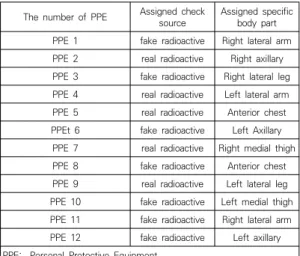
The number of PPE Assigned check
source Assigned specific body part PPE 1 fake radioactive Right lateral arm PPE 2 real radioactive Right axillary PPE 3 fake radioactive Right lateral leg PPE 4 real radioactive Left lateral arm PPE 5 real radioactive Anterior chest PPEt 6 fake radioactive Left Axillary
PPE 7 real radioactive Right medial thigh PPE 8 fake radioactive Anterior chest PPE 9 real radioactive Left lateral leg PPE 10 fake radioactive Left medial thigh PPE 11 fake radioactive Right lateral arm PPE 12 fake radioactive Left axillary PPE: Personal Protective Equipment
Table 1. The assignment of the check source and the specific body part in 12 personal protective equipments (PPEs)
Therefore, we attempted to verity the validity of medical application of two representative types of survey meters through the convergence of the concept of disaster medicine and measuring technology for the efficient triage in massive radiologiacal disasters by simulating radiation contaminated patient in the radiological disaster drill.
2. METHODS 2.1 Study Design
This is a simulation study using a randomized blind method.
2.2 Participants
We enrolled 12 paramedic students who participated the radiological disaster drill as one of a formal curriculum which was designed and approved according to the policy of safety and conflict of interest for students. There were 6 males and 6 females among participants and their average age of participants was 20 (range:
19-22). The average height was 1,702 ± 84.58 cm (mean ± standard deviation, SD) with average weight of 64.23 ± 12.76 kg.
2.3 Study Settings
In order to establish a simulated disaster environment, we created a scenario that a radiation source was accidently exposed to some of patients in a radiotherapy medical facility, resulting in possible external radiological contamination. This scenario was informed the participants who were set to simulate these possible externally contaminated patients.
We prepared 12 check sources with the same shape and weight, and 12 Personal Protective Equipments (PPEs) numbered from 1 to 12. Each PPE was assigned to one of the specific body parts (anterior chest, axillary, lateral leg, medial thigh, and lateral calf) and one of 12 check
sources Table 1. Of the 12 check sources, five real radioactive sources were attached to one of the specific body parts in 5 PPEs with adhesive patches Table 1. In the remaining seven PPEs, a fake check source was attached to one of the above regions, respectively (Table 1). The assignment of the number of PPEs and the radioactive source were blinded to the all participants and all simulation assistants and researchers except the simulation supervisor.
Then 12 participants of suspected contamination were randomly selected to wear one of 12 PPEs.
The real radioactive source was Cobalt and the radiation dose was average of 119.8 Counts Per Second (CPS) ± 20.86 Standard Deviation (SD).
In order to minimize other environmental influences, the simulation was conducted indoors.
As the simulation begun, the research assistants
who played a disaster responder in the scenario
controlled the participants in the waiting area,
and the dedicated measurement researcher 4
meters away from the waiting area sequentially
measured 12 suspected contamination patients
with the hand held survey meter (FH40G series,
REMTECH, Korea) and investigated whether they
were contaminated while other research assistant
recording the time Fig. 1. Then, the same participants were measured by using the transportable portal monitor (Minisentry, Canberra, US) (Figure 1). After the first drill was over and the PPEs were removed, 12 participants of the drill randomly were selected to wear one of the 12 PPEs again as the second drill conducting in the same manner.
2.4 Data Collections and Outcome Measures The time and the detection of the contamination were recorded and compared between the hand held survey meter and the transportable portal monitor. The primary outcome was comparison of the time in measurement. The secondary outcome was calculation and comparison of the sensitivity and specificity of detection rate between two survey meters. Data were expressed as mean ± standard deviation (SD), median (interquartile range) or median (range). The time differences in measurement between the hand held survey-meter and the transportable portal monitor were analysed using non parametric Mann Whitney test. P-values <0.05 were considered statistically significant.
3. Results
The average background radiation was 10196
± 122.51 CPS in the first drill and 10216 ± 200.76 CPS in the second drill.
In the first drill, the average time in measurement of 12 subjects with the hand held survey meter was 231.9 ± 116.6 seconds, and the time with the transportable portal monitor was 8.690 ± 1.667 seconds, which was statistically significantly shorter (Table 2). In the second drill, it spent 198.3 ± 104.8 seconds and 8.251 ± 1.305 seconds to measure with the hand held survey meter and the transportable portal monitor, respectively, and similarly to the first drill, the portal monitor performed measurements more
quickly Table 3.
The five real radioactive sources were all detected correctly by using the hand held survey meter and the transportable portal monitor, thus there was no difference in sensitivity and specificity of the two methods at a 100% sensitivity, specificity and detection rate Table 2, Table 3.
The Table 2 and the table 3 showed the transportable portal monitor detected the real radioactive source in statistically shorter time than the hand held survey meter with a 100 % detection rate.
Type of survey meter Hand held (second)
Transportable portal monitor
(second) p value Simulation patient 1 400.00 10.15
Simulation patient 2 211.00 7.77 Simulation patient 3 144.00 8.77 Simulation patient 4 333.00 6.06 Simulation patient 5 306.00 7.17 Simulation patient 6 34.00 8.07 Simulation patient 7 283.00 8.37 Simulation patient 8 298.00 9.37 Simulation patient 9 299.00 7.91 Simulation patient 10 37.00 10.01 Simulation patient 11 286.00 8.11 Simulation patient 12 152.00 12.53
Total 2783.00 104.29
Mean ± SD 231.9 ± 116.6 8.690 ± 1.667 <.0001 SD: Standard Deviation
p value by Mann Whitney test
Table 2. The time spent in measurement in the first simulation
Type of survey meter Hand held (second)
Transportable portal monitor
(second) p value Simulation patient 1 33.00 8.92
Simulation patient 2 184.00 8.85 Simulation patient 3 305.00 7.91 Simulation patient 4 331.00 6.54 Simulation patient 5 297.00 6.54 Simulation patient 6 133.00 8.15
Simulation patient 7 80.00 7.03
Simulation patient 8 254.00 8.95 Simulation patient 9 235.00 11.30 Simulation patient 10 236.00 8.22 Simulation patient 11 34.00 8.89 Simulation patient 12 258.00 12.53
Total 2380.00 99.02
Mean ± SD 198.3 ± 104.8 8.251 ± 1.305 0.0005 SD: Standard Deviation
p value by Mann Whitney test
Table 3. The time spent in measurement in the
second simulation
4. Discussion
When radiation exposed patients occur, they should be evacuated to a secondary receiving hospital after the pre-hospital rescue and the primary decontamination on the scene. In the secondary hospital, all patients except those who have unstable vital signs or need the emergency treatment related to life threatening conditions should be initially triaged and investigated for contaminations to prevent the spread of them. A hand held survey meter is commonly utilized to detect external contamination due to the swiftness and the convenience although it might consume valuable times and resources in massive radiological disasters. The drawback of this medical device could bring an adverse impact on the efficient patient treatment by the possible failure of management of limited medical resources [14,15].
Contrary to a hand held survey meter, a transportable portal monitor can detect radiation contaminated patients in a short time due to the mechanical engineering design, which have the possibility to enhance the efficient management of medical resources in massive radiological disasters where a large amount of radiation- exposed patients occurs. This might enable the prognosis of patients to be improved by promptly identifying radiation contaminated patients and assigning them appropriate priorities [16-19].
When a radiological disaster affects a large portion of population, there are far more worried well patients, who are worried about radiological contamination but actually not contaminated, than actually radiation- contaminated patients, and most of medical resources are consumed to triage such worried well patients. Therefore, it is essential to the efficient disaster responses to effectively triage suspected contaminated patients and provide them medical assurance and appropriate medical
guidelines [20-26].
Thus, the effective triage is the key for efficient disaster responses in the massive radiological disasters which can be systematically achieved by the evaluation of the effect on medical application and the convergence of the concept of disaster medicine and the mechanical technology. Because the time of measurement and detection of the contamination with the two representative survey meter is innately distinguishing between the mechanical attributes of two devices, a study method of simple comparison of them can not evaluate the medical validity of them. That is the reason why we designed the simulation study based on the concept of disaster medicine and the convergence of technology.
In this study, the possible external radiation
contaminated patient were measured and
compared in the setting for the evaluation of not
mechanical performance but medical
performance for application in massive
radiological disasters. While 100% of all radiation
sources were detected by transportable portal
monitor, the time in measuring 12 patients was
104.29 seconds in the first drill, and 99.02
seconds in the second drill, which spent
approximately 10 seconds per suspected
contamination participant. Time saving of
measuring suspected externally radiation
contaminated victims by approximately 10 folds
is medically highly important based on the
concept of disaster medicine, because the saved
time can provide valuable moments to
decontaminate and treat more confirmed
contaminated victims, resulting in the
improvement of the survival rate. Thus we
considered that this results can provides
evidences for transportable portal monitor
system to have medical application in massive
radiological disasters based on the concept of
disaster medicine and convergence of
technology.
Nevertheless this study has several limitations.
Firstly, as a simulation study, the experiments was conducted indoors to avoid interference from other factors as much as possible, but this could not reflect all conditions in which radiation disasters occur.
Secondly, since there were only 12 participants suspected of contamination and two repeated times of disaster drills, both survey meter showed 100% detection rates. However, we believe this is not likely to change as the number of participants and the repeated time of the drill increase because the mechanical performance of the transportable portal monitor were highly outstanding as an engineering contribute.
Lastly, in this study, the radiological contamination was simulated by attaching a radiation source to five parts of the human body.
This did not reflect all contaminated areas that may occur in an actual radiation accident. When the radioactive source attached areas are diversified, the time and detection rate have the possibility of changes.
4. Conclusion
The transportable portal monitor survey meter spent significantly shorter time to detect contaminations than the hand held survey meter, and the detection rate of contaminations was not lowered compared to that of the hand held survey in the simulated setting. This provides evidences that the transportable portal monitor survey meter can be considered to have medical application based on the convergence of technology and play an important role for efficient disaster responses by monitoring and screening suspected contamination patient in massive radiological disasters.
REFERENCES
[1] Korea Institute of Nuclear Safety. (2014).
Radiation accident 2014.
[2] K. Coeytaux, E. Bey, D. Christensen, E. S. Glassman, B.
Murdock &, C. Doucet. (2015). Reported radiation overexposure accidents worldwide, 1980-2013: a systematic review.
PLoS One
.19;10(3)
, e0118709. DOI:10.1371/journal.pone.0118709
[3] V. Meineke & H. Dörr. (2012). The Fukushima radiation accident: consequences for radiation accident medical management.
Health Phys, 103(2)
, 217-20. DOI: 10.1097/HP.0b013e31825b5809 [4] Y. W. Jin, M. Jeong, K. Moon, M. H. Jo & S. K. Kang.(2010). Ionizing radiation-induced diseases in Korea.
J Korean Med Sci. 25(Suppl)
, S70-6.DOI: 10.3346/jkms.2010.25.S.S70
[5] A. Jaworska. (2009). Types of radiation mass casualties and their management.
Ann Ist Super Sanita. 45(3)
, 246-50.[6] H. D. Dörr & V. Meineke. (2006). Appropriate radiation accident medical management: necessity of extensive preparatory planning.
Radiat Environ Biophys. 45(4)
, 237-44.DOI: 10.1007/s00411-006-0068-x
[7] M. Selikson, M. Felice, R. Forrest, L. Lodhi, J. McCue
& J. Reilley. (1996). A portable survey meter method for locating and quantifying removable contamination after 131I therapies.
Health Phys.70(2)
, 245-9.DOI: 10.1097/00004032-199602000-00013
[8] P. E. Fehlau & G. S. Brunson. (1983). Coping with Plastic Scintillators in Nuclear Safeguards.
IEEE Transactions on Nuclear Science. 30(1),
158-161.DOI: 10.1109
[9] M. Bahadori, S. M. Rezayat Sorkhabadi, S. Fazli Tabaei
& D. D. Farhud. (2020). Convergence Science to Transform Biomedicine: A Narrative Review.
Iran J Public Health
.49(2),
221-229. PMID: 32461929 [10] K. Markiewicz, J. A van Til & M. J. IJzerman. (2014).Medical devices early assessment methods: systematic literature review.
Int J Technol Assess Health Care.
30(2),
137-46. DOI: 10.1017/S0266462314000026.[11] K. B. Kim, K. Keum & C. Jang. (2017). Research on the Convergence of CCTV Video Information with Disaster Recognition and Real-time Crisis Response System. J
ournal of the Korea Convergence Society.
8(3),
15-22. DOI: 10.15207/JKCS.2017.8.3.015 [12] O. Ahn, J. E. HEE & S. Kim. (2017). Development ofthe Disaster Nursing Preparedness·Response Competency (DNPRC) Scale in terms of Convergence.
Journal of the Korea Convergence Society. 8(7),
101-111. DOI: 10.15207/JKCS.2017.8.7.101[13] K. Choi & J. K. Cho. (2018). Statistical analysis of national examination for radiological technologists in
convergence perspective.
Journal of the Korea Convergence Society. 9(5),
85-90.Doi.org/10.15207/JKCS.2018.9.5.085
[14] T. G. Adams & R. Casagrande. (2018). Screening internal contamination of inhaled and ingested radionuclides with hand-held survey meters.
Health Phys, 114(3)
, 299-306.DOI: 10.1097/HP.0000000000000756
[15] M. J. Youngman. (2015). Review of methods to measure internal contamination in an emergency.
J Radiol Prot. 35(2)
, R1-15.DOI: 10.1088/0952-4746/35/2/R1
[16] S. L. Sugarman, W. M. Findley, R. E. Toohey & N.
Dainiak. (2018). Rapid response, dose assessment, and clinical management of a plutonium-contaminated puncture wound
. Health Phys. 115(1)
, 57-64.DOI: 10.1097/HP.000000000000082.
[17] D. Cole & N. Martin-Burtart. (2018). Calibration of radiation portal monitors for characterization of historic low-level radioactive waste.
Health Phys.
2115(3)
, 409-413.DOI: 10.1097/HP.0000000000000892
[18] M. C. Erdman, K. L. Miller & B. E. Achey. (2001).
Experience with a medical waste portal monitoring system.
Health Phys. 80(2 Suppl)
, S13-5.[19] F. D. Amaro, C. M. Monteiro, J. M. Dos Santos & A.
Antognini. (2017). Novel concept for neutron detection: proportional counter filled with 10B nanoparticle aerosol.
Sci Rep. 9(7)
, 41699.DOI: 10.1038/srep41699
[20] Murakami M et al. (2018). Effect of radiological countermeasures on subjective well-being and radiation anxiety after the 2011 disaster: the fukushima health management survey.
Int J Environ Res Public Health. 12;15(1)
, 124DOI: 10.3390/ijerph15010124
[21] K. Rothkamm et al. (2013). Manual versus automated gamma-H2AX foci analysis across five European laboratories: can this assay be used for rapid biodosimetry in a large scale radiation accident?
Mutat Res. 30;756(1-2)
, 170-3.doi: 10.1016/j.mrgentox.2013.04.012 Epub 2013 May 3.
[22] M. E. Rea, R. M. Gougelet, R. J. Nicolalde, J. A. Geiling
& H. M. Swartz. (2010). Proposed triage categories for large-scale radiation incidents using high-accuracy biodosimetry methods.
Health Phys. 98(2)
, 136-44.DOI: 10.1097/HP.0b013e3181b2840b
[23] J. T. Bushberg et al. (2007). Nuclear/radiological terrorism: emergency department management of radiation casualties.
J Emerg Med. 32(1)
, 71-85. DOI:10.1016/j.jemermed.2006.05.034
[24] S. A. Bland. (2004). Mass casualty management for radiological and nuclear incidents.
J R Army Med Corps. 150(3 Suppl 1)
, 27-34.[25] S. M. Becker & S. A. Middleton. (2008). Improving
hospital preparedness for radiological terrorism:
perspectives from emergency department physicians and nurses.
Disaster Med Public Health Prep, 2(3)
, 174-84. DOI: 10.1097/DMP.0b013e31817dcd9a [26] J. Valentin & International Commission onRadiological Protection. (2005). Protecting people against radiation exposure in the event of a radiological attack. A report of The International Commission on Radiological Protection.