• 검색 결과가 없습니다.

Spark Plasma Sintering of Stainless Steel Powders Fabricated by High Energy Ball Milling

N/A
N/A
Protected

Academic year: 2021

Share "Spark Plasma Sintering of Stainless Steel Powders Fabricated by High Energy Ball Milling"

Copied!
5
0
0

로드 중.... (전체 텍스트 보기)

전체 글

(1)

Spark Plasma Sintering of Stainless Steel Powders Fabricated by High Energy Ball Milling

Si Young Chang

a,

*, Sung-Tag Oh

b

, Myung-Jin Suk

c

, and Chan Seok Hong

Graduate Student, Department of Materials Engineering, Korea Aerospace University, Gyeonggi-do 412-791, Korea

a

Department of Materials Engineering, Korea Aerospace University, Gyeonggi-do 412-791, Korea

b

Department of Materials Science and Engineering, Seoul National University of Science and Technology, Seoul 139-743, Korea

c

Department of Materials and Metallurgical Engineering, Kangwon National University, Samcheok 245-711, Korea (Received March 12, 2014; Revised April 11, 2014; Accepted April 13, 2014)

···

Abstract The 304 stainless steel powders were prepared by high energy ball milling and subsequently sintered by spark plasma sintering, and the microstructural characteristics and micro-hardness were investigated. The initial size of the irregular shaped 304 stainless steel powders was approximately 42 µm. After high energy ball milling at 800 rpm for 5h, the powders became spherical with a size of approximately 2 µm, and without formation of reaction compounds.

From TEM analysis, it was confirmed that the as-milled powders consisted of the aggregates of the nano-sized particles.

As the sintering temperature increased from 1073K to 1573K, the relative density and micro-hardness of sintered sample increased. The sample sintered at 1573K showed the highest relative density of approximately 95% and a micro-hard- ness of 550 Hv.

Keywords: 304 stainless steel powder, High energy ball milling, Spark plasma sintering, Micro-hardness, Microstructure

···

1. Introduction

Stainless steels have been widely used in all industrial fields including household articles because of the excel- lent corrosion resistance, and usually provided through smelting and rolling, and so on. On the other hand, stain- less steel powders have recently received much attention because there is a great demand for the structural and functional sintered components. Such components have been fabricated by powder metallurgy that gives high ability producing the near net-shaped components. Among the powder metallurgy methods, the high energy ball milling is a process of mechanical alloying (MA) that is possible to manufacture amorphous phase or nanocrystal- line structure in inorganic materials synthesis at room temperature with a very simple device so that it has been an active study [1]. It consists of repeated events of energy transfer, promoted by the milling device, from the milling tools (generally balls) to the milled powder. In

general, the nano-sized powders obtained by high energy ball milling are rapidly ripened during conventional sin- tering because they are exposed to high temperature for a long time. Therefore, it is important to restrain the ripen- ing during sintering for the nano-sized bulk materials.

Recently, a spark-plasma-sintering (SPS) technology has attracted a lot of researchers’ attention because of the merits of rapid heating rate, short holding time, high sin- tering density, small grain size and easy manipulation compared to other conventional sintering methods [2, 3].

In SPS method, starting powder materials are subjected to pressure in uniaxial direction, and are sintered by Joule heat and the effect of spark plasma generated in the gap between powder materials. The SPS has been applied for new materials, such as fine ceramics [4, 5], nano phase materials [6], hard alloy tool materials [7], magnetic materials [8] and so on, but few of ferrous materials have been reported.

In this work, therefore, the commercial 304 stainless

*Corresponding Author : Si Young Chang, TEL: +82-2-300-0168, FAX: +82-2-3158-3770, E-mail: [email protected]

<PM리뷰>
(2)

The commercial 304 stainless steel (Fe-18Cr-8Ni) pow- ders were ball-milled under a high purity argon atmo- sphere using zirconia balls in the self made high energy ball mill. The ball to powder weight ratio was 20:1 and

tered samples were observed by a scanning electron micro- scope (SEM) and a transmission electron microscopy (TEM).

The powder size and shape factor were investigated by an image analysis. The composition of powders was analyzed by an energy dispersive spectroscope (EDS), and the phase and structure changes in the powders were analyzed by an X- ray diffractometer (XRD). The relative density of sintered samples was obtained by Archimedes method. Micro-hard- ness was measured by a Vickers micro-hardness tester under a load of 500 g for 15 sec.

3. Results and Discussion

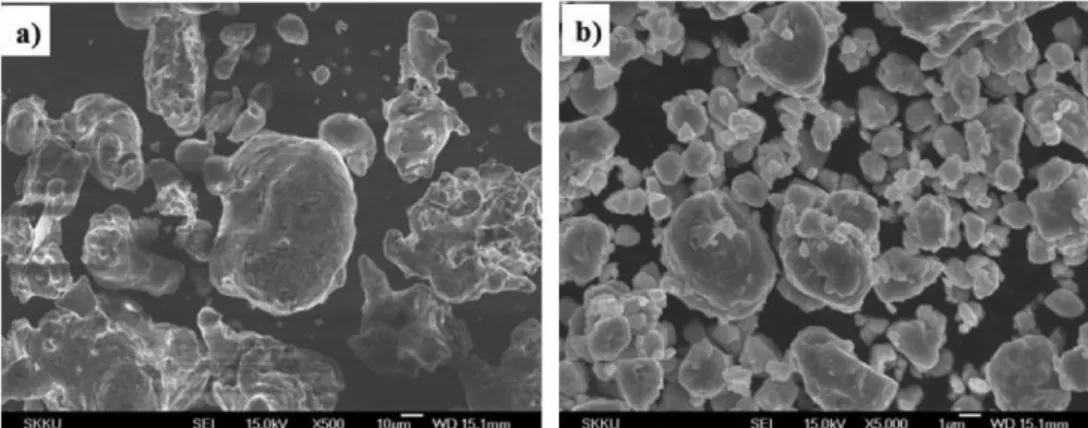
The typical SEM photographs of as-received and as- Fig. 1. External appearance of sample obtained by spark plasma

sintering.

Fig. 2. SEM images of (a) as-received and (b) as-milled stainless steel powders.

Fig. 3. (a) Mean powder size and shape factor and (b) size distribution curves of as-received and as-milled stainless steel powders.

(3)

milled stainless steel powders are shown in Fig. 2. The initial stainless steel powders were irregular shape, whereas the shape was changed to be spherical after mill- ing. The size, shape factor and size distribution obtained from Fig. 2 are quantitatively shown in Fig. 3. The as- received stainless steel powders had the mean size of approximately 42 µm. After ball-milling at 800 rpm for 5h, a mean size was reduced to approximately 2 µm and the shape factor of as-received powders which was 0.6 increased to approximately 0.7, indicating that the pow- ders were almost sphere. The size distribution of as- received powders was inbetween 8 and 70 µm, and as- milled powders showed 0.5~5 µm in size distribution.

The highest number peaks of as-received and as-milled powders corresponded to their average size.

Fig. 4 and Fig. 5 show the EDS and XRD analyses of stainless steel powders, respectively. It was analyzed that the as-received and as-milled powders contained only Cr, Ni, Cu and Fe

3

C phases, which indicated that there was

no formation of impurities and new phases due to colli- sions between balls during milling. As seen from the XRD pattern, the intensities of main diffraction peaks decreased and disappeared after milling at 800 rpm for 5h. Meanwhile, the peaks became broader, indicating a decrease in the particle size of powders and the forma- tion of metastable structure. It is generally known that the differential broadening of XRD peaks is often observed in metastable materials due to large amounts of strain [9].

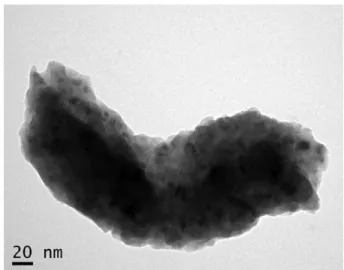
Fig. 6 shows typical TEM photograph of as-milled powder. The as-milled powder consisted of particles. The mean size of particles was approximately 13 nm. Accord- ingly, it was apparent that the as-milled powders shown in Fig. 2 were agglomerated with nano-sized particles.

The size of particles obtained by TEM images was com- pared with that calculated by Scherrer formula based on XRD pattern as shown in Fig. 7. The calculated size was approximately 7 nm, which relatively well corresponds to the size obtained from TEM images.

Fig. 4. EDS analysis of as-milled stainless steel powders.

Fig. 5. XRD pattern of as-received and as-milled stainless steel powders.

Fig. 6. TEM image showing an aggregate of particles after

milling.

(4)

Fig. 8 shows SEM images of as-milled stainless steel pow- der samples sintered by spark plasma sintering method at 1073~1573K. As the sintering temperature increased up to 1473K, there was no apparent change in not only the size of agglomerated powders but the microstructure with many open pores, indicating that sufficient substance migration including diffusion had not occurred during sintering. At 1573K, however, the sintered samples showed dense micro- structure including the inter/intra-granular pores.

The change of relative density in the sintered samples with increasing sintering temperature is shown in Fig. 9.

As the sintering temperature increased, the relative den- sity increased. In particular, the sample sintered at 1573K showing dense microstructure had the highest relative density of approximately 95%, whereas that of samples sintered at lower temperatures than 1573K was lower than approximately 85%, which results from large open pores as shown in Fig. 8.

The micro-hardness of the sintered samples is plotted in Fig. 10. The micro-hardness markedly increased with increasing sintering temperature, which can be explained based on the change of relative density with temperature shown in Fig. 8 rather than the size change of agglomer-

ated powders. In general, the commercial 304 stainless steel by conventional processing has approximately 200 H

v

in micro-hardness [10]. In this study, however, the sample sintered at 1573K had much higher micro-hard- ness of more than 550 H

v

. This is considered to be due to the much finer grains in the sintered sample.

4. Conclusions

The commercial 304 stainless steel powders were milled Fig. 7. Mean particles size of as-milled stainless steel particles.

Fig. 8. SEM images of as-milled stainless steel powders after spark plasma sintering (SPS).

Fig. 9. Relative density of as-SPSed stainless steel powders.

Fig. 10. Micro-hardness of as-SPSed stainless steel powders.

(5)

by high energy ball milling at 800 rpm for 5h. The pow- ders were changed from an irregular shape to a spherical shape after milling. As-milled powders that were the aggregates consisting of the nano-sized particles had approximately 2 µm in mean size, and the size distribu- tion was inbetween 0.5 and 5 µm. Based on the EDS and XRD results, there was no formation of reaction com- pounds during high energy ball milling. As-milled pow- ders were subsequently subjected to spark plasma sintering at 1073~1573K for 3h with 130 MPa. The relative density increased with increasing sintering temperature and the highest relative density of approximately 95% was obtained at 1573K. The micro-hardness also increased with increas- ing sintering temperature, and the sample sintered at 1573K showed the highest micro-hardness of approxi- mately 550 Hv.

Acknowledgements

This work was supported by a grant No.C2009-0089508

from National Research Foundation of Korea funded by the Ministry of Education, Science and Technology, Repub- lic of Korea

References

[1] J. S. Benjamin: Metall. Trans., 1 (1970) 2943.

[2] L. Gao and H. Miyamoto: J. Inorg. Mater., 12 (1997) 129.

[3] M. Tokita: J. Soc. Powder Technol. Japan, 30 (1993) 790.

[4] T. Takeuchi, M. Tabuchi, H. Kageyama and Y. Suyama: J.

Am. Ceram. Soc., 82 (1999) 939.

[5] Z. J. Shen, M. Johnsson, Z. Zhao and M. Nygren: J. Am.

Ceram. Soc., 85 (2002) 1921.

[6] G. D. Zhan, J. D. Kuntz, J. L. Wan and A. K. Mukherjee:

Nat. Mat., 2 (2003) 38.

[7] S. I. Cha, S. H. Hong and B. K. Kim: Mater. Sci. Eng. A, 351 (2003) 31.

[8] M. Yue, J. X. Zhang, Y. F. Xiao, G. P. Wang and T. Li:

IEEE Trans. Magn., 39 (2003) 3551.

[9] Diandra L. Leslie-Pelecky and E. M. Kirkpatrick: Nano- Structured Materials, 12 (1999) 887.

[10] Japan Institute of Metals: Ferrous Materials, Sendai (1988)

167.

수치

Fig. 3. (a) Mean powder size and shape factor and (b) size distribution curves of as-received and as-milled stainless steel powders.
Fig. 6 shows typical TEM photograph of as-milled powder. The as-milled powder consisted of particles
Fig. 8. SEM images of as-milled stainless steel powders after spark plasma sintering (SPS).

참조

관련 문서

An evaluation of marginal fit of three-unit fixed dental prostheses fabricated by direct metal laser sintering system.. Marginal accuracy and fracture strength

The effects of recycling on the tensile bond strength of new and clinically used stainless steel orthodontic brackets: an in vitro study. Material testing of

Through this analysis, the residual stress of the high tensile steel fillet weld was measured, and the reliability of numerical simulation was secured by

In the heating method by line heating, the initial properties of steel are changed by variables such as temperature, time, and speed. The experimental data

Hirose, Relationship between intermetallic compound layer thickness with deviation and interfacial strength for dissimilar joints of aluminum alloy and stainless

7 Effect of annealing temperature on the tensile properties of high manganese austenitic stainless steel with two phases of reversed austenite and

Application of TMDs to attenuate floor vibration by Steel Structures and Seismic

Surface characteristics of hydroxyapatite coated Ti-40Ta-xNb alloys by plasma electrolytic oxidation and sputtering