• 검색 결과가 없습니다.

Hepatoprotective Effect of Solvent Fractions from Raphiolepis indica against Oxidative Stress

N/A
N/A
Protected

Academic year: 2021

Share "Hepatoprotective Effect of Solvent Fractions from Raphiolepis indica against Oxidative Stress"

Copied!
7
0
0

로드 중.... (전체 텍스트 보기)

전체 글

(1)

ISSN 2288-1069 (Online)

http://dx.doi.org/10.12925/jkocs.2018.35.4.1269

Hepatoprotective Effect of Solvent Fractions from Raphiolepis indica against Oxidative Stress

Sun Young Kim

1

․Hye-Ran Kim

2

․Kyung-Soo Chang

1,✝

1

Department of Clinical Laboratory Science, College of Health Sciences, Catholic University of Pusan, Busan 46252, Republic of Korea,

2

Department of Clinical Laboratory Science, College of

Medical Sciences, Daegu Haany University, Gyeongsan 38610, Republic of Korea (Received November 2, 2018; Revised December 12, 2018; Accepted December 17, 2018)

Abstract : Raphiolepis indica ( R. indica ) is one of evergreen shrubs belonging to the Rosaceae and is grown wildly in Jeju. This study was performed to evaluate the hepatoprotective effect of different fractions (n-hexane, dichloromethane, ethyl acetate, butanol, water) from R. indica . Anti-oxidative effects were determined using 1,1-diphenyl-2-picrylhydrazyl (DPPH) scavenging activity and total phenol contents. Hepatoprotective effect was identified by 3-[4, 5-dimethylthiazol-2-yl]-2, 5-diphenyltetrazolium bromide (MTT) assay in Huh7 cells. Among various fractions, ethyl acetate and butanol fractions showed the lowest DPPH remained rate reaching approximately 78.7 and 65.5% at 400 μg/mL. Ethyl acetate and butanol fractions showed the total phenolic content at 164.5 and 137.3 mg GAE/g extract. The ethyl acetate and butanol fractions were resistant against oxidative stress in MTT assay and showed higher hepatoprotective effect than other fractions. Therefore, these results suggest that the ethyl acetate and butanol fractions of R. indica might have therapeutic value in liver damage.

Keywords : Anti-oxidative effect, Hepatoprotective effect, Jeju natural extract, Raphiolepis indica

1. Introduction

There are reactive oxygen species (ROS) in the cells, and ROS induce the peroxidation of membrane lipids[1]. The human have mechanism for defense to protect the human body from ROS. Defense mechanisms are known to include anti-oxidative enzymes[2].

However, excessive ROS and low anti-oxidant defense system continue to increase oxidative



Corresponding author (E-mail: [email protected])

stress[3]. As a result, oxidative stress is related with various chronic inflammatory diseases such as cancer, hepatitis, and early aging as well as various diseases[4,5]. With the increasing number of various diseases caused by oxidative stress, research on anti-oxidant agent is increasing as well.

As synthetic anti-oxidant agents including butylated hydroxyanisole and butylated hydroxytoluene, have side effects which include liver damage and the production of cancer, antioxidant agents from natural extracts are active research field of pharmacy, currently[6].

Materials from natural extracts are sources of

(2)

many medical supplies which are currently applied in clinic therapy.

Diverse flora are distributed on Jeju Island, and widely used as medical plants[7].

Rhaphiolepis indica ( R. indica ), which is an evergreen, belongs to Rosaceae. There are more than 3,000 species in Rosaceae, many of which are economically instrumental fruit trees like apple, apricot, cherry, peach and pear[8].

In the field of studies about R. indica , as physiological effects has not been researched enough except anti-inflammative effects of Triterpenoids, Biphenyls, Dibenzofurans extracted from the roots of R. indica , research on physiological effects are necessary[9,10].

In this study, the experiment was preformed in order to confirm anti-oxidative effects using solvent fractions from R. indica leaves, to prove cytoprotective effect after treating the extracts to hepatocyte, and to be used as base data for development of natural anti-oxidant drug using natural extracts.

2. Materials and Methods

2.1. Extraction of plants

Leaves of R. indica , were collected in Jeju, where R. indica grow naturally. Collected material was washed two or three times, dried for two weeks, and pulverized to be used as extract material. After dried material was extracted twice with 80% ethanol, the filtrated extract was decompression-condensed and dried by a freeze drier. And then the production of fraction of R. indica leaves includes extracting process, using different polarities of solvents such as n-hexane, dichloromethane, ethyl acetate, butanol and water in sequence.

2.2. DPPH radical scavenging

Anti-oxidative effects of the fractions from R. indica was measured using 1,1-diphenyl-2- picrylhydrazyl (DPPH) scavenging effects. After preparing natural materials at 25, 100 and 400

μg/mL, 10 μL material was dispensed in a 96 well plate and 190 μL of 200 μM DPPH (Sigma-Aldrich, St. Louis, MO, USA) in ethanol was applied. In this process, after 30 minutes at 37℃, optical density (550 nm) were measured using Biotrak II Plate reader (Amersham Life Science, Buckinghamshire, UK).

2.3. Total phenolic content

Total phenolic content was carried out in the Folin-Denis method. Mixing a 0.1%

fractions (50 μL), D.W (1.65 mL), and Folin-Denis reagent (100 μL), 200 μL of 1 N Na

2

CO

3

was added, and the mixture compound reacted for 2 hours at room temperature. Then, the optical density was measured at 750 nm using spectrophotometer (Milton Roy Company, New York, USA).

Gallic acid (Sigma-Aldrich, St. Louis, MO, USA) was measured in the same method as that used for the samples. After it, the standard curve was made. Total phenolic contents ware indicated as gallic acid equivalents per gram fractions sample (mg GAE/g fractions).

2.4. Cell Culture

The cells used in the experiment was Huh7 hepatoma cells. These cells were dispensed by the Korean Cell Link Bank (KCLB) in South Korea. Dulbecco's Modified Eagle's Medium (Hyclone, Logan, UT, USA) were used as the medium for the culture of cells. The cell line was cultured in a 5% CO

2

incubator at 37℃

by adding 10% fetal bovine serum (Hyclone, Logan, UT, USA), and anti-biotics such as penicillin-streptomycin (GIBCO, Rockville, MD, USA).

2.5. Cytotoxic effects using hepatocytes

The cytotoxic effects of solvent fractions

from R. indica were identified using a

3 - ( 4 , 5 - d i m e t h y l t h i a z o l - 2 - y l ) - 2 ,

5-diphenyltetrazoliumbromide (MTT) assay

[11]. After the culture of Huh7 cells, cell

(3)

counting was performed. The cells were adjusted to 1X10

5

/mL. After each 100 μL of cells was dispensed in a 96 well micro plate, the content was cultured for 24 hours at 37℃.

After the fractions were dispensed in the respective cells (25, 50, 100, 200, 400 μ g/mL), the content was cultured for 48 hours at 37℃ and 5% CO

2

. MTT (Ambresco, Ohio, USA) solution was each 20 μL was dispensed.

The materials were cultured at 37℃ and 5%

CO

2

for 2 hours. After the medium was removed, each 200 μL of dimethyl sulfoxide (DMSO) was dispensed. The optical density at 560 nm was identified, ELISA reader (Amersham Life Science, Buckinghamshire, UK).

2.6. Cytoprotective effects for hepatocytes

The cytoprotective effects of solvent fractions from R. indica were identified using a MTT assay when hydrogen peroxide (H

2

O

2

) and t-butyl hydroxy peroxide (t-BHP) were treated respectively. After the culture of Huh7 cells, cell counting was performed. The cells were adjusted to 1X10

5

/mL. After 100 μL of cells were dispensed in a 96 well micro plate, the cells were cultured for 24 hours at 37℃.

After each 100 μL of the extract fractions were dispensed in the respective cells at 25, 50, 100 and 200 μg/mL, the materials were cultured for 24 hours at 37℃ and 5% CO

2

. Then 100 mM H

2

O

2

and t-BHP were prepared and each 20 μL was dispensed in the 96 well plates of the H

2

O

2

and t-BHP treatment group, and the materials were cultured for 24 hours. MTT solution was each 20 μL was dispensed. The content was cultured at 37℃ and 5% CO

2

for 2 hours.

After mediums were removed as much as possible, each 200 μL of DMSO was dispensed. The optical density at 560 nm was measured, ELISA reader (Amersham Life Science, Buckinghamshire, UK).

2.7. Statistical analysis

Statistical analysis was conducted with

one-way ANOVA.

3. Results and Discussion

3.1. DPPH scavenging activity

The results of measuring the DPPH scavenging activities of solvent fractions from R. indica showed dose-dependent anti- oxidative effect. Among various fractions, ethyl acetate and butanol fractions from R. indica showed the lowest DPPH remained rate reaching approximately 78.7 and 65.5% at 400 μg/mL. Quercetin used as the control group showed DPPH remained rate reaching approximately 47.0%, which were relatively lower than ethyl acetate and butanol fractions from R. indica (Fig. 1). As free radicals can be scavenged by compounds that can donate hydrogen atom[12], a number of research about anti-oxidative effects are conducted using radical scavenging test. About 18% of DPPH radical scavenging was identified in the extracts of Bonnemaisonia hamifera at 200 μ g/mL[13] and a similar level of DPPH scavenging activity (21%) at 400 μg/mL was identified by the ethyl acetate fractions from R. indica .

Fig. 1. DPPH radical remained rate of Solvent Fractions from Raphiolepis indica and quercetin. Abbreviation: HF, hexane fraction; MF, methylene chloride fraction; EF, ethyl acetate fraction; BF, butanol fraction; DW, DW fraction;

QUE, quercetin.

(4)

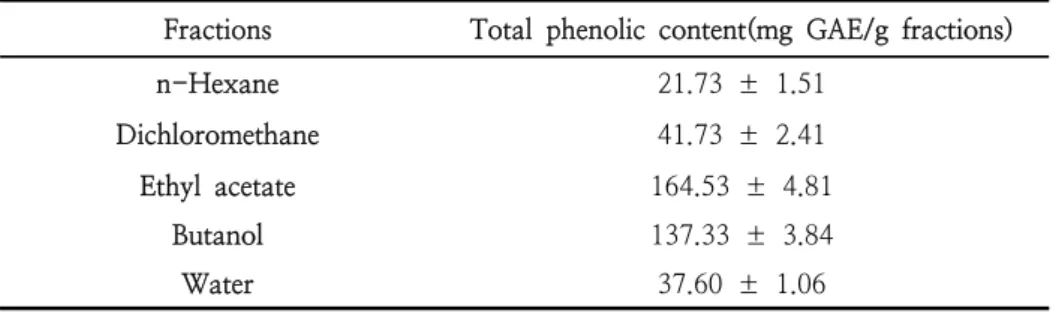
Fractions Total phenolic content(mg GAE/g fractions)

n-Hexane 21.73 ± 1.51

Dichloromethane 41.73 ± 2.41

Ethyl acetate 164.53 ± 4.81

Butanol 137.33 ± 3.84

Water 37.60 ± 1.06

Table 1. Total phenolic content of solvent fractions from Raphiolepis indica 3.2. Total phenolic content

Total phenolic content in the solvent fractions from R. indica was measured using gallic acid as a reference material. Total phenolic content in the n-hexane, dichloromethane, ethyl acetate, butanol and water fractions were 22.7, 41.7, 164.5, 137.3 and 37.6 mg GAE/g fractions, respectively.

Among various fractions, ethyl acetate and butanol fractions from R. indica showed higher total phenolic content(Table 1). The content of polyphenol, which plays an essential role as an antioxidant, has been discovered in various plants, and the total phenolic contents of guava ( Psidium Guayaba L . ), mango ( Mangifera indica L . ), and barbados cherry ( Malpighia glabra L . ) are 24.15, 44.18, and 49.21 mg GAE/g respectively. Ethyl acetate and butanol fractions from R. indica were confirmed to contain higher total phenolic contents than these three extract[14].

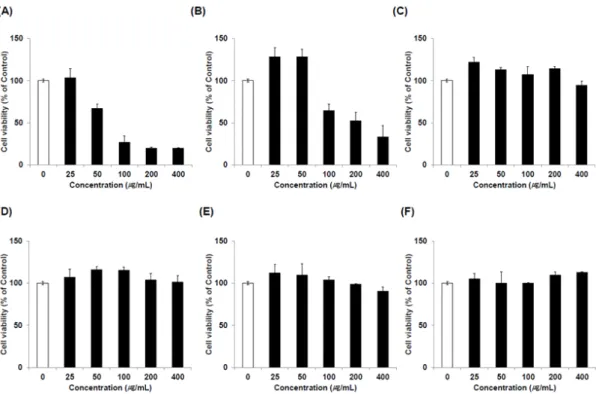
3.3. Cytotoxic effects using hepatocytes To measure the cytotoxic effects of the solvent fractions from R. indica in hepatocytes according to concentrations, the solvent fractions from R. indica were treated using the Huh7 cells and their cytotoxic effects was measured in 48 hours. The n-hexane fractions in hepatocytes did not show cytotoxic effects when treated at 25 μg/mL or below. The dichloromethane fractions in hepatocytes did not show cytotoxic effects when treated at 50 μg/mL or below. The ethyl acetate fractions in hepatocytes did not show cytotoxicity when

treated at 200 μg/mL or below. The butanol and water fractions in hepatocytes did not show cytotoxicity when treated at 400 μg/mL or below. Quercetin used as the control group showed cytotoxicity when treated at 400 μ g/mL or below(Fig. 2).

3.4. Cytoprotective effects on hepatocytes against H

2

O

2

To measure the cytoprotective effects of the

solvent fractions from R. indica in hepatocytes

regarding oxidative stress, the Huh7 cells were

treated with H

2

O

2,

thereby inducing oxidative

stress. After this process, the cytoprotective

effects of the solvent fractions from R. indica

were measured. n-hexane, dichloromethane

and water fractions did not show

cyto-protective effects. However, ethyl acetate

fractions from R. indica identified

approximately 43 and 47% of cell survival

rates at 100 and 200 μg/mL. This means that

ethyl acetate fractions of R. indica showed 13

and 17% higher cell survival rates than the

negative control showed. Also, the butanol

fractions from R. indica showed 10% higher

cell survival rates than the negative control

showed. Quercetin as positive control showed

approximately 90% of cell survival rates. This

means that quercetin showed 60% higher cell

survival rates than the negative control

showed. This result identified cytoprotective

effects of ethyl acetate and butanol fractions

from R. indica , though lower than the effects

of quercetin(Fig. 3).

(5)

Fig. 2. Cell viability on Huh7 cells.

(A) hexane fraction, (B) dichloromethane fraction, (C) ethyl acetate fraction, (D) butanol fraction, (E) water fraction, (F) quercetin

Fig. 3. Cytoprotective effects on Huh7 cells against hydrogen peroxide-induced oxidative damage. Abbreviation:

EtOAc, ethyl acetate fraction; BuOH, butanol fraction.

3.5. Cytoprotective effects on hepatocytes against t-BHP

To measure the cytoprotective effects of the

solvent fractions from R. indica in hepatocytes

regarding oxidative stress, the Huh7 cells were

treated with t-BHP, thereby inducing oxidative

stress. After this process, the cytoprotective

effects of the solvent fractions from R. indica

were measured. n-hexane, dichloromethane

and water fractions did not show

cytoprotective effects. However, ethyl acetate

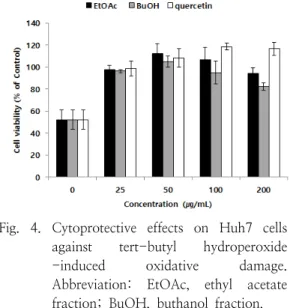
and butanol fractions showed approximately

90% of cell survival rates at 25, 50, 100 and

200 μg/mL. This means that ethyl acetate

fractions of R. indica showed 40% higher cell

survival rates than the negative control

showed. Quercetin as positive control showed

50% higher cell survival rates than the

(6)

negative control showed. This result identified cytoprotective effects of ethyl acetate and butanol fractions, though lower than the effects of quercetin. As studies on cytoprotective effects using various extracts have been conducted. The group treated with oxidative stress such as t-BOOH using Pinus koraiensis extracts protected hepatocytes and increased the cell survival rates[15]. And the group treated with oxidative stress such as t-BOOH using Sutherlandia frutescens protected pneumocytes[16]. This study confirmed cytoprotective effects against the oxidative stress in the hepatocytes.

Hepatoprotective effects were identified with ethyl acetate and butanol fractions, which showed higher anti-oxidative effects.

Fig. 4. Cytoprotective effects on Huh7 cells against tert-butyl hydroperoxide -induced oxidative damage.

Abbreviation: EtOAc, ethyl acetate fraction; BuOH, buthanol fraction.

4. Conclusion

This study confirmed a high level of DPPH scavenging activity, total phenolic content and cyto-protective effects on Huh7 cells from ethyl acetate and butanol fractions from R.

indica , and this conclusion can be used as basic data for development of a liver

protectant.

Acknowledgements

This work was supported by grants from Brain Busan 21 program.

References

1. N. Singh, P. S. Rajini, “Free radical scavenging activity of an aqueous extract of potato peel”, Food Chem, Vol.85, No.4 pp. 611-616, (2004).

2. S. Bayati, R. Yazdanparast, “Antioxidant and free radical scavenging potential of yakuchinone B derivatives in reduction of lipofuscin formation using H

2

O

2

-treated neuroblastoma cells”, Iran Biomed J, Vol.15, No.4 pp. 134-142, (2011).

3. C. T. Kumarappan, E. Thilagam, S. C.

Mandal, “Antioxidant activity of polyphenolic extracts of Ichnocarpus frutescens”, Saudi J Biol Sci, Vol.19, No.3 pp. 349-355, (2012).

4. T. Debnath, S. R. Park, D. H. Kim, J. E.

Jo, B. O. Lim, “Anti-oxidant and anti-inflammatory activities of Inonotus obliquus and germinated brown rice extracts”, Molecules, Vol.18, No.8 pp.

9293-9304, (2013).

5. P. Mahakunakorn, M. Tohda, Y.

Murakami, K. Matsumoto, H. Watanabe,

“Antioxidant and free radical-scavenging activity of Choto-san and its related constituents”, Biol Pharm Bull, Vol.27, No.1 pp. 38-46, (2004).

6. T. Chipiti, M. A. Ibrahim, N. A.

Koorbanally, M. S. Islam, “In vitro antioxidant activities of leaf and root extracts of Albizia antunesiana harms”, Acta Pol Pharm, Vol.70, No.6 pp.

1035-1043, (2013).

7. J. Y. Moon, E. Y. Yim, G. Song, N. H.

(7)

Lee, C. G. Hyun, “Screening of elastase and tyrosinase inhibitory activity from Jeju Island plants”, EurAsia J. BioSci, Vol.4 pp.

41-53, (2010).

8. L. Fan, M. Y. Zhang, Q. Z. Liu, L. T.

Li, Y. Song, L. F. Wang, S. L. Zhang, J.

Wu, “Transferability of Newly Developed Pear SSR Markers to Other Rosaceae Species”, Plant Mol Biol Report, Vol.31, No.6 pp. 1271-1282, (2013).

9. C. H. Lin, H. S. Chang, H. R. Liao, I. S.

Chen, I. L. Tsai, Triterpenoids from the roots of Rhaphiolepis indica var. tashiroi and their anti-inflammatory activity, Int J Mol Sci, Vol.14, No.5 pp. 8890-8898, (2013).

10. C. H. Lin, H. S. Chang, C. H. Liao, T.

H. Ou, I. S. Chen, I. L. Tsai,

“Anti-inflammatory Biphenyls and Dibenzofurans from Rhaphiolepis indica”, J Nat Prod, Vol.73, No.10 pp. 1628-1631, (2010).

11. Y. S. Shin, H. J. Jo, S. W. Lee, Y. O.

Kim, Y. P. Hong, K. S. Chang, “Analysis of anti-oxidant activity of medicinal plants according to the extracted parts”, J. Med.

Plants Res, Vol.6, No.31 pp. 4615-4624, (2012).

12. S. Mohan, K. Thiagarajan, R.

Chandrasekaran, J. Arul, “In vitro protection of biological macromolecules against oxidative stress and in vivo toxicity evaluation of Acacia nilotica (L.) and ethyl gallate in rats”, BMC Complement Altern Med, Vol.14 pp. 257, (2014).

13. M. J. Piao, Y. J. Hyun, S. J. Cho, H. K.

Kang, E. S. Yoo, Y. S. Koh, N. H. Lee, M. H. Ko, J. W. Hyun, “An ethanol extract derived from Bonnemaisonia hamifera scavenges ultraviolet B (UVB) radiation-induced reactive oxygen species and attenuates UVB-induced cell damage in human keratinocytes”, Mar Drugs, Vol.10, No.12 pp. 2826-2845, (2012).

14. K. L. Araujo, M. Magnani, J. A.

Nascimento, A. L. Souza, P. S.

Epaminondas, N. Queiroz, A. G. Souza,

“Antioxidant activity of co-products from guava, mango and barbados cherry produced in the Brazilian northeast”, Molecules, Vol.19, No.3 pp. 3110-3119, (2014).

15. S. B. Won, G. Y. Jung, J. Kim, Y. S.

Chung, E. K. Hong, Y. H. Kwon,

“Protective effect of Pinus koraiensis needle water extract against oxidative stress in HepG2 cells and obese mice”, J Med Food, Vol.16, No.7 pp. 569-576, (2013).

16. S. Tobwala, W. Fan, C. J. Hines, W. R.

Folk, N. Ercal, “Antioxidant potential of

Sutherlandia frutescens and its protective

effects against oxidative stress in various

cell cultures”, BMC Complement Altern

Med, Vol.14 pp. 271, (2014).

수치

Table  1.  Total  phenolic  content  of  solvent  fractions  from  Raphiolepis  indica3.2
Fig.  2.  Cell  viability  on  Huh7  cells.
Fig.  4.  Cytoprotective  effects  on  Huh7  cells  against  tert-butyl  hydroperoxide  -induced  oxidative  damage

참조

관련 문서

Objectives: This study aimed to investigate the relationship between job stress and turnover intention of employed opticians and to investigate the mediating effect of burnout

  Investigation of turnover comes from the job itself and in this study worked in a care facility for the elderly, Caregiver Stress, Burnout comes from

To measure antioxidant effects of the yuzu seed oil, DPPH radical scavenging and lipid peroxidation were investigated... DPPH radical scavenging

The purpose and necessity of this study was to investigate the effect of the 8-week GX complex exercise program on the stress index, blood lipid and APG

In this study, the laminar free convection in Bingham plastic fluids from isothermal spheroids has been investi- gated numerically to delineate the effects of fluid yield

In this study, two experiments were conducted to understand the effects of additional charge on the detailed growth mechanism of Alq 3 and to determine the effect of

DPPH radical scavenging activity of Yanggaeng added with different levels of Molokhia( Corchorus olitorius L.) powder.. Bars with different letters

Activation of Autophagy by Mangiferin Protects Auditory Hair Cells from Oxidative stress Induced Ototoxicity.. Gyeongmin