• 검색 결과가 없습니다.

Effect of Supplementation of Trehalose, Glycerol on Conventional Freezing and Vitrification of Boar Sperm

N/A
N/A
Protected

Academic year: 2021

Share "Effect of Supplementation of Trehalose, Glycerol on Conventional Freezing and Vitrification of Boar Sperm"

Copied!
5
0
0

로드 중.... (전체 텍스트 보기)

전체 글

(1)

Effect of Supplementation of Trehalose, Glycerol on Conventional Freezing and Vitrification of Boar Sperm

Sun-Ho Choi

, Mi-Jin Lee, Kyung-Mi Lee, Soo-Jin Sa, Hyun-Jong Kim, Hyun-Ju Jin, Yong-Sup Song and Jun-Cheol Park

National Institute of Animal Science, RDA, Suwon 441-706, Korea

ABSTRACT

The boar sperm has more lipid droplets and specialty of seminal plasma compared with other species, causing difficulties of freezing sperm and decreases for the utilization of frozen semen into the artificial insemination. However, several studies reported significant results for the recovery of sperm motility and reproductive by addition of cryopro- tectants and seminal plasma after thawing. This study was designed to investigate the effects of supplementation of trehalose or glycerol in the LEY (lactose and egg yolk in BTS) solution for the conventional freezing and vitrification process. Two boars aged 16 months were used to collect semen for 2 times in a week. The samples were allotted to 3 freezing solutions (LEY + glycerol 10.5% + OEP 1.5%, LEY + trehalose 1M + OEP 1.5%, and sucrose 1.5M + trehalose 1 M + OEP 1.5%) after centrifugation at 800 g for 10 minutes. Semen was equilibrated in freezing solutions for 10 minutes and injected into plastic straws with 2 ∼3 air bubbles to minimize freezing damages. Vitrification was performed to locate sperm in 5 cm above LN

2

for 5 minutes, and the conventional freezing was conducted with an automatic freezer. Motility and survival rates were measured by CASA (Computer assisted sperm an alyzing system) and FITC (Fluorescein isothiocyanate), respectively after thawing semen at 50 ℃ for 12 seconds. The results were analyzed by ANOVA with STATVIEW statistical program. The vitrificatioin solution (LEY + 10.5% glycerol + 1.5%

OEP) presented higher motility (20.9%) than other solutions while the solution (LEY + 1M trehalose + 1.5% OEP) showed the lowest (motility : 5.2%). However, survival rates of vitrified sperms detected by FITC showed 1~4% live sperms in almost of dead sperms at all vitrification solutions’ groups, but survival rate of freezing solution of LEY + 1M trehalose + 1.5% OEP LEY and LEY + 10.5% glycerol + 1.5% OEP were showed 49%, and 79%, respectively.

There were differences (P<0.05) survival rate of conventional freezing in LEY + 10.5% glycerol + 1.5% OEP and LEY + 1M trehalose + 1.5% OEP and the remaining showed no differences. The results suggested that vitrified boar semen was not enough to be utilized for the artificial insemination, but it showed possibility to utilize for ICSI and conventional freezing with glycerol would be useful method for artificial insemination in pig while we choose the outstanding semen against tolerance to freezing damages.

(Key words : sucrose, trehalose, glycerol, boar semen, vitrification)

*

This work was supported by Grant No. PJ009481 from Rural Development Administration.

Correspondence : [email protected]

INTRODUCTION

Boar sperm cryopreservation is an important basic element to improve the artificial insemination and additionally develop the animal genetic improvement (Bailey et al., 2008). Frozen semen offers long term storage of livestock and wild rare ani- mals. However cryopreservation methods of boar semen are still unstable about the diversity of freezing methods. The boar sperm has more lipid droplets and specialty of seminal plasma as with fractions of the ejaculated semen compared with other species, causing difficulties of freezing sperm and decreases.

However, several studies reported significant results for the

recovery of sperm motility and reproductivity by addition of

cryoprotectants (Mazur et al., 2008), such as glutathione and

ascorbic acid and seminal plasma (Alkmin et al., 2014; Gonzalez-

Cadavid et al., 2014) after thawing. Freezing extenders of boar

semen is based on egg yolk (Westendorf et al., 1975) with

other additives (Andrabi et al., 2008; Bathgare et al., 2006) and

cryoprotectants. The most used cryoprotectant is glycerol that

used low concentration owing to the toxicity (Murdoch and

Jones, 1978; Jones et al., 1992; Bhur et al., 2001; Gutierrez-

Perez et al., 2009; Malo et al., 2010) in bull and so on. The

(2)

other one is trehalose which acts in various organisms in res- ponse to dehydration (Leslie et al., 1995), temperature (Ramlov and Westh, 1992) and osmotic damage (Hounsa et al., 1998;

Gutierrez-Perez et al., 2009). And trehalose probably protects biomolecular structures the replacement of water in hydrogen bonds (Chen et al., 2000; Hu et al., 2009) and essential hydra- tion water molecules (Patisr and Zoerb, 2005) and maintain the viscosity of biomolecular structure (Sampedro and Uribe, 2004).

Some of the reports suggested that trehalose has significant effects on sperm freezing in mouse, bull, ram and goat and indicated the mitochondria membrane potential frozen-thawed with trehalose in boar spermatozoa (Athurupana and Funahashi, 2014). The other cryoprotectant frequently used in boar semen freezing with dry ice, is Equex STM paste (OEP) which extracts more lipid or lipoproteins from egg yolk to the freezing exten- der (Axner et al., 2004; Wu et al., 2012). These cryoprotectants were avoided intracellular formation of ice crystal during free- zing of spermatozoa and penetrated to cells for taking place intercellular water. To inhibition of crystallization, intercellular water is to convert the vitrified form with non-permeable agent, large molecules such as sucrose, polyvinyl-pyrrolidone (PVP).

Currently, methods of vitrification are also developed, Nawroth et al. (2002) and Isachenko et al. (2003) reported the vitrifica- tion of human spermatozoa without cryoprotectants which was effective and could be recommended for human IVF. But vi- trification of animal sperm is not established yet to use for commercial fields and has no trial. In this regards, the objective of this study was to investigate the motility and survival rate on cryoprotective effects of trehalose, glycerol and Equex STM paste and adaptation of vitrification in boar spermatozoa.

MATERIALS AND METHODS

1. Experimental Animals and Semen Sample Treatment

Two boars aged 16 months were used to collect semen for 2 times in a week. Semen was diluted to 1:1 with BTS (Bestville Thawing solution) and measured the survival rate and con- centration of raw semen. Sperm morphology was detected by hyposolution contained 3% salt at 37 ℃. One aliquot of was mounted on glass slide and counted 200 sperms and evaluated the percentage of sperm with survivals, damaged membrane or straight or coiled tail, respectively.

2. Freezing of Boar Sperm

The samples were diluted with lactose egg-yolk (LEY) solu- tion contained with 20% fresh egg yolk separated from whole egg. Experimental groups were allotted to 3 freezing solutions (LEY + glycerol 10.5% + OEP 1.5%, LEY + trehalose 1 M + OEP 1.5%, and sucrose 1.5 M + trehalose 1 M + OEP 1.5%) after centrifugation at 800 g for 10 minutes. Semen was equili- brated in freezing solutions for 10 minutes and injected into 0.5 ml plastic straws with 2 ∼3 air bubbles to minimize freezing damages. Vitrification was performed to locate straws contained equilibrated sperm with glycerol in 5 cm above LN

2

for 5 mi- nutes, and the conventional freezing was conducted with an automatic freezer. Frozen semen was thawed with 50 ℃ for 12 sec and then measured the survival rates.

3. Detection of Motility and Survival

Motility and survival rates were measured by CASA (Com- puter assisted sperm analyzing system) and FITC (Fluorescein isothiocyanate) staining methods, respectively.

4. Statistical Analysis

The results of vitrified sperm were analyzed by ANOVA with STATVIEW statistical program.

RESULTS

1. Survival Rates after Freezing

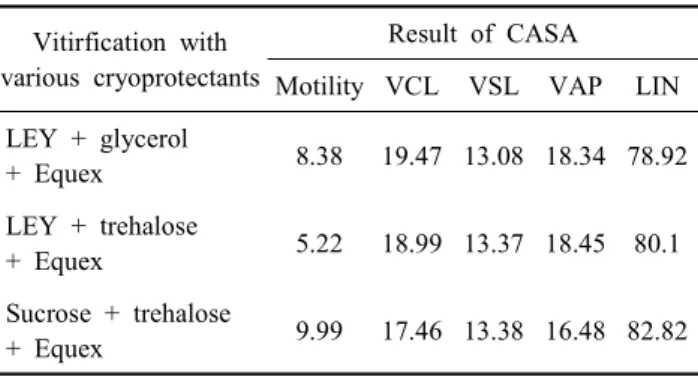
Semen sample used in this study was normal morphology and 70% or more living sperms at raw status. And we had been found the phenomenon about the ability to tolerate the freezing damages in some of boars. So boar selection was occurred among boars breeding in NIAS (National Institute of Animal Science). The results of conventional freezing and vitrification in boar sperm were represented in Table 1 and Table 2. And the results of survival rates on conventional freezing and vitri- fication were showed in Table 3 and Table 4.

The conventional freezing in solution (LEY + 10.5% glycerol + 1.5% OEP) presented higher motility (20.9%) than other solutions while the solution (LEY + 1 M trehalose + 1.5%

OEP) showed the lowest (motility 6.9%). Almost of vitrified sperm showed lower motility as 5.2 ∼9.9% than conventional freezing. And the movements measured by CASA were also weak, it seems to be unavoidable to induce AI injection to sows.

However, survival rates of vitrified sperms detected by FITC

showed 1 ∼4% live sperms of almost of vitrified sperms in all

(3)

Table 1. Effects of cryoprotectants on conventional freezing in boar sperm

Freezing with various cryoprotectants

Result of CASA

Motility VCL VSL VAP LIN

LEY + glycerol

+ Equex 20.98 41.98 18.92 25.3 52.07

LEY + trehalose

+ Equex 6.92 45.03 12.41 21.18 43.45

Sucrose + trehalose

+ Equex 8.32 41.34 14.13 20.46 56.87

VCL: Curvilinear line velocity, VSL: Straight line velocity, VAP: Average path velocity, Lin: Linearity.

Table 2. Effects of cryoprotectants on vitrification in boar sperm

Vitirfication with various cryoprotectants

Result of CASA

Motility VCL VSL VAP LIN

LEY + glycerol

+ Equex 8.38 19.47 13.08 18.34 78.92

LEY + trehalose

+ Equex 5.22 18.99 13.37 18.45 80.1

Sucrose + trehalose

+ Equex 9.99 17.46 13.38 16.48 82.82

VCL: Curvilinear line velocity, VSL: Straight line velocity, VAP: Average path velocity, Lin: Linearity.

Table 3. Results of survival rates of frozen-thawed sperm by FITC staining in boar sperm

Freezing with various cryoprotectants

No. of sperms

Live Dead Survival rates (%) LEY + glycerol

+ Equex 49 151 24.3±4.7

a

LEY + trehalose

+ Equex 79 121 39.7±3.1

b

Sucrose + trehalose

+ Equex 0 200 0±0

a,b
within same column means significantly different (p<0.05).

vitrification solutions’ groups, but survival rate of freezing solution of LEY + 1M trehalose + 1.5% OEP LEY and LEY + 10.5% glycerol + 1.5% OEP were showed 49%, and 79%, respectively. There were differences (P<0.05) survival rate of

Table 4. Results of survival rates of vitrified-thawed sperm by FITC staining in boar sperm

Freezing with various cryoprotectants

No. of sperms

Live Dead Survival rates (%) LEY + glycerol

+ Equex 4 196 2.0±0.9

LEY + trehalose

+ Equex 1 199 0.3±0.6

Sucrose + trehalose

+ Equex 0 200 0±0

conventional freezing in LEY + 10.5% glycerol + 1.5% OEP and LEY + 1M trehalose + 1.5% OEP and the remaining sho- wed no differences. In conventional freezing and vitrification, the groups of LEY plus cryoprotectants were showed live sperm after freezing while treatment of sucrose + trehalose + OEP was showed all of dead sperm. It seems that sucrose could not be taken place with LEY.

DISCUSSION

This results agreed the effects of the trehalose-containing freezing extender used for boar semen is possible to preserve of membrane structure. And acrosomal integrity was increased by detecting live sperm with FITC when trehalose was added freezing extender (Gutierrez-Perez et al., 2009). In report of Athurupana and Funahashi (2014), trehalose without glycerol attributes effect of mitochondria membrane potential in boar sperm, that seems trehalose maintains the activity of mitochon- dria during freezing damage. In our results, survival rate of conventional freezing with trehalose was better than glycerol group. And trehalose protects osmotic effect and specific inte- raction with membrane phospholipids. It appears connection of replacing water at the membrane-solution interface. Although glycerol had been used for cryoprotectans in some species, but it is not profitable to satisfy protecting freezing tolerance (Hu et al., 2009; Malo et al., 2010). When trehalose was added into freezing media, Hu et al. (2009) reported the synergic effects of trehalose and glycerol on boar sperm integrity.

Because extraction of intercellular water from cells is induced

through stable membrane in the freezing media. Trehalose

gives the specific cryoprotecting ability on the lipidic bilayer

(Patist and Zoerb, 2005; Hu et al., 2009). And Hu et al.(2009)

(4)

suggested the optimal concentration of trehalose is 100 mM and sperm membrane integrity significantly decreased when more adding of 100 mM of trehalose. But we used 10 times trehalose than theirs, survival rates of frozen-thawed boar sperm was showed lower for this reason.

The useful compound of Equex STM paste is sodium dodecyl sulfate (SDS). It suggested SDS probably acts modifying the structure of egg yolk lipoproteins in the extracellular medium.

The mechanism of cryoprotective effect of Equex STM paste on sperm is not completely known. Axner et al. (2004) reported Equex did not affect the intact sperm membrane or motility immediately after thawing and motility and membrane integrity decreased at a faster rate in Equex treated cat sperms. Com- pared with dog sperms, addition of Equex to freezing extender significantly improves sperm membrane integrity, motility and longevity (Rota et al., 1997). The cryoprotective effect of Equex seems to be exerted by modification of egg yolk lipoproteins and SDS is known to be toxic effect on sperm membrane. If Equex would have the useful effects if frozen-thawed sperma- tozoa would be use for artificial insemination. In this regarding, our results were showed lower survival rates than the results of Wu et al. (2013). They reported the optimal concentration of boar sperm freezing extender is 0.5% Equex and frozen- thawed sperms were detrimental in 2% Equex. Even if our results were lower than that of theirs, it is not easy to estimate the harmful inducer in our freezing extender because of mixing high concentration of trehalose and Equex. To confirm this difference, more research may be needed to change the concen- tration and/or cryoprotective agents (Buranaamnuay et al., 2009).

Vitirification of boar sperm was not found in any articles but in the case of boar, these type was required the freezing of boar semen, because it is not established yet and we need another trial for boar semen cryopreservation. Isachenko et al.

(2002, 2003) tried to vitrify human spermatozoa without per- meable cryoprotectants (Isachenko et al., 2012) and reported success to extend the reproduction methods with IVF, ICSI and so on. And they applied to vitrify sperm of animals such as sperm of fish, dog and tissues of human organisms. They vitrified the human sperm with 0.5% sucrose in HTF (human tubal fluid) + 1% HSA (human serum albumin) of vitrification solution and produce two babies. We think that it is nice trial for the breeds which is difficult to cryopreserve. They indicated the cryopreservation is normally achieved tertiary combination of cells, permeable cryoprotectants and a low temperature en-

vironment and cryoprotectants has negative effects on spermato- zoa including damaging the cytoplasm, functional destabilization and mutagenesis. As mentioned above, numerous researchers reported the low concentration of cryoprotectants and mainte- nance of the membrane status for stream of intercellular water.

And number of frozen-thawed sperm is promised on artificial insemination in animals, sperms for fertilizing in oviduct need few thousands sperms and few millions in uterus. Even though AI technique is developed as manipulating injection of sperms, it is essential to prepare live sperms. In conclusion, our results are not enough to use AI for reproducing pigs, but trial of vitrification can be used in assisted reproduction. And numerous reports have been indicated the diversity of cryopreservation on breeds (Nicolas et al., 2012), further studies are needed to investigate the possible optimal cryopreservation of boar semen.

REFERENCES

Alkmin DV, Perez-Patino C, Barranco I, Parrilla I, Vazquez JM, Martinez EA, Rodriguez-Martinez H and Roca J. 2014.

Boar sperm cryosurvival is better after exposure to seminal plasma from selected fractions than to those from entire ejaculate. Cryobiology 69:203-210.

Andrabi SMH, Ansari MS, Ullah N, Anwar M, Mehmood A and Akhter S. 2008. Duck egg yolk in extender improves the freezability of buffalo bull spermatozoa. Anim. Reprod.

Sci. 104:427-433.

Athurpana R and Funahashi H. 2014. 63 stepwise thawing pre- serves mitochondria membrane potential of boar spermatozoa extended in glycerol free medium containing trehalose. Re- prod. Fert. Develop. 27:124-125.

Axner E, Hermansson U and Linde-Forsberg L. 2004. The effect of Equex STM paste and sperm morphology on post-thaw survival of cat epididymal spermatozoa. Anim. Reprod. Sci.

84:179-191.

Bailey JL, Lessard C, Jacques J, Breque C, Dobrinski I, Zeng W and Galantino-Homer HL. 2008. Cryopreservation of boar semen and its future importance to the industry. Therioge- nology 70:1251-1259.

Bathgare R, Maxwell WMC and Evans G. 2006. Studies on the effect of supplementing boar semen cryopreservation media with different avian egg yolk types on in vitro post- thaw sperm quality. Reprod. Dom. Anim. 41:68-73.

Bhur M, Fisher P, Bailey J and Curtis E. 2001. Cryopreser-

(5)

vation in different concentrations of glycerol alters boar sperm and their membranes. J. Androl. 22:961-969.

Buranaamnuay K, Tummaruk P, Singlor J, Rodriguez-Martinez H and Techakumphu M. 2009. Effect of straw volume and Equex STM on boar sperm quality after cryopreservation.

Reprod. Domest. Anim. 44:69-73.

Chen T, Fowler A and Toner M. 2000. Brief communication, literature review: Supplemented phase diagram of the tre- halose-water binary mixture. Cryobiology 40:277-282.

Gonzalez-Cadavid V, Martins JAM, Moreno FB, Andrade TS, Santos ACL, Monteiro-Moreira ACO, Moreira R and Moura AA. 2014. Seminal plasma proteins of adult boars and co- rrelations with sperm parameters. Theriogenology 82:697- 707.

Gutierrez-Perez O, Juarez-Mosqueda ML, Cavajal SU and Ortega MET. 2009. Boar spermatozoa cryopreservation in low gly- cerol/trehalose enriched freezing media improves cellular integrity. Cryobiology 58:287-292.

Hounsa C, Brandt E, Thevelenin J, Hohmann S and Prior B.

1998. Role of trehalose in survival of Saccharomyces cere- visiae under osmotic stress. Microbiology 144:671-680.

Hu JH, Li QW, Jiang Zl, Yang H, Zhang SS and Zhao HW.

2007. The cryoprotective effect of trehalose supplementation on boar spermatozoa quality. Reprod. Dom. Anim. 44:571- 575.

Isachenko E, Isachenko V, Katkov ll, Dessole S and Nawroth F. 2003. Vitrification of mammalian spermatozoa in the ab- sence of cryoprotectants : From past practical difficulties to present success. Reprod. Biomed. Online 6:191-200.

Isachenko V, Isachenko E, Petrunkina AM and Sanchez R. 2012.

Human spermatozoa vitrified in the absence of permeable cryoprotectants: Birth of two healthy babies. Reprod. Fert.

Develop. 24:323-326.

Jones AR, Chantril L, and Cokinakis A. 1992. Metabolism of glycerol by mature boar spermatozoa. J. Reprod. Fert. 94:

129-134.

Leslie S, Isarali E, Ligthaart B, Crowe J and Crow L. 1995.

Trehalose and sucrose protect both membranes and proteins in intact bacteria during drying. Appl. Environ. Microb. 61:

3529-3597.

Malo C, Gil L, Gonzalez N, Cano R, de Blas I and Esponosa E. 2010. Comparing sugar type supplementation for cryo- preservation of boar semen in egg yolk based extender.

Cryobiology 61:17-21.

Mazur P, Leibo SP and Seidel GE jr. 2008. Cryopreservation of the germplasm of animals used in biological and medical research: Importance, impact, status and future directions.

Biol. Reprod. 78:2-12.

Murdoch RN and Jones RC. 1978. The effects of glycerol on the metabolism and ultrastructure of boar spermatozoa. J.

Reprod. Fert. 54:419-422.

Nawroth F, Isachenko V, Dessole S, Rahimi G, Farina M, Vargiu N, Mallmann P, Dattena M, Capobianco G, Peter D, Orth I and Isachenko E. 2002. Vitrification of human sper- matozoa without cryoprotectants. Cryo. Letters 23:93-102.

Nicolas M, Alvarez M, Borragan S, Martinez-Pastor F, Cha- morro CA, Alvarez-Rodriguez M, de Paz P and Anel L.

2012. Evaluation of the qualitative and quantitative effecti- veness of three media of centrifugation (Maxifreeze, Cushion fluid Equine, and puresperm 100) in preparation of fresh or frozen-thawed brown bear spermatozoa. Theriogenology 77:

1119-1128.

Patist A and Zoerb H. 2005. Preservation mechanism of trehalose in food and biosystem. Colloid. Surface B 40:107-113.

Ramlov H and Westh P. 1992. Survival of the cryptobiotic eu- tardigrade Adorybiotus coronifer during cooling to —196℃:

Effect of cooling rate, trehalose level and short-term accli- mation. Cryobiology 29:125-130.

Rota A, Strom B, Linde-Forsberg C and Rodriguez-Martinez H.

1997. Effects of STM paste on viability of frozen thawed fog spermatozoa during in vitro incubation at 38 ℃. Therio- genology 47:1093-1101.

Sampedro JG and Uribe S. 2004. Trehalose-enzyme interactions result in structure stabilization activity inhibition. The role of viscosity. Mol. Cell. Biochem. 256:319-327

Westendorf P, Richter L and Treu H. 1975. Deep freezing of boar sperma. Labaratory and insemination results using the Hulsenberger paillete methods. Dtsh. Tierarztl. Wochenschr.

82:261-267.

Wu TW, Cheng FP, Yang CH, Tsai MY, Wang JH and Wu JT. 2013. The combination effect of different Equex paste concentrations, cryoprotectans and the straw-freezing methods on the post-thaw boar semen. Reprod. Dom. Anim. 48:53- 58.

Received October 31, 2014, Revised December 15, 2014,

Accepted December 29, 2014

수치

Table  3.  Results  of  survival  rates  of  frozen-thawed  sperm  by  FITC  staining  in  boar  sperm

참조

관련 문서