Ⅰ14Ⅰ www.ksdf.or.kr
〈Research Paper 〉
Dyeing Characteristics of Casein Protein Fiber with Acid Dyes and Reactive Dyes
Jae-hong Choi
†
and Mi-hyeon Kim
Dept. of Textile System Engineering, Kyungpook National University, 1370 Sankyuk-dong Buk-gu, Daegu(702-701), Korea
(Received: September 18, 2008/Revised: October 14, 2008/Accepted: October 20, 2008)
Abstract ― The present paper focuses on the application of commercial acid dyes and wool reactive dyes to casein protein fabric. Nine acid dyes and six wool reactive dyes were compared their dyeing properties as well as color fastness. The exhaustion yields were higher than 80 % which dramatically increased at pH 3. Excellent wash fastness was obtained with metal-complex acid and wool reactive dyes. Both light and rubbing fastness were overall good, but perspiration fastness was comparatively poor.
Keywords: casein protein fiber, acid dyes, reactive dyes, buffer solution, dye exhaustion
1. Introduction
In recent, some sorts of natural fibers are now attracting interest in the textile market. For instance, those based on bamboo, soybean and casein fibers have biodegradable, non allergic, microbiocidal and anti-ageing properties
1). Another type of polyester, poly- (lactic acid) (PLA), has also attracted attention as a polymer for textiles because, in addition to offering similar technical properties to PET, it is produced from renewable resources and can be biodegradable
2,3,4,5). Casein fiber is one of the man-made protein fibers of animal origin (milk protein). The casein is separated from the whey by dissolving in caustic soda, there- after spun in a precipitating bath with sulfuric acid, sodium sulfate
6). Therefore, casein fibers have a certain similarity to sheep’s wool. Lanital was the first com- mercial protein fiber obtained from milk casein, as patented by Antonio Feretti in 1935
7). As the important ingredients of milk protein fiber are casein proteins, which can nourish and lubricate the skin. The milk protein contains the natural humectant factor, which can capture moisture and will maintain the skin’s moisture
7). Some properties of casein protein fiber are compared with those of other natural fibers in Table 1.
†Corresponding author. Tel: + 82-53-950-5644 ; Fax: + 82-53-950-6617 ; e-mail: [email protected]
The content of amino acids in milk fiber is around 30% which was tested by SGS-CSTC Standards Technical Services Co. Ltd Shanghai Branch. As shown in Table 2, milk fiber contains 18 amino acids similar to those found in wool and silk, but the proportions are different. The main components are Glutamic acid, Proline, Leucine and Aspartic acid.
The nature of side-chain of Glutamic acid and Aspartic acid can be featured as an acidic group compared with those of other amino acids, as illustrated in Fig. 1.
For the dyeing of new materials, as mentioned above, there have been some research results on poly(lactic acid) fiber
10,11)and soybean fiber
1). However in the case of coloration of casein fiber, very limited research results have been reported dyeing properties of casein fiber.
Due to the similarity in chemical compositions between casein fiber and wool, dyeing of casein fiber with acid dyes and some reactive dyes can be utilized.
In this paper, the optimum conditions for pretreatment
have been studied, then dyeing performance of a
range of acid dyes and wool reactive dyes containing
different reactive groups have been assessed in terms
of exhaustion yield depending on the pH of the
dyebath.
J. of the Korean Soc. of Dyers and Finishers, Vol. 20, No. 5 Ⅰ15Ⅰ
Property Casein fiber Cotton Silk Wool
Fineness (dtex) 1.52 1.2-2.0 1.0-2.8 6-9
Tensile strength (dry, CN/dtex) 2.8 1.9-3.1 3.8-4.0 2.6-3.5
Tensile strength(wet, CN/dtex) 2.4 3.2 2.1-2.8 0.8
Breaking elongation rate(dry, %) 25-35 7-10 11-16 14-25
Breaking elongation rate(wet, %) 28.8 13 27-33 50
Moisture regain (%) 5-8 7-8 8-9 15-17
Specific weight (g/cm3) 1.22 1.50-1.54 1.46-1.52 1.34-1.38
Table 1. Property comparisons between casein fiber and other natural fibers
7)Amino acid Casein (%) Wool (%) Silk (%)
Glutamic acid 20.3 11.9 1.3
Proline 9.3 6.6 0.4
Leucine 9.1 7.7 0.6
Lysine 8.4 2.9 0.4
Aspartic acid 7.5 6.5 1.6
Valine 6.3 5.6 2.4
Tyrosine 5.8 3.8 5.1
Serine 5.2 10.4 11.9
Alanine 3.3 5.4 28.9
Glycine - 8.4 43.9
Others 24.8 30.8 3.5
Table 2. Amino acid composition of casein and other protein fibers
7,8,9)(1) (2)
Fig. 1. Chemical structure of Glutamic acid (1) and Aspartic acid (2).
The reactive groups studied in this investigation included
α
-bromoacrylamide (Lanasol dyes) and difluoro- chloropyrimidine (Drimalan F dyes)
12,13).
2. Experimental
2.1 Materials
100% Casein plain-fabric was woven by Cho Yang Wool Textile Co. The casein fabric was scoured and bleached prior to dyeing. Scouring and bleaching was carried out in one stage using with 3g/l of scouring agent (Sunmorl CS-1 supplied from Nicca Korea), 3g/l of stabilizer (Neorate PLC-8800D supplied from Nicca Korea) and 8g/l of H
2O
2(30% wt, Aldrich) at 95
℃
for 60 minutes.
2.2 SEM analysis
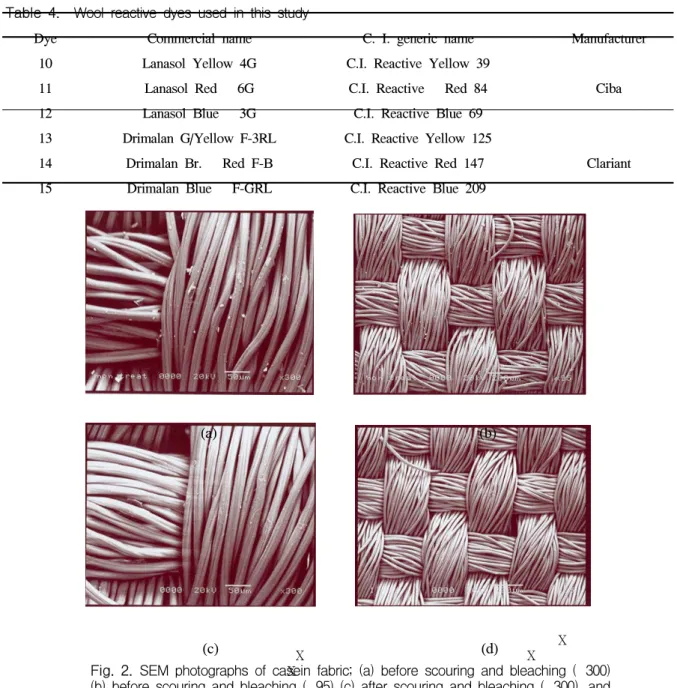
The surface change of the casein fabric by scouring and bleaching treatments was investigated by a scanning electron microscope (Jeol JSM 5800-LV).
2.3 Commercial acid and wool reactive dyes
To evaluate the dyeability of casein fiber, 9 acid dyes containing levelling, milling and metal-complex types, and 6 wool reactive dyes were used in this study. The commercial dyes provided by corresponding manufacturers, as listed in Table 3 and Table 4.
2.4 Dyeing procedure
The dyeings were performed under an exhaust dyeing method in a laboratory dyeing machine (KS-W24 Inter Cooler IR Dyeing machine, Korea Scientific Co.).
The casein fabric specimens were dyed at a liquor- to-goods ratio of 20:1. Dye bath pH was adjusted to pH 3 using sodium acetate/acetic acid buffer system.
In case of acid dyes a levelling agent (1% o.w.f.,
Ⅰ16Ⅰ www.ksdf.or.kr
Newbon MG, Nicca Korea)was added into the dye bath. The dyeing commenced at 40 ℃ which was then raised to 95℃ at a gradient of 1.5 ℃ /min. After holding at this temperature for 40 minutes, and then cooled to 70 ℃
at 2 ℃
/min. In the case of wool reactive dyeings, the fabric was removed from the dyebath and rinsed with a soaping agent (2 g/l, Lipotol RF-101, Nicca Korea).
2.5 Effect of dyeing temperature on exhaustion
To determine the optimum dyeing temperature, the temperature was varied as 90 ℃
, 95 ℃
and 100 ℃ using levelling type acid dyes, Telon Yellow RNL micro, Telon Red FRL micro and Telon Blue BRL micro. The corresponding K/S values at λ
max
were evaluated.
2.6 Effect of pH on exhaustion
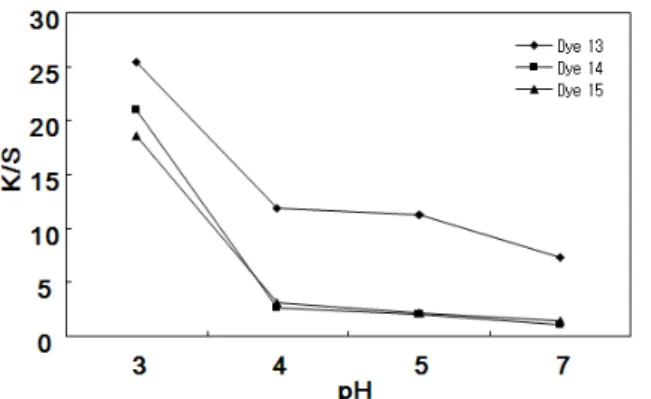
The pH in the dyebath was adjusted 3, 4, 5 and 7 using acetic acid. Dyeing at each pH conditions was performed at 95
℃
for 40 min, and the corresponding K/S values at
λ
max
were evaluated.
2.7 Build-up properties
Dyeing concentrations of 1, 2, 3 and 4% o.w.f. were employed and the corresponding K/S values were measured. The dyeing conditions were described above.
2.8 Determination of dye exhaustion yield
The dye uptake was obtained using a UV-visible spectrophotometer (Shimadzu UV-2100, Japan), mea- suring the absorbance at the wavelength of maximum absorption of the dye. The % percentage dye bath exhaustion (%E )was calculated using equation(1):
%E=(A
0–
A
1)/A
0× 100 (1) where, A
0and A
1are the absorbance at
λ
max