Involvement of Cdk Inhibitor p21(WIP1/CIP1) in G2/M Arrest of Human Myeloid Leukemia U937 Cells by N -Methyl- N' -Nitro- N -Nitrosoguanidine
Yung Hyun Choi*
Department of Biochemistry, Dongeui University College of Oriental Medicine and Department of Biomaterial Control, Dongeui University Graduate School, Busan 614-052, South Korea
Received September 5, 2008 /Accepted December 16, 2008
In this paper, to elucidate the further mechanisms of N-methyl-N'-nitro-N-nitrosoguanidine (MNNG)-induced growth arrest, we investigated the effect of MNNG on cell cycle and proliferation in U937 cells, a p53-null human myeloid leukemia cell line. It was found that MNNG causes an arrest at the G2/M phase of the cell cycle and induces apoptosis, which is closely correlated to inhibition of cyclin B1 and cyclin-dependent kinase (Cdk) 2-associated kinase activities. MNNG treatment in- creased protein and mRNA levels of the Cdk inhibitor p21(WAF1/CIP1), and activated the reporter construct of a p21 promoter. By using p21 promoter deletion constructs, the MNNG-responsive ele- ment was mapped to a region between 113 and 61 relative to the transcription start site. These data indicate that in U937 cells MNNG can circumvent the loss of wild-type p53 function and induce crit- ical downstream regulatory events leading to transcriptional activation of p21. Present results indicate that the p53-independent up-regulation of p21 by MNNG is likely responsible for the inhibition of cyclin/Cdk complex kinase activity rather than the down-regulation of cyclins and Cdks expression.
These novel phenomena have not been previously described and provide important new insights into the possible biological effects of MNNG.
Key words : N-methyl-N'-nitro-N-nitrosoguanidine (MNNG), U937, G2/M arrest, p21
*Corresponding author
*Tel:+82-51-850-7413, Fax:+82-51-853-4036
*E-mail : [email protected] or [email protected]
Introduction
Genotoxic events such as ultra violet and alkylating agents can activate various signaling pathways that serve, for example, to activate DNA repair mechanisms, halt cell cycle progression and/or trigger advancement into apopto- sis, a programmed cell death. Although all genotoxins pro- duce such general responses, the mechanisms that govern response to divergent forms of DNA damage are potentially diverse themselves. Alkylating agents are an important class of anticancer drugs used in the chemotherapy [3,20,29]. They produce a variety of lesions by covalently transferring the alkyl group to oxygen and nitrogen atoms in DNA, and the damage is repaired by the DNA mismatch repair and/or base-excision repair pathway [6,35].
Among them, the monofunctional alkylating agent N-methyl-N'-nitro-N-nitrosoguanidine (MNNG) is known to cause growth arrest at the G2/M checkpoint and apoptosis in various human cancer cell lines [1,7,15,16,21,31,32].
Previous reports showed that the treatment of human cancer cells with MNNG results in p53 phosphorylation on serine
residues, and these phosphorylation events depend on the presence of functional protein complexes involved in mis- match repair [2,13,17]. These results implicate action of the mismatch repair system in the initial step of a damage-sig- naling cascade that can lead to cell-cycle checkpoint activa- tion or apoptosis in response to DNA damage [2,17,22]. To date, despite accumulated data, the molecular mechanism of MNNG-induced antiproliferative action on the cell cycle of human cancer cells is poorly understood.
The progression of eukaryotic cells through the cell cycle is orchestrated by sequential activation and inactivation of the cyclin-dependent kinases (Cdks), which is associated with their respective cyclin subunits. G1 progression and G1/S transition are regulated by Cdk4/Cdk6 which assem- bles with D-type cyclins in mid-G1 and Cdk2 which com- bines later with cyclin E. While Cdk2 controls the S-phase when associated with cyclin A, G2/M transition is regulated by Cdc2 in combination with cyclins A and B [11,33,36]. In addition, the relative balance between the cellular concen- trations of low molecular weight Cdk inhibitors also regu- lates the cell cycle progression. Two gene families of mam- malian Cdk inhibitors have been identified to date: one group is the Cdk-interaction protein/Cdk inhibitor (CIP/
KIP) family, including p21, p27 and p57, and has a broad
specificity; and the other group acts as inhibitors of the Cdk4 (INK4) family including p15, p16, p18 and p19. INK4 binds only to Cdk4 and Cdk6, while CIP/KIP targets a broader range of substrates, including Cyclin D-, E-, A- and B-de- pendent kinases [11,25,34].
In this study, we have shown that MNNG inhibited the cell growth and induced apoptotic cell death in human mye- loid leukemia U937 cells, which are deleted and mutated by the p53 gene [9]. Subsequent experiments indicated that U937 cells were arrested at the G2/M checkpoint by MNNG, which was accompanied by the inhibition of cyclin B1 and Cdk2-associated kinase activity and transcriptional up-regu- lation of p21 in a p53-independent manner.
Materials and Methods Cell culture and viability assay
Human myeloid leukemia U937 cells were obtained from the American Type Culture Collection (Rockville, MD) and cultured in RPMI1640 medium supplemented with 10%
heat-inactivated fetal calf serum (FBS), 2 mM glutamine, 100 U/ml penicillin and 100 μg/ml streptomycin (Gibco BRL) at 37
oC and 5% CO
2. MNNG was purchased from Sigma Chemical Co. (St. Louis, MO), dissolved in distilled water. Cells were cultured in the absence and presence of variable concentrations of MNNG for the indicated times.
Measurement of cell viability was determined using a MTT assay, which is based on the conversion of MTT to MTT-for- mazan by mitochondrial enzyme.
Flow cytometry analysis
Cells were harvested and washed once with cold phos- phate-buffered saline (PBS), fixed in ice-cold 70% ethanol and then stored at 4
oC. Prior to analysis, the cells were wash- ed once again with PBS, suspended in 1 ml of a cold propi- dium iodide (PI, Sigma) solution containing 100 μg/ml RNase A, 50 μg/ml PI, 0.1% (w/v) sodium citrate, and 0.1%
(v/v) NP-40, and then incubated on ice for an additional 30 min in the dark. Next, flow cytometric analyses were con- ducted using a flow cytometer (FACS Caliber, Becton Dikinson, San Jose, CA) and the CellQuest software was then used to determine the relative DNA content based on the presence of a red fluorescence.
Annexin-V and PI staining
Cells were collected, washed with cold PBS and then re-
suspended in annexin-V binding buffer containing 10 mM HEPES/NaOH, pH 7.4, 140 mM NaCl, and 2.5 mM CaCl
2according to the manufacturer’s protocol (BD Pharmingen, San Diego, CA). Aliquots containing cells were incubated with annexin-V FITC, mixed, and incubated for 15 min at room temperature in the dark. PI at a final concentration of 5 μg/ml was added to identify necrotic cells. Apoptotic cells were measured using a fluorescence-activated cell sort- er analysis in a flow cytometer.
RNA extraction and reverse transcription-PCR
Total RNA was prepared using an RNeasy kit (Qiagen, La Jolla, CA) and primed with random hexamers to synthe- size the complementary DNA using AMV reverse tran- scriptase (Amersham Corp., Arlington Heights, IL) accord- ing to the manufacturer's instructions. A polymerase chain reaction (PCR) was carried out using a Mastercycler (Eppendorf, Hamburg, Germany) with the primers shown in Table 1. The following conditions were used for the PCR reactions: 1× (94
oC for 3 min); 35× (94
oC for 45 sec; 58
oC for 45 sec; and 72
oC for 1 min) and 1× (72
oC for 10 min).
The amplification products obtained by PCR were separated electrophoretically on 1% agarose gel and visualized by ethi- dium bromide (EtBr) staining.
Gel electrophoresis and Western blot analysis
The cells were harvested, lysed, and the protein concen- trations were quantified using a Bio Rad protein assay (BioRad Lab., Hercules, CA), according to the procedure re- ported by the manufacturer. For Western blot analysis, an equal amount of protein was subjected to electrophoresis on SDS-polyacrylamide gel and transferred to a nitrocellulose
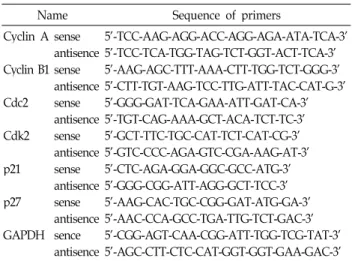
Table 1. Gene-specific primers for RT-PCR
Name Sequence of primers
Cyclin A Cyclin B1 Cdc2 Cdk2 p21 p27 GAPDH
sense antisence sense antisence sense antisence sense antisence sense antisence sense antisence sence antisence
5'-TCC-AAG-AGG-ACC-AGG-AGA-ATA-TCA-3' 5'-TCC-TCA-TGG-TAG-TCT-GGT-ACT-TCA-3' 5'-AAG-AGC-TTT-AAA-CTT-TGG-TCT-GGG-3' 5'-CTT-TGT-AAG-TCC-TTG-ATT-TAC-CAT-G-3' 5'-GGG-GAT-TCA-GAA-ATT-GAT-CA-3' 5'-TGT-CAG-AAA-GCT-ACA-TCT-TC-3' 5'-GCT-TTC-TGC-CAT-TCT-CAT-CG-3' 5'-GTC-CCC-AGA-GTC-CGA-AAG-AT-3' 5'-CTC-AGA-GGA-GGC-GCC-ATG-3' 5'-GGG-CGG-ATT-AGG-GCT-TCC-3' 5'-AAG-CAC-TGC-CGG-GAT-ATG-GA-3' 5'-AAC-CCA-GCC-TGA-TTG-TCT-GAC-3' 5’-CGG-AGT-CAA-CGG-ATT-TGG-TCG-TAT-3’
5’-AGC-CTT-CTC-CAT-GGT-GGT-GAA-GAC-3’
membrane (Schleicher & Schuell, Keene, NH) by electroblott- ing. The blots were probed with the desired antibodies for 1 h, incubated with the diluted enzyme-linked secondary an- tibodies and visualized by enhanced chemiluminescence (ECL) according to the recommended procedure (Amersham). Primary antibodies were purchased from Santa Cruz Biotechnology Inc. (Santa Cruz, CA) and Calbiochem (Cambridge, MA). Peroxidase-labeled donkey anti-rabbit im- munoglobulin and peroxidase-labeled sheep anti-mouse im- munoglobulin were purchased from Amersham.
Immune complex kinase assay
Immune complex kinase assays were performed as de- scribed [31]. Briefly, cell lysates were incubated with primary antibody, and immune complexes were collected on protein A-Sepharose beads and resuspended in kinase assay mixture containing [γ-
32P]ATP (ICN) and histone H1 (Life Technologies, Inc.) as a substrate. The proteins were sepa- rated on 10% SDS-polyacrylamide gels, and bands were de- tected by autoradiography.
p21 promoter-luciferase constructs and transfection assay
Four constructs of p21 promoter, the full length 2.4-kb human p21 promoter constructs as well as p21 promoter de- letion constructs, p21 Sma (0 to -113), p21 Sma Δ1 (0 to -61) and p21 Sma Δ2 (full-length p21 promoter from which the region -62 to -114 was deleted) were tested [10]. For the re- porter assay, cells were seeded at 2×10
5cells per 60 mm di- ameter plate and transiently transfected with p21 pro- moter-luciferase reporter constructs using LipofectAMINE transfection reagent (Gibco BRL), as recommended by the manufacturer. Following transfection the cells were in- cubated for 12 h, the medium was exchanged, and the cells were incubated for an additional 36 h in the presence or absence of 40 ng/ml MNNG. The cells were then lysed, and luciferase activity in the lysates was assayed using a Dynatech ML1000 luminometer (Dynatech Laboratories) as previously described [32].
Results
MNNG inhibited the cell proliferation and induced G2/M arrest
To investigate the effects of MNNG on cell viability, U937 cells were treated with various concentrations of MNNG for
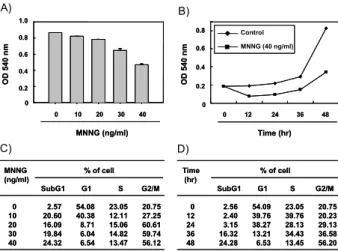
the indicated times and subjected to MTT assays. We found that MNNG had strong inhibitory effects on cell pro- liferation in dose- and time dependent manner (Fig. 1A and B). To determine whether MNNG treatment resulted in the alteration of cell cycle progression, the cell cycle patterns were examined. The data demonstrated that the growth in- hibiting action of MNNG was the consequence of a specific G2/M phase arrest (Fig. 1C and D). At a concentration of 40 ng/ml for 48 h, many more U937 cells (56.20%) were sta- tioned in the G2/M phase and far fewer cells (6.54%) in the G1 phase compared with the control.
MNNG induced apoptosis
Further experiments were carried out to determine if this inhibitory effect of MNNG on cell viability is the result of apoptotic cell death. As shown in Fig. 1C and D, the addi- tion of MNNG is seen to result in the increased appearance of cells in the sub-G1 phase, similar to the results observed for MNNG-induced loss of cell viability. Flow cytometry analysis with annexin V and PI staining was also used to determine the magnitude of apoptosis elicited by MNNG.
As shown in Fig. 2, the annexin V-positive cells increased
OD 540 nm
MNNG (ng/ml) 0 10 20 30 40 0
0.2 0.4 0.6 0.8 1.0
OD 540 nm
MNNG (ng/ml) 0 10 20 30 40 0
0.2 0.4 0.6 0.8 1.0
A)
OD 540 nm
Control MNNG (40 ng/ml)
0 0.2 0.4 0.6 0.8
0 12 24 36 48 Time (hr)
OD 540 nm
Control MNNG (40 ng/ml) Control MNNG (40 ng/ml)
0 0.2 0.4 0.6 0.8
0 12 24 36 48 Time (hr)
B)
MNNG % of cell
(ng/ml)
SubG1 G1 S G2/M 0 2.57 54.08 23.05 20.75 10 20.60 40.38 12.11 27.25 20 16.09 8.71 15.06 60.61 30 19.84 6.04 14.82 59.74 40 24.32 6.54 13.47 56.12
MNNG % of cell
(ng/ml)
SubG1 G1 S G2/M 0 2.57 54.08 23.05 20.75 10 20.60 40.38 12.11 27.25 20 16.09 8.71 15.06 60.61 30 19.84 6.04 14.82 59.74 40 24.32 6.54 13.47 56.12
C)
Time % of cell
(hr)
SubG1 G1 S G2/M 0 2.56 54.09 23.05 20.75 12 2.40 39.76 39.76 20.23 24 3.15 38.27 28.13 29.13 36 16.32 13.21 34.43 36.58 48 24.28 6.53 13.45 56.20
Time % of cell
(hr)
SubG1 G1 S G2/M 0 2.56 54.09 23.05 20.75 12 2.40 39.76 39.76 20.23 24 3.15 38.27 28.13 29.13 36 16.32 13.21 34.43 36.58 48 24.28 6.53 13.45 56.20
D)
Fig. 1. Effect of MNNG on the proliferation of and cell cycle distribution of U937 cells. U937 cells were seeded at 3×10⁴per ml in 35 mm dish and incubated for 24 hr.
The cells cultured in the absence (0, control) or in the presence of increasing concentrations of MNNG for the indicated times. (A and B) Cell viability was measured by the metabolic-dye-based MTT assay. The data shown represent the mean ± the SD of three independent experiments. (C and D) The cells grown under the same conditions were collected, fixed, and stained with PI for flow cytometry analysis. The percentages of cells in the each phase of cell cycle are presented. The data represent the average of two independent experiments.
0 5 10 15 20 25 30
0 10 20 30 40
MNNG (ng/ml)
% of apoptotic cells
For 48 h
0 5 10 15 20 25 30
0 10 20 30 40
MNNG (ng/ml)
% of apoptotic cells
For 48 h
A)
0 5 10 15 20 25 30
0 12 24 36 48
MNNG (40 ng/ml)
Time (hr)
% of apoptotic cells
0 5 10 15 20 25 30
0 12 24 36 48
MNNG (40 ng/ml)
Time (hr)
% of apoptotic cells
B)
Fig. 2. Induction of apoptosis by MNNG in U937 cells. U937 cells were seeded at an initial density of 2.5´105cells per 60 mm plate, incubated for 24 hr, and treated with differ- ent concentrations of WEEH for the indicated times. The cells were collected and stained with FITC-conjugated annexin-V and PI for flow cytometry analysis. The apop- totic cells were determined by counting the % of annexin V(+)/PI(-) cells and the % of annexin V(+)/PI(+) cells.
The results are expressed as the mean±SD of three in- dependent experiments.
concentration- and time dependently in the MNNG-treated U937 cells compared with the untreated control cells.
These results demonstrated that the cytotoxic effects ob- served in response to MNNG are associated with the in- duction of G2/M arrest and apoptotic cell death in U937 cells, as was observed in several other cancer cell lines [1,7,15,16,21,31,32].
MNNG inhibited cyclin B1 and Cdk2-associated kinase activity
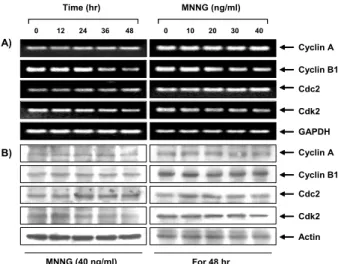
The G2/M transition is regulated by B-type cyclins which bind to and activate Cdc2 and cyclin A, which activates Cdk2. Because MNNG arrests U937 cells in G2/M, we tested whether MNNG decreased mRNA and protein levels of cy- clin A, cyclin B1, Cdk2 and Cdc2, and as demonstrated in Fig. 3, there was little detectable change in the level of these mRNAs and proteins, even after 48 h of exposure to MNNG.
On the other hand, Fig. 4 shows that the cyclin B1 and Cdk2-associated activities of U937 cells were markedly re- duced to undetectable levels in MNNG-treated cells as as- sessed by enzymatic assays of specific immunoprecipitates.
This data indicated that MNNG inhibited the kinase activity of cyclin/Cdk complexes by changing the activation states, rather than altering the expression of cyclins and Cdks proteins.
Induction of Cdk inhibitor p21 by MNNG
As Cdk activity is highly regulated by association with Cdk inhibitors, we next examined the possible up-regulation of these proteins and mRNAs in cells treated with MNNG.
Time (hr)
0 12 24 36 48
Cyclin A MNNG (ng/ml)
0 10 20 30 40
Cyclin B1
GAPDH
MNNG (40 ng/ml)
Cyclin A Cyclin B1
Actin For 48 hr
A)
B)
Cdc2 Cdk2
Cdc2 Cdk2
Fig. 3. Effect of MNNG on the expression of cyclins and Cdks protein, and Cdks kinase activity in U937 cells. Cells were treated with MNNG for the time indicated. (A) Total RNAs were isolated and reverse-transcribed. The resulting cDNAs were then subjected to PCR with the indicated primers and the reaction products were sub- jected to electrophoresis in a 1% agarose gel and vi- sualized by EtBr staining. GAPDH was used as an in- ternal control. (B) The cells were lysed and the cellular proteins were then separated by electrophoresis on SDS-polyacrylamide gels and transferred onto nitro- cellulose membranes. Next, the membranes were probed with the indicated antibodies and the proteins were vi- sualized using an ECL detection system. Actin was used as an internal control.
IP : Cyclin B1 IP : Cdk2
Histone H1 MNNG (ng/ml)
0 10 20 30 40
Histone H1 Fig. 4. Inhibition of cyclin B1 and Cdk2-associated kinase activ-
ities by MNNG in U937 cells. The cells grown under the same conditions as Fig. 3 were collected and total cell lystaes (500 μg) were prepared and immunoprecipitated with anti-cyclin B1 or Cdk2 antibody, and the kinase ac- tivity was assayed using histone H1 as a substrate.
As shown in Fig. 5A and B, MNNG induced a marked in-
crease in the level of the Cdk inhibitor p21 protein as well
as mRNA. As the p53 gene is deleted in U937 cells [9], it
is most likely that the induction of the p21 by MNNG is
mediated in a p53-independent fashion. However, the other
Cdk inhibitor, such as p27, was not significantly affected by
MNNG. The data suggested that the induction of the p21
expression is consistent with the result that MNNG inhibited
the growth and induced G2/M arrest.
Transcriptional activation of p21 promoter by MNNG Since the p21 expression is markedly induced by MNNG, we subsequently investigated the effect of MNNG on the transcriptional regulation of p21 using p21 promoter constructs. For this study, p21 promoter-luciferase reporter constructs were transfected into U937 cells, and luciferase activity was measured in the presence and absence of MNNG. The full-length 2.4-kb promoter construct contain- ing two p53 response elements was activated 4.96-fold by MNNG (Fig. 5C). Three deletion constructs were employed to further map this region of the p21 promoter. A construct consisting of 0 to 113 base pairs was in part responsive to MNNG. In contrast, a construct consisting of the region from
Time (hr)
0 12 24 36 48
p21 p27 GAPDH MNNG (ng/ml)
0 10 20 30 40
MNNG (40 ng/ml)
p21 p27 Actin For 48 hr
A)
B)
p21P
p21P Sma D2 p21P Sma D1 p21P Sma
Fold Induction
4.96
1.47 1.13 2.80 Luc
Luc Luc -113 Luc
-61
Luc
Luc Luc Luc Luc
Luc Luc -113 Luc
-61 p53
binding site
Sp1 binding site
C)
Fig. 5. Transcriptional activation of Cdk inhibitor p21 by MNNG in U937 cells. U937 cells were cultured for the indicated times in the absence or in the presence of MNNG. (A) Total RNAs were isolated and reverse-transcribed. The resulting cDNAs were then subjected to PCR with p21 and p27 primers and the reaction products were sub- jected to electrophoresis in a 1% agarose gel and vi- sualized by EtBr staining. GAPDH was used as an in- ternal control. (B) The cells were lysed and the cellular proteins were then separated by electrophoresis on SDS-polyacrylamide gels and transferred onto nitro- cellulose membranes. Next, the membranes were probed with p21 and p27 antibodies and the proteins were vi- sualized using an ECL detection system. Actin was used as an internal control. (C) U937 cells were transiently transfected with p21 promoter luciferase constructs and incubated for 12 hr; the medium was changed; the cells were incubated for an additional 36 hr in the presence or absence of 40 ng/ml MNNG, and luciferase activity was measured. The results are expressed as the mean±S.D. of three separate experiments.
0 to 61 was non-responsive to MNNG. A deletion construct consisting of the full-length promoter minus the region 62 to 114 was also non-responsive to MNNG. These data local- ize the region responsive to MNNG to the sequences be- tween 62 and 113 base pairs. Because the region between 62 and 113 contains four Sp1 binding sites [10], these data localize the MNNG-responsive region and suggest that Sp1 may play a critical role in the activation of p21 transcription in response to MNNG.
Discussion
In this study, we evaluated the ability of MNNG to inhibit the growth of human monocytic leukemia U937 cells. We found that treatment of cells with MNNG resulted in a con- centration- and time dependent inhibition of cell viability, which was associated with the induction of apoptosis and cell-cycle block at the G2/M phase transition. These results suggest that MNNG interferes with the proliferation of U937 cells, and that a possible mechanism of this interference is arrest at G2/M, which is induced by modulation of cell cy- cle-regulators.
In terms of regulation of the cell cycle, Cdks play a most critical role. Two major mechanisms for Cdk regu- lation are binding with its catalytic subunit cyclin, fol- lowed by activation of Cdk/cyclin complexes, and bind- ing with Cdk inhibitors followed by inactivation of Cdk/cyclin complexes [11,33,36]. An alteration in the for- mation of these complexes could lead to increased cell growth and proliferation, and decreased cell growth and proliferation followed by differentiation and/or cell death by apoptosis. A protein kinase, Cdk2 that interacts with cyclin E and cyclin A has been found to play an im- portant role in the regulation of the S and G2 phase.
Cdc2 interacts with cyclin B, and activation of the cyclin
B/Cdc2 complex is required for transition from the G2 to
M phase of the cell cycle. In addition, increased kinase ac-
tivity induces the phosphorylation of histone H1 and lam-
in of the nuclear membrane, followed by breakdown of
the membrane and chromosome formation, leading the
cells to the start of mitosis [24,30,37]. Based on these re-
ports, we investigated the effects of MNNG on the ex-
pression of G2/M regulatory factors. The results from the
RT-PCR and immunoblotting analyses demonstrated that
MNNG did not affect the intracellular protein levels of
cyclin A, cyclin B1, Cdk2 and Cdc2 in U937 cells (Fig. 3).
We further examined whether MNNG inhibits the kinase activity of cyclin/Cdk complexes using histone H1 as substrates. The results from the immunocomplex kinase assays using specific antibodies to cyclin B1 and Cdk2 demonstrated that MNNG markedly inhibited both cyclin B1 and Cdk2-associated kinase activities, rather than alter- ing those protein levels (Fig. 4). Taken together, these re- sults suggest that MNNG suppressed cell proliferation by down-regulating the activity of cyclin/Cdk complex kin- ase and consequently arrested the cell cycle at G2/M in U937 cells. Because we supposed the down-regulation of cyclin/Cdk complex activities by MNNG may be also caused by additional inhibitory mechanism (s), to eluci- date this hypothesis we next investigated whether Cdk in- hibitors are involved in the MNNG-induced G2/M arrest.
This hypothesis was clearly supported by the fact, that MNNG selectively induces the expression of both mRNA and protein levels of Cdk inhibitor p21 (Fig. 5).
It was first reported that Cdk inhibitor p21 is potently transactivated by the tumor suppressor gene product p53, which has further been shown to mediate the induction of cell cycle arrest at the G1 phase by inhibiting Cdk4/Cdk2 activities [14]. In addition to p53, p21 can also be trans- activated via a p53-independent pathway in various cell lines stimulated for growth arrest and differentiation.
Activation of p21 by vitamin D3 and STAT1 occurs more than 500 base pairs upstream of the MNNG-responsive re- gion [8,28]. In U937 cells, it has been demonstrated that acti- vation of p21 transcription by phorbol esters (TPA) and oka- daic acid is mediated by the promoter region between 154 and +16 and that Sp1 plays a critical role in this response [5]. In other caner cells including K562, SW480, and HepG2 cells, the activation of p21 transcription by TPA was mapped to the region between 95 and 121 [4]. Additionally, many studies have shown that Sp1 is a critical factor in regulating transcriptional responses to chemotherapeutic agents such as histone deacetylase inhibitors, alkylphospholipids, vita- min D3, lovastatin etc., [12,19,23,26-28,38] as was observed in this study. Although previous results showed that an in- crease of wild-type p53 protein level and phosphorylated form of p53 protein accompanied the G2/M arrest caused by MNNG [7,16,18], the present results clearly demonstrated that the induction of p21 by MNNG might be independent on wild-type p53 and Sp1 may play a critical role in MNNG-induced activation of the p21 promoter. Our data also suggested that the down-regulations of cyclin B1 and
Cdk2-associated kinase activities are caused by selective in- duction of p21 expression.
In summary, the present study demonstrates that 1) re- duced survival of U937 cells after exposure to MNNG is as- sociated with G2/M phase cell cycle arrest and apoptosis;
2) MNNG can inhibit cell cycle progression at the G2/M phase by decreasing cyclin B1 and Cdk2-associated kinase activity accompanied with a p53-independent induction of the Cdk inhibitor, p21; 3) treatment with MNNG results in the transcriptional activation of p21 through Sp1 binding sites. Taken together, our data show that Sp1 plays an im- portant role in MNNG-mediated G2/M arrest in U937 cells, and provide a basic mechanism for the anti-cancer properties of MNNG in cancer cells.
Acknowledgement
This work was supported by a grant from the Korea Research Foundation Grant funded by the Korean Government (MOEHRD, Basic Research Promotion Fund) (KRF-2007-521-E00015).
References
1. Adamson, A. W., D. I. Beardsley, W. J. Kim, Y. Gao, R.
Baskaran and K. D. Brown. 2005. Methylator-induced, mis- match repair-dependent G2 arrest is activated through Chk1 and Chk2.
Mol. Biol. Cell
16, 1513-1526.2. Adamson, A. W., W. J. Kim, S. Shangary, R. Baskaran and K. D. Brown. 2002. ATM is activated in response to N-meth- yl-N'-nitro-N-nitrosoguanidine-induced DNA alkylation.
J.
Biol. Chem.
277, 38222-38229.3. Bielawski, K. and A. Bielawska. 2008. Small-molecule based delivery systems for alkylating antineoplastic compounds.
Chem. Med. Chem.
3, 536-542.4. Biggs, J. R. and A. S. Kraft. 1999. The role of the Smad3 protein in phorbol ester-induced promoter expression.
J.
Biol. Chem.
274, 36987-36994.5. Biggs, J. R., J. E. Kudlow and A. S. Kraft. 1996. The role of the transcription factor Sp1 in regulating the expression of the WAF1/CIP1 gene in U937 leukemic cells.
J. Biol.
Chem.
271, 901-906.6. Casorelli, I., M. T. Russo and M. Bignami. 2008. Role of mismatch repair and MGMT in response to anticancer therapies.
Anticancer Agents Med. Chem.
8, 368-380.7. Cejka, P., L. Stojic, N. Mojas, A. M. Russell, K. Heinimann, E. Cannavo, M. di Pietro, G. Marra and J. Jiricny. 2003.
Methylation-induced G(2)/M arrest requires a full comple- ment of the mismatch repair protein hMLH1.
EMBO J.
22, 2245-2254.8. Chin, Y. E., M. Kitagawa, W. C. Su, Z. H. You, Y. Iwamoto
and X. Y. Fu. 1996. Cell growth arrest and induction of cy- clin-dependent kinase inhibitor p21 WAF1/CIP1 mediated by STAT1.
Science
272, 719-722.9. Danova, M., M. Giordano and G. A. Mazzini. 1990.
Expression of p53 protein during the cell cycle measured by flow cytometry in human leukemia.
Leuk. Res.
14.417-422.
10. Datto, M. B., Y. Yu and X. F. Wang. 1995. Functional analy- sis of the transforming growth factor b responsive ele- ments in the WAF/Cip1/p21 promoter.
J. Biol. Chem.
270, 28623-28628.11. de Cárcer, G., I. Pérez de Castro and M. Malumbres. 2007.
Targeting cell cycle kinases for cancer therapy.
Curr. Med.
Chem.
14, 969-985.12. de Siervi, A., M. Marinissen, J. Diggs, X. P. Wang, G. Pages and A. Senderowicz. 2004. Transcriptional activation of p21(waf1/cip1) by alkylphospholipids: role of the mi- togen-activated protein kinase pathway in the trans- activation of the human p21(waf1/cip1) promoter by Sp1.
Cancer Res.
64, 743-750.13. Duckett, D. R., S. M. Bronstein, Y. Taya and P. Modrich.
1996. hMutSα- and hMutLα-dependent phosphorylation of p53 in response to DNA methylator damage.
Proc. Natl.
Acad. Sci. USA
96, 12384-12388.14. el-Deiry, W. S., T. Tokino, V. E. Velculescu, D. B. Levy, R.
Parsons, J. M. Trent, D. Lin, W. E. Mercer, K. W. Kinzler and B. Vogelstein. 1993. WAF1, a potential mediator of p53 tumor suppression.
Cell
75, 817-825.15. Fang, M. Z., M. H. Lee, Y. S. Lee, Y. C. Kim, B. M. Lee and M. H. Cho. 2002. Low expression of cyclin D2 in G2/M-arrested and transformed proliferating Balb/3T3 cells.
J. Vet. Med. Sci.
64, 201-205.16. Fang, M. Z., W. C. Mar and M. H. Cho. 2001. Cell cycle was disturbed in the MNNG-induced initiation stage dur- ing in vitro two-stage transformation of Balb/3T3 cells.
Toxicology
163, 175-184.17. Hickman, M. J. and L. D. Samson. 1999. Role of DNA mis- match repair and p53 in signaling induction of apoptosis by alkylating agents.
Proc. Natl. Acad. Sci. USA
96, 10764-10769.18. Hour, T. C., S. Y. Shiau and J. K Lin. 1999. Suppression of N-methyl-N'-nitro-N-nitrosoguanidine- and S-nitro- soglutathione-induced apoptosis by Bcl-2 through inhibit- ing glutathione-S-transferase pi in NIH3T3 cells.
Toxicol.
Lett.
110, 191-202.19. Huang, L., Y. Sowa, T. Sakai and A. B. Pardee. 2000.
Activation of the p21WAF1/CIP1 promoter independent of p53 by the histone deacetylase inhibitor suberoylanilide hy- droxamic acid (SAHA) through the Sp1 sites.
Oncogene
19, 5712-5719.20. Izbicka, E. and A. W. Tolcher. 2004. Development of novel alkylating drugs as anticancer agents.
Curr. Opin. Investig.
Drugs
5, 587-591.21. Jaiswal, A. S., A. S. Multani, S. Pathak and S. Narayan. 2004.
N
-methyl-N
'-nitro-N
-nitrosoguanidine-induced senescence- like growth arrest in colon cancer cells is associated withloss of adenomatous polyposis coli protein, microtubule or- ganization, and telomeric DNA.
Mol. Cancer
3, 3.22. Jaiswal, A. S. and S. Narayan. 2002. SN2 DNA-alkylating agent-induced phosphorylation of p53 and activation of p21 gene expression.
Mutat. Res.
500, 17-30.23. Koutsodontis, G., I. Tentes, P. Papakosta, A. Moustakas and D. Kardassis. 2001. Sp1 plays a critical role in the transcrip- tional activation of the human cyclin-dependent kinase in- hibitor p21(WAF1/Cip1) gene by the p53 tumor suppressor protein.
J. Biol. Chem.
276, 29116-29125.24. Krek, W. and E. A. Nigg. 1991. Differential phosphorylation of vertebrate p34Cdc2 kinase at the G1/S and G2/M tran- sitions of the cell cycle: identification of major phosphor- ylation sites.
EMBO J.
10, 305-316.25. Lee, M. H. and H. Y. Yang. 2001. Negative regulators of cyclin-dependent kinases and their roles in cancers.
Cell Mol. Life Sci.
58, 1907-1922.26. Lee, S. J., M. J. Ha, J. Lee, P. Nguyen, Y. H. Choi, F. Pirnia, W. K. Kang, X. F. Wang, S. J. Kim and J. B. Trepel. 1998.
Inhibition of the 3-hydroxy-3-methylglutaryl-coenzyme A reductase pathway induces p53-independent transcriptional regulation of p21(WAF1/CIP1) in human prostate carcino- ma cells.
J. Biol. Chem.
273, 10618-10623.27. Lin, Y. C., J. H. Lin, C. W. Chou, Y. F. Chang, S. H. Yeh and C. C. Chen. 2008. Statins increase p21 through in- hibition of histone deacetylase activity and release of pro- moter-associated HDAC1/2.
Cancer Res.
68, 2375-2383.28. Liu, M., M. H. Lee, M. Cohen, M. Bommakanti and L. P.
Freedman. 1996. Transcriptional activation of the Cdk in- hibitor p21 by vitamin D3 leads to the induced differ- entiation of the myelomonocytic cell line U937.
Genes Dev.
10, 142-153.
29. Martínez, R. and L. Chacón-García. 2005. The search of DNA-intercalators as antitumoral drugs: what it worked and what did not work.
Curr. Med. Chem.
12, 127-151.30. Ohsumi, K., C. Katagiri and T. Kishimoto. 1993.
Chromosome condensation in Xenopus mitotic extracts without histone H1.
Science
262, 2033-2035.31. Park, C., B. T. Choi, J. Cheong, S. K. Moon, C. H. Kim, W. H. Lee and Y. H. Choi. 2004. Induction of apoptosis and G2/M arrest by N-methyl-N'-nitro-N-nitrosoguanidine in human prostate carcinoma cells.
Mutat. Res.
563, 139-149.32. Park, C., B. T. Choi, K. I. Kang, T. K. Kwon, J. Cheong, W. H. Lee, N. D. Kim and Y. H. Choi. 2005. Induction of apoptosis and inhibition of cyclooxygenase-2 expression by
N
-methyl-N
'-nitro-N
-nitrosoguanidine in human leukemia cells.Anticancer Drugs
16, 507-513.33. Pawlik, T. M. and K. Keyomarsi. 2004. Role of cell cycle in mediating sensitivity to radiotherapy.
Int. J. Radiat. Oncol.
Biol. Phys.
59, 928-942.34. Pei, X. H. and Y. Xiong. 2005. Biochemical and cellular mechanisms of mammalian CDK inhibitors: a few un- resolved issues.
Oncogene
24, 2787-2795.35. Pors, K. and L. H. Patterson. 2005. DNA mismatch repair deficiency, resistance to cancer chemotherapy and the de- velopment of hypersensitive agents.
Curr. Top. Med. Chem.
5, 1133-1149.
36. Shapiro, G. I. 2006. Cyclin-dependent kinase pathways as targets for cancer treatment.
J. Clin. Oncol.
24, 1770-1783.37. Sleiman, R. J., D. R. Catchpoole and B. W. Stewart. 1998.
Drug-induced death of leukaemic cells after G2/M arrest:
higher order DNA fragmentation as an indicator of
mechanism.
Br. J. Cancer
77, 40-50.38. Xiao, H., T. Hasegawa and K. Isobe. 1999. Both Sp1 and Sp3 are responsible for p21waf1 promoter activity induced by histone deacetylase inhibitor in NIH3T3 cells.