Antibacterial Effect of Bacteria Isolated from the Plant Rhizosphere against Pathogenic Bacteria of Fish
Ji-Woon Jeong
1, So-Hyun Park
1, Dong-Hwi Kim
1, Yong-Chull Jeun
2and Moon-Soo Heo
1*
1
Major of Aquatic Life Medicine, Faculty of Marine Biomedical Sciences, Jeju National University, Jeju 690-756, Korea
2
Major of Plant Resources and Environment, Faculty of Bioscience and Industry, Jeju National University, Jeju 690-756, Korea
Received June 10, 2014 /Revised June 24, 2014 /Accepted June 25, 2014Olive flounder (Paralichthys olivaceus) is an important aquaculture fish species in Jeju Island, South Korea. Due to the intensification of flounder fish farming, huge amounts of chemical antibiotics are used against several fish diseases. This has many harmful side effects on fish, as well as human consumers. Hence, an alternative to chemical antibiotic agents is needed for disease control. In this study, three strains of rhizobacteria (BRH433-2, TRH415-2, and THJ609-3) were isolated from the rhi- zosphere of plants. Assays of their antibacterial activity against fish pathogens, such as S. iniae, S. para- uberis, V. anguillarum, and E. tarda, were performed with untreated broth culture (without cell separa- tion), supernatant, and precipitated pellets separated by centrifugation. Among these, the cell suspen- sion prepared from the precipitated pellet showed significant antimicrobial activity when compared with that of the untreated broth culture and centrifugal supernatant. These results indicate that the three isolated rhizobacterial strains exhibit antibacterial activity. Analysis of the 16S rDNA sequences of the BRH-433-2, THJ609-3, and TRH415-2 strains showed the highest similarity to Burkholderia gladioli (99.5%), Pseudomonas baetica (97.7%), and P. koreensis and P. baetica (98.4%), respectively. We suggest that the strains hold promise in disease management of fish.
Key words : Antibacterial activity, cell suspension, fish pathogens, phylogenetic tree, rhizobacteria
*Corresponding author
*Tel : +82-64-754-3473, Fax : +82-64-712-3473
*E-mail : [email protected]
This is an Open-Access article distributed under the terms of the Creative Commons Attribution Non-Commercial License (http://creativecommons.org/licenses/by-nc/3.0) which permits unrestricted non-commercial use, distribution, and reproduction in any medium, provided the original work is properly cited.
Journal of Life Science 2014 Vol. 24. No. 7. 757~761 DOI : http://dx.doi.org/10.5352/JLS.2014.24.7.757
서 론
1990년대 이후 양식산업의 급격한 성장에 따라 어류질병에 의한 피해 역시 증가하고 있다 . 특히 양식넙치에 감염되는 주 요 세균성 질병으로는 에드워드병 (Edwardsiellosis, Edward- siella tarda), 활주세균증(Flavobacteriosis, Flexibacter mar- itimus), 비브리오병(Vibriosis, Vibrio anguillarum), 연쇄구균증 (Streptococcosis, Streptococcus sp.) 등이 있다[18]. 이러한 세균 성 질병을 치료 , 예방하기 위한 방법으로 항생제와 백신요법 을 사용하는데 [3], 항생제의 경우에는 오남용으로 인한 넙치의 체내 잔류 [12]와 내성균의 출현[21]과 같은 문제를 유발한다.
또한 최종 소비자인 사람의 체내에 항생제가 장기간 축적될 경우 인체에 유해한 내성균의 출현과 균교대증 , 알러지 반응 유발 등의 안전성 문제가 제기 될 수 있다 [5].
천연물에 존재하는 항균성 물질에 관한 연구로는 식품소재 [1, 4], 향신료[19], 미생물의 대사산물[15, 16] 등 다양한 연구가 수행되어왔다 . 식물근권세균은 최근 잔류농약에 의한 오염과
저항성 품종의 육종 등을 이유로 농약 사용이 금지되어 있는 친환경 농업 분야에서 병을 방제하는 화학농약의 대체 수단으 로 연구가 이루어지고 있다 [8, 9, 11]. 농업분야와 마찬가지로 어류의 세균성 질병을 유발하는 원인균에 대하여 항균작용을 나타내는 천연물질의 개발은 질병의 예방뿐만 아니라 수산물 의 안전성 확보 차원에서 그 의의가 매우 크다고 할 수 있다 [17].
본 연구에서는 식물의 질병 제어에 효과가 있다고 알려져 있는 식물근권세균을 이용하여 어류질병세균에 대한 항균활 성의 확인을 통해 양식 어류의 세균성 질병에 대한 치료 , 예방 대책으로서의 이용 가능성을 제시하고자 하였다 .
재료 및 방법
식물근권세균의 분리
식물근권세균의 분리는 제주 지역에 자생하는 1년생 식물
의 근권을 채취하여 , 뿌리가 손상되지 않도록 흐르는 물에 세
척하고 물기를 제거하였다 . 뿌리 1 g을 10 ml의 멸균증류수에
넣고 막자사발을 이용하여 잘게 으깬 후 , 멸균거즈를 이용하
여 여과하였다 . 여과액 1 ml를 9 ml의 멸균증류수에 넣고 10
-8까지 단계희석 하였다 . 10
-7, 10
-8희석액을 각각 200 μl를 취하
여 Tryptic Soy Agar (TSA, Difco, USA)에 배지에 도말 후,
25℃에서 48시간 배양하여 모양과 색이 서로 다른 colony를
분리하였다 [14]. 분리된 200여개의 세균 중 식물 병원균에 대
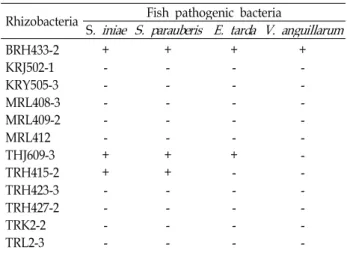
Table 1. Inhibitory effect of rhizobacteria against fish bacterial pathogens
Rhizobacteria Fish pathogenic bacteria
S
. iniae S. parauberis E. tarda V. anguillarum
BRH433-2KRJ502-1 KRY505-3 MRL408-3 MRL409-2 MRL412 THJ609-3 TRH415-2 TRH423-3 TRH427-2 TRK2-2 TRL2-3
+ - -- -- ++ - -- -
+ - -- -- ++ - -- -
+ - -- -- +- - -- -
+ - -- -- -- - -- - +, inhibited; -, non-inhibited
Table 2. Antibacterial activity of BRH433-2, THJ609-3, TRH415-2 against fish bacterial pathogens
Pathogen
Antibacterial activity
BRH433-2 TRH609-3 THJ415-2 crude pellet crude pellet crude pellet
S. iniae
S. parauberis E. tarda V. anguillarum
++
+++ +
+++
++++++
++
+++
++ -
+++
+++ -
+ +- -
++
++- - +, 10-15mm; ++, 15-20mm; +++, over 21mm; -, non-inhibited
하여 항균효과가 확인된 12개의 균주를 항균활성 실험에 사용
하였다 [8, 9, 10, 11, 13, 22].
식물근권세균의 항균활성 탐색
어류질병세균에 대한 항균효과를 확인하기 위해 식물근권 세균을 TSA에 접종하여 25℃에서 48시간 동안 배양하였다.
한국생물자원센터 (Korean Collection for Type Culture, KCTC) 로 부터 분양 받은 그람 양성균 Streptococcus iniae (KCTC 3757), S. parauberis (KCTC 3651)와 그람 음성균 Edwardsiella tarda (KCTC 12267)는 1.5%의 NaCl이 첨가된 Brain Heart Infusion (BHIB, Difco, USA)에, 그람 음성균 Vibrio anguilla- rum (KCTC 2711)은 Marine Broth (MB, Difco, USA)에 접종하 여 25℃에서 24시간 동안 배양하였다. 병원균 배양액은 660 nm에서 Optical Density (O.D) 값이 0.4가 되도록 희석하여 멸균된 면봉으로 Muller Hinton Agar (MHA, Difco, USA)에 고르게 도말하였다 . 각각의 병원균이 도말된 MHA에 식물근 권세균이 배양된 TSA를 절취하여(직경 8 mm) 접종하고, 25℃
에서 48시간 배양하여 1차적으로 생육저해환(clear zone, mm) 의 생성여부를 확인하였다 .
식물근권세균 12균주 중 억제환이 생성된 균을 선발하여 Tryptic Soy Broth (TSB, Difco, USA)에 48시간 동안 배양한 후 14,000x g 에서 15분간 원심하여 상층액과 균체를 분리하였 다 . 분리한 상층액은 0.45 μm syringe filter (Whatman, UK)를 이용하여 여과하였고 , 모아진 균체는 0.85% 생리식염수 1 ml 에 현탁 시켰다 . 원심분리를 하지 않은 배양액과 상층액, 균체 현탁액을 각각 멸균한 8 mm paper disc (ADVANTEC, Japan) 에 50 μl씩 분주, 건조시켜 병원균 4종의 O.D값(660 nm)이 0.4가 되도록 희석하여 각각 도말된 MHA에 부착한 후, 25℃
에서 48시간 배양하였고 생성된 생육저해환의 크기를 측정하 여 항균활성을 확인하였다 .
16S rDNA 염기서열의 계통학적 분석
생육저해환이 생성된 균주는 Chelex bead를 이용한 boiling 방법으로 genomic DNA를 추출하였다. 추출한 genomic DNA 는 27F/1492R universal primer를 이용하여 Initial denatura- tion (95℃, 2분) 후, Denaturation (95℃, 30초), Annealing (5 5℃, 30초), Extension (72℃, 30초)으로 총 30 cycle을 반복하여 PCR을 수행하였다. 최종 cycle에서 Last Extension (72℃, 5분) 까지 수행하여 16S rDNA 유전자를 증폭하고 염기서열을 분 석하였다 (Solgent co., Ltd., Korea). 분석한 염기서열은 National Center for Biotechnology Information (NCBI)의 Blast와 EzTaxon-e (http://eztaxon-e.ezbiocloud.net/)를 이 용하여 Genbank에 보고된 균주와의 상동성을 조사하고 ClustalX로 multiple alignment를 수행하고, MEGA6.0으로 계 통도 (phylogenetic tree)를 작성하였다.
결과 및 고찰
식물근권세균의 항균활성 탐색
어류질병세균에 대하여 고체 배지에 배양된 식물근권세균 의 균체를 이용한 항균활성 탐색결과는 다음과 같다 (Table 1).
실험에 사용한 식물근권세균 12종 중, 어류질병세균에 대해 항균활성 효과가 있는 세균은 BRH433-2와 THJ609-3, TRH415- 2로 나타났으며, 나머지 9종의 식물근권세균은 어류질병세균 에 대한 항균활성 효과가 관찰되지 않았다 .
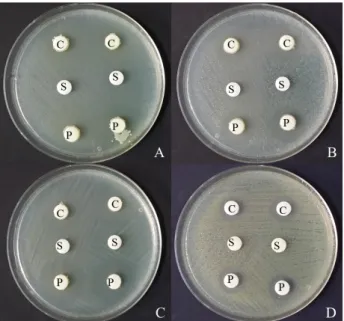
저해환이 생성된 BRH433-2, THJ609-3, TRH415-2를 배양액 과 상층액 , 균체 현탁액으로 나누어 항균활성을 측정한 결과 는 다음과 같다 (Table 2). 3종의 균주 모두 균체 현탁액에서 항균활성이 가장 높게 나타났다 . 특히 BRH433-2은 23 mm (S.
iniae), 21 mm (S. parauberis), 21 mm (E. tarda), 16 mm (V.
anguillarum) 로 세 균주 중 항균활성이 가장 높고, 그람 양성균
과 음성균 모두에서 활성이 관찰되었기 때문에 항균범위가
넓은 것으로 나타났다 (Fig. 1). THJ609-3은 S. iniae와 S. para-
uberis에 대하여 각각 24 mm, 17 mm, E. tarda에서 21 mm의
생육저해환을 나타내었으며 V. anguillarum에 대해서는 항균
활성이 관찰되지 않았다 (Fig. 2). 반면 THJ609-3은 그람 양성균
Fig. 1. Antibacterial activity of BRH433-2 against
S. iniae
(A),S. parauberis
(B),E. tarda
(C),V. anguillarum
(D). It was performed by experiments repeated twice. C, no treated cultural broth; S, supernatant; P, bacterial pellet.Fig. 2. Antibacterial activity of THJ609-3 against
S. iniae
(A),S.
parauberis
(B). It was performed by experiments repeated twice. C, no treated cultural broth; S, supernatant; P, bac- terial pellet.Fig. 3. Antibacterial activity of TRH415-2 against
S. iniae
(A),S. parauberis
(B). It was performed by experiments re- peated twice. C, no treated cultural broth; S, super- natant; P, bacterial pellet.인 S. iniae, S. parauberis에 대해 각각 18 mm, 15 mm로 나타났 지만 , 그람 음성균 2종에 대해서는 생육저해환이 관찰되지 않 았다 (Fig. 3). 세 균주 모두 상층액에서는 억제환이 생성되지 않았다 .
식물의 뿌리에 존재하는 근권세균은 유기물분해활성이 뛰 어나며 세포벽 분해효소와 같은 항균활성을 갖는 물질을 생산 하는 등 식물보호뿐만 아니라 식물의 생장촉진에도 이용된다 고 알려져 있다 [5, 6]. 그러나 이러한 유익한 효과를 나타내는 식물근권세균의 이용 가능성에 대한 연구는 농업 분야 외에는 아직 미비하며 , 항균활성을 나타내는 근권세균이 생산하는 물 질에 대한 분석 또한 많이 이루어지지 않고 있다 . Bacteriocin 은 천연 antimicrobial polypeptide로, 기존의 미생물 유래 항 균물질이 대부분 2차 대사산물인 것에 반해 유전자로부터 직 접 생합성되는 것이 특징이다 [2]. 또한 단백질이기 때문에 소
화기관의 단백질 가수분해 효소에 의해 쉽게 분해되어 생체에 무독성이고 잔류성이 적어 천연 항생제 및 보존제로서 그 이 용 가능성이 크다 [20]. 본 연구에서 어류질병세균에 대해 항균 활성 효과를 나타낸 3종의 균주 모두 상층액에서는 항균효과 가 관찰되지 않았다 . 그러나 균체에서는 항균활성이 나타나는 것으로 보아 , 본 실험균주는 항균성 2차 대사산물을 생산하지 않으며 , bacteriocin을 생합성 하는 것으로 추측된다. 따라서 이에 대한 추가 연구가 진행되어야 할 것으로 여겨진다 .
본 연구에 사용된 실험균주 BRH433-2는 난과 식물에서 질 병을 유발하지만 , 마늘, 감귤, 토마토 등 작물의 진균성 질병의 억제 및 균사체의 성장 억제 효과가 있으며 , TRH415-2와 THJ609-3은 감귤에서 궤양병을 유발하는 그람 음성균인 Xanthomonas citri subsp. citri에 대하여 항균 효과가 보고되었 다 [22]. 또 세 균주 모두 식물의 성장촉진 효과가 있다고 보고 된 바 있다 [8, 10]. 따라서 어류에 대한 충분한 안정성 실험을 거친 후 , 양식 산업에 적용할 경우 질병의 제어뿐만 아니라 양식어류의 성장에 대해서도 유익한 효과를 기대할 수 있을 것이다 .
16S rDNA 염기서열의 계통학적 분석
BRH433-2, THJ609-3, TRH415-2의 계통학적 분석 결과는 각각 표준 균주와의 염기서열 분석 비교를 통해 이루어졌다 . BRH433-2의 염기서열 분석결과는 Burkholderia gladioli와 99.5%, B. plantarii 98.9%, B. ubonensis 98.5%, B. pyrrocinia 98.3%, B. glumae 98%로 나타났으며, 이에 대한 계통수를 작성 하였다 (Fig. 4). THJ609-3은 Pseudomonas baetica와 97.7%, P.
moorei와 P. plecoglossicida에 대해서는 각각 97.6%, 97.5%의 상 동성을 나타내었다 . TRH415-2는 P. koreensis, P. baetica와 98.4%, P. moraviensis 98.3%의 염기서열 유사도를 나타내었다.
따라서 THJ609-3과 TRH415-2는 신속 또는 신종으로 보고될
가능성이 있다고 여겨지며 , 그에 관해 표준 균주들과 비교하여
추가적인 신종 실험의 진행이 수행되어야 할 것으로 사료된다 .
Fig. 4. Neighbor-joining tree based on 16S rDNA sequences, showing relationships between BRH433-2 and member of the
Burkholderia
sp.. Number of the nodes are levels of bootstrap support (%), based on neighbor-joining analyses of 1,000 resampled database.감사의 말
본 연구는 교육부와 한국연구재단의 지역혁신인력양성사 업으로 이루어졌으며 , 이에 대해 깊은 감사를 드립니다. (NRF- 2013H1B8A2032163)
References
1. Beuchat, L. R. and Colden, D. A. 1989. Antimicrobials occur- ring naturally in foods.
Food Technol
43, 134-142.2. Cleverland, J., Montville, T. J., Nes, I. F. and Chikindas, M.
L. 2001. Bacteriocin: sage, natural antimicrobials for food preservation.
Int J Food Microbiol
71, 1-20.3. Eldar, A., Shapiro, O., Bejerano, Y. and Bercovier, H. 1995.
Vaccination with whole-cell vaccine and bacterial protein extract protects tilapia against
Streptococcus difficile
meningoencephalitis.Vaccine
13, 867-870.4. Hughey, V. L. and Hohnson, E. A. 1987. Antimicrobial activ- ity of lysozyme against bacteria involved in food spoilage and food-borne disease.
Appl Environ Microbiol
53, 2165- 2170.5. Jang, D. S., Kim, Y. M., Lee, M. S., Shin, I. S. and Lee, H.
J. 2010.
Fisheries food hygienics
, pp. 289, Pukyong National University, Busan, Korea.6. Jeun, Y. C., Park, K. S. and Kim, C. H. 2001. Different mecha- nisms of induced systemic resistance (ISR) and systemic ac- quired resistance (SAR) against
Colletotrichum orbiculare
on the leaves of cucumber plants.Mycobiology
29, 19-26.7. Jung, H. K., Kim, J. R., Woo, S. M. and Kim, S. D. 2007.
Selection of the auxin, siderophore, and cellulase-producing PGPR,
Bacillus licheniformis
K11 and its plant growth pro- moting mechanisms.J Korean Soc Appl Biol Chem
50, 23-28.8. Kang, S. Y. and Jeun, Y. C. 2012. Suppression Effect of white rot by Rhizobacteria in Garlic.
J Asian Agric Biotechnol
28, 25-32.9. Kang, S. Y., Kang, Y. K., Song, C. K. and Jeun, Y. C. 2010.
Suppressive effect of
Bacillus cereus
TRL2-3 against Lateblight caused by
Phytophthora citrophthora
in Citrus Fruits.J Asian Agric Biotechnol
26, 35-41.10. Kang, S. Y. and Jeun, Y. C. 2010. Suppressive effect of bacte- rial isolates from plant rhizosphere against late blight caused by
Phytophthora citrophthora
in citrus fruits.Res Plant Dis
16, 35-40.11. Kang, S. Y., Kim, C. W. and Jeun, Y. C. 2013. Disease sup- pression on late blight in potato tissue culture by
Burkholderia gladioli
TRK2-2 or DL-3-amino butyric acid.J Asian Agric Biotechnol
29, 1-7.12. Karunasagar, I., Pai, R., Malathi, G. R. and Karunasagar, I. 1994. Mass mortality of
Penaeus monodon
larvae due to antibiotic resistantVibrio harveyi
infection.Aquaculture
128, 203-209.13. Ko, Y. J., Kang, S. Y. and Jeun, Y. C. 2012. Supperession of citrus melanose on the leaves treated with rhizobacterial strains after inoculation with
Diaporthe citri. Res Plant Dis
18, 331-337.14. Lee, C. S., Kim, K. D., Hyun, J. W. and Jeun, Y. C. 2003.
Isolation of Rhizobacteria in Jeju Island showing anti-fungal effect against various plant pathogens.
Mycobiology
31, 251-254.15. Mok, J. S., Miyamoto, T. and Kataoka, K. 1998. Properties of antibacterial substance produced by wild
Lactobacillus
strain IMC-1 from Inner Mongolian cheese.Animal Sci Technol
(Japanese) 69, 768-778.16. Mok, J. S., Miyamoto, T., Kataoka, K., Araki, M., Yoneya, T. and Sewaki, T. 1999. Antibacterial action of an anti- microbial substance from
Lactobacillus amylovorus
IMC-1 against foodborne spoilage and pathogenic organisms.Milk Sci
48, 79-85.17. Mok, J. S., Sing, K. C., Choi, N. J. and Yang, H. S. 2001.
Antibacterial effect of cinnamon (
Cinnamomum cassia
) Bark extract against fish pathogenic bacteria.J Korean Fish Soc
34, 545-549.18. Oh, S. P., Kim, D. H., Lee, J. J. and Lee, C. H. 1998. Bacterial diseases in flounder farms of Cheju Island.
Korean J Fish Pathol
11, 23-27.19. Shelef, L. A., Naglicm, O. A. and Bogen, D. W. 1980.
초록:식물근권에서 분리한 세균의 어류질병세균에 대한 항균활성 효과 정지운
1․박소현
1․김동휘
1․전용철
2․허문수
1*
(
1제주대학교 해양의생명과학부 수산생명의학전공 ,
2제주대학교 생물산업학부 식물자원환경전공 ) 천연 항균물질의 연구는 대부분 식품소재 , 특히 약용식물을 대상으로 하여 많은 연구가 진행되어 왔다. 그러나 식품소재의 경우 대량의 추출물 등을 제조하기 위해 많은 양의 재료가 필요하며 , 이로 인한 비용 문제가 발생하게 된다 . 미생물은 적절한 환경 하에서 대량 배양이 용이하기 때문에 천연항생제로 이용하기 위해 지속적인 연구가 이루어지고 있다 . 본 연구에서는 식물병 억제에 효과가 있는 식물근권미생물을 이용하여 어류질병세균 4종을 대 상으로 항균활성을 확인하였다 . 이 중 항균활성을 나타낸 균 3종을 선발하여 배양액, 상층액, 균체 현탁액으로 나누어 어느 부위에서 항균효과를 나타내는지 탐색하고 , 16S rDNA 염기서열 분석을 통해 균을 동정하였다. 12종 의 식물근권세균 중 BRH433-2, THJ609-3, TRH415-2 3종에서 항균활성이 나타나는 것을 확인하였다. 세 균주의 배양액 , 상층액, 균체 현탁액 중에서는 균체 현탁액이 가장 강한 항균활성을 나타내는 것을 알 수 있었다. 세 균주 의 16S rDNA 염기서열 분석 결과, BRH433-2는 Burkholderia gladioli와 99.5%, B. plantarii 98.9%, B. ubonensis 98.5%, B. pyrrocinia 98.3%, B. glumae 98%로 나타났다. THJ609-3은 Pseudomonas baetica와 97.7%, P. moorei와 P.
plecoglossicida에 대해서는 각각 97.6%, 97.5%의 상동성이, TRH415-2는 P. koreensis, P. baetica와 98.4%, P. mor- aviensis 98.3%의 염기서열 유사도를 나타났다. 따라서 3종의 식물근권세균은 충분한 안정성 및 안전성 실험을 실 행한 후 , 양식산업에 적용하여 항생제 대체 물질로서의 이용가치가 있다고 생각된다.
Sensitivity of some common food-borne bacteria to the spices sage, rosemary and allspice.
J Food Sci
45, 1042-1044.20. Tagg, J. R., Dajani, A. S. and Wannamaker, L. W. 1976.
Bacteriocins of gram-positive bacteria.
Bacteriol Rev
40, 722-756.21. Witte, W., Klare, I. and Werner, G. 1999. Selective pressure by antibiotics as feed additives.
Infection
27, 35-38.22. Yang, J. S., Kang, S. Y. and Jeun, Y. C. 2014. Suppression of Citrus Canker by Pretreatment with Rhizobacterial strains showing antifungal activity.