논문 2012-49-12-19
마이와이 표준의 열 센서망의 3차원 실시간 자료 시각화를 위한 가상 현실 모델링 언어 데이터베이스 액세스
( VRML Database Access for 3D Real-time Data Visualization in MiWi TM Thermal Wireless Sensor Network )
만 설 분*, 양 의**, 최 검***, 정 도****, 마 려*****
( Xue-fen Wan, Yi Yang, Jian Cui, Tao Zheng, and Li Ma )
요 약
본 논문에서는 중국 현지 염색 기업의 열 센서망에 적용 가능한 원격 가상 현실 제어 플랫폼에서 실행할 수 있는 데이터베 이스 액세스를 가상 현실 모델링 언어 (VRML)를 소개하였다. 또한, 3차원 실시간 자료 시각화를 위한 가상 현실 모델링 언어 -액티브엑스 서버 페이지(VRML-ASP)를 소개하였다. 나아가 이와 관련된 스크립트도 다루었을 뿐만 아니라, 열 센서 노드와 센서 영역에서의 움직임을 분석하였다. 이 데이터베이스 프레임워크는 마이크로칩에서 발표한 마이와이TM(MiWiTM)의 표준에 최적화되었다. 이러한 분석 결과를 근거로, 시스템 구성에 따라 가상 현실 모델링 언어-액티브엑스 서버 페이지(VRML-ASP) 데이터 액세스 프레임워크가 가상 현실 원격 산업 공정 제어 시스템을 위한 하나의 경쟁력 있는 데이터 관리 해결책이 될 수 있음을 확인할 수 있었다.
Abstract
A Virtual Reality Modeling Language (VRML) database access in remote virtual reality control platform for dyeing enterprise MiWiTM thermal sensor network is presented in this paper. The VRML-ASP framework is introduced for 3D real-time data plotting in this application. The activities of thermal sensor nodes and sensor area are analyzed. The database access framework is optimized for MiWiTM wireless sensor networks. The experimental results show that VRML-ASP database access framework could be a reliable and competitive data-manage candidate for targeted virtual reality remote industrial visualization application.
Keywords: ASP; VRML; database access; MiWiTM wireless sensor network; virtual reality;
industrial process control
* 화북과학기술원 컴퓨터과학기술학부. 연교, 중국
(Department of Computer Science and Technology, North China Institute of Science and Technlogy, Sanhe, P.
R. China)
** 동화대학 정보과학기술대학, 상해, 중국
(College of Information Science & Technology, Donghua University, Shanghai, P. R. China)
*** 북경항공항천대학 공사훈련센터, 북경, 중국
(Engineering Training Center, Beihang University, Beijing, P. R. China)
**** 연산대학 경제관리대학, 진황도, 중국
(School of Economics and Management, Yanshan University, Qinhuangdao, P. R. China)
※ This work is supported by National Natural Science Foundation of China (61077068) and STCSM (08DZ2231100).
※ The green dyeing decision support system (GDDSS which the MiWiTM thermal sensor network is designed for) is developed by teams from Donghua University and Yanshan University under the Fundamental Research Funds for the Central Universities: 12D10417 and 2010 Social Science Development Research Project of Hebei Province (201005022).
접수일자: 2012년8월17일, 수정완료일: 2012년11월26일
Ⅰ. Introduction
With the increasing attention to global market extension and eco-systems management, the dyeing industry face more challenge than before[1∼3]. In Chinese dyeing industry, the corporations have variety of equipment, the domestic and international markets have instability, and their financial and technology supports are inadequate. Most of them are small enterprise with common and obsolete equipments. But their manufacturing process should be flexible and alterable according to the changing of domestic and international market. The energy consumption in dyeing process should be reduced too.
The thermal monitoring plays a main role in dyeing industry processes[4]. Fluctuation in temperature between several degrees would cause fatal results in dyeing production. Evaluation on the thermal data could be used for green-process development. Besides, thermal controlling is helpful for energy consumption reduction. The temperature distribution in plant of dyeing enterprise could be collected though wireless sensor networks (WSN) for thermal control[5]. The MiWiTM protocol is a wireless network protocol specifically designed for Wireless Personal Area Network (WPAN), and it could be used in low data rate sensors and control networks too. Compared to ZigBee, MiWiTM adopt simpler protocols. On the PIC platform, the MiWi protocol stacks are small foot-print alternatives (3K-17K) to ZigBee (40K-100K), which makes them useful for cost-sensitive applications with limited memory. Its wireless framework is very useful in process monitoring for the small and medium plant which have old no-digital equipment. (The thermal data collected by MiWiTM sensor network show discrete temperature distribution in plant. And some nodes gather more data than other node. Thermal distribution of plant would be plot in 3D form for visual display and graphical user interfaces is introduced for easy remote controlling.)
The Virtual Reality Modeling Language (VRML) is an open language with the 3D virtual modeling and interact operation in network environment [6∼8]. VVRML provides long-haul 3D data transmission and controlling instruction in low-band network. It could be integrated with other data system with graphical user interface and object model. The control platforms based on VRML have been used in many remote industrial controlling systems[9]. In dyeing thermal controlling platform, VRML provide 3D visualization about temperature distribution in plant and controlling options for operators. To improve thermal real-time visualization for MiWiTM thermal WSN, database VRML supporting is introduced. In this paper, VRML database access for MiWiTM thermal WSN is present.
Ⅱ. MiWi
TMThermal Sensor Network Implementation
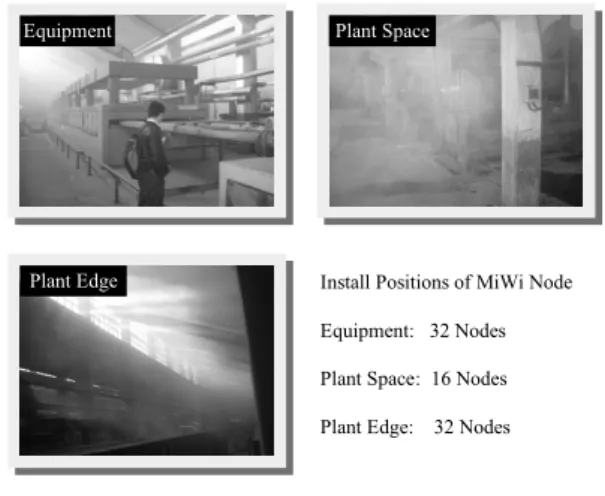
Our design is developed for dyeing enterprise from Guanyinmiao Textile Industry Park, Nantong. This enterprise is founded in 1970s, and most of its equipments are obsolete. A MiWiTM thermal sensor network is introduced for thermal monitoring and energy consumption evaluation. Three positions are mainly concerned in dyeing plant: equipment, plant space and plant edge. As shown in Figure 1, the dyeing equipment, plant space and plant edge get 32, 16, 32 MiWiTM nodes each. This design adopts cluster tree topology. Routers are included and they all connected to a coordinator. This coordinator collects the thermal data and sent to the remote control platform though the wireless communication. The number and ID of the MiWiTM nodes are fixed in our project. We choose MiWiTM design for compatibility and easy-design in MiWiTM protocol stacks. So the cost of this design and R/D cycle can achieve balance.
Three groups of MiWiTM nodes are installed in this dyeing plant with cluster tree topology. The MiWiTM
Install Positions of MiWi Node Equipment: 32 Nodes Plant Space: 16 Nodes Plant Edge: 32 Nodes
Equipment Plant Space
Plant Edge
그림 1. TWSN project의 마이와이 노드 설치 위치 Fig. 1. Install position of MiWi nodes of our TWSN
project.
User
VRML with GUI
MiWi Thermal Sensor Network Database
Algorithms Library
Computer Interface
Control Instruction Manager
그림 2. 마이와이 TWSN project의 원격 제어 플랫폼 구 성
Fig. 2. Configuration of Remote Control Platform in MiWi TWSN project.
node is design with MicrochipiTM's PIC18 MCU and MRF24J40. The initial temperature distribution is collected at network initialization or reset. Once the temperature changes above threshold, the MiWiTM nodes sent the temperature sampling result of its positions to remote controlling platform. The collected data through nodes of thermal sensor network is written to the database. A database is employed for thermal distribution data storage. The thermal distribution of plant would be created and update in real time. Interpolation is chosen to deal with the discrete thermal data. It supports the green dyeing enterprise Decision Support System (GDDSS) which
is presented early too[1∼2]. The power supply of MiWiTM network come form the plant power supply, so that it sensor and communication capacity are not be limited by power factors. All nodes are Full Function Device (FFD). Therefore the MiWiTM power monitoring and node function control is not included in remote control platform. There isn't air condition automatic interface in dyeing plant; the control instruction and thermal distribution plot are sent from the remote control platform to the plant chief operator's computer directly. The energy consumption evaluation and dyeing process monitoring are based on this database.
Ⅲ. VRML Database Access
To MiWiTM, its topology is suitable for VRML 3D visualization. Each MiWiTM node can be used as VRML backbone frame point. More MiWiTM nodes make VRML texture features finer. The working behavior of sensor can be introduced for VRML dynamic visualizing (extremely for VRML 2.0). As other industrial wireless sensor network, MiWiTM suffer from unstable data acquisition and transmission. The mesh topologies of MiWi industrial wireless network have automatic updates in fixed period. Because of mechanical damage, high temperature and high humidity in dyeing works, the configuration of MiWi network is dynamic in long term. Utilizations of database improve the efficiency of VRML. The sensor data and working characters of sensor themselves are cached in database for VRML visualizing. Some sections is Move to Part II after being revised)
The database-VRML framework offer real-time dynamic generation under user's demand with the diverse data format access. But VRML has limited data exchanging ability for its unusual data format and inextensibility in some nodes. Besides, it is difficult in data node define for VRML frameworks.
Fortunately, its Script nodes have independent URL
domain and hybrid programming is allowed with other language. Microsoft's ASP (ActiveX Server Page) is object orient web data server theology. ASP affords interaction between database and applications.
In ASP based VRML platform, VRML module, ASP module and database are insulated in Web server.
Each of them could be configured, executed and managed independently for flexibility and extendibility. The ASP supporting module is imbedded in server and only the necessary data and result are transferred by it. This framework minimizes the transferring spending in server and user. By Brower/Server mechanism, it lends efficiency and effectiveness in data response.
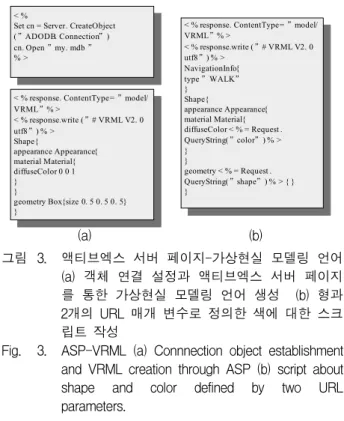
The relationship between ASP and database should be founded at first. ASP provides ADO (ActiveX Data Objects) database access module for Open Database Connectivity (ODBC) or Object Linking and Embedding (OLE). The connection object of it could be used for establishing and managing the connection between ODBC database and application. Connection object is not only employed with property and method to open and close data connection, but also sent the query statement for database update. To establish database connection, the instance of connection object should be founded. The script about connection object foundation and database opening for Microsoft Access is shown in Figure 3 (a). By this statement, connection objections with name “cn” and its connection to Access database with name
“my.mdb” are founded. Followed by “Execute”
command (Set rs = cn.Execute (“SQL” statement)) to execute the SQL statement. The “rs” is Recordset.
The operation about read, add, delete, and modify are realized by this method.
The default extended name of VRML is “.wrl”. But it can' be identified directly by browser. The VRML is identified by Web Server extended MINE type. To apply ASP create VRML, an extended MINE type (model/VRML) is created at head of page files. At head of ASP file, a statement (< % response.
< %
Set cn = Server. CreateObject (”ADODB. Connection”) cn. Open ”my. mdb ”
% >
< % response. ContentType = ”model/
VRML”% >
< % response.write (”# VRML V2. 0 utf8”) % >
Shape{
appearance Appearance{
material Material{
diffuseColor 0 0 1 }
}
geometry Box{size 0. 5 0. 5 0. 5}
}
< % response. ContentType = ”model/
VRML”% >
< % response.write (”# VRML V2. 0 utf8”) % >
NavigationInfo{
type ”WALK”
} Shape{
appearance Appearance{
material Material{
diffuseColor < % = Request . QueryString(”color”) % >
} }
geometry < % = Request . QueryString(”shape”) % > { } }
(a) (b)
그림 3. 액티브엑스 서버 페이지-가상현실 모델링 언어 (a) 객체 연결 설정과 액티브엑스 서버 페이지 를 통한 가상현실 모델링 언어 생성 (b) 형과 2개의 URL 매개 변수로 정의한 색에 대한 스크 립트 작성
Fig. 3. ASP-VRML (a) Connnection object establishment and VRML creation through ASP (b) script about shape and color defined by two URL parameters.
ContentType = “model/ VRML”% >) should be employed as head information. Besides, the VRML head statement (< % response. write (“# VRML V2.
0 utf8”) % >) should be adopted for program initialization. An example about ASP-VRML is shown in Figure 3 (as below). This script provides basic temperature distribution in dyeing plant (blue cube). The thermal sensor results which are use in VRML plotting also could be gathered thought ASP.
By URL, database access or Cookie, the sensor result could be achieved by VRML control framework. The color and shape in plant are related to the thermal distribution. For example, the script about shape and color defined by two URL parameters is shown in Figure 4.
VRML has weak database control capacity; so that some interface module should be involved. This interface module record collected results and user input in memory for VRML. It also offers real-time database update. The thermal data in database is supervised by this data manage module. Short-time/
long-time results are classified and standard monitoring result is generated. Plot module read
< % dim cook
set cook = Server. CreateObject (”ADODB. Connection”) cook. Open”power”
Set rs = Server. CreateObject (”ADODB. Recordset”)
sql = ”select 3 from list where id = 1
”
rs = cook. Execute (sql)
% >
< % response. ContentType = ”model/
VRML”% >
< % response.write (”# VRML V2. 0 utf8”) % >
⋯ Shape {
appearance Appearance {
material Material { diffuseColor 0. 1 0.
8 0}
}
geometry Text { # text of 温度 string ”< % = rs (”温度”) % > ” fontStyle FontStyle {
style ”BOLD”
size 0. 12 } } }
그림 4. 액티브엑스 서버 페이지를 통한 가상 현실 모 델링 언어 데이터베이스 액세스 스크립트 작성 Fig. 4. VRML database access script through ASP.
database and call interpolation module to create mesh structure for VRML plotting. This 3D plotting cost computational complexity and computational time.
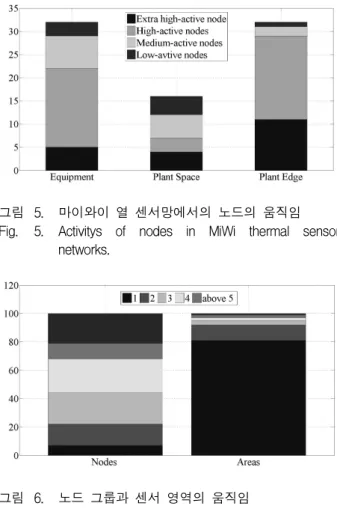
Extremely for VRML-ASP framework which has inadequate database access capacity. It isn't strange that temperature in some area change more frequently than other area. For example, the temperatures at the vents and cloth export change in every minute. But some node is inactive for more than one hour. As shown in Figure 5, few nodes have extra-high activities (updating time < 1 mins).
In database access, this behavior could reduce amount of writing data. The distributions of thermal node activities affect the interpolation.
It should be note that the ASP isn't the only way to create VRML remote control platform. Developed with JSP (Java Server Pages), VRML would achieve 3D dynamic effect[7]. The PHP or JavaScript also could be employed. And EAI (External Authoring Interface) get more flexibility by limiting modeling modification in browse process. Because EAI
그림 5. 마이와이 열 센서망에서의 노드의 움직임 Fig. 5. Activitys of nodes in MiWi thermal sensor
networks.
그림 6. 노드 그룹과 센서 영역의 움직임 Fig. 6. Node groups and sensor area activities.
(External Authoring Interface) limited modeling modification in browse process, but PHP and ASP get scene modification in load process. Usually, there aren't Java frameworks but ASP framework integrated in traditional dyeing equipments in China, so the VRML monitoring visualization based on ASP database access is suitable for analogous equipment updating. Besides, ASP provides database access interface for VRML too.
Ⅳ. 결 론
In this paper, VRML database access and its related design in remote control platform for dyeing industry MiWiTM wireless thermal sensor networks are presented. A VRML-ASP framework is adopted for basic system database architecture. This scripts about key operation in database manage module are
given. The particular network structure and thermal data acquisition pattern make this design efficient.
VRML plotting module create 3D thermal scene from database with interpolator and LOD. The temperature particularity in this thermal sensor network reduces the complexity of database access design. The experimental results show the VRML-ASP database access framework is high efficient. And VRML-ASP design show good compatibility with old dyeing system. If some data processing is employed in nodes, the VRML visualization can be more efficient.
MiWiTM network protocol stacks are small foot-print alternatives (3K-17K). So the are more memory for this processing in MiWi nodes. To conclude, VRML-ASP database access framework could be a competitive candidate for virtual reality remote thermal MiWi IPC controlling.
References
[1] Y. Yang, X-F. Wan, T. Zheng, “A decision support system for green dyeing performance evaluation,” Proc. IEEE International Conference on Software Engineering and Service Sciences, IEEE Press, July, 2010, pp. 191-194.
[2] Y. Yang, T. Zheng, X. Lin, F-P. Wan,
“Chemical oxygen demand production coefficient forecasting in dyeing enterprise: An application of the ranking interval number method,” 2nd Conference on Environmental Science and Information Application Technology, IEEE Press, July, 2010, pp. 167-170.
[3] R. M. Christie, Environmental Aspects of Textile Dyeing, CRC Press, 2007.
[4] K. Hunger, Industrial Dyes: Chemistry, Properties, Applications, Wiley-VCH, 2003.
[5] I. F. Akyildiz, W. Su, Y. Sankarasubramaniam, E. Cayirci, “Wireless sensor networks: a survey,” Computer Networks, vol. 38, Mar. 2002, pp. 393-422.
[6] E-M. Lima, T. Honjo, K. Umekia, “The validity of VRML images as a stimulus for landscape assessment,” Landscape and Urban Planning, vol.
77, Jan. 2006, pp. 80-93.
[7] D. Koroec, A. Holobar, M. Divjak, D. Zazula,
“Building interactive virtual environments for
simulated training in medicine using VRML and Java/JavaScript,” Computer Methods and Programs in Biomedicine, vol. 80, Suppl. I, Dec.
2005, pp. S61-S70.
[8] P. Murano, D. Mackey, “Usefulness of VRML building models in a direction finding context,”
Interacting with Computers, vol. 19, Jan. 2007, pp. 305-313.
[9] B. Bascle, K. Hampel, N. Navab, B. Baxter, X.
Zhang, “An industrial 3D graphical interface for process control,” Proc. 8th IEEE International Conference on Emerging Technologies and Factory Automation, IEEE Press, 2001, pp.
559-562.
저 자 소 개 Xue-fen Wan was born in
Lianyungang. She received the B.S.
and M.S. degrees in Computer Engineering from YanShan University, Qinhuangdao, in 2001 and 2004, respectively. She is working in North China Institute of Science and Technology, Sanhe, since 2004. Her research interests focus on Virtual Reality and Wireless Sensor Networks.
Yi Yang was born in Chengdu, 1978. He received the B.S. and M.S.
degrees in Electrical Engineering from YanShan University, Qinhuangdao, in 2000 and 2003, respectively. He received the Ph.D degree in electronics engineering from the Beijing University of Aeronautics and Astronautics, Beijing, in 2009. He has been with Donghua University, Shanghai, since May 2009. His research interests focus on Virtual Reality, Wireless Sensor Network, and decision support systems.
Jian Cui was born in Beijing in 1980. He received the B.S. in Electrical Engineering from Beijing University of Aeronautics and Astronautics, Beijing, in 2000. He achieved Ph. D. degree in same university. He has been with Engineering Training Center, Beijing University of Aeronautics and Astronautics, since 2010. His research interests focus on Industrial Wireless Network, High-speed Transmission Bus, and Optical Networks.
Tao Zheng was born in Qinhuangdao in 1978. She achieved Ph.D. degree from Beijing Institute of Technology. She is association professor in Yanshan University School of Economics and Management. Her research interests focus on Decision Support Systems.
Li Ma was born in Nov. 1976 in Tang Shan, China. She holds a PHD in management from Beijing University of Aeronautics and Astronautics of China. She is association professor in Yanshan University. She is mainly engaged in research in the area of Human Resource Management and Organization Behavior.