1. Introduction
Industrial robots which do various tasks are used in the manufacturing industry. Many industrial robots are
consisted of manipulators instead of human arms and hands. Recently, the recognized robots based on a motion, gesture, temperature and infrared sensor are researched from a function of the repeated working [1].
Unknown-Parameter Identification for Accurate Control of 2-Link Manipulator using Dual Extended Kalman Filter
Ji Hoon Seung
1, Jung Kil Park
2, Sung Goo Yoo
3*1Division of Electronic Engineering, Chonbuk National University
2Robodyne Systems. Co.
3Mechanical and fusion Systems Engineering, Kunsan National University
2링크 매니퓰레이터 제어를 위한 듀얼 확장 칼만 필터 기반의 미지 변수 추정 기법
승지훈1, 박정길2, 유성구3*
1전북대학교 전자공학과, 2로보다인시스템, 3군산대학교 기계융합시스템공학부
Abstract In this paper, we described the unknown parameter identification using Dual Extended Kalman Filter for precise control of 2-link manipulator. 2-link manipulator has highly non-linear characteristic with changed parameter thought tasks. The parameter kinds of mass and inertia of system is important to handle with the manipulator robustly. To solve the control problem by estimating the state and unknown parameters of the system through the proposed method. In order to verify the performance of proposed method, we simulate the implementation using Matlab and compare with results of RLS algorithm. At the results, proposed method has a better performance than those of RLS and verify the estimation performance in the parameter estimation.
Key Words : manipulator, dual extended kalman filter, nonlinear dynamic system, ordinary differential equation, Lagrangian.
요 약 본 논문은 듀얼 확장 칼만 필터를 기반으로 2링크 매니퓰레이터의 정밀한 제어를 위한 미지 변수 추정법을 제안한 다. 2링크 매니퓰레이터 시스템은 기구학 및 동역학 방정식에 비선형성을 가지며 내부 파라미터의 변화에 민감한 특성을 보인다. 이러한 시스템의 경우 내부 미지 파라미터의 추정이 매우 중요하다. 특히 거친 환경에서 작업을 수행함에 있어서 중량과 관성행렬의 변화는 시스템을 불안정하게 만드는 요소이다. 따라서 본 논문에서 제안한 방법을 기반으로 시스템의 상태 및 미지 변수를 동시에 추정하여 앞서 소개한 문제점들을 해결하고자 한다. 제안한 방법은 Mathwork에서 제공하는 Matlab 기반으로 시뮬레이션을 수행했고, 그 결과는 RLS 알고리즘과 비교하여 성능을 분석하였다. 제안된 방법은 상태 및 미지 변수 추정에 RLS 방법보다 뛰어난 추정 성능을 보임을 확인 하였다.
주제어 : 매니퓰레이터, 듀얼 확장 칼만 필터, 비선형 동역학 시스템, 상미분방정식, 라그랑지안
*This research was supported Business for Cooperative R&D between Industry, Academy, and Research Institute funded Korea Small and Medium Business Administration in 2017 (C0530843).
*Corresponding Author : Sung Goo Yoo ([email protected]) Received April 13, 2018
Accepted June 20, 2018
Revised May 4, 2018 Published June 28, 2018
Manipulator has to be precisely controlled for a manufacturing accuracy and a safety of workers.
However, in case of the manipulators taken the complex structures, deriving the mathematical model is very difficult. Inaccurate modelling for the control leads to the factor of decreasing the performance in system.
Therefore, design of robust control is required for increasing the performance in a situation of the uncertain system model [2,3].
Proportional Derivative (PD) and Proportional Integral Derivative (PID) controllers are used in most of industries of the traditional control methods[4-7]. PD and PID controller can apply the low processing system and get a satisfying performance. On the other hands, the performance of the system required to the fast response and processing is decreased in applying PD and PID controller[8-13]. In order to prohibit the decrease of control performance, many researchers studied control methods of multi value control, passive control and sliding mode control[14-17]. However, the parameter identification is also needed to apply kinds of its control methods. Specifically, we are not sure for accuracy of parameter identification when the system has a nonlinearity and disturbance from external input.
In this paper, we present the parameter identification method using Dual Extended Kalman Filter(DEKF) including a measurement noise for a precise control. In order to verify the performance of parameter estimation, we employ the 2-Link Manipulator to do a simulation. The results of parameter estimation show that the accuracy is more improvement than estimation results of Recursive Least Sqaure(RLS) method.
2. Two-Link Manipulator System
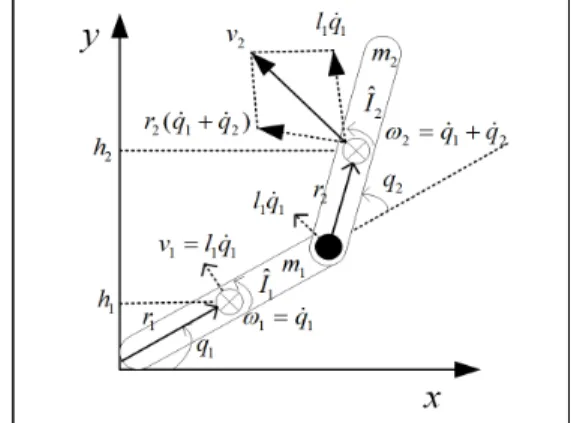
In this section, we present an introduction to the dynamics of two-link manipulator and derive the equations of motion. The mechanical system is described in Fig. 1. It is consisting of the coupled Links and the operating motors. In order to derive dynamic
model, we handle with a set of nonlinear, second-order, ordinary differential equations which depend on the kinematic and inertial properties of the system.
Lagrange’s equation is as follows:
for ⋯ (1)
where Lagrangian defines
, difference between the kinetic energy
and the potential energy of the system. is the external force acting on the generalized coordinate. ⋯ is position vector of manipulator, ⋯ is velocity vector.
Fig. 1. Two-link manipulator
In case of manipulator system, the kinetic energy is derived with quadratic from.
(2)
where is inertia matrix and generally inertia matrix has the characteristic of the symmetric and the positive definite.
The vector form of the equation (1) is as follows:
(3)
The Lagrangian L is substituted in equation (3):
(4)
The general manipulator dynamic equation using equation (2) and (4) can be derived as follows:
(5)
where in n-order gravity vector and defines
. is n-order Coriolis and centrifugal vector. is the disturbance vector.
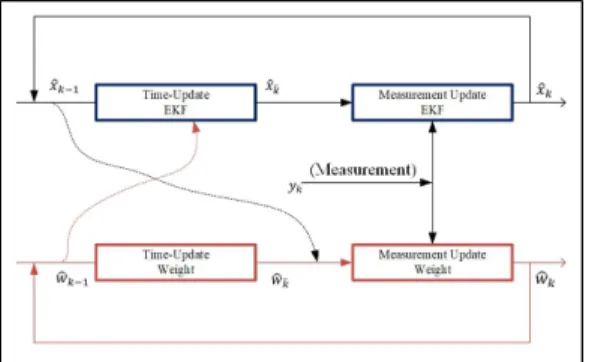
Fig. 2. Diagram of dual extended kalman filter
From Fig. 1, we can derive the velocity vector .
(6)
The kinetic energy of two-link manipulator system is as follows:
(7)
where cos, cos, cos ,
sin, sin, and sin.
The potential energy equation is as follows:
(8)
The Lagrangian equation can be calculated by using the equation (7) and (8).
(9)
The dynamic equation of system referred by equation (5) is as follows:
(10)
where are the i-th stop and kinetic friction force .
3. Estimation Algorithm
The Extended Kalman Filter(EKF) provided an efficient method for generating approximate maximum likelihood estimates of the state of a discrete-time nonlinear dynamical system[18,19]. The filter involves a recursive procedure to optimally combine noisy observations with predictions from the known dynamic model[8,9]. A second use of the EKF involves
estimating the parameters of a model in Fig. 2. In this paper, we consider the dual estimation problem, in which both the states of the dynamical system and its parameters are estimated simultaneously, given only noisy observations. To be more specific, we consider a discrete-time nonlinear dynamical system.
(11)
where the state states and the set of model parameters for the dynamical system mush be simultaneously estimated from only the observed noisy signal . and are the process and measurement noise.
The algorithm of dual extended kalman filter(DEKF) is consisting of extended kalman filter and weight filter in Table 1.
The dynamic equation for weight filter is defined.
(12)
where the parameter correspond to a stationary process with identity state transition matrix, driven by process noise . The output corresponds to a nonlinear observation on .
The algorithm of weight filter is given by Table 2.
4. Parameter Identification
In this section, we describe the parameter identification from the dynamic equation. the parameters can be divided with a dynamic regressor.
The parameters vector is as follows:
(13)
Linear dynamic equation based on the equation (13) is derived.
⇓
(14)
∴
Table 1. Extended state kalman filter Initialize with:
for ∈⋯∞, the time-update equations of the extended kalman filter are
and the measurement-update equations are
where
≈
≈
and where are covariance of , respectively.
Table 2. Extended weight kalman filter Initialize with:
for ∈⋯∞, the time-update equations of kalman filter are
and the measurement-update equations are
where
≈
In order to identify the parameters (13), the equation of state-space matrix form is considered. Here, the previous equation (5) is adopted to equation (10).
(15)
cos
cos
The equation (5) is transformed as follows:
(16)
where, .
The regressor of system based on the momentum is derived.
(17)
where,
.
The state variable is defined for applying to proposed method.
(18)
The state-space matrix form is as follows:
(19)
4. Simulation Results
In order to verify the performance of unknown estimation simulation using RLS and proposed method in Matlab(2016a) environments. We set all of the parameters of dynamical system as the unknown parameters. The initial parameters (initial value and error covariance) of state and weight estimator are set as follows:
⋯
⋮ ⋱ ⋮
… ×
(20)
Table 3. Analysis of parameter estimation results Unknown
Parameters
RLS algorithm (RMSE)
Proposed method (RMSE)
w[1] 0.0228 0.0222
w[2] 0.0025 0.0025
w[3] 0.0034 0.0033
w[4] 0.0184 0.0191
w[5] 0.0069 0.0053
w[6] 0.0034 0.0027
w[7] 0.0154 0.0081
w[8] 0.0290 0.0073
w[9] 0.0187 0.0170
w[10] 0.0176 0.0123
For the estimators, initial process noise covariances of each estimator are given as
×
(21)
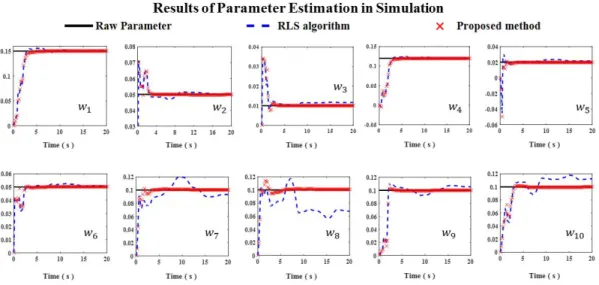
In Fig. 3, the black line means the raw parameter, the dot-blue line and the shape of x are estimation results of RLS algorithm and proposed method, respectively. Fig. 3 shows the performance of proposed method and RLS algorithm. Specifically, estimation results of parameter value w[7] and w[8] have a large estimation error in RLS results. On the other hands, the proposed method shows the constants performance of all parameter estimation. All estimated parameter is converged to raw parameter values. The computational results based on root mean square error are summarized and given in Table 3.
In Table 3, the proposed method can estimate unknown parameters well without the parameter w[4]
in view of performance based on the numerical result.
5. Conclusion
In this paper, we present the unknown parameter estimation using Dual Extended Kalman Filter for precise control. In order to estimate unknown parameter of dynamic system, we derive state equation
and state-space matrix form including the inertial characteristic of system. The results of parameter estimation in Fig. 3 shows that the proposed method have good performance to estimate unknown parameter despite the measurement noise. In particular, numerical analysis result also show the proposed method have better performance compared to RLS algorithm.
REFERENCES
[1] Y. H. Chen & S. Pandey, (1990). Uncertainty bounded-based hybrid control for robot manipulators, IEEE Transactions on Robotics and Automation, 6(3), 303-311.
DOI : 10.1109/ICAR.1991.240529.
[2] D. T. Lee, M. Morf & B. Friedkander. (1981). Recursive least - squares ladder estimation algorithm. IEEE Trans. Acoust Speech. Signal Processing, 29, 627-641.
[3] Bing X., Shen Y. & Okyay K., (2016). Tracking Control of Robotic Manipulators With Uncertain Kinematics and Dynamics. IEEE Transactions on Industrial Electronics, 63(10). 6439-6449.
DOI : 10.1109/TIE.2016.2569068
[4] Jafarov, E. M., Parlakci, M. A., & Istefanopulos, Y.
(2005). A new variable structure PID-controller design for robot manipulators. IEEE Transactions on Control Systems Technology, 13(1), 122-130.
Fig. 3. Results of parameter estimation performance
DOI : 10.1109/TCST.2004.838558
[5] Ayala, H. V. H., & dos Santos Coelho, L. (2012). Tuning of PID controller based on a multiobjective genetic algorithm applied to a robotic manipulator. Expert Systems with Applications, 39(10), 8968-8974.
DOI : 10.1016/j.eswa.2012.02.027
[6] Perez, J., & de la Fuente, M. S. L. (2017). Trajectory Tracking Error Using Fractional Order PID Control Law for Two‐Link Robot Manipulator via Fractional Adaptive Neural Networks. In Robotics-Legal, Ethical and Socioeconomic Impacts. InTech.
DOI : 10.5772/intechopen.70020
[7] Kumar, V., & Rana, K. P. S. (2017). Nonlinear adaptive fractional order fuzzy PID control of a 2-link planar rigid manipulator with payload. Journal of the Franklin Institute, 354(2), 993-1022.
DOI : 10.1016/j.jfranklin.2016.11.006
[8] S. Li, Y. Zhang, & L. Jin. (2017). "Kinematic Control of Redundant Manipulators Using Neural Networks,"
IEEE Transactions on Neural Networks and Learning Systems, 28(10), 2243-2254.
DOI : 10.1109/TNNLS.2016.2574363
[9] R. M. Robinson, C. S. Kothera, R. M. Sanner & N. M.
Wereley. (2016), "Nonlinear Control of Robotic Manipulators Driven by Pneumatic Artificial Muscles,"
IEEE/ASME Transactions on Mechatronics, 21(1), 55-68.
DOI : 10.1109/TMECH.2015.2483520
[10] T. G. Thuruthel, E. Falotico, M. Manti & C. Laschi.
(2018) "Stable Open Loop Control of Soft Robotic Manipulators," IEEE Robotics and Automation Letters, 3(2), 1292-1298.
DOI : 10.1109/LRA.2018.2797241
[11] W. He, H. Huang & S. S. Ge. (2018) "Adaptive Neural Network Control of a Robotic Manipulator With Time-Varying Output Constraints," IEEE Transactions on Cybernetics, 47(10), 3136-3147.
DOI : 10.1109/TCYB.2017.2711961
[12] M. Jin, S. H. Kang, P. H. Chang & J. Lee. (2017)
"Robust Control of Robot Manipulators Using Inclusive and Enhanced Time Delay Control," IEEE/ASME Transactions on Mechatronics, 22(5), 2141-2152.
DOI : 10.1109/TMECH.2017.2718108
[13] Y. Ouyang, W. He, & X. Li. (2016) "Reinforcement learning control of a single-link flexible robotic manipulator," IET Control Theory & Applications, 11(9),1426-1433.
DOI : 10.1049/iet-cta.2016.1540
[14] S. Y. Oh. (2015) “Decision Tree State Tying Modeling Using Parameter Estimation of Bayesian Method,”
Journal of Digital Convergence, 13(1), 243-248.
[15] K. J. Park. & D. Y. Lee. (2016) “Nonlinear Inference Using Fuzzy Cluster,” Journal of Digital Convergence, 14(1), 203-209.
[16] T. Yu. & Y. Zhai. (2014) “HW/SW Co-design of a Visual Driver Drowsiness Detection System,” Journal of Convergence for Information Technology, 14(1), 31-39.
[17] K. S. Ahn, J. H. Kim & B. H. Lee. (2017) “Action Realization of Modular Robot Using Memory and Playback of Motion,” Journal of Convergence for Information Technology, 7(6), 181-186.
[18] Aksoy, S., Mühürcü, A., & Kizmaz, H. (2010, September). State and parameter estimation in induction motor using the Extended Kalman Filtering algorithm.
In Modern Electric Power Systems (MEPS), 2010 Proceedings of the International Symposium. 1-5.
[19] S. Haykin, (2001). Kalman Filtering and Neural Networks.
DOI : 10.1002/0471221546
승 지 훈(Seung, Ji Hoon) [정회원]
▪2010년 2월 : 전북대학교 전자공 학과 (공학학사)
▪2013년 2월 : 전북대학교 전자공 학과 (공학석사)
▪2014년 3월 ~ 현재 : 전북대학교 전자공학과 박사과정
▪2011년 1월 ~ 2012년 1월 : Texas A&M 대학교 기계 공학과 방문연구원
▪관심분야 : 추정 알고리즘, 제어시스템, 항법 알고리즘
▪E-Mail : [email protected]
박 정 길(Park, Jung Kil) [정회원]
▪2014년 2월 : 전북대학교 전자공 학과 (공학학사)
▪2016년 2월 : 전북대학교 전자공 학과(공학석사)
▪2016년 9월 ~ 현재: 로보다인시 스템 대표
▪관심분야 : 로보틱스, 이동로봇제어, SLAM
▪E-Mail : [email protected]
유 성 구(Yoo, Sung Goo) [정회원]
▪2005년 2월 : 전북대하교 제어계 측공학과(공학석사)
▪2010년 8월 : 전북대학교 제어계 측공학과(공학박사)
▪2011년 2월 ~ 2018.02 : 서남대학 교 전기전자공학과 교수
▪2018년 3월 ~ 현재 : 군산대학교 기계융합시스템공학 부 연구원
▪관심분야 : 로보틱스, 인공지능, 제어시스템
▪E-Mail : [email protected]
![Table 3. Analysis of parameter estimation results Unknown Parameters RLS algorithm(RMSE) Proposed method(RMSE) w[1] 0.0228 0.0222 w[2] 0.0025 0.0025 w[3] 0.0034 0.0033 w[4] 0.0184 0.0191 w[5] 0.0069 0.0053 w[6] 0.0034 0.0027 w[7] 0.0154 0.0081 w[8] 0](https://thumb-ap.123doks.com/thumbv2/123dokinfo/5007316.548824/5.799.419.710.756.931/analysis-parameter-estimation-results-unknown-parameters-algorithm-proposed.webp)