• 검색 결과가 없습니다.

Structural Properties of Steel-glulam Composite Column

N/A
N/A
Protected

Academic year: 2021

Share "Structural Properties of Steel-glulam Composite Column"

Copied!
6
0
0

로드 중.... (전체 텍스트 보기)

전체 글

(1)

*1 Received on April 22, 2010; accepted on July 7, 2010

*2 Department of Bio-based Materials, Faculty of Agriculture and Life Sciences, Chungnam National University, Daejeon 305-764, Korea

Corresponding author : Sang Sik Jang (e-mail: [email protected])

Structural Properties of Steel-glulam Composite Column* 1

Sang Sik Jang*

2†

, Yun Hui Kim*

2

, and Il Joong Shin*

2

ABSTRACT

A new green home designed to save money while at the same time saving the environment with some of the finest green features available in the market. Composite column composed of structural steel and structural glued laminated timber is avery Eco-friendly building products for design building because that use recycled or second hand. For compare to compressive strength of structural glued laminated timber (glulam), structural steel, and composite column (steel-glulam), tested compressive strength of each specimen. 1) structural glued laminated timber : Theoretical compressive strength is 151.6 kN similar to elastic limits. 2) structural steel (H type) : Theoretical compressive strength is 148.2 kN little under the elastic limits. 3) structural steel (D type) : Theoretical compressive strength is 147.3 kN upper than the elastic limits. 4) composite column : Actual elastic limits are about 600 kN. Result in, composite column improve compressive strength of Structural steel column and provide structural stability of the building.

Keywords : structural steel, structural glued laminated timber (glulam), composite column

1. INTRODUCTION

Inthe last decade, the wood-framed housing has grown and expanded into new markets in Korea. The fact remains that most of architects use steel structure for design building because they are familiar with steel structure. Steel structure is widely accepted in industrial and commercial construction. Increasing long-span and multi-story building require mechanical properties greater than criteria. Also, due to concerns about the environment, now is the time to make “Green-House” eco-friendly and reduce carbon footprint. Many studies are on

saving the building Energy to cope with FCCC (Framework convention on Climate Change).

Structural steel and Structural glued laminated

timber can be a very Eco friendly building prod-

uct for new homes or extensions, even more so

when we use recycled or second hand. Most

Korean architects have low credibility of the

lumber because they consider that lumber is not

a structural product. For expending wood- framed

housing market, should make a new system to

correct the flaws. Upper than 4 story buildings

need to performance verification of structural

properties defined the construction standard for

light wood framed structure on KS F 9002.

(2)

Table 1. Allowable stress of glulam 10S-34B grade (Unit : N/mm

2

)

F

b

F

c

F

t

F

v

F

c⊥

E

11 9.5 8 2 3.5 8,000

Table 2. Strength of structural steel SS400 grade (Unit : N/mm

2

)

F

y

F

t

E

235 400 206,000

Table 3. Strength of structural steel SPSR400 grade (Unit : N/mm

2

)

F

y

F

t

E

235 400 206,000

Many studies looking for high capacity hybrid materials to get developed building design.

Yang (2006) mentioned new adhesive system of composite column composed of structural steel and structural glued laminated timber. We ex- pect that composite column (steel-glulam) pro- vide high mechanical properties for long-span and multi-story building design. In this study, composite column compare to compareto com- pressive strength of structural steel, structural glued laminated timber (glulam) and composite column.

2. MATERIALS and METHODS

2.1. Structural Glulam

Korean Larch was used to manufacture glu- lam in accordance with KS F 3021. Structural glulam was produced using the 10S-34B grade and all the laminations were selected to have the same machine stress grade which was E11 or greater. Table 1. Shows allowable stress of glulam specified in KS F 3021. During manu- facture, resorcinol resin adhesive was applied at the rate of 250 g/m

2

and at the pressure of 7 ∼ 10 kg/cm

2

. Size of cross section is 150 × 150 mm and length is 3,000 mm.

The theoretical formula used to calculate the compressive strength of structural glued lami- nated timber (glulam). Design value of com- pressive strength should considered stability fac- tor, specified strength in compression parallel to grain and cross-sectional area. Calculated design compressive strength of the structural glued laminated timber is 151,560 N.

2.2. Structural Steel

 2.2.1. H Type

According to KS D 3503, structural steel was produced using the SS400 grade. Table 2. Shows strength of Structural steel specified in KS D 3503. Web and flange of Structural steel (H type) are 6.5 mm and 9 mm. Size of cross sec- tion is 125 × 125 mm and length is 3,000 mm.

Cross-sectional area is 3,031 mm

2

. Compressive strength for design should consider slenderness variables and specified strength in compression parallel to grain. Calculated design value com- pressive strength of the structural steel (H type) is 148,243 N.

2.2.2. □ Type

According to KS D 3568, structural steel was produced using the SPSR400 grade. Table 3.

shows strength of Structural steel specified in KS D 3503. Size of cross section is 80 × 80 mm and length is 3,000 mm. Thickness of Structural steel ( □ type) is 3.2 mm. Cross-sec- tional area is 956.7 mm

2

. Calculated design val- ue compressive strength of the structural steel ( □ type) is 136,007 N.

 2.3. Composite Members

Structural glulam was used to manufacture

(3)

Table 4. Size of composite columns selected for strength

Kind of specimen Sizes of structural steel (depth × width × length)

Sizes of specimen (depth × width × length) H-section steel column with glulam cover

for compressive tests 125 × 125 × 3,000 mm 250 × 250 × 3,000 mm

□-section steel column with glulam cover

for compressive tests 80 × 80 × 3,000 mm 200 × 200 × 3,000 mm

(a)

(b)

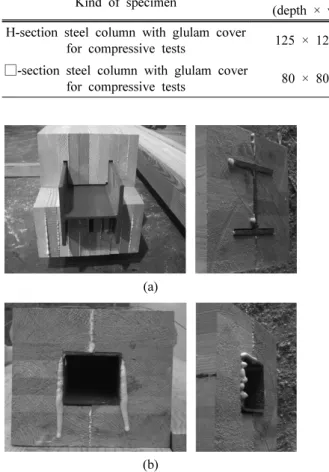
Fig. 1. (a) steel H column covered by glulam and (b) steel □-column covered by glulam.

Fig. 2. Compressive test for glulam, structural steel and composite column.

composite member as a cover on structural steel. Steel H and □-section steel tube act as a structural frame. Resorcinol resin adhesive ap- plied to glue steel and glulam. Section of the composite members are arranged in Fig. 1.

Table 4 demonstrates the size of structural ma- terials selected for strength and fire tests.

2.4. Strength Tests

5 specimens for each member used to evaluate the mechanical properties of composite columns. Using the LVDT, displacement of

composite members measured during the com- pression test. For measure deformation of col- umn, LVDT set up 180 mm from bottom edge.

Using an elasticity line join 2,720 mm span.

The compressive test parallel to the grain were performed by a Universal-type testing machine.

The specimen is supported near the butt and tip, and a load is applied at the ground line by the moving head of the mechanical testing machine.

The average loading speed is 9.80 N/mm

2

per

minute. All deflection curves were obtained from

the compressive test, and then the ultimate com-

pressive strengths parallel to the grain were cal-

culated from the ultimate load.

(4)

Fig. 3. Compressive strength of glulam.

Fig. 4. Failure mode of glulam.

Fig. 5. Compressive strength of structural steel (H type).

Fig. 6. Compressive strength of structural steel (□ type).

3. RESULTS and DISCUSSION

3.1. Compressive Strength of Structural Glued Laminated Timber

Fig. 3 shows the compressive strengths of structural glued laminated timber (glulam).

Theoretical design compressive strength, 151.6 kN, similar to elasticity limits of actual com- pressive test. Elasticity limits of actual com- pressive test is 135.8 kN. Stress-strain diagram separated three section. Slope of the last section is lower than other sections.

Fig. 4 is major two failure mode of structural glued laminated timber. One is that high strength finger – joint member digs into low strength finger-joint on the face layer of structural glued laminated timber. The other major failure mode is that column failed from bending through

buckling.

3.2. Compressive Strength of Structural Steel

Theoretical design compressive strength of Structural steel (H type) is 148.2 kN. It is lower than elasticity limits of actual compressive test.

According to Fig. 5, almost section include elasticity section and reach the maximum load after the elasticity section. Elasticity limits of actual compressive test is 151.9 kN.

Fig. 6. Shows compressive strength of struc-

(5)

Fig. 7. Failure model of structural steel (H type, □ type).

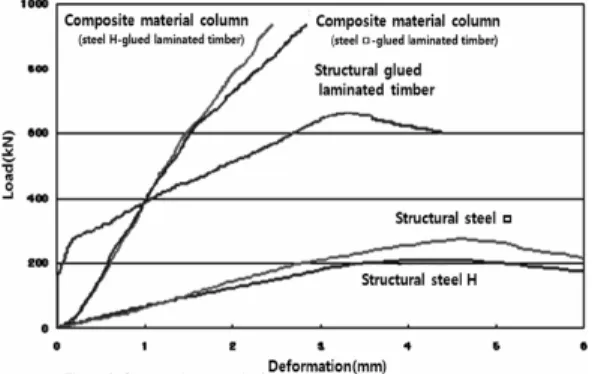
Fig. 8. Compressive strength of composite members.

tural steel ( □ type) and theoretical design com- pressive strength of structural steel ( □ type) is 147.3 kN. Also, theoretical design compressive strength of structural steel ( □ type) is lower than elasticity limits of actual compressive strength of structural steel like a structural steel (H type).

Measured elasticity limits of actual compressive test is 113.7 kN lower than elasticity limits of structural steel (H type).

Structural steel (H type) failed by buckling on Perpendicular to web. Structural steel ( □ type) failed by bucking on parallel to flange.

Fig. 7 shows failure model of structural steel (H type) and structural steel ( □ type).

3.3. Compressive Strength of Composite Column

Fig. 8 indicates the compressive strengths of composite columns. Composite columns not shows failure mode. As shown Fig. 8, compo- site columns (steel-glulam) have limit of elas- ticity around 600 kN. It considered to calculate compressive strength of composite column. In Fig. 8, elasticity limits of composite column is higher than other members. Compressive strength of composite members were much higher than steel columns in spite of that the initial stiffness was lower than glulam columns.

4. CONCLUSION

Structural steel and Structural glued lami- nated timber can be a very Eco friendly build- ing product for new homes or extensions, even more so when we use recycled or second hand.

Structural glulam cover improved the stiffness and strength of structural steel columns under compressive loads. For compare to compressive strength, tested structural glued laminated tim- ber, structural steel (H type), structural steel ( □ type) and composite column (steel-glulam).

1) Structural glued laminated timber : Theo- retical compressive strength is 151.6 kN similar to elastic limits (135.8 kN).

2) Structural steel (H type) : Theoretical com- pressive strength is 148.2 kN littleunder the elastic limits (151.9 kN).

3) Structural steel ( □ type) : theoretical com- pressive strength is 147.3 kN upper than the elastic limits (113.7 kN).

4) Composite column : Measured elastic lim-

its is about 600 kN. Compressive strength of

composite members were much higher than

steel columns in spite of that the initial stiffness

was lower than structural glued laminated tim-

ber column. Also, the results expected that com-

posite column improve design compressive

strength of Structural steel column and provide

structural stability of the building.

(6)

ACKNOWLEDGEMENT

This work was supported by ‘Forest Science

& Technology Projects (2007)’ funded by the Korea Forest Service, Republic of Korea.

REFERENCES

1. Korean Building code and commentary. 2005.

2. Breyer, D. E., K. J. Fridley, and K. E. Cobeen.

Design of Wood Structures ASD, Fourth Edition.

3. Yang, T.-H., S.-Y. Wang, M.-J. Tsai, C.-Y. Lin, and Y.-J. Chuang. 2009. Effect of fire exposure on the mechanical properties of glued laminated timber. Materials and Design 320: 698 ∼703.

4. Jang, S. S., Y. H. Kim, and Y. I. Jang. 2009.

Mechanical Properties of Composite Materials Composed of Structural steel and Structural glued laminated timber. K Wood Science and Technology 37: 300 ∼309.

5. Breyer, D. E., K. J. Fridley, K. E. Cobeen, and D. G. Pollock. Design of Wood Structures- ASD/LRFD, Sixth edition.

6. KS D 3052 Shape, dimensions, weight and toler-

ances of hot-rolled steel flats, 2007.

7. KS D 3502 Dimensions, mass and permissible variations of hot rolled steel sections, 2007.

8. KS D 3503 Rolled steels for general structure, 2007.

9. KS D 3568 Carbon steel square pipes for general structural purposes, 2007.

10. KS F 3021 Structural glued laminated timber, 2005.

11. Kim, S. C. and I. S. Yang. 2006. Elasto-plastic behavior of structural laminated timber joint by flange thickness of H beam, Korea Society of Steel Construction. 81∼2.

12. Kim, S. C., I. S. Yang, and Y. J. Moon. 2006.

Elasto-plastic behavior of joint by inserting length of H-beam and structural laminated timber, Korea Society of Steel Construction. 81∼2.

13. Yang, T.-H., S.-Y. Wang, M.-J. Tsai, C.-Y. Lin, and Y.-J. Chuang. 2009. Effect of fire exposure on the mechanical properties of glued laminated timber. Materials and Design 30: 698∼703.

14. Wang, Y. C. 2002. Steel and Composite Structures-

Behaviour and Dsign for Fire Safety, Spon

Press-Taylor & Francis Group.

수치

Fig. 2. Compressive test for glulam, structural steel  and composite column.
Fig. 7. Failure model of structural steel (H type, □ type).

참조

관련 문서

 Euler buckling strength of long column cannot be improved by higher- strength material since it is due to the instability of the column as a whole.  For a column

 Hull girder failure is controlled by buckling, ultimate strength and yielding of longitudinal structural elementsl.  The maximum value on the static

Positive shear force: Q WP  0.. Design Theories of Ship and Offshore Plant, Fall 2017, Myung-Il Roh 41. Example of Midship Section of a 3,700

2 0 50 , max.. 1) 1) When the section modulus is calculated, standard breadth depending on a is used for effective breadth for simplicity. But effective breadth in accordance

1 Week Ultimate Limit State, Material behavior of Steel Structures.. 2 Week Column Buckling No class due to ISSC

To confirm the characteristics and field application of lightweight air-mixed soil, compressive strength, capillary rise height, permeability coefficient,

In this paper, high-strength galvanized steel for application of the automotive cowl parts carry out respective processes MIG, Laser, Nd:Yag Laser-Mig

3.2 Relation between cement content and unconfined compressive strength - optimum mixing choice