DOI http://dx.doi.org/10.9725/kstle.2013.29.5.318
New Cooling System Design of BLDC Motor for Electric Vehicle Using Computation Fluid Dynamics Modeling
Duc Thuan Vu and Pyung Hwang *
†Department of Mechanical Engineering, Yeungnam University
*School of Mechanical Engineering, Yeungnam University
(Received May 2, 2013 ; Revised July 18, 2013 ; Accepted July 23, 2013)
Abstract − Overheating in electrical motors results in detrimental effects such as degradation of the insulation materials, demagnetization of magnets, increases in Joule losses, and decreases in motor efficiency and lifetime.
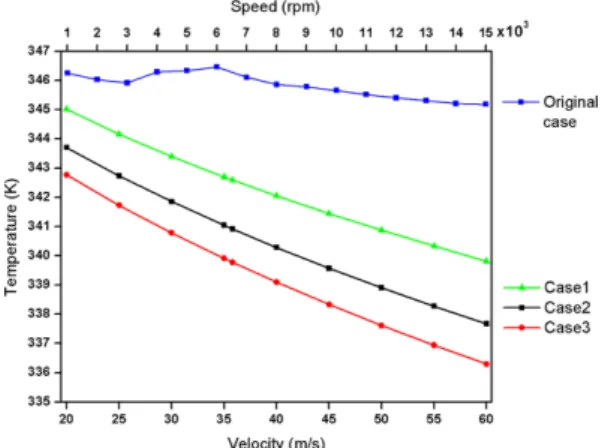
Thus, it is important to find ways to dissipate heat from the motor and to keep the motor operating at its most efficient temperature. In this study, a new design to guide air flow through a given brushless direct current (BLDC) motor is developed and the design is analyzed, specifically by using computational fluid dynamics (CFD) simulations. The results showed that the temperature distribution in the three proposed models is lower than that in the original model, although the speed of the cooling fan in the original model reaches a very high value of 15 × 10
3rpm. The results also showed that CFD can be effectively used to simulate the heat transfer of BLDC motors.
Keywords − brushless direct current motor, hybrid electric vehicles, numerical method, cooling systems, computational fluid dynamics
1. Introduction
Brushless direct current (BLDC) motors are increas- ingly being employed in electrical vehicles (EVs) and hybrid electric vehicles because of their high effi- ciency, high power density, and minimal maintenance [1]. The ability of a BLDC motor to function as a gen- erator during regenerative braking makes it ideal for application to EVs.
The motor temperature is closely linked to the life and performance of BLDC motors. The stator winding temperature directly affects the durability of the wind- ing insulation system, whereas the rotor temperature affects the efficiency of the permanent magnet [2].
Overheating in the windings increases Joule losses because the electrical resistance of the winding mate- rial is highly temperature dependent [2]. Therefore, it is
imperative to conduct thermal analyses in the design of BLDC motors. Heat generated within an electric motor comes from two primary sources: electromagnetic losses and mechanical losses. Electromagnetic losses consist of Joule losses attributable to the flow of elec- tric current and core losses attributable to the hysteresis effect. Mechanical losses compose of bearing frictional losses and windage losses [3].
Most recent publications have focused on cooling system designs that use water, in which a water jacket is usually located between the stator frame and the sta- tor core [4-7]. According to the flow path of cooling water, a water jacket can be classified into two catego- ries: circumferential water jacket and axial water jacket. For the circumferential water jacket, the cooling water flows along the spiral-type path from one end of the stator frame to the other and removes the heat from the machine. For the axial water jacket, the plates are mounted on the surface of the stator to form many axial paths, which are connected together. The cooling water
†