• 검색 결과가 없습니다.

Performance Assessment of Three Turfgrass Species, in Three Different Soil Types, and their Responses to Water Deficit in Reinforced Cells, Growing in the Urban Environment

N/A
N/A
Protected

Academic year: 2021

Share "Performance Assessment of Three Turfgrass Species, in Three Different Soil Types, and their Responses to Water Deficit in Reinforced Cells, Growing in the Urban Environment"

Copied!
10
0
0

로드 중.... (전체 텍스트 보기)

전체 글

(1)

Research Article Weed & Turfgrass Science

338

Weed & Turfgrass Science was renamed from both formerly Korean Journal of Weed Science from Volume 32 (3), 2012, and formerly Korean Journal of Turfgrass Science from Volume 25 (1), 2011 and Asian Journal of Turfgrass Science from Volume 26 (2), 2012 which were launched by The Korean Society of Weed Science and The Turfgrass Society of Korea found in 1981 and 1987, respectively.

Weed & Turfgrass Science was renamed from formerly both Korean Journal of Weed Science from Volume 32(3), 2012, Korean Jour- nal of Turfgrass Science from Volume 25(1), 2011 and Asian Journal of Turfgrass Science from Volume 26(2), 2012 which were launched by The Korean Society of Weed Science and The Turfgrass Society of Korea founded in 1981 and 1987, respectively.

Performance Assessment of Three Turfgrass Species, in Three Different Soil Types, and their Responses to Water Deficit in

Reinforced Cells, Growing in the Urban Environment

Ow, L. F*, Ghosh, S., and Chin, S. W.

Centre for Urban Greenery and Ecology, National Parks Board, Singapore Botanic Gardens, 1 Cluny Road, 259569 Singapore

Introduction

Erratic and insufficient rainfall is a major constraint to turfgrasses. Drought of various intensities and duration severely limits grass growth and increases the likelihood of die back, and subsequent bare patches. Although some agronomic interventions to conserve soil moisture and enhance water use efficiency (WUE), which is an indication of water used in plant metabolism against the amount of water lost, is available (Youngner et al., 1981; Liu and Stutzel, 2004), but the effects may not necessarily work for every grass (Pound and Street, 2001). Developing turf varieties tolerant to drought and efcient in water use is preferable as it is a long term and cost effective solution to the uncertainty of water availability (Mittler, 2006). So far, the approach to breeding varieties with superior performance under limited water conditions has remained in most part, empirical, with few exceptions (Hayatu and Mukhtar, 2010). More rapid progress

may be achieved through a prioir knowledge of the physiological basis of turfgrass performances. These include the ability of root systems to capture water at greater depths, specic leaf area (SLA; ratio of leaf area to leaf dry weight), grass growth that may be achieved through a chlorophyll reading (e.g. measuring F

v

/F

m

, photosynthetic efficiency) (Songsri et al., 2009), optical sensors measuring the normalized differences in vegetation index (NDVI), and turf digital colour analysis (Leinauer et al., 2014).

In this study, grasses in turf reinforcement cells were exposed to drought conditions. Reinforcement cells (TurfPave®, Elmich, Pte Ltd) (Fig. 1) are particularly suited for the urban landscapes where grasses can be integrated into spaces used for parking, and on access roads, or even a driveway. Turf reinforcement cells are lightweight, high strength interlocking plastic pavers that provide a scaffold for the even distribution of grass growth and the cells are built to hold vehicular loads. In urban areas approximately 70 to 90%

of building sites are paved to accommodate podiums, parking ABSTRACT. Reinforcement cells are used to aid grass growth and taken together, this serves to extend greenery beyond the conventional spaces of lawns, tree pits, gardens, and parks, and is advantageous to urban cities since space for greening is often limited. Drought has variable effects on plant life and the resilience of turf to drought resistance also varies with species. Changes in photosynthetic ability were more pronounced for media rather than grass species. The media of sand without organic matter was found to be least suited for drought resistance. Normalized difference vegetation index (NDVI) and digital image analysis (DIA) data were generally in favour of Zoysia species as oppose to A. compressus. In A. compressus, selective traits such as, a more extensive root system and lower specific leaf area (SLA) were not an underlying factor that assisted this grass with enhanced drought resistance. Generally, WUE was found to be strongly related to plant characterises such as overall biomass, photosynthetic features as well as the lushness indexes, and specific leaf area. This study found a strong relationship between WUE and a suite of plant characteristics. These traits should serve as useful selection criteria for species with the ability to resist water stress.

Key words: Biomass, Digital image analysis, Drought, Normalized difference vegetation index, Turfgrasses Received on October 2, 2015; Revised on November 11, 2015; Accepted on November 17, 2015

* Corresponding author: Phone) +65-6-462-6960, Fax) +65-6-472-3033; E-mail) [email protected]

© 2015 The Korean Society of Weed Science and The Turfgrass Society of Korea

This is an Open-Access article distributed under the terms of the Creative Commons Attribution Non-Commercial License (http://cre-

ativecommons.org/licenses/by-nc/3.0) which permits unrestricted noncommercial use, distribution, and reproduction in any medium,

provided the original work is properly cited.

(2)

lots, driveways or walkways (Gartland, 2012; Li, 2015). Most paved areas are constructed from impermeable materials such as concrete, bitumen, stone, and tiles (Li, 2015). These materials retain a vast amount of heat, increasing the ambient temperature (Gartland, 2012).

To mitigate the negative effects of extensive impermeable materials in an urban environment, turf reinforcement cells may be used as an alternative to asphalt and concrete, and can serve to stabilise turf surfaces against erosion. The application of these cells will allow for grass growth to replace impervious surfaces given the high load strength, and so the ability to extend greenery beyond the conventional spaces of lawns, tree pits, gardens, and parks that will be advantageous to urban cities where spaces for greening is often limited yet highly sort after.

The resilience of turf to drought resistance can vary extensively between species and soil type (Jiang and Huang, 2001). The basis to drought resistant is essentially the enhanced ability to mine water from the soil (Qian and Fry, 1997; Songsri et al., 2009). This might be achieved through the selection for larger, deeper root systems, and smaller leaf area (for better drought adaptation). The ability for the soil to retain moisture is therefore, inextricably linked to drought avoidance in grasses (Songsri et al., 2009).

Accumulated information on WUE and its related traits demonstrated in turfgrasses showed that it is negatively correlated with SLA and this finding generally covered a wide range of species (Liu and Stutzel, 2004). Conversely, a strong and positive relationship was found between F

v

/F

m

and WUE (Muhammad et al., 2007; Marcelo et al., 2013). Extensive empirical work on grasses have been focused primarily on conventional growing conditions, in the ground (Huang and Gao, 1999; Qian and Engelke, 1999; Jiang and Huang, 2001;

Kowalewski et al., 2013) with very limited empirical information available for growth within reinforcement cells, and much lesser involving drought conditions. Therefore, this study was set up to better understand how different species of turf grasses would respond to a 4-month period of drought

stress, and to investigate the traits of WUE and changes in physiological parameters with drought stress. These were coupled with the assessment of soil type on the potential of drought avoidance. Three turf grass species and three different soil media were used with the intent to address the following questions: (1) which species was better suited for drought conditions and does these drought resistant species differ in WUE, DIA, NDVI, biomass accumulation, SLA and F

v

/F

m

(2) Which media was better suited for drought resistance? (3) What are the relationships between WUE, rooting parameters, DIA, NDVI, SLA and F

v

/F

m,

in response to drought stress? (4) Was there a difference in post-drought stress recovery between different turf grasses and was the type of media influential in recovery? Therefore, the objectives of this study were to, (i) evaluate physiological variations in WUE, DIA, NDVI, rooting parameters, SLA and F

v

/F

m

among turf species growing in different soil types, to assess their responses to drought, and (ii) assess the relevance of the various physiological traits to WUE in turf grasses under receding soil moisture.

Materials & Methods

Plant materials and experimental procedures A controlled experiment was conducted under glasshouse conditions at the Research Station within the confines of an exhibitory horticulture park located in Singapore (Latitude 1.5

o

N and Longitude 104

o

E) for one year (February 2014 to February 2015). Temperatures ranged between 27 –33 and 22- –29

o

C for day and night time (Table 2), respectively. No artificial lighting was used in this study except for natural light from the sun with a mean daily photosynthetic photon flux density (PPFD) of 2000 µmol m

−2

s

−1

(Licor line quantum sensor, LI-191R coupled with the light sensor logger, LI-1500;

Lincoln Nebraska, USA). The mean relative humidity was between 73 and 80%.

Fifty four cells (inclusive of controls) and three turfgrasses species (Zoysia matrella (L.) Merr., Axonopus compressus (Sw.) P. Beauv. and Zoysia japonica (Steud.)) were used in this experiment. The experiment was further divided into 3 soil types. One with equal proportions of loam, clay and organic matter (Type A), and another which had only sand and organic matter (Type B), and the third which was made up of loamy soil and sand without organic matter (Type C). The set up and combinations were planted in a randomized complete block design (RCBD) with three replications. The experiment had two key stages which were, a) the establishment phase, and b) the drought phase. Wherein, the aim was to compare the effect of drought across 90 and 120 days, on the species of grasses across different soil types.

Two soil moisture levels which were, full capacity (FC) and total water deprivation were used to control irrigation. The Fig. 1. Reinforced cell with dimension: 500 mm (L) × 500 mm

(W) × 40 mm (H) .

(3)

moisture levels on the experimental site were evaluated using moisture probes placed at a depths of between 10 to 15 cm from the surface (Theta-probe soil moisture sensor, Delta-T Devices Ltd, Cambridge, United Kingdom). The proportion of soil in type A is made up of 60% clay, 25% loam, and 15%

organic matter (by volume). Soil type B (by volume) is made up of sand and organic matter in the proportions of 80% and 20%, respectively. Soil type C is made up of 65% sand and 35%

loamy soil (by volume). The soils were mixed thoroughly to ensure a well-blended, consistent product using a wheelbarrow.

Reinforced cells were in the dimensions of 500 mm (L) × 500 mm (W) × 40 mm (H), weighing some 1.1 kg (Fig.

1). Cells were made of polypropylene and are resistant against chemical and biological degradation. Each cell also possessed a compressive strength of >2,000 kN m

2 when unfilled.

Under filled conditions, the strength is estimated to increase by some 20 to 40%. Each cell was set up with 2-10 mm gravel to provide support for weight-bearing loads, following which, the cells were positioned on the compacted gravel and the respective growing media (types A, B and C) were installed (~40 mm). Lastly, the different turfgrasses were planted. An establishment period of 30 days was allocated after sowing (DAS).

Water was applied to all cells to bring them to FC (80-85%

soil moisture). The moisture for all plots was maintained at FC until 30 DAS. After 30 DAS, the irrigation treatments were initiated. Soil water levels were maintained uniformly at full capacity from planting until harvest in the control plots, while the moisture levels in the drought-treated plots were allowed to gradually decrease until they reached levels of visible stress which occurred between 90 to 120 days from the onset of treatment. Moisture levels at 90 to 120 days from the onset of treatment were within the ranges of 5 to 12%

Measurement of water use efficiency (WUE) Water use efficiency (Songsri et al., 2009; Marcelo et al., 2013) is deemed here as the photosynthesis rate, Pn at the leaf level divided by evapotranspiration, ET.

Water Use Efficiency (WUE) = Pn/ET

Measurement of chlorophyll fluorescence

Chlorophyll fluorescence was measured using a portable fluorescence spectrometer (Hansatech Instruments Ltd, England, United Kingdom). Measurements were recorded as in Percival and Sheriffs (2002). Fluorescence responses were induced by a red light, which peaked at 650 nm at a light intensity of 600 W m

−2

. The light intensity was provided by six light-emitting diodes. The potential for a species to tolerate water stress can be effectively assessed through a decline in the F

v

/F

m

ratio representing the maximum quantum yield of PS II which is correlated to the quantum yield of net photosynthesis. This ratio has been widely used as a measure

of plant vitality and as a means to diagnose early signs of stress (Resco et al., 2008). Chlorophyll fluorescence was measured once a week on two samples per cell throughout the phases of establishment and drought. Every effort was made to ensure that measurements were conducted on cloudless days and measurements were taken between 1000 h to 1400 h for the purpose of consistency.

Specific leaf area (SLA)

The leaf area was measured with a leaf area meter (LICOR- 3100C, Nebraska, USA) and leaves were oven dried at 80

o

C between 48-72 h for leaf dry weight measurements.

Immediately after drying, the leaves were weighed and the SLA was derived as leaf area per unit leaf dry weight (cm

2

g

−1

).

The SLA was calculated using the following formula:

SLA = Leaf Area (cm

2

) / Leaf Dry Weight (g) Root dry weight and root length

Grasses were harvested at the end of the experiment (120 days from the onset of treatment). The plant material was clipped at the soil surface and removed before roots were sampled for length measurements. Roots were washed and oven-dried at 80

o

C for 48-72 h (Pessarakli et al., 2008) and dry weights were recorded.

Digital image analysis for green foliage estimates Digital images were obtained with a Panasonic LUMIX DMC-FZ 10 (Panasonic Corporation, Osaka, Japan) digital camera mounted on a tripod set at approximately 1 m in height so that the camera was positioned such that an image could be obtained directly above the cell without any obstructions. The collected images were saved in JPEG (Joint photographic experts group) format, with a colour depth of 16.7 million colours, and an image size of 1280 by 960 pixels.

Camera settings included a shutter speed of 1/400 sec, an aperture of F4.0, and a focal length of 35 mm. Images were taken on days with full sunlight between 1300 and 1500 h.

Digital images were downloaded to a personal computer

and analysed individually by Systat SigmaScan Pro (version

5.0, SPSS, Inc., Chicago, IL). The colour threshold feature in

the SigmaScan software allowed the user to search a digital

image for a specific colour or a range of colour tones. Previous

work with similar images indicated that a hue range between

55 to 110, and a saturation range of 0 to 100 would allow for

selective identification of green foliage in the images. After

developing a fingerprint of the green areas on the image, the

measurement tools in the software were used to count the

total number of selected green pixels. The number of green

pixels in each image was then divided by the total pixel count

of the image so as to determine the percent leaf/green cover in

each image.

(4)

Normalized Difference Vegetation Index (NDVI) The TCM500 NDVI meter (Field Scout, Spectrum Technologies, Inc. Plainfield, IL, USA) was used in this study.

The equipment can work in three different modes (Bremer et al., 2011). The first is the Normalized Difference Vegetative Index (NDVI) which is defined as:

NDVI = (NIR – Red)/ (NIR + Red) Where:

NDVI = Normalized Difference Vegetation Index NIR = Reflectance in the band of 850 ± 5 nm Red = Reflectance in the band of 660 ± 5 nm

The second is that of the grass index which works on a scale of 1 to 9 and approximates the rating a visual observer would assign to the turf grass. This is generally a very subjective parameter and was omitted from this study. The third mode is that of reflectance where the percent of incident light of each wavelength (band) that is reflected back to the optical sensor in the meter is recorded and these same reflectance values are used to calculate NDVI and the grass index. This parameter was used alongside the first mode as a means of verification.

Statistical Analysis

All data collected were subjected to an analysis of variance (ANOVA) and where appropriate, mean separation was performed using least significant difference tests (SAS Institute, software Version 9.4, Cary, NC, USA). Treatment means were compared by least significant difference to determine whether means of the dependent variable were significantly different at P = 0.05, and also to identify significant differences between media and species. Linear regressions were used to determine the relationships of rooting parameters, SLA, DIA, NDVI and F

v

/F

m

against WUE.

Results

Soil Moisture

The results showed reasonably good management of soil moisture (Figs. 2a and 2b). Water levels were significantly lower in the plants experiencing drought as compared to the controls. Visual observations also showed severe wilting in the

Fig. 2. Typical soil volumetric content (%) for controls over a 24-hour cycle (A), Typical soil volumetric content (%) for turf exposed to water deprivation between 0 to 120 days from the onset of treatment (B).

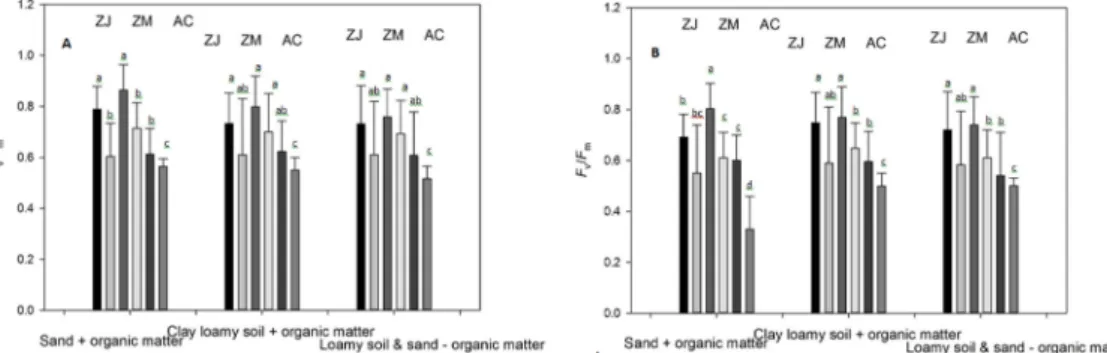
Fig. 3. Mean F

v

/F

m

indexes for control and water deprived turf, 90 days from the onset of treatment across three different soil types (A).

Mean F

v

/F

m

indexes for control and water deprived turf, 120 days from the onset of treatment across three different soil types (B).

Controls are represented by dark bars for each species of grass. ZJ stands for Zoysia japonica; ZM stands for Zoysia matrella; AC stands

for Axonopus compressus.

(5)

treated cells at 120 days (following the commencement of treatment). (data not shown).

F

v

/F

m

indexes

Ninety days from the onset of water deprivation, all 3 species of grasses grown on sand with organic matter exhibited a significant decline in the F

v

/F

m

ratio when compared against the controls (Fig. 3a). However, at 120 days from the onset of treatment the rate of decline was less prevalent in Z. japonica (compared against the controls) while the other 2 species continued to exhibit a decline in this ratio (Fig. 3b).

Generally, the effect of drought on the F

v

/F

m

ratio was less intense for grasses grown on clay loamy soil with organic matter. Zoysia grasses showed no significant decrease in this ratio at 90 days following drought. A. compressus was the only

species that exhibited a significant decline in this ratio (Fig.

3a). At 120 days from the onset of treatment, it was apparent that water deprivation had taken a toll on most of the grasses except for the Z. japonica (Fig. 3b).

The effect on the F

v

/F

m

ratio for grasses grown in loamy soil and sand without organic matter was similar to what was observed in the grasses grown in clay loamy soil with organic matter at 90 and 120 days from the onset of treatment (Fig. 3a and 3b). The exceptional species tended to be the Z. japonica which was least affected by water deprivation.

Digital image analysis (DIA)

The controls across grasses and soil types were not significantly different at 90 and 120 DAS (Table 2). The outlook of the controls was generally lush, with very few brown spots and just a handful of wilted blades. For grasses

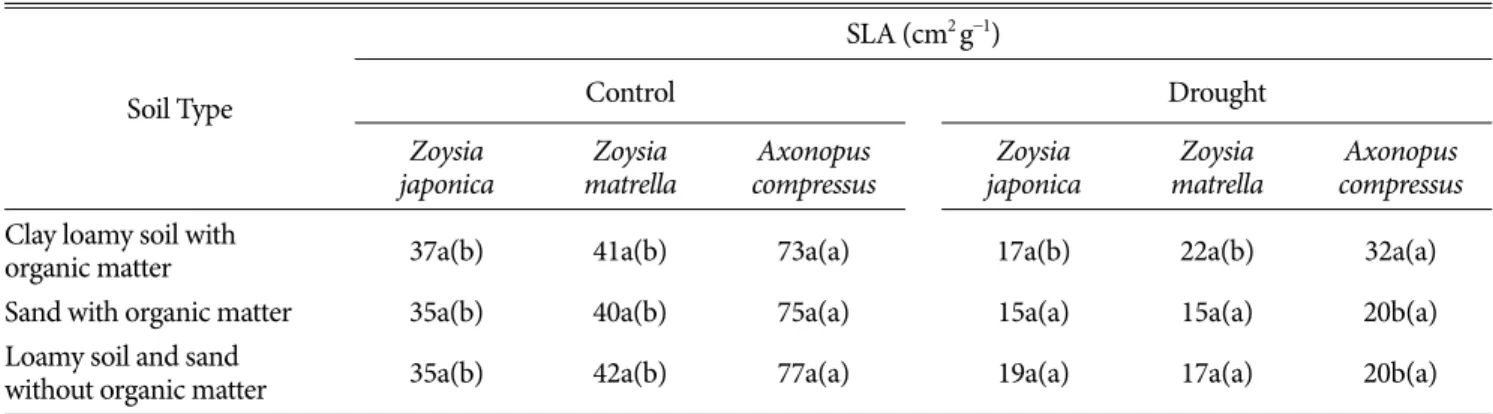
Table 1. Effect of drought stress on specific leaf area (SLA) across different grasses growing in different soil types at 120 days from the onset of treatment.

Soil Type

SLA (cm

2

g

−1

)

Control Drought

Zoysia japonica

Zoysia matrella

Axonopus compressus

Zoysia japonica

Zoysia matrella

Axonopus compressus Clay loamy soil with

organic matter 37a(b) 41a(b) 73a(a) 17a(b) 22a(b) 32a(a)

Sand with organic matter 35a(b) 40a(b) 75a(a) 15a(a) 15a(a) 20b(a)

Loamy soil and sand

without organic matter 35a(b) 42a(b) 77a(a) 19a(a) 17a(a) 20b(a)

Different alphabets indicate significant differences across media type. Alphabets in parentheses indicate significant differences across species for drought and control grosses.

Table 2. Mean values for Digital Image Analysis (DIA) for control and drought exposed turf across 3 different soil types at 90 and 120 days from the onset of treatment.

Soil Type

Digital Image Analysis (%)

90 Days 120 Days

Control Drought Control Drought

Zoysia japonica

Zoysia matrella

Axonopus compressus

Zoysia japonica

Zoysia matrella

Axonopus compressus

Zoysia japonica

Zoysia matrella

Axonopus compressus

Zoysia japonica

Zoysia matrella

Axonopus compressus Clay loamy

soil with organic matter

95

a(a)

92

a(a)

97

a(a)

59

a(a)

55

a(a)

38

a(b)

98

a(a)

94

a(a)

95

a(a)

46

a(a)

43

a(a)

25

a(b)

Sand with

organic matter 88

a(a)

87

a(a)

91

a(a)

30

b(a)

28

b(a)

21

b(b)

90

a(a)

90

a(a)

92

a(a)

19

b(a)

18

b(a)

10

b(b)

Loamy soil

and sand without organic matter

91

a(a)

90

a(a)

94

a(a)

53

a(a)

51

a(a)

42

a(b)

95

a(a)

92

a(a)

95

a(a)

40

a(a)

39

a(a)

21

a(b)

Different alphabets indicate significant differences across media type; Different alphabets in parentheses indicate significant differences across spe-

cies for drought and control grasses (for 90 & 120 days, respectively).

(6)

exposed to drought, those grown in sand with organic matter tended to fair worse at 90 & 120 DAS (Table 2). All 3 grass species grown in this media was negatively affected by water deprivation. The DIA values for grasses grown in clay loamy soil with organic matter and loamy soil without organic matter were generally not significantly different though marginal superiority was observed in grasses grown in clay loamy soil with organic matter (Table 2).

A. compressus was the least tolerant against water stress. It exhibited significantly lower DIA values and was seen with the greatest degree of wilted blades, brown patches, and die back at 90 and 120 days from the onset of treatment. The mean decline in DIA values from 90 through to 120 days from the onset of treatment was some 50% for A. compressus while Z.

japonica and Z. matrella exhibited a mean decline in DIA values of between 20 to 40%.

NDVI

The findings from NDVI readings were consistent with the data observed with DIA. Controls across grasses and soil types were not significantly different at 90 and 120 days from the Table 3. Mean values for NDVI for control and drought exposed turf across 3 different soil types at 90 and 120 days from the onset of treatment.

Soil Type

NDVI

90 Days 120 Days

Control Drought Control Drought

Zoysia japonica

Zoysia matrella

Axonopus compressus

Zoysia japonica

Zoysia matrella

Axonopus compressus

Zoysia japonica

Zoysia matrella

Axonopus compressus

Zoysia japonica

Zoysia matrella

Axonopus compressus

Clay loamy soil with organic matter

0.89

a(a)

0.821

a(a)

0.726

a(b)

0.79

a(a)

0.773

a(a)

0.653

a(b)

0.854

a(a)

0.781

a(a)

0.702

a(b)

0.702

a(a)

0.701

a(a)

0.56

a(b)

Sand with

organic matter 0.83

a(a)

0.789

b(a)

0.663

b(b)

0.70

b(a)

0.65

b(a)

0.441

b(b)

0.795

a(a)

0.741

a(a)

0.631

a(b)

0.651

b(a)

0.612

b(b)

0.4

b(c)

Loamy soil and sand without organic matter

0.857

a(a)

0.837

a(a)

0.687

b(b)

0.752

a(a)

0.751

a(a)

0.63

a(b)

0.812

a(a)

0.795

a(a)

0.65

a(b)

0.701

a(a)

0.707

a(a)

0.52

a(b)

Different alphabets indicate significant differences across media type; Different alphabets in parentheses indicate significant differences across spe- cies for drought and control grasses (for 90 & 120 days, respectively).

Table 4. Root biomass and root length data across species and soil types following 120 days from the onset of treatment.

Species Clay loamy soil with

organic matter Sand with organic matter Loamy soil and sand without organic matter Biomass (g) length (cm) Biomass (g) length (cm) Biomass (g) length (cm)

Zoysia japonica 130

a(c)

8

a(b)

105

b(b)

9

a(b)

120

a(c)

10

a(b)

Zoysia matrella 190

a(b)

10

a(b)

132

b (b)

10

a(b)

200

a(b)

9

a(b)

Axonopus compressus 300

a(a)

20

a(a)

252

c (a)

15

a(a)

272

b(a)

16

a(a)

Different alphabets indicate significant differences across media type; Alphabets in parentheses indicate significant differences across species for drought and control grasses.

Table 5. Correlation coefficient between dry matter and WUE, between species and soil types for drought exposed grasses.

Species Coefficient

value Soil type Coefficient value

Zoysia japonica 0.985

Clay loamy soil with organic matter

0.896 Zoysia matrella 0.846 Sand with

organic matter 0.409 Axonopus

compressus 0.412

Loamy soil and sand without organic matter

0.729

(7)

onset of treatment (Tables 3) and grasses grown in sand with organic matter tended to fair worse at 90 & 120 days from the onset of treatment than the other soil types (Table 3). There was generally no significant difference between grasses grown in clay loamy soil with organic matter and those grown in loamy soil without organic matter.

Similarly, NDVI values also suggested that A. compressus was the least tolerant against water stress (Table 3). The decline in NDVI values from 90 through to 120 days from the onset of treatment was between 9 to 17% for A. compressus while Z.

japonica exhibited a 7 to 11% decline. Z. matrella exhibited some 6 to 9% decline in NDVI.

Specific leaf area (SLA)

SLA was measured at 120 days from the onset of treatment.

It is noteworthy for this parameter to understand that the A.

compressus possessed a different growth habit (i.e. wide, thick leaf blades with lateral stems that develop aboveground, along the surface of the soil) from Zoysia grasses. Despite the differences in growth form and habit, it was evident from the data that water stress had a negative impact on SLA for drought exposed grasses (Table 1). For example, SLA as a function of clipping dry weight (CDW) exhibited a significant reduction and this was consistent across species and media (data not shown). At 120 days from the onset of treatment, SLA values indicated that A. compressus was the exception where SLA was significantly lower for those grown in the media of sand with organic matter and loamy soil and sand without organic matter (Table 1). The decline in SLA values was greatest for A. compressus, between the ranges of 50 to 75% while the Zoysia grasses generally exhibited a smaller decline of between 40 to 60%.

Root biomass and root length

Generally, biomass data for all 3 grasses were significantly lower when grown in sand with organic matter (Table 4).

Across species, Z. japonica had the lowest biomass values and this finding was significant for the soil types of clay loam with organic matter and loamy soil and sand without organic matter. Soil type had no effect on root length across species (Table 4), but given the growth habit and form of A.

compressus, it tended to be superior to the Zoysia grasses in

both aspects of root biomass and root length.

Overall dry matter and Water Use Efficiency (WUE) A strong linear relationship was observed in species when comparing dry matter and WUE for Zoysia grasses. A weaker relationship was found with A. compressus (Table 5). With soil type, a strong relationship was found in grasses grown in clay loamy soil with organic matter and loamy soil and sand without organic, but a weak relationship was seen in the media of sand with organic matter (Table 5). Generally, biomass data indicated a negative correlation between drought and overall dry matter. The magnitude was greater for A. compressus (data not shown).

Root biomass, DIA, NDVI, and F

v

/F

m

indicated strong relationships between these parameters and WUE (Table 6).

The exception was with A. compressus where the relationship was some 50% weaker in most parameters. A negative relationship between SLA and WUE was observed.

Discussion

An understanding of the traits associated with WUE such as the ability of roots to increase water uptake and maintain high photosynthetic capacity is important for turf survival under drought stress (Connellan, 2013). This information should provide a better understanding on how different species adapt to low soil water levels and will have important implications on selection of drought resistant turfgrasses. The effect of drought on photosynthetic ability was more pronounced for media rather than species type. The results were generally in favour of the Zoysia grasses as a drought resistant grass as oppose to A. compressus.

Drought adaptive traits have been correlated with large root systems (Nageswara et al., 1995; Comas et al., 2013) and greater root length while greater root density was found to be ideal at shallower depths (Songsri et al., 2009). These aspects have been used as selection criteria for drought resistance in turfgrasses. The data here suggest that sandy soils were not beneficial to root biomass but this limitation did not affect root length. It is noteworthy that the superiority of root length and biomass findings for A. compressus observed in this study may be attributed to its stoloniferous growth nature which was Table 6. Prediction of WUE of grasses based on physiological components at P≥0.0001 through simple linear regressions for root biomass, DIA, NDVI, SLA and F

v

/F

m

parameters.

Species Root biomass (R

2

) DIA (R

2

) NDVI (R

2

) SLA (R

2

) F

v

/F

m

(R

2

)

Zoysia japonica 0.823 0.830 0.783 0.687 0.707

Zoysia matrella 0.787 0.735 0.811 0.712 0.685

Axonopus compressus 0.414 0.31 0.462 0.501 0.312

#Results across soil types have been pooled together.

(8)

made up of stout culms, wide leaves, long spikelets and a dense mat formation. This was in stark contrasts to the Zoysia grasses that tended to develop through rhizomes with fine textured leaf blades.

The species with the largest root system did not necessarily translate into stronger resistance against water deprivation (Richardson et al., 2008). In A. compressus, the more extensive root system may have contributed to vegetative growth but less to stress resistance. This species exhibited thicker leaves (lower SLA) which are usually indicative of higher chlorophyll per unit leaf area and hence a greater photosynthetic capacity compared with thinner leaves (Choudhary et al., 2015) and may in part explain the significant decline in the F

v

/F

m

ratio when exposed to drought. The F

v

/F

m

is an indicator of the photosynthetically active light-transmittance characteristics of the leaf, which is dependent on the unit amount of chlorophyll per unit leaf area (chlorophyll density) (McMillen and McClendon, 1983; Richardson et al., 2002). Signicant and positive correlations between F

v

/F

m

and chlorophyll content (Akkasaeng et al., 2003; Arunyanark et al., 2008) have been confirmed in other reports which may explain the significant effect drought had on this species of grass.

In this study, the Zoysia grasses were better able to maintain their F

v

/F

m

ratios under drought stress and were also more tolerant to drought as confirmed through digital image analysis and corresponding NDVI data. The media of sand with organic matter was the least suited for drought resistance for all grasses. This may be attributed to the greater degree of porosity which results in enhanced loss of soil moisture through drainage.

Negative correlations between SLA and WUE were observed across all species and this had been supported by previous reports (Nageswara et al., 2001; Upadhyaya, 2005;

Nigam et al., 2003, 2005; Nigam and Aruna, 2008). SLA decreased with drought stress, in all species and across all soil types.

The strong linear relationship between WUE and overall dry matter in the Zoysia grasses may be associated to the variation in photosynthetic capacity per unit leaf area (Wright and Nageswara, 1994; Nageswara et al., 1995; Anwar et al., 1999). Their leaves were thinner than those of the A.

compressus which in turn, is suggestive of a lower density of chlorophyll per unit leaf area, resulting in reduced photosynthetic capacity. Even so, the Zoysia grasses still fared better under conditions of water deprivation based on observations made with the other parameters. This provides good evidence of resilience and will potentially support the rationale for higher F

v

/F

m

and lower SLA alongside greater resilience against drought. All this may have been possible thorough enhanced photosynthetic machinery per unit leaf area.

The findings also indicated that WUE was strongly

dependent upon various plant characterises (Simioni et al., 2004; Lawson and Blatt, 2014) such as, SLA, overall biomass, photosynthetic features as well as the lushness indexes of DIA and NDVI. It is noteworthy however, that these associations were less pronounced for A. compressus.

In summary, the findings here open up research potential for more in depth analysis into the effects of species and soil type on the molecular and biochemical nature of turfgrass responses to drought stress. In addition, aspects of traffic and shade on turfgrasses may be studied alongside the effects of water deprivation so as to have a holistic understanding on how various turfgrasses adapt to stressful growing conditions.

Conclusions

The effect of drought on photosynthetic ability was more pronounced for media rather than species. The media of sand without organic matter was found to be the least suited for drought resistance for all grasses However, the photosynthetic, NDVI and DIA results were generally in favour of the Zoysia grasses as a drought resistant species as oppose to A.

compressus. The data showed that greater root dry weights and a more extensive root system did not necessarily translate into enhanced drought avoidance capabilities. The turfgrass which had the more extensive root system and lower SLA was not superior in its ability to maintain higher WUE under water stress. WUE was strongly related to plant characterises such as overall biomass, photosynthetic features as well as the lushness indexes of DIA, NDVI, and SLA (though the relationship was a negative one). This study found a strong relationship between WUE and a suite of plant characteristics. Therefore, when grasses are exposed to drought, these traits could serve as useful selection criteria for species with the ability to resist water stress.

This study identified Z. japonica as the outstanding species for drought resistance. Aspects of photosynthesis was least affected by water stress and this grass generally fared better for all other measured parameters.

With post drought recovery, there were no clear effects brought about by media but the rate of recovery tended to be in favour of Zoysia grasses with Z. japonica possessing marginal superiority.

Acknowledgements

The authors are grateful for the financial support from Spring Singapore under the Capability Development Grant, and the work was also supported in part by Elmich Pte Ltd.

We are grateful to Mr Gabriel Soon and Ms Lillian Yuan for

data collection, experimental set up and all associated field

work and data processing. We also extend our gratitude to the

(9)

students of Republic Polytechnic who have helped with data collection. Special thanks also to Mr Mohd Lokman Yusof for assisting with the installation and maintenance of research equipment.

References

Akkasaeng, C., Vorasoot, N., Jogloy, S. and Patanothai, A. 2003.

Relationship between SPAD readings and chlorophyll contents in leaves of peanut (Arachis hypogaea L.). Thai J. of Agriculture Sci. 36(3):279-284.

Anwar, M.R., McKenzie, B.A. and Hill, G.D. 1999. Water use effi- ciency of chickpea (Cicer arietinum L.) cultivars in Canterbury:

effect of irrigation and sowing date. Agronomy New Zealand 29:1-8.

Arunyanark, A., Jogloy, S., Akkasaeng, C., Vorasoot, N., Kesmala, T., et al. 2008. Chlorophyll stability is an indicator of drought tolerance in peanut. J. of Agronomy and Crop Sci. 194:113-125.

Bremer, D.J., Lee, H., Su, K. and Keeley, S.J. 2011. Relationships between normalized difference vegetation index and visual quality in cool season turfgrass: II Factors affecting NDVI and its component reflectances. Crop Sci. 51(5):2219-2227.

Choudhary, M.L., Patel, V.B., Mohammed, W.S. and Sheraz, S.M.

2015. Climate dynamics in Horticulture Sci.: Principles and Applications. (Vol. 1). Canada: Apple Academic Press, Inc.

Canada.

Comas, L.H., Becker, S.R., Von Mark, V.C., Byrne, P.F. and Dierig, D.A. 2013. Root traits contributing to plant productivity under drought. Frontiers in Plant Sci. 4(442):1-24.

Connellan, G. 2013. Water Use Efficiency for irrigated turf and landscape. Australia: CSIRO Publishing.

Gartland, L. 2012. Heat Islands; Understanding and mitigating heat in urban areas. London: Sterling, VA.

Hayatu, M. and Mukhtar, F.B. 2010. Physiological responses of some drought resistant cowpea genotypes (Vigna unguiculata (L.) Walp) to water stress. Bayero J. of Pure and Applied Sci.

3(2):69-75.

Huang, B. and Gao, H. 1999. Physiological responses of diverse tall fescue cultivars to drought stress. HortSci. 34(5):897-901.

Jiang, Y. and Huang, B. 2001. Ses to heat stress alone or in combination with drought: a comparison between tall fescue and perennial ryegrass. HortSci. 36(4):682-686.

Kowalewski, A.R., Schwartz, B.M., Grimshaw, A.L., Sullivan, D.G., Peake, J.B., et al. 2013. Biophysical effects and ground force of the baldree traffic simulator. Crop Sci. 53(5):2239-2244.

Lawson, T. and Blatt, M.R. 2014. Stomatal size, speed, and responsiveness impact on photosynthesis and water use efficiency. Plant Physiol. 164(4):1556-1570.

Leinauer, B., VanLeeuwen, D.M., Matteo, S., Schiavon, M. and Sevostianova, E. 2014. Digital image analysis and spectral reflectance to determine turfgrass quality. Agronomy J.

106(5):1787-1794.

Li, H. 2015. Pavement material for heat island mitigation: design

and management strategies. Butterworth-Heinemann (Elsevier), Kidlington, Oxford, UK.

Liu, F. and Stutzel, H. 2004. Biomass partitioning, specific leaf area, and water use efficiency of vegetable amaranth (Amaranthus spp.) in response to drought stress. Scientia Horticult. 102:15-27.

Marcelo, A.S., JifonII, J.L., Moura dos SantosI, C., JadoskiI, C.Jnr.

and SilvaII, J.A.G. 2013. Photosynthetic capacity and water use efficiency in sugar cane genotypes subject to water deficit during early growth phase. Brazilian Archives of Biology and Technol.

56(5):735-748.

McMillen, G.G. and McClendon, J.H. 1983. Dependence of Photosynthetic rates on leaf density thickness in deciduous woody plants grown in sun and shade. Plant Physiol. 72:674-678.

Mittler, R. 2006. Abiotic stress, the field environment and stress combination. Trends in Plant Sci. 11(1):15-19.

Muhammad, J., Shafiq, R., Kui, J.L., Jeong, M.K., Kim, H.S., et al. 2007.

Salinity reduced growth PS2 photochemistry and chlorophyll content in radish. Scientia Agricola. 64(2):111-118.

Nageswara, R., Talwar, R.C. and Wright, G.C. 2001. Rapid assessment of specific leaf area and leaf nitrogen in peanut (Arachis hypogaea L.) using a chlorophyll meter. J. of Agronomic Crop Sci. 186:175-182.

Nageswara, R., Udaykumar, R.C., Farquhar, M., Talwar, G.D. and Prasad, T.G. 1995. Variation in carbon isotope discrimination and its relationship to specific leaf area and ribulose-1,5-bispho- sphate carboxylase content in groundnut genotypes. Functional Plant Biol. 22(4):545-551.

Nigam, S.N. and Aruna, R. 2008. Stability of soil plant analytical development (SPAD) chlorophyll meter reading (SCMR) and specific leaf area (SLA) and their association across varying moisture stress conditions in groundnut (Arachis hypogaea L.).

Euphytica. 160:111-117.

Nigam, S.N., Basu, M.S. and Cruickshank, A.W. 2003. Hybridisation and description of the trait-based and empirical selection programs. Paper presented at the Proceedings of a Collaborative Review Meeting, 25-27 Feb, Hyderabad, Andhra Pradesh, India.

Nigam, S.N., Chandra, S., Sridevi, K.R., Bhukta, M., Reddy, A.G.S., et al. 2005. Efficiency of physiological trait-based and empirical selection approaches for drought tolerance in groundnut.

Annals of Application Biol. 146:433-439.

Percival, G.C. and Sheriffs, C.N. 2002. Identification of drought tolerant woody perennials using chlorophyll fluorescence. J. of Arboricult. 28(5):215-223.

Pessarakli, M., Kopec, D.M. and Gilbert, J.J. 2008. Growth responses of selected warm season turfgrasses under salt stress.

Turfgrass, Landscape and Urban IPM Research Summary pp.

47-54.

Pound, W.E. and Street, J.R. 2001. Managing turfgrass under drought conditions. Horticulture and Crop Sci. pp. 1-2.

Qian, Y.L. and Engelke, M.C. 1999. Performance of 5 turfgrasses under linear gradient irrigation. HortSci. 34(5):893-896.

Qian, Y.L. and Fry, J.D. 1997. Water relations and drought tolerance

(10)

of four turfgrasses. J. of American Society of Hort. Sci.

122(1):129-133.

Resco, V., Ignace, D.D., Sun, W., Huxman, T.E., Weltzin, J.F., et al.

2008. Chlorophyll fluorescence, predawn water potential and photosynthesis in precipitation pulse-driven ecosystems-impli- cations for ecological studies. Functional Ecol. 22:479-483.

Richardson, M.D., Duigan, S.P. and Berlyn, G.P. 2002. An evaluation of noninvasive methods to estimate foliar chlorophyll content.

New Phytologist 153:185-194.

Richardson, M.D., Karcher, D.E., Hignight, K. and Rush, D. 2008.

Drought tolerance and rooting capacity of Kentucky Bluegrass cultivars. Crop Sci. 48:2429-2436.

Simioni, G., Roux, X.L., Gignoux, J. and Walcroft, A.S. 2004. Leaf gas exchange characteristics and water-and nitrogen-use effi- ciencies of dominant grass and tree species in a west African

savanna. Plant Ecol. 173:233-246.

Songsri, P., Jogloy, S., Holbrook, C.C., Kesmala, T., Vorasoot, N., et al.

2009. Association of root, specific leaf area and SPAD chlorophyll meter reading to water use efficiency of peanut under different available soil water. Agriculture Water Manage. 96:790-798.

Upadhyaya, H.D. 2005. Variability for drought resistance related traits in the mini core collection of peanut. Crop Sci. 45:1432-1440.

Wright, G.C. and Nageswara, R. 1994. Peanut water relations. pp.

281-325. In: Smartt, J. (Ed.). The ground nut crop. London:

Chapman and Hall. UK.

Youngner, V.B., Marsh, A.W., Strohman, R.A., Gibeault, V.A. and

Spaulding, S. 1981. Water use and turf quality of warm season

and cool season turfgrasses. Californian Turfgrass Culture

31(3):1-4.

수치

Fig. 3. Mean F v /F m indexes for control and water deprived turf, 90 days from the onset of treatment across three different soil types (A).
Table 1. Effect of drought stress on specific leaf area (SLA) across different grasses growing in different soil types at 120 days from the onset of treatment
Table 5. Correlation coefficient between dry matter and WUE, between species and soil types for drought exposed grasses.

참조

관련 문서