| Abstract |
Purpose: This study aimed to compare the contraction ratios of the abdominal muscles and the preferential activation ratios of the transversus abdominis muscle (TrA) during the abdominal drawing-in maneuver (ADIM) in the hook-lying, sitting, and standing positions.
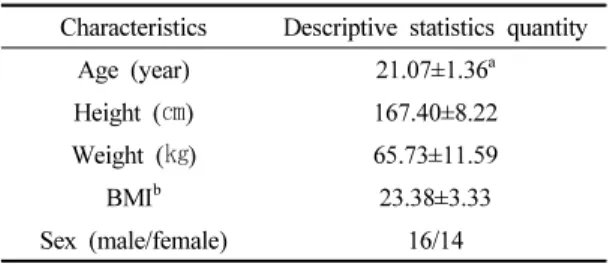
Methods: This study included 30 healthy participants. The thicknesses of the TrA, internal oblique muscle (IO), and external oblique muscle (EO) were measured at rest and during the ADIM in the hook-lying, sitting, and standing positions using B-mode ultrasound imaging. The contraction ratios of these muscles and the preferential activation ratios of the TrA were calculated for each position.
Results: The contraction ratio of the TrA and preferential activation ratio of the TrA during the ADIM in the hook-lying position were significantly higher than those in the sitting and standing positions (p ˂ 0.05). The contraction ratio of the TrA during the ADIM in the sitting position was significantly higher than that in the standing position (p ˂ 0.05).
Conclusion: The hook-lying position tended to facilitate TrA activity better than the sitting position. Furthermore, the sitting position tended to facilitate TrA activity better than the standing position. These findings suggest that the ADIM in the hook-lying position should be implemented before that in the sitting position and that the ADIM in the sitting position should be implemented before that in the standing position.
Key Words: Sitting positions, Standing positions, Transversus abdominis, Ultrasonography
†Corresponding Author : Jong-Im Won ([email protected])
Original Article Open Access
무릎 구부리고 누운 자세, 앉은 자세, 선 자세에서 복부 드로잉-인 방법을 수행하는 동안 배가로근의 수축비 비교