• 검색 결과가 없습니다.

Sustainable Environmental Science & Recycling Technology Education for High School and Middle Schools: Global Scenario

N/A
N/A
Protected

Academic year: 2021

Share "Sustainable Environmental Science & Recycling Technology Education for High School and Middle Schools: Global Scenario"

Copied!
4
0
0

로드 중.... (전체 텍스트 보기)

전체 글

(1)

To whom corresponding should be addressed.

Tel : +82-42-868-3578 E-mail :

에너지공학, 제28권 제1호(2019)

Journal of Energy Engineering, Vol. 28, No. 1, pp.45~48(2019) https://doi.org/10.5855/ENERGY.2019.28.1.045

Sustainable Environmental Science & Recycling Technology Education for High School and Middle Schools: Global Scenario

Thenepalli Thriveni

1

, Chilakala Ramakrsihna

2

, Ahn Ji Whan

3†

1&3

Center for Carbon Mineralization, Mineral Resources Division, Korea Institute of Geosciences and Mineral Resources (KIGAM), 124 Gwahak ro, Gajeong-dong, Yuseong-gu, Daejeon 34132,

Republic of Korea.

2
Department of Bio-based Materials, School of Agriculture and Life Science, Chungnam National University, 99 Daehak-ro, Yuseong-gu, Daejeon 34134, Republic of Korea.

(Received 21 January 2019, Revised 20 February 2019, Accepted 27 February2019) Abstract

Currently, the global atmosphere around the world is altering at a very rapid pace. Among those changes, some are beneficial, but most of the changes are lead to destruction to our planet. The area of environmental science is a significant resource for learning more about these changes. Due to the urbanization, the human population is increasing, natural resources becoming very limited. To solve the limited resources issues, recycling is absolutely an alternative source for the new demands and limitations. Recycling education is very important to raise awareness among students and their communities about the need for recycling and what materials are recyclable locally. In this paper, we reported the role of sustainability science and technology and the impact of recycling research education in the middle schools, both in developing countries and Asian countries and also we included the brief data of global recycling of waste.

Key words : sustainability, Environmental science & technology, recycling education, middle schools, global scenario

1. Introduction

Environmental sustainability is described as the accountable association with the ecosystem to keep away from exhaustion or starvation of natural re- sources and allow for extended environmental stan- dards. The implementation of environmental sustain- ability assists to fortify that the needs of today’s ur- banization are met without threatening the ability of upcoming generations to meet their requirements.

Developed science technologies are always beneficial to the environment, sustainable but it leads to the production of million tons of waste [1,2].

The environmental protection agency (EPA), USA suggest resources to raises the solid waste issues, stimulate and increase waste minimize concept, and

motivate contribution to environmental to surpass activities. One of the long term solid waste manage- ment strategy in the USA is reaching kids with the recycling message [3-6].

In Portland state university, a new recycling

awareness project was launched, and it was a com-

munity based, service learning experience which

used recycling as a vehicle to address the problems

facing high school youth and schools. In this project,

college, high school, and grade school youth learned

about recycling and waste stream reduction issues

and taught each other [7]. This recycling education

awareness project provides a model of youth in com-

munity service learning which enhances educational

experience while improving recycling rates in the

community; demonstrate a method for creating long

term mentoring opportunities integrated into local

higher education programs, through college/high school

participation, reduce high school dropout rates, de-

(2)

Thenepalli Thriveni, Chilakala Ramakrsihna, Ahn Ji Whan

에너지공학 제28권 제1호 2019 46

velop a curriculum on recycling which can be used by high school and middle school teachers, raising positive student ties up with the local community.

2. Environment Education

The main goal of the environmental education pro- grammes is to understand the idea of the sustainable environment in the primary school curriculum, a mechanism in environmental education, acquire kno- wledge by a different process of teaching in environ- mental education, and techniques for the efficacy and efficiency of environmental education. Environment education has a wide scope and depends on the so- cio-economic impacts, degradation of limited natural sources etc.

Environmental Protection Agency(EPA), the USA encourages an environmental education system in high schools and middle schools to learn global environ- mental issues, solutions for limited resources, and re- mediations to these environmental damage problems.

As a result, children, high school, and middle school students develop a depth understanding of environ- mental issues and creating possible solutions and re- sponsible decisions [8].

3. Recycling Education Strategy at Asian Countries

In Asian countries, recycling education at primary schools, high schools, and middle schools are very limited. But the importance of the recycling educa- tion program at national levels are ongoing through campaigns and science fare exhibitions. Recently, 3Rs policies (Reduce, Reuse and Recycle) are sig- nificantly promoting the recycling of waste to wealth. Asia is observing rapid urbanization, growing industrialization, rising higher incomes and consump- tion of goods and this is one of the causes of leading to the production of the toxic waste amount. Among those, majority recyclable paper, plastic, and metals occupied. There is a prompt rise in toxic materials in the solid wastes as well as in wastewaters. Particu- larly, substantial populated cities like South Korea, India, Singapore, Thailand, Japan, Malaysia, China, Indonesia, and the Philippines urgently required to develop advanced technologies for solid waste dis- posal.

Bishnu B. Bhandari et al., [9] reported that, the problems of environmental education (EE) in 36 countries and expressing the general trends and also patterns in the Asia-Pacific region. This article main- ly argues that the Asian countries have awareness of environment education, but in contempt of their eco- nomic situations, the countries have shown interest- ing and in encouraging environment education (EE).

In Asian countries, EE has not been competent to make a strong foundation at high school and middle school levels, because of its directly linked with the population, poverty, discrimination and environ- mental degradation.

3.1. Recycling Education Program for middle school students in Japan

There are several environmental educatin programs are ongoing in the Japan such as Integration of envi- ronmental education and ecoflow projects. Japan launched an exchange program (Education for Sus- tainable Development (ESD) for teachers from both Japan and the USA. Under this Japan-U.S. Teacher Exchange Program, 24 U.S. teachers and admin- istrators can travel to Japan with a fully-funded op- portunity to learn about ESD accomplishments and build up ESD curricula in both countries. According to the United Nations Educational, Scientific, and Cultural Organization (UNESCO), the ESD program mainly aimed “a vision and mission of education need to balance human and with cultural traditions and protect for the earth’s natural resources,”.

In Kansai University, Japan, the technical program was held in resources circulation engineering labo- ratory for middle, high school levels students, pa- rents and teachers. The lectures are given by Prof.

Shibata and Dr. Sano on plating and plating waste fluid process. The demonstration shows the various experiments (handling it carries out an experiment the processing experiment of the plating waste fluid by the hydroxide deposition method, zero-emission using the solvent extraction method).

3.2. Ecoflow Projects

In the fiscal year 2005, the Ministry of the Envi- ronment, Japan aimed to launch a "School Eco- Renovation and Environmental Education Program”

in schools. Which are important centers for educat-

ing the policies related to the anti-global warming,

(3)

Sustainable Environmental Science & Recycling Technology Education for High School and Middle Schools: Global Scenario

Journal of Energy Engineering, Vol. 28, No. 1 (2019) 47

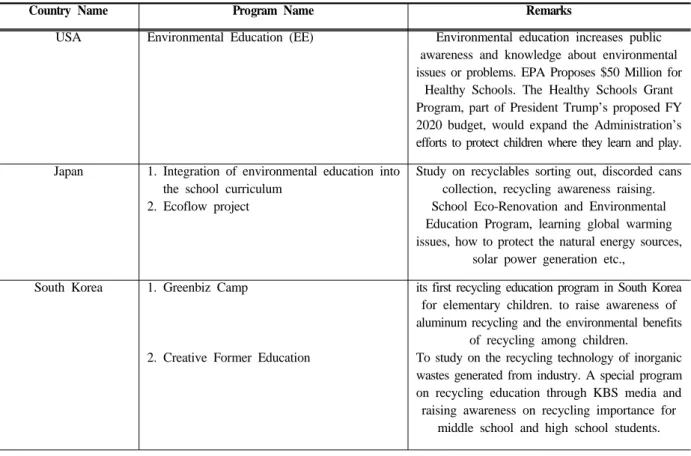
Country Name Program Name Remarks

USA Environmental Education (EE) Environmental education increases public awareness and knowledge about environmental issues or problems. EPA Proposes $50 Million for

Healthy Schools. The Healthy Schools Grant Program, part of President Trump’s proposed FY 2020 budget, would expand the Administration’s efforts to protect children where they learn and play.

Japan 1. Integration of environmental education into the school curriculum

2. Ecoflow project

Study on recyclables sorting out, discorded cans collection, recycling awareness raising.

School Eco-Renovation and Environmental Education Program, learning global warming issues, how to protect the natural energy sources,

solar power generation etc., South Korea 1. Greenbiz Camp

2. Creative Former Education

its first recycling education program in South Korea for elementary children. to raise awareness of aluminum recycling and the environmental benefits

of recycling among children.

To study on the recycling technology of inorganic wastes generated from industry. A special program on recycling education through KBS media and raising awareness on recycling importance for

middle school and high school students.

Table 1. Recycling environmental education programs in Asia for middle and high school students solar power generation, green roofs of the houses,

natural energy resources, minimize the energy con- sumption on heating and cooling? Through the Eco-Flow project, students can easily understand the sustainable environmental construction from the pri- mary education level.

3.3. Recycling Education Program for middle school students in South Korea

An Aluminium rolling and recycling company named Novelis launched a new "GreenBiz Camp,". In South Korea, this is the first recycling education pro- gram for elementary school children. Novelis aims to raise awareness of aluminum importance, recycling and benefits to the environment by recycling to the children.

The GreenBiz Camp, a global youth educational group and co-sponsored by Junior Achievement Korea, hosted 52 children to educate them in sustain- ability aspects. It is a three-day camp and trained them in making a solar energy car and also teach the importance of recycling technologies. This youth ed- ucation group have a chance to visit the Novelis

Yeongju Recycling Center, which is Asia’s largest aluminum recycling facility in Korea.

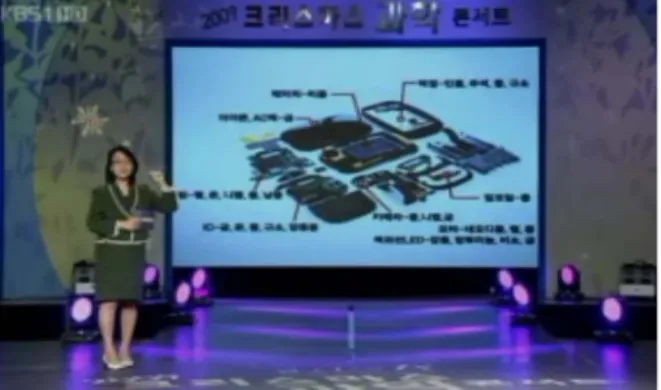
There are several recycling education programs through media conducted in South Korea (Fig.1). In KIGAM, Dr. Ahn Ji Whan, Director had carried out the project during the years 2007-2010(10) related to study on the recycling technology of inorganic wastes generated from different industries. This project is funded by the Ministry of Education (ME, Korea).

Under this project, she visited schools and educated the students about recycling importance and con- ducted the recycling education programs for middle school and high school students with the “Creative Former Education” program in Korea. Dr. Ahn Ji Whan is an adjunct professor to Recycling and Energy Program and educating the students at Korea Science Academy of KAIST. During the five years, she educated teachers from elementary, middle and high schools through her recycling education pro- gram lectures "The Expedition of creating Resources from Trash Island" in Creative Geo Camp in KIGAM.

The overall environmental education programs throu-

ghout Asia was summarized in the Table 1.

(4)

Thenepalli Thriveni, Chilakala Ramakrsihna, Ahn Ji Whan

에너지공학 제28권 제1호 2019 48

Fig. 1. Recycling Education Program through KBS media, 2009

4. Conclusions

Recycling is one of the technique which helps to minimize energy consumption, reduce fresh raw ma- terials usage, minimize water pollution and air pollu- tion (from landfilling). The major benefit from re- cycling is that it helps the environment to be sustainable. Most of the European countries devel- oped their own recycling programmes incorporating some extent of manufacturer responsibility. Asia net- work also lanched a basic recycling education pro- gram in high schools and middle schools similar to the Europian Union. Recycling helps to save energy particularly, it is crucial in massive production, such as refining or mining. There are major benefits of re- cycling is it helps to minimize greenhouse gas emis- sions and also global warming. Recycling is a sig- nificant resource technology needs to encourage at primary school education level, corporate offices and at international levels. This could help to preserve our precious natural resources for our future gen- eration, without any limitations.

Acknowledgments

This study was supported by the Energy Technol- ogy Development Project [20141010101880] of the Korea Institute of Energy Technology Evaluation and Planning, financed by the Ministry of Trade, Indu- stry, and Energy.

References

1. Cristina, Poncibò., 2017, The law and practice of

international sale contracts: protecting the envi- ronment for future generations, Uncitral Confer- ence (4-6 July 2017).

2. Imperatives, S., 1987, Report of the world com- mission on environment and development: our common future (Oxford: Oxford University Press, 1987), pp. 1-300.

3. Gregory, L. V., Deborah, A. S., Jay, G., 2009, Waste limitation management and recycling de- sign challenge, educator’s guide with activities in science, technology, engineering, and mathematics, grades 5-8, National Aeronautics and Space Administration(NASA), pp.1-64.

4. Report, 2011, Education, audio-visual and culture executive agency, science education in Europe:

national policies, practices, and research, pp.1-166.

5. Report, 2010, A middle school curriculum on re- cycling, talking trash in Tucson, City of Tucson recycling education program, pp.1-39.

6. Chris, B., 2018, Students lead recycling effort at Huntington, Adena. https://www.chillicothegazette.

com/story/news/local/2018/03/06/students-lead-recy cling-effort-Huntington-adena/397148002/.

7. Peter, C., Nan, S., 1994, The recycling awareness project, a service learning experience, final report, Poland, pp.1-97.

8. Brief Report Book, 2004, Environmental educa- tion materials: guidelines for excellence, 171BO 4003, ISBN:1-884008-41-0, The North American association for environmental education, pp.1-32.

9. Bishnu, B. B., Osamu, A., 2000, Environmental education in the Asia-Pacific region: some prob- lems and prospects, international review for envi- ronmental strategies, 2000, Vol.1, No.1, pp. 57-77.

10. Ji Whan, A., 2010, Study on the recycling tech-

nology of inorganic wastes generated from in-

dustry fields by CO

2

gas, 2007-2010.

수치

Table 1. Recycling environmental education programs in Asia for middle and high school studentssolar power generation, green roofs of the houses,
Fig. 1. Recycling Education Program through KBS  media, 2009

참조

관련 문서