Effect of Sexual Harassment Experience on the Job of a Physical Therapist : Seoul Metropolitan Area
Kim Sunho, PT
1․ Yu Wonjong, PT, Ph.D
2⧧1
Dept. of Physical Therapy, Eulji University, Undergraduate, Student
2⧧
Dept. of Physical Therapy, Eulji University, Professor
Abstract
Purpose : Sexual harassment cases involving health and medical workers, including physical therapists, nurses and psychotherapists, are on the rise. Despite the increased incidence of sexual harassment, prior studies show that physical therapists, nursing assistants and caregivers are not doing well cope with sexual harassment. Therefore this study examines the factors associated with sexual harassment damage experience among physical therapists, as well as the relationship between sexual harassment damage experience and job-related aspects. It is intended to prepare basic data for programs and research that can mediate these issues.
Methods : We conducted a self-reported questionnaire survey of 200 physical therapists working at medical institutions in the Seoul metropolitan area. The survey items included sexual harassment experience and job-related aspects such as satisfaction, stress, burnout, and engagement. A correlation analysis was conducted to clarify the relationship between sexual harassment experience and job-related factors, and multiple regression analysis was conducted to verify the correlations of sexual harassment experience on physical therapists’ job.
Results : There was a weak correlation between sexual harassment experience, job satisfaction, and job engagement, and a moderate correlation between sexual harassment experience, job stress, and job burnout. The impact of sexual harassment experience on job had a significant correlation on job satisfaction, job stress and burnout.
Conclusions : Sexual harassment damage experience among physical therapists had a significant impact on many job aspects.
Thus, there is a need for countermeasures and education to prevent sexual harassment, or at least effectively cope with the consequences. It is proposed to expand to other local or national units as follow-up studies, to study other factors affecting sexual harassment damage experience, and to develop and verify programs to cope with or prevent sexual harassment damage experience.
Key Words : sexual harassment, job stress, satisfaction, burnout, engagement
⧧
Corresponding author : Yu Wonjong, [email protected]
2)
Received : November 28, 2019 | Revised : December 23, 2019 | Accepted : December 27, 2019
Ⅰ. Introduction
Sexual harassment cases among health and medical workers such as physical therapists, nurses, and psychotherapists are on the rise (DeMayo, 1997). In a previous study, sexual harassment was investigated by occupational therapists, and the results of sexual harassment surveys by nurses in nursing homes and nursing care nurses reported that many cases of sexual harassment occurred and experienced (Lee et al., 2017). However, the physical therapist has been exposed to numerous sexual harassment damages due to the lack of prior research to investigate such sexual harassment damages. Those who have experienced sexual harassment are fearful of others, not just the perpetrators, and experience negativity in their workplace relationships as well as posttraumatic stress disorder symptoms such as anger and depression (Sin et al., 2017; Son et al., 2015). This increase in stress has consequences such as emotional exhaustion and depersonalization, ultimately affecting job satisfaction (Wang & Kim, 2015).
Job satisfaction is a psychological state that satisfies promotion, status, remuneration, working hours, and motivation to achieve (Cheon, 1991). Job satisfaction is closely related to quality of life and physical and mental health. In particular, excess stress and an inability to overcome the problem can compromise physical therapists’
ability to work; this occurs through communication breakdown and interpersonal disorders (Moon et al., 2010).
On the contrary, job stress, whether it is brought on by factors internal or external to the organization, is a factor that promotes and induces mental and physical reactions by stimulating the endocrine system and sympathetic nerves (Park, 2013). In particular, physical therapists experience a high degree of work-related stress through their relationships with patients, caregivers, and coworkers (Park, 2016). This leads to higher turnover rates, resulting in a decrease in the number of professionally trained physical
therapists and a decline in the quality of physical therapy (Hwang & Myoung, 2014).
According to Maslach’ commonly used definition, job burnout is a negative response to excessive stress, which can lead to dissatisfaction with and inattention to one’
surroundings (Son, 2018). Job burnout has three dimensions: cynicism, exhaustion, and inefficacy.
Job engagement refers to an individual’ level of involvement in an organization (Jang, 2018). A high degree of job engagement indicates that you will do your best on the job and that you prefer yours to other jobs (Han et al., 2010). In other words, job engagement is an important variable that determines job satisfaction and organizational and individual performance.
In our society, an ethical approach to health care is partly attempted, and ethics education related to health care is recognized as a professional ethical education for health workers. Because of the growing interest in ethical aspects, physical therapists also need to study the ethically problematic sexual harassment damages. There have been many studies on occupational therapists, caregivers, and nursing assistants but sexual harassment research, especially in the context of physical therapists, is sorely lacking.
Therefore, this study investigates the related factors of sexual harassment damage experience among physical therapists by studying its effects on job satisfaction, stress, burnout, and immersion in the clinical environment. By examining these relationships, this study attempts to identify the prevalence of sexual harassment in this population and prepare basic data for programs and studies that can mediate such problems.
Ⅱ. Methods
1. Research design
A self-reported a paper questionnaire was distributed to
physical therapists working in medical institutions in the
Seoul metropolitan area. Prior to conducting the survey, the researcher visited the medical institution and explained the purpose and necessity of the study.
2. Research participants
In this study, 185 people in Lee et al. (2017) study and 140 people in Park et al. (2014) study were surveyed for sexual harassment experience (Lee et al., 2017; Park et al., 2014). In this study, 207 people were surveyed. The participants were 207 physical therapists aged 23 to 48 who agreed to participate in the study. After excluding seven questionnaires owing to incomplete or inadequate responses, the data of 200 participants were used for the analysis.
3. Research period
The data were collected over a 31-day period from July 16 to August 15, 2019.
4. Research tools
1) Sexual harassment
Sexual harassment experience involved visual, verbal, and physical aspects. Twenty-six of the questions used by Kim et al. (2013) were modified for use among physical therapists and scored on a five-point Likert scale. Higher scores were indicative of more sexual harassment experiences. The reliability of previous studies was Cronbach’ α = 0.96 (Kim et al., 2013).
2) Job satisfaction
In this study, the Job Satisfaction Index used by Jang (2010) was used. As for scoring, 10 of the 18 items were reverse coded, as done in Jang (2010). The eight items that were not inverted were scored on a five-point Likert-type scale ranging from 1 (not absolutely) to 5 (always true).
The 10 reverse-coded items were scored from 5 (not
absolutely) to 1 (always true), which means that the higher the score, the higher the job satisfaction. In a previous study, Cronbach's α has been demonstrated to be 0.508-0.745 (Jang, 2010).
3) Job stress
Job stress was measured with Kim (2017) modification of the nurse job stress measurement tool developed by Kim and Gu (1984). Only physiotherapist-related items were used. This tool consists of five questions related to workload, four questions related to doctors and supervisors, three questions related to patients and guardians, and four questions related to professional role conflict. The 16 questions are scored on a five-point Likert-type scale, with the sum of the scores of each item corresponding to each factor divided by the number of items. In a previous study, Cronbach’ α has been demonstrated to be 0.77 (Kim, 2017).
4) Job burnout
Park (2016) Korean version of the Maslach Burnout Inventory- General Survey was used to measure job burnout. This 16-item tool includes five items related to emotional exhaustion, five items related to cynicism, and six items related to job confidence, scored on a five-point Likert-type scale. In a previous study, Cronbach's α was 0.843 for exhaustion, 0.809 for cynicism, and 0.866 for job confidence (Park, 2016).
5) Job engagement
In this study, the Job Engagement Index used by Baek (2016) was used. This was the version used in the present study. Eight emotional and eight normative engagement items were scored on a five-point Likert-type scale. In a previous study, Cronbach’ α was 0.801 for emotional engagement and 0.826 for normative engagement (Baek, 2016).
5. Analysis method
The collected data were analyzed using the SPSS 21.0 statistical program. Frequency and technical analyses were conducted to identify general characteristics and sexual harassment experience, and correlation analysis was conducted to clarify the relationship between sexual harassment experience and job-related factors such as satisfaction, stress, burnout, and engagement. Multiple regression analysis was conducted to verify the effects of sexual harassment damage experience on job satisfaction, stress, burnout, and engagement. In the correlation analysis, p<.05 is low, p<.01 is medium, p<.001 can be interpreted as having a high correlation.
Ⅲ. Results
1. General characteristics
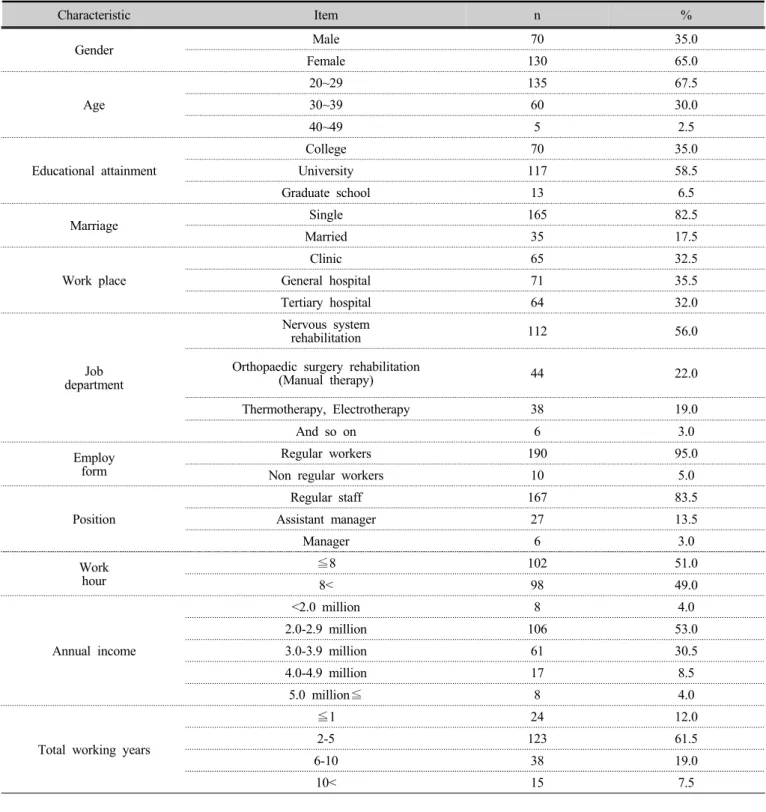
Regarding the participants’ general characteristics, 65.0
% were females, and most (67.0 %) were in their 20s.
General hospitals were the most common type of workplace (35.5 %) and with regard to job department, most participants (56.0 %) worked in nervous system rehabilitation. Most participants (95.0 %) were full-time workers, and the most common position (83.5 %) was that of a regular staff member. Of the participants, 51.0 % worked fewer than eight hours a day. Regarding annual income, the most common bracket (53.0 %) was under 30 million won. Most participants’ (61.5 %) total work experience was under five years. Among the types of sexual harassment, verbal sexual harassment (mean=1.79) was the most common while physical harassment (mean=1.79) was the least common (Table 1).
2. Chi-square distribution by gender
The results of cross analysis by gender. There was a significant difference in visual, verbal and physical sexual
harassment experience according to gender (p<.05). Also, There was a significant difference a emotional engagement in job engagement (p<.05). Since the average score of male sexual harassment victims is lower than that of females, it can be seen that more female sexual harassment victims experience from female. There was no significant difference in other job satisfaction, job stress, job burnout, and normative engagement of job engagement, so gender was not affected (Table 2).
3. Correlations between sexual harassment damage, job satisfaction, job stress, job burnout, and job engagement
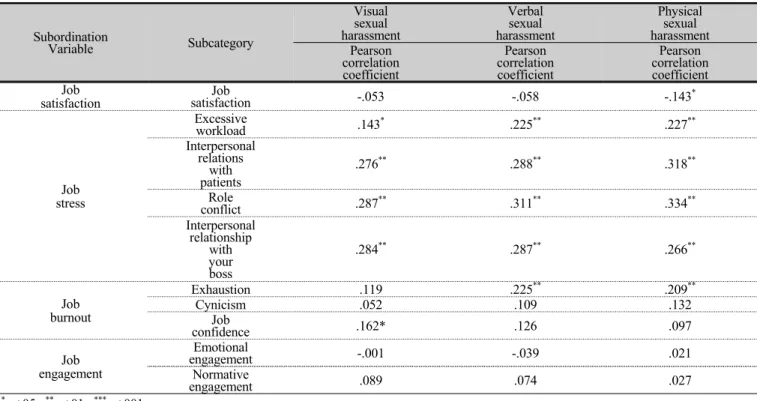
An examination of the relationships between sexual harassment damage experience and the above mentioned job-related factors showed that job satisfaction had a weak negative correlation with physical sexual harassment (p<.05) and most of the job stress has had a middle correlation (p<.01). There was a weak correlation between visual sexual harassment and excessive workload (p<.05). There was middle a correlation between burnout, verbal harassment, and physical harassment. There was a weak correlation between visual harassment and job confidence (p<.05). However, there was a very weak correlation in job engagement (Table 3).
4. Effects of sexual harassment damage experience on job satisfaction, job stress, job burnout, and job engagement
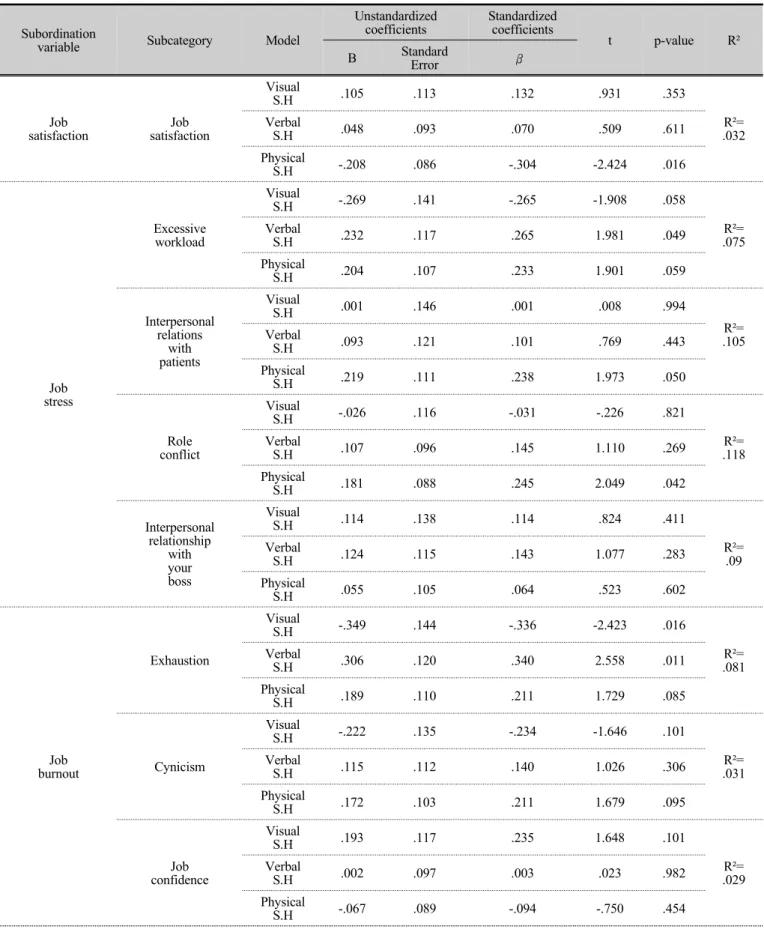
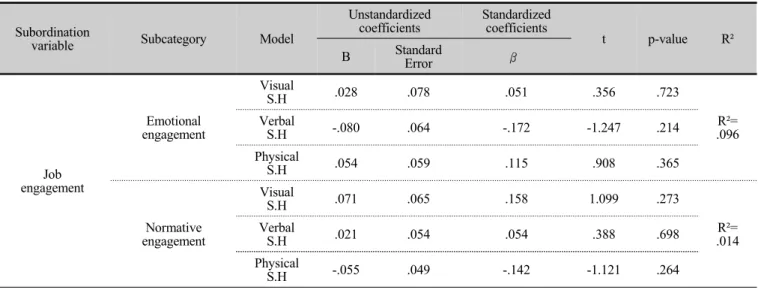
Physical sexual harassment had a significant effect on job satisfaction (p<.05, R²=.032), interpersonal relations with patients (p<.05), and role conflict (p<.05). In the case of verbal sexual harassment, it was found to affect excessive workload (p<.05), while visual and verbal sexual harassment affected burnout (p <.05). However, sexual harassment experience did not affect the interpersonal relationship with the boss, cynicism, job confidence, emotional engagement, and normative engagement (p<.05).
In the case of job stress, interpersonal relations with
patients (R²=.105), role conflict (R²=.118), and interpersonal relationship with your boss (R²=.09) were found to have high explanatory power. In addition, the emotional engagement of job engagement showed a high level of explanatory power that sexual harassment affects (R²=.096).
The low level of explanation is the job satisfaction (R²=.032), job cynicism of job burnout (R²=.031), job confidence (R²=.029) and normative engagement of job engagement (R²=.014)(Table 4).
Characteristic Item n %
Gender Male 70 35.0
Female 130 65.0
Age
20~29 135 67.5
30~39 60 30.0
40~49 5 2.5
Educational attainment
College 70 35.0
University 117 58.5
Graduate school 13 6.5
Marriage Single 165 82.5
Married 35 17.5
Work place
Clinic 65 32.5
General hospital 71 35.5
Tertiary hospital 64 32.0
department Job
Nervous system
rehabilitation 112 56.0
Orthopaedic surgery rehabilitation
(Manual therapy) 44 22.0
Thermotherapy, Electrotherapy 38 19.0
And so on 6 3.0
Employ form
Regular workers 190 95.0
Non regular workers 10 5.0
Position
Regular staff 167 83.5
Assistant manager 27 13.5
Manager 6 3.0
Work hour
≦ 8 102 51.0
8< 98 49.0
Annual income
<2.0 million 8 4.0
2.0-2.9 million 106 53.0
3.0-3.9 million 61 30.5
4.0-4.9 million 17 8.5
5.0 million≦ 8 4.0
Total working years
≦1 24 12.0
2-5 123 61.5
6-10 38 19.0
10< 15 7.5
Table 1. General characteristics
Subordination
variable Subcategory Mean Pearson
Chi-Square
value p-value
Mean±SD Male Female Mean±SD
Sexual harassment
Visual sexual
harassment 1.32±.45 1.91±.72 46.357 .000
Verbal sexual
harassment 1.41±.52 2.00±.86 46.122 .001
Physical sexual
harassment 1.40±.60 1.86±.86 36.825 .002
satisfaction Job Job
satisfaction 3.32±.56 3.17±.55 59.085 .078
stress Job
Excessive
workload 3.14±.77 3.25±.71 20.286 .378
Interpersonal relations
patients with
2.75±.75 2.86±.74 16.930 .152
conflict Role 3.44±.69 3.52±.59 17.867 .213
Interpersonal relationship
with your boss
2.95±.78 3.05±.70 14.590 .481
burnout Job
Exhaustion 3.10±.76 3.30±.72 23.168 .184
Cynicism 2.37±.70 2.54±.66 24.283 .146
confidence Job 3.52±.61 3.42±.57 27.009 .079
engagement Job
Emotional
engagement 2.93±.41 2.79±.37 40.563 .002
Normative
engagement 2.54±.31 2.59±.31 16.912 .203
Value are M±SD.
Table 2. Chi-square distribution by gender
Subordination
Variable Subcategory
Visual sexual harassment
Verbal sexual harassment
Physical sexual harassment Pearson
correlation coefficient
Pearson correlation coefficient
Pearson correlation coefficient satisfaction Job Job
satisfaction -.053 -.058 -.143
*stress Job
Excessive
workload .143
*.225
**.227
**Interpersonal relations
patients with
.276
**.288
**.318
**conflict Role .287
**.311
**.334
**Interpersonal relationship
your with boss
.284
**.287
**.266
**burnout Job
Exhaustion .119 .225
**.209
**Cynicism .052 .109 .132
confidence Job .162* .126 .097
engagement Job
Emotional
engagement -.001 -.039 .021
Normative
engagement .089 .074 .027
*