• 검색 결과가 없습니다.

elements for providing high energy liquid. This study focuses on the analysis of a high pressure multistage centrifugal pump for descaling in a hot rolling mill[2].

N/A
N/A
Protected

Academic year: 2021

Share "elements for providing high energy liquid. This study focuses on the analysis of a high pressure multistage centrifugal pump for descaling in a hot rolling mill[2]. "

Copied!
9
0
0

로드 중.... (전체 텍스트 보기)

전체 글

(1)

1. Introduction

Multistage centrifugal pump is one of the most widely used turbo machines in industrial and mining enterprises. Pumping systems consume a great deal of power and have great energy saving potential. Studies show that pumps contribute to around 20% of global energy consumption through electric motors[1]. Many industries still rely on substandard low efficiency pumps to operate their plants. The search for more efficient systems has led to significant growth in the field of pump analysis, design and development. Moreover, multistage centrifugal pumps have gained a lot of attention in the past several years as fundamental

elements for providing high energy liquid. This study focuses on the analysis of a high pressure multistage centrifugal pump for descaling in a hot rolling mill[2].

Modern centrifugal pump design is heavily dependent on testing and experimentation. In order to save time and resources, manufacturers turn to computational techniques to study design features, reduce the number of tests conducted and identify undesirable design characteristics at an early stage. Computational fluid dynamics (CFD) can help pump designers develop pumps that operate at higher efficiencies. In order to produce a hydraulically efficient pump, there are a variety of geometrical design parameters that need to be identified and optimized. Some impeller design

* Graduate school, Department of Mechanical Engineering, Mokpo National University, Muan-gun, 58554, Republic of Korea

** Department of Mechanical Engineering, Institute of New and Renewable Energy Technology Research, Mokpo National University, Muan-gun, 58554, Republic of Korea

† Corresponding Author, E-mail : [email protected]

◎ Original Paper ISSN (Print): 2287-9706

고압 다단 원심펌프의 성능향상 및 소형화를 위한 유로 형상 설계

곽명*⋅최영도**†
Flow Passage Shape Design of a High Pressure Multistage Centrifugal Pump for Performance Improvement and Miniaturization

Ming Guo *

*

, Young-Do Choi **†

**

Key Words : Multistage Centrifugal Pump( 다단 원심 펌프 ), flow passage shape( 유로 형상 ), Performance improvement( 성능 향상 ), Miniaturization( 소형화 ), Computational Fluid Dynamics( 전산 유체 역학 ).

ABSTRACT

A descaler is a device that is used to remove scales from heat treated steel at hot rolling mills. Scales are impurities that affect

the appearance and properties of heat treated steel. Oxide scales form on heat treated steel when the iron in the steel is exposed to

the oxygen in the air during the heat treating process. This study focuses on the performance improvement and miniaturization of a

high pressure multistage centrifugal pump model which is used for descaling in a hot rolling mill. In order to achieve the performance

improvement and miniaturization of this multistage pump, the flow passage shapes including impeller, diffuser and return vane have

been newly designed. The design process of new flow passage shapes were discussed in detail. A commercial numerical code (ANSYS

CFX) was adopted to conduct the numerical simulation for pump models and only two stages of the pump models were analysed to

reduce solving time. The internal flow characteristics were compared with original and new design. The new designed flow passage

shapes of multistage pump model were smaller and the new design showed a better efficiency and much smoother internal flow

characteristics, which means that the performance improvement and miniaturization of the multistage pump model were achieved.

(2)

parameters include entrance/discharge blade angle, number of blades, blade sweep and meridional plane.

Akiha et al.[3] had investigated the flow instability in off design operation of a multistage centrifugal pump.

They focused on diffuser rotating stall, and observed the positive-slope phenomena in the Q-H curve through experimental method and numerical analysis. The increase in the loss of the diffuser was found as the main cause of positive slope. Lee et al.[4] investigated the recirculation of flow inside the return channel vanes of a multi-stage centrifugal pump. A better exit blade angles of 90˚ and 100˚ showed a better performance. The return channel with blade exit angles of 90˚ and 100˚

removed flow recirculation and the efficiency of pump increased about 2%. Kim et al.[5] studied a high- pressure multistage pump used in combined cycle power plants. pump performance characteristics were numerically analyzed for different shapes of the radial diffuser. Ding et al.[6] investigated about the performance prediction of a 14-stage centrifugal pump with opposed impeller configuration including all the fluid volumes, wearing ring leakage and seal flush.

In this study, a high pressure multistage centrifugal pump model used for descaling in a hot rolling mill was analyzed as the original design. Regarding the industrial application, the original designed multistage centrifugal pump model showed poor hydraulic performance. Moreover, a relative smaller assembled pump structure could reduce space occupied and manufacturing costs. Therefore, the performance improvement and miniaturization of multistage centrifugal pump models were adopted as the research objectives. The new flow passage shapes were designed to meet with the industrial demand. The detailed flow characteristics of new and original designs were compared and it was verified that the smaller new design of two-stage multistage centrifugal pump achieved a better pump performance by using a commercial code of ANSYS CFX[7].

2. Modeling and numerical methods 2.1 Two-stage multistage pump model

2.1.1 Design of pump impeller

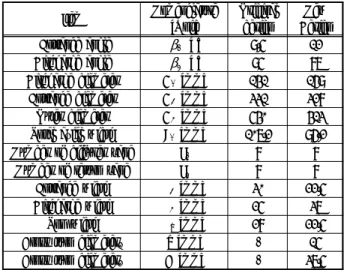
Table 1 shows the design specification of the two-

stage multistage pump, including the rotational speed, specific speed, capacity coefficient and head coefficient.

The definitions of capacity and head coefficient[8]

are shown as follows:

  

 

(1)

  



(2)

Where the u 2 is the impeller peripheral velocity, H is the head of one stage multistage pump and c m2 is the meridional velocity at impeller discharge.

Table 1 Design specification

Item Nomenclature[Unit] value

Capacity coefficient Φ 0.090

Head coefficient ψ 0.974

Rotational speed n [rpm] 4350

Specific speed n s (One stage)

[m, m 3 /min, min -1 ] 176

Table 2 Design parameters of impeller Item Nomenclature

[Unit]

Original design

New design Outlet diameter D 2 [mm] 331 322

Inlet diameter D 1 [mm] 189 169 shaft diameter d h [mm] 115 95

Blade Num. Z 7 7

Wrap angle θ ] 103 126

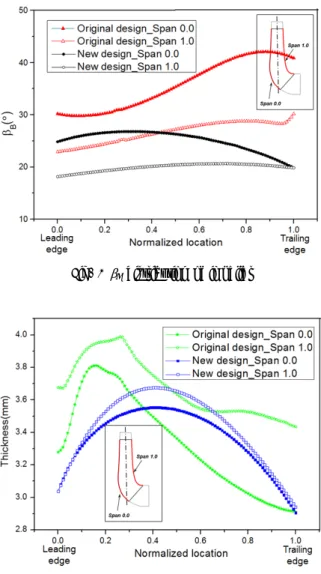
Outlet blade width b 2 [mm] 17.5 20 Inlet blade width b 1 [mm] 27 37 Blade angle β B [˚ ] Fig. 1 Fig. 1 Blade thickness δ [mm] Fig. 2 Fig. 2

According to the input power and torque, the

strength and stiffness were estimated and the shaft

diameter of impeller was determined. The other main

design parameters of impeller also have been

calculated by basic equations[9] and the design

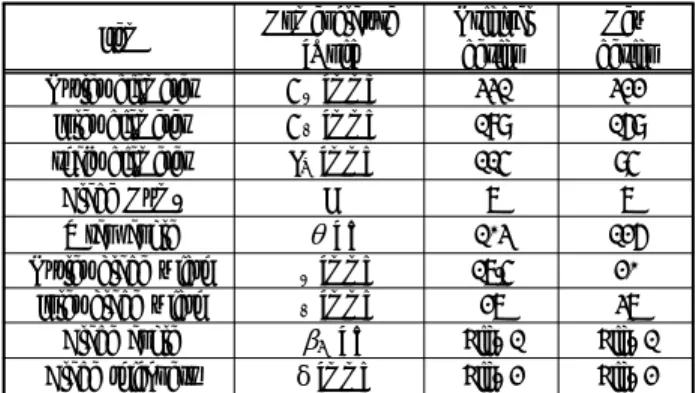
parameters are listed in Table 2. The original designed

two stage impellers, diffusers and return vanes were

the same. therefore, the new designed first and second

stage of impellers, diffusers and return vanes were

also kept the same in the multistage pump. From

Table 2, the design parameter difference between the

original and new designed impellers could be easily

checked.

(3)

Fig. 1 β B distribution of impeller

Fig. 2 Blade thickness distribution of impeller

Fig. 1 and Fig. 2 show the impeller blade angle and blade thickness distributions. As we know, a smooth transition of blade angle and thickness distribution has positive effect on the performance of pump.

Moreover, the meridional shape is also a important factor which has great influence of the pump performance. Regarding the previous design practice and detailed applications, the two-arc design method[9] of impeller meridional shape has been adopted for the new design. The impeller meridional shapes of original and new design have been shown in Fig. 3(a) and the comparison of cross section area of meridional shapes is illustrated in Fig. 3(b). The cross section area of new design is larger than original design and there is a hump existing at the cross section area distribution of new design, which could improve the cavitation performance of the multistage pump.

Fig. 3(a) Meridional shape of impellers

Fig. 3(b) Comparison of cross section areas of meridional shape

2.1.2 Design of diffuser and return vane

The design parameters of original diffuser and return vane have been determined. The design process of continuous diffuser and return vane are presented as follows. A draft impeller meridional shape can be obtained from equation (3) to (5)[8]. The Braembussche et al. and Sulzer et al.'s previous study[9] also were referred.

The parameters of b 3 , D 3 , D 4 can be calculated by the following equation:

    ∼  (3)      ∼  (4)    ∼  ×   (5)

The discharge diameter of continuous diffuser and

return vane is the same with impeller entrance, so

(4)

Fig. 4 Velocity triangle distribution

Fig. 5 Absolute flow angle distribution

both of them could be perfectly connected. The entrance and discharge angles of the continuous vane also need to be considered carefully. The entrance of the continuous vane guides the water flow from the impeller. So the entrance angle needs to match with absolute angle of water flow.

Fig. 4 shows the velocity triangle of the water between the impeller and diffuser. α is the absolute angle which is between the absolute velocity( V ) and peripheral tangential velocity( U ). β is the relative angle which is between the relative velocity( W ) and peripheral tangential velocity( U ).

The absolute flow angle around the impeller outlet is illustrated in Fig. 5. Regarding the absolute flow angle(α) distribution, 12˚(10˚+2˚[attack angle]) is selected as the diffuser entrance angle( β 1 ′ ).

The recommended value of discharge vane angle( β 2 ′ ) is between 60˚ and 90˚. If the absolute flow angle (α) in the discharge area can be close to 90˚, the water can flow out straightly and it can reduce the swirl and recirculation flow at the impeller entrance.

Therefore, the discharge vane angle( β 2 ′ ) is determined as 87˚. The number of diffuser and return vane is selected as 8.

Fig. 6 Meridional shape of diffuser and return vane

Fig. 7 Comparison of meridional shape of original and new designed multistage pump

Table 3 Design parameters of diffuser and return vane Item Nomenclature

[Unit]

Original design

New Design Entrance angle β 1 ' [˚ ] 9.5 12 Discharge angle β 2 ' [˚ ] 95 87 Discharge diameter D 0 [mm] 141 169 Entrance diameter D 3 [mm] 331 328 Outer diameter D 4 [mm] 540 413 Total axial width L 0 [mm] 107.2 96.2

Number of diffuser vane Z 1 8 8

Number of return vane Z 2 8 8

Entrance width b 3 [mm] 30 22.5 Discharge width b 4 [mm] 25 37

Top width b r [mm] 28 22.5

Cross turn diameter 1 r [mm] - 15 Cross turn diameter 2 R [mm] - 37.5

All the design parameters are listed in Table. 3.

Meridional shapes are illustrated in Fig. 6 and total

comparison of meridional shape of original and new

designed multistage pump is shown in Fig. 7.

(5)

Fig. 8 shows the shroud of vane development on a plane. The vane development on a plane is drawn to correspond to the profile and the vane angle at entrance and discharge.

The most important parameter L can be calculated by the following equation:

 



×  (6)

Where D 3 is the entrance diameter of diffuser. Δψ is the trap angle of continuous diffuser and return vane. The value of wrap angle is recommended to be between 120˚ and 170˚. The value of L 1 can be calculated by equation (7):

  ∼  ×  (7)

The transition point is in the sharp turn of the continuous diffuser and return vane. The vane at this point will change direction. To be smoother transition of diffuser and return vane at this point, This angle should be kept as 0˚. The hub line also can be drawn with the same method.

After all the design parameters have been determined and shroud-hub lines have been constructed. The 3-D modeling can be established by following the Error Triangle Method[9].

Fig. 8 Vane development on a plane (Shroud line)

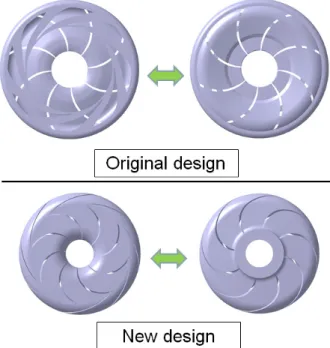
For the current design, 3-D modeling is illustrated in Fig. 9. From Fig. 9, it can be seen that the whole fluid domain of new designed continuous diffuser and return vane is divided into several independent flow channels. The respective water flows in the separated channels do not affect each other. Original design consists of discontinuous diffuser and return vane.

One more transition part connects the discontinuous diffuser and return vane.

Fig. 9 Original and new designed diffusers and return vanes

2.2 Numerical methods

Fig. 10 Numerical grid

(6)

Fig. 11 Mesh dependence test

Calculation type Analysis type Steady state

Numerical methods

Fluid type Water

Turbulence model Shear Stress Transport y+ Below 10 at impeller

Below 32 at others

Boundary condition

Inlet Total pressure

Outlet Flow rate

Wall No-slip

Table 4 Numerical methods and boundary condition

To investigate the internal flow characteristics of the two-stage multistage pump, a series of simulations have been conducted. A commercial code of ANSYS CFX[7] was utilized for the numerical simulations. The numerical mesh of whole fluid domain used in this study is shown in Fig. 10. The numerical mesh dependence test also has been carried out by original design as shown in Fig. 11 and finally a mesh number of 6.5×10 6 is selected for numerical simulations. The same mesh number was adopted in the new design of two-stage pump.

Furthermore, the numerical methods and boundary condition are shown in Table 4. Single phase(water) steady state calculations were conducted and Shear Stress Transport(SST) turbulence model was utilized for CFD analysis. The boundary condition of total pressure and flow rate were applied in the pump inlet and outlet, respectively.

3. Results and discussion 3.1 Performance curves

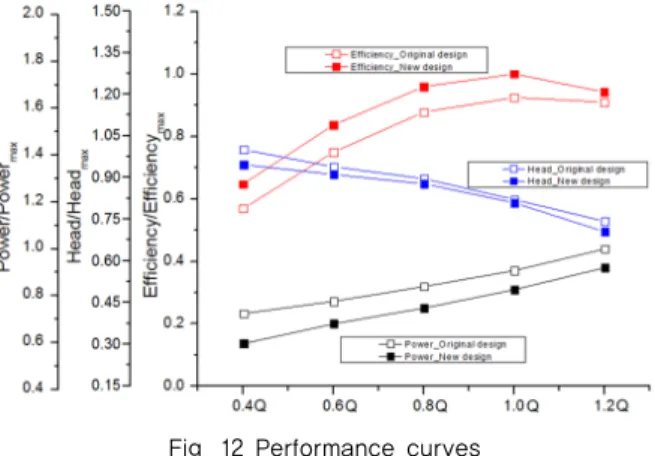
To evaluate the overall performances of original design and new design two-stage multistage pumps,

Fig. 12 Performance curves

the performance curves are shown in Fig. 12.

The efficiency of multistage centrifugal pump is defined by the equation as follows:

η =

 

 

(8)

Where η is the efficiency of the multistage centrifugal pump; T is the input torque; H is the effective head; Q is the flow rate of pump.

This multistage centrifugal pump is used for descaling in a hot rolling mill. For the normalized performance curves, efficiency, head and power at various operation conditions were divided by the maximum values of efficiency, head and power as indicated in Fig. 12. From Fig. 12, it can be seen that the effective heads at different flow rates were achieved. The new design two-stage multistage centrifugal pump reduces a quite amount of input power and the efficiency increases much in different operation conditions.

3.2 Loss analysis

In order to more deeply understand the contribution of each component in the two stage multistage centrifugal pump, the loss analysis has been done in the original and new design multistage pump. The equations are defined as follows:

   (9)       

   (10)

Where the H loss gives the total head loss for the

(7)

each components of two-stage multistage centrifugal pump except impeller. H Loss,impeller gives the total head loss only for the impeller of two-stage multistage centrifugal pump. Δp Total is the total pressure difference between each component.

All the loss at each component of two-stage multistage centrifugal pump were calculated as shown in Fig. 13. The new designed impeller and continuous diffuser and return vane show a better performance than the original design. The new designed components reduced loss, especially in the continuous diffuser and return vane.

Fig. 13 Loss analysis at each component of pump(Design point)

3.3 Internal flow analysis

Fig. 14 shows the tangential velocity ratio distribution. The measurement location is around the impeller outlet. The axis of Y ordinate is defined as

Fig. 14 Tangential velocity ratio distribution

tangential velocity ratio( v θ /u 0 ), where the v θ is the tangential flow velocity around the impeller and u 0 is the tangential velocity in the periphery of impeller defined by the following equation:

u 0 = rω (11)

Where ω is the angular velocity, r is the radius of impeller.

From the result of Fig. 14, it can be seen that there are some parts of the original designed impeller’s tangential velocity ratio distribution is below 0. The 0 level line is marked in the figure. As we know, the impeller only has one fixed rotational direction. In normal conditions, the flow pattern has a consistent direction. The negative value means that the water flow in this area has a tangential velocity component in the opposite direction. So it can be inferred that the water flow is not smooth enough and flow uniformity is low in this area. And it will increase the loss in the impeller.

Fig. 15 Pressure coefficient distribution of continuous

diffuser and return vane blade(New design)

(8)

Fig. 16 Pressure measurement location

Fig. 17 Streamline distribution on the blade of continuous diffuser and return vaneby new design

The pressure coefficient distribution around the blade of new designed continuous diffuser and return vane is shown in Fig. 15. The measurement location is shown in Fig. 16. The pressure coefficient is calculated by the following equation:

   



(12)

Where p blade is the pressure around the blade of continuous diffuser and return vane, ρ is water density, r is the radius of impeller and ω is angular velocity.

For the streamwise location of two stage continuous diffuser and return vane blade, the value of 0 means the inlet leading edge of blade, and 1 means the trailing edge of the blade. From the result of Fig. 15, it can be seen that the pressure is kept no change in a streamwise range of 0-0.55 and it becomes to decrease in a streamwise range of 0.55-1. Almost the

Fig. 18 Streamline distribution on diffuser and return vane

same tendency of stage 1 and stage 2 could be observed. As we know, the diffuser and return vanes are used to transfer the water flow from one impeller to next impeller. The pressure decreasing means energy loss in this part.

Fig. 17 shows the streamline distribution of 2 stage continuous diffuser and return vane blades by new design. There is recirculation flow in the latter part of both first and second stage blades. That is why the pressure decreases in a location range of 0.55-1. The sharp turn of blade maybe cause the recirculation flow in this area. This problem will be investigated more in the future study.

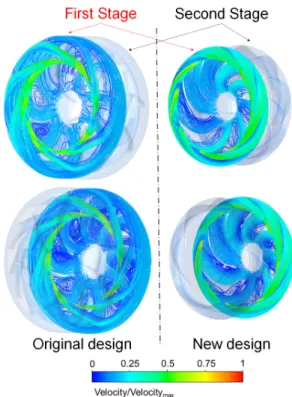
In the streamline distribution of Fig. 18, both first stage and second stage of continuous diffuser and return vane shows a smoother streamline distribution.

For the original designed diffuser and return vane, the water flow is not properly guided by diffuser and there are many recirculation flows existing in the return channel. That is why in Fig. 13 this part shows much higher loss than new design.

4. Conclusions

In this study, the different flow passage shapes of

(9)

multistage pump were designed and numerical simulations also were carried out to investigate the performance and internal flow characteristics.

The performance curves and loss analysis showed that the new designed flow passage shapes achieved a better performance and the loss in each component of new design was less than the original design.

It was proven that the new designed continuous diffuser and return vane was much better than original design. Moreover, the radial diameter and axial width of new design were both smaller than the original design. From streamline distribution, it can be seen that the separated flow channels of new design reduce the loss of recirculation flows.

Acknowledgment

This research(work) was supported by the long- term oversea training support program of Mokpo National University in 2019.

References

(1) I. Wolfgang, M. Berthold, “Pumps for descaling systems in steel making”, World Pumps, Volume 2007, Issue 490, pp. 22~25, 2007.

(2) T. Khin Cho, K. Mya Mya, A. Khin Maung,

“Design and Performance Analysis of Centrifugal Pump”, World Academy of Science, Engineering and Technology, pp. 46, 2008.

(3) S. Akiha, H. Hideto, M. Kazuyoshi, “Study of flow instability in off design operation of a mul- tistage centrifugal pump”, Journal of Mechanical Science and Technology, pp. 493~498, 2016.

(4) J. Lee, M. Moshfeghi, N. Hur and I. S. Yoon,

“Flow analysis in a return channel of a multi-stage centrifugal pump”, Journal of Mechanical Science and Technology, pp. 3993~4000, 2016.

(5) D. S. Kim, S. Mamatov, S. G. Jeon and W. G.

Park, “A study of the performance of a radial diffuser for a multistage high-pressure pump”, Journa of Mechanical Science and Technology, pp. 1693~1700, 2017.

(6) H. Ding, W. Gao, H. Gao, “CFD simulation of a multi-stage centrifugal pump”, Proceeding of the ASME 2017 Fluids Engineering Division Summer meeting FEDSM2017, Waikoloa, Hawaii, USA (7) ANSYS Inc, ANSYS CFX Documentation Ver.

18.1 http://www.ansys.com (2017)

(8) A. J. Stepanoff, “Centrifugal and Axial Flow Pumps Theory Design and Application”, America, pp. 95~99, 129~132, 1957.

(9) X. F. Guan, “Modern pump theory and design”,

China, pp. 325~326, 2011.

수치

Table 1 Design specification
Fig. 1 and Fig. 2 show the impeller blade angle and  blade thickness distributions. As we know, a smooth  transition  of  blade  angle  and  thickness  distribution  has  positive  effect  on  the  performance  of  pump
Fig. 7 Comparison of meridional shape of original and new  designed multistage pump
Fig. 8 shows the shroud of vane development on a  plane. The vane development on a plane is drawn to  correspond  to  the  profile  and  the  vane  angle  at  entrance and discharge
+4

참조

관련 문서