H. Lee ・ S. H. Lee ・ H. B. Kim ・ N. H. Lee ・ C. S. An ( ) School of Biological Sciences, College of Natural Sciences, Seoul National University, Seoul 151-747, Korea
e-mail: [email protected] H. Lee
Division of Life Sciences, Korea Polar Research Institute, KORDI, Incheon 406-840, Korea
S. H. Lee
Department of Plant Biology, University of Minnesota, St. Paul, Minnesota 55108, U.S.A
H. B. Kim
The Natural Science Research Institute, Myongji University, Yongin 449-728, Korea
Analysis of the Oxidative Stress-Related Transcriptome from Capsicum annuum L.
Hyoungseok Lee ・ Sang Ho Lee ・ Ho Bang Kim ・ Nam Houn Lee ・ Chung Sun An
Received: 12 October 2010 / Accepted: 26 October 2010
ⓒKorean Society for Plant Biotechnology
Abstract For the massive screening of the genes related to oxidative stress, a cDNA library was constructed from hot pepper (Capsicum annuum L. cv. Nockkwang) leaves treated with methyl viologen. From this library, 1,589 cDNA clones were sequenced from their 5' ends. The sequences were clustered into 1,252 unigenes comprised of 152 contigs and 1,100 singletons. Similarity search against NCBI protein database identified 1,005 ESTs (80.3%) as Known, 197 ESTs (15.7%) as Unknown, and 50 ESTs (3.99%) as No hit.
In the ESTs, oxidative stress-related genes such as ascorbate peroxidase, catalase, and osmotin precursor were highly expressed. The cDNA microarray containing 1,252 unigenes was constructed and used to analyze their expression upon methyl viologen treatment. Analyses of the hybridization revealed that various stress-related genes such as peroxidase, tyrosine aminotransferase, and omega-6 fatty acid desaturase, were induced and some metabolism related genes such as aldolase and ketol-acid reductoisomerase, were repressed by methyl viologen treatment, respectively. The information from this study will be used for further study on the functional roles of oxidative stress-related genes and signaling network of oxidative stress in hot pepper.
Keywords Capsicum annuum, EST, hot pepper, methyl viologen, microarray, oxidative stress
Introduction
In plants, exposure to various abiotic and biotic stresses is known to induce reactive oxygen species (ROS) accumulation such as hydrogen peroxide (H2O2), superoxide (O2-), hydroxyl radicals, and singlet oxygen (1O2) (Desikan et al. 1998; Niyogi 1999). Among them, due to its relatively long half-life and high permeability across membrane, H2O2 especially plays an important role under these conditions (Yang and Poovaiah 2002). It participates in many protective reactions such as reinforcing cell wall and phytoalexin production (Quan et al. 2008).
However, excess H2O2 and corresponding oxidative stress can be detrimental to cells. Various internal or external factors, such as drought stress, ABA, H2O2 itself synthesized in response to loss of turgor, low and high temperatures, excess excitation energy, UV irradiation, and ozone (Karpinski et al. 1999; Langebartels et al.
2000; Pei et al. 2000; Wahid et al. 2007; Gao and Zhang 2008) can induce accumulation of H2O2. Those stimuli thus can lead to inactivation of photosynthetic activities and the oxidation of lipids, proteins and enzymes necessary for the proper chloroplast functions and eventually the proper cell functions as a whole (Foyer et al. 1994).
There are a number of genes expressed to protect plants from toxic H2O2 effects. A portion of genes are expressed for the biogenesis of peroxisome, an organelle of direct importance for antioxidant defense, and some other genes encodes defense-related enzymes such as glutathione S-transferase (GST), Phe ammonia lyase (PAL), superoxide dismutase (SOD), and ascorbate peroxidase (APX) that can dismutate O2- radicals and scavenge H2O2 (Niyogi DOI:10.5010/JPB.2010.37.4.472
Research Article
1999; Desikan et al. 1998; Grant et al. 2000; Ort and Baker 2002; Jagadeeswaran et al. 2009).
These enzymes are also required to generate H2O2 as a signal molecule to regulate specific biological processes such as photosynthesis, photorespiration, senescence and tolerance to abiotic and biotic stresses (Apel and Hirt 2004). It has become increasingly clear that the specificity of the biological response to the altered ROS levels depends on multiple factors including interaction with other signaling molecules such as nitric oxide, lipid messengers and plant hormones (Gechev et al. 2006).
How specificity in plant cells is transduced is still unclear, but activation of different MAP kinases depending on type of stimulus could be a key factor as studied in Schizosaccharomyces pombe (Quinn et al. 2002).
Capsicum annuum is known as the most widely consumed pepper species throughout the world due to the nutritional values and spicy taste (Knapp 2002). It is a good source of vitamins (11 mg/g in the dried fruit) and it also has medicinal properties such as alleviating pain, arthritis and long-term inflammation (Bosland and Votava 1999).
Considering the vegetative growth of hot pepper species is severely affected by oxidative damage caused by environmental stresses in natural conditions (Supanjani 2006), elucidation of molecular mechanism of defense against oxidative stress in hot pepper is very important.
At present, three pepper EST databases have been constructed: DFCI pepper gene index (http://compbio.
dfci.harvard.edu/tgi/cgi-in/tgi/gimain.pl?gudb=pepper), Pepper unigene at the sol genomics network (http://www.sgn.
cornell.edu) and Pepper EST database (http://genepool.kribb.
re.kr/pepper/). Though there has been a growing international need for more specific ESTs for various stresses and gene expression analysis in hot pepper, we could find only one such report with hot pepper exposed to ozone to induce various ROS generation (Lee and Yun 2006).
Accordingly, we have used EST and cDNA microarray technologies to identify genes specifically involved in oxidative stress response by methyl viologen (MV, 1, 1'- Dimethyl-4, 4'-bipyridinium dichloride paraquat) treatment.
This herbicide acts as an artificial electron acceptor both from chloroplast photosystem I (Dodge 1971) and mitochondrial electron transport chain (Palmeira et al.
1995), therebyexacerbating the production of superoxide radicals.
Materials and methods
Plant materials, growth condition, and MV treatments
Hot pepper plants (Capsicum annuum L. cv. Nokkwang) were grown in a controlled environment chamber with 16 h/8 h and 27oC/22oC of light/dark cycle under 60%
relative humidity and the irradiance of 100 μmol m-2 s-1 with fluorescent lamps. The 6 week-old plants were used for stress treatment. The primary leaves of 6 weeks-old plants were sprayed with 100 μM methyl viologen (Sigma, Saint Louis, Mo, USA) and harvested on 1, 2, 4, 6, 8, 12 and 24 h after the treatment, respectively.
H2O2 assay
H2O2 concentration was measured by the FOX1 method, based on the peroxide-mediated oxidation of Fe2+, followed by the reaction of Fe3+ with xylenol orange [o-cresolsulfonephthalein 3', 3"-bis(methylimino) diacetic acid, sodium salt; Farmitalia Carlo Erba, Milan] (Wolff 1994). Standard curves for H2O2 were obtained for each independent experiment by adding variable amounts of H2O2 to 500 µL of basal medium mixed with 500 µL of assay reagent. Datawere normalized and expressed as µM H2O2 per gram of fresh weightof explants from three independent experiments with standard deviation.
RNA isolation and cDNA libraries construction
As H2O2 generation was highly induced at 8 h and 12 h after MV treatment, total RNA was isolated from leaves of 6 weeks-old plants treated with methyl viologen for 8 h and 12 h using TRIZOL Reagent (Sigma). The isolated total RNAs were equally mixed for further steps. RNase- free DNase (Promega, Madison, WI, USA) was used to remove genomic DNA contamination in the RNA samples during RNA purification. cDNA was prepared using a ZAP-cDNA synthesis kit, directionally ligated to ZAP II vector, and packaged using Gigapack III Gold packaging extracts (Stratagene, Cedar Creek, TX, USA). Plasmids containing cDNA inserts were excised using Ex-Assist helper phage and propagated in SOLR cells according to the manufacturer’s instructions.
Single-pass sequencing and sequence processing
ESTs were generated by 5' end sequencing and resulted sequences were edited automatically to remove the vector and bacterial sequences, and ambiguous regions. Individual ESTs were assembled into groups of contigs representing unique transcripts using the CAP3 program. Consensus sequences of all contigs were generated based on 75%
homology over a minimum of 30 bp. The individual ESTs were searched against the GenBank nr database using a BLASTX algorithm. On the basis of BLASTX results, we classified ESTs into three categories: known, unknown, and no hit described as previously (Lee et al. 2008). Hot pepper EST sequences are available at dbEST (http://www.
ncbi.nlm.nih.gov/projects/dbEST/) with EST ID from GO3 44440 to GO345958.
Preparation of cDNA microarray
For the preparation of cDNA microarray, we used 1,252 cDNA clones and control DNAs. Each plasmid DNA was isolated and its insert was PCR-amplified using a pair of T3 and T7 promoter primers. The PCR cycles included 94℃ for 5 min of initial denaturation, followed by 94℃ for 30 sec, 56℃ for 30 sec, and 72℃ for 2 min (for a total of 35 cycles), followed by a 10 min of final extension at 72℃. The PCR products were examined by 1% agarose gel electrophoresis, purified using Sephadex G-50 columns, dried and resuspended in 50% DMSO solution. Prepared DNAs were spotted using a PixSys 5500A (Digilab, Hollison, MA, USA) onto amine coated micro glass slides (Telechem International, Sunnyvale, CA, USA). Each slide was cross-linked with 300 mJ of short wave ultraviolet irradiation (Stratalinker, Stratagene) and stored in a desiccator until use.
Probe preparation and the microarray analysis
cDNA probes were prepared from total RNA extracted using RNeasy mini kit (Qiagen, Germantown, MD, USA), from biological triplicate sets of six-week-old plants of 1, 6 and 12 h after the methyl viologen treatment, respectively.
They were labeled with Cy5, and cDNA from non-treated plants was labeled with Cy3 and used as a control in all hybridization using 3DNATM Array 50 kit (Genisphere
LLC, Hatfield, PA, USA) and SuperScript II reverse transcriptase (Invitrogen, Carlsbad, CA, USA) according to the manufacturer’s instructions. Microarray hybridization and analysis were performed as described previously (Lee et al. 2004).
RNA gel blot analysis
Gel blotting and filter hybridization were performed as described previously (Kwon and An 2003). Total RNA (20 μg) was separated on 1.2% (w/v) agarose-formaldehyde gels and transferred to Hybond-N nylon membrane. After digestion with EcoR I / Xho I, fragments of cDNA clones were labeled with [α-32P] dCTP to prepare probes for hybridization. Hybridization was performed in modified Church buffer [1 mM EDTA, 0.25 M Na2HPO4, H3PO4
(pH 7.4), 1% (w/v) casein, 7% (w/v) SDS] at 62oC for 16 h. After hybridization, membranes were washed once with 2×SSC and 0.1% (w/v) SDS for 20 min. at room temperature, then twice with 1×SSC and 0.1% SDS at 62oC for 20 min. The membrane was air-dried and exposed to the X-ray film for 3-4 days.
Results
Generation of H2O2 in leaves of hot pepper treated with MV
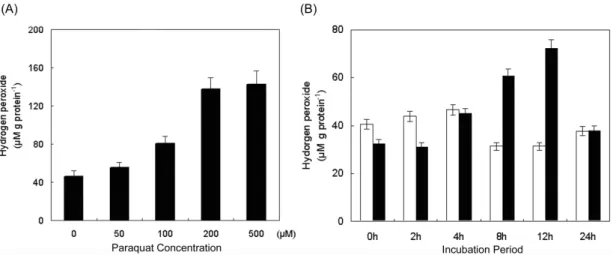
In this study, we used MV as an inducer of oxidative stress response to investigate transcriptome of hot pepper under oxidative stress. As the first step, the appropriate amount and time of MV treatment for the induction of oxidative stress were determined. Plants were sprayed with 0, 50, 100, 200 and 500 μM MV and exposed for 12 h under light condition (100 μmol m-2 s-1) (Fig. 1A).
Because plants showed necrosis all over the leaves and withered after 200 and 500 μM MV treatment, 100 μM concentration of MV was selected as the most effective concentration for further experiments. In case of time course analysis, the H2O2 concentration was increased up to 8 and 12 h after MV treatment, then declined (Fig.
1B). Thus, we harvested samples at these time points, and mRNAs from these samples were used to construct a cDNA library.
Fig. 1 Measurement of hydrogen peroxide in MV-treated plants. (A) Plants were sprayed with 0, 50, 100, 200 and 500 μM MV.
(B) Plants were sprayed with 100 μM MV during the indicated time points. White bars represent control leaves, while black bars show leaves treated with MV. All samples were exposed to light (100 μM m-2 s-1) for 12 h after treatments. H2O2 concentration was measured by the FOX1 method. Each data point is the mean (± SD) of three independent experiments
Table 1 EST cluster collection statistics and distribution according to the BLASTX search results
No. EST GC contents
No. of cDNA sequenced 1,589 Cluster summary
No. of singletons 1,100
No. of contigs 152
No. of unigenes 1,252 Annotation of unigenes
Known 1,005 (80.27%) 42.6%
Protein of known function 674 Protein of putative function 193 Unknnown function 138
Unknown 197 (15.74%) 38.2%
No Hit 50 (3.99%) 35.1%
Qualitative and cluster analyses of EST sequences
To examine genes expressed after MV treatment, a cDNA library was constructed using mixed mRNA from hot pepper leaves of 8 h and 12 h after MV treatment. A total of 1,589 cDNA clones were randomly selected and sequenced from their 5' ends. Clustering analysis revealed 1,252 unigenes comprised of 152 contigs and 1,100 singletons.
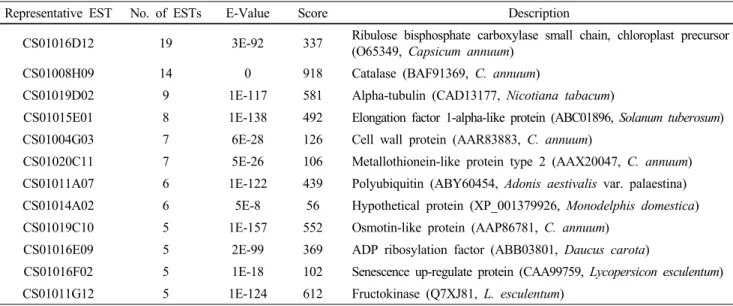
The average length of unigenes was approximately 662 bp. After querying the NCBI database using the BLASTX program, sequence data was classified into Known, Unknown and No hit using E-value as cut-off value. Through the overall analysis of the ESTs, 1,005 clones (80.3%) were identified as Known sequences, 197 clones (15.7%) as Unknown, and 50 clones (4.0%) as No hit. The GC contents were 42.6% for Known sequences, 38.2% for Unknown, and 35.1% for No hit ESTs. Highly expressed unigenes from this library were annotated in Table 1. The most abundantly expressed gene is ribulose bisphosphate carboxylase (RuBisCo), which is the representative abundant mRNA in photosynthetic plant leaves. RuBisCo was then followed by catalase transcripts encoding a typical enzyme detoxifying harmful effect of ROS. Also, metallothionein gene was highly expressed, which is known to be involved in homeostasis and detoxification of metals and in response to oxidative stress (Nishiuchi et al. 2007).
Differential gene expression under MV treatment
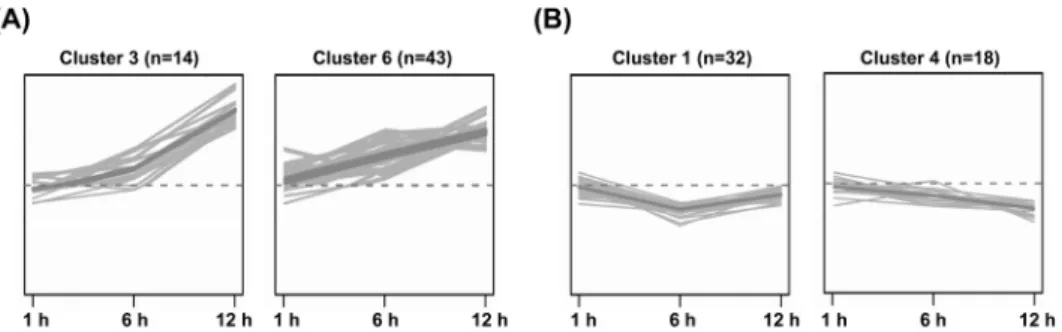
To study the global changes in transcriptome of hot pepper in response to MV, we constructed cDNA microarray composed of PCR products from 1,252 cDNA clones and used pBlueScript Ⅱ SK+ vector and luciferase from firefly (Photinus pyralis) as a negative controls, and tubulin and ribulose bisphosphate carboxylase from C. annuum as positive controls. As a result of the cDNA microarray analysis, 145 genes showed significant changes in expression by MV treatment. Their expression patterns were grouped into ten clusters using the hierarchical clustering method. Among them, 50 genes in clusters 1 and 4 were down-regulated
Fig. 2 k-means clustering of the gene expression data. Cluster analysis of (A) 50 ESTs down-regulated and (B) 57 ESTs up-regulated after MV treatment in hot pepper. Classification of the clones was based on the similarity of their expression profiles using the k-means clustering technique. Thick lines show tendencies in each cluster according to time course
Fig. 3 RNA gel-blot analyses to confirm DNA microarray data. Lanes contained 20 μg of total RNA extracted from control (C) and MV treated sample (P) at given time points. Blots were sequentially hybridized to the designated probes. All hybridizations for each probe were performed under the same condition
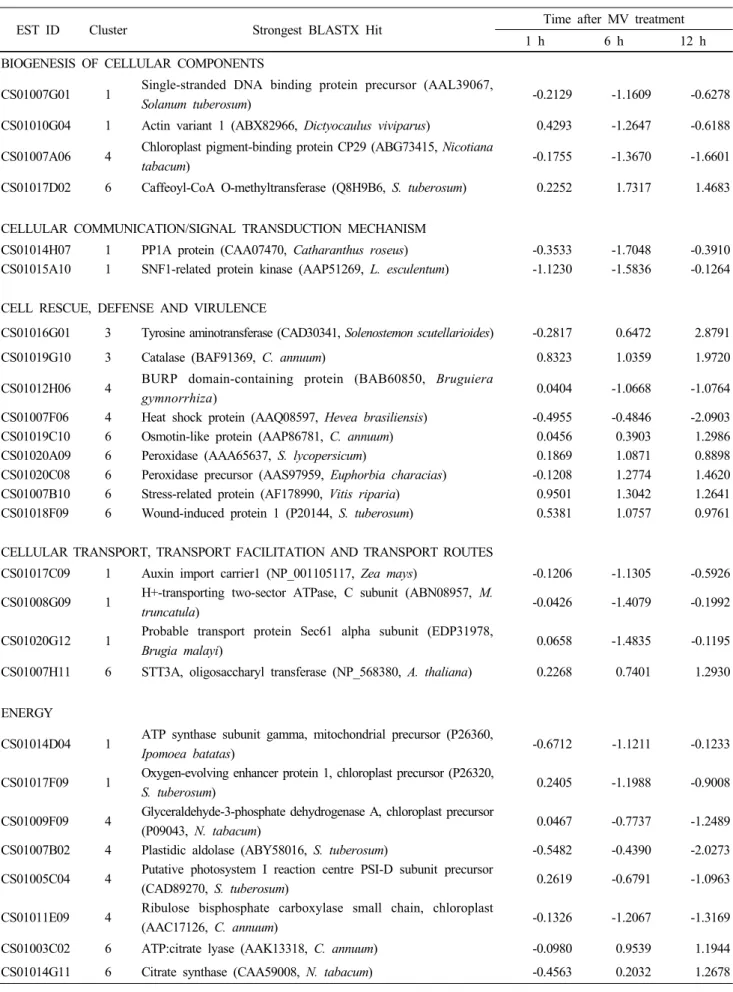
and 63 genes in clusters 3 and 6 were up-regulated by MV treatment (Fig. 2). A total of 83 genes comprised of down-regulated 38 genes and up-regulated 45 genes were grouped based on MIPS functional categories and their expression ratios are shown in Table 2. We could find that various stress-related genes such as peroxidase, tyrosine aminotransferase, omega-6 fatty acid desaturase (ω-6 FAD), and glutathione-S-transferase were induced, while some metabolism related genes such as aldolase and ketol-acid reductoisomerase were repressed by MV.
Expression of selected genes assessed by northern hybridization
To confirm the microarray data, we performed northern hybridization analyses with some gene-specific probes.
We analyzed two genes in cluster 3 and two in cluster 6 (Fig. 3). The results of these data agreed in most cases with the profiles derived from the microarray data.
Discussion
The oxidative stress-related studies using ESTs and microarray have been concentrated on Arabidopsis (Desikan et al.
2001; Mahalingam and Fedoroff 2001). Though hot pepper is one of the major crops in many western countries as well as in Korea, the massive analysis on oxidative stress-related genes using EST and microarray from hot pepper has not been performed yet. The high-throughput gene identification and global gene expression analysis are the first step for functional analysis of plant genes involved in many biological processes. Accordingly, in this study, we have analyzed transcriptional changes of the hot pepper to oxidative stress using ESTs and DNA microarray technologies.
In response to oxidative stress, 1 to 2% of genes in Arabidopsis genome showed differential expression pattern in the previous microarray data (Desikan et al. 2001).
Gadjev et al. (2006) reported that around 600 genes have shown differential expression on 12 h after MV, which
Table 2 The 12 most abundant contigs from the ESTs
Representative EST No. of ESTs E-Value Score Description
CS01016D12 19 3E-92 337 Ribulose bisphosphate carboxylase small chain, chloroplast precursor (O65349, Capsicum annuum)
CS01008H09 14 0 918 Catalase (BAF91369, C. annuum)
CS01019D02 9 1E-117 581 Alpha-tubulin (CAD13177, Nicotiana tabacum)
CS01015E01 8 1E-138 492 Elongation factor 1-alpha-like protein (ABC01896, Solanum tuberosum) CS01004G03 7 6E-28 126 Cell wall protein (AAR83883, C. annuum)
CS01020C11 7 5E-26 106 Metallothionein-like protein type 2 (AAX20047, C. annuum) CS01011A07 6 1E-122 439 Polyubiquitin (ABY60454, Adonis aestivalis var. palaestina) CS01014A02 6 5E-8 56 Hypothetical protein (XP_001379926, Monodelphis domestica) CS01019C10 5 1E-157 552 Osmotin-like protein (AAP86781, C. annuum)
CS01016E09 5 2E-99 369 ADP ribosylation factor (ABB03801, Daucus carota)
CS01016F02 5 1E-18 102 Senescence up-regulate protein (CAA99759, Lycopersicon esculentum) CS01011G12 5 1E-124 612 Fructokinase (Q7XJ81, L. esculentum)
is about 2.5% of 24,000 genes of Arabidopsis whole genome. In this study, microarray experiment using hot pepper ESTs revealed that approximately 9% of ESTs was differentially expressed in response to MV treatment (113 from 1,252 ESTs).
Considering that the genome size of hot pepper is about 26 times bigger than that of Arabidopsis (Moscone et al. 2003), the strategy using stress-specific EST and subsequent microarray analysis is very effective to find genes related to specific environmental stress. In EST analysis, 1,252 ESTs from MV-treated cDNA library repre- sented not only oxidative stress-related genes such as the catalase and peroxidase but also a number of house- keeping genes such as the RuBisCo, elongation factor 1- α, and α-actin (Table 1).
The most well-defined molecular feature of plants under oxidative stress condition is enhanced transcription of ROS scavenging enzymes (Quan et al. 2008). Our data revealed several genes (CS01019G10, CS01020C08, and CS01017B08) showing significant sequence similarity to genes encoding enzymes such as catalase, peroxidase, and GST, respectively, were up-regulated by ROS generation (Table 2). In particular, CS01019G10 showed the highest similarity (89%) with Arabidopsis Cat2 which is known as the most important player for the protection of chloroplasts against oxidative damage (Mittler et al. 2004). These data indicate that our experiments were performed under appropriate condition to generate ROS in planta.
Microarray data showed that 63 genes were induced
and 50 genes repressed by MV treatment (Fig. 2). They were clustered based on MIPS category, indicating that MV treatment affects on various biological processes (Table 2). Especially, several genes known to be induced by pathogen attack were highly induced by MV treatment on hot pepper leaves (Table 2, Fig. 3) ; WRKY family transcription factor, SAR (systemic acquired resistance) 8.2 precursor, pathogenesis-related protein, wound induced protein and ω-6 FAD.
WRKY family transcription factor is known to be a large group of plant-specific transcriptional regulators implicated in pathogen and stress responses, and senescence (Eulgem et al. 2000; Guo and Gan 2005). In Arabidopsis, two WRKY family genes (At4g01250 and At3g56400) were induced at 24 h after treatment of 10 µM MV (Gadjev et al. 2006). Our microarray data showed that WRKY transcription factor (CS01007H12) was expressed at 1 h and 12 h after MV treatment. Among 72 WRKY transcription factors in Arabidopsis genome, AtWRKY33 shares highest similarity with CS01007H12 (64%). AtWRKY33 is known to be induced 21 times by MV, and 24 times by ozone (Gadjev et al. 2006). It suggests possible roles of AtWRKY33 and CS01007H12 as a transcription factor to turn on a series of downstream genes, which are involved in scavenging oxygen radicals and protecting cellular components against toxic effects of oxidative stress.
Several ESTs encoding PR (pathogen-related) proteins such as wound induced protein and SAR 8.2 precursor were induced by MV treatment (Table 2). Previous studies
Table 3 Functional classification of transcripts differentially regulated by MV treatment in hot pepper
EST ID Cluster Strongest BLASTX Hit Time after MV treatment
1 h 6 h 12 h
BIOGENESIS OF CELLULAR COMPONENTS
CS01007G01 1 Single-stranded DNA binding protein precursor (AAL39067,
Solanum tuberosum) -0.2129 -1.1609 -0.6278
CS01010G04 1 Actin variant 1 (ABX82966, Dictyocaulus viviparus) 0.4293 -1.2647 -0.6188 CS01007A06 4 Chloroplast pigment-binding protein CP29 (ABG73415, Nicotiana
tabacum) -0.1755 -1.3670 -1.6601
CS01017D02 6 Caffeoyl-CoA O-methyltransferase (Q8H9B6, S. tuberosum) 0.2252 1.7317 1.4683
CELLULAR COMMUNICATION/SIGNAL TRANSDUCTION MECHANISM
CS01014H07 1 PP1A protein (CAA07470, Catharanthus roseus) -0.3533 -1.7048 -0.3910 CS01015A10 1 SNF1-related protein kinase (AAP51269, L. esculentum) -1.1230 -1.5836 -0.1264
CELL RESCUE, DEFENSE AND VIRULENCE
CS01016G01 3 Tyrosine aminotransferase (CAD30341, Solenostemon scutellarioides) -0.2817 0.6472 2.8791
CS01019G10 3 Catalase (BAF91369, C. annuum) 0.8323 1.0359 1.9720
CS01012H06 4 BURP domain-containing protein (BAB60850, Bruguiera
gymnorrhiza) 0.0404 -1.0668 -1.0764
CS01007F06 4 Heat shock protein (AAQ08597, Hevea brasiliensis) -0.4955 -0.4846 -2.0903 CS01019C10 6 Osmotin-like protein (AAP86781, C. annuum) 0.0456 0.3903 1.2986 CS01020A09 6 Peroxidase (AAA65637, S. lycopersicum) 0.1869 1.0871 0.8898 CS01020C08 6 Peroxidase precursor (AAS97959, Euphorbia characias) -0.1208 1.2774 1.4620 CS01007B10 6 Stress-related protein (AF178990, Vitis riparia) 0.9501 1.3042 1.2641 CS01018F09 6 Wound-induced protein 1 (P20144, S. tuberosum) 0.5381 1.0757 0.9761
CELLULAR TRANSPORT, TRANSPORT FACILITATION AND TRANSPORT ROUTES
CS01017C09 1 Auxin import carrier1 (NP_001105117, Zea mays) -0.1206 -1.1305 -0.5926 CS01008G09 1 H+-transporting two-sector ATPase, C subunit (ABN08957, M.
truncatula) -0.0426 -1.4079 -0.1992
CS01020G12 1 Probable transport protein Sec61 alpha subunit (EDP31978,
Brugia malayi) 0.0658 -1.4835 -0.1195
CS01007H11 6 STT3A, oligosaccharyl transferase (NP_568380, A. thaliana) 0.2268 0.7401 1.2930
ENERGY
CS01014D04 1 ATP synthase subunit gamma, mitochondrial precursor (P26360,
Ipomoea batatas) -0.6712 -1.1211 -0.1233
CS01017F09 1 Oxygen-evolving enhancer protein 1, chloroplast precursor (P26320,
S. tuberosum) 0.2405 -1.1988 -0.9008
CS01009F09 4 Glyceraldehyde-3-phosphate dehydrogenase A, chloroplast precursor
(P09043, N. tabacum) 0.0467 -0.7737 -1.2489
CS01007B02 4 Plastidic aldolase (ABY58016, S. tuberosum) -0.5482 -0.4390 -2.0273 CS01005C04 4 Putative photosystem I reaction centre PSI-D subunit precursor
(CAD89270, S. tuberosum) 0.2619 -0.6791 -1.0963
CS01011E09 4 Ribulose bisphosphate carboxylase small chain, chloroplast
(AAC17126, C. annuum) -0.1326 -1.2067 -1.3169
CS01003C02 6 ATP:citrate lyase (AAK13318, C. annuum) -0.0980 0.9539 1.1944 CS01014G11 6 Citrate synthase (CAA59008, N. tabacum) -0.4563 0.2032 1.2678
EST ID Cluster Strongest BLASTX Hit Time after MV treatment
1 h 6 h 12 h
INTERACTION WITH THE ENVIRONMENT
CS01018A04 1 Unknown (ABU45188, Capsicum frutescens) -0.1676 -1.0926 -0.1520
METABOLISM
CS01014A06 1 Aconitase (AAP30039, Lycopersicon pennellii) 0.4801 -1.1559 -0.5757 CS01007C03 1 Ketol-acid reductoisomerase (CAA48253, A. thaliana) 0.1932 -1.9717 -1.2082 CS01020A06 3 Glutamate-cysteine ligase, chloroplast precursor (O22493, L.
esculentum) -0.2493 1.2282 2.9419
CS01005C09 3 L-allo-threonine aldolase-related protein (ABB72802, S. tuberosum) -0.2069 0.2796 2.3469 CS01020D02 3 Microsomal omega-6-desaturase (AAT72296, N. tabacum) 0.3764 -0.0230 2.4241 CS01003D05 3 Omega-6 desaturase (CAI48076, C. chinense) 0.1526 -0.2137 2.3619 CS01003A01 3 Omega-6 fatty acid desaturase (CAI48074, Capsicum chinense) 0.2653 0.9925 3.4143 CS01008F10 3 Tropinone reductase-1 (BAA13547, Hyoscyamus niger) -0.9815 0.2954 2.0338 CS01015E08 4 GDSL-motif lipase/hydrolase family protein (NP_190416, A.
thaliana) 0.6310 -0.3921 -1.8855
CS01005F08 4 S-adenosyl-L-methionine synthetase (AAD56396, Petunia x hybrida) 0.4178 -1.0089 -1.4704 CS01014G04 6 Mevalonate disphosphate decarboxylase (ABW87316, S. lycopersicum) 0.2049 0.4139 1.3316 CS01004B08 6 Resveratrol/hydroxycinnamic acid O-glucosyltransferase (ABH03018,
Vitis labrusca) -0.7702 0.4306 1.4844
CS01012F04 6 Isoamylase isoform 1 (AAN15317, S. tuberosum) 0.8314 1.4009 1.6885 CS01017H09 6 Phenylpropanoid:glucosyltransferase 1 (AAK28303, N. tabacum) 0.4170 1.2210 1.5387 CS01018G05 6 Putative oxalyl-CoA decarboxylase (AAP69814, V. vinifera) 0.8842 1.6687 2.2482 CS01011F06 6 Nitrite reductase (AAC17127, C. annuum) 0.9154 1.0780 1.5031 CS01017C11 6 Putative short-chain type alcohol dehydrogenase (AAN32641, S.
tuberosum) 1.0873 0.5898 2.0412
CS01012F06 6 Resveratrol/hydroxycinnamic acid O-glucosyltransferase (ABH03018,
V. labrusca) 1.0811 1.6295 2.0516
CS01008G12 6 Short-chain dehydrogenase/reductase (SDR) family protein (NP_
567300, A. thaliana) 0.4395 0.8092 2.0172
CS01020F08 6 Glutamate synthase, chloroplast precursor (NADH-GOGAT) (Q03460,
Medicago sativa) 0.7333 3.6489 2.2988
PROTEIN SYNTHESIS
CS01015E01 1 Elongation factor 1-alpha-like protein (ABC01896, S. tuberosum) -0.0949 -1.3895 -0.6559 CS01011G02 1 Poly(A)-binding protein (AAF66823, N. tabacum) -0.4259 -1.3289 -0.4500 CS01019A10 4 AGO4-2 (ABC61505, Nicotiana benthamiana) -0.8797 -1.3585 -1.3306 CS01005C03 4 Poly(A)-binding protein (AAF66823, N. tabacum) -0.4800 -0.9623 -1.3964 CS01011A05 6 60S Ribosomal protein L10-like protein (ABB17003, S. tuberosum) 0.6836 0.9975 1.3879
PROTEIN WITH BINDING FUNCTION OR COFACTOR REQUIREMENT
CS01017B08 3 Glutathione S-transferase T1 (AAG16756, Lycopersicon esculentum) -0.1997 1.3230 2.4616 CS01004A10 6 Glutathione-S-transferase (AAX20044, Capsicum annuum) 0.4474 0.5617 1.7841 CLASSIFICATION NOT YET CLEAR-CUT
CS01011G05 1 Nuclear RNA binding protein-like (ABA81884, S. tuberosum) 0.2611 -1.6577 -0.2126 CS01020E07 1 RNA helicase (CAA09205, A. thaliana) 0.0668 -2.2707 -1.0664 CS01015B07 3 Cytochrome P450 (AAF27282, C. annuum) -0.7116 1.2992 3.5732 CS01014H03 6 Epoxide hydrolase (ABN08020, Medicago truncatula) 0.3223 1.3564 1.0962 CS01003D06 6 Putative membrane protein (CAC37355, S. tuberosum) 0.2922 0.6946 1.9123
EST ID Cluster Strongest BLASTX Hit Time after MV treatment
1 h 6 h 12 h
CS01012C11 6 Unnamed protein product (CAO68407, V. vinifera) 0.2447 0.6158 1.5439 CS01013E06 6 Avr9/Cf-9 rapidly elicited protein 140 (AAV92899, N. tabacum) 0.9969 1.4306 1.1983 CS01017G03 6 Late embryogenis abundant protein 5 (AAC06242, N. tabacum) 0.6409 1.3896 1.8663 CS01009F08 6 SAR8.2 protein precursor (AAL16783, C. annuum) 0.7110 1.5107 2.0950 CS01016C10 6 Putative pathogenesis related protein (CAI48023, C. annuum) 1.2096 1.5040 3.0302 CS01007H12 6 WRKY-type transcription factor (ABD65255, C. annuum) 1.2399 -0.2727 1.3710 CS01008E01 6 Luminal-binding protein 5 precursor (BiP 5) (Q03685, N. tabacum) 0.9114 1.4015 1.1502
UNCLASSIFIED PROTEINS
CS01004C03 1 Glutamate decarboxylase isozyme 1 (AAC24195, N. tabacum) -0.4125 -1.8729 -0.7721 CS01007H10 1 Protein disulfide isomerase (AAT39459, I. batatas) -0.8186 -1.3931 -0.6466 CS01016H11 1 Unnamed protein product (CAO21490, V. vinifera) -0.4220 -1.2057 -0.6679 CS01015B06 1 Unnamed protein product (CAO39382, V. vinifera) -0.7679 -1.4984 -0.5703 CS01008G02 1 Unnamed protein product (CAO63461, V. vinifera) -0.3723 -1.3789 -0.8686 CS01003C05 1 Unnamed protein product (CAO65444, V. vinifera) -0.1976 -1.6549 -0.8760 CS01003C09 1 Unnamed protein product (CAO68293, V. vinifera) -0.1116 -1.1939 -0.0469 CS01003E10 1 Vitamin C defective 2 (NP_567759, A. thaliana) -0.0218 -1.5550 -0.6970
CS01020G01 3 CYP72A58 (ABC69422, N. tabacum) -0.3772 0.4081 2.4885
CS01019G11 3 Unnamed protein product (CAO17291, V. vinifera) -0.0984 0.9040 2.1215 CS01020B06 4 Chalcone-flavanone isomerase family protein (ABK96098, A.
thaliana) -0.5354 0.1479 -2.2927
CS01018C01 4 Epidermis-specific secreted glycoprotein EP1 precursor (Q39688,
Daucus carota) -1.3266 -0.3631 -1.9882
CS01003D04 4 FLK (AAX51268, A. thaliana) -0.4598 -0.7917 -1.4343
CS01003A03 4 Unknown protein (NP_566847, A. thaliana) -0.0508 -0.3477 -1.0459 CS01017B11 6 Unnamed protein product (CAO45614, V. vinifera) 0.9005 0.2756 1.3354 CS01012B04 6 Histone H1 (P40267, Lycopersicon pennellii) 0.9994 1.1904 1.3219 CS01005D05 6 Hypothetical protein (CAN73253, V. vinifera) 0.2610 0.8879 2.0266 CS01020F07 6 Unnamed protein product (CAO63741, V. vinifera) 0.3729 0.9566 1.9067 CS01014E09 6 Monoterpene synthase 2 (AAX69064, S. lycopersicum) 1.7563 1.8360 2.7723 CS01017C03 6 Unnamed protein product (CAO22510, V. vinifera) 0.7866 1.8934 2.3880
have shown that PR genes have been induced by several plant hormones including salicylic acid as well as pathogen attack (van Loon et al. 2006; Loake and Grant 2007). PR genes identified from this study started to be expressed at 6 h after MV treatment and then reached at the highest level after 12 h treatment (Table 2). This PR gene expression might be followed by the expression of the transcription factors such as WRKY factor identified from this study. The increased expression of PR genes after MV treatment also can be a line of evidence for the possible close relationship between oxidative stress and the response against plant pathogen infection.
Fatty acids are a component of cellular membrane and also precursors for the plant hormone, jasmonic acid, which plays essential roles in pollen maturation and
dehiscence and wound-induced defense against biotic attacks (Park et al. 2002; Wasternack 2007). Plant fatty acids are desaturated by introducing double bonds on their fatty acyl chains by a number of fatty acid desaturases.
An ω-6 FAD gene was very strongly expressed at 6 h treatment and maintained its strong expression up to 12 h after treatment (Table 2 and Fig. 2). In Arabidopsis, FAD2 gene (At3g12120) was induced in leaves at 4 h after treatment of 10 µM MV (http://urgv.evry.inra.fr/cgi-bin/
projects/CATdb/consult_expce.pl?experiment_id=116).
Accordingly, the increased expression of this gene after MV treatment may be required to meet enhanced cellular demands for the reorganization of cellular membrane and modification of lipids. The high level expression of ω-6 FAD gene may be also essential to increase jasmonic acid
level for the rapid response against the oxidative stress, which is known to share the signaling network with wound- induced pathogen attack (Mahalingam et al. 2003).
ROS are continuously generated as toxic by-products of many essential metabolic pathways, including photosynthesis.
Because they are highly reactive, ROS cause irreversible damage to major cellular components such as lipids, proteins, and nucleic acids. However, evidences show that H2O2, one of the ROS, plays important roles as second messenger in controlling various biological processes, including programmed cell death, stomatal closure, and defense responses to environmental stresses (Mittler and Berkowitz 2001). Recently, some reports revealed that MAP kinase cascade is involved in signaling pathway by H2O2 from biotic and abiotic stresses (Hua et al. 2006; Liu et al.
2007). In this study, CS01016G09 clone shared 54%
similarity with ATMKK4 (Arabidopsis thaliana mitogen- activated protein kinase kinase 4). Its expression was induced at 1 h after MV treatment. Considering that ATMKK4 is known as a signaling component inducing hypersensitive response when transiently expressed in tobacco leaf (Yuasa et al., 2001), CS01016G09 gene product could be a component of MAP kinase signaling cascade operating under ROS stress in hot pepper.
In this study, EST and microarray have provided the means to analyze the expression profiles in response to oxidative stress by MV treatment. This is the first report for the mass analysis using ESTs and microarray on oxidative stress from hot pepper. The information and genetic material from this study will be very useful to elucidate the functional roles of the identified genes.
Acknowledgments
This research was supported in part by Mid-career Researcher Program through the National Research Foundation of Korea (NRF) funded by the Ministry of Education, Science and Technology (2006-0050138).
References
Apel k, Hirt H (2004) Reactive oxygen species: metabolism, oxidative stress, and signal transduction. Annu Rev Plant Biol 55:373-399
Bosland PW, Votava EJ (1999) ‘NuMex Primavera’ jalapeno.
HortScience 33:1085-1086
Desikan R, A-H-Mackerness S, Hancock JT, Neill SJ (2001) Regulation of the Arabidopsis transcriptome by oxidative stress. Plant Physiol 127:159-172
Desikan R, Burnett EC, Hancock JT, Neill SJ (1998) Harpin and hydrogen peroxide induce the expression of a homologue of gp91-phox in Arabidopsis thaliana suspension cultures.
J Exp Bot 49:1767-1771
Dodge AD (1971) The mode of action of the bipyridylium herbicides, paraquat and diquat. Endeavour 30:130-135 Eulgem T, Rushton PJ, Robatzek S, Somssich IE (2000) The
WRKY superfamily of plant transcription factors. Trends Plant Sci 5:199-206
Foyer CH, Descourvières P, Kunert KJ (1994) Protection against oxygen radicals: an important defense mechanism studied in transgenic plants. Plant Cell Environ 17:507-523 Gadjev I, Vanderauwera S, Gechev TS, Laloi C, Minkov IN,
Shulaev V, Apel K, Inzé D, Mittler R, Van Breusegem F (2006) Transcriptomic footprints disclose specificity of reactive oxygen species signaling in Arabidopsis. Plant Physiol 141:436-445
Gao Q, Zhang L (2008) Ultraviolet-B-induced oxidative stress and antioxidant defense system responses in ascorbate- deficient vtc1 mutants of Arabidopsis thaliana. J Plant Physiol 165:138-148
Gechev TS, Van Breusegem F, Stone JM, Denev I, Laloi C (2006) Reactive oxygen species as signals that modulate plant stress responses and programmed cell death. Bioessays 28:1091-1101
Grant JJ, Yun BW, Loake GJ (2000)Oxidative burst and cognate redox signalling reported by luciferase imaging: identification of a signal network that functions independently of ethylene, SA and Me-JA but is dependent on MAPKK activity. Plant J 24:569-582
Guo Y, Gan S (2005) Leaf senescence: signals, execution, and regulation. Curr Top Dev Biol 71:83-112
Hua ZM, Yang X, Fromm ME (2006) Activation of the NaCl- and drought-induced RD29A and RD29B promoters by constitutively active Arabidopsis MAPKK or MAPK proteins.
Plant Cell Environ 29:1761-1770
Jagadeeswaran G, Saini A, Sunkar R (2009) Biotic and abiotic stress down-regulate miR398 expression in Arabidopsis.
Planta 229:1009-1014
Karpinski S, Reynolds H, Karpinska B, Wingsle G, Creissen G, Mullineaux P (1999) Systemic signaling and acclimation in response to excess excitation energy in Arabidopsis.
Science 284:654-657
Knapp, S (2002) Tobacco to tomatoes: a phylogenetic perspective
on fruit diversity in the Solanaceae. J Exp Bot 377:2001-2022 Kwon, SI and An CS (2003) Cloning and expression of
mitochondrial MnSOD from the small radish (Raphanus sativus L.). Mol Cells 16:194-200
Langebartels C, Schraudner M, Heller W, Ernst D, Sandermann H (2000) Oxidative stress and defense reactions in plants exposed to air pollutants and UV-B radiation. In Inze D, Montagu MV, eds, Oxidative Stress in Plants, Harwood Academic Publishers, London, pp 105-135
Lee H, Cho HH, Kim I-C, Yim JH, Lee HK, Lee YK (2008) Expressed sequence tag analysis of Antarctic hairgrass Deschampsia antarctica from King George Island, Antarctica.
Mol Cells 25:258-264
Lee H, Hur CG, Oh CJ, Kim HB, Pakr SY, An CS (2004) Analysis of the root nodule-enhanced transcriptome in soybean. Mol Cells 18:53-62
Lee S, Yun S-C (2006) The ozone stress transcriptome of pepper (Capsicum annuum L.). Mol. Cells 21:197-205
Liu Y, Ren D, Pike S, Pallardy S, Gassmann W, Zhang S (2007) Chloroplast-generated reactive oxygen species are involved in hypersensitive response-like cell death mediated by a mitogen-activated protein kinase cascade. Plant J 51:941-954 Loake G, Grant M (2007) Salicylic acid in plant defence-the
players and protagonists. Curr Opin Plant Biol 10:466-472 Mahalingam R, Fedoroff N (2001) Screening insertion libraries
for mutations in many genes simultaneously using DNA microarrays. Proc Natl Acad Sci USA 98:7420-7425 Mahalingam R, Gomez-Buitrago A, Eckardt N, Shah N,
Guevara-Garcia A, Day P, Raina R, Fedoroff NV (2003) Characterizing the stress/defense transcriptome of Arabidopsis.
Genome Biol 4:R20
Mittler R, Berkowitz G (2001) Hydrogen peroxide, a messenger with too many roles? Redox Rep 6:69-72
Mittler R, Vanderauwera S, Gollery M, Van Breusegem F (2004) Reactive oxygen gene network of plants. Trends Plant Sci 9:490-498
Moscone EA, Baranyi M, Ebert I, Greilhuber J, Ehrendorfer F, Hunziker AT (2003) Analysis of nuclear DNA content in Capsicum (Solanaceae) by flow cytometry and Feulgen densitometry. Ann Bot 92:21-29
Nishiuchi S, Liu S, Takano T (2007) Isolation and characterization of a metallothionein-1 protein in Chloris virgata Swartz that enhances stress tolerances to oxidative, salinity and carbonate stress in Saccharomyces cerevisiae. Biotechnol Lett 29:1301-1305
Niyogi KK (1999) Photoprotection revisited: genetic and molecular approaches. Annu Rev Plant Physiol Plant Mol Biol 50:333-359
Ort DR, Baker NR (2002) A photoprotective role for O(2) as an alternative electron sink in photosynthesis? Curr Opin Plant Biol 5:193-198
Palmeira CM, Moreno AJ, Madeira VM (1995) Mitochondrial bioenergetics is affected by the herbicide paraquat. Biochim Biophys Acta 1229:187-192
Park JH, Halitschke R, Kim HB, Baldwin IT, Feldmann KA, Feyereisen R (2002) A knock-out mutation in allene oxide synthase results in male sterility and defective wound signal transduction in Arabidopsis due to a block in jasmonic acid biosynthesis. Plant J 31:1-12
Pei ZM, Murata Y, Benning G, Thomine S, Klusener B, Allen GJ, Grill E, Schroeder JI (2000) Calcium channels activated by hydrogen peroxide mediate abscisic acid signalling in guard cells. Nature 406:731-734
Quan LJ, Zhang B, Shi WW, Li HY (2008) Hydrogen peroxide in plants: a versatile molecule of the reactive oxygen species network. J Integr Plant Biol 50:2-18
Quinn J, Findlay VJ, Dawson K. Millar JBA, Jones N (2002) Distinct regulatory proteins control the graded transcriptional response to increasing H2O2 levels in fission yeast Schizosaccharomyces pombe. Mol Biol Cell 13:805-816 Supanjani KDL (2006) Hot pepper response to interactive
effects of salinity and boron. Plant Soil Environ 52:227-233 van Loon LC, Rep M, Pieterse CM (2006) Significance of
inducible defense-related proteins in infected plants. Annu Rev Phytopathol 44:135-162
Wahid A, Perveen M, Gelani S, Basra SM (2007) Pretreatment of seed with H2O2 improves salt tolerance of wheat seedlings by alleviation of oxidative damage and expression of stress proteins. J Plant Physiol 164:283-294
Wasternack C (2007) Jasmonates: an update on biosynthesis, signal transduction and action in plant stress response, growth and development. Ann Bot (Lond) 100:681-697 Wolff SP (1994) Ferrous ion oxidation in presence of ferric ion
indicator xylenol orange for measurement of hydroperoxides.
Methods Enzymol 233:182-189
Yang T, Poovaiah BW (2002) Hydrogen peroxide homeostasis activation of plant catalase by calcium/calmodulin. Plant Biol 99: 4097-4102.
Yuasa T, Ichimura K, Mizoguchi T, Shinozaki K (2001) Oxidative stress activates ATMPK6, an Arabidopsis homologue of MAP kinase. Plant Cell Physiol 42:1012-1016