Received: June 17, 2020 Accepted: June 23, 2020 Trauma and InJury
Correspondence to Gil Jae Lee, M.D., Ph.D.
Department of Traumatology, College of Medicine, Gachon University, Department of Trauma Surgery, Gachon University Gil Medical Center, 783 Namdong-daero, Namdong-gu, Incheon 21556, Korea Tel: +82-32-460-3010
Fax: +82-32-460-2372 E-mail: [email protected]
Part 2. Clinical Practice Guideline for Trauma Team Composition and Trauma Cardiopulmonary resuscitation from the Korean Society of Traumatology
Oh Hyun Kim, M.D., Ph.D. 1 , Seung Je Go, M.D. 2 , Oh Sang Kwon, M.D. 3 , Chan-Yong Park, M.D., Ph.D. 4 , Byungchul Yu, M.D. 5 , Sung Wook Chang, M.D. 6 , Pil Young Jung, M.D., Ph.D. 7 , Gil Jae Lee, M.D., Ph.D. 5 , KST (Korean Society of Traumatology) Clinical Research Group
1
Department of Emergency Medicine, Wonju College of Medicine, Yonsei University, Wonju, Korea
2
Department of Trauma Surgery, Chungbuk National University Hospital, Cheongju, Korea
3
Department of Trauma Surgery, Cheju Halla General Hospital, Jeju, Korea
4
Department of Trauma Surgery, Wonkwang University Hospital, Iksan, Korea
5
Department of Traumatology, College of Medicine, Gachon University, Department of Trauma Surgery, Gachon University Gil Medical Center, Incheon, Korea
6
Department of Thoracic and Cardiovascular Surgery, Trauma Center, Dankook University Hospital, Cheonan, Korea
7
Department of Surgery, Wonju Severance Christian Hospital, Yonsei University Wonju College of Medicine, Wonju, Korea
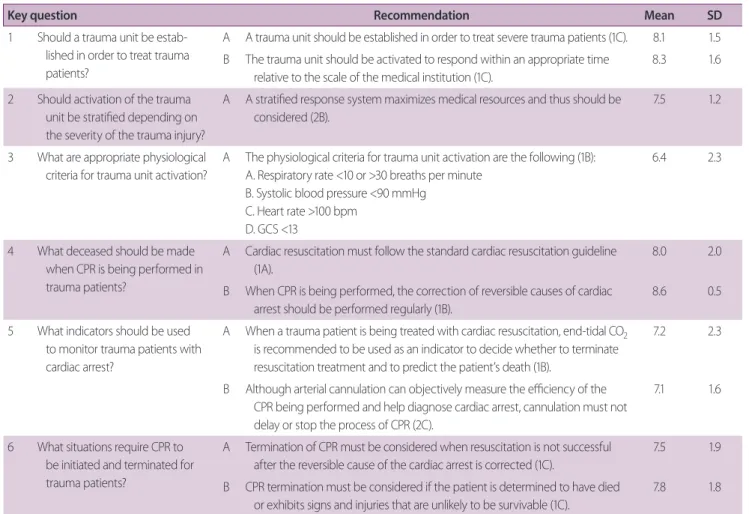
Based on the revised recommendations, the final recommendations were confirmed after collecting opinions from trauma experts, experts from the Korean Society of Traumatology, and research method experts using the Delphi technique (Table 1).
Should a trauma unit be eStabliShed in order to treat trauma patientS?
Recommendation
A. A trauma unit must be established in order to treat severe trauma patients (1C).
B. The trauma unit should be activated to respond within an appropriate time rela-
tive to the scale of the medical institution (1C).
Evidence summary
1. Configuration of trauma units
It is internationally understood and established that different medical specialists and personnel must work together to treat polytrauma patients. In many developed countries with trauma units, the completion of a profes- sional trauma program such as Advanced Trauma Life Support, the Japan Advanced Trauma Evaluation and Care, or the European Trauma Course is required to join a trauma unit. Multiple studies have reported that the establishment of specialized trauma units has many ad- vantages [1-4]. However, no study has evaluated the most appropriate configuration of the trauma unit. The mem- bership of a trauma unit depends on the location and institution-specific circumstances [5-11]. Although some
studies have reported that only two doctors are needed to effectively treat trauma patients [12,13], other studies have reported the need to have more than two doctors in the trauma unit depending on the severity of the patient.
The interpretation, experience, and education of each trauma unit differ according to local circumstances. It is stated in South Korea’s administrative guideline for trau- ma centers that a trauma unit must be able to respond within 10 minutes and must consist of general surgeons, thoracic surgeons, neurosurgeons, and emergency med- icine physicians. However, only 16 trauma centers meet these criteria, and most emergency departments in South Korea do not satisfy these criteria.
2. The role and qualifications of the team leader
The role of the team leader is to assess patients’ data, con-
Table 1. Scores from the Delphi technique (Likert scale 1-9)
Key question Recommendation Mean SD
1 Should a trauma unit be estab- lished in order to treat trauma patients?
A A trauma unit should be established in order to treat severe trauma patients (1C). 8.1 1.5 B The trauma unit should be activated to respond within an appropriate time
relative to the scale of the medical institution (1C).
8.3 1.6
2 Should activation of the trauma unit be stratified depending on the severity of the trauma injury?
A A stratified response system maximizes medical resources and thus should be considered (2B).
7.5 1.2
3 What are appropriate physiological criteria for trauma unit activation?
A The physiological criteria for trauma unit activation are the following (1B):
A. Respiratory rate <10 or >30 breaths per minute B. Systolic blood pressure <90 mmHg
C. Heart rate >100 bpm D. GCS <13
6.4 2.3
4 What deceased should be made when CPR is being performed in trauma patients?
A Cardiac resuscitation must follow the standard cardiac resuscitation guideline (1A).
8.0 2.0
B When CPR is being performed, the correction of reversible causes of cardiac arrest should be performed regularly (1B).
8.6 0.5
5 What indicators should be used to monitor trauma patients with cardiac arrest?
A When a trauma patient is being treated with cardiac resuscitation, end-tidal CO
2is recommended to be used as an indicator to decide whether to terminate resuscitation treatment and to predict the patient’s death (1B).
7.2 2.3
B Although arterial cannulation can objectively measure the efficiency of the CPR being performed and help diagnose cardiac arrest, cannulation must not delay or stop the process of CPR (2C).
7.1 1.6
6 What situations require CPR to be initiated and terminated for trauma patients?
A Termination of CPR must be considered when resuscitation is not successful after the reversible cause of the cardiac arrest is corrected (1C).
7.5 1.9
B CPR termination must be considered if the patient is determined to have died or exhibits signs and injuries that are unlikely to be survivable (1C).
7.8 1.8
SD: standard deviation, GCS: Glasgow coma scale, CPR: cardiopulmonary resuscitation, MTP: massive transfusion protocol.
sider multiple treatment options, and swiftly decide on a treatment plan. Leadership requires the ability to facilitate communication among members and to work out an interdisciplinary agreement. Hoff et al. [14] reported that the implementation of a team leader led to improvements in the treatment process of a trauma patient. Further- more, Alberts et al. [15] reported that after the implemen- tation of a “trauma unit leader”, the outcomes of trauma patients improved. The team leader must have superb knowledge regarding the treatment of polytrauma pa- tients and experience in interdisciplinary treatment, which consists of being able to assess the patient depending on the situation, treat and monitor, consult with other med- ical specialties, adjust the medical team, and explain the decision process in the trauma unit to the patient’s legal guardian. It is important that the interdisciplinary meth- od of treatment does not cause a lag in the treatment pro- cess, which underscores the importance of establishing a treatment guideline [14,16,17]. According to a nationwide survey of trauma centers conducted by the American Col- lege of Surgeons Committee on Trauma (ACSCOT), one- fourth of team leaders were trauma surgeons and one-half were general surgeons [17]. Although it was reported that the time to surgery was faster when the team leader was a trauma surgeon, there was no significant difference in survival outcomes [18]. The main role of the team leader is to manage the trauma unit. The management of a team involves recording the team members’ competencies, and researching and making decisions at every step of diagno- sis and treatment through discussion and agreement. In trauma, a team leader must possess the ability and qualifi- cations to follow standard guidelines through an interdis- ciplinary approach to medicine [19].
3. Response time
The response time is defined as the time from the pa- tient’s arrival to the initiation of treatment by the trauma team doctor [20]. The response time allowed for level I and II trauma centers is 15 minutes, whereas for level III and IV trauma centers, the maximum allowed response time is 30 minutes. According to a study conducted by the Trauma Audit and Research Network, the inclusion of a trauma surgeon significantly reduced the mortality rate from 60% to 32% for trauma patients [21]. Luchette et
al. [22] reported that when a trauma doctor resides in the hospital, the diagnosis was quicker and the operation was also faster. However, in cases of severe thoracic and head trauma, the time to intensive care treatment was not affected [1,2,10]. Wyatt et al. [23] reported that when an experienced doctor treated severe trauma patients (1,427 patients, injury severity score [ISS] >15), the survival rate was higher than when doctors without much experience treated these patients. It is also recommended that acute trauma patients be reevaluated within 24 hours of their initial treatment in order to prevent additional complica- tions.
Although trauma centers in South Korea are not grad- ed, the 16 trauma centers that exist function as level I centers. Therefore, it was determined that this clinical practical guideline was acceptable and applicable within South Korea.
Should activation of the trauma unit be Stratified depending on the Severity of the trauma injury?
Recommendation
A stratified response system maximizes medical resources and thus should be considered (2B).
Evidence summary
1. Activation of the trauma unit
In an effective trauma system, the patient’s status and
severity must be determined and the patient must be
transported prior to activating the trauma unit. Not only
does the matrix triage system provide a more efficient
way to treat severe trauma patients, but it also reduces
transportation costs. The American Trauma Society states
that 25% to 35% patients are overtriaged, whereas 5% are
undertriaged [20]. However, when the sensitivity of the
goal was set to 80%, a study was not able to reduce the
ratio of underestimation to lower than 70% [24]. Accord-
ingly, the ACSCOT responded by publishing a standard
matrix triage system, which has proven to be more effi-
cient. A study utilizing the ACSCOT matrix triage system
conducted at a level I trauma center with 7,031 trauma
patients reported that matrix triage system yielded a 45%
rate of overestimation and a 24% rate of underestimation [25]. Since a stratified medical system maximizes medical resources, the application of such implementation of such systems may be considered for South Korea.
What are appropriate phySiologi- cal criteria for trauma unit acti- vation?
Recommendation
The physiological criteria for trauma unit activation are the following (1B):
A. Respiratory rate <10 or >30 breaths per minute B. Systolic blood pressure <90 mmHg
C. Heart rate >100 bpm
D. Glasgow coma scale (GCS) <13
The criteria for trauma unit activation according to the 2016 operating instructions for trauma centers in South Korea are as follows:
1. Physiological indications
A. Airway obstruction/Decreased respiratory rate B. Intubation prior to arrival
C. Adults: Respiratory rate <10 or >30 breaths per minute D. Adults: Systolic blood pressure <90 mmHg
E. Adults: heart rate >100 bpm F. GCS <13
G. A transferred patient undergoing blood transfusion to maintain vital signs
H. Worsening status of a stabilized patient
2. Anatomical criteria A. Penetration injury
i. Penetrating injury to the craniocervical, thoracic, or abdominal region
ii. Limbs: Penetrating injury proximal to the elbow or knee
B. Thorax
i. Chest wall instability or deformity (e.g. flail chest)
C. Nervous system
i. Open or depressed skull fracture
ii. Quadriplegia or suspicion of spine injury
D. Orthopedic i. Pelvic fracture
ii. Two or more proximal long-bone fractures
iii. Crushed, degloved, mangled, or pulseless extremity iv. Amputation proximal to wrist or ankle
3. Mechanism of injury
A. Death in the same passenger compartment B. Ejection (partial or complete) from an automobile C. Traffic collision at over 60 km/h
D. Automobile versus pedestrian/bicyclist: thrown, run over, or with significant (over 30 km/h) impact E. Rescue time exceeding 20 minutes
F. Motorcycle, bicycle, etc.: collision over 30 km/h or roll-over accident
G. Fall greater than or equal to: 6 m for adults, 3 m for children
H. Injury from an explosion
※ When deemed necessary by a clinician in the resusci- tation area.
Evidence summary
1. Blood pressure and respiratory rate
Low blood pressure in trauma patients is correlated with a 1.6-fold increase in emergency operations, a 24-fold increase in the mortality rate, and a 7-fold increase in the need for intensive care unit (ICU) treatment [26]. The ACSCOT implements low blood pressure as a criteiron for transporting the patient to the trauma center, where- as hospitals in the state of South Wales in Australia use blood pressure as an indicator for activating the trauma unit [20,27]. Furthermore, in a study conducted by New York’s trauma registry, low blood pressure and a respi- ratory rate of <10/min or >29/min were correlated with mortality rates of 32.9% and 28.8%, respectively [28].
2. GCS
According to Kohn et al. [29], 44.2% patients with a GCS
score of less than 10 were confirmed to have severe brain
injury. Although a GCS score of less than 14 was shown to be correlated with the presence of a pathological brain injury [30,31], the need to activate the trauma unit was not implicit (GCS ≤14 and ≥11). In another study, a GCS score less than 10 was correlated with a 3.5-fold increase in mortality during surgery [32]. In the ACSCOT guideline, the indications for trauma activation include a car accident that caused the car to be dented by more than 20–30 inches, a pedestrian hit at the speed of 20–30 mph, or a passenger dying from the traffic accident [20].
It is also stated that a rollover car crash increases the risk of severe trauma [33].
3. Mechanism of injury
When the trauma unit was activated based on the mech- anism of injury alone, 92% of cases were overestimated, and the sensitivity and PPV were reported to be 50–70%
and 16.1%, respectively [34-36]. However, when the mechanism of injury was included in the criteria, the sensitivity and specificity increased to 80% and 90%, re- spectively [35]. Kohn et al. [29] reported in a prospective study that 9.4% of patients who fell from a height over 6 m needed ICU care or immediate surgery. Furthermore, Yagmur et al. [37] reported that patients who died from falling injuries fell from heights over 9 m.
4. Age
When Kohn et al. [29] analyzed various trauma activation protocols, such as that of the ACSCOT, it was determined that an age cut-off of over 65 years was most appropri- ate for activating the trauma unit [29]. Demetriades et al. [38] reported that patients over 70 years of age had a 16% higher mortality rate and a 19% higher likelihood of needing surgical and ICU treatment than younger patients. Mackenzie demonstrated that after the age of 55 years, the risk of fatal trauma injuries significantly in- creased [39]. Lastly, Grossman et al. [40] reported that pa- tients over the age of 65 had a 6.8% higher mortality rate than their younger counterparts. Since, South Korea uses most of the Centers for Disease Control and Prevention field triage guidelines, it was determined that this clinical practical guideline was applicable within South Korea.
What factorS Should be conSid- e r e d Wh e n c ar d i o pu lmo nary reSuScitation (cpr) iS being per- formed in trauma patientS?
Recommendation
A. Cardiac resuscitation must follow the standard cardi- ac resuscitation guideline (1A).
B. When CPR is being performed, the correction of re- versible causes of cardiac arrest should be performed regularly (1B).
Evidence summary
According to the International Liaison Committee on Resuscitation (ILCOR) and the European Resuscitation Council (ERC) guideline, trauma patients receiving car- diac resuscitation should be treated according to standard cardiac resuscitation guidelines [41-44]. The 2015 Ameri- can and European cardiac resuscitation guidelines recom- mend that the 5 H’s and 5 T’s (hypovolemia, hypoxia, hy- drogen ion [acidosis], hypo/hyperkalemia, hypothermia, tension pneumothorax, cardiac tamponade, coronary thrombosis, pulmonary thrombosis, toxins) or the 4 H’s and 4 T’s must be treated actively during cardiac resusci- tation [43,44].
Complications from hemorrhage such as severe brain injury and hypovolemia are the most common cause of cardiac arrest from trauma. Other common causes of traumatic cardiac arrest include other reversible causes such as hypoxia, tension pneumothorax, and tamponade, which must be corrected immediately [43]. Not only does the above guideline recommend assessing, diagnosing, and treating the causes of cardiac arrest of trauma patients as soon as possible, but it states that treating the reversible causes should be prioritized before performing cardiac compressions [43]. In trauma patients, the primary cause of cardiac arrest must be treated by rapidly administering crystalloids and utilizing surgical endoscopic and endo- vascular techniques to control hemorrhage [44].
Furthermore during the hands-off time of cardiac re-
suscitation, it is recommended that a trained sonographer
perform heart sonography in order to diagnose and treat
the cause of hypovolemic cardiac arrest [44]. Some retro-
spective studies have reported that inserting a chest tube
for preventing or treating tension pneumothorax can increase the survival rate for trauma patients with cardiac arrest [45-48].
In the S3 guideline published by the German Trauma Society (DGU), 10,359 patients in the trauma registry were analyzed. In this study the survival rate of trau- ma-induced cardiac arrest patients was 7.8% when the patient was treated with thoracotomy at the emergency department. However, the type of trauma was associated with a difference in the survival rate: that of cardiac arrest caused by blunt trauma was 1.6%, whereas that of cardiac arrest caused by penetrating trauma was 11.2% [49-51].
Lastly it is recommended by the EAST guideline that car- diac arrests caused by penetrating trauma injuries should be treated with emergency thoracotomy [52].
The DGU S3 guideline implemented much of the 2005 ERC guideline, and it was determined that a more up- dated guideline would be needed. In the ERC and AHA 2015 guideline, policies were implemented from the 2010 recommendations without further review. Since the ERC guideline presents a thorough algorithm for performing CPR in cases of trauma, it was determined that the car- diac arrest algorithm from the ERC guideline would be implemented (Fig. 1).
What indicatorS Should be uSed to monitor trauma patientS With cardiac arreSt?
Recommendation
A. When a trauma patient is being treated with cardiac resuscitation, end-tidal CO 2 is recommended to be used as an indicator to decide whether to terminate resuscitation treatment and to predict the patient’s death (1B).
B. Although arterial cannulation can objectively mea- sure the efficiency of CPR and help diagnose cardiac arrest, cannulation must not delay or stop the pro- cess of CPR (2C).
Evidence summary
Physiological indicators can be helpful alongside clinical signs and electrocardiograms when performing CPR.
However, no recommendations exist regarding which specific physiological indicator(s) should be used to deter- mine the need for CPR. This fact stems from the concern that the evidence used to determine the need for CPR could actually do more harm than good. End-tidal CO 2 (ETCO 2 ) should not be used alone to predict death and the termination of CPR [46], but ETCO 2 can be recom- mended for use as a threshold value [53].
The initiation time of CPR should be determined by the readings of an electrocardiogram and signs of cardiac arrest [54]. Pulse oximetry and capnography readings are essential for polytrauma patients and can be used during cardiac arrest. However, the limitations of such indicators for patients in shock or hypothermia should be noted [44].
To assess the quality of CPR, the intubation tube must be placed in the correct location, and waveform capnog- raphy can be used to monitor the return of spontaneous circulation [54].
According to the S3 guideline, early catheterization of the femoral artery can be used to continuously measure blood pressure, help diagnose cardiac arrest in the emer- gency room, and objectively measure the effectiveness of CPR. However, it was recommended that catheterization must not delay or stop the process of CPR [44].
In the ERC and AHA 2015 guidelines, policies were implemented from the 2010 recommendations without further review. In the DGU S3 guideline on cardiac resus- citation, much of the information was based on the ERC 2005 guideline. Therefore, these guidelines should be up- dated.
What SituationS require cpr to be initiated and terminated for trau- ma patientS?
Recommendation
A. Termination of CPR must be considered when re- suscitation is not successful after the reversible cause of cardiac arrest is corrected (1C).
B. CPR termination must be considered if the patient
is determined to have deceased or exhibits signs and
injuries that are unlikely to be survivable (1C).
Evidence summary
In a previous study conducted throughout the 1980s to the 1990s, the ERC reported that cardiac arrest trauma patients had a survival rate below 2%. However, accord- ing to a German and American study conducted using cardiac arrest trauma patients from the DGU registry, the survival rate of such patients was 17.2% and 13% respec-
tively, a higher rate than was previously thought [55,56].
It must be noted, though, that the American study only included cardiac arrest patients who arrived within the ICU bay within 1 hour.
If the health care provider is unable to find a pulse, or other clinical signs suggesting cardiac arrest, the health care provider must without hesitation start CPR. The clin- fig. 1. Guideline for cardiac resuscitation in traumatic patients. Reprinted from Truhlář et al.
45Trauma patient
Star t Co ntin ue A LS
Cardiac arrest/
Periarrest situation?
Consider non-traumatic cause
Return of spontaneous circulation Hypoxia
Tension pneumothorax Tamponade
Hypovolaemia
Consider termination of CPR
Simultaneously address reversible causes
Pre-hospital:
■
Perform only life-saving interventions
■
Immediate transport to appropriate hospital In-hospital:
■
Damage control resuscitation
■