• 검색 결과가 없습니다.

A Study on the Situation of Safety Management in Central African Construction Sites - Focusing on DR Congo and Rwanda -

N/A
N/A
Protected

Academic year: 2021

Share "A Study on the Situation of Safety Management in Central African Construction Sites - Focusing on DR Congo and Rwanda -"

Copied!
7
0
0

로드 중.... (전체 텍스트 보기)

전체 글

(1)

J. Korea Inst. Build. Constr. Vol. 18, No. 4 : 395-401 / Aug, 2018

https://doi.org/10.5345/JKIBC.2018.18.4.395 www.jkibc.org

A Study on the Situation of Safety Management in Central African Construction Sites

- Focusing on DR Congo and Rwanda -

1)

Bitamba, Bauma Frigeant An, Sung-Hoon

*

Department of Architectural Engineering, Daegu University, Gyeongsan-si, Gyeongsangbuk-do, 38453, Korea

Abstract

The Central African Region is known as one of the most troubled and unsafe regions in Africa. But more recently the Central African Region has been growing and developing, with many projects underway involving huge local and foreign construction companies. Despite this fact, workers in the Central African Region often encounter unsafe working conditions and must confront many kinds of hazards. Therefore, the aim of this study is to identify the safety management situation in Central African construction sites, by focusing on the countries of Rwanda and DR Congo. Through our research, it was found that the two countries studied in the Central African Region are very similar with regard to their safety management systems, with some exceptions. In addition, it was revealed that both these countries in the Central African Region had good safety performance. This study will help to illuminate the situation of safety systems on construction sites in the Central African Region, and can be used by companies advancing into the Central African Region’s construction market.

Keywords : safety management, central africa, safety regulation, safety education

1. Introduction

The Central African region is known as one of the most troubled and unsafe regions in Africa. In the several civil wars that have taken place in the last two decades in some of the Central African region countries, many of the buildings were destroyed and the Central African region became impoverished. But today, the Central African region is growing and is being developed by huge local and foreign construction companies. This is contributing to economic growth in this region. Previous research has demonstrated that there is a positive and statistically significant relationship between the

Received : May 8, 2018

Revision received : May 16, 2018 Accepted : July 3, 2018

* Corresponding author: An, Sung-Hoon

[Tel: 82-53-850-6518, E-mail: [email protected]]

ⓒ2018 The Korea Institute of Building Construction, All rights reserved.

construction industry and economic growth in the developing countries[1]. According to previous research, in most developing countries the construction industry contributes to 11% of gross domestic product (GDP)[2].

Despite this fact, workers in the Central African region face unsafe working conditions and must confront many kinds of hazards. Hazards frequently encountered in the construction industry include dangerous chemicals, dust, exposure to vibration, high noise levels, manual lifting of heavy weights, unguarded openings, ionizing radiation, fire, exposure to live cables, and moving mobile construction plants on site[3].

In particular, the big problem is that employers,

administrators and workers have a lack of knowledge

when it comes to safety issues. Work conditions on

construction sites in the Central African region have

always been notoriously dangerous, with many

safety measures completely ignored by most

(2)

A Study on the Situation of Safety Management in Central African Construction Sites - Focusing on DR Congo and Rwanda -

contractors, and worse still, some contractors not even being aware of the existence of basic safety measures.

Also, construction sites do not establish any safety implementation plan, and in most sites, the majority of the workers do not put on personal protection equipment during the work. Furthermore, onsite safety training is rarely given to construction workers. According to previous research, construction health and safety should be of primary concern to employers, employees, governments and project participants[3].

Employers in developing countries have the responsibility to take measures to control health and safety risks at work. According to the International Labor Office (ILO)[4], employers should provide adequate means and organization to support safety, should establish a suitable program for the safety of workers that is consistent with national laws and regulations, and should comply with the prescribed safety and health measures at the workplace.

Previous research[5] has argued that management should encourage and support safety by setting a good safety example, effectively managing safety programs, wearing protective equipment where it is required, and providing sufficient resources to implement a safety and health program. They should also visibly demonstrate and communicate their safety and health commitment to workers and others, and should be fully committed to continuously improving workplace safety and performance.

Most of these studies have concentrated more on safety in construction sites, and were not particularly focused on the safety situation in the Central African region's construction sites. Actually, safety in Central African region construction sites involves both the physical and psychological well-being of site workers. Safety management in these regions must become one of the primary concerns for safety researchers.

Therefore, the aim of this study is to learn about the safety management situation on Central African construction sites. This study will support an evaluation of the application of the safety management system in the Central African construction sites through both qualitative and quantitative investigation methods, with the goal of determining how compliant this system is with international standards.

2. Literature review

There are several definitions of safety.

Occupational health and safety has been defined as [6] : “The promotion and maintenance of the highest degree of physical, mental and social well-being. The prevention of ill-health among workers caused by their working conditions. The protection of workers from factors adverse to their health in their employment, and the placing and maintaining of workers in occupational environments adapted to their individual and psychological conditions.”

Health is defined as the protection of the body and mind of people from illness resulting from materials, processes or procedures used in the workplace, whereas safety is defined as the protection of people from physical injury[7]. Also, safety means a state in which no danger of a damage-causing accident exists. A high level of occupational health and safety contributes to the achievement of material and economic objectives, and provides high quality and performance in working life[8].

Previous research indicated that culture occurs upstream within the management system, exposure the end of the upstream to downstream sequence[9].

This was confirmed in the same thesis[9], which

indicated that the positive components of a health

and safety culture have a substantial positive impact

on health and safety performance. Therefore, the

(3)

Variables Hypotheses about the safety management situation

Plan of action H1, there is a significant difference between the two countries with regard to the management of a plan of action.

Competency of workers and

ongoing training H2, there is a significant difference between the two countries with regard to the satisfaction level in terms of competency of workers.

Personal protective equipment H3, there is a significant difference between the two countries with regard to worker satisfaction in term of wearing personal protective equipment and having an emergency system to prevent or treat any case of

accidents at the construction sites.

Safety monitoring & inspection

system H4, there is a significant difference between the two countries with regard to the construction site audits and inspections carried out by the government

Hazard and accidents reporting H5, there is a significant difference between the two countries with regard to the satisfaction with the hazard and accident reporting system.

Discipline H6, there is a difference between the two countries in terms of satisfaction regarding discipline and disciplinary decisions taken after an accident happens on a construction site.

Responsibility & organization for

safety in the workplace H7, there is a significant difference between the two countries with regard to the satisfaction with the safety responsibility and organization management system at the site

Cost H8, there is a significant difference between the two countries in terms of satisfaction with the budget allocated to the safety before a construction project

Table 1. Variables to find out the situation of safety management

promoted by the management of contracting organizations directly or indirectly enhances the safety of individuals on the job site.

Currently, there is no documented data on issues of safety management in the Central African construction industry. However, given the similarities in the construction industries in some developing countries such as Ghana and Kenya, there is little doubt that the trends observed might be different in the Central African region. In Ghana for example, about 65% of construction workers, particularly the new recruits, do not have knowledge of safety issues on construction sites[10]. Another study in this country revealed that 60% of contractors do not provide safety materials (safety gear, boots, safety uniforms, helmets, gloves, nose masks, etc.) to workers on construction sites[11]. In Kenya, previous research found that most construction sites did not have preventive measures for accidents, exposing the workers further to hazards, and the smallest measures applied were not necessarily effective in preventing accidents[12].

The situations stated above will contribute to understanding the safety management situation in the Central African region, since developing and some developed countries present a similar situation.

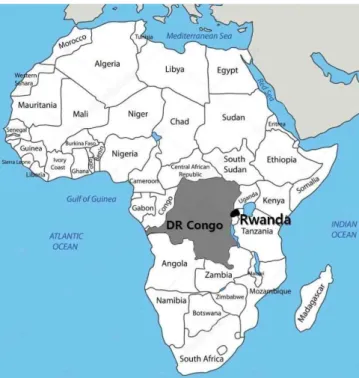
Figure 1. Location of DR congo and rwanda

3. Methodology

The purpose of this study is to learn about the

situation of safety management in the Central

African region. To do this, the authors researched

and compared the differences between two countries

(Rwanda and Democratic Republic of Congo (DR

Congo)). These two countries were selected for the

reason that DR Congo is one of the largest countries

(4)

A Study on the Situation of Safety Management in Central African Construction Sites - Focusing on DR Congo and Rwanda -

Variables Questions Average

Mean Mean Rwanda Var. Mean DR Congo Var. P-value

Plan of action

1) Satisfaction with the company safety plan and risk assessment 3.76 3.81 1.36 3.73 0.84 0.81 2) Satisfaction with the plan’s clear objectives to handle the different hazards

on site 3.69 3.63 1.58 3.73 0.92 0.78

3) Satisfaction with procedures specified by that plan to prevent accidents 3.55 3.44 2.40 3.62 0.65 0.67 4) Satisfaction with accessibility of the action plan for managers, supervisors

and workers 3.67 3.69 2.10 3.65 1.12 0.94

5) Satisfaction with role in developing the action plan 3.62 3.31 2.23 3.81 1.28 0.26 Competency of

workers and ongoing training

1) Satisfaction with your general knowledge on the safety regulations in your

construction sites 3.60 3.75 1.40 3.5 1.38 0.51

2) Satisfaction with the company's onsite training policy 3.38 3.25 1.67 3.46 1.38 0.60 3) Importance of the experience and safety training of operatives at the

recruitment of managers, supervisors and workers 3.38 2.75 3.00 3.77 1.86 0.06

Personal protective &

emergency equipment

1) Importance of wearing a personal protective equipment for

construction workers 4.52 4.94 0.06 4.27 1.56 0.01

2) Importance of the presence of first aid and aiders on construction

sites 4.21 4.63 1.05 3.96 1.64 0.07

3) Satisfaction with the functional fire extinguishers on construction sites 3.62 3.81 0.96 3.5 1.70 0.38 4) Satisfaction with the visibility of emergency exit on construction sites 3.69 3.81 1.63 3.62 1.53 0.63 Safety monitoring &

inspection system 1) Satisfaction with role in safety audits 3.57 3.56 1.06 3.58 1.61 0.97

2) Importance of safety audits at the workplace 3.86 4.50 0.53 3.46 1.14 0.00

Hazard and accidents reporting

1) Satisfaction with the formal channel (body) for reporting hazards or

accidents cases 3.07 3.50 1.60 2.81 2.16 0.11

2) Satisfaction with the policy of your company on reporting accidents or

dangerous situations discovered at sites 3.45 3.63 1.45 3.35 1.76 0.49

3) Importance of the reporting system for incidents and near misses 3.40 3.06 2.60 3.62 1.85 0.26

Discipline

1) Satisfaction with the strategy of your company when an accident or

dangerous situation happens 3.76 3.94 0.86 3.65 0.64 0.32

2) Satisfaction with the disciplinary procedures for employees in breach of

safety 3.69 3.69 1.03 3.69 1.74 0.99

3) Satisfaction with your role in this disciplinary process 3.79 3.56 1.73 3.92 1.11 0.36 4) Satisfaction with the decision taken after an accident or incident

happens on site 3.86 4.13 0.52 3.69 0.86 0.10

Responsibility &

organization for safety in the

workplace

1) Satisfaction with the responsibility taken by the main contractor for safety

on site 3.57 3.63 1.45 3.54 0.82 0.81

2) Satisfaction with the responsibility taken by the client for safety on site 3.31 3.50 2.40 3.19 1.28 0.50 3) Satisfaction with your responsibilities for safety on site 3.39 4.06 0.73 3.85 0.54 0.41 4) Satisfaction with the organization chart showing the names and positions

with responsibility lines for safety performance management 3.83 3.75 1.93 3.88 0.83 0.73 5) Importance about having competent safety officers and safety supervisors

appointed and engaged for the site 4.26 4.5 0.67 4.12 1.23 0.20

Cost 1) Importance of the safety training item in construction budget 4.43 4.5 0.67 4.38 0.89 0.68 2) Satisfaction with your company's financial budget allocated to safety 3.10 3.13 2.12 3.08 0.87 0.91 Table 2. Results of T-test for comparison the situation of safety management between two countries

in the region, while Rwanda is one of the smallest(Figure 1). The findings will provide us with a clearer picture of the safety management situation on construction sites in the Central African region.

This research was conducted in two Central African Region countries (DR Congo and Rwanda) through a questionnaire survey. A questionnaire was distributed to field managers, onsite engineers and safety regulations supervisors in the two countries.

As seen in Table 1, 8 variables were used to evaluate and compare the general situation of safety management of these two countries.

The 28 questions focusing on 8 variables, which

are shown in Table 2, were based on a review of the previous research[3,13] on the safety management of African construction sites. The qualitative analysis involved collecting data through observation and interviews with field managers, on-site engineers and contractors on the construction sites within the region.

The quantitative analysis of the aforementioned

variables using the 28 questions was measured using

a 5-point Likert scale (very important (5 points),

important(4 points), neutral(3 points), not important(2

points) and not very important(1 point)). The reason

for this is to quantitatively compare the safety

(5)

T-test (statistical hypothesis test).

A total of 42 questionnaires were collected and used for the analysis after 6 incomplete questionnaires were excluded. Of the 42 questionnaires, 16 were from Rwanda and 26 were from DR Congo.

4. Results analysis and discussions

Table 2 presents the results of the T-test for the comparison of the safety management of the two countries. The T-test was conducted on two samples assuming unequal variance. This is because the amount of data collected was small (16 surveys in Rwanda and 26 in DR Congo) and it was difficult to be sure of equal variances.

In the results of the t-test, 5 questions were analyzed as showing a statistically significant difference between two countries at the 90%

confidence level because the p-value was less than 0.1. There is also one question for which the p-value was slightly greater than 0.1 but close to 0.1 (0.11).

In this study, the confidence level was reduced to 90%

(p<0.1) instead of 95%(p<0.05) which is generally used, because the number of data collected was small.

Based on the results obtained, the authors were able to identify the situation of safety management systems in the Central African region. In addition, the authors learned that the situation of the safety management systems of the two countries was very similar, with some exceptions.

In terms of the statistical details, none of the questions in the variables ‘Plan of action,’ ‘Responsibility and organization for safety in the workplace’ and ‘Cost’

showed any significant difference between the two countries.

For the variable ‘Competency of workers &

ongoing training,’ Rwanda received a lower mean

‘importance of experience and safety training of operatives in the recruitment of managers, supervisors and workers.’ This can be interpreted as indicating that Rwanda, as a very young country, has a lower consciousness of the importance of experience and safety training.

On the other hand, Rwanda got a higher mean score of 4.94 on ‘importance of wearing personal protective equipment,’ and scored 4.63 on ‘the presence of first aid and aiders on construction sites,’ 4.50 on ‘safety audits at the workplace’ and 3.50 on ‘satisfaction with the decision taken after an accident or incident happened.' Based on the above results the authors considered that Rwanda has a slightly higher consciousness of safety regulations than DR Congo.

DR Congo got a lower mean score (2.81) than Rwanda on ‘Satisfaction with the formal channe l(body) for reporting hazards or accidents cases.’ The authors thought that this result showed DR Congo has lower reliability of its safety government.

Overall, the results of this survey to assess the

situation of safety management in Central African

construction sites showed that the mean for all

questions was on average over 3 points (with the

maximum being 5 points). Significantly, statements

such as ‘Importance of wearing personal protective

equipment for construction workers,’ ‘Importance of

the presence of first aid and aiders on construction

sites,’ ‘Importance of having competent safety

officers and safety supervisors appointed and

engaged for the site’ and ‘Importance of the safety

training item in the construction budget’ got an

average of more than 4 points out of 5. This means

that both of the Central African region countries

studied (Rwanda and DR Congo) had good safety

performance. It is important to note that Rwanda

recorded the lowest mean (2.75) in 'Importance of the

experience and safety training of operatives at the

recruitment of managers, supervisors and workers'

(6)

A Study on the Situation of Safety Management in Central African Construction Sites - Focusing on DR Congo and Rwanda -

whereas the lowest mean in DR Congo was 2.81 'Satisfaction with the formal channel (body) for reporting hazards or accident cases.'

The construction industry is an important element that is bringing more foreign capital to this region[1,2]. As such, foreign construction companies in general and Korean construction companies specifically should not worry about the adequacy of the safety organization and management system in the Central African construction sites.

5. Conclusion and Recommendations

In general, this research revealed that the safety management system on construction sites was similarly managed in both of the Central African countries studied. On average, the areas that had the highest mean scores on the surveys in both countries were 4.52 and 4.43 in personal protective equipment and importance of the safety training item in the construction budget, respectively. This can be a good indicator to encourage investors in the construction domain to invest in the Central African region.

On the other hand, the study also revealed some differences about the five questions in four different variables. For example, Rwanda scored lower than DR Congo in 'the importance of the experience and safety training of operatives at the recruitment of managers, supervisors and workers'. In the area of personal protective equipment, Rwanda scored higher than DR Congo. This means that while the Rwandan government has not paid attention to the development of safety training, the country has strong labor laws and policies which ensure that investors in the construction companies provide their workers with personal protective equipment.

Based on the results, which showed that Rwanda had a lower score in 'importance of the experience and safety training of operatives at the recruitment

of managers, supervisors and workers' it is recommended that employers and contractors provide suitable programs that are consistent with national laws and regulations to ensure the safety of workers. On the other hand, in DR Congo 'Satisfaction with the formal channel(body) for reporting hazards or accident cases' had a lower score, and thus this study suggests that contractors must keep accidents registered at site and make records of all kinds of accidents, from minor bruises to major and fatal accidents, and submit reports thereafter to each country’s occupational health and safety executives.

Finally, this study recommends all stakeholders in construction projects combine their efforts to make their safety management of construction sites in the Central African region more effective.

This study will help the reader to understand the situation of safety organization and the management system in Central African construction sites, so it is meaningful in that an international construction company can use it in advancing into Central African construction market.

Acknowledgement

This research was supported by the Daegu University Research Grant, 2016.

References

1. Giang DTH, Pheng LS. Role of construction in economic development; Review of key concepts in the past 40 years.

Hbitat International. 2011 Jan;35(1):118-25.

2. Yoon SJ, Lin HK, Chen G, Yi S, Choi J, Rui Z. Effect of Occupational Health and Safety Management System on Work-Related Accident Rate and Differences of Occupational Health and Safety Management System Awareness between Managers in South Korea’s Construction Industry. Safety and Health at Work. 2013 Dec;4(4):201-9.

3. Kheni NA. Impact of health and safety management on safety

(7)

Loughborough University; 2008. 318 p.

4. International Labour Office (ILO). Safety and Health in construction: An ILO code of practice. [Geneva (Swiss)]: ILO;

1992; 114 p.

5. Occupational Safety and Health Administration (OSHA), Safety and Health Program Management Guidelines. Washington DC:

OSHA; 2015 Nov. 39 p.

6. Tadesse T, Admassu M (University of Gondar, Gondar, Ethiopia).

Occupational Health and Safety. Lecture Notes for Environmental and Occupational Health Students. Ethiopia Public Health Training Initiative(Ethiopia): 2006 Aug. 247 p.

7. Hughes P, Ferrett E. Introduction to Health and Safety in Construction. 3rd ed. Oxford: Elsevier Ltd; 2008. 552 p.

8. World Health Organization (WHO). Global strategy on occupational health for all: the way to health at work, recommendation of the Second Meeting of the WHO Collaborating Centres in Occupational Health, 11-14 October 1994, Beijing, China. [Geneva (Swiss)]: WHO; 1995; 68 p.

9. Smallwood JJ. The influence of health and safety(H&S) culture on health and safety performance. 18th Annual ARCOM Conference; 2002 Sep 2-4; Newcastle, UK. Newcastle, (UK):

Association of Researchers in Construction Management; 2002.

p. 2017-26.

10. Danso FO, Badu E, Ahadzie DK, Nani G, Manu P. Towards a framework for the management of health, safety and well-being on adaptive-retrofit projects in Ghana. In: ARCOM Doctoral Workshop - Health, Safety and Wellbeing; 2015 Feb 11; Edinburgh, Scotland, UK: ARCOM; 2015. p. 73-83.

11. Danso FO. Occupational Health and Safety issues involving causal workers on building construction sites in Ghana, a Kumasi study [master’s thesis]. [Kumasi (Ghana)]: Kwame Nkrumah University Of Science And Technology; 2010. 117 p.

12. Nyaruai MN, Kinyua R, Gathu R. Factors affecting management of safety and health in the building construction industry in Nakuru County, Kenya. International Journal of Innovation and Applied Studies. 2016 Oct;18(1):83-89.

13. Musonda I, Smallwood J. Health and safety (H&S) awareness and implementation in Botswana's construction industry.

Journal of Engineering, Design and Technology. 2008

Apr;6(1):81-90.

수치

Table 1. Variables to find out the situation of safety management

참조

관련 문서