• 검색 결과가 없습니다.

Assessment of Integrated N<sub>2</sub>O Emission Factor for Korea Upland Soils Cultivated with Red Pepper, Soy Bean, Spring Cabbage, Autumn Cabbage and Potato

N/A
N/A
Protected

Academic year: 2021

Share "Assessment of Integrated N<sub>2</sub>O Emission Factor for Korea Upland Soils Cultivated with Red Pepper, Soy Bean, Spring Cabbage, Autumn Cabbage and Potato"

Copied!
11
0
0

로드 중.... (전체 텍스트 보기)

전체 글

(1)

Assessment of Integrated N 2 O Emission Factor for Korea Upland Soils Cultivated with Red Pepper, Soy Bean, Spring Cabbage,

Autumn Cabbage and Potato

Gun-Yeob Kim*, Un-Sung Na, Sun-Il Lee, Hyun-Cheol Jeong, Pil-Joo Kim 1 , Jong-Eun Lee 2 , Young-Ho Seo 3 , Jong-Sik Lee, Eun-Jung Choi, and Sang-Uk Suh

National Institute of Agricultural Sciences, Rural Development Administration, Wanju, 55365, Korea

1

Gyeongsang National University, Jinju, 52828, Korea

2

Chungcheongnam-do Agricultural Research and Extension Services, Yesan, 32418, Korea

3

Gangwondo Agricultural Research and Extension Services, Chuncheon, 24226, Korea

(Received: October 6 2016, Revised: November 14 2016, Accepted: November 15 2016)

Greenhouse-gas emission factors are widely used to estimate emissions arising from a defined unit of a specific activity. Such estimates are used both for international reporting to the United Nations Framework Convention on Climate Change (UNFCCC) and for myriad national and sub-national reporting purposes (for example, European Union Emissions Trading Scheme; EU ETS). As with the other so-called 'Kyoto protocol GHGs', the Intergovernmental Panel on Climate Change (IPCC) provides a methodology for national and sub-national estimation of N 2 O emissions, based on the sector from which the emissions arise. The objective of this study was to develop a integrated emission factor to estimate the direct N 2 O emission from an agricultural field cultivated with the red pepper, soy bean, spring cabbage, autumn cabbage and potato in 2010

∼2012. Emission factor of N 2 O calculated using accumulated N 2 O emission, N fertilization rate, and background N 2 O emission over three year experiment was 0.00596±0.001337 kg N 2 O-N (N kg) -1 . More extensive studies need to be conducted to develop N 2 O emission factors for other upland crops in the various regions of Korea because N 2 O emission is influenced by many factors including climate characteristics, soil properties, and agricultural practices.

Key words: N 2 O emission factor, N 2 O emission, Upland soil

Relationships between the averaged N 2 O emissions and nitrogen fertilizer application rates during red pepper, soy bean, spring cabbage, autumn cabbage and potato cultivation in upland soil from 2010 to 2012.

1)

*Corresponding author: Phone: +82632382493, Fax: +82632383823, E-mail: [email protected]

§
Acknowledgement: This study was carried out with the support of “Cooperative Research Program for Agricultural Science & Technology

Development (Project No. PJ009980)”, Rural Development Administration, Republic of Korea.

(2)

Introduction

농경지 토양에서 아산화질소 (N 2 O)는 질소질 비료와 가축 분뇨를 투입했을 때 토양 미생물이 탈질 과정을 일으키는 동안 발생된다 (Freney, 1997; Singh and Tyagi, 2009; Warneck, 2000). Iserman (1994)은 농경지에 시용된 질소비료 중 절반 은 무기태질소의 형태로 유실된다고 하였으며, 농경지로부 터 대기로 배출되는 N 2 O 중에서 81% 정도가 질소비료 시용에 의해 배출된다고 하였다. 따라서 질소비료 시용은 농경지로 부터 대기로 배출되는 N 2 O의 가장 큰 요인으로 작용하고 있 으며 (Minami, 1997), 토양의 무기태 질소 중에 NO 3 - -N의 상 승이 N 2 O 배출을 증가시킨다고 하였다 (Hellebrand et al., 2008). 그러나 토양에서 N 2 O 배출의 감축은 유기물이나 비료 시용을 줄이는 것보다 토양 중에서 발생하는 질산화 및 탈질 작용 등 생화학적 과정을 적절히 조절하는 것이 더 큰 효과를 볼 수 있다고 하였다 (Firestone and Davidson, 1989). 그리 고 그 다음 감축 효과로는 토양수분을 조절하여 N 2 O 배출을 줄일 수 있으며, 대기온도에 따른 토양온도 변화에도 N 2 O 배 출에 영향을 받는다고 하였다 (Frolking et al., 1998; Parton et al., 1996).

2006년 IPCC (Intergovernmental Panel for Climate Change) 가이드라인에는 농경지에서 온실가스 배출량을 산정하는 방 법을 크게 Tier 1, 2, 3으로 구분하고 있다 (IPCC, 2006).

Tiers는 방법의 복잡성 정도를 나타내는 것으로서, 방법론의 선택은 배출계수 (emission factor) 및 활동자료 (activity data) 확보수준에 따라 달라질 수 있다. 국가고유의 배출계수가 아 직 준비되어 있지 않을 경우에는 Tier 1 방법으로 N 2 O 배출량 을 산정할 수 있다. 이때는 IPCC 가이드라인에서 제시하고 있는 N 2 O 배출계수와 활동자료 등을 활용하여 연간 N 2 O 배 출량을 산정할 수 있다 (IPCC, 2006). 한편, Tier 2 수준에서 는 각국의 기상, 토양환경이 다르기 때문에 그 나라 환경에 맞게 개발한 고유 N 2 O 배출계수와 활동자료를 활용하여 정 확한 N 2 O 배출량을 산정한다. Tier 3은 Tier 2보다 더 높은 정확도를 갖는 배출계수이며, 상당부분 시험・분석을 통하여 개발한 매개변수 값을 활용한다. 온실가스 배출 통계작성의 복잡성 및 정확성은 Tier 3로 갈수록 높으며, Tier 2 이상은 국가고유의 작성방법으로 간주된다.

3년간 (2010~2012) 국내 고추, 콩, 봄배추, 가을배추 그리 고 감자 등의 재배토양에서 N 2 O 배출계수 개발 시험연구를 통해 2014년에 주요 작물 재배지 국가고유 N 2 O 배출계수로 설정되어 국가공인을 받았다. 이전에는 IPCC에서 제시한 임 의 값인 0.0125 kg N 2 O-N (N kg) -1 (IPCC, 1996)과 0.01 kg N 2 O-N (N kg) -1 (IPCC, 2006)을 이용하여 N 2 O의 발생량을 추정하였다. 즉, 농경지에 시용한 무기질 비료나 가축분 퇴·

액비의 질소 가운데 휘산되지 않고 남은 부분의 1.25% 또는 1%가 N 2 O로 직접 대기에 배출된다는 것이다. 국가고유 배출

계수는 그 나라의 토양, 기후, 농사 기술과 재배환경 등을 반 영하므로 IPCC에서 주어지는 임의 계수보다 온실가스 배출 량의 불확도 (Uncertainty)를 줄이면서 정확하게 배출계수를 추정할 수 있다. 지금까지 국내 주요작물 재배 토양에서 국가 고유 배출계수를 개발하지 못하여 IPCC에서 부여하는 N 2 O 임의계수 값을 적용하였기 때문에 국가 온실가스 배출량이 과대평가가 될 우려가 있었다. 따라서 본 연구에서는 더욱 정 밀한 온실가스 인벤토리 작성을 위하여 질소비료 시용량에 따라 N 2 O 배출 특성을 3년 (2010~2012년)간 조사하여 2014 년에 우리나라 국가 고유 N 2 O 배출계수로 등록된 주요 작물 재배토양의 배출 특성을 파악하고자 하였다.

Materials and Methods

밭에서 N 2 O 배출계수 개발의 이론적 배경을 살펴보면, 2006 IPCC 가이드라인 (IPCC, 2006)에 따라 N 2 O 총 배출량 은 아래의 Eq. 1과 같이 N 2 O 직접배출량에서 EF 1 (배출계수) 을 개발해야 한다.

 

 

 















×



















×



(Eq.1)

여기서,F SN : 화학비료로 공급되는 질소량 (kg N yr -1 ) F ON : 축산분뇨로 배설되는 양을 유기질비료로서 농

경지에 투입된 질소량 (kg N yr -1 )

F SOM : 무기질 토양의 무기화에 의해 공급되는 질소 량 (kg N yr -1 )

F CR : 토양으로 환원되는 작물 잔사에 의해 공급되 는 질소량 (kg N yr -1 )

EF 1 : 밭 토양에서 N 2 O 직접 배출계수 (kg N 2 O-N (N kg) -1 투입)

EF 1FR : 벼논에서 질소시용으로 배출되는 N 2 O 배출계 수 (kg N 2 O-N (N kg) -1 )

(F SN +F ON +F CR +F SOM ) FR * : 벼논에 해당

작물재배 토양에서 N 2 O 배출량을 정확하게 산정하기 위해 서는 1차적으로 우리나라 밭 재배환경 하에서 N 2 O 고유 배출 계수 (N 2 O-N input )의 설정이 선행되어야 한다.

본 시험은 우리나라 주요 작물 재배지 토양의 고유 N 2 O 배 출계수를 설정하기 위해, Table 1에서와 같이 강원도 춘천, 경기도 수원 및 충청남도 예산 등 3지역을 5개 밭작물재배 조 사포장으로 선정하였다. 3지역 모두 2009년 포장을 설치하 였으며 2010년 (1차년도)부터 2013년(3차년도)까지 시험포장 에서 N 2 O를 포집・분석하였다.

시험토양은 수원시에 위치한 국립농업과학원 기후변화생

태과 밭 시험포장에서 수행하였다. 토양통은 고평통 미사질

(3)

Table 1. Sampling site, Soil series and Soil texture properties of soil before experiment at 3 different sites.

Parameter Investigation site

Suwon Chuncheon Yesan

Sampling site (GPS reading)

N 37°15 ′27.68″, E 126°59 ′16.05″

N 37°57 ′15.9″, E 127°46 ′26.6″

N 36°44 ′15″, E 126°49 ′07″

Soil series Gopyeong Yonggye Yesan

Soil texture SICL SCL L

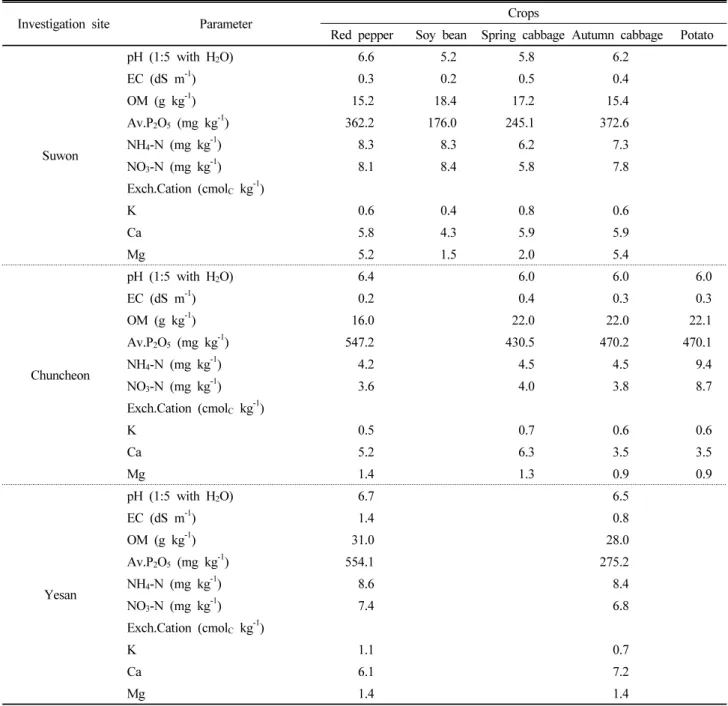
Table 2. Chemical properties of soil before experiment at 3 different sites.

Investigation site Parameter Crops

Red pepper Soy bean Spring cabbage Autumn cabbage Potato

Suwon

pH (1:5 with H

2

O) 6.6 5.2 5.8 6.2

EC (dS m

-1

) 0.3 0.2 0.5 0.4

OM (g kg

-1

) 15.2 18.4 17.2 15.4

Av.P

2

O

5

(mg kg

-1

) 362.2 176.0 245.1 372.6

NH

4

-N (mg kg

-1

) 8.3 8.3 6.2 7.3

NO

3

-N (mg kg

-1

) 8.1 8.4 5.8 7.8

Exch.Cation (cmol

C

kg

-1

)

K 0.6 0.4 0.8 0.6

Ca 5.8 4.3 5.9 5.9

Mg 5.2 1.5 2.0 5.4

Chuncheon

pH (1:5 with H

2

O) 6.4 6.0 6.0 6.0

EC (dS m

-1

) 0.2 0.4 0.3 0.3

OM (g kg

-1

) 16.0 22.0 22.0 22.1

Av.P

2

O

5

(mg kg

-1

) 547.2 430.5 470.2 470.1

NH

4

-N (mg kg

-1

) 4.2 4.5 4.5 9.4

NO

3

-N (mg kg

-1

) 3.6 4.0 3.8 8.7

Exch.Cation (cmol

C

kg

-1

)

K 0.5 0.7 0.6 0.6

Ca 5.2 6.3 3.5 3.5

Mg 1.4 1.3 0.9 0.9

Yesan

pH (1:5 with H

2

O) 6.7 6.5

EC (dS m

-1

) 1.4 0.8

OM (g kg

-1

) 31.0 28.0

Av.P

2

O

5

(mg kg

-1

) 554.1 275.2

NH

4

-N (mg kg

-1

) 8.6 8.4

NO

3

-N (mg kg

-1

) 7.4 6.8

Exch.Cation (cmol

C

kg

-1

)

K 1.1 0.7

Ca 6.1 7.2

Mg 1.4 1.4

식양토 (37°15′27.68″N, 126°59′16.05″E)로서 유기물 함량이 15.2~18.4 g kg -1 그리고 인산이 176.0~372.6 mg kg -1 , 암모니 아태 질소 6.2~8.3 mg kg -1 와 질산태질소 5.8~8.4 mg kg -1 이였다. 춘천시에 위치한 강원도농업기술원의 밭 시험포장 (37°57′ 15.9″N, 127°46′26.6″E)은 용계통 사질식양토로서 유

기물 함량이 16.0∼22.1 g kg -1 그리고 인산이 430.5~547.2

mg kg -1 , 암모니아태 질소 4.2~9.4 mg kg -1 와 질산태질소

3.6~8.7 mg kg -1 이였다. 그리고 예산읍에 위치한 충남농업

기술원 밭 시험포장 (36° 44′15″N, 126° 49′07″E)은 예산통

양토로서 유기물 함량이 28.0~31.0 g kg -1 그리고 인산이

(4)

Fig. 1. Steady-state chamber for collecting N 2 O in soil.

Table 3. Gas Chromatographic analysis conditions for N 2 O measurement.

Detector ECD

Column Packing material Materials O.D. x length

Porapack Q (80/100) Stainless steel

1/8" x 2 m

Carrgier gas N

2

Flow rate 30 ml/min

(Carrier+make up) Temperature Column

Injector Detector

70°C 80°C 320°C

Retention time 3.2 min

Concentration of calibration gas 0.5 and 1.0 ppmv N

2

O in N

2

Loop 2 ml

275.2~554.1 mg kg -1 , 암모니아태 질소 8.4~8.6 mg kg -1 와 질산태질소 6.8~7.4 mg kg -1 이였다 (Table 1, 2).

비료 시용량은 각 작물의 표준 시비량을 기준으로 하였으 며, 3지역 작물별 NPK 처리는 N-P 2 O 5 -K 2 O를 고추 225- 112-149 kg ha -1 , 봄・가을배추 320-78-198 kg ha -1 , 콩 32- 33-37 kg ha -1 그리고 감자 137-33-114 kg ha -1 이며 토양 수 분관리는 자연 강우량으로 하였다. 질소비료 처리의 양은 3 지역의 시험포장 면적 규모의 여건에 따라 수원에서는 0배, 1 배, 2배, 춘천은 0배와 1배 그리고 예산지역은 0배, 0.5배, 1배, 2배로 시용하였다. 농촌진흥청 작물별 시비처방기준 (RDA, 2006)의 표준시비방법에 준하였으며, 콩은 요소, 인산, 칼리 를 전량 기비 하였으며 콩을 제외한 그 외 작물의 질소는 요 소를 2회 분시, 인산은 용성인비로 전량 기비, 칼리는 염화칼 리를 1회 분시 하였다.

N 2 O 배출 플럭스를 조사하기 위해 국제적으로 공인된 밀 폐형태 챔버인 steady-state (Hutchinson and Livingston, 1993)를 사용하였다 (Fig. 1). 설치된 챔버는 외부로의 공기

유출이 없도록 하였으며, 지름이 0.25 m, 높이가 0.5 m인 PVC 소재로 각 시험구의 대표 지점에 안정적으로 설치하였 다. 가스시료 채취는 Yagi (1991)의 방법에 의하여 10:00∼

13:00시 사이에 60 ml 주사기로 1주일에 2회 채취하여 분석 하였다.

채취한 공기 시료의 N 2 O 기체농도는 10 port와 4 port valve 를 장착한 GC-ECD (Varian 3800)를 사용하였고 column은 Porapack Q (80/100 mesh)를 충전한 1/8″×2 m의 stainless steel tubing column, 그리고 Detector의 온도는 320 ℃로 하 였다. N 2 O 분석 조건은 Table 3과 같다.

플럭스는 다음 식에 따라서 계산 (F: ㎎ m -2 hr -1 ) 하였다.

F = ρ․V A -1 ․Δc Δt -1 ․273 T -1 (Eq.2)

ρ는 가스밀도 (㎎ m -3 ), A는 챔버 바닥면적 (㎡), V는 챔버내 공기체적 (㎥),

Δc Δt -1 는 챔버내 가스농도의 평균 증가속도 (10 -6 m 3 m -3 hr -1 ),

T는 챔버내 평균기온 (K)

N 2 O ρ값 (T=273 K)은 다음과 같다.

ρ N2O = 1.96, ρ N2O-N = 1.25

IPCC에서는 불확도 평가를 통해 생산 자료의 신뢰성 확보 를 요구하고 있다 (IPCC, 2006). 우리나라 주요 밭작물재배 토양에서 N 2 O 배출계수를 구하기 위하여 3년간 전국 3개 지 역에서 조사된 N 2 O 배출계수의 정규분포 95% 신뢰구간을 산 정하였고, 본 신뢰구간의 절대 값을 평균 배출계수로 나누어 자료의 불확도 (%)를 평가하였다 (SRI, 2011).

Results and Discussion

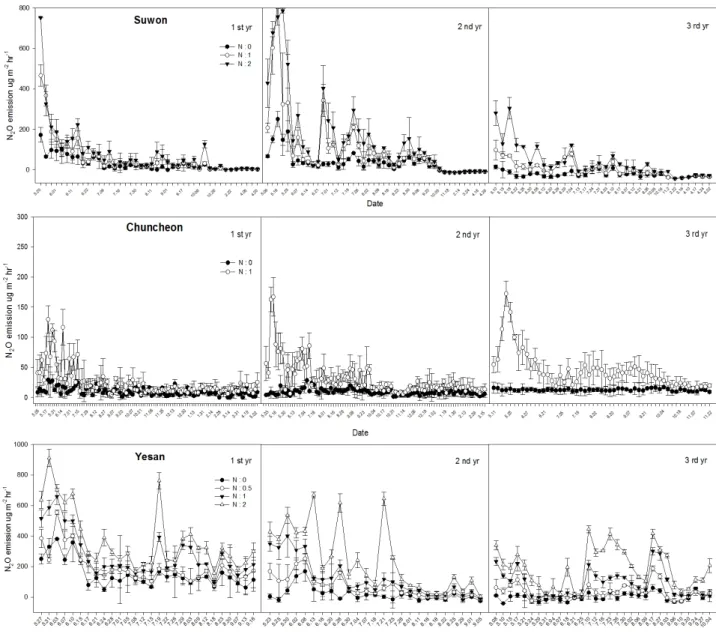
고추 재배지 N 2 O 배출 N 2 O 배출량 변화는 조사지역 별 조사 연차와 관계없이 일정한 변화 양상을 보였다 (Fig.

2). 고추 생육초기에 질소 비료에 의해 N 2 O 배출량이 빠르게 증가하였으며, 여름철 7~8월 사이에도 소폭의 증가를 보였 다. 특히 타 지역 보다 충남 예산지역에서는 생육초기 뿐만 아니라 7월에도 배출 증가를 보였고, 또한 N 2 O 배출량도 많 았다. 3개 지역 중 3개 지역 N 2 O 배출량은 시간이 지남에 따 라 크게 감소하여 수확기와 수확 후 기간까지 낮은 배출을 유 지하였으며, 3개 지역 모두 질소비료 시용량이 많을수록 배 출량이 증가하였다.

조사지역에 따라 강수량과 기온 등의 재배환경 차이로 인

해 고추 수량에 다소 간 차이가 있었다 (Table 4). 토양온도와

토양수분은 다른 지역에 비해 예산에서 높았으며 이는 N 2 O

배출 양상에도 영향이 미친 것으로 보인다. N 2 O 배출 양상은

(5)

Fig. 2. N 2 O emission patterns in pepper soils located at 3 different sites treated by N fertilizer levels.

토양온도와 토양수분 변화와는 밀접한 경향이 있으며 토양 온도와 토양수분이 증가할수록 N 2 O 플럭스가 증가된다고 하 였다 (Clayton et al., 1997; Conen et al., 2000; Dobbie et al., 1999; Kim et al., 2008; Mahmood et al., 1998; Sozanska et al., 2002). Arone and Bohlen (1998)은 N 2 O 배출량과 토양 수분함량과는 정의 상관관계가 있다고 하였으며, Dobbie 등 (1999)은 남부 스코틀랜드의 N 2 O 배출량이 조사지역과 기후 차이에 관계없이 토양수분과 밀접한 관계가 있다고 하였다.

Sozanska et al. (2002)은 토양수분에서 액상과 기상부분을 고려한 WFPS (Water Filled Pore Space)가 80~85%에서 N 2 O 배출이 최대가 되고, 토양 수분과 토양온도가 증가함에 따라 배출도 증가한다고 하였다.

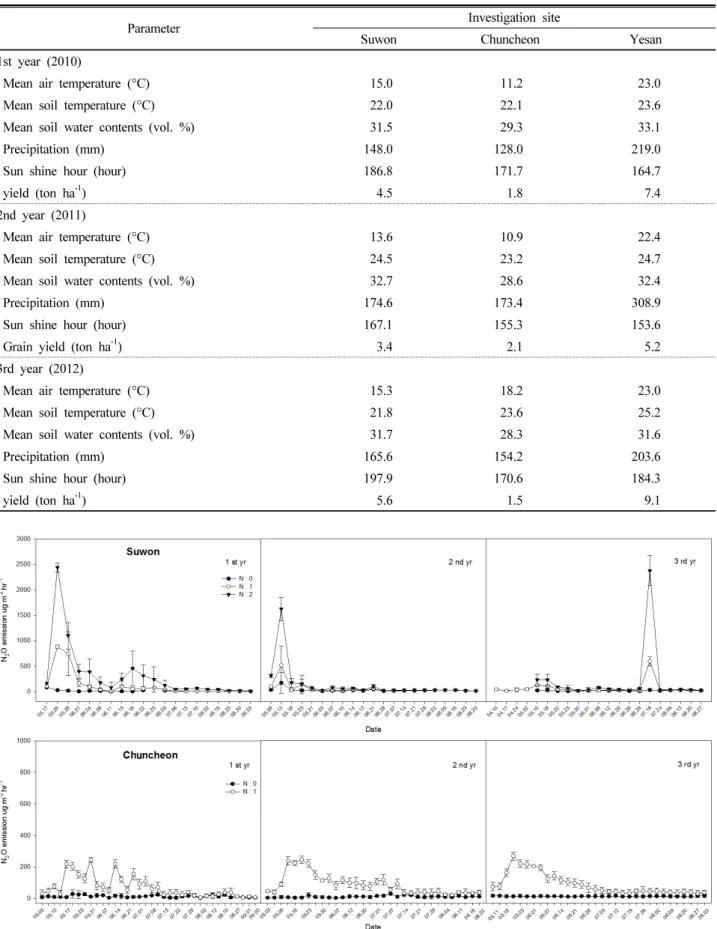
봄배추 재배지 N 2 O 배출 우리나라 밭 토양에서 국가 고유의 N 2 O 배출계수 개발을 위하여 3년 동안 봄 배추재배기

간 중에 측정한 N 2 O 배출변화는 Fig. 3과 같다. N 2 O 배출량

은 조사지역과 연차와 관계없이 대부분 정식 후 한 달까지는

높은 양상을 보였다. 생육초기에는 질소비료 시용으로 N 2 O

배출량이 빠르게 증가하였으나, 정식 후 1개월 이후에는 크

게 감소하여 수확기와 다음해 정식 전 기간까지 낮은 배출을

유지하였다. 그리고 3개 지역 모두 질소비료 시용량이 많을

수록 배출량이 증가하였다. 특히, 2010과 2011년에 수원지역

에서 N 2 O 배출량이 춘천지역 보다 정식 직후 생육초기에 높

았는데, 이는 토양온도와 토양수분이 춘천보다 높은데 (Table

5), 원인이 있다고 생각되었다. 또한 2012년에 수원지역의 정

식 직후 N 2 O 배출이 낮은 원인은 생육초기 강수량이 적어 토

양온도와 토양수분이 낮았기 때문으로 판단된다. 2012년 수

확 후 7월18일 수원지역에서 N 2 O 배출량이 높은 것은 7월16

일~7월19일 태풍 카눈의 영향으로 토양수분 증가의 영향이

미치는 강수량이 상대적으로 높은 원인이라 판단된다.

(6)

Table 4. Comparison of climate condition and yield properties in upland soils located at 3 different sites during pepper cultivation.

Parameter Investigation site

Suwon Chuncheon Yesan

1st year (2010)

Mean air temperature (°C) 15.0 11.2 23.0

Mean soil temperature (°C) 22.0 22.1 23.6

Mean soil water contents (vol. %) 31.5 29.3 33.1

Precipitation (mm) 148.0 128.0 219.0

Sun shine hour (hour) 186.8 171.7 164.7

yield (ton ha

-1

) 4.5 1.8 7.4

2nd year (2011)

Mean air temperature (°C) 13.6 10.9 22.4

Mean soil temperature (°C) 24.5 23.2 24.7

Mean soil water contents (vol. %) 32.7 28.6 32.4

Precipitation (mm) 174.6 173.4 308.9

Sun shine hour (hour) 167.1 155.3 153.6

Grain yield (ton ha

-1

) 3.4 2.1 5.2

3rd year (2012)

Mean air temperature (°C) 15.3 18.2 23.0

Mean soil temperature (°C) 21.8 23.6 25.2

Mean soil water contents (vol. %) 31.7 28.3 31.6

Precipitation (mm) 165.6 154.2 203.6

Sun shine hour (hour) 197.9 170.6 184.3

yield (ton ha

-1

) 5.6 1.5 9.1

Fig. 3. N 2 O emission patterns in Chinese cabbage (spring season) soils located at 2 different sites treated by different N fertilization levels.

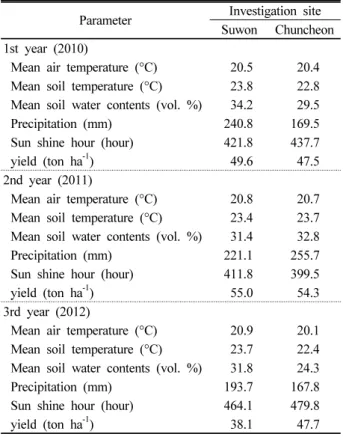
시험지역과 연차별 배추 수량을 보면 (Table 5), 강수량과 기온 등 재배환경 차이로 인해 배추수량에 다소 간 차이가 있

었다. 특히, 2년차인 2012년 봄배추 수량은 두 지역 모두에서

높았으나, N 2 O 배출 특성과는 관련성이 없는 것으로 나타났다.

(7)

Table 5. Comparison of climate condition and yield properties in upland soils located at 3 different sites during Chinese cabbage (spring season) cultivation.

Parameter Investigation site Suwon Chuncheon 1st year (2010)

Mean air temperature (°C) 20.5 20.4 Mean soil temperature (°C) 23.8 22.8 Mean soil water contents (vol. %) 34.2 29.5

Precipitation (mm) 240.8 169.5

Sun shine hour (hour) 421.8 437.7

yield (ton ha

-1

) 49.6 47.5

2nd year (2011)

Mean air temperature (°C) 20.8 20.7 Mean soil temperature (°C) 23.4 23.7 Mean soil water contents (vol. %) 31.4 32.8

Precipitation (mm) 221.1 255.7

Sun shine hour (hour) 411.8 399.5

yield (ton ha

-1

) 55.0 54.3

3rd year (2012)

Mean air temperature (°C) 20.9 20.1 Mean soil temperature (°C) 23.7 22.4 Mean soil water contents (vol. %) 31.8 24.3

Precipitation (mm) 193.7 167.8

Sun shine hour (hour) 464.1 479.8

yield (ton ha

-1

) 38.1 47.7

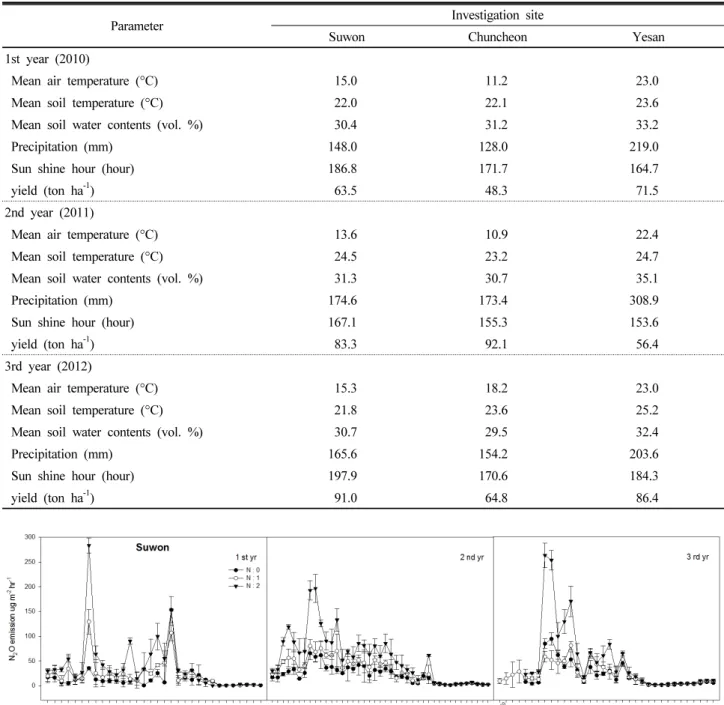
Fig. 4. N 2 O emission patterns in Chinese cabbage (autumn season) soils located at 3 different sites treated by different N fertilization levels.

가을배추 재배지 N 2 O 배출 N 2 O 배출량 변화는 조사 지역별 조사 연차와 관계없이 대부분 정식 후 한 달까지는 높 은 N 2 O 배출 양상을 보였다 (Fig. 4). 이는 생육초기에 질소 비료 시용효과로 N 2 O 배출량이 빠르게 증가하였다. 3개 지역 N 2 O 배출량은 정식하고 한 달 이후부터 시간이 지남에 따라 크게 감소하여 수확기와 이듬해 정식 전 기간까지 낮은 배출 을 유지하였다. 특히 3지역 중 충남 예산지역의 N 2 O 배출이 타 지역 보다 많았는데, 이는 토양온도와 토양수분이 다른 지 역에 비해 예산에서 높았으며 (Table 6) 이는 N 2 O 배출 양상 에도 영향이 미친 것으로 보인다.

3지역 모두 가을이 깊어지는 9월 중순~10월 초순 이후부 터 N 2 O 배출이 거의 일어나지 않았다. 이는 봄배추의 경우 봄~여름철 기간에 재배하기 때문에 여름철에 빈번한 강우로 인한 토양수분과 토양온도의 상승으로 N 2 O 배출이 증가하 나, 가을배추는 가을~초겨울 기간 동안 재배하므로 10월부 터는 강수량이 적고 기온이 떨어져 토양수분과 토양온도가 낮아져 N 2 O 배출이 감소하는 것으로 나타났다.

조사지역에 따라 강수량과 기온 등의 재배환경 차이로 인

해 가을배추 수량에도 차이가 있었다 (Table 3). 토양온도와

토양수분은 다른 지역에 비해 예산에서 높았으며 이는 N 2 O 배

출의 양상은 토양온도와 토양수분 변화와는 밀접한 경향이 있

으므로 N 2 O 배출에도 영향을 미친 것으로 보인다 (Goodroad et

(8)

Table 6. Comparison of climate condition and yield properties in upland soils located at 3 different sites during Chinese cabbage (autumn season) cultivation.

Parameter Investigation site

Suwon Chuncheon Yesan

1st year (2010)

Mean air temperature (°C) 15.0 11.2 23.0

Mean soil temperature (°C) 22.0 22.1 23.6

Mean soil water contents (vol. %) 30.4 31.2 33.2

Precipitation (mm) 148.0 128.0 219.0

Sun shine hour (hour) 186.8 171.7 164.7

yield (ton ha

-1

) 63.5 48.3 71.5

2nd year (2011)

Mean air temperature (°C) 13.6 10.9 22.4

Mean soil temperature (°C) 24.5 23.2 24.7

Mean soil water contents (vol. %) 31.3 30.7 35.1

Precipitation (mm) 174.6 173.4 308.9

Sun shine hour (hour) 167.1 155.3 153.6

yield (ton ha

-1

) 83.3 92.1 56.4

3rd year (2012)

Mean air temperature (°C) 15.3 18.2 23.0

Mean soil temperature (°C) 21.8 23.6 25.2

Mean soil water contents (vol. %) 30.7 29.5 32.4

Precipitation (mm) 165.6 154.2 203.6

Sun shine hour (hour) 197.9 170.6 184.3

yield (ton ha

-1

) 91.0 64.8 86.4

Fig. 5. N 2 O emission patterns in soybean soils located in Suwon treated by different N fertilization levels.

al., 1984; Kim, et al., 2010).

콩 재배지 N 2 O 배출 콩 밭에서 질소비료 시용량에 따 른 N 2 O 배출량 경시적 변화는 Fig. 5와 같다. 배출량은 대기 온도가 상승하는 7월 여름부터 가을인 10월까지 지속적으로 N 2 O가 배출되었다. 2011년은 다른 해 (453.4~1493.7 ug m -2 hr -1 )에 비해 전체적으로 배출량이 높았는데 (884.1~2,283.9 ug m -2 hr -1 ) 이는 N 2 O 배출에 영향을 미치는 토양온도와 토 양수분이 높았기 때문으로 (Table 7) 보인다 (Goodroad and Keeney, 1984; Kim et al., 2014). 수원지역의 강수량과 기온

등의 재배환경을 보면 3년 동안 평균 대기온도는 11.4~13.8°C, 토양온도와 토양수분은 19.6~21.9°C와 28.2~31.3 vol. %였 으며 수량은 2011년도에 2.57톤 ha -1 으로 가장 많았다.

감자 재배지 N 2 O 배출 감자 재배기간 동안 질소시비

량에 따른 N 2 O 배출 변화는 Fig. 6과 같다. 3년 동안 대부분

의 아산화질소 배출량은 감자 재배 초기에 가장 많았고 다음

으로 7~8월에 배출을 보였다. 감자 재배 초기와 중기에는 강

우량이 집중되는 기간으로 토양수분이 증가함에 따라 질소

비료의 탈질 현상이 활발히 일어나기 때문에 N 2 O 발생이 증

(9)

Table 7. Comparison of climate condition and yield properties in upland soils located at Suwon site during soybean cultivation.

Parameter Investigation site Suwon 1st year (2010)

Mean air temperature (°C) 11.4

Mean soil temperature (°C) 19.6

Mean soil water contents (vol. %) 28.2

Precipitation (mm) 129.1

Sun shine hour (hour) 186.5

yield (ton ha

-1

) 2.4

2nd year (2011)

Mean air temperature (°C) 13.8

Mean soil temperature (°C) 21.9

Mean soil water contents (vol. %) 31.3

Precipitation (mm) 158.8

Sun shine hour (hour) 186.0

yield (ton ha

-1

) 2.6

3rd year (2012)

Mean air temperature (°C) 13.4

Mean soil temperature (°C) 21.7

Mean soil water contents (vol. %) 30.5

Precipitation (mm) 148.3

Sun shine hour (hour) 179.6

yield (ton ha

-1

) 2.0

Fig. 6. N 2 O emission patterns in potato soils located in Chuncheon treated by different N fertilization levels.

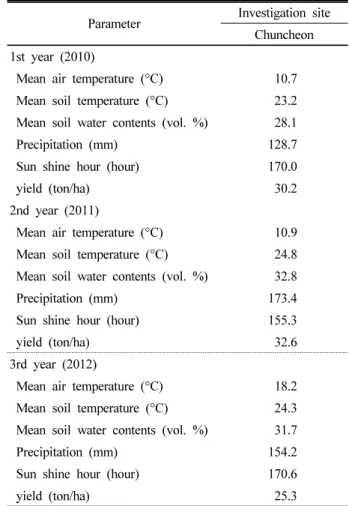
Table 8. Climate condition and yield properties in upland soils located at Chuncheon site during potato cultivation.

Parameter Investigation site Chuncheon 1st year (2010)

Mean air temperature (°C) 10.7 Mean soil temperature (°C) 23.2 Mean soil water contents (vol. %) 28.1

Precipitation (mm) 128.7

Sun shine hour (hour) 170.0

yield (ton/ha) 30.2

2nd year (2011)

Mean air temperature (°C) 10.9 Mean soil temperature (°C) 24.8 Mean soil water contents (vol. %) 32.8

Precipitation (mm) 173.4

Sun shine hour (hour) 155.3

yield (ton/ha) 32.6

3rd year (2012)

Mean air temperature (°C) 18.2 Mean soil temperature (°C) 24.3 Mean soil water contents (vol. %) 31.7

Precipitation (mm) 154.2

Sun shine hour (hour) 170.6

yield (ton/ha) 25.3

가하는 것으로 생각된다. 그리고 질소비료 시용량이 많을수 록 N 2 O 배출량이 증가하였고 가을로 접어드는 10월 이후부 터 월동기간을 포함한 봄까지 배출량은 미미하였다. 춘천지 역의 강수량과 기온 등의 재배환경을 보면 3년 동안 평균 대 기온도는 10.7~18.2°C, 토양온도와 토양수분은 23.2~24.8°C 와 28.1~32.8 vol. %였으며 수량은 2011년에 32.6톤 ha -1 으 로 가장 많았다.

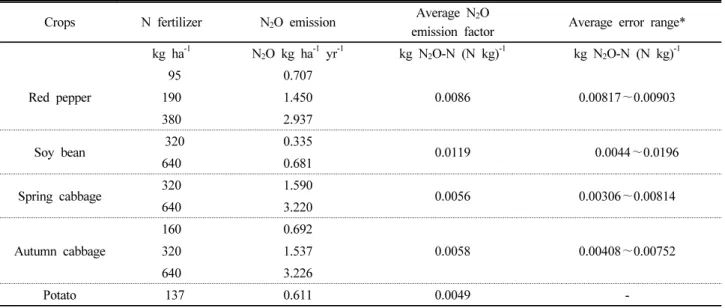
Table 9는 작물별 질소비료 시용량에 따른 N 2 O 배출량과 평균 N 2 O 배출계수를 나타낸 것이다. 고추의 평균 N 2 O 배출

계수는 0.0086 kg N 2 O-N (N kg) -1 이였으며 조사 자료의 평 균 오차범위 (error range)는 0.00817~0.00903 kg N 2 O-N (N kg) -1 그리고 불확도는 5.0%였다. 콩의 평균 N 2 O 배출계 수는 0.0119 kg N 2 O-N (N kg) -1 , 평균 오차범위는 0.0044~

0.0196 kg N 2 O-N (N kg) -1 으로 불확도는 64.0%였으며, 봄배

추와 가을배추의 평균 N 2 O 배출계수는 각 0.0056와 0.0058

kg N 2 O-N (N kg) -1 , 평균 오차범위는 0.00306~0.00814과

0.00408~0.00752 kg N 2 O-N (N kg) -1 이며 불확도는 45.4과

29.7%였다. 그리고 감자의 평균 N 2 O 배출계수는 0.0049 kg

(10)

Table 9. Comparison of N 2 O emission (N kg ha -1 yr -1 ) and average N 2 O emission factor in upland soils located at 3 different sites during red pepper, soy bean, spring cabbage, autumn cabbage and potato cultivation treated by different N fertilization levels.

Crops N fertilizer N

2

O emission Average N

2

O

emission factor Average error range*

kg ha

-1

N

2

O kg ha

-1

yr

-1

kg N

2

O-N (N kg)

-1

kg N

2

O-N (N kg)

-1

Red pepper

95 0.707

0.0086 0.00817 ∼0.00903

190 1.450

380 2.937

Soy bean 320 0.335

0.0119 0.0044 ∼0.0196

640 0.681

Spring cabbage 320 1.590

0.0056 0.00306 ∼0.00814

640 3.220

Autumn cabbage

160 0.692

0.0058 0.00408 ∼0.00752

320 1.537

640 3.226

Potato 137 0.611 0.0049 -

Note) *Error range within 95% confidence intervals.

Fig. 7. Relationships between the averaged N 2 O emissions and nitrogen fertilizer application rates during red pepper, soy bean, spring cabbage, autumn cabbage and potato cultivation in upland soil from 2010 to 2012.

N 2 O-N (N kg) -1 이며 평균 오차범위와 불확도는 단일 질소비 료 처리로 통계처리는 할 수 없었다.

Fig. 7은 2010년부터 2012년 까지 고추, 봄과 가을배추, 콩, 감자 등 5개 작물 및 재배지를 대상으로 N 2 O 배출량을 평 균하였다. 그리고 질소비료 시용량과 N 2 O 배출과의 관계를 회귀분석으로 나타낸 것이다. 질소비료 시용량이 많을수록 N 2 O 배출량이 증가하였으며, 질소비료 시용량에서 89.9%로 N 2 O 배출의 경시적 변이를 설명할 수 있었다. N 2 O 배출량과 질소비료 시용량의 상관은 0.948***로서 높은 상관관계를 보였다. 5개 작물 재배지의 평균 N 2 O 배출계수는 0.00596 kg N 2 O-N (N kg) -1 으로 평가되어 IPCC default 값인 2006 가이 드라인의 0.01 kg N 2 O-N (N kg) -1 과 1996 가이드라인의

0.0125 kg N 2 O-N (N kg) -1 보다 40.4~52.3%가 낮았다. IPCC default 값은 Bouwman (1996)과 Mosier et al. (1998)의 보고 에 의하면 대부분 유럽과 미국의 목초지와 밭 토양의 NH 4 + 와 NO 3 - 함량 자료를 참고하였고 아시아에서는 유일하게 일본 에 밭 토양 자료를 활용하여 0.0125와 0.01 kg N 2 O-N (N kg) -1 을 결정하였다. 그리고 대부분 밭 토양보다 질소비료 시 용량이 많은 목초지가 많아서 배출계수 값이 높은 것으로 판 단된다.

Conclusions

우리나라 5개 작물 및 재배지를 대상으로 N 2 O 배출량을 측정하여 5개 작물의 배출량을 통합한 통합 배출계수를 산정 하였다. 5개 작물 평균 N 2 O 배출계수는 0.00596 kg N 2 O-N (N kg) -1 으로 산정하였다. 본 연구를 통해 5개 작물을 통합하 여 산정된 배출계수는 2014년에 우리나라 고유배출계수로 국가에 등록하였고 앞으로 우리나라와 지자체에서 밭작물 재배지역에서 발생하는 N 2 O 배출량을 산정할 때 사용된다.

국가 고유 배출계수 개발 이전에는 IPCC에서 부여하는 임의 계수를 적용하였기 때문에 국가 온실가스 배출량이 과대평 가되어 왔었다.

국가 고유온실가스 배출계수 개발은 선진국 수준의 정밀

도를 가지는 배출량 인벤토리 산정의 의미를 담고 있으며,

UN 기후변화사무국 및 온실가스 담당 정부부처 (환경부 온

실가스종합정보센터)에 제출하는 국가 온실가스 보고서 작

성에 기본 자료로 활용될 뿐만 아니라 국가 온실가스 배출통

계의 품질개선 및 신뢰도도 향상될 것으로 기대하고 있다. 이

외에도 국가 고유의 아산화질소 배출계수 적용으로 국가 및

(11)

지자체 온실가스 배출량 감축도 기대하고 있다.

References

Arone, J.A. and P.J. Bohlen. 1998. Stimulated N 2 O flux from intact grassland monoliths after two growing seasons under elevated atmospheric CO 2 . Oecologia. 116:331-335.

Bouwman, A.F. 1996. Direct emission of nitrous oxide from agricultural soils. Nutr. Cycling Agroecosyst. 46:53-70.

Clayton, H., I.P. Mctagart, J. Parker, L. Swan, and K.A. Smith.

1997. Nitrous oxide emissions from fertilised grassland : A 2-year study of the effects of N fertiliser form and environmental conditions. Biol. Fertil. Soils 25:252-260.

Conen, F., K.E. Dobbie, and K.A. Smith. 2000. Predicting N 2 O emissions from agricultural land through related soil parameters.

Global Change Biol. 6:417-426.

Dobbie, K.E., I.P. Mctagart, and K.A. Smith. 1999. Nitrous oxide emissions from intensive agricultural systems: variations between crop and seasons; key driving variables; and mean emission factors. J. Geophys. Rcs. 104:26891-26899.

Firestone, M.K. and E.A. Davidson. 1989. Microbiological basis of NO and N 2 O production and consumption in soil. In: Andreae, M.O., Schimel, D.S. (Eds.), Exchange of Trace Gases between Terrestrial Ecosystems and the Atmosphere. Wiley, New York.

Freney, J.R. 1997. Emission of nitrous oxide from soils used for agriculture. Nutr. Cycling Agroecosyst. 49(1-3):1-6.

Frolking, S.E., A.R. Mosier, and D.S. Ojima. 1998. Comparison of N 2 O emissions from soils at three temperate agricultural sites: simulations of year-round measurements by four models.

Nutr. Cycling Agroecosyst. 52:77-105.

Goodroad, L.L. and D.R. Keeney. 1984. Nitrous oxide production in aerobic soils under varying pH, temperature and water content.

Soil Biol. Biochem. 16(1):39-43.

Hellebrand, H.J., V. Scholz, and J. Kern. 2008. Fertilizer induced nitrous oxide missions during energy crop cultivation on loamy sand soils. Atmos. Environ. 42:8403-8411.

Hutchinson, G.L. and G.P. Livingston. 1993. Use of chamber systems to measure trace gas fluxes. Agricultural ecosystem effects on trace gases and global climate change. ASA Spec.

Publ. 55:63-78.

IPCC, 2006. IPCC (Intergovernmental Panel on Climate Change), 2006. IPCC GL (Guidelines) for NGGI (National Greenhouse Gas Inventories).

IPCC. 1996. Revised IPCC guidelines for national greenhouse gas inventories: Reference Manual, revised in 1996, IPCC.

Iserman, K. 1994. Agriculture's share in the emissions of trace

gases affecting the climate and some cause oriented proposals for reducing this share. Environ. Pollut. 83:95-111.

Kim, G.Y., B.H. Song, K.A. Roh, S.Y. Hong, B.G. Ko, K.M.

Shim, and K.H So. 2008. Evaluation of green house gases emissions according to changes of soil water content, soil temperature and mineral N with different soil texture in pepper cultivation. Korean J. Soil Sci. Fert. 41:399-407.

Kim, G.Y., H.C. Jeong, Y.K. Son, S.Y. Kim, J.S. Lee, and P.J.

Kim. 2014. Effect of soil water potential on methane and nitrous oxide emissions in upland soil during red pepper cultivation. J.

Korean Soc. Appl. Biol. Chem. 57:15-22.

Kim, G.Y., K.H. So, H.C. Jeong, K.M. Shim, S.B. Lee, and D.B.

Lee. 2010. Evaluation of N 2 O emissions with changes of soil temperature, soil water content and mineral N in red pepper and soybean field. Korean J. Soil Sci. Fert. 43:880-885.

Mahmood, T., R. Ali., K.A. Malik, and S.R.A. Shamsi. 1998. Nitrous oxide emissions from an irrigated sandy-clay loam cropped to maize and wheat. Biol. Fertil. Soils. 27:189-196.

Minami, K. 1997. Mitigation of nitrous oxide emissions from fertilized soils. In: Proceedings if IGAC symposium, Nagoya, Japan.

Mosier, A., C. Kroeze, C. Nevison, O. Oenema, S. Seitzinger, and O. van Cleemput. 1998. Closing the global atmospheric N 2 O budget: Nitrous oxide emissions through the agricultural nitrogen cycle, Nutr. Cycling Agroecosyst. 52:225-248.

Parton, W.J., A.R. Mosier, D.S. Ojima, D.W. Valentine, D.S. Schimel, K. Weier, and A.E. Kulmala, 1996: Generalized model for N 2 and N 2 O production from nitrification and denitrification.

Global Biogeochem. Cycles. 10:401-412.

RDA (Rural Development Administration). 2006. Fertilizer recommendation standards for various crops, Sanglok-sa, 58-59.

Singh, S.N. and L. Tyagi. 2009. Nitrous oxide: Sources, sinks and mitigation strategies. In Sheldon A. I., Barnhart E. P. (eds.):

Nitrous oxide emissions research progress. Nova Science Publishers, Inc., New York, 127-150.

Sozanska, M., U. Skiba, and S. Metcalfe. 2002. Developing an inventory of N 2 O emissions from British Soils. Atmos. Environ.

36:987-998.

SRI (Statistical Research Institute). 2011. A study on uncertainty calculator of activity data-National GHGs emission statistics, 110-172 (in Korea).

Warneck, P. (2000) Chemistry of the Natural Atmosphere. 2nd edition, Academic Press, New York.

Yagi, K. 1991. Emission of biogenic gas compounds from soil

ecosystem and effect of global environment. 2. Methane emission

from paddy fields. Soil Fert. Japan. 62(5):556-562.

수치

Table 2. Chemical properties of soil before experiment at 3 different sites.
Table 3. Gas Chromatographic analysis conditions for N 2 O  measurement.
Fig. 2. N 2 O emission patterns in pepper soils located at 3 different sites treated by N fertilizer levels.
Table 4. Comparison of climate condition and yield properties in upland soils located at 3 different sites during pepper cultivation.
+5

참조

관련 문서