Nutrient Balances and Soil Properties Affected by Application of Soybean and Barley Residues
Taek-Keun Oh, Yeon-Kyu Sonn, Dong Sung Lee
1, Myung-Sook Kim, Seok-Cheol Kim, Hong Bae Yun, Deog-Bae Lee, and Chang-Hoon Lee*
Division of Soil and Fertilizer, NAAS, RDA, Suwon, 441-707, South Korea
1
Department of Agricultural Chemistry, Graduate School, Chungnam National University, Daejon, 305-764, South Korea
(Received: March 28 2014, Accepted: April 15 2014)
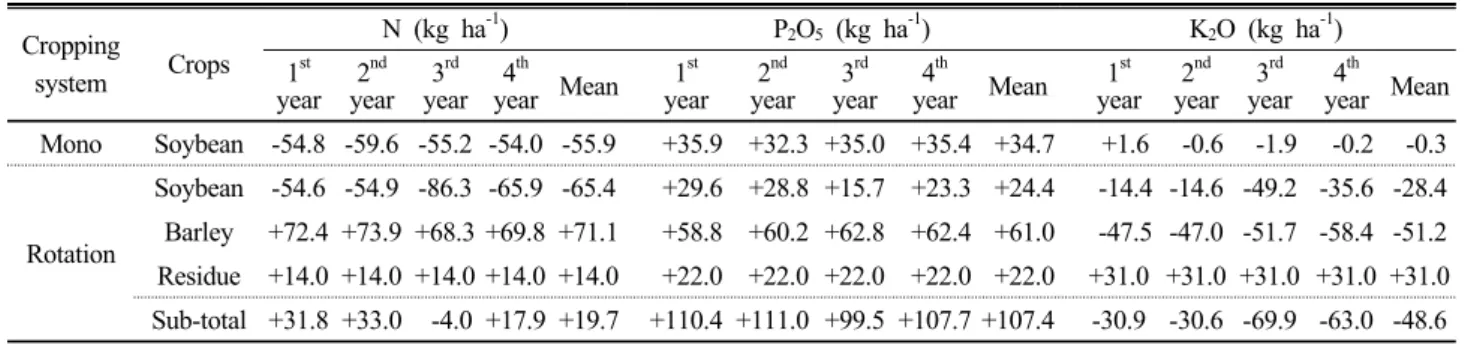
An accurate analysis of nutrient balance in different cropping systems is necessary for improving soil fertilities, causing higher crop yields and quality. This study was carried out to investigate the nutrient balance, changes in soil properties, and their effects on crop yield in long-term field cultivation under mono- and rotation-cropping systems (MCS and RCS, respectively). The analytical results of the soil properties showed that the application of mineral fertilizers alone in the MCS leads the reduction of soil CEC, exchangeable Ca, and microbial biomass C and N. Compared with the MCS of soybean, the RCS of soybean and barley significantly improved the soil properties, which increased crop yield. It might be due to the barley residue added to the RCS soil. Mean nutrient balances for 4 years were −55.9 kg N, +34.7 kg P
2O
5, and −0.3 kg K
2O ha
-1for the MCS and +19.7 kg N, +107.4 kg P
2O
5, and −48.6 kg K
2O ha
-1for the RCS, respectively. These nutrient imbalances mean that conventional fertilizer recommendations were inadequate for maintaining soil nutrient balance. From these results, we can conclude that the crop rotation may change comprehensive physical, chemical, and biological soil properties. These changes could affect the nutrient balance and then the crop yield.
Key words: Nutrient balances, Soil properties, Crop residue, Cropping systems
Comprehensive physical, chemical, and biological changes by crop rotation could affect the nutrient balance and then the crop yield.
Cropping system Crops N (kg ha
-1) P
2O
5(kg ha
-1) K
2O (kg ha
-1) Mean for 4 years Mean for 4 years Mean for 4 years
Mono Soybean -55.9 +34.7 -0.3
Rotation
Soybean -65.4 +24.4 -28.4
Barley +71.1 +61.0 -51.2
Residue +14.0 +22.0 +31.0
Sub-total +19.7 +107.4 -48.6
1)
*Corresponding author : Phone: +82312900325, Fax: +82312900208, E-mail: [email protected]
§
Acknowledgement: The authors would cordially thank Prof. Jiro Chikushi for his invaluable guidance, comments, and suggestions to
improve this manuscript. This study was supported by 2014 Postdoctoral Fellowship of National Academy Agricultural Science
(PJ:009348032014), Rural Development Administration, Republic of Korea.
Table 1. Physical and chemical properties of soil used in experiment.
pH (1:5)
EC (dS m
-1)
OM (g kg
-1)
T-N (g kg
-1)
Av. P
2O
5(mg kg
-1)
Ex. Cations
(cmol
ckg
-1) Bulk density (g cm
-3)
Particle size distribution
(%) Soil
texture
K Ca Mg Clay Silt Sand
5.5 0.2 10.2 0.9 193.3 0.1 1.9 0.7 1.4 15.2 31.1 53.7 Sandy loam
Note: EC: electrical conductivity, OM: organic matter, T-N: Total nitrogen, Av. P2O5: available phosphorus, Ex. Cations: exchangeable cations
Table 2. Mean monthly air temperature (°C) and precipitation (mm) at experimental site.
Year Climate factors Oct. Nov. Dec. Jan. Feb. Mar. Apr. May Jun. Jul. Aug. Sep.
1
stAir temperature 13.9 7.3 -0.1 -1.1 0.4 0.6 12.8 16.9 22.4 25.5 25.9 22.9 Precipitation 92.3 25.3 18.2 7.3 1.8 54.0 73.6 121.3 76.7 345.0 338.4 402.2 2
ndAir temperature 14.1 6.1 0.3 -2.0 -2.1 5.6 11.6 17.5 23.3 26.9 25.9 20.1 Precipitation 21.6 27.5 28.4 57.7 1.4 3.1 20.4 43.7 118.2 375.8 448.8 182.2 3
rdAir temperature 15.4 5.9 -1.1 -4.0 -0.6 4.2 12.1 18.1 21.8 25.5 25.7 21.6 Precipitation 58.1 14.2 14.7 42.2 47.4 15.1 12.9 13.8 222.3 469.7 144.7 12.1 4
thAir temperature 11.6 2.7 0.4 -0.4 0.4 6.2 12.7 16.4 21.0 24.7 23.7 20.6 Precipitation 73.8 12.2 17.2 31.8 3.2 35.7 152.4 77.0 52.0 257.8 487.3 31.3 Average Air temperature 13.8 5.5 -0.1 -1.9 -0.5 4.2 12.3 17.2 22.1 25.7 25.3 21.3
Precipitation 61.5 19.8 19.6 34.8 13.5 27.0 64.8 64.0 117.3 362.1 354.8 157.0
Introduction
Chemical fertilizer is a very important contributor to the increase in global agricultural productivity over the last three decades. However, the continuous and excessive use of chemical fertilizer has led various problems such as nutrient depletion, soil acidification, and groundwater contamination by nutrient leaching (Herencia et al., 2007; Undurraga et al., 2009). In particular, mono cropping, which is a traditional cropping system of only one crop growth (Zuo and Zhang, 2009), has been known to raise more serious problems with nutrient imbalance by continuous input of the chemical fertilizers, causing the reduction of crop yield and quality. Thus, the oversupply or deficiency of soil nutrient, associated with the misuse of fertilizer in the mono cropping systems, is one of the most important problems in modern agriculture in terms of sustainable and stable crop productivity in many areas throughout the world.
Although there have been many literature on the imbalanced fertilizer in the various conditions, most of the topics were limited only to crop yield and soil property analyses based on a short term and single cropping system. Little information have been published about comprehensive analysis including changes in soil properties, nutrient levels of crop-residual biomass, and crop productivity under the cropping systems in arable land. In particular, an accurate analysis on the periodic nutrient balance in the long-term rotation cropping system is necessary for more efficient and sustainable crop productivity as well as for improving soil quality and health.
In the present study, we compared mono- and rotation-cropping systems for 4 years with respect to nutrient balance, soil physical, chemical and biological properties, and their effects on crop yield. We also examined the possibility of application of crop residue to the soil as a nutrient source comparable to the crop requirement and as a soil amendment to enhance crop growth in rotation-cropping system.
Materials and Methods
Experimental site Field experiments were conducted in the National Institute of Crop Science (NICS), Rural Development Administration (RDA), Suwon (37° 26’N; 127° 02’E), Republic of Korea. The soil was a well drained Jungdong loam (coarse loamy, mixed, mesic, family of Typic Udifluvents). Resulted physical and chemical properties of the soil are summarized in Table 1. The soil was characterized by pH of 5.5 (soil water ratio 1:5), organic matter (OM) of 10.2 g kg
-1, available phosphate (Av. P
2O
5) of 193.3 mg kg
-1, and bulk density 1.4 g cm
-3. During the experimental period, the average annual air-temperature and precipitation at the experimental site were 12.1°C and 108.0 mm, respectively (Table 2). In particular, the annual precipitation in Korea depends largely on the summer rainy season of 30 to 40 days from late June through July, being strongly controlled by the East Asian summer monsoon system. The precipitation in this season amounts to more than 40% of the annual precipitation (Lee et al., 1998).
Experimental design and procedure Soybean (Glycine
max cv. ‘Sinpaldal 2’) and barley (Saechalssalbori) were selected as the test crops because they were the common and largely cultivated in Korea. In addition, as a rough estimation, about 2.25 × 10
5ton of barley straw produced yearly in Korea is burned on site after harvesting and it causes air pollution (Kim, 2011). This means the loss of biomass resources expected to become huge nutrient sources in the arable soil.
The experimental design was composed of two cropping systems, these are mono-cropping system of soybean (MCS) and rotation-cropping system of soybean-to-barley (RCS).
Fertilizer for soybean and barley cultivation was yearly applied at the standard rates used in the region. Soybean was manually sown in the middle of June. In the RCS, barley was sown in the same plot in the middle of October after the harvest of the soybean and grown until the next May. After the harvest of the barley grain, the straw (barley residue) was chopped and spread with a chopper mounted on the combine harvester. The chopped barley straw was directly incorporated into the rotation field soil by tillage.
Chemical and biological properties The soil samples were collected randomly from the arable land in 0-15 cm depth after the harvest of the soybean and crushed to pass 2 mm sized sieve. We analyzed pH and electrical conductivity (EC) by the 1:5 water extraction method, OM content by the Walkley- Black method, cation exchange capacity (CEC) by the 1 M ammonium acetate method followed by the Kjeldahl determination of ammonium, Av. P
2O
5and exchangeable cations (Ex. Cations) by inductively coupled plasma-optical emission spectrophotometer (ICP, GBC SDS-270), total nitrogen (T-N) by the Kjeldahl method, particle size distribution by the hydrometer method, and bulk density by the soil core method described by Blake and Hartge (1986). To determine the biological effect by the crop rotation, we also measured changes in soil microbial biomass carbon (C
mic) and microbial biomass nitrogen (N
mic) for 4 years under the two different cropping systems after the harvest of the soybean. The C
micand N
micwere determined by the chloroform-fumigation extraction method described by Vance et al. (1987) as follows: After the harvesting, the soil samples were collected randomly, passed through 2 mm size sieve, and sorted to remove plant debris. Then, the samples were allowed to stabilize for 7 days at 25°C before the analysis of soil microbial biomass and fumigated with ethanol-free chloroform for 24 hours.
To analyze nutrient content of the crop, the crop samples were also collected randomly after the harvest and were oven-dried at 50°C for 24 hours. Then, the samples were ground in a cutting mill and sieved into less than 1-mm size.
Normal nutrient contents of the crop samples were analyzed using the same methods as those for the soil. Yield of the soybean and barley were measured according to the standard investigation and research on agricultural science technology
(RDA, 1995).
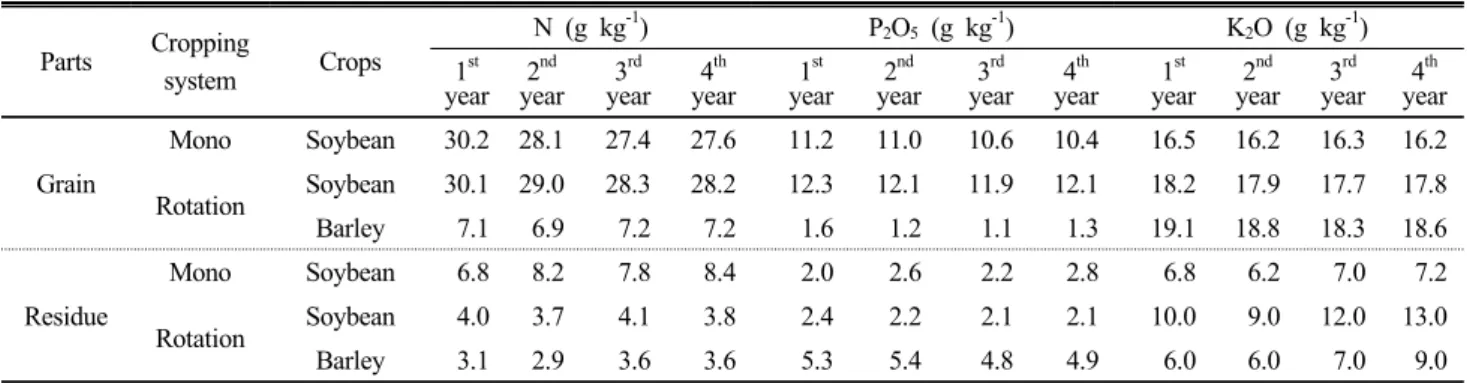
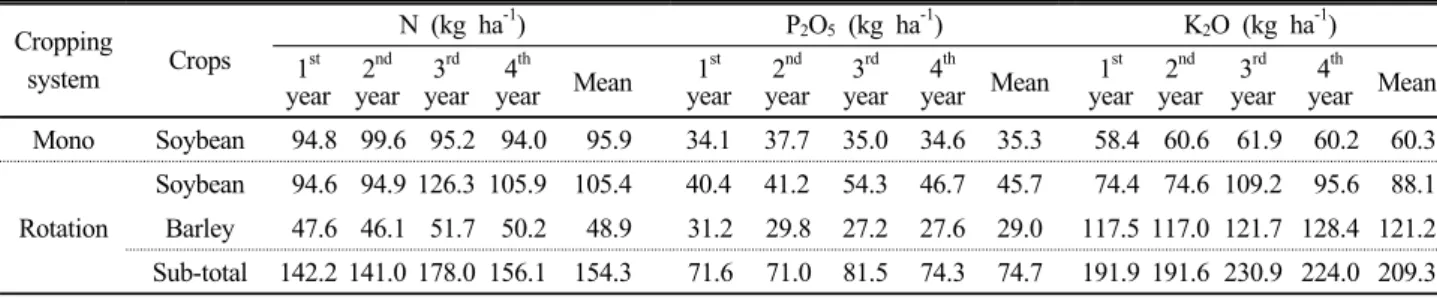
Nutrient balance To understand whether required amounts of nutrients are depleting in an unsustainable way, the nutrient balances of N, P
2O
5and K
2O were determined as the difference between the nutrient inputs by the application of chemical fertilizer and/or barley residue and nutrient outputs by crop uptake. The calculations were made as follows:
ANB
MCS= (N
addby chemical fertilizer application) - (N
uptakeby crop uptake) (1) ANB
RCS= (N
addby the application of chemical fertilizer and
barley straw) - (N
uptakeby crop uptake) (2)
where ANB
MCSand ANB
RCSare apparent nutrient balance in the MCS and the RCS, respectively, N
addis nutrient addition, and N
uptakeis nutrient uptake. The word of ‘apparent’ is come from that other factors of inputs or outputs such as N fixation, atmospheric deposition, and nutrient losses by leaching, chemical transformation, and erosion were neglected in these equations.
Results and Discussion
Changes in soil properties Soil physical, chemical, and biological properties were evaluated to determine the changes in the cropping systems. As shown in Table 3, most chemical properties except for the soil pH were significantly improved in the RCS compared with the MCS. In the first year the OM content was higher in the MCS than in the RCS, but was higher in the RCS than in the MCS in the following years. In other words, the OM content for the RCS increased nearly 22.1%, while that for the MCS increased about 11.2% during total cultivation periods of the 4 years. This might be due to the barley residue added to the soil in the RCS. In addition, the OM content increased with the Av. P
2O
5during the cultivation periods. This agrees with the result reported by Kang et al.
(2009) that OM was significantly correlated with Av. P
2O
5, K, Zn, and Cu. The higher Av. P
2O
5content for the RCS might be due to the amount of chemical phosphate fertilizer added to the soil in barley cultivation. During the cultivation periods, the CEC for the RCS increased significantly from 6.4 to 7.4 cmol
ckg
-1(about 15.6%), while that for the MCS gradually decreased from 6.4 to 5.7 cmol
ckg
-1(about 10.9%).
The physical properties for the MCS are not significantly correlated with cultivation periods, but the correlation for the RCS would be improved due to the increasing OM inputed as the barley straw every year. According to Haynes and Naidu (1998), the increase in OM content will certainly improved soil physical conditions with long-term fertilizer additions, i.e.
the increasing OM content characteristically decreased bulk
density and surface crusting and increased water holding capacity,
macroporosity, infiltration capacity, hydraulic conductivity,
Table 3. Changes of soil properties in different cropping system during the cultivation period.
Cropping
system Crops Year pH (1:5)
OM (g kg
-1)
Av. P
2O
5(mg kg
-1)
Ex. Cations
(cmol
ckg
-1) CEC (cmol
ckg
-1)
Bulk density (g cm
-3)
Porosity (%)
Microbial biomass ( μ g kg
-1)
K Ca Mg C N
Mono Soybean
1999 6.3 11.6 190.0 0.2 1.9 0.7 6.4 1.43 46.0 115.2 23.7
2000 6.3 11.8 195.0 0.2 1.9 0.5 6.3 1.45 45.3 110.8 22.9
2001 6.1 12.7 206.0 0.2 1.8 0.6 6.2 1.48 44.2 92.2 21.7
2002 6.1 12.9 210.0 0.2 1.7 0.7 5.7 1.36 48.7 79.8 18.7
Rotation
Soybean and Barley
1999 6.5 11.3 212.0 0.2 2.0 0.6 6.4 1.31 50.6 118.5 22.9
2000 6.3 12.7 218.0 0.2 2.1 0.7 6.9 1.31 50.6 129.3 30.2
2001 6.2 13.6 221.0 0.3 2.0 0.8 7.0 1.28 51.7 142.2 34.3
2002 6.2 13.8 225.0 0.3 2.2 0.7 7.4 1.28 51.7 164.1 37.5
※ Soil was sampling after harvesting in every autumn.
Note: OM: organic matter, Av. P
2O
5: available phosphorus, Ex. Cations: exchangeable cations, CEC: cation exchange capacity.
Table 4. Fertilization levels in different cropping system.
Cropping system Crops Application rate (kg ha
-1year
-1) Total application rate (kg ha
-14 year
-1)
N P
2O
5K
2O N P
2O
5K
2O
Mono Soybean 40 70 60 160 280 240
Rotation
Soybean 40 70 60 160 280 240
Barley 120 90 70 480 360 280
Residue
a14 22 31 56 88 124
Sub-total 174 182 161 696 728 644
a