INTRODUCTION
Heavy metal pollution has raised concerns regarding the potential health risks to the public in the metal mining regions of South Korea. Biochemical acid- generation processes in rocks and tailings exposed after mining are capable of dissolving heavy metals contained within the rocks and mine tailings
1). Heavy rainfall with combination of topological condition in South Korea can cause increasing mobilization of heavy metals, such as Fe, Al, Mn, Cu, Pb, Zn, Cd, and As, to paddy fields via surface and ground water, which the major crop, rice, is grown on. Furthermore, South Korea was reported as the second producer of Cd in 2005
2). Most of the heavy metals are poisonous, causing severe dysfunction of the kidneys, reproductive system, liver, brain, and central nervous system
3).
Physicochemical methods have been practiced for several decades for toxic heavy metal removal from industrial wastewaters. Although conventional sorption technology using chemical adsorbents has been exploited,
several disadvantages include both economic and environmental aspects
4). Therefore, there is an urgent need for the development of cost-effective and efficient technologies that could treat metal-containing wastes including aqueous streams. A wide variety of living and dead biomass of bacteria, algae, fungi, and plants is capable of sequestering toxic metals from waste streams, which offers an economical alternative for sorption technologies. Once the toxic metals are absorbed and/or transferred within organic materials, they can be removed from wastewater and returned to the soil-organic matrix, which can enhance fixation of heavy metals in ecosystems
5,6).
The mechanisms associated with metal removal by microorganisms are rather complex compared with chemical absorbents, and can be divided into three categories: (1) biosorption of metal ions on the cell surface, (2) intracellular uptake of metal ions, and (3) chemical transformation of metal ions by microorganisms
7). Adsorption of particulates has been observed with fungi and was proposed as a process for the removal of suspended matter from waste water
8,9). The enhanced active uptake and intracellular deposition of metals has been reported for several elements like copper and iron
10). In addition to the precipitation of metal
Lead Tolerance Profile of Pseudomonas Stuzeri in Liquid Culture
Su-Jung Kim, A-Young Jung
1), and Jin Ho Joo
*Department of Biological Environment, College of Agriculture and Life Sciences,
1)graduate student, Department of Biological Environment, College of Agriculture and Life Sciences Kangwon National University, Chunchon 200-701, Korea
(Received October 18, 2007, Accepted December 6, 2007)
ABSTRACT: Pseudomonas stutzeri strain KCCM 34719 was used in this experiment to determine the effects of increasing Pb(II) concentrations on its growth rate. To obtain optimum growth conditions, strain KCCM 34719 was cultivated in nutrient broth under various conditions, such as temperature, pH, and NaCl concentration. Optimal conditions for cell growth were 30 ℃ of temperature, 8.0 of pH, and 3% of NaCl concentration, respectively. Growth response of bacterial cell to Pb(II) showed tolerance to concentrations ranging from 10 to 100 mg l
-1in liquid culture, following a growth pattern similar to the control. Growth rate was greatly inhibited at 200 mg l
-1of Pb(II).
Key Words: Heavy metals, Metal tolerance, Optimum conditions, Pseudomonas stutzeri
*Corresponding author:
Tel: +82-33-250-6448 Fax: +82-33-241-6640 E-mail: [email protected]
332
biosorbents is mainly influenced by biomass characteristics, physicochemical properties of the target metals, and the microenvironment of contact solution including pH, temperature, and interaction with other ions
12). For example, increase in pH can cause precipitation of metal ions generally in the order of Fe
3+>Cu
2+>
Pb
2+>Zn
2+>Cd
2+ 4).
Pseudomonas stutzeri is Gram-negative and aerobic and reside in soil and water
13). The living biomass has been found in mine waste waters polluted with various heavy metals and shown Cu-tolerant at a high concentration, 1000 mg l
-1 14). The objective of this research was to determine the growth response of P. stutzeri strain KCCM 34719 to various conditions (NaCl concentration, pH, and temperature) in nutrient broth and to evaluate the optimum conditions for strain KCCM 34719 tolerant to Pb(II)-containing broth.
MATERIALS AND METHODS
Bacterial species and growth medium
The microorganism used for this experiment was Pseudomonas stutzeri strain KCCM 34719 which was obtained from Korean Culture Center of Microorganism (KCCM), Seoul, Korea. Bacterial cell was initially cultured in nutrient broth (MERCK, Germany) and then maintained in nutrient agar medium (Difco, Detroit, USA). Cell density was determined by O.D. 600 nm with UV-vis spectrophotometer (SHIMADZU, Japan).
Metal solution for growth response
The nitrate salt of Pb(II) manufactured by Junsei, Japan, KANTO was used to prepare stock solution with autoclaved distilled water. The stock solution (1000 mg l
-1) was diluted to a desired concentration with autoclaved distilled water before experiments.
Response of Pseudomonas stutzeri to metal solution The nitrate salt of Pb(II) was added to a series of Erlenmeyer flasks containing Nutrient broth (200 ml) with the following conditions: initial nitrate salt concentration (10, 50, 100, and 200 mg l
-1), pH (6.0, 7.0, 8.0, and 9.0), temperature (20, 30, and 38 ), and ℃ NaCl concentration (0.5, 1.0, and 3.0%). In order to
initial concentration and incubated at pH 8, 30 , and 130 r min
-1. Samples (3 ml) were collected at selected time intervals for 240 min and analyzed for O.D. at 600 nm.
The mathematics of growth
The rate of growth during the exponential phase in vitro culture can be expressed in terms of the average growth rate constant (k).
k= (N
t-N
0)/t
where N
tand N
0is the O.D. values at time t and initial time
15).
RESULTS AND DISCUSSION
Optimum condition of Pseudomonas stutzeri
Environmental temperature profoundly affects the growth rate of microorganisms, like all other organisms.
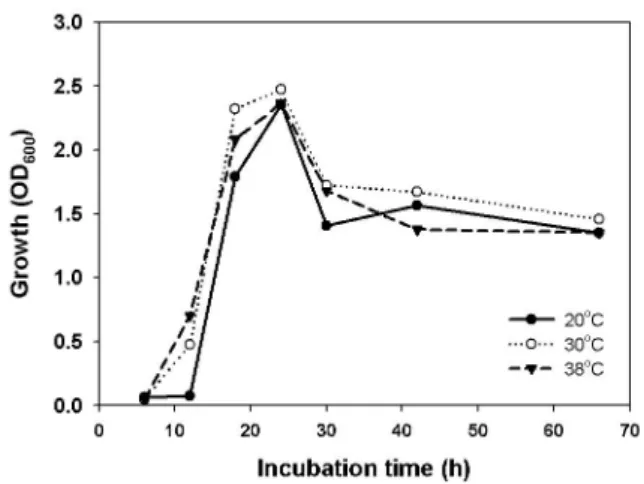
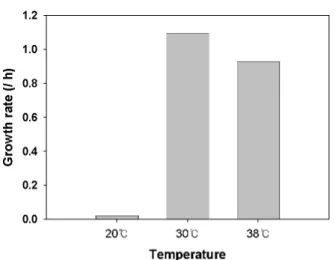
Since P. stutzeri is Gram-negative, they are particularly susceptible. For these reasons, bacterial cell temperature directly reflects that of the cell's surroundings, which most influences enzyme-catalyzed reactions. When cells were grown in Nutrient broth with various temperatures, average growth of strain KCCM 34719 showed a longer lag phase at 20℃ than at 30 and 38℃
(Fig. 1); however, growth rate was highest at 30℃
(Fig. 2).
Fig. 1. Average growth of strain KCCM 34719 cultivated in nutrient broth containing 10 mg l‐1of Pb(II) at various temperatures over time (h).
Microorganisms are dramatically influenced by pH, each species of which has a definite pH growth range and growth optimal conditions. Although growth occurs over a wide range of pH and beyond the optima, there are limits to their tolerance. Drastic changes in cytoplasmic pH harm microorganisms by disrupting the plasma membrane or inhibiting the activity of enzymes and membrane transport proteins.
It is well known that most bacteria die if the internal pH drops much below 5.0 to 5.5. We therefore conducted studies within a pH range from 6.0 to 9.0.
Average growth of the bacterium over the pH ranges surprisingly followed similar lag phases (Fig. 3). However, growth rate was the optimum at pH 8.0 (Fig. 4).
The amount of water available to microorganisms can be reduced by interaction with solute molecules known as the osmotic effect. Microorganisms differ greatly in their ability to adapt to habitats with low water activity (a
w). Water activity is defined as a
w= P
solu/P
waterwhere P
soluand P
waterrepresent the vapor pressures of solution and pure water, respectively.
Some microorganisms able to grow in a habitat with a low a
wvalue are osmotolerant and may grow over a wide range of water activity or osmotic concentration.
Halophiles especially can grow optimally in the presence of NaCl or other salts at the minimum con- centration 2M
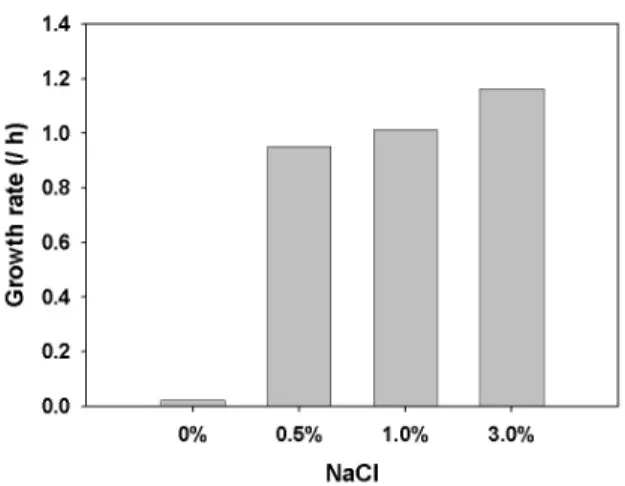
15). As shown in Figs. 5 and 6, strain KCCM 34719 was characteristically moderately halophilic.
Average growth of strain KCCM 34719 in broth medium containing 3% NaCl showed a longer lag phase than in the absence of NaCl; strain KCCM 34719 could tolerate high levels of NaCl (Figs. 5 and 6).
Overall, strain KCCM 34719 had optimum conditions of 30 ℃ of temperature, 8.0 of pH, and 3% of NaCl in broth medium containing 10 mg l
-1of Pb(II), which in turn has been known to affect tolerance capacity (or sorption capacity) of the strain to heavy metals at a higher concentration
16,17).
Growth response of strain KCCM 34719 to Pb(II) Growth response of strain KCCM 34719 in liquid culture from 10 to 100 mg l
-1conc. of Pb(II) followed the same growth pattern as the control for 66 h incubation (Fig. 7). Growth curve of the bacterium in the broth containing 200 mg l
-1of Pb(II) showed a much longer lag phase than any other conditions, meaning that the growth was greatly inhibited at 200 mg l
-1of Pb(II). Since most metal-microbe interactions are initiated at the concentration level of metal uptake by microorganisms, the uptake mechanism is
Fig. 2. The effect of temperature on averaged growthrate of strain KCCM 34719.
Fig. 3. Average growth of strain KCCM 34719 cultivated in nutrient broth containing 10 mg l‐1of Pb(II) at various pH over time (h).
Fig. 4. The effect of pH on average growth rate of strain KCCM 34719.
likely to be linked to the mechanism of metal resistance in the microorganism
4,17,18). Strain KCCM 34719, thus,
This study was supported by a grant from the Research Institute of Agricultural Science, Kangwon National University, Korea.
REFERENCES
1. Sengupta, M. (1993) Environmental impacts of mining:
monitoring, restoration, and control. CRC Press, Boca Raton, FL, USA. pp. 167-259.
2. British geological survey. (2006) Annual report of the British geological survey 2005-2006. Natural Environ- ment Research Council. The United Kingdom of Great Britain. www.bgs.ac.uk/ annualreport/ 0506 3. Adriano, D. C., Bollag, J. -M., Frankenberger, W.
T. Jr. and Sims, R. C. (1999) Bioremediation of contaminated soils. ASA-CSA-SSSA, Madison, WI, USA. pp. 53-88.
4. Eccles, H. (1999) Treatment of metal-contaminated wastes: why select a biological process? T. Biotech.
17, 462-165.
5. Paul, E. A. (2007) Soil microbiology, ecology, and biochemistry. Elsevier Inc., Burlington, MA, USA.
pp. 389-432.
6. Hughes, M. N. and Poole, R. K. (1989) Metals and microorganisms. Chapman & Hall, New York, USA.
p 412.
7. Harbhajan, S. (2006) Mycoremediation: fungal biore- mediation. John Wiley & Sons, Inc., Hoboken, NJ.
USA. pp. 484-532.
8. Amils, R. and Ballester, A. (1999) Biohydrometallurgy and the environment toward the mining of the 21st century. Part B. Elsevier, Amsterdam. pp.
725-730.
9. Poole, R. K. and Gadd, G. M. (1989) Metal- microbe interactions. Special publications of the society for general microbiology. Volume 26. IRL Press, Oxford.
pp. 119-130.
10. Poole, R. K. and Gadd, G. M. (1989) Metal- microbe interactions. Special publications of the society for general microbiology. Volume 26. IRL Press, Oxford.
pp. 85-98.
11. Laskin, A. I., Bennett, J. W. and Geoffrey, G. (2001)
Fig. 5. Average growth of strain KCCM 34719 cultivatedin nutrient broth containing 10 mg l‐1of Pb(II) at various NaCl concentrations over time (h).
Fig. 6. The effect of NaCl concentration on average growth rate of strain KCCM 34719.
Fig. 7. Average growth of strain KCCM 34719 cultivated at various Pb(II) concentrations over time (h).