Print ISSN: 2288-4637 / Online ISSN 2288-4645 doi:10.13106/jafeb.2021.vol8.no7.0591
The Effect of Branding Capability on Business Performance:
An Empirical Study in Indonesia*
Yuslinda Dwi HANDINI
1, Suharyono NOTOSUBROTO
2, Sunarti SUNARTI
3, Edriana PANGESTUTI
4Received: March 30, 2021 Revised: June 07, 2021 Accepted: June 17, 2021
Abstract
This study examined the effect of branding capability on business performance moderated by learning capability. This study was conducted with small- and medium-sized enterprises (SMEs) of coffee cafes in the ex-Besuki region, East Java, Indonesia, covering four regencies located around coffee-producing areas with geographical indication (GI) certification. 150 managers of coffee cafe were sampled using the census technique. Data were collected by questionnaires distributed to the coffee cafe managers. The data were then analyzed by using simple regression analysis, Moderation Regression Analysis (MRA) and Moderated MultiGroup Analysis (MMA). The results showed that learning capability positively and significantly affect business performance, and learning capability moderated/enhanced the effect of branding capability on business performance. The findings of this study suggest that branding capability and learning capability play a crucial role in the performance of coffee cafe business especially in the dynamic environment. Coffee cafe managers need to take concrete steps to improve their branding capability and learning capability and they also need to improve their ability to interact with their environment and be committed in managing the coffee cafe. Therefore, it is imperative that the role of branding capability and learning capability be optimized in order to improve the business performance of the coffee cafe.
Keywords: Branding Capability, Learning Capability, Business Performance, Coffee Cafe JEL Classification Code: L25, M10, M13, M31
uniqueness of “Nusantara” region is the coffee business.
“Nusantara” coffee is an Indonesian indigenous product attracting more and more Indonesian people. This encourages the establishment of more coffee cafes serving indigenous coffee in some areas in Indonesia. One of the areas producing high quality coffee is East Java. This has positively affected the development of coffee cafe in this area. Coffee cafes play a crucial role in East Java, which the government is keen to develop. Most coffee cafes in this area belong to small- and medium-sized enterprises (SMEs). In East Java especially the ex-Besuki region, there has been local coffee commodity, which has attained geographical indication (IG) certification, namely, “Arabica Coffee of Java Ijen Raung” (Department of Communication and Information of Bondowoso Regency. (n.d.)).
A coffee cafe operation requires branding capability and learning capability in order to improve the business performance. Several studies highlight the importance of branding in operating business. Ngo et al. (2019) argue that branding is an important aspect of a company to achieve strategic success and market dynamics. Marchelia (2018) argues that coffee cafe may have a strong concept to build a
*Acknowledgements:
This research has been financially supported by BPPDN Scholarship from The Directorate General of Higher Education, Republic of Indonesia.
1
First Author and Corresponding Author. [1] Doctoral Program of Business Administration, Faculty of Administrative Sciences, Brawijaya University, Malang, Indonesia [2] Faculty of Social and Political Science, Jember University, Jember, Indonesia [Postal Address: Jalan Kaliurang Perumahan Taman Kampus A5-5, Sumbersari, Jember, Jawa Timur, 68124, Indonesia]
Email: [email protected]; [email protected]
2
Professor, Faculty of Administrative Sciences, Brawijaya University, Malang, Indonesia. Email: [email protected]
3
Assistant Professor, Faculty of Administrative Sciences, Brawijaya University, Malang, Indonesia. Email: [email protected]
4
Assistant Professor, Faculty of Administrative Sciences, Brawijaya University, Malang, Indonesia. Email: [email protected]
© Copyright: The Author(s)
This is an Open Access article distributed under the terms of the Creative Commons Attribution Non-Commercial License (https://creativecommons.org/licenses/by-nc/4.0/) which permits unrestricted non-commercial use, distribution, and reproduction in any medium, provided the original work is properly cited.
1. Introduction
One of the business enterprises capable of integrating
the local wisdom into their business and developing the
brand regarding the location of the cafe. Branding of coffee cafe as not only a place to hang out, but also a place to socialize with their communities.
This study explores the idea that a coffee cafe needs to optimize its branding capability and learning capability as dynamic resources and capability to enhance its business performance. Branding capability is the capability of the enterprise to gather a series of company’s interrelated routines to conduct their activities and marketing program to deliver their brand consistently to their customer (O’Cass & Ngo, 2011). Although the previous study conducted by Odoom et al. (2017a) shows the effect of branding capability on business performance mediated by brand regulations, it also indicates that branding capability positively influences business performance. However, the effect is weakened as brand regulation in operation negatively moderates the relationship between branding capability and company brand performance (Odoom et al., 2017a). Odoom et al. (2017a) show that policymakers need to review business regulation especially regarding SMEs.
There is a gap in Odoom et al. (2017a) study because there are very few studies focusing on using branding as a study to overview SMEs.
Meanwhile, learning capability plays an important role in business performance and enterprises need to pay careful attention on it to develop their business. Companies with a learning capability will be able to alleviate their performance. Dhir and Dhir (2018) argue that learning capability is an ability of a company to learn from internal and external sources in order to suit or modify their action to reflect the new cognitive situation to improve their performance.
Previous studies also highlight learning capability.
Prieto and Revilla (2017) empirically investigate the relationships between the learning capability in an organization with business performance evaluated financially and non-financially. The gap in this study is that it emphasizes the import role of learning capability on business performance, but it did not cover how learning capability needs to be done; hence, further studies may focus on other roles of learning capability variables.
Furthermore, Akgun et al. (2014) study the learning capability in companies and their performance through customer relationship marketing (CRM). The gap in this study is that it was conducted only on the banking sector in Turkey; therefore, future research may focus on different sectors within different cultural context. Hooi (2019) studies the learning capability and company performance.
The results show that learning capability significantly influences company performance. The gap in this study was that it was conducted only on Malaysian SMEs; thus, a further study on a different sector is deemed necessary.
Gomes and Wojahn (2017) conducted a study on the relationships between learning capability, innovation, and business performance on SMEs. The gap in this research was that there was a need for a study to further evaluate the contingency of learning capability, innovation, and business performance in the different sector. Further studies may analyze the differences between manufacture and service sectors.
Recent studies regarding learning capability focus on banking and retail industries such as those conducted by Sok et al. (2013), Prieto and Revilla (2006), Akgun et al. (2014), Gomes and Wojahn (2016), Dhir and Dhir (2018) and Hooi (2019). However, those studies did not correlate the influence of learning capability mediation on branding capability to business performance. Therefore, this study aims to explore the effect of learning capability variable mediation on branding capability variable toward business performance, which were not covered in the previous studies.
The following are the theoretical contributions that this study offers to culinary industry especially coffee cafe. First, this study proposes an integrated theoretical framework on the importance of branding capability and learning capability to enhance the business performance of coffee cafes. Second, this study aims to investigate the relationship between branding capability toward business performance and the influence of learning capability moderation on the influence of branding capability on the business performance of coffee cafes, which is a relatively under-researched area. Third, this study expands the current understanding of the branding capability, learning capability and business performance especially on a dynamic environment.
According to Sumiati (2020), in Indonesia, SMEs
are currently getting more attention from the Indonesian
government because the contribution of this sector to
regional and national income has increased. On the other
hand, although the government is providing a lot of attention
and facilities to small businesses in the manufacturing sector,
they face intense competition. This study utilized coffee
cafes that are the size of SMEs in East Java, Indonesia,
as an experimental site. In Indonesia, coffee cafe is a part
of food and beverage culinary industry, a fast-growing
creative industry. Food and beverage culinary industry is
growing rapidly and dominates the creative economy sector
in Indonesia. This is in line with the information from the
statistical data of the creative economy compiled by the
Creative Economy Agency (BEKRAF) in cooperation
with Statistic Indonesia Agency (BPS), which mention that
Indonesian culinary industry accounts for 41.69 percent or
equal to IDR355.3 trillion. Meanwhile, the fashion industry
represents 18.15 percent or about IDR154.7 trillion, and the
craft industry contributes to about 15.7 percent with a value of IDR133.8 trillion (Statistical Data and Results of Survey, BEKRAF and BPS, 2017).
In Indonesia, especially in East Java, based on the data of BPS East Java, the food and beverage sector of the culinary industry account for the highest market share compared to other sectors with 31.69%. This sector is higher that other sectors in East Java such as tobacco manufacturing, pharmacy and traditional herbal medicines, furniture, textile, and other sectors (BPS- Statistics of Jawa Timur Province, 2017). However, despite the high growth of culinary industry, there is little research focusing on this sector especially the coffee cafe industry.
2. Literature Review
In its development, many management and strategy experts have put forward their opinions, such as Resource- Based View (RBV) theory by Barney (1991) and Dynamic Capability by Teece et al. (1997). Barney (1991) proposes that knowledge resources can be considered a unique and valuable resource connecting company’s competitive excellence. RBV theory proposes that a company may have a continuous competitive excellence from their resources and capabilities, which are valuable, rare, and cannot be copied or substituted (Barney, 1991). On the other hand, Grant (1991) categorizes resources and capability as a view of resource-based perspective and classifies resources as tangible, intangible, and personnel resources. Moreover, Grant (1991) clarifies that capability is a competence built by combining resources. Kim et al.
(2015) argue that resources cover capital, equipment, brand, internal knowledge on technology, trade contract, and personnel.
Teece et al. (1997) introduces the dynamic capability view, which is the capability of a company or organization to integrate, building, and configuring company or organizational competence either deriving from internal or external sources in order that they can adapt the rapid environmental changes making the internal and external competence a source of continuous competitive excellence.
On the other hand, Griffith and Harvey (2001) defines dynamic capability as the capability of a company to unify, develop, and configure internal and external competence in order to be able to cope with the rapid changes. Jiao et al. (2011) mention that dynamic capability is a form of managerial capability, which is difficult to imitate organizationally, functionally, and through technological competence to change operational mechanism in order to meet customer needs, and the final goal is to improve competence. Based on those definitions of dynamic
capability, it can be concluded that a company or organization needs to be capable of managing its dynamic capability well in order to thrive and compete in the fast changing and dynamic market.
2.1. Branding Capability
According to the American Marketing Association (in Kotler & Keller, 2012) brand is name, term, sign, symbol, design, or combination of these aimed to identify products or services of a seller or a group of sellers to distinguish them from products or services of their competitor. Further, Swasty (2016) identifies branding as the whole process of selecting the elements, values, and the commitment that an entity possesses (products, services, company, and many more).
After understanding brand and branding, the next term to discuss is branding capability. Although its definition has not been robustly rooted in the literature, several experts define branding capability. According to O’Cass and Ngo (2011), branding capability is the capability of a company to collect a series of interrelated company routines to conduct their activities and marketing program to deliver their consistent brand to the customer. Merriless et al. (2011) mention that branding capability consists of four elements, namely, identifying the meaning of brand, using brand as an operational tool, communicating the meaning of brand consistently and bringing staff to support company’s brand. Odoom, Agbernaise, Dorson, and Mensah (2017a) argue that branding capability consists of identifying brand meaning, utilizing brand as a tool for the company, consistently communicating the meaning of brand, recruiting staff who support the company’s brand, mobilizing resources from external association, building string connection with supplier, having the capability to maintain good relationship with the stakeholders, and having the capability to gain additional skills from partners.
Odoom, Narteh, and Rand (2017b) propose the components of branding capability inter alia: the capability to utilize company’s knowledge to use its new brand to fulfill customers’ demand, the creativity for branding, the ability to mobilize a set of interrelated organizational routines for branding activities.
2.2. Business Performance
According to Jajja et al. (2017), business performance of
a company is reflected on its market share, average growth
of market share, brand acceptance, income growth, and profit
growth. Najib and Kiminami (2011) elaborate that company
performance can be seen from its sales volume, profitability
and their market.
In this study, perception measurement was used to measure the business performance in a company. Dess and Robinson (1984) propose that measuring company performance by using perception measurement has been found to be consistent with objective steps. This is in line with Prieto and Revilla’s (2006) opinion that perception measurement of company performance can overcome manager’s or business operator’s reluctance to provide the results of their work objectively.
From those several definitions of business performance, it can be concluded that each business organization or company needs to review its business performance.
Business performance is a result of a management activity in a company. These results can then be used as a parameter to assess whether or not the management of a business has been successful in achieving the goals set by the company.
Odoom et al. (2017a) studied branding capability and SMEs in the developing market moderated by brand regulation, and found that branding capability positively influences business performance. Based on the discussion, the following hypothesis is formulated:
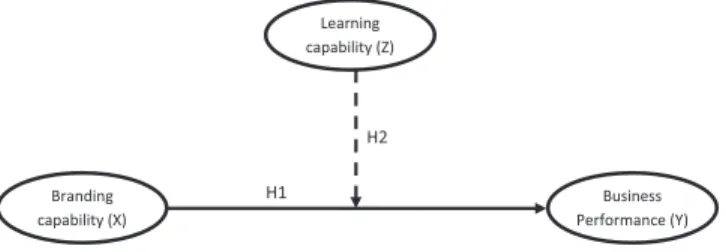
H1: Branding capability positively and significantly affects business performance.
2.3. Learning Capability
Learning capability is one of the important issues that a company needs to pay attention to to develop its business. A company with learning capability will be able to improve its company performance. According to Dhir and Dhir (2018), learning capability is the ability of a company to learn from the internal and external sources to adapt and modify its actions to reflect the new cognitive situation with the aim to improve its performance. Akgun et al. (2014) argue that a company needs to invest in the collective learning in the entire organization, to build a team committed to learning, to build a system to create and spread knowledge cross functional borders, to encourage openness toward external environment, to facilitate risk-taking and to eradicate obstacles to change and to support reinforcement on general interpretation among individuals in the company.
This is related to Resource-Based View (RBV) theory, which posits that a company with a valuable and rare resource will have a potential to achieve superior performance (Barney, 1991). The importance of a company to possess learning capability to improve the business performance has been studied by Prieto and Revilla (2006), Akgun et al.
(2014), Gomes and Wojahn (2017), Dhir and Dhir (2018) and Hooi (2019). The results of previous studies state that learning capability significantly affect company business performance.
According to Prieto and Revilla (2006), learning capability in a company consists of three important elements, namely, (1) knowledge of all elements in the company either on the individual, group, or organizational level; (2) the existence of explorations of the learning flow;
and (3) the exploitation from the learning in the company.
Further, Akgun et al. (2014) argue that learning capability comprises the existence of managerial commitment, system perspective, openness and experimentation, all other knowledge, and integration.
On the other hand, Gomes and Wojahn (2017) mention that learning capability in a company consists of the ability to experiment, interact with the environment, cope with risks, and engage in dialogue. In line with this, Hooi (2019) also mentions that learning capability of a company consist of the existence of managerial commitment, perspective in the system, openness and ability to experiment, and transfer knowledge.
As previously elaborated, Odoom et al. (2017a) studied branding capability and SMEs in the developing market moderated by brand regulations. The results of the research show that branding capability positively affects business performance. However, in the study, the effect was weakened by the operation where brand regulation negatively moderates the relationship between branding capability and company brand performance. Odoom et al. (2017a) show that policymakers need to review business regulations especially regarding SMEs. This study is different from the previous one, which utilized brand regulation as moderator; this research used learning capability as the moderation variable.
H2: Learning capability positively and significantly moderates/enhances the effect of branding on business performance.
3. Methods and Materials 3.1. Population, Sample, and
Sampling Technique
This study was conducted on coffee cafes in the
ex-Besuki region covering the four regencies of Jember,
Banyuwangi, Situbondo and Bondowoso in East Java,
Indonesia. The entire population in this research became
respondents as it met the criteria; thus, this research is
a census research. 150 managers of coffee cafes were
sampled using the census technique. In 2019, there were
coffee cafes in this region with the following population
criteria: registered with the relevant government agency
or a member of a coffee cafe community in the ex-Besuki
region; has been in operation for more than a year; is a
small- and medium-sized enterprise, provides and serves local coffee products indigenous of ‘Nusantara’ in the area of Java Ijen Raung; and employs a barista.
3.2. Measurement
Construct measurement was adopted from previous studies. The measurement scale used in this study was an attitude scale, which is a collection of tools to measure individual the opinions of an object or phenomenon (Kuncoro, 2003). This study used a 5-point Likert scale, ranging from 1 “totally disagree” to 5 “totally agree”.
Branding capability measurement adopted the eight indicators from Merriless et al. (2011), O’Cass and Ngo (2011), Odoom et al. (2017a) and Odoom et al. (2017b).
Business performance was measured using four indicators adopted from Najib and Kiminami (2011), Jajja et al.
(2017), and Gomes and Wojahn (2017). Learning capability was measured using four indicators adopted from Gomes and Wojahn (2017), Hooi (2019) and Akgun et al. (2014).
The conceptual framework of this study is presented in Figure 1.
3.3. Analysis Method
In this study, the research instrument testing and descriptive analysis were conducted with SPSS 18.
Meanwhile, data analysis and hypothesis testing were done by simple regression analysis, Moderated Regression Analysis (MRA) and Moderated MultiGroup Analysis (MMA).
4. Results
4.1. Respondent Description
Data from the questionnaire showed that the majority of the respondents were male (80.67%). The biggest percentage of respondents were between 20–29 years old (40.67%), with the majority of them having a bachelor degree (58%). Meanwhile, the biggest proportion of respondents ran business operation 1–2 years (46%), the
biggest number has 5–6 employees (48.67%). All the baristas had access to coffee processing equipment to serve coffee to customers.
4.2. Validity and Reliability
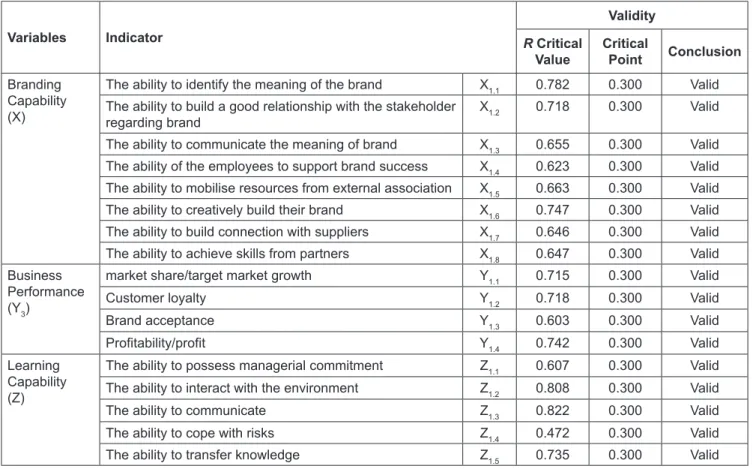
In this study, validity and reliability of the research instruments were tested by using SPSS 18 (see Table 1).
Validity and reliability tests were conducted to ensure the quality of data collected by the questionnaire. According to Sekaran (2003), validity test measures how well an instrument is constructed to measure a certain concept designed to be measured. The validity of the instrument is tested by using product-moment correlation analysis from Pearson by calculating the correlation between indicator score (each indicator) with the total score. If the indicator is correlated to the total score with a high correlation value, it is considered highly valid. According to Sekaran (2003), if the correlation coefficient of the question items to the total score of other indicators is ≥0.30, the statement is considered valid.
The reliability test (Table 2) was conducted to know the stability/consistency of an instrument in a research that is how well the instrument can be used to measure consistently and accuracy. According to Malhotra (2010), a scale or data measurement instrument or the resulted data are considered reliable if the instrument results are consistent in every measurement. In this study, Cronbach’s Alpha coefficient was used to measure reliability; if the Cronbach’s Alpha coefficient is ≥0.60, the instrument is considered reliable (Maholtra, 2010).
4.3. Evaluation Model
To test hypothesis 1 regarding the effect of branding capability on business performance, a data analysis without involving moderation variable was conducted by using simple linear regression. The effect was considered significant if p-value < 0.050. Table 3 presents the results of the analysis.
Data on Table 3 shows that branding capability had a significant effect on business performance with p-value < α (0.000 < 0.05). Therefore, it can be concluded that branding capability (X) positively and significantly affects business performance (Y).
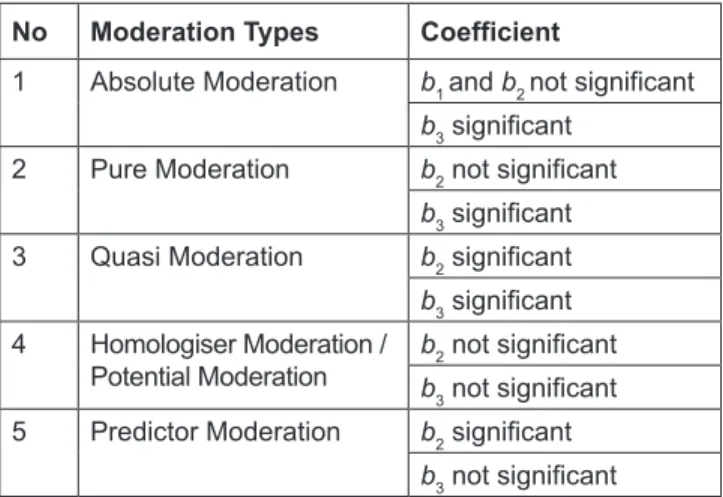
To test hypothesis 2 regarding whether learning capability moderates the effect of capability on business performance, a Moderated Regression Analysis (MRA) and Moderated MultiGroup Analysis (MMA) were conducted.
According to Solimun et al. (2017), there are two methods to identify whether or not there is a moderator variable, namely, Moderated Regression Analysis (MRA) and
Learning capability (Z)
Branding capability (X)
Business Performance (Y) H1
H2