식물 내건성 평가를 통한 제지 슬러지의 옥상녹화 이용 가능성 연구
최재혁·박봉주
1†접수일(2016년 11월 7일), 수정일(2016년 12월 14일), 채택일(2016년 12월 16일)
Study on the Possibility of Paper Mill Sludge Application for Green Roof throughout Assessment of Plant Drought Tolerance
Jaehyuck Choi and Bong-Ju Park
1Received November 7, 2016; Received in revised form December 14, 2016; Accepted December 16, 2016
ABSTRACT
The purpose of this study was to find out the possibility of paper mill sludge application for green roof by assessing drought tolerance of Hosta longipes with five different mix- ing ratio of paper mill sludge and horticultural substrate (9:1, 7:3, 5:5, 3:7 and 1:9).
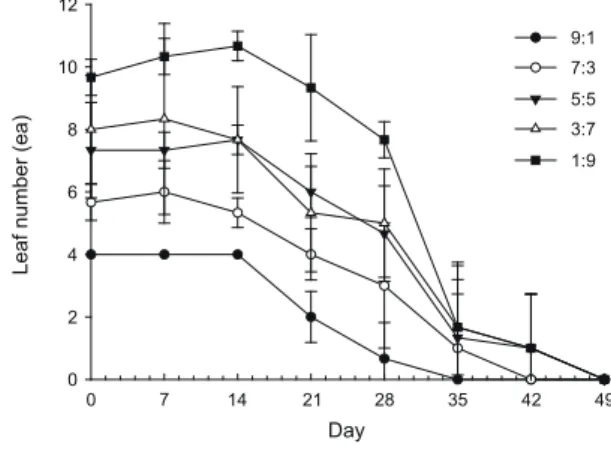
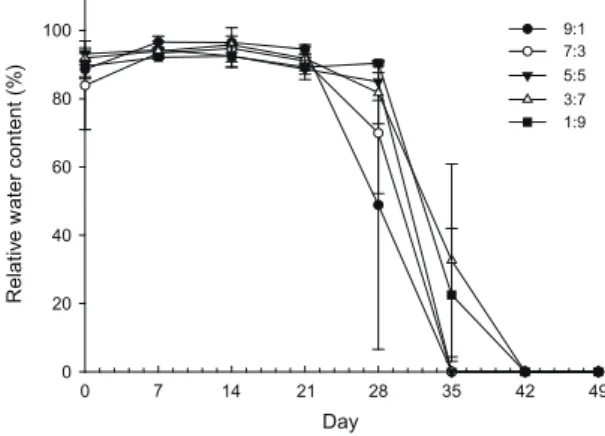
From August 11th to September 29th, number of leaves, plant height, leaf size, chloro- phyll content, volumetric water content, evapotranspiration, and relative water content (RWC) were measured. As results, 9:1 was reached 0% of volumetric water content earli- est and withered earliest on 35th day of unirrigated experiment, and 7:3 was withered on 42th day. All other mixing ratios were withered on 43th day or later. As for chloro- phyll content, all mixing ratios steadily decreased and showed similar patterns. Number of leaves and leaf size were very stable for 21 days and then rapidly decreased. Soil moisture reduction patterns were almost same and evapotranspiration reduction was di- rectly proportional to ratio of horticultural substrate. In conclusion, 50% or less of paper mill sludge application does not significantly affect drought tolerance of H. longipes so that paper mill sludge can be used as substrate for green roof.
Keywords: Green roof, drought tolerance, hosta longipes, paper mill sludge, substrate
• 충북대학교 산림학과(Dept. of Forest Science, Chungbuk National University, Cheongju, Chungbuk, 28644, Korea)
1 충북대학교 응용생명공학부(School of Applied Plant Science & Biotechnology, Chungbuk National University, Cheongju, Chungbuk, 28644, Korea)
† 교신저자(Corresponding Author): E-mail: [email protected]
Printed in Korea http://dx.doi.org/10.7584/JKTAPPI.2016.12.48.6.150
1. 서 론
도시화와 산업화로 인하여 도시환경에 수많은 부정적 영향이 발생하고 생태계 서비스(ecosystem services)로 얻을 수 있는 많은 해택들은 사라져 가고 있다.
1)도시개 발로 인한 불투수층 면적의 증가는 도시생태계의 악화, 도심홍수, 도시열섬현상 등과 같은 환경문제를 발생시키 고,
2,3)물의 자연적 순환과정을 방해함으로써 땅속으로 스며들어 토양과 대수층에 저장되어야하는 물들을 표면 으로 유출시켜 오염시키고 있다.
4)이러한 문제점들을 해 결하기 위한 대안으로 그린인프라가 도시 내에 폭넓게 적용되고 있으며
5)우리나라에서도 많은 분야에서 이에 대한 논의가 진행 중에 있다.
그린인프라의 여러 접근방법 중에서 옥상녹화는 토지 의 추가 확보 없이도 도시 내 부족한 녹지를 확충할 수 있 고, 유출수 조절을 통한 도시 내 홍수방지, 공기 질 향상, 생물서식처 제공, 소음경감 효과, 경관개선 등과 같은 환 경적 개선효과 뿐만 아니라,
6-8)여름철에는 건축물의 표 면온도를 낮추는 효과를 통한 경제적 이득을 가져다주 며,
9)겨울철에는 옥상녹화에 식재된 식물들이 방호장벽 (insulative barrier)의 역할을 하여 추위로부터 건물을 보호하고 열에너지 손실을 줄여주는 역할을 한다.
10)옥상녹화는 이러한 많은 환경적·경제적 장점을 가지고 있지만, 대부분의 건물들은 옥상에 흙을 쌓고 식물을 키 울 목적으로 지어진 것이 아니기 때문에, 건물이 버틸 수 있는 하중의 한계치를 넘길 수 없는 물리적 한계 때 문에 관리 중량형(intensive)보다는 저관리 경량형(ex- tensive green roof) 위주로 적용되고 있다.
11)저관리 경 량형 옥상녹화는 토심 20 cm 이하로 유지관리를 최소화 할 수 있다는 장점이 있는 반면 토심이 낮아 상대적으로 식물 생육에 불리하기 때문에,
12)수분스트레스와 가뭄, 높은 온도, 강한 바람 등으로 인한 악조건을 고려한 식 물 선정이 필요하다.
13)이에 따라 저관리 경량형 옥상녹 화에 적합한 강한 내건성 식물종 탐색이 활발하게 이루 어지고 있으며, 다양한 종류의 식물들 중에서도 Sedum 속 식물이 옥상녹화에 많이 이용되고 있다.
11,14,15)높은 내건성을 지닌 식물 선택은 여름철 장기간 가뭄 지속시 식생을 유지 시킬 수 있는 중요한 요소가 될 수 있으며, 이와 더불어 식물들의 생존 기간을 향상시킬 수 있는 식 재기반재의 개발도 필요하다. 지금까지 제지 슬러지는 주로 농작물 재배를 위한 상토로서의 적용 가능성에 대
한 연구들이
16-19)주를 이루고 있으나, 옥상녹화 식재기 반재 적용을 위한 연구사례는 거의 전무한 실정이다. 이 에 본 연구에서는 제지 슬러지와 원예용 상토 혼합비에 따른 비비추(Hosta longipes)의 수분스트레스에 대한 내성을 분석하여 향후 저관리 경량형 옥상녹화 조성 시 제지 슬러지의 식재기반재로서의 적용 가능성에 대해서 평가하였다.
2. 재료 및 방법
2016년 6월 18일에 제지 슬러지와 원예용 상토를 각각 9:1, 7:3, 5:5, 3:7, 1:9(v/v)로 혼합한 다음 직경 18 cm
× 높이 18 cm의 플라스틱 용기에 본엽이 6-7엽인 비비 추를 1개체씩 정식하여 혼합비율별로 10반복, 총 50개의 실험구를 조성하였다. 원예용 상토는 ㈜성화에서 제조된 토백이를 사용하였고 제지 슬러지는 충북 청주시에 위치 한 D사에서 신문용지와 인쇄용지의 탈묵 후 발생한 것으 로 충북대학교 부속농장 비닐온실에서 넓게 펼쳐 자연 건조시킨 후 사용하였으며, 중금속을 포함한 유해성분들 이 환경부와 국토부의 기준치 이하로 나타난 것이다.
20)내건성 실험은 8월 11일부터 9월 29일까지 49일 동안 부 속농장 비닐온실에서 진행되었으며, 실험 시작 24시간 전 플라스틱 포트 밑면으로 중력수가 흘러내릴 정도로 충분하게 관수한 후 이후 무관수 상태에서 진행하였다.
실험기간 동안 온실 내 온습도는 휴대용 온·습도계(SK- L200TH, SATO, Japan)를 이용하여 측정하였으며, 평 균온도 25.7°C, 상대습도 43.1%를 기록하였다.
측정항목으로는 초장, 엽폭, 엽수, 엽록소 함량, 잎의
상대수분 함량(relative water content; RWC), 녹엽면
적율, 생존률, 토양용적수분 함량, 증발산량을 측정하였
다. 초장은 자를 이용하여 지면에서부터 정단부까지의 길
이를 엽폭은 가장 큰 잎을 측정하였다. 엽수는 1 cm 이상
의 모든 잎에 대해서 측정하였으며, 엽록소 함량은 휴대
용 엽록소측정기(SPAD-502Plus, Konica Minolta,
Japan)를 이용하여 엽장과 엽폭을 측정했던 동일한 잎을
대상으로 엽맥을 피해 측정하였다. 잎의 상대수분 함량은
0.2 g의 잎을 전자저울로 측정 한 후(W), 증류수에 넣고
4시간 후 무게를 측정하고(TW) 열풍순환식건조기(HB-
502M, Hanbaek Science, Korea)로 70°C에서 48시간
건조 후 건조중량(DW)을 측정하여 계산하였다(Eq. 1).
RWC (%) = [(W-DW) / (TW-DW)] × 100 [1]
여기서, W: Sample fresh weight, TW: Sample turgid weight, DW: Sample dry weight.
토양용적수분 함량은 FDR센서(ML2x, Delta-T De- vices, UK)로 포트 가장자리에서 1 cm 떨어진 곳에서 토양 내 용적수분 함량이 0%에 도달할 때까지 1일 1회 빈도로 같은 시간에 측정하였다. 또한 증발산량은 전자 저울(SW-1S, CAS, Korea)을 사용하여 식물체가 고사 및 토양 내 수분 증발로 인한 무게변화가 없을 때까지 측정하였다.
모든 측정항목은 3반복하여 측정하였으며, 통계분석은 SAS(statistical analysis system, V. 9.3, Cary, NC, USA)를 이용하여 P<0.05 수준에서 DMRT(Duncan's multiple range test)로 유의성을 검정하였다.
3. 결과 및 고찰
3.1 식물생육
초장과 엽수는 실험초기에는 제지 슬러지 혼합 비율이 높을수록 낮은 경향을 보였는데, 이는 제지 슬러지 특성 상 높은 탄질율(C/N ratio)에 따른 질소기아현상(nitro- gen starvation)에
21)기인하는 것으로 판단된다. 그러나
무관수 기간이 경과함에 따라 제지 슬러지와 원예용 상토 혼합비에 따른 유의한 차이는 나타나지 않았다(Figs. 1, 2). 엽폭은 제지 슬러지와 원예용 상토 9:1 혼합비에서만 무관수 14일 이후 급격히 감소하였으나 다른 실험구에서 는 21일 이전에는 실험초기와 비슷한 값을 유지하다가 21 일을 기점으로 급격히 감소하는 경향을 보였다(Fig. 3).
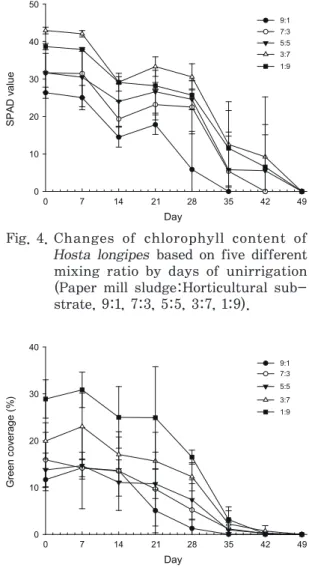
엽록소 함량 측정결과 제지 슬러지의 비율이 높아질수 록 엽록소 함량이 낮아지고 원예용 상토의 비율이 높아 질수록 높아지는 경향을 보였는데(Fig. 4), 이는 일반적 으로 식물체 내의 엽록소와 질소 함량은 정(+)의 상관관 계를 나타내기 때문으로 판단된다.
22)또한 무관수 일수 가 경과함에 따라 모든 배합비에서 엽록소 함량이 감소 하는 경향을 보였는데, 대부분의 식물들은 급격한 스트 레스를 받을 때 엽록소 함량이 감소하는데,
23)이는 결과 적으로 엽의 황백화 현상을 초래하고 건조 스트레스에 대한 민감도를 높이게 된다.
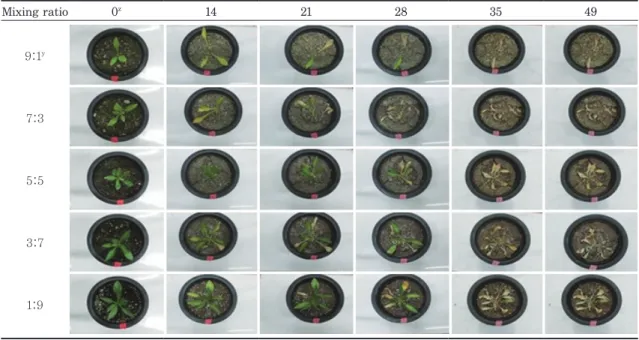
24)제지 슬러지와 원예용 상토 혼합 비율에 따른 녹엽면적 율 측정결과는 Fig. 5와 같다. 녹엽면적율은 원예용 상 토 비율이 높을수록 높은 경향을, 제지 슬러지 비율이 높 을수록 낮은 경향을 보였다(Table 1). 가장 높은 녹엽면 적율은 1:9 혼합비로 실험초기 약 30%정도를 유지하였 으며, 무관수 28일째까지 약 20%정도를 유지하다가 이 후 급격히 감소하는 경향을 보였다. 그 다음으로 3:7 혼 합비는 실험초기 약 20%정도를 유지하였으며, 무관수 28일째는 약 15%정도를 유지하다 그 이후 급격히 감소 하였다. 그 밖의 혼합비에서는 실험초기에는 약 15%정
Fig. 1. Changes of plant height based on five different mixing ratio by days of unir- rigation (Paper mill sludge:Horticul- tural substrate, 9:1, 7:3, 5:5, 3:7, 1:9).
Fig. 2. Changes of leaf numbers based on five
different mixing ratio by days of unir-
rigation (Paper mill sludge:Horticul-
tural substrate, 9:1, 7:3, 5:5, 3:7, 1:9).
도를 유지하다가 무관수 시간이 경과하면서 서서히 감소 하는 경향을 보였으며, 특히 9:1 혼합비는 가장 빠른 무 관수 34.3일에 녹엽면적율이 0%에 도달하였다.
제지 슬러지와 원예용 상토 혼합비율에 따른 비비추의 생존기간을 측정한 결과는 Table 2와 같다. 제지 슬러지 와 원예용 상토 혼합비에 따른 생존율은 3:7 혼합비에서 48.0일로 가장 길었으며, 그 다음으로 1:9 혼합비가 44.7일, 5:5 혼합비가 43.0일, 7:3 혼합비가 41.3일로 무관수 이후 40여일 이상 생존하는 것으로 나타났으며, 9:1 혼합비가 34.3일로 가장 빠르게 고사하는 것으로 나 타났다. 펄라이트:피트모스:원예용상토 7:2:1(v:v:v) 혼 합비에서 수행한 비비추의 내건성에 관한 선행연구
25)에 서는 27일째 고사한 것으로 보고되었는데, 본 실험에서 는 9:1 배합비를 제외하고는 모든 실험구에서 2주 이상 생존율이 길게 나타나 제지 슬러지의 옥상녹화 식재기반 재로서의 이용 가능성이 확인되었다. 그러나 옥상녹화 식재기반재로 적용하기 위해서는 하중에 대한 문제가 발 생할 수 있기 때문에
11)옥상녹화 적용을 위한 적정 배합 비에 대한 추가적인 연구가 필요하다.
3.2 토양용적수분 함량 및 증발산량
제지 슬러지와 원예용 상토 혼합비별 무관수에 따른 토 양용적수분 함량의 변화는 Fig. 6과 같다. 실험초기 가장 높은 토양용적수분 함량을 유지한 것은 제지 슬러지와 원예용 상토 비율이 3:7 실험구로 49.7%를 유지했으며,
그 다음으로 1:9 비율이 47.0%, 5:5 비율이 45.1%, 7:3 비율이 43.7%였으며, 9:1 비율이 37.8%로 가장 낮아 원 예용 상토 비율이 높아질수록 토양용적수분 함량은 높아 지는 경향을 보였다. 이는 본 실험에 사용한 원예용 상토 가 약 75%의 유기성 재료(코코피트, 피트모스)와 약 25%의 무기성 재료(버미큘라이트, 펄라이트, 제올라이 트)로 구성되어 있어 이들이 보수력에 영향을 주었기 때 문으로 판단된다. 원예용 상토 내 유기성 재료의 혼합비 율이 60% 이상일 경우에 대부분 식물의 생육에 적절한 Fig. 3. Changes of leaf width based on five
different mixing ratio by days of unir- rigation (Paper mill sludge:Horticul- tural substrate, 9:1, 7:3, 5:5, 3:7, 1:9).
Fig. 4. Changes of chlorophyll content of Hosta longipes based on five different mixing ratio by days of unirrigation (Paper mill sludge:Horticultural sub- strate, 9:1, 7:3, 5:5, 3:7, 1:9).
Fig. 5. Changes of green coverage rate based
on five different mixing ratio by days
of unirrigation (Paper mill sludge:Hor-
ticultural substrate, 9:1, 7:3, 5:5, 3:7,
1:9).
물리성 즉, 포화수리전도도를 갖는다는 연구결과도 이를 뒷받침한다.
26)무관수 후 중량변화에 따른 증발산량 측정 결과, 가밀 도가 높은 제지 슬러지의 비율이 높을수록 초기 중량은 높아지는 경향을 보였다(Fig. 7). 그러나 시간이 경과함 에 따라 모든 실험구에서 7일째에는 500 g-600 g의 증 발산량이 이루어졌으며, 14일째는 200 g-300 g의 증발 산량이 이루어졌고 그 이후로는 제지 슬러지와 원예용
상토의 혼합비율에 따라 약간의 차이가 있었지만 대체적 으로 100 g 정도의 증발산량이 이루어지다 0 g에 이르 렀다. 증발산량이 0 g에 이르는 시간은 제지 슬러지와 원예용 상토 1:9 배합비에서 가장 빠른 21일이었으며, 그 다음으로 3:7과 9:1에서 각각 35일, 5:5와 7:3은 각 각 42일 순이었다.
Table 1. Changes of green coverage based on five different mixing ratio by days of unirrigation
Mixing ratio 0z 14 21 28 35 49
9:1y
7:3
5:5
3:7
1:9
z Days of unirrigation.
y Paper mill sludge:Horticultural substrate.
Table 2. Survival period based on five differ- ent mixing ratio by unirrigation
Mixing ratio Survival period
9:1z 34.3±2.3 cy
7:3 41.3±4.0 b
5:5 43.0±3.0 ab
3:7 48.0±1.7 a
1:9 44.7±2.3 ab
Significance **
z Paper mill sludge:Horticultural substrate.
y Means separation within columns by Duncan's multiple range test, p=0.05.
NS,*,**,*** Non-significant or significant at p=0.05, 0.01, or 0.001, respectively.