• 검색 결과가 없습니다.

A Review on Spray Characteristics of Biobutanol and Its Blended Fuels in IC engines

N/A
N/A
Protected

Academic year: 2021

Share "A Review on Spray Characteristics of Biobutanol and Its Blended Fuels in IC engines"

Copied!
11
0
0

로드 중.... (전체 텍스트 보기)

전체 글

(1)

A Review on Spray Characteristics of Biobutanol and Its Blended Fuels in IC engines

Soo-Young No

Abstract

This review will be concentrated on the spray characteristics of biobutanol and its blends fuels in internal combustion engines including compression ignition, spark ignition and gas turbine engines. Butanol can be produced by fermentation from sucrose-containing feedstocks, starchy materials and lignocellulosic biomass. Among four isomers of butanol, n-buta- nol and iso-butanol has been used in CI and SI engines. This is due to higher octane rating and lower water solubility of both butanol compared with other isomers. The researches on the spray characteristics of neat butanol can be classified into the application to CI and SI engines, particularly GDI engine. Two empirical correlations for the prediction of spray angle for butanol as a function of Reynolds number was newly suggested. However, the applicability for the suggested empirical correlation is not yet proved. The butanol blended fuels used for the investigation of spray characteristics includes butanol-biodiesel blend, butanol-gasoline blend, butano-jet A blend and butanol-other fuel blends. Three blends such as butanol/ethanol, butanol/heptane and butanol/heavy fuel oil blends are included in butanol-other fuel blends. Even though combustion and emission characteristics of butanol/diesel fuel blend in CI engines were broadly investigated, study on spray characteristics of butanol/diesel fuel blend could not be found in the literature. In addition, the more study on the spray characteristics of butanol /gasoline blend is required.

Key Words: Spray characteristics, butanol, butanol blended fuel, CI engine. GDI engine, gas turbine

1. Introduction

Among alcohol family, the only three alcohols such methanol, ethanol and butanol are competitive alternative fuels due to their physico-chemical prop- erties. Ethanol and butanol are considered to possess the potential to alternative fuels for internal combus- tion (IC) engines, based on grounds of production rate, ease of use, sustainability, and particulate matter reduction capability

(1)

. Particularly, it is known that butanol is a more compatible alcohol fuel than etha- nol for use with current vehicle and engine technolo-

gies, as well as with existing supply and distribution infrastructure

(2)

. Butanol has received increasing attention in recent years after being identified as a feasible alternative for spark ignition (SI) and com- pression ignition (CI) engines.

Advances in diesel-alcohol blends and their effects on the combustion, performance and emissions of diesel engines were reviewed by Kumar et al.

(3)

. They found that blending of alcohols, along with some cetane number improver, to diesel fuels can reduce exhaust emissions without adverse impacts on the performance of diesel engines. They concluded that butanol (butyl alcohol) is a better alternative for diesel fuel due to its superior fuel properties and mis- cibility with diesel fuel than those of methanol and ethanol. A comprehensive review on exhaust emis- sions with ethanol or n-butanol diesel fuel blends during transient operation was reported by Giak-

(Recieved: 18 July 2016, Recieved in revised form: 9 Sep 2016, Accepted: 12 Sep 2016)

Dept. of Biosystems Engineering, Chungbuk National University, Cheongju, Korea

E-mail : [email protected]

TEL : (043) 261-2583 FAX : (043) 271-4413

(2)

oumis et al.

(1)

. They found that a decreasing trend in PM and CO emissions, and an increasing trend in HC emission with increase in alcohol percentage were shown in diesel engine fueled with ethanol or n-butanol/diesel fuel blends during transient condi- tions. However, the trend for NOx emissions was not clear with both increase and decreases being reported according to the specific alcohol content. In addition, n-butanol or iso-butanol has been also used as a sur- factant/cosolvent to improve the stability of ethanol- gasoline and methanol-gasoline blends.

In the review of alternative fuels for transportation vehicles, Salvi et al.

(4)

briefly discuss the butanol pro- duction only. Extensive literature review on the prog- ress in the production and application of n-butanol as a biofuel was conducted by Jin et al.

(5)

. In addition to the improvement in butanol production, studies of basic combustion of butanol as a substitute for gaso- line in SI engines, and supplement for diesel fuel in CI engines were addressed. It is important to note that they emphasized the possibility of application of n-butanol to CI engines with advanced combustion technologies, i.e. homogeneous charge compression ignition (HCCI) or low temperature combustion (LTC).

1-butanol, also known as n-butanol, can be pro- duced from fossil fuel as petro-butanol and from bio- mass as biobutanol, but biobutanol and petro-butanol have the same chemical properties. As same as etha- nol

(6)

, biobutanol can be produced by alcoholic fer- mentation from agricultural feedstocks such as corn, wheat, sugar beet, sorghum, cassava and sugarcane

(5)

. Alternatively, in order to increase the production

scale and avoid the use of food crops, a bacterial fer- mentation process for the production of biobutanol from lignocellulise is also developed as shown in Fig. 1.

(1, 7)

As a four carbon alcohol compound (C4H9OH), butanol exists as four different chemical isomers based on the location of the hydroxyl (OH) group and carbon chain structure

(8)

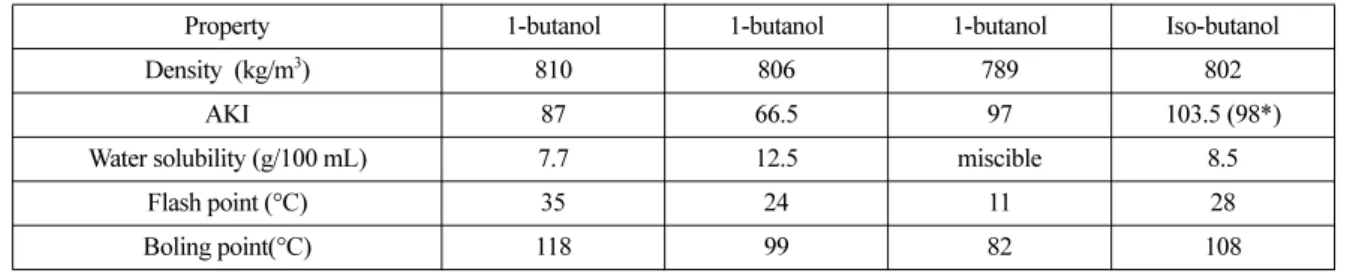
. As can be seen in Table 1, anti-knock index (AKI) as octane rating of 1-buta- nol and iso-butanol are very high and water solubility values of them are relatively low. These advantages of both butanol compared with other butanol isomers are likely the reason for them being considered one of the most promising alternative fuels in SI and CI engines. Isobutanol has been also used as a surfac- tant/cosolvent to improve the stability of methanol- gasoline ad ethanol-gasoline blends

(9)

.

The primary objective of this review is to provide an update on the spray characteristics of biobutanol and its blended fuels in IC engines. In addition, the field of researches on the spray characteristics of biobutanol which is required in the future will be suggested.

Fig. 1 Feedstocks and production process of biobuthanol.

Table 1 Comparison of properties for butanol isomers

(3, 5, 8)

Property 1-butanol 1-butanol 1-butanol Iso-butanol

Density (kg/m

3

) 810 806 789 802

AKI 87 66.5 97 103.5 (98*)

Water solubility (g/100 mL) 7.7 12.5 miscible 8.5

Flash point (°C) 35 24 11 28

Boling point(°C) 118 99 82 108

AKI(anti-knock index)=(MON+RON)/2

*value from (8)

(3)

2. Spray Characteristics of Neat Butanol

The researches on the spray characteristics of neat butanol can be classified into the application to CI and SI engines, particularly GDI engine as follows.

The discussion will be followed by spray characteris- tics of neat butanol in CI engines and SI engines in order.

2.1 CI engines

Spray penetration in CI engine conditions is the penetration of the mixture of vapor and liquid. For non-evaporating sprays, the vapor part and the liquid part of penetration are equal, while the liquid part of the penetration is limited by the lifetime of the drop- let. Therefore, spray penetration in the evaporating fuel jets can be divided into vapor-phase penetration and liquid phase penetration

(10)

. Liquid phase pene- tration of neat n-butanol spray was measured by Liu et al.

(11)

on a constant volume chamber at ambient temperature of 1000 K and three different oxygen concentrations of 21, 16, and 10.5%, respectively. To simulate the EGR with the oxygen concentration, they assumed no EGR for 21%, medium EGR for 15% and heavy EGR for 10.5%, respectively. Liquid phase penetration was increased with decrease in ambient oxygen concentration. This is because it takes longer time for the fuel to auto-ignite with less oxygen present, thus allowing spray to penetrate fur- ther into the combustion chamber. In their continued work

(12)

, the data obtained in the previous study had compared with those of soybean biodiesel. In addi- tion, various ambient temperature ranged from 700 K to 1000 K were tested to mimic the diesel in-cylinder environment covering both conventional and low temperature combustion conditions. They found that the overall liquid phase penetration decreased with the increase of ambient temperature due to the fast evaporation rate. They also concluded that the tran- sient liquid phase penetration of n-butanol was less affected by the downstream flame and was shorter than that of soybean biodiesel under similar condi- tions. Their works further continued to compare the spray and combustion characteristics of neat acetone-

butanol-ethanol (ABE 100), n-butanol (Bu100), and diesel in a constant volume chamber

(13)

. In this study, ABE 100 revealed relatively shorter liquid phase penetration than that of Bu100 at the lower ambient temperature of 800 K, but at higher ambient tempera- tures of 1000 K and 1200 K, the difference in liquid phase penetration between ABE 100 and Bu100 was nearly negligible. The liquid phase penetration of diesel fuel showed the longest one at every ambient temperature and ambient oxygen concentration. They argued that the low boiling point, high vapor pres- sure, and low viscosity of both acetone and ethanol in ABE enhanced the spray breakup early for ABE 100 relative to Bu100 under low ambient tempera- ture. They concluded that although ambient tempera- ture affect significantly to the liquid phase penetration, the ambient oxygen concentration shows slight effect on it.

Reddemann et al.

(14)

had measured the liquid and vapor phase penetrations for five different fuels including butanol and ethanol within optically acces- sible pressurized chamber. The ambient conditions had been set to temperatures of 600 K, 700 K and 800 K and ambient pressure of 5 MPa for all experi- ments. They found that initial liquid phase penetra- tion (from 0.3 to 0.55 ms after SOI) for butanol is nearly similar with that of ethanol, but two liquid phase penetrations in the latter stage (from 0.6 to 1.4 ms after SOI) shows the difference, particularly in the higher ambient temperature. However, vapor phase penetration remains largely unaffected by fuel properties and ambient temperature. In their contin- ued study

(15)

, the effect of fuel properties on liquid phase penetration, droplet size and velocity distribu- tion of spray for the same five fuels with the previ- ous study was investigated. They found that butanol has the bigger SMD than that of ethanol because of its high surface tension, which is the most relevant parameter for the initial droplet diameter. However, lower enthalpy of vaporization, i.e. higher evapora- tion rate of n-butanol that that of ethanol resulted in a comparatively shorter liquid phase penetration.

In the study of the influence of fuel properties on

primary jet breakup for a piezo injector with midi-sac

(4)

hole nozzle in a state-of-the-art diesel injection sys- tem, n-butanol was included among eleven different fuels and six different injection pressures selected to cover a wide range of Reynolds numbers and gas- eous Weber numbers

(16)

. An empirical correlation for the prediction of spray angle as a function of Reyn- olds numbers was newly suggested in this study as follows.

θ = G log [Re/2300]

for 10

3

< Re < 10

5

, 10

2

< We < 10

3

(1) where θ is spray angle, G is the nozzle geometry fac- tor (=4.3°), and Re is Reynolds number based on outlet velocity of the liquid jet from the nozzle in the stationary regime. It is interesting to note that the measurement position for spray angle was defined depending on the ratio between spray penetration and vertical picture width which is arbitrary fixed.

In their continued study

(17)

, sixteen fuels including 1-butanol and three different ambient densities were introduced to analyze the macroscopic spray charac- teristics such as penetration, spray angle and spray volume by using the high speed camera. They found that the liquid density is the main affecting fuel prop- erty for the spray penetration. They newly suggested the following empirical correlation for the prediction of spray angle.

θ = C Re

m

ρ

*n

for 10

3

< Re < 10

5

and 10

−3

< ρ

*

< 0.7 × 10

−1

(2) where θ is spray angle, C = 22.7817, m = 0.0568, and n = 0.1940, Re is Reynolds number same as the pre- vious work

(16)

, and ρ

*

is the density ratio (ambient density/ liquid density). At first, this correlation is different with one in previous work by the same author. It should be noted that spray angle was deter- mined at an axial distance of 200 d

o

from the nozzle, which is widely different from their previous work

(16)

and the other literatures

(18)

. Here d

o

designates the nozzle orifice diameter. It is well known in the work by Heywood

(19)

that the most significant variables for spray angle are gas/liquid density ratio and nozzle geometry. However, it should be noted that the Reyn- olds number is newly introduced as one of main

parameters in this study.

In the study related to atomization characteristics of microscale liquid jet for a better understanding of primary breakup, Reddemann et al.

(20)

developed a new simple double-imaging transmitted light micros- copy technique enabling a basic investigation of pri- mary breakup of a microscale liquid jet. This method was applied to an optically dense spray of 1-butanol emerging from a 109 µm diesel nozzle at various injection pressures under atmospheric conditions.

They found that the microscopy technique is the appropriate tool for the investigation of selected droplets inside the droplet cloud at the spray edge.

To summarize, the effects of ambient temperature and fuel properties on liquid and vapor phase pene- tration, droplet size and velocity distribution of spray in CI engine for neat butanol were investigated. For spray angle, two empirical correlations were sug- gested.

2.2 SI engines

It was not possible to find out the study on the spray characteristics of neat butanol in PFI SI engine.

However, there are many studies on the application of neat butanol to GDI engines, which is newly designed spark ignition engine. An understanding of spray and atomization characteristics of butanol is critical to optimizing the GDI injector in practical engine.

Zhang et al.

(21)

conducted the spray visualization and particle size measurement under two different injection pressures (7.0 and 10.2 MPa) to address the spray characteristics of neat butanol, ethanol and iso- octane for spray used in GDI engines. In their study, spray structure and spray angle were analyzed, and the SMD, DV(50) and DV(90) were reported. Of three fuels, butanol showed the smallest spray angle values at low injection pressure, and there was no difference between low and high injection pressure.

It should be noted that the increase of injection pres- sure in initial and development phases of the spray did not reduce the SMD for butanol and ethanol.

However, two injection pressures are not enough to

discuss the tendency for the influence of injection

(5)

pressure on SMD.

The effect of fuel type on spray development from a GDI multi-hole injector operating under realistic engine conditions of temperatures and load was investigated by Serras-Pereira et al.

(22)

. The fuels considered in their study were ethanol, butanol, iso- octane and gasoline. Apart from the works related to macroscopic spray characteristics, projected spray areas were calculated from the images acquired through the piston crown. They found that the growth rates of spray areas were lower for alcohol fuels than for both iso-octane and gasoline, showing peak values of spray area at the end of injection 20%

lower for butanol. In addition, peak values of spray area were highest for ethanol, with gasoline, butanol and iso-octane following.

The operation of GDI engines with relatively high injection pressure in order to provide efficient fuel atomization and mixture formation leads to spray impingement onto wall such as piston crown and liner. This results in a deteriorate effect on the exhaust emission, particularly HC and PM. The researches related to minimize liquid fuel impinge- ment onto the cylinder walls and take into consider- ation various type of biofuels are, therefore, required.

In their continued works

(23, 24)

, the analysis of wall impinging sprays of butanol, ethanol, gasoline, iso- octane and E10 in a GDI engine was conducted.

Adopting split injections to break up the high spray momentum of a single injection was found to be a successful way for decreasing the spray tip penetra- tion and thus reducing impingement onto the engine's liner. They found that the difference in timing of peak heat flux between the different fuels was a mea- sure of the differences in rates of spray tip penetra- tion as a result of different physical properties of fuels considered. In their latter work, they found that the general spray behavior was different for the alco- hols to that of hydrocarbons, with butanol exhibiting effects related to poor atomization and slow evapora- tion. The basic phenomena and physical mechanisms of droplet/wall interaction can be found in the exten- sive review reported by Moreira et al.

(25)

The atomization and evaporation of several biofu-

els at different ambient conditions were investigated by Knorsch et al.

(26)

For moderate ambient conditions such as 0.56 MPa/473 K, isooctane, gasoline, ethanol and three component biofuel mixture (35% n-hexane with low boiling point, 45% isooctane with middle boiling point and 20% n-decane with high boiling point) showed the similar evaporation rates by simi- lar droplet sizes, in spite of large difference in boiling point, vapor pressure and evaporation enthalpy of the single component fuel. However, n-butanol as a higher viscosity with the highest boiling point of the fuels (see Table 2) considered and a relatively high evaporation enthalpy shows the largest droplet mean diameter, followed by other three component biofuel mixture (10% n-hexane, 75% ethanol, and 15% n- butanol). Even though this mixture contains only 15% by volume of n-butanol spray behavior of this mixture was much more similar to n-butanol, rather than to ethanol which is 75% by volume. They con- cluded from this point of view that the high boiling point components plays important role in the spray behavior and atomization.

In their continued investigation

(27)

, the ambient conditions at low, moderate and high ambient pres- sures and temperatures (0.04, 0.56 and 0.80 MPa, and 293, 373, 473, 673 K) were introduced. They found that the fuels with the highest heat of vaporiza- tion values such ethanol and n-butanol revealed the longer spray penetration than that of other four fuels considered. For low and moderate ambient pressures and temperatures, high boiling point components such as n-butanol (see Table 2) showed a strong effect on the droplet size distribution. They con- cluded that the heat of vaporization is a dominant physico-chemical property for the droplet evapora- tion rate.

Aleiferis and van Romude

(28)

studied the effects of

fuel properties, temperature and pressure conditions

on the extent of spray formation from a six-hole

injector with gasoline, iso-octane, n-pentane, ethanol

and n-butanol. Those fuels were tested at injector

body temperature of 293, 323, 363 and 393 K for

ambient pressures of 0.05 and 0.1 MPa. Both high

speed imaging and droplet sizing techniques were

(6)

applied for the measurement of spray penetration, spray angle, droplet sizes and velocities. Although the macroscopic spray structure of n-butanol was similar to iso-octane's one over the range of test con- ditions, n-butanol showed less well atomized than iso-octane up to 363 K, which is likely due to higher viscosity and surface tension effects as shown in Table 2. This is in good agreement with the results obtained by Serras-Pereira et al.

(24)

. At 0.5 MPa gas pressure, there was an increase in spray penetration by ~120% for most fuels. Increase in injector tem- perature showed an small effect on spray penetra- tion for a given ambient pressure without any spray collapse, which were typically ~10% longer at 363 K, 0.1 MPa. Even though both ethanol and gasoline sprays revealed a clear reduction in spray angle with an increase in injector temperature, n- butanol showed very small changes in spray angle.

It should be noted that the measurement of droplet size and velocities was not performed for n-buta- nol in this study.

The effect of fuel properties and injection pressure on spray propagation and near-nozzle velocities of GDI hollow -cone sprays for ethanol, n-butanol, and 1-decanol, including three alkanes and one alcohol with cyclic structure was investigated by Mathieu et al.

(29)

. It was clear from this study that spray tip pen- etration for 1-butanol was shorter than that for etha-

nol due to the higher viscosity as can be seen in Table 2. It is notable from Table 2 that butanol is more hydrocarbon-like in its properties.

An experimental imaging study into the influences of fuel properties, temperatures and pressure condi- tion on the extent of cavitation, flash-boiling and, subsequently spray formation was conducted by Aleiferis et al.

(30)

. To avoid the exact complexity of the multi-hole GDI injectors, two optical nozzles with the diameter of 0.5 mm and 0.2 mm, respec- tively were designed for simultaneous images of both the nozzle flow and the resulting spray. Five fuels including butanol and ethanol were tested at 293, 323 and 363 K injector body temperatures for ambient pressures of 0.05 MPa and 0.1 MPa. They found that the cavitation films appeared thinner with two alco- hols, particularly butanol, in comparison to the hydrocarbons. Two alcohols were placed in the sec- ond wind induced regime and cross into atomization regime only when at quite higher temperatures than 353 K. An increase in fuel temperature of butanol from 293 to 323 K resulted in the slight difference to the in-nozzle cavitation or the spray formation.

To summarize, the effect of injection pressure, fuel properties, ambient pressure and temperature on the macroscopic and microscopic spray characteristics as well as evaporation and cavitation of neat butanol in GDI spray were extensively studied.

Table 2 Physico-chemical properties of alternative and conventional fuels

(5, 28)

Propertiy Diesel Gas-oline Iso-octane Etha-nol Metha-nol n-buthanol

Density (kg/m

3

at 20

o

C) 820-860 720-780 692 790 796 808-809

Kinematic viscosity (mm

2

/s at 40

o

C) 1.9-4.1 0.4-0.8 - 1.08 0.5p 2.63 (3.71

b

)

Surface tension (mN/m at 20

o

C) - 25.8 14.7 22.4 - 25.4

Cetane number 40-55 0-10 - 8 3 25

AKI ~25 90 100 9.8 - 87

Flash point (

o

C) 65-88 -45 ~ -38 - 8 12 35

Boiling point (

o

C) 180-370 25-215 99.8 78.4 64.5 117.7

Latent heat (kJ/kg at 25

o

C) 270 364-500 305 904 1109 582

LHV (HJ/kg) 42.5 42.7-44.0 45.0 26.8 19.9 33.1

Autoignition temp (

o

C) ~200 ~300 - 434 47 385

a: at 20

o

C, b:calculated from Table 1 in (28)

AKI: Anti-Knock Index

(7)

3. Spray Characteristics of Butanol Blended Fuels

Even though combustion and emission characteris- tics of butanol/diesel fuel blend in CI engines or LTC were mainly investigated

(31-37)

, study on spray charac- teristics of butanol/diesel fuel blend could not be found in the literature. There are so many studies on combustion and emission characteristics of butanol/

gasoline blends in SI engines

(38-43)

. However, the research on the spray characteristics of butanol/gasoline blends is limited. Therefore, in this review, the spray charac- teristics of butanol-biodiesel-diesel blends will be discussed at first and then the spray characteristics will be followed for butanol-gasoline blends, buta- nol-jet A blends and butanol-other fuel blends. As B has traditionally been used for the abbreviation of biodiesel in the expression of biodiesel blends, Bu in the expression of butanol blends will be used for the abbreviation for butanol or biobutanol in this study.

3.1 butanol-biodiesel-diesel blend

It is known that the solubility of diesel-biodiesel- butanol is higher than the solubility of diesel-bio- diesel-ethanol at temperatures of 283-303 K

(44)

. In addition, as an alternative fuel in diesel engines, the blend of 85% diesel, 10% biodiesel and 5% butanol is recommended because it provided a stable mixture and acceptable fuel properties.

In the investigation of spray and combustion char- acteristics of a ternary blend of butanol-biodiesel-die- sel under diesel engine-relevant conditions by Liu et al.

(45,46)

, the liquid phase penetration of the butanol- biodiesel-diesel blends is decreased with the increase in the ambient temperature (800, 900, 1000 and 1200 K) and the butanol contents (0, 5 and 10%). Even though the dispersion angle instead of spray angle was defined by taking the arctangent of half maxi- mum radial spray width divided by axial location of the spray width, the data for dispersion angle cannot be found in both papers.

Since the volatilities and boiling points of butanol and diesel/biodiesel are significantly different, micro-explo- sion can be expected in the atomization of blend spray.

A numerical model of micro-explosion in multi-compo- nent bio-fuel droplets was proposed by Shen et al.

(47)

. In their study, they found that no micro-explosion is observed for butanol-diesel blends with butanol compo- sition varying from 20% to 80%. This is because the difference in volatility and boiling point between buta- nol and diesel may not be significant enough to support homogeneous nucleation. However, micro-explosion in butanol-biodiesel blends was observed because bio- diesel had a higher boiling point that diesel.

3.2 Butanol-gasoline blends

There is only one reference as to the spray character- istics of butanol/gasoline blends in SI engine, particu- larly GDI engine. In parallel to the combustion and emission characteristics, effect of injection pressure and blending ration on SMD, one of microscopic spray characteristics, of butanol/gasoline blends in GDI engine with six hole injector was investigated by Ko

(48)

. In order to measure the SMD for the different blends of Bu0, Bu20, Bu40, Bu60, Bu80, Bu100, phase doppler particle analyzer (PDPA) system with the light source of Ar-ion laser was introduced. They found that SMD of butanol/gasoline blends was decreased with increase in injection pressure and was increased with increase in butanol percentage in the blends.

3.3 Butanol-Jet A blends

The effect of butanol/Jet A blends (Bu25, Bu50, and Bu75) on the performance and emission characteristics of a gas turbine engine was investigated by Mendez et al.

(49)

, They concluded that the blends of butanol with Jet A are promising alternative fuels with performance similar to that of Jet-A, but with less CO and NOx emissions. However, they couldn't find the any ten- dency in the reduction of CO and NOx with increase in the blending ratio of butanol with Jet A.

Nine potential bioderived fuels including n-butanol

were tested by Chuck and Donelly

(50)

for their com-

patibility with Jet A-a aviation kerosene. The key

fuel properties such as kinematic viscosity, cloud

point, distillation, lower calorific value, flash point,

and density of the biofuels and their blends with

JetA-1 were assessed. They found that the viscosity

(8)

of n-butanol even at low blend levels was too great to be compatible with Jet A-1. In addition, the cloud point and flash point of n-butanol blends were out of specification.

3.4 Butanol/other fuel blends

As one of n-butanol/other fuel blends, electro- sprays of butanol/ethanol and butanol/heptane blends including ethanol/heptane blends with the same elec- tric conductivity and surface tension were experi- mentally investigated by Agathou and Kyritsis

(51)

. They summarized that even though sprays of buta- nol-containing blends were amenable to electrostatic manipulation, the monodispersion was practically non-acheivable for the range of droplet sizes, veloci- ties and nozzle configurations that should pertain to automotive application. They also found that electri- cal conductivity and surface tension do not determine fully the spray behaviour.

Spray characteristics of n-butanol/ heavy fuel oil (HFO) blends were numerically investigated by Nowruzi et al.

(52)

under injection pressures of 60 and 100 MPa in marine CI engine. An Eulerian-Lagrang- ian multiphase scheme in OpenFOAM CFD toolbox was used to simulate blends of HFO and 0%, 10%, 15%, and 20% by volume of n-buanol. They found that the effects of n-butanol addition to neat HFO on spray penetration were negligible for both injection pressures. The average velocity of spray for n-buta- nol/HFO blends was increased that that of neat HFO, particularly more evident at injection pressure of 60 MPa. In addition, the average of particle diameter for all n-butanol/HFO blends except Bu20 at 60 MPa was decreased.

To summarize, the studies on the spray characteris- tics of butanol-biodiesel-diesel blends in diesel engine, butanol-gasoline blends in GDI engine, and butanol- Jet A blends in gas turbine engine were conducted.

4. Discussions and Summary

The researches on the spray characteristics of neat butanol are mainly conducted in CI and GDI engines.

For neat butanol, the effects of ambient temperature and fuel properties on liquid and vapor phase pene- tration, droplet size and velocity distribution of spray in CI engine condition were investigated. For spray angle, two empirical correlations were suggested.

Two empirical correlations for the prediction of spray angle for butanol as a function of Reynolds number was newly suggested. However, the test of applica- bility for the suggested empirical correlation is required.

The literature concerning the spray characteristics of neat butanol is limited to GDI engines. Most works were conducted to compare the spray charac- teristics of butanol with those of ethanol, iso-octane or gasoline in GDI engine.

The effect of injection pressure, fuel properties, ambient pressure and temperature on the macro- scopic and microscopic spray characteristics as well as evaporation and cavitation of neat butanol in GDI spray were extensively studied.

The butanol blended fuels used for the investigation of spray characteristics includes butanol-biodiesel blend, butanol-gasoline blend, butanol-jet A blend and butanol-other fuel blends. Butanol/other fuel blends include butanol/ethanol, butanol/heptane and butanol/

heavy fuel oil blends. Even though the investigation on combustion and emission characteristics of butanol/

diesel fuel blend in CI engines were widely conducted, study on spray characteristics of butanol/diesel fuel blend could not be found in the literature. There are so many studies on combustion and emission characteris- tics of butanol/gasoline blends in SI engines. However, the only one research on the spray characteristics of butanol/gasoline blends is found in the literature. The more study concerning the spray characteristics of butanol/gasoline blend is required.

The blends of butanol with Jet-A are promising alternative fuels with performance similar to that of Jet-A, but with less CO and NOx emissions for gas turbine engine.

Acknowledgements

This work was supported by Chungbuk National

(9)

University Research Grant in 2015.

References

(1) E. G. Giakoumis, C. D. Rakopoolos, A. M. Dimaratos and D.C. Rakopoulos, Exhaust emissions with ethanol or n-butanol diesel fuel blends during transient operation:

A review. Renewable and Sustainable Energy Reviews, Vol. 17, 2013, pp. 170~190.

(2) J. Serras-Pereira, P. G. Aleiferis, D. Richardson and S.

Wallace, Characteristics of ethanol, butanol, iso-octane and gasoline sprays and combustion from a multi-hole injector in a DISI engine. SAE paper, 2008-01-1591, 2008.

(3) S. Kumar, J. H. Cho, J. Park and I. Moon, Advances in diesel-alcohol blends and their effects on the performance and emissions of diesel engines. Renewable and Susta- inable Energy Reviews, Vol. 22, 2013, pp. 46~72.

(4) B. L. Salvi, K. A. Subramanian and N. L. Panwar, Alternative fuels for transportation vehicles: A techni- calreview, Renewable and Sustainable Energy Reviews, Vol. 25, 2013, pp. 404~419.

(5) C. Jin, M. Yao, H. Liu, C. F. Lee and J. Ji, Progress in the production and application of n-butanol as a biofuel, Renewable and Sustainable Energy Reviews Vol. 15, 2011, pp. 4080~4106.

(6) S. Y. No, A review on Spray Characteristics of Bioeth- anol and Its Blended Fuels in CI Engines, Journal of ILASS-Korea, Vol. 19, No. 4, 2014, pp. 155~166.

(7) L. Reijnders and M. A. J. Huijbregts, Biofuels for Road Transport, Springer, 2009.

(8) T. Wallner, Correlation Between Speciated Hydrocarbon Emissions and Flame Ionization Detector Response for Gasoline/Alcohol Blends, Journal of Engineering for Gas Turbines and Power, Vol. 133, 2011, pp. 82~801.

(9) R. W. Rice, A. K. Sanyai, A. C. Elrod and R. M. Bata, Exhaust Gas Emissions of Butanol, Ethanol, and Methanol-Gasoline Blends, Journal of Engineering for Gas Turbines and Power, Vol. 113, 1991, pp. 377~381.

(10) S. Y. No, Prediction of Maximum Liquid-phase Pene- tration in Diesel Spray: A review, Journal of ILASS- Korea Vol. 13, No. 3, 2008, pp. 117-125.

(11) H. Liu, C-F. Lee, Y. Liu, M. Huo and M. Yao, Spray and Combustion Characteristics of n-butanol in a Con- stant Volume Combustion Chamber at Different Oxy-

gen Concentrations. SAE paper, 2011-01-1190, 2011 (12) H. Liu, M. Huo, Y. Liu, X. Wang, H. Wang, M. Yao

and C-F. Lee, Time-resolved spray flame, soot quanti- tative measurement fueling n-butanol and soybean bio- diesel in a constant volume chamber under various ambient temperature, Fuel, Vol. 133, 2014, pp. 317-325.

(13) H. Wu, K. Nithyanandan, T. H. Lee, C-F. Lee and C.

Zhang, Spray and Combustion Characteristics of Neat Acetone-Butanol-Ethanol, n-Butanol and Diesel in a Constant Volume Chamber, Energy and Fuels, Vol. 28, 2014, pp. 6380~6391.

(14) M. A. Reddemann, F. Mathieu, D. Martin and R. Kneer, Experimental Investigation of Spray Propagation and Mixture Formation of Tailor-Made Fuels under Engine- Relevant Conditions, ICLASS 2009, 11th Triennial International Conference on Liquid Atomization and Spray Systems, Vail, Colorado, USA, July , 2009.

(15) M. A. Reddemann, F. Mathieu, D. Martin and R. Kneer, The Influence of Fuel Properties on Spray Propaga- tion, Atomization and Evaporation, ILASS-Europe 2010. 23rd European Conference on Liquid Atomiza- tion and Spray Systems, Brno, Czech Republic, Sept., 2010.

(16) M. A. Reddemann, F. Mathieu, D. Marti and R. Kneer, Impact of Physical Properties on Primary Breakup for a Diesel Nozzle Configuration, Atomization and Sprays, Vol. 21, No. 3, 2011, pp. 221~235.

(17) M. A. Reddemann, F. Mathieu, D. Cordes and R. Kneer, Parametic Study of Fuel Impact on Spray Behavior Using High-Speed Visualization, ICLASS 2012, 12th Triennial Int'l Conf. on Liquid Atomization and Spray Systems, Heidelberg, Germany, Sept. 2-6, 2012.

(18) S. Y. No, Definition and Correlation for Spray Angle in Non-Reacting Diesel Fuel Sprays, Journal of ILASS- Korea, Vol. 11, No. 4, 2006, pp. 244~250.

(19) A. H. Lefevbre, Atomization and Sprays, Hemisphere, 1989, p. 296.

(20) M. A. Reddemann, F. Mathieu and R. Kneer, Transmit- ted light microscopy for visualizing the turbulent pri- mary breakup of a microscale liquid jet, Experiments in Fluids, Vol. 54, 2013, p.1607.

(21) J. Zhang, S. Yao, H. Patel and T. Fang, An experimen- tal study on gasoline direct –injection spray and atom- ization characteristics of alcohol fuels and isooctane, Atomization and Sprays, Vol. 21, No. 5, 2011, pp.

363~374.

(10)

(22) J. Serras-Pereira, P. G. Aleiferis, D. Richardson and S.

Wallace, Characteristics of Ethanol, Butanol, Iso-Octane and Gasoline Sprays and Combustion from a Multi- Hole Injector in a DISI Engine, SAE paper, 2008-01- 1591, 2008.

(23) J. Serras-Pereira, P. G. Aleiferis and D. Richardson, Imaging and heat flux measurements of wall imping- ing sprays of hydrocarbons and alcohols in a direct- injection spark-ignition engine, Fuel, Vol. 91, No. 1, 2012, pp. 264~297.

(24) J. Serras-Periera, P. G. Aleiferis, H. L. Walmsley, T, J.

Davies and R. F. Cracknell, Heat flux characteristics of spray wall impingement with ethanol, butanol, iso- octane, gasoline and E10 fuels, International Journal of Heat and Fluid Flow, Vol. 44, 2013, pp. 662-683.

(25) A. L. N. Moreira, A. S. Moita and M. R. Panao, Advances and challenges in explaining fuel spray impingement:

How much of single droplet impact research is use- ful?, Progress in Energy and Combustion Science, Vol.

36, No. 5, 2010, pp. 554~ 580.

(26) T. Knorsch, L. Zigan, J. Trost, M. Wensing and A.

Leipertz, Biofuel Droplet Evaporation Rate of a DISI Spray by Laser-induced Fluorescence and Phase Dop- pler Anemometry, ICLASS 2012, 12th Triennial Int'l Conf. on Liquid Atomization and Spray Systems, Hei- delberg, Germany, Sept. 2-6, 2012.

(27) T. Knorsch, M. Heldmann, L. Zigan, M. Wensing and A. Leipertz, On the role of physicochemical properties on evaporative behavior of DISI biofuel sprays, Exper- iments in Fluids, 2013, vol. 54, p.1522

(28) P. G. Aleiferis and Z. R. van Romunde, An analysis of spray development with iso-octane, n-pentane, gaso- line, ethanol and n-butanol from a multi-hole injection under hot fuel conditions, Fuel, Vol. 105, 2013, pp.

143-168.

(29) F. Mathieu, M. Cardenas, M. A. Reddemann, D. Mar- tin and R. Kneer, Fuel Influence on Propagation and Near-Nozzle Velocities of GDI Hollow-Cone Sprays, ILASS-Europe 2011. 24th European Conference on Liquid Atomization and Spray Systems, Estoril, Portu- gal, Sept, 2011.

(30) P. G. Aleiferis, J. Serras-Peireira, A. Augoye, T. J.

Davies, R. F. Cracknell and D. Richardson, Effect of fuel temperature on in-nozzle cavitation and spray for- mation of liquid hydrocarbons and alcohols from a real-sixe optical injector for direct-injection spark-igni-

tion engines. International Journal of Heat and Mass Transfer, Vol. 53, 2010, pp. 4588~4606.

(31) G. Valentino, F. E. Corcione, S. E. Lannuzzi and S.

Serra, Experimental study on performance and emis- sions of a high speed diesel engine fueled with in-buta- nol diesel blends under premixed low temperature combustion, Fuel, Vol. 92, pp. 295~307.

(32) C. D. Rakopoulos, A. M. Dimaratos, E. G. Giakoumis and D. C. Rakopoulos, Study of turbocharged diesel engine operation, pollutant emissions and combustion noise radiation during starting with bio-diesel or n- butanol diesel fuel blends, Applied Energy, Vol. 88, 2011, pp. 3905~3916.

(33) C. D. Rakopoulos, A. M. Dimaratos, E. G. Giakoumiks and D. C. Rakopoulos, Investigating the emissions during acceleration of a turbocharged diesel engine operating with bio-diesel or n-butnaol diesel fuel blends, Energy, Vol. 35, 2010, pp. 5173~5184.

(34) D. C. Rakopoulos, C. D. Rakopoulos, R. G. Papagiannakis and D.C. Kyritis, Combustion heat release analysis of ethanol or n-butanol diesel fuel blends in heavy- duty DI diesel engine, Fuel, Vol. 90, 2011, pp.1855~1867.

(35) D. C. Rakooulos, C. D. Rakopoulos, D. T. Hountalas, E. C. Kakaras, E. G. Giakoumis and R. G. Papagiannakis, Investigation of the performance and emissions of bus engine operating on butanol/diesel fuel blends, Fuel, Vol. 89, 2010, pp. 2781~2790.

(36) D. C. Rakopoulos, C. D. Rakopoulos, E. G. Giakoumis, A. M. Dimaratos and D.C. Kyritsis, Effects of butanol- diesel fuel blends on the performance and emissions of a high-speed DI diesel engine, Energy Conversionand Management, Vol. 51, 2010, pp. 1989~1997.

(37) Z. Chen, Z. Wu, J. Liu and C. Lee, C., Combustion and emission characteristics of high n-butanol/diesel ratio blend in a heavy-duty diesel engine and EGR impact, Energy Conversion and Management, Vol. 78, 2014, pp. 787~795.

(38) M. Vojtisek-Lom, M. Peachout and M. Mazac, Real- World On-Road Exhaust Emissions from an Ordinary Gasoline Car Operated on E85 and on Butanol-Gaso- line Blend, SAE paper, 2013-24-0102, 2013

(39) F. N. Alasfour, NOx emission from a spark ignition engine using 30% iso-butanol-gasoline blend: part 1- preheating inlet air. Applied Thermal Engineering, Vol.

18, No. 5, 1998, pp. 245~256.

(40) F. N. Alasfour, NOx emission from a spark ignition

(11)

engine using 30% iso-butanol-gasoline blend: part 2- ignition timing, Applied Thermal Engineering, Vol. 18, No. 8, 1998, pp. 609~618.

(41) J. Yang, X. Yang, J. Liu, Z. Han and Z. Zhong, Dyno Test Investigations of Gasoline Engine Fueled with Butanol-Gasoline Blends, SAE paper, 2009-01-1891.

(42) X. He, J. C. Ireland, B. T. Zigler, M. A. Ratcliff, K. E.

Knoll and T. L. Alleman, The Impacts of Mid-level Biofuel Content in Gasoline on SIDI Engine-out and Tailpipe Particulate Matter Emissions, SAE paper, 2010-01-2125, 2010

(43) D. H. Kim, J. M. Lee, E. H. Park, J. H. Song and S. I.

Park, Engine Performance and Toxic Gas Analysis of Biobutanol-blended Gasoline as a Vehicle Fuel, Interna- tional Journal of Automotive Technology, Vol. 12, No.

3, 2011, pp. 409~416.

(44) A. Chotwichien and A. Luengnaruemitchai, Utilization of palm oil alkyl esters as an additive in ethanol-diesel and butanol-diesel blends, Fuel, Vol. 88, 2009, pp.

1618~1624.

(45) Y. Liu, W. L. Cheng, M. Huo, C. F. Lee and J. Li, Effect of Micro-Explosion on Butanol-Biodiesel-Diesel Spray and Combustion, ILASS-Americas, 22nd Annual Con- ference on Liquid Atomization and Spray systems, Cincinnati. OH. May, 2010.

(46) Y. Liu, W. L. Cheng, M. Huo, C. F. Lee and J. Li, Laser Diagnostics of Butanol-Biodiesel-Diesel Spray and Combustion, Proc. of 14th Annual Conf. on Liquid

Atomization and Spray Systems-Asia. Jeju, Korea, Oct. 21-22, 2010, pp.164~170.

(47) C. Shen, W. L. Cheng, K. Wang and C. F. Lee, Estimat- ing the Secondary Droplet Size Distribution after Micro-Explosion of Bio-fuel Droplets, ILASS-Ameri- cas 2010, 22

nd

Annual Conf. on Liquid Atomization and Spray Systems, Cincinnati, OH, May, 2010.

(48) J. Ko, A study on the spray, combustion and emissions characteristics of biobutanol fuel in a GDI engine sys- tem, MSc thesis, Dept. of Mechanical Convergence Engineering, Hanyang University, Seoul, Korea, 2015.

(49) C. J. Mendez, R. N. Parthasarathy and S. R. Gollahalli, Performance and emission characteristics of butanol/

Jet A blends in a gas turbine engine, Applied Energy, Vol. 118, 2014, pp. 135-140.

(50) C. J. Chuck and J. Donnelly, The compatibility of potential bioderived fuels with Jet A-1 aviation kerosene, Applied Energy, Vol. 118, 2014, pp. 83~91.

(51) M. S. Agathou and D. C. Kyritsis, Fuel composition effects on the electrostatically-driven atomization of bio-butanol containing engine fuel blends, Energy Con- version and Management, Vol. 60, 2012, pp. 28~35.

(52) H. Nowruzi, P. Ghadimi and M. A. Yousefifard, A Numer-

ical Study of Spray Characteristics in Medium Speed

Engine Fueled by Different HFO/n-Butanol Blends,

International Journal of Chemical Engineering 2014,

ID 702890.

수치

Table 1 Comparison of properties for butanol isomers (3, 5, 8)
Table 2 Physico-chemical properties of alternative and conventional fuels (5, 28)

참조

관련 문서

By analysing the dependences of the maximum increase in temperature and the maximum acceleration on the medium properties and the information of the damage

Using selected engine performance simulation results as input to the intake faces of the nozzles and ejector CFD simulation to determine pressure loss, temperature levels and

To visualize the vari- ation in various transport characteristics (the non-dimen- sional axial velocity and temperature distributions, pressure gradient, rate of heat

CMP characteristics such as the removal rate and WIWNU% were improved by the increase of CMP pressure; however, the electrical properties

In terms of the mould design, the effects of runner system design and the mould temperature on filling characteristics, the weldline formation, the

• For dry or semi-dry concrete exposed to water, capillary suction pressure has the same effect on flow as a pressure head of 2.4 MPa in saturated concrete.. •

In addition, it is the purpose of this study to analyze social and historical background and the characteristics on the establishment of the varied

In conclusion, it aims to express a food and beverage space by the unusual and abstract expressional characteristics of Depaysement, as the more