• 검색 결과가 없습니다.

Polymer Dispersed Liquid Crystal for Enhanced Light Out-Coupling Efficiency of Organic Light Emitting Diodes

N/A
N/A
Protected

Academic year: 2021

Share "Polymer Dispersed Liquid Crystal for Enhanced Light Out-Coupling Efficiency of Organic Light Emitting Diodes"

Copied!
7
0
0

로드 중.... (전체 텍스트 보기)

전체 글

(1)

Polymer Dispersed Liquid Crystal for Enhanced Light Out-Coupling Efficiency of Organic Light Emitting Diodes

Akpeko Gasonoo

*

, Hyeon-Sik Ahn

*

, Jonghee Lee

**

, Min-Hoi Kim

**

, Jae-Hyun Lee

**

, Yoonseuk Choi

*

Abstract

We investigated light extraction film based on polymer dispersed liquid crystal (PDLC) for application in organic light emitting diodes (OLEDs). At least 30 seconds of direct UV irradiation process for curing PDLC film on a bottom-emitting OLEDs was successfully achieved without damage on the intrinsic properties of the OLED.

We demonstrated that high haze and transmittance can be tuned simultaneously by controlling the UV curing time. By adding PDLC as an external layer without any additional treatment, the light scattering and extraction is increased. Consequently, a PDLC scattering film with 89.8% and 59.9 of total transmittance and haze respectively, achieved about 16% of light intensity enhancement from integrating sphere measurement.

Key words:polymer dispersed liquid crystal, OLED, out-coupling efficiency, haze, light extraction

* Department of Electronic Engineering, Hanbat National University

** Department of Creative Convergence Engineering, Hanbat National University

★ Corresponding author

E-mail:[email protected], [email protected], Tel:+82-42-821-1134, +82-42-821-1970

※ Acknowledgment

This work was supported by the KETEP and the MOTIE of the Republic of Korea (No. 20183010013840) and Basic Science Research Program through the NRF funded by the Ministry of Education (NRF-2018R1A6A1A03026005) Manuscript received Mar. 6, 2020; revised Mar. 13, 2020; accepted Mar. 20, 2020.

This is an Open-Access article distributed under the terms of the Creative Commons Attribution Non-Commercial License (http://creativecommons.org/licenses/by-nc/3.0) which permits unrestricted non-commercial use, distribution, and reproduction in any medium, provided the original work is properly cited.

Ⅰ. Introduction

The novel advantages of organic light emitting diodes (OLEDs) such as the ability to bend, curve and roll make it possible for fabricating thin and flexible next generation large area flat-panel displays and lighting [1-4]. However, the optical out-coupling efficiency of OLEDs which is as low as about 25% (typical light loss is almost 75%) still remain a matter of concern in obtaining highly efficient OLEDs [5-6]. This is inevitable in general OLED systems because the light is emitted and travels out through multi-layers with different refractive indices. Consequently, the light suffers various optical effects such waveguide loss, surface plasmon

absorption loss and total internal reflection [7-9].

These losses significantly limit the total out- coupling efficiency of the generated light from the device [6].

To reduce the intrinsic internal light loss and derive maximum out-coupling efficiency, various optical light extraction techniques have been deployed [10]. The basic concept and mechanism of light extraction technique is the addition of an optical structure to reduce the refractive index mismatch between the OLED layers, leading to reduction in light loss due to total internal reflection.

For this purpose, various optical light extraction

techniques have been investigated so far. Some

of the techniques reported are microlens array

140

(2)

[11-12], silica microsphere [13], random surface [14], micro-cavity structure [15], photonic crystal [16], and scattering layer [17]. Most of these solutions are very expensive and clumsy in structure. Conventional scattering films are usually made from isotropic polymer matrix and dispersed isotropic nano-particles. Practical application of nano-particle scattering films for out-coupling efficiency enhancement of OLEDs has proven to be relatively simple. However, there still remain issues of non-uniform light extraction film formation due to aggregation of the isotropic nano-particles [17-18]. Thus, uniform film formation require additional deployment of surface treatment techniques.

Optical inefficiencies due to low transmittance of the nano-particles have also been reported [19].

From the viewpoint of practical and commercial application, it is important to achieve a simple, cheap and large area adaptable process with high light extraction efficiency without any additional surfactants.

In this study, we adopt polymer dispersed liquid crystal (PDLC) film as a light scattering and extraction layer for enhancing the out-coupling efficiency of OLEDs. Thin PDLC films have been developed for a wide range of photonic applications in recent years [20-21]. They are made from isotropic polymer matrix and dispersed anisotropic liquid crystal droplets. In PDLCs, liquid crystals (LCs) exist within polymeric matrix as periodically arranged droplets of several micron-sized diameters and the optical properties of the entire film can be controlled by the curing time [22]. This mechanism is important for making light enhancing films for OLEDs. By adding the PDLC film as an external out-coupling layer on bottom-emitting OLED, the light scattering and extraction is increased.

The total intensity of the light is measured by an integrating sphere. The optimum haze and transmittance of the PDLC scattering film are determined by controlling the UV curing time.

Optical microscopic analysis showed homogeneous films for large scale application in optical devices.

This technology is expected to be extended to highly efficient flexible OLEDs.

Ⅱ. Fabrication of PDLC scattering film

We made PDLCs from a prepolymer, UV curable adhesive NOA65 (from Norland Products, Inc.) with refractive index, n

p

= 1.524, and nematic liquid crystal (E7, Merck.) with ordinary refractive index, n

o

= 1.528 and extraordinary, n

e

= 1.732.

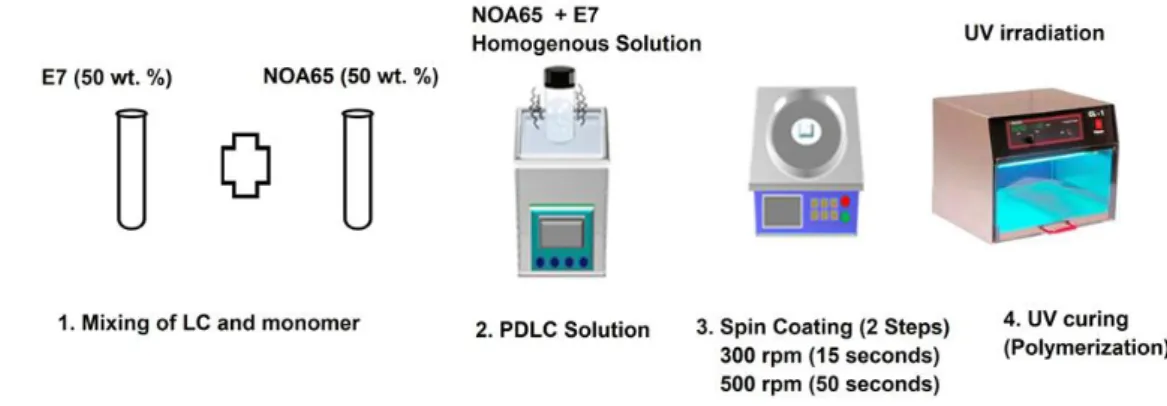
Figure 1 shows the fabrication process of the PDLC scattering films. The LC (50%) and the prepolymer (50%) were mixed and then spin coated on glass substrates. Samples were cured under UV light (with the intensity 350 μW/cm

2

) at different durations. The LC phase separated from the polymer to form micron-sized droplets.

In a regular PDLC film, the droplet orientation is random throughout the film.

Ⅲ. Optical analysis of PDLC scattering film

First, optical analysis was done to elucidate the optical characteristics of the PDLC films. Figure 2 shows the optical microscopic images of PDLC films prepared with different curing times at room temperature with a 4 W ultraviolet (UV) source (350 μW/cm

2

at wavelength of 365 nm).

The images were taken by using the reflection

mode of polarizing optical microscope (Olympus

BX-43F). The mechanism of UV curing is to

enable phase separation between the LC molecules

and the NOA65 polymers. After 25 s of curing,

about 50 μm sized LC droplets are formed and

distributed within the precured NOA65 as shown

in Figure 2a. When NOA65 polymer is precured,

the LC droplets freely move within the liquid

film and aggregate with other droplets, creating

droplets with bigger sizes. However, the film is

cured (polymerized) after 30 s of UV curing,

creating evenly distributed LC droplets with sizes

less than 1 μm. Figure 2b and 2c show stable

PDLC films cured at 30 s and 40 s respectively.

(3)

Fig. 1. Fabrication process of PDLC scattering film.

The images showed homogeneously distributed film. Thus, it is safe to say at least 30 s is enough to cure the PDLC films reported in this study.

Fig. 2. Optical microscopic images of PDLC scattering films on bare glass substrate cured at (a) 25 s (b) 30 s and (b) 40 s, respectively.

Transmission measurements to determine the light extraction of the PDLC scattering film were conducted and analyzed using a UV-vis-NIR spectrophotometer (Perkinelmer Lambda 950) in the wavelength range of 380~800 nm. Table 1 shows the optical characteristics of PDLC scattering film for films cured at 30 s and 40 s respectively.

Table 1. Optical characteristics of PDLC scattering film.

In the table, total transmittance means the amount of measured transmitted light after passing through the sample gathered at the half-sphere integrator. Thus it represents how much absorption

and reflection is occurred at the sample including a glass substrate. Total transmittance, Tt is calculated as the sum of parallel transmittance, Tp and the diffused transmittance, Td. Figure 3 shows the transmittance spectrum of PDLC scattering films cured at 30 s and 40 s respectively on glass substrate. Note that the reference sample is composed of the glass substrate and polymer film only.

Total transmittance is increased with increasingcuring time. When the phase separation is increased, it causes a proportional increase in the diffused transmittance. Total transmittance for films cured at 30 s and 40 s are 89.8% and 93.2% respectively.

This technique is very useful for application in optoelectronic devices requiring scattering layers with high transmittance.

Haze of the films was calculated based on the equation:

  

 

× 

In principle, haze is defined as the measured diffused transmittance divided by total transmittance.

To get a large scattering effect, the haze is the most important factor. It is known that the large haze can increase the light extraction efficiency of OLED by guiding the leaked light at the interface due to internal reflection [23-24]. In our experiment, the haze is increased with increase in the curing time as depicted in the Table 1.

Conventional scattering films reported required

(4)

various complicated manufacturing process or expensive high refractive index nano-particle materials and surfactants to achieve high haze and high transmittance films. However, we have demonstrated that we can easily get a large haze and high transmittance films in a simple and tunable manner by simply changing the UV curing time of the prepolymer and the nematic LC homogeneous mixture.

Ⅳ. Implementation in OLED

We coated the PDLC scattering film directly on a typical bottom-emission OLED device and analyzed the light extraction effect and OLED characteristics.

OLEDs are sensitive to UV exposure and it is required to use an optimum UV curing time that does not affect the electrical properties of the OLED.

Indium tin oxide (ITO, 150 nm) layer patterned glass substrates were cleaned sequentially with acetone and isopropyl alcohol in an ultrasonic bath, boiled in isopropyl alcohol and dried in an oven at 150°C for 15 minutes respectively. On the ITO patterned glass, OLEDs were fabricated by sequentially depositing the following organic layers on the substrates: molybdenum oxide (MoO

3

, 4 nm) as a hole injection layer, 1,4-bis[N- (1-naphthyl)-N′-phenylamino]-4,4′diamine (NPB, 90 nm) as a hole transport layer, and tris (8-hydroxyquinolinato) aluminum (Alq

3

, 70 nm) as a light emitting layer using a shadow mask, at 0.5 Å/s, 2 Å/s, and 2 Å/s deposition rates respectively. In addition, lithium fluoride (LiF, 1.2 nm) as electron injection layer and aluminum (Al, 100 nm) as cathode, were evaporated onto the organic layer using a metal shadow mask, at 0.5 Å/s and 4 Å/s deposition rates, respectively.

After the fabrication of OLED device, the homogeneous NOA65 prepolymer and nematic LC mixture was spin-coated on the opposite side of substrate and cured for 30 s. Fabrication of the PDLC scattering film is same as discussed in

the previous chapter.

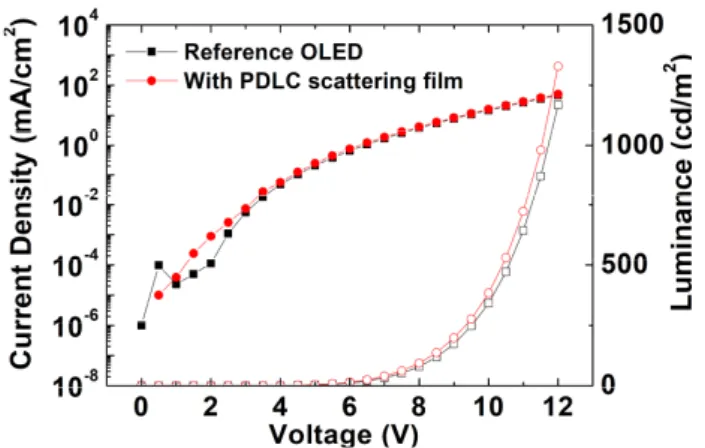
The current density-voltage-luminance (J-V-L) characteristics of the OLED was measured by means of a voltage source and a current meter using a Source Meter (KEITHLEY 2400) and analyzed in the vertical direction using Photo Research (LMS PR 650) software. The voltage was applied in the range from 0 to 12 V with 0.5 V intervals. Figure 4 shows the J-V-L characteristics of bottom-emission OLED with and without PDLC scattering film.

Fig. 4. The current density-voltage-luminance (J-V-L) characteristics of OLED devices with (red circle) and without (black square) scattering film.

Both curves in Figure 4 showed similar J-V characteristics. This shows that one step process of direct formation of PDLC scattering film on OLEDs does not affect the electrical characteristics of pristine OLEDs. From the measured luminance on vertical direction, turn-on voltage at 1 cd/m

2

and operating voltage at 1000 cd/m

2

were determined as 4.0 V and 11.5 V, respectively. The luminance with the PDLC scattering film is enhanced.

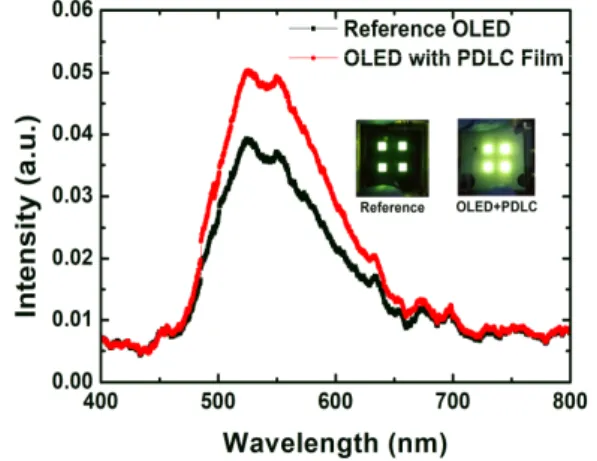
We used an integrating sphere (IS200-4) and a

spectrometer (Thorlab, CCS200/M) in order to

analyze the light extraction efficiency in all

directions. We compared the luminance intensity

at 8 V for the OLED with or without PDLC

scattering film as shown in Figure 5. The two

EL measurements show same spectrum with center

wavelength of 525 nm since the PDLC scattering

film has a nearly flat transmittance at the visible

(5)

range as shown in Figure 3.

As shown in Figure 5, total light emission of OLED was increased by almost 16% by area. The effect of the scattering film is also demonstrated by the picture of the OLED with and without PDLC scattering film. It has been shown that films with high haze can increase the out-coupling efficiency of the OLEDs [23-24].

Fig. 5. EL spectrum of OLEDs with (red circle) and without (black square) the PDLC scattering film (cured at 30 s).

We have demonstrated that high haze and transmittance can be tuned by controlling the UV curing time. By far, we have proven that PDLC films can be easily fabricated and applied in improving the out-coupling efficiency of OLEDs at a low cost.

Ⅴ. Conclusion

In this study, we investigated PDLC films as light extraction layers and their application in enhancing the out-coupling efficiency of OLEDs.

Uniform and transparent composite film was successively fabricated with UV curable prepolymer and nematic LC in a proportionate concentration.

At least 30 s of UV curing in a direct fabrication process of the PDLC film on a bottom-emitting OLED was successfully achieved without damage on the intrinsic properties of the OLED. We demonstrated that the required haze and transmittance of the light extraction film can be easily tuned

by controlling the UV curing time. An enhancement factor of 16% by area at 524 nm was achieved by a PDLC film cured within 30 s. The fabrication process is very simple, easy to control and can be adapted to various large-sized OLED applications.

Our investigation can be extended to PDLC adaptable flexible substrates for advanced flexible OLED applications.

References

[1] N. Thejo Kalyani and S. J. Dhoble, “Organic light emitting diodes: Energy saving lighting technology—A review,” Renewable Sustainable Energy Rev., Vol.16, No.5, pp.2696-2723, 2012.

DOI: 10.1016/j.rser.2012.02.021

[2] T.-H. Han, Y. Lee, M.-R. Choi, S.-H. Woo, S.-H. Bae, B. H. Hong, J.-H. Ahn and T.-W.

Lee, “Extremely efficient flexible organic light- emitting diodes with modified graphene anode,”

Nat. Photonics, Vol.6, pp.105-110, 2012.

[3] H. Sasabe and J. Kido, “Development of high performance OLEDs for general lighting,” J.

Mater. Chem. C, Vol.1. No.9, pp.1699-1707, 2013.

[4] S. Kunic and Z. Sego, “OLED technology and displays,” Proc. ELMAR, pp.31-35, 2012.

[5] C. W. Tang and S. A. VanSlyke, “Organic electroluminescent diodes,” Appl. Phys. Lett. Vol.51, No.12, pp.91915, 1987. DOI: 10.1063/1.98799 [6] R. Windisch, P. Heremans, A. Knobloch, P.

Kiesel, G. H. Döhler, B. Dutta, and G. Borghs,

“Light-emittingdiodes with 31% external quantum efficiency by outcoupling of lateral waveguide modes,” Appl. Phys. Lett. Vol.74, No.16, pp.2256- 2258, 1999. DOI: 10.1063/1.123817

[7] K. Saxena, V. K. Jain, and D. S. Mehta, “A review on the light extraction techniques in organic electroluminescent devices,” Optical Materials, Vol.32, No.1, pp.221-233, 2009.

DOI: 10.1016/j.optmat.2009.07.014

[8] H.-W. Chang, K.-C. Tien, M.-H. Hsu, Y.-H.

Huang, M.-S. Lin, C.-H. Tasi, Y.-T. Tasi, and

C.-C. Wu, “Organic light-emitting devices integrated

(6)

with internal scattering layers for enhancing optical out-coupling,” J. Soc. Inf. of Disp., Vol.19, No.2, pp.196-204, 2011. DOI: 10.1889/JSID19.2.196 [9] H.-W. Chang, J.-H. Lee, S. Hofmann, Y. H.

Kim, L. Muller-Meskamp, B. Lussem, C.-C. Wu, K. Leo, and M. C. Gather, “Nano-particle based scattering layers for optical efficiency enhancement of organic light-emitting diodes and organic solar cells,” J. Appl. Phys., Vol.113, No.20, pp.204-502, 2013. DOI: 10.1063/1.4807000

[10] N. K. Patel, S. Ciná, and J. H. Burroughes,

“High-efficiency organic light-emitting diodes,”

IEEE J. Sel. Top. Quantum Electron. Vol.8, No.2, pp.346-361, 2002. DOI: 10.1109/2944.999190 [11] S. Möller and S. R. Forrest, “Improved light out-coupling in organic light emitting diodes employing ordered microlens arrays,” J. Appl. Phys., Vol.91, No.5, pp.3324-3327, 2002.

DOI: 10.1063/1.1435422

[12] A. Kim, G. Huseynova, J. Lee, J.-H. Lee,

“Enhancement of out-coupling efficiency of flexible organic light-emitting diodes fabricated on an MLA-patterned parylene substrate,” Organic Electronics, Vol.71, pp.246-250, 2019.

DOI: 10.1016/j.orgel.2019.05.025

[13] Feng Li, Xiao Li, J. Zhang, B. Yang, “Enhanced light extraction from organic light-emitting devices by using microcontact printed silica colloidal crystals,”

Organic Electronics, Vol.8, No.5, pp.635-639, 2007.

DOI: 10.1016/j.orgel.2007.06.001

[14] J.-W. Shin, D.-H. Cho, J. Moon, C. W. Joo, J. Lee, J. W. Huh, S. K. Park, J.-H. Han, N. S.

Cho, J. Hwang, H. Y. Chu, and J.-I. Lee, “Random nanostructure scattering layer for suppression of microcavity effect and light extraction in OLEDs,”

Opt. Letters, Vol.39, No.12, pp.3527-3530, 2007.

[15] J. Lim, S. S. Oh, D. Y. Kim, S. H. Cho, I. T.

Kim, S. H. Han, H. Takezoe, E. H. Choi, G. S.

Cho, Y. H. Seo, S. O. Kang, and B. Park, “Enhanced out-coupling factor of microcavity organic light- emitting devices with irregular microlens array,”

Opt. Express, Vol.14, No.14, pp.6564-6571, 2006.

DOI: 10.1364/OE.14.006564

[16] Y.-J. Lee, S.-H. Kim, J. Huh, G.-H. Kim, Yong-Hee Lee, S.-H. Cho, Y.-C. Kim, and Y. R.

Do, “A high-extraction-efficiency nanopatterned organic light-emitting diode,” Appl. Phys. Lett., Vol.82, No.21, pp.3779-3781, 2003.

DOI: 10.1063/1.1577823

[17] C.-H. Shin, E. Y. Shin, M.-H. Kim, J.-H.

Lee, and Y. Choi, “Nanoparticle scattering layer for improving light extraction efficiency of organic light emitting diodes,” Opt. Express, Vol.23, No.3, pp.A133-A139, 2015. DOI: 10.1364/OE.23.00A133 [18] D.-Y. Zhou, X.-B. Shi, C.-H. Gao, S.-D. Cai, Y. Jin, L.-S. Liao, “Light extraction enhancement from organic light-emitting diodes with randomly scattered surface fixture,” Applied Surface Science, Vol.314, pp.858-863, 2014.

DOI: 10.1016/j.apsusc.2014.07.001

[19] J. Jiang, G. Mcgraw, R. Ma, J. Brown, and D.-K. Yang, “Selective scattering polymer dispersed liquid crystal film for light enhancement of organic light emitting diode,” Opt. Express, Vol.25, No.4, pp.3327-3335, 2017. DOI: 10.1364/OE.25.003327 [20] J. W. Doane, A. Golemme, J. L. West, J. B.

Whitehead, and B. G. Wu, “Polymer dispersed liquid crystals for display application,” Mol. Cryst.

Liquid Cryst., Vol.165, No.1, pp.511-532, 1988.

DOI: 10.1080/00268948808082211

[21] S. C. Sharma, “A review of the electro-optical properties and their modification by radiation in polymerdispersed liquid crystals and thin films containing CdSe/ZnS quantum dots,” Mater. Sci.

Eng: B, Vol.168, No.1-3, pp.5-15, 2010.

DOI: 10.1016/j.mseb.2010.01.014

[22] Y. Kim, D. Jung, S. Jeong, K. Kim, W. Choi, Y. Seo, “Optical properties and optimized conditions for polymer dispersed liquid crystal containing UV curable polymer and nematic liquid crystal,”

Current Applied Physics, Vol.15, No.3, pp.292-297, 2015. DOI: 10.1016/j.cap.2014.12.027

[23] J. Lee, N. Chopra, and F. So, “Cavity effects on light extraction in organic light emitting devices,”

Appl. Phys. Lett. Vol.92, No.3, pp.033303, 2008.

DOI: 10.1063/1.2830820

(7)

[24] H.-W. Chang, K.-C. Tien, M.-H. Hsu, Y.-H.

Huang, M.-S. Lin, C.-H. Tsai, Y.-T. Tsai, and C.-C. Wu, “Organic light-emitting devices integrated with internal scattering layers for enhancing optical out-coupling,” J. SID., Vol.19, No.2, pp.196-204, 2011. DOI: 10.1889/JSID19.2.196

BIOGRAPHY

Akpeko Gasonoo (Member)

2013:BS degree in Computer Engineering, KNUST, Ghana 2017:MS degree in Electronic Engineering, Hanbat Nat'l Univ.

2017~present:PhD degree in Electronic Engineering, Hanbat Nat'l Univ.

Hyeon-Sik Ahn (Member)

2013~2017:BS degree course of Electronics & Control Engineering, Hanbat National University.

2018~present:MS degree in Electronic Engineering, Hanbat Nat'l Univ.

Jonghee Lee (Member)

2002:BS degree in Chemistry, Korea Advanced Institute of Science and Technology (KAIST), Korea.

2004:MS degree in Chemistry, KAIST, Korea.

2007:Ph.D. degree in Chemistry, KAIST, Korea.

2007~2010:Senior Member of Engineering Staff, Researcher, Electronics and Telecommunication Research Institute (ETRI), Korea

2010~2012:Post Doc. Researcher, IAPP, Technical Univ. of Dresden, Germany.

2012~2018:Senior Member of Engineering Staff, Researcher, ETRI, Korea

2018~present: Assistant Professor, Hanbat Nat'l Univ.

Min-Hoi Kim (Member)

2006:BS degree in Electrical Engineering, Yonsei University.

2013:PhD degree in Electrical and Computer Engineering, Seoul Nat'l Univ.

2013~present:Associate Professor, Hanbat Nat'l Univ.

Jae-Hyun Lee (Member)

2002:BS degree in Material Science and Engineering, Korea University.

2011:PhD degree in Material Science and Eng., Seoul Nat'l Univ.

2011~2012:Post Doc. Researcher, IAPP, TU Dresden (Germany).

2012~present:Associate Professor, Hanbat National University.

Yoonseuk Choi (Member)

1999:BS degree in Electrical Engineering, Seoul Nat'l Univ.

2006:PhD degree in Electrical Engineering, Seoul Nat'l Univ.

2006~2008:Principal Researcher, Hanyang Univ.

2008~2010:Post Doctoral Scholar, Case Western Reserve Univ.

2010~present:Associate Professor, Hanbat National

University.

수치

Fig. 1.  Fabrication  process  of PDLC  scattering  film.
Fig.  4.  The  current  density-voltage-luminance  (J-V-L)  characteristics  of  OLED  devices  with  (red  circle)  and  without (black  square)  scattering  film.
Fig. 5.  EL spectrum of OLEDs with  (red circle)  and without  (black square) the PDLC scattering film (cured at 30 s).

참조

관련 문서

In this thesis, we studied the enhancement of the light extraction efficiency in InGaN-based light-emitting diodes (LEDs) patterned with nano structures.. The

Most submerged lamp system have a fundamental fouling problem and due to the absorption of UV light by fouling materials on the quartz sleeve, germicidal power of UV

and Richmond, A., “Productivity and photosynthetic efficiency of spirulina platensis as affected by light intensity, algal density and rate of mixing in a

Hakim, The Story of Science – – Newton at the Center, Newton at the Center,... Thermal

LED(Light Emitting

The purpose of this study is to compare the degrees of conversion of light curing resin cement specimens cured by the light transmitted different thickness of zirconia

χ is the fraction of the emitted light flux absorbed in the water Ф OH is the quantum yield for generation of ·OH radicals... <Example 1>. We assume that for

• LED, Light Emitting Diode embedded GFRP, Glass Fiber