약학회지 제34권 제3호 199〜 205(1990)
Yakhak Hoeji
Vol. 34, No. 3구영순 •최 경 주 이화여자대학교 약학대학 (Received April 12,1990)
Microencapsulation of Nalidixic Acid Using Eudragit R L
Young Soon Ku and Kyung Joo Choi
College of Pharmacy, En ha Woman s University,
Seoul 120-750, Korea
Nalidixic Acid 의 Eudragit R L Microencapsulation 에 관한 연구
Abstract—— Microencapsulation of nalidixic acid using Eudragit RL, a methacrylic acid copolymer was investigated.
Microcapsules were prepared by dispersing the drug solution in liquid paraffing using aluminium tristearate as dispersing agent. The preparation of the microcapsules showed high reprodulibility in parti
cle size, shape and the drug content.
The dissolution rates of Nalidixic acid from the these microcapsules considerably decreased as com
pared with that from Nalidixic acid powder and Nalidixic acid-Kudragit RL solid dispersions. The release of Nalidixic acid increased with increasing percentage of aluminium tristearate added to the microcap
sules.
Keywords □ Nalidixic acid, Endragit RL, Microencapsulation
Eudragit은 유기용매용과 물에 분산시켜 사용하 는 수분산용의 2가지로 크게 분류되며 L,S, E,
RL, RS 등의 type 이 있다. 이 중 Eudragit Retard 는 4급 고분자로서 4급 암모늄기를 구조내 에 함유한 methacrylic acid 와 acrylic acid ester 의 공중합체로 Eudragit Retard L (high permeability, low retard effect) 와 Eudragit Retard S (poor permeability, strong retard effect) 의 2종류가 있으며 필름자체의 막투과성에 기인하는 약물의 확산에 의해 약물을 방출하는 기전 을 가지고 있으며 용해도는 pH 와 무관하며 위장관 에서 불활성이다. 1-3>
Eudragit 을 사용하여 서방화를 시도한 예는 coating 정제2〉에 관한 것이 있으며 matrix 정제,4》
공침불 등5,6>에 관한 보고가 있다.
Microcapsule 에 대한 Mitsuru 등7}은
acetone 에 녹인 E udrag it S 를 potassium pe
n icillin V 의 butanol 현탁액과혼화한 다음 ace- tone 을 실온에서 증발시켜서 microcapsule 화 하 였다.
Lehm ann -i-8)-g- phenylpropanolam ine -§-§:
E udrag it L,S,E,R L , R S 의 10〜 20% 의 용액으 로 fluidized bed coating 법으로 encapsulation 하 였 고 Elsayed5>는 rib o fla v in e 의 benzene, isopropylalcohol 용액을 E u d ra g it R L 용액에 현 탁시킨 후 coacervation 법에 의해 조제하였다.
Fouli 등9>은 E udrag it E , L 을 사용하여 sa
licylic acid 를 non-solvent a d d itio n m ethod 로 coacervation 을 이용하여 microcapsule 을 만'!' 었는데 m atrix-controlled m e ch anism 에 따라 방 출된다고 보고하였으나 제제로서의 평가는 충분히 수행되지 않았다.
200 구영순 •최경주
Pongpaibul 등10》은 E udragit R S 와 L 의여러 비율로 indom ethacin 을함유하는 microsphere 를 조제하여
in
야Yn? 에서의 약물방출속도에 대한 polymer ᅬ solvent—polymer polymer -drug 비율 등의 영향을 조사하였고 약물의 80% 가 방출될 때까지 겉보기 0차 반응을 따른다고 보고하 였다.또한 Lehm ann 등11)은 m icrocapsule 조제시 첨
가제의 영향에 대한 연구에서 fluidized bed
coating machine 을 사용하여 coating 용액에 talc, m agnesium stearate 를 분산시키면 조작조 건이 적당할 때 microcapsule 의 응집을 현저하게 피할 수 있었다.
D onbrow 등12)은 paracetam ol 을 chloroform- cyclohexane 혼합액에서 Eudragit RS 의 mi
crocapsule 을 조제하였다.
G oto 둥13》은 sulfam ethizole 을 E udragit RS 로 수중건조법으로 구상이며 정립성이 있는 mi
crocapsule 을 조제하였다.
E udrag it R S 를 이용한非 Steroid 성 소염 진통 제의 microcapsule 에대한 연구로 k a w a ta 등14》
은 acetone/liquid p a ra ffin system 을 사용하여 evaporation m ethod 로 E udrag it R S microcap- sule 을조제하여 w ater phase 에 의한조제에서 볼 수 있었던 팽윤과 물리적 강도의 문제점을 해결하였 다.
화학요법제로 요로감염중에 사용되고 있는 nalidixic acid 는 물에 난용성이므로 therapeutic concentration 에 도달시키기 위해 비교적 많은 약 용량(성인 1曰 l 〜 4g) 을 필요로 하고 half-life (plasma half life: 90min)가 짧기 때문에 1曰 2〜 4회 반복투여해야 하는 단점이 있으므로 조절방 출성 제제의 개발은 복용방법의 번잡성으로 인한 noncompliance로 생기는 치료효과의 감소를 방지 할 수 있을 것으로 생각된다. 따라서 본 논문에서는 Eudragit RL 을 사용하여 nalidixic acid 를 함유 하는 microcapsule 을 만들어 연구한 결과를 보고 한다.
實驗및方法 1. 試藥
Eudragit R L (R o h m P h arm a G m bH , W est G erm any), N a lid ix ic a c id (K P V ),A lu m in
ium triste a ra te (Ju n se i C h e m ic a l, J a p a n ), A cetone (D u k s a n P h a r m a c e u tic a l) , L iq u id p araffin (D uksan P harm aceutical)
2
.U V Spectrophotometer (S him adzu UV-240), D is s o lu tio n T ester (F in e S c ie n tific I n d . , DST-300),p H meter (Beckm an, Model 3500), M echanical Stirrer (Fractional H . P. M otors L t d .) , T esting Sieves(청계상공사 K P V ),M i
croscope (Olym pus M od el), Scanning Elec
tron Microscope (JE O L,JSM -35CF), X-Ray (Simens, K ristalloflex, 805).
3. M icrocapsule 의調製
Kawata 둥의 방법을 응용하여 Scheme 1과 같 이 조제하였다.
Eudragit RL 5. 5g을 30m/ 의 acetone 에 완전 히 용해시켰다. 여기에 aluminium tristearate 1, 3,5, 7g 과 nalidixic acid 1.4g 을 각각 가하고 10°C 수욕상에서 30분 동안 250 rpm 으로 교반하였 다. 위의 현탁액을 미리 10oC로 냉각시킨 liquid paraffin 150m/ 에 가한 후 500rpm 에서 6시간 교반하는 동안 수욕의 온도를 점차 올려 20°C 로 조 절하였다. w-hexane 50m/ 로 5회 세척하고 여과 하여 분리한 후 12시간 동안 실온에서 감압하여 건 조하였다.
5.5g of Eudragit RL dissolved in acetone 30
ml
•add aluminium tristearate
•add drug powder 1.4g Stirring (10°C, 250 rpm, 30 min.) Pour into liquid paraffin of 150
ml
Stirring (gradually heat up to 20°C, 500 rpm,
i 6 h) I
filtration
Washing with 50 mi of n-hexane (5 times) drying j
(12
h, under reduced pressure)Scheme 1. Preparation of Eudragit RL microcapsules
J. Pharm. Soc. Korea
Nalidixic Acid 의 Eudragit RL Microencapsulation 에 관한 연구 201
4. Microcapsule 중의 nalidixic acid 의정량 검량선의 작성一Nalidixic acid 약 20 m g을 정 밀히 칭량하여 0.01N NaOH 용액과 pH 6.8의 붕 해시험 제 2액에 각각 용해하여 4,8,12,16,
20Mg/
의 농도로 희석한 후 335nm, 330nm에서의 홉광도를 측정하여 다음의 검량선식을 얻었다.
0.01N NaOH 용액 :
Y = 0 .
0493X-0.0008 pH 6.8 buffer :Y = 0 .
0422X-0. 0053함량측정ᅳNalidixic acid 10 mg 에 해당하는 시 료를 칭량하고 0.01N NaOH 용액 500m/ 를 사 용하여 용해시킨 투 일정량을 취하여 milipore filter (pore size 0.45//m)로 여과하고 335 이고 에 서의 홉광도를 측정하여 검량선의 작성에서 구한 검 량선식에 의하여 함량을 정량하였다.
5. Scanning Electron Microscopy
제조한 microcapsule 의 형태와 표면상태를 조사 하기 위하여 aluminium tristearate 1.45, 4.35,
7.25 및 10.15% 를 사용하여 제조한 microcapsule 을 scanning electron microcope 로 관찰하였다.
6. 粒® 分布
Microcapsule 조제에 사용한 nalidixic acid powder 와 Eudragit RL microcapsule 을 test
ing sieve 7 mesh (2830 //m ), 10 (2000), 14(1410) , 20(841) , 40(420) , 60(250) , 100(149), 200(74)를 사용하여 일정량의 시료를 상 단체에 넣은 후 10분간 수평으로 가끔 가법게 두드 려서 혼든 다음 각 sieve 위의 잔류량을 정밀히 칭 량하여 백분율을 구하였다.
7. 용출시험
약전의 paddle 법을 준용하여 회전속도는 150 rpm 으로 하고 용출용매로 500m/ 의 pH 6.8 buffer 를 사용하였다. Nalidixic acid 20 mg 에 해당하는 시료를 넣고 용매온도를 37.0±0.5oC로 유지 하였다.
검액은 nalidixic acid powder에서는 10, 20,
30,40,50,60, 90, 120, 150,180분에,조제한 microcapsule 에서는 30, 60, 90, 120, 180, 240, 300,360,420,480분에 3m / 의 검액을 채취 하여 milipore filter (pore size : 0.45//m)로 여 과 한 후 330nm에서의 홉광도를 측정하였다. 검액채
結果 및考察
Eudragit RS 를 시용하여 microcapsule 을 조제 하는 경우 Eudragit RS 는 구조 중에 친수기를 가 지고 있어서 수중에서는 팽윤하는 성질이 있다. 따 | 라서 水 中 乾 燥法 으 로 sulfamethizole 의 m i
crocapsule 조제시 magnesium stearate 를 첨가 하지 않으면 Eudragit RS 의 대전성이나 점착성 때 문에 성형성 •정립성이 양호한 microcapsule을 얻 기가 어렵다. 15) Microcapsule 의 팽윤을 최소한으 로 하여 유리한 조건하에서 제조하기 위해 수회■수를 함유하지 않는 aluminium tristearate 를 사용하여 수중건조법 (methylene chloride/water system) 으로 microcapsule 을 조제할 때 첨가한 a lu m in ium tristearate 양이 2% 이상이면 m icrocapsule 의 응집이 일어났다. 15> acetone/liquid paraffin system, 즉유중건조법에 의한 m icrocapsule 조제 에 alu m iniu m tristearate 1 .45,4 . 35,7 . 25,
1 0 .15% 를 첨가한 모든 시료에서는 성형성이 확인
되었다.
유중건조법에 의한 E ud rag it R L m icrocapsule 생성에 대한 alu m in iu m tristearate 의 영향은 최 근 Benita 등이 coacervation 법에 의해 Eudragit R etard microcapsule 조제시 응집을 방지할 목적 으로 polyisobutylene을 첨가하였으나 생성된 microcapsule 이 불규칙 한 형 상을 나타내 어 유용성
이 거의 인정되지 않았다. 12>
한 편, G oto 등15)은 m a g n e siu m stearate, sodium stearate, calcium stearate,aluminium stearate 등의 스테아린산 금속염이 m icrocapsule 화에 미치는 영향에 관한 연구에서 스테아린산 금속 염을 첨가하지 않으면 성형정립성이 현저하게 떨어 지는 결과를 얻었으나 소량(0 .7〜2 .0 % ) 첨가의 경 우는 구상이며 정립성있는 m icrocapsule 을 얻을 수 있었고 스테아린산 금속염의 최적 %를 넘으면 m icrocap sule의 응 집을 족 진 하 였 다. 그 리 고 sodium stearate, m agnesium stearate, c a l
cium ste a ra te에서는 응집현상이 생기는 한계 % 까지 m icrocapsule 에포함되는 물의 양은 차차 증 가하여 microcapsule의 체적이 현저히 증가해가는
202 구영순 •최 경주
현상은 나타나지 않으며 이 중 지용성이 가장 크고 수화수를 갖지 않는 a lu m iniu m tristearate 가
m icrocapsule 의 팽윤을 최소로 하고 구상성형성
및 정립성이 가장월등하다
. 13, 15)
Nalidixic acid 의 지속성 제제 개발의 가능성에 관한 연구로 nalidixic acid 의 Eudragit RL 의 microcapsule 에 대한 연구에서 우선 분리분산제로 aluminium tristearate 를 선택하였다. Microen-
capsulation 에 대한 농도변화의 영향을 보기 위하
여 aluminium tristearate 1.45, 4 .35, 7.25,
1 0 .1 5 (w /w)% 를 첨가하여 실험한 결과,a lu m in iu m tristearate 를 첨가하지 않으면 응집이 일어나 며,aluminium tristearate 의 소량 (1.45%) 첨가 로 microcapsule 이 완전하게 만들어졌고 4.35, 7.25, 10.15% 를 첨가한 microcapsule 에서도 구 상 microcapsule 이 형성됨을 확인하였다. Alu
minium tristearate 는 acetone 의 증발에 따라 불 용성의 aluminium tristearate 와 약물의 양 입자 표면상에 Eudragit RL 이 석출하여 양 입자가 피 복되는 것으로 생각된다. 즉 aluminium tristear- ate 는 불용상태로 존재하나 acetone/liquid paraf
fin 계면에 상당량이 모여서 피막 및 계면활성제로 서의 역할을 하여 microcapsule의 구상성형성에 기여하는 것으로사료된다. 15)
T able I은 m icrocapsule 중의 nalidix ic acid 의 함량을 나타낸 것이다
.
E udragit R L m icrocapsule 조제시 첨가한 alu m in iu m tristearate
의 양에 관계없이 모든 microcapsule 중의
n a lidix ic a c id의함량은 약 19.8%로 일정하였다.
Table I 一 Nalidixic acid content of eudragit RL microc
apsules
Microcapsules Content of Nalidixic (Percentage of Aluminium acid,
tristearate treated) mean ± S.D. (%)
A (1.45%) 20.0 ±0.56
B (4.35%) 19.9 ±0.45
C (7.25%) 19.5 ±0.64
D (10.15%) 19.8 ±0.73
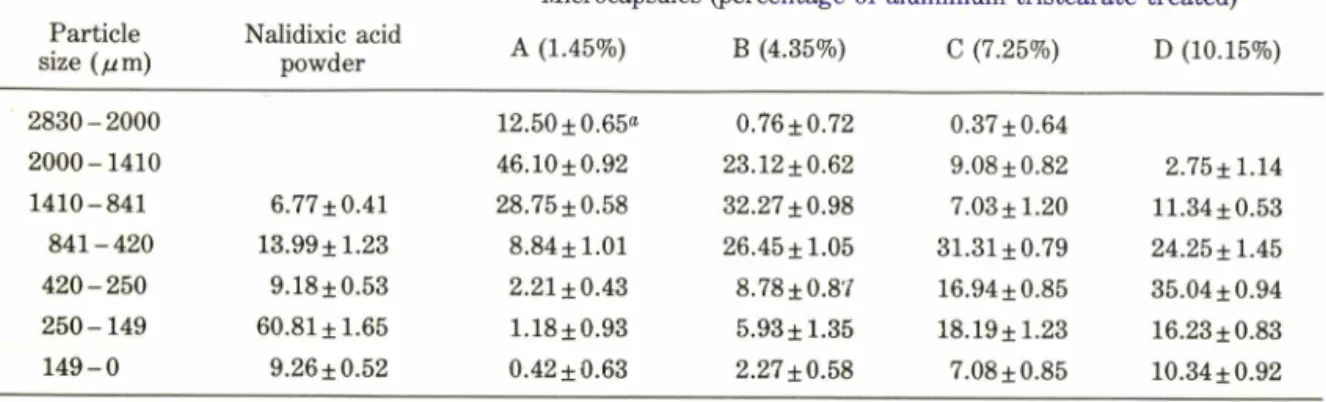
T able I I는 조제된 E udragit R L microcap- sule 과 nalidixic acid powder 의 입도분포이 다.
Microcapsule 의 particle size 는 aluminium stearate 의 첨가량이 증가함에 따라 입도분포 his
togram 의 최다 % 는 particle size 가 micro
capsule A 의 2000〜 1410/mi 가 microcapsule D 의 420〜 250//m로 감소하였다. 이것은 alumin
ium tristearate 의 첨가로 microencapsulation
system에서의 분산이 촉진되기 때문이라고 사료된
다. 14)
F ig. 1〜4는 E u d rag it R L m icrocapsule 의 S E M 사진이다. A lu m in iu m tristearate 를 소량
첨가(1.45% )한 m icrocapsule의 표면이 가장 치 밀하였고 첨가한 a lu m iniu m tristearate 의 양을 증가시킴에 따라 거칠어져 가장 많이 첨가(10.15%) 한 m icrocapsule 이가장 거칠었다.
Fig. 5는 p H 6.8 buffer 용액에서 alum inium tristearate 1 .45,4. 35,7 .25,10 .15%를 함유하 는 E udragit R L m icrocapsule 로부터의 nalidi-
Table II —— Particle size distribution of eudragit RL microcapsules and nalidixic acid powder
Microcapsules (percentage of aluminium tristearate treated) Particle
size (/im)
Nalidixic acid
powder A (1.45%) B (4.35%) C (7.25%) D (10.15%)
2830-2000 12.50 ±0.65a 0.76 ±0.72 0.37 ±0.64
2000-1410 46.10 ±0.92 23.12 ±0.62 9.08 ±0.82 2.75±1.14
1410-841 6.77±0.41 28.75 ±0.58 32.27 ±0.98 7.03 ±1.20 11.34±0.53
841-420 13.99 ±1.23 8.84 ±1.01 26.45 ±1.05 31.31 ±0.79 24.25±1.45
420-250 9.18±0.53 2.21 ±0.43 8.78 ±0.87 16.94 士 0.85 35.04 ±0.94
250-149 60.81 ±1.65 1.18±0.93 5.93 ±1.35 18.19±1.23 16.23 ±0.83
149-0 9.26 ±0.52 0.42 ±0.63 2.27 士 0.58 7.08 ±0.85 10.34 ±0.92
a
percent of particles土 S.D.J. Pharm. Soc. Korea
Nalidixic Acid 의 Eudragit RL Microencapsulation 에 관 한 연구 203
F ig .
1 —— Scanning electron micrographs of microcapsulesF ig .
3 — Scanning electron micrographs of microcapsules containing nalidixic acid treated with 1.45% of containing nalidixic acid treated with 7.25% ofaluminium tristearate. aluminium tristearate.
F ig . 2
— Scanning electron micrographs of microcapsules containing nalidixic acid treated with 4.35% of aluminium tristearate.F ig . 4 —
Scanning electron micrographs of microcapsules containing nalidixic acid treated with 10.15% of aluminium tristearate.204 구영 순•최경주
f t
(hour)F ig . 6
一 Release of nalidixic acid from microcapsules produced with different amount of aluminium tristearate treated according to the matrix model.
Key: • ,1.45%; ■ , 4.35%; a , 7.25%; ★ , 10.15%.
Time (hour)
F ig .
7 一 Release of nalidixic acid from microcapsules produced with different amount of alumium tristerate treated according to the first order model.
Key: #, 1.45%; ■,4.35%; ▲,7.25%; ★,10.15%.
2 0
.10
*60 120 180 240 300 360 420 480 Time (min.)
F ig .
5—
D isso lu tio n p ro file s o f n a lid ix ic a c id fro m microcapsules and powder in pH6.8
buffer at 37°C and 150 rpm.Key: □ , Microcapsule A; ★, Microcapsule B; ■,
Microcapsule C; ▲,Microcapsule D; • , powder
xic acid 의 용출특성을 나타낸다.
p H 6 .8 buffer 용액에서의 nalidix ic acid m icrocapsule 의 용출은 nalidix ic acid powder 와 비교해 볼 때 상당히 억제되었다. 초기 30분에 있어서 na lid ix ic acid powder 는 69% 가용해된데 비해 1.45,4.35,7 .25 및 10 .15% 의 alu m iniu m tristearate 를 첨가하여 조제한 m icrocapsule 은 2 .4,2 .8,3. 7 및 4. 3% 만이용출되었다. 또한 1시 간에서는 n a lid ix ic acid powder 는 92% 가용해되 었으며 1..45, 4.35, 7.25 및 10.15% 함유 m icrocapsule 에서는 3 .9,4 .9,6.0 및 8 .5% 가 용출되었다. 9 9 .5% 의 nalidix ic acid powder 가 용해되는 ^시간에서의 용출량은 1.45,4.35,7.25 및 1 0 .15% 첨가한 microcapsule 에서는 10.0, 13.0,18.1 및 26 .8% 가 용출되었고 8시간에서도 18.8,28.8,36 .5 및 51 .7%로 용출시간이 지연되 었다.
그리고 조제한 microcapsule 로부터의 nalidix ic acid 의 용출량을 시간의 square root 에 대하여 plo t한 결과 직선관계가 성립하였다(Fig.6). 그러 나 이 d a ta 는 또한 시간에 대하여 microcapsule
o
ro o- 0' 0- 0- 8
7
6
5
4
3 (#
)
- oa A o s s
^ sppB
o p q^
1 3S{I
/.
Pharm. Soc. Korea
Nalidixic Acid 의 Eudragit RL Microencapsulation 에 관 한 연구 205
에 남아있는 log 양이 직선관계를 나타내는 first order e q u atio n도 성립하였다(Fig. 7 ) . 16_18) 그러 므로 용출의 m echanism 을 명확히 구명하기 위해 서는 계속적인 연구검토가 있어야 할것으로 사료된 다.
한편, microcapsule 에 첨가한 a lu m iniu m tri- stearte 의양을증가시킴에 따라 nalidix ic acid 의 용출량이 증가함을 알 수 있다(F ig .5). 이는 a l
u m inium tristearate 의 첨가량을 증가시키면 mi- crocapsule 의 particle size 를 감소시켜 총 표면 적을 증가시키는 것으로 설명할 수 있다. N a li
dixic acid 의 E udrag it R L 의 microcapsule 은 서방형 제제의 가능성이 있으며 m icrocapsule 에 첨가하는 a lu m iniu m tristearate 의 양을 변화시킴 으로써 약물방출속도를 조절할 수 있으리라고 예상 된다.
結 論
A cetone/liquid p a ra ffin system 을 이용하여 oil phase 에서 solvent evaporation process 에 의해 nalidixic acid 를 함유하는 E udrag it R L microcapsule 을조제할 때
1. 분리분산제로 alu m in iu m tristearate 14.5, 4.35,7.25 및 0.15%를 첨가하였을 때구상성형성 과정립성이 좋은 m icrocapsule 을조제할 수 있었 다.
2. pH 6 .8 buffer 용액에서 nalidix ic acid powder 는 S시간에 용출이 완료되었으나 a lu m in ium tristearate 1.45, 4 .35,7 .25 및 10 .15% 를 첨가한 E udragit R L microcapsule 은 8시간에서 각각 18.8,29.8,32.5 및 54 .5% 가 용출되어 용 출시간이 지연되었다.
문 헌
1) Eudragit information phamphlets from the manufac
turing company, Roehm Pharm GmbH. Darmstadt.
West Germany.
2) K. Lehmann amd I). Dreher:
Drtt^s made in (Ger
many.
, 7, 59 (1969).3) Informations ** Eudragit Retard” of the Roehm Phar- ma. GmbH. Darmstadt.
4) F. Cali, G. Cappone, I. Colombo, L. Magarotto and A. Motta:
Int. J. Pharm.,
21, 317 (1984).5) A. A. El-Sayed:
Pharm. Acta. Hclv.,
57(2), 61 (1982).6
) S. A. El-Fattah, N.N. Salib and M. El-Massik:Dru^.
Dev. Ind. Pharm.,
10,649 (1984).7) F. Mitsuru and S.Tsutomu.: Japan Kokai., 7455820, 30(1974).
8
) K. Lehmann, H. Boessler and I). Dreher:Midi.
Macromol. Mono^r.,
5, 111 (1978).9) F. Fouli, A.A. El-Sayed and A.A. Budawi:
Int. J.
Pharm.,
14,95 (1983).10) Y. Pongpaibul, J.C. Price and C.W. Whitworth:
Drug. Dev. Ind. Pharm.,
10(10),1597(1984).11) K. Lehmann, H. Boessler and I). Dreher:
Acta.
Pharm. Seitc.,
13, Suppl. 37 (1976).12) M. Donbrow, S. Ben it a and Hoffman:
Appl. Biochcm.
Biotcchn.,
10,245 (1984).13) S. Goto, M. Gawata, M. Nakamura and T. Aoyama:
Yakugaku Zasshi.,
105(11), 1087(1985).14) S. Goto, M. Gawata, M. Nakamura and T. Aoyama:
Chem. Pharm. Bull.,
34(6), 2618 (1986).15) S. Goto, M. Gawata, M. Nakamura and T. Aoyama:
Yakugaku Zasshi.,
106,60 (1986).16) J. Schwaryz, A. Simonelli and W. Higuchi:
J. Pharm.
Sci.,
57(2), 274 (1968).17) M. Donbrow and S. Benita,/
Pharm. Pharmacol:
547 (1982).
18)