약학회 지 제 49 권 제 2 호 140〜 146 (2005)
Yakhak Hoeji
Vol. 49, No. 2藥 學 舍 職
Ginkgo Terpene
의Candida albicans
로 인 한 관 절 염 에 대 한 치 료 효 과이 순 현 • 이주희 • 한 용 문 #
동덕여자대학교 약학대학 면역 • 미생물학교실 (Received December 31, 2004; Revised March 8,2005)
Therapeutic Anti-inflammatory Effect of G inkgo Terpene on Arthritis due to C andida albicans
Soonhyun Lee, Jue-Hee Lee and Yongmoon Han#
College of Pharmacy, Dongduk Womens University, Seoul 136-714, Korea
A bstract —
Candida albicans ,
a polymorphic fungus, causes systemic and local infections. Recent reports show that the fungus is a main etiological agent for the arthritis. For treatment, antifungal drugs and/or rheumatoid drugs are used, but resistance and side effects lim it application of the drugs. In search of new sources for treatment of the fungal arthritis, we choose EGb 761 (extract ofGinkgo
leaves 761), one of the most popular over-the-counter herbal medicines. The EGb 761 contains two major ingredients such as terpene and flavonoid. In the present study, we examined if the terpene portion of EGb 761 had anti-inflammatory activity against C.albicans-caused
arthritis. The terpene was extracted with combination of methanol and water from the EGb 761,followed by gel-permeation chromatography. Presence of terpene was determined by the Salkowski colorimetric method and HPLC analysis. For an animal model of inflammation induction, mice were given an emulsion form of C.albicans
cell wall mixed with Complete Freund's Adjuvant (CFA) by footpad-injection. Results showed that intraperitoneal administration of the water-soluble portion that contained terpene and flavonoid reduced the inflammation. Whereas the terpene had anti-inflammatory activity, flavonoid portion had no such activity. For determination of possible mechanism of the activity, the terpene seemed to be suppression of nitric oxide (NO) production from LPS- treated macrophages. Taken together, theGinkgo
terpene may have anti-inflammatory effect againstC. albicans <aused
arthritis, possibly by blocking NO production.
K eyw ords □
Candida arthritis ,
EGb 761,Ginkgo
terpene, anti-inflammation, NO, miceC andida albicans는 진균 중에서 가장 많은 문제를 일으키는 다형 태성 진균으로 전신감염과 이구창(thrush), 질염 (vaginitis)같 은 국소적 감쉼을 일으킬 .뿐만 아니라 무릎, 둔부, 어깨부위의 관 절 등에 침범하며 감염성 관절염의 원인이 되기도 한다.1'3) 이러 한 C. albicans에 의한 관절염은 최근에 점차 중가하고 있으며1a 특히, 관절에 glucocorticoid와 같은 면역억제제를 투여한 경우, 인공관절 이식 등의 장기 이식수술로 인하여 면역력이 억제된 경 우,2'4) Non-Hodgkin's lymphoma, hematological malignancies 같은 질병, 암환자나 AIDS 감염으로 인한 면역결핍 환자,당뇨 병과 같은 소모성 질환자,간 또는 신부전 환자, 저체중 신생아 에게서 발병될 가능성이 빈번한 것으로 알려져 있다> 5) 이러한
#본 논문에 관한 문의는 저자에게로 (전화) 02-940-4521 (팩스) 02-940-4195 (E-mail) [email protected]
관절염은 궁극적으로는 관절연골 조직이 파괴되어 관절의 기능
을 상실하게 된다 . 이에 대한 치료약으로서는
azole계열의
fluconazole, itraconazole이나 polyene 계 열 의 amphotericin B 등의 항진균제 (antiflmgal drug)가 단독 또는 병용하여 시용되며1,4〉
C.
albicans
감염 치료 후 유발된 관절염 경우에는 관절염제제로 치료한다. 예 를 들 면 , gold salt, methotrexate, sulfasalazin, azathioprine와 같은 rheumatoid 치료제(DMARDs : disease- m odifying anti-rheumatic drugs)나 6’7) naproxen, ibuprofen, indomethacin, sulindac, diclofenac 등과 같은 NSAIDs(non steroidal anti-inflammatory drugs) 계열 진통 • 소염제 약물을 시용하기도 한다.8>C. albicans로 의한 관절염 치료에 있어 항진균제의 투여는 비 록 제한적이라 하더라도 이 약물에 대한 내성과 부작용 때문에 효과가 크지 않다.3〉DMARDs 투여의 경우에도 완치 확률이 높 지 않은 반면에 투여를 중단한 후 재발 또는 악화될 위험이 크
Ginkgo Terpene 의 Candida albicans 로 인한 관절염에 대한 치료효과 141
며, 신독성 또는간독성등의부작용발생 가능성이 많다. 또한 장기복용의경우에는약물에 대한내성과기회감염의 가능성이 중가하기때문에시용이 무척 제한적이며, NSAIDs 경우에도근 본적인원인치료가될수없다.6’73) 즉 관절염 진행을억제시키 거나연골조직을보호할수는없고오직 통증및경직성을감소 시키는 정도의중상완화효과만기대되며 장기복용의 경우, 위 장관장애와간장및신장 기능의 감소, 고혈압등의부작용발 생가능성이 매우높다.9> 따라서 최근에 이러한기존치료제의
부작용때문에 C. albicans로 인한관절염과같은민성적 염증치
료에부작용을최소화하고전달성이 개선된새로운약물및제 형의필요성이 요구된다. 이러한 일환으로본연구에서는 천연 물에서 가능성이 있는물질을검색하였다.
은행잎 주줄물인 EGb 761(extract of Ginkgo leaves 761)는 미국이나유럽에서 over-the-countei■(ᄋTC) 의약품중가장많이 판매되고 있는천연물제제로,10) EGb 761의주요 성분은크게 terpene trilactone인 ginkgolidesfi}- flavonoid glycosidesS. M"눌"
수 있 다 . Ginkgolides는 탄 소 수 20개의 diterpenoid(ginkgo terpenoid)로 hydroxyl 기능기숫자와위치에따라 ginkgolide A, B, C, J 및 M 과 sesquiterpene lactone인 bilobalide 등이 있 으 며 , flavonoids^l는 kaempferol, isorham netin, m yrcetin quercetir^f rutin 등이 있고 HPLC의분석에 의하면 EGb 761는 flavonoids glycosides를 22~27% 정도 포 함 하 고 있으며 terpenoids를 6%
정도함유하고 있다.10-12) 이두성분군의화학구조는 Fig. 1에 도식되어 있다. EGb 761의효과는 뇌혈관및말초혈관확장작 용과혈액순환 개선효과가있으며,11_13) 항산화효과에 의한 free radical제거로세포막손상을 방지하며 , 콜레스테롤감소효과보 고도있다.14) 최근에는 대뇌신경계 장애,15) A lzheim er 질환같 은노인성 치매의 치료와헤방께 대안적인신경보호약물로서 기 대가되고있다.13_15) EG b 761의주요성분인 ginkgolides는혈소 판옹집저해 작용, 면역기능의 증가, prostaglandin 생성저해 효 과둥이 보고되고 있으며,11’1647:1 특히, 염증이 유발되었을 때 macrophage로부터 생산되는nitric oxide(NO) 억제작용이 있는 것으로알려지고있다.19) 그러므로본 연구에서는 0T C 제제로
가장많이판매되고있는E G b 761의상기와같은약물기전중
에서항염효과가알려져있으므로이효과가C. albicans로 유발 된관절염에 대한효과여부를연구조사하였다.
재료 및 방법
실험동물
6~7주렴의 BALB/c 암컷생쥐 (Charles River Lab, NY, USA) 를사용하였으며 멸균된사료(ᄋrient Inc, Seoul, Korea) 및물 은지유롭게 먹게 하였다. 구입된 생쥐는 실험실환경에서 1주 일간적응시킨 후실험하였고, 동물실의 환경은온도 25±20C,
습도 55±5%로유지하였으며 조명은 12시간간격으로밤과 낮 을조절하였다.
C. albians
cell wall extract(CW )의 분리C. albians의 세포벽은 본연구실에서 예전에 보고된 방법을
사용하였다.19_21) 이 과정을 간략히 기술하면, glucose-yeast extract peptone(GYEP) broth에서 배양한 C. albicans 균을수 집하여 0.1 M disodium ED T A (pH 7.5)와 0.1 M-trisodium EDT A (pH 9.0)로 연속 처리한 후 0 .3 M 2-mercaptoethan이로
30분동안실온에서처리한다음윈심분리 방법으로상등액을수
집하여 투석막(Sigma, St. Louis, M O , USA; m em brane cut-off
= 12,000 D a)에넣고멸균된탈이온수에 대하여 3일동안투석
하였다. 물은 6시간마다교체하였으며 투석이 완료된후투석막 내부물질을동결건조(Eyela FD-1000, Tokyo, Japan)하여분말화 하였다. 추출한세포벽은desiccator(Sigm a) 안에저장보관히몄다.
EGb 716에서 terpene 성분추출과 성분확인
EGb 761(Emil Flachsmann AG, Wadenswil, Switzerland) 5 g # 클로로포름과메탄올혼합액 150 m/(5 :1 v/v)에넣고간
헐적으로진탕하면서 실온에서 24시간동안추출하였다.22) 수집 한상등액을rotary vacuum evaporator(Eyela)을이용해용매를
제거하고 남은 잔사에 10 m/ 증류수를 가해서 수용성분획만을
분리하고동결 건조하였다. 이수용성 물질을 G H 415로명명 하고 H PLC 분석은 C18 역상 컬럼(Nova-Pak 4 .6 X 150 m m:
W aters, USA)을사용하였으며 비교물질로 ginkgolide B(Sigm a) 를사용하였다. 계속적으로 G H 415를gel perm eation chro
m atography 방법으로 분획하였다. 즉, Sephadex G-50 Fine (Pharmacia, Uppsla, Sweden)으로중전된 컬럼 (직경 2 cm x 높 이70 cm; Pharmacia)에물에용해한 G H 415를여과(0.45|im ; Corning, NY, USA)한다음이colum n에주입하고이온증류수를 이동상으로하며 분획하였다. 각분획은흡광도 450nm에서 측 정히였다. 분획된fraction 성분검색을위한확인시험으로terpene 성분은Salkowski 반응법으로확인하였으며 flavonoid 성분은금 속마그네슘과염산을사용하여 확인하였다. Terpene 성분을함 유하고있는peak를Fr. I로명명하였다.
C. albicans
로 유발된 관절염 염증에 대한 G H 415의 함염증 효과검색CFA(Com plete Freund's Adjuvant; G ibcoBRL, NY, U SA)를 DPBS(Dulbecco's phosphate buffered saline solution; Sigma) 와 1 : l(v/v)의 비율로 혼합하여 sonicator(Sonics & Materials Inc., CT, USA)로유화시킨후 syringe로 생쥐의오른쪽뒷발바 닥에 다양한용량으로 3일동안피하주사하여 염중을유발시켰 다. 족부종상태는 2일에한번씩 dial calipers(M itatoyo Co., IL,
142 이순현 • 이주희 • 한§문
USA)로측정하였다. 각각의 대조군으로서 유발물질을투여하지 않은왼쪽뒷발도같은방법으로측정하였다. 이실험결과 50 마 가적정용량으로 선택하였다(data not shown). 이결과를토대 로하여 CFA로유발된 염중에 대한 GH 415의효과를 먼저조 사하였으며, C. albicans로 기인되는 관절성 염증모델은 C albicans cell wall(CW) lm g을 1 m/ DPBS에용해시킨후동일 한양의 CFA와혼합하며 emulsion 형태로 제조한다음에 생쥐 의오른쪽뒷발에 이혼합액을 5 0 10/씩 3일동안피하주사하며 족부종이 유발된후이생쥐에게 GH 415(2 mg/mouse), 양성대 조군 생쥐에는 indomethacin(60 (ig/mouse), 음성대조군 생쥐에 는희석용액으로사용된 DPBS를각각 3일에 한번씩 7회복강 으로투여하였다. 부종억제정도는부종억제율(%)로나타냈으며 [(약물투여군의 일정시간후의평균부종율-대조군의 일정시간후 의평균부종율)/대조군의 일정시간후의평균부종율]x 100로계
^■하였다.
C.
albicans
관절염 염증에 대한 Fr. I의 항염증 효과검색 상기 기술한동일한방법으로생쥐를 5마리씩 모두 3군으로 나눈 후에 모든군을 CW와 CFA의혼합물질로 족부종 염중을 유발시킨 후, 1회용량으로 첫번째군에는 Fr. 1(200 ng/mouse) 을, 두번째 군은양성대조군으로서 indomethacin(60 |ag/mouse) 을,세번째 군은음성대조군으로 Fr. I 대신에 DPBS를각각복 강으로 투여하였다. 투여용량은 일회 200 마로 3일에 한번씩 모두 5번복강투여하고각군의 족부종을측정하였다.Fr. I의 NO(nitric oxide)의 생성억제 효과
Fr. I의항염중효과작용기전을검색하기 위해 macrophage를 사용히여검시하였다꾸 macrophage는 RAW 264.7 macrophage/
m onocyte cell line(한국세포주은행)을사용하였으며 37°C 하에 서 5% C 0 2 배양기에서 배양하였다. 배양배지는 RPM I 1640 (Sigma) 에 10%의 FBS(fetal bovine serum), penicillin(Sigma, 10,000 unit/m/) 및 streptomycin(Sigma,10,000 unit/m/)을 첨가 하여사용하였다. macrophages의N O 생성 유도를위해사용된 lipopolysaccharide(LPS; Eschericia coli 026:B6)는 Sigma에서 구입하였다. 실험방법은 macrophages를 24시간배양후 2x 10⁵ macrophages/m/의농도로 24-well plate에넣고 LPS를 3|_ig/m/
농도로첨가하고 syringe filter로여과한 Fr. I을 50 ng/m/의농 도로첨가한다음 48시간동안동일한배양조건에서배양하였다. 대조군 well에는 Fr. I 대신에 DPBS를첨가하였고또다른대조 군 well에는 LPS와 Fr. I을첨가하지 않고오직 DPBS만을첨가 하였다. 이 macrophages에서생성된 NO의양은 48시간배양한
후각w ell에서 세포 배양액을 취하여 원심분리한후상등액
100 (j^ i: 96-wall plate에 주 하 고 Griess 시 약 [l% (w /v) sulfanil amide, 5%(v/v) phosphoric acid, 0.1%(w/v) iV-l-napthylethyl-
enediamine(Sigma) solution] 100 jo/와혼합하여 10분' 동안반응 시키고m icroreaders 550nm에서흡광도를측정하였다. 생성된 N O 의 양은N aN 02(Chameleon, Osaka, Japan)를시용?!: 표준검 량선(standard curve)을작성하여 비교신출하였다.
통계 처리
실험결과는평균±표준오차(M ean± S.E.)로계산하였다. 각군 간의 유의성 검증은 Student's t-test를시용하였고값이5% 미 만일때에유의성이 있는것으로판정하였다.
결 고卜
EGb 716에서 G in k g o terpene의 분리
G H 415 성분을H PLC 방법으로분석한결과를동일조건하
에서ginkgolide B(Sigma) H PLC로 분석한결과와비교하였을 때G H 415에는ginkgolides group이함유되어 있음을알수있 었으며, 이결과는이전의본연구실실험결과22)와Lee와Fitzloff 의분석결과24)와일치하였다.
GH 415를size exclusion chromatography 방법으로분획하였 을때, 세peak로분획되었으며 Salkowski 확인시험방법으로처 음유출된peak(Fr. I)가terpene 성분임을알수있었으며 Fr. II
와Fr. m은마그네슘-염산확인시험에 모두양성으로flavonoid
성분이 함유된 것으로 검색되었다. Fr. I의 terpene 순도를
B ilobalide
G in k g o lid e A R ,= O H , R 2 = R 3=H G in k g o lid e B R, = R 2= O H , R 3=H G in k g o lid e C R ,= R 2= R 3=OH
Flavonol glycosdcs
K aem pfe rol : R=H lso rha m ne tin : R = O M e Q u ercetin : R = O H
Fig. 1 - The active chemical structures of terpenoid ginkgolides and flavonols and a toxic substance, bilobalide, contained in the EGb 761. Different kinds of ginkgolides are named by A, B, and C depending upon the position and number of hydroxyl groups attached to them. In this work, bilobalide was removed by chloroform treatment before isolation of terpene from EGb 761.
Ginkgo Terpene 의 Candida albicans Sl 인한 관절염에 대한 치료효과 143
CW /CFA/GH 415-untreated mice
—o— CW /CFA/GH 415-treated mice
— f—
DPBS/DPBS-received miceFig. 3 - The GH 415 also reduces the inflammation induced by C.
albicans
cell wall. The GH 415 (2 mg/dose) resulted in reduction of the footpad-edema of mice groups having the inflammation caused by an injection ofC. albicans
cell wall (CW) mixed with CFA to the hind footpad as compared to mice groups that received no GH 415 (PcO.05). Not that involvement of the CW induced around three folds more footpad-swelling when compared to CFA alonefor
theinflammatory induction (refer the scale of Y-axis in Fig. 2).
Repeated experiments displayed the similar data. Thickness of the edema was measured by a dial gauger in arbitrary unit (AU). Each group contained five mice. Bar indicates SE.
7회투여 후는 46% 정도의 부종억제 효과가 확인되었다. G H 415를2회투여 이후부터 30일관찰기간종료때까지음성대조 군생쥐의 족부종과비교시그 억제정도가 전반적으로지속적 으로유지됨을 알수있었다CP<0.05) (Fig. 3). 반복실험에서도 유사한결과가관찰되었다.
Fr. I의 항
C. albicans
관절염성 효과C. albicans
cell wall로유발된 생쥐의 족부종에 대하여 G H 415에서분리된 Fr. I(20(Hig/dose)을투여받은 생쥐는 Fr. I 대 신에 DPBS를투여 받은 대조군에비하여 4회투여 이후부터는 현저하게부종이 억제되었으며,이때의부종차이는유의성이 있 는것으로판정되었다(P<0.05) (Fig. 4). 또한, 양적(w/w)비교에 서이부종억제는기존의소염진통제인 indom ethacin(60 pg/dose) 과유사한형태로 억제됨이 관찰되었으며,반복실험에서도유사 한결과가확인되었다.Fr. I의 NO 생성억제 효과
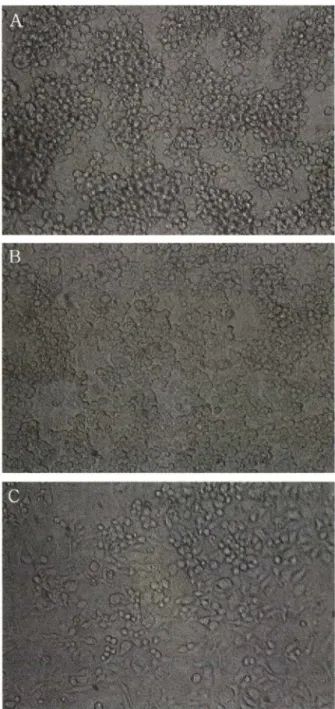
Fr. I로인한macrophages의활성화 억제를현미경 하에서 관 찰하였을 때,DPBS로만처리한 경우에는 형태변화가 없으나 D a y s
— • CFA/ GH 415-untreated mice
•ᅳoᅳ CFA/GH 415-treated mice ᅳ▼ᅳ DPBS/DPBS-received mice
Fig. 2 - The GH 415 has anti-inflammatory effect on CFA-induced inflammation. The GH 415 (2 mg/dose) by i.p-route reduced the footpad-edema of mice that had inflammation due to CFA injection to the footpad. The footpad-edema between GH 415 treated and GH 415 untreated mice groups declined ranging from approximately approximately 21% to 51% during the 35-day observation period. Dif
ference between the two groups was significant (P<0.05).
Control mice groups that were given only DPBS main
tained thickness of footpad when the CFA was not injected.
Repeated experiments showed the similar results. Thickness of the edema was measured by a dial gauger in arbitrary unit (AU). Each group contained five mice. Bar indicates SE.
ginkgolide B를사용한표준검량선 (standard curve)과비교한결 과 93%의순도가확인되었다. 이결과는 Fr. I에화학구조모핵 이동일한 ginkgolides 그룹(Fig. 1)이함유되어 있음을알수있 었다.
GH 415의 항
C. albicans
관절염성 효과먼저 ginkgolides를함유하고있는 EGb 761의수용성성분인 GH 415의항염중효과를조사하였다. BALB/c 생쥐의 뒷발바닥 에 CFA를 25, 50,100너 CFA/mouse 용량으로 투여하고측정 한기초실험결과 50(j//mouse에서적절한족부종이 형성되었다. 이적정용량인 50 바 CFA/mouse을투여 받은생쥐의 족부종에 대하여 GH 415의항염중효과를조사하였을 때, GH 415을투 여받은생쥐는 GH 415 대신에 DPBS를투여 받은 대조군에 비해서족부종이감소되었으며 7회투여후경우에는 51% 이상 억제되어 GH 415가 CFA로유발된 일반염증에효과가 있음을 알수있었다(^<0.05) (Fig. 2). 또한, C. albicans cell wall로유
발된관절염성 염증에 대한 GH 415의항염효과검사결과에서
도 GH 415를투여받은생쥐의부종억제율은 3회투여후 28%,
(rw)FdldJᄋS
.S1PMS
(n v
)
pedloo
l-
uJOSUS3MS
144 이순현 . 이주희 ■ 한용문
~• ᅳ C W /C F A /F r.I-u n tre a te d m ice
~ O— C W /C F A /F r . I-tre a te d m ic e
ᅳ▼ᅳ C W /C F A /In d o m e th a c in -tre a te d m ice Fig. 4 - The Fr. I is responsible for the anti-inflammatory activity to
the inflammation by candidal cell wall. The Fr. I reduced footpad-edema caused by CW mixed with CFA at 200
[ig/
dose which is 1/10 of GH 415 (2 mg/dose) as shown on Fig.
3. In addition, the reduction pattern displays in the almost same fashion as with indomethacin (60 p.g/dose) that was used as a positive control. These reductions as compared to footpad-edema from untreated mice groups were significant (P<0.05). Thickness of the edema was measured by a dial gauger in arbitrary unit (AU). Each group contained five mice. Bar indicates SE.
(Fig. 5A) LPS만으로 처리된macrophages는활성화되어 위족 (pseudopod)이형성되었음을알수있다(Fig. 5B). 이에비해 Fr.I
와LPS로처리된 macrophages는활성화가억제되어 위족형성
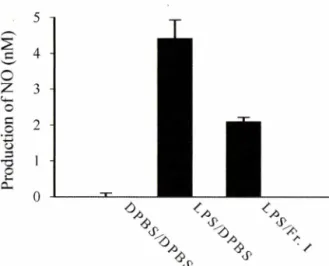
은거의 관찰되지 않았으며,macrophages의크기가음성대조군 (Fig. 5A)에비하여다소커진것을알수있었다(Fig. 5C). 각군 의상등액내의 N O 유무를측정한결과 LPS로활성화된양성대 조군의 macrophages서 생성된N O 양에비하여 LPS와Fr. I로
처리된macrophages에서는대략57%의NO가억제되었음을알
수있었다(Fig. 6).
고 찰
은행잎추출물인 E G b 761의수용성 성분(G H 415)을분리하
여H PLC 방법으로분석했을 때이성분은terpene계물질인
ginkgolides와flavonoid 성분을 함유하고 있었다. G H 415는
CFA로유발된생쥐의일반적족부종에 대하여 항염증효과가있
었으며 C. albicans cell wall과CFA 혼합물질로유발된Candida 관절염 동물모델에서도 항염증효과가 검색되었다. 이효과가 terpene 성분에의한것인지를조사하기 위해서 G H 415를size exclusion chromatography로분획된 terpene 성분을함유한Fr.
I의항염증효과를조사하였을때Fr. I도항Candida 관절염효
Fig. 5 - Microscopical analysis displays that the Fr. I suppresses activation of the LPS-treated macrophages. Macrophages that received diluent (DPBS) only show round shape (A), whereas macrophages treated with LPS (lipopolysaccharide) only demonstrate pseudopod formation around them (B).
However, morphology of LPS-treated macrophages in the presence of Fr. I was mostly maintained their round shape although their size appears to be slightly bigger (C) than the DPBS-received macrophages (A). These results seems to be due to the suppression of activation of the macrophage by the Fr. I.
과가있었다. 이항관절염효과는 indom ethacin과유사한형태
(pattern)로부종을감소시키는것으로관찰되었다. 이항염증효
과의작용기전검색에서 Ginkgo terpene의macrophages 활성화 억제를위족형성 감소등으로알수 있었으며,이러한활성억제
D v )PEdoᄋJJO
&U0 S 3 M
S
;
Ginkgo Terpene 의 Candida albicans 로 인한 관절염에 대한 치료효과 145
Fig. 6 - The Fr. I blocks NO production from the LPS-treated macrophages. To confirm suppression of macrophages activation by the Fr. I, NO production from the each group of the macrophages were measured by the Griess test.
Results showed that NO production from the LPS alone- received macrophages (LPS/DPBS) was around 4.9 nM, whereas NO production from LPS and Fr. I-treated macrophages (LPS/Fr. I) was 2.1 nM. Macrophages given DPBS only showed little background. These data indicate that the Fr. I presence blocked approximately 57% of NO production (P<0.05). These values were averages of triplicate repeated experiments. Bar indicates SE.
로인한 NO 생성이 감소됨을 Griess 시험법으로확인되었다. 이 결과를고찰할때, 염증이 유발되면 macrophages가그염증부위 로유입되어 부종이형성되고,25’26) 자극된 macrophage에서 NO 가 생성 분비되어서 주변의 세포나 조직을 파괴하기 때문에 통승이 야기되는데,27) Ginkgo terpene은 염증부위에 유입된 macrophages에서 NO 생성을억제하여 C. albicansS. 인한관절 성염증을감소하는것으로 사료된다. 연구결과를종합하면,천 연물에서 획득되는 Ginkgo terpene 성분이 C. albicansSL 기인 되는관절염치료에 효과가있음이 규명되었으며, 이성분은부
작용으로문제가보고되는 기존의 Candida入효관절염 치료제를
대신할수있는 가능성이고려된다. 본연구실에서는이 결과를 바탕으로하여효과적인성분전달을위해 terpene을 liposome에 포접시켜 항염증효과를증대시키는연구가현재진행중에있다.
감사의 말씀
본연구는한국과학재단의 여자대학교연구기반확충사업 연 구비지원에 의해수행되었습니다.
문 헌
1) Cuende, E., Barbadillo, C. E., Mazzucchelli, R., Isasi, C.,
Trujillo, A. and Andreu, J. L. : Candida arthritis in adult patients who are not intravenous drug addicts: report of three cases and review of the literature.
Semin Arthritis Rheum.
22,224 (1993).
2) Lerch, K., Kalteis, T., Schubert, T., Lehn, N. and Grifka, J. : Prosthetic joint infection with osteomyelitis due to
Candida albicans. Mycoses.
46, 462 (2003).3) Azaceta, G .,Olave. T., de los Martires, L. D .,Delgado, C., Gutierrez, M . and Palomera, L. : Successful lipid-complexed amphotericin B treatment of
Candida
arthritis in a lymphoma patient.Rev. Rhum. Engl.
66,434 (1999).4) Choi, I. S., Kim, S. J., Kim, B. Y , Joh, J. W , Kim, Y. I., Lee, S.
K., Huh, W. S., Oh, H. Y.,Kim , D. J., Kim , Y. G .,Kim, M . K .,
Ko, Y. H. and Lee, B. B. : Candida polyarthritis in a renal transplant patient: case report of a patient successfully treated with amphotericin B.
Transplant Proc.
32,1963 (2000).5) Turgut, B.,Vural, 0 .,Demir, M . and Kaldir,M . : Candida arthritis in a patient with chronic myelogenous leukemia (CML) in blastic transformation, unresponsive to fluconazole, but treated effectively with liposomal amphotericin B.
Ann.
Hematol.
81,529 (2002).6) Lee, D. M . and Weinblatt, M . E .: Rheumatoid arthritis.
Lancrt.
358,903 (2001).
7) Felson, D. T., Anderson, J. J. and Meena, R. E : Use of short
term efficacy/toxicity tradeoffs to select second-line drugs in rheumatoid arthritis: a metaanalysis of published clinical trials.
Arthritis Rheum.
35,1117 (1992).8) Myers, L. K .,Kang, A. H., Postlethwaite, A. E., Rosloniec, E.
E, Morham, S. G.,Shlopov, B. V, Goorha, S. and Ballou, L. R. : The genetic ablation of cyclooxygenase 2 prevents the development of autoimmune arthritis.
Arthritis Rheum.
43,2687 (2000).
9) Bauer, H. and Marker-Hermann, E. : Therapy with non
steroidal anti-inflammatory drugs.
Orthopade.
32,1088 (2003).10) Beek, T. A. : Chemical analysis
of Ginkgo biloba
leaves and extracts. /.Chromato. A
967,21 (2002).11) Maelennan, K. M., Darlington, C. L. and Smith, R E : The CNS effects of
Ginkgo biloba
extracts and ginkgolide B.Prog.
Neurobiol.
67,235 (2002).12) DeFeudis, E Y. :
Ginkgo biloba
Extract (EGb 761) : Pharmacological activities and Clinical Application.Elesevier
97,135 (1991).
13) Kobuchi, H., Droy-Lefaix, J., Christen, Y. and Packer, L. :
Ginkgo biloba
extract (EGb 761) inhibitory effect on nitric oxide production in the machrophage cell line Raw 264.7.Biochem. Pharmacol.
53, 897 (1997).14) Logani, S., Chen, M . C.,Tran, T, Le, T. and Raffa, R. B. : Action of
Ginkgo biloba
related to potential for the treatment of conditions involving cerebral hypoxia.Life Sciences
1389ᄋ
(
s c )ᄋ
z J o
UOJPtl
-OJo a.
146 이순현 . 이주희 . 한용문
(2000).
15) Hu, L.,Chen, Z., Cheng, X. and Xie, Y. : Chemistry of ginkgolides: structure-activity relationship as PAF antagonists.
Pure. Appl Chem.
71, 1153 (1999).16) Nishida, S. and Satoh, H. : Comparative vasodilating action among terpenoids and flavonoids contained in
Ginkgo biloba
extract.
Clinica. Chimica Acta
339,129 (2004).17) Braquet, R and Hosford, D. : Ethnopharmacology and the development of natural PAF antagonists as therapeutic agents.
J. Ethnopharmacol.
32, 135 (1991).18) Zhao, H. W. and Li, X. Y. : Ginkgolide A, B, and huperzine A inhibit nitric oxide-induced neprotoxicity.
Int. Immunophar- macol.
2, 1551 (2002).19) Han, Y. and Cutler, J. E. : Antibody response that protects against disseminated candidiasis.
Infect Immun.
63, 2714(1995).
20) Han, Y., Kozel, T. R., Zhang, M. X., MacGill, R. S., Carroll, M . C. and Cutler, J. E .: Complement is essential for protection by an IgM and an IgG3 monoclonal antibody against experimental, hematogenously disseminated candidiasis. /.
Immunol.
167,1550 (2001).
21) Han, Y., Ulrich, M . A. and Cutler, J. E. : Candida albicans mannan extract-protein conjugates induce a protective immune
response against experimental candidiasis. /•
Infect. Dis.
179,1477 (1999).
22) Lee, S. and Han, Y. : Isolation and analysis of ginkgolides compound from EGb 761.
Dongduk Pharm. Res.
7, 39 (2003).23) Han, Y., Jin, B. S., Ko, S. K. and Lee, J. H. : Immunoactivity of ginsenosides Re and R g l enhances resistance of mice against experimental disseminated candidiasis.
Nat. Prod. Sci.
10, 134 (2004).24) Li, W and Fitzloff, J. E : Simultaneous determination of terpene lactones and flavonoid aglycones in
Ginkgo biloba
by high- performance liquid chromatography with evaporative light scattering detection.J. Pharm. Biomed. Anal.
30,67 (2002).25) Lotito, A. R, Muscara, M . N.,Kiss, M . H., Teixeira, S. A., Novaes, G. S., Laurindo, I. M., Silva, C. A. and Mellᄋ,S. B. : Nitric oxide-derived species in synovial fluid from patients with juvenile idiopathic arthritis.
Rheumatol.
31,992 (2004).26) Nissler,K., Pohlers, D., Huckel, M ., Simon, J., Brauer, R. and Kinne, R. W. : Anti-CD4 monoclonal antibody treatment in acute and early chronic antigen induced arthritis: influence on macrophage activation.
Ann. Rheum. Dis.
63,1470 (2004).27) Kinne, R. W., Brauer, R.,Stuhlmuller, B.,Palombo-kinne, E.
and Burmester,G.-R. : Macrophages in rheumatoid arthritis.