Article http://dx.doi.org/10.14478/ace.2016.1052
Fluorine이 도입된 Quinoxaline과 Fluorene 골격을 가진 고분자의 합성 및 특성분석
송수희⋅최효일*⋅신인수⋅박성수*⋅이근대*⋅박성흠⋅진영읍*,†
부경대학교 물리학과, *부경대학교 공업화학과
(2016년 5월 31일 접수, 2016년 7월 5일 심사, 2016년 8월 22일 채택)
Synthesis and Photovoltaic Properties of Copolymers with Fluorinated Quinoxaline and Fluorene Moiety
Suhee Song, Hyo Il Choi*, In Soo Shin, Seong Soo Park*, Gun Dae Lee*, Sung Heum Park, and Youngeup Jin*,†
Department of Physics, Pukyong National University, Busan 48513 Korea
*Department of Industrial Chemistry, Pukyong National University, Busan 48513, Korea (Received May 31, 2016; Revised July 5, 2016; Accepted August 22, 2016)
초 록
새로운 전자 받개인 6,7-difluoro-2,3-dihexylquinoxaline을 이용하여 유기 태양 전지형 고분자를 개발하였다. Fluorene과 6,7-difluoro-2,3-dihexylquinoxaline으로 Suzuki polymerization방법을 이용하여 낮은 HOMO 에너지를 가지는 PFDTQxF 고분자를 합성하였다. 필름상태의 PFDTQxF은 368과 493 nm에서 두 개의 흡광도를 보였다. PFDTQxF의 HOMO와 LUMO 에너지는 각각 -5.55와 -3.91 eV을 나타내었다. PFDTQxF의 태양전지 소자는 0.47 V의 VOC와 4.48 mA/cm2의 JSC와 0.32의 FF를 가지고 있어 0.78%의 에너지 효율을 나타내었다.
Abstract
New electron deficient moiety, 6,7-difluoro-2,3-dihexylquinoxaline, was developed for the push-pull type copolymer for organ- ic photovoltaics (OPVs). The PFDTQxF with lower HOMO energy level was synthesized using fluorene and 6,7-di- fluoro-2,3-dihexylquinoxaline by Suzuki polymerization. The PFDTQxF thin film shows two absorption peaks at 368 and 493 nm. The HOMO and LUMO energy levels of PFDTQxF are calculated -5.55 and -3.91 eV, respectively. The device compris- ing PFDTQxF showed a VOC value of 0.47 V, a JSC value of 4.48 mA/cm2, and a FF of 0.32, which yielded PCE of 0.78%, under the illumination of AM 1.5.
Keywords: polymer, quinoxaline, fluorene, fluorine atom, solar cells
1. Introduction
1)
Research on organic photovoltaics (OPVs) has attracted intensive re- search in industry caused by lightweight plastic substrates, flexible, and low-cost manufacturing[1-3]. The bulk-heterojunction (BHJ) polymer solar cell based on blend of PCBM as the electron acceptor and con- jugated polymer as the electron acceptor have been the most successful device architecture for OPVs[4]. Polymer solar cells have been re- searched intensively into the syntheses of conjugated polymers with low band gap for more light harvesting of influx photons in matching the solar spectrum[1]. The lower HOMO energy level of conjugated polymer is very significant to leak a high open circuit voltage (VOC)
† Corresponding Author: Pukyong National University, Department of Industrial Chemistry, Busan 48513, Korea Tel: +82-51-629-6426 e-mail: [email protected]
pISSN: 1225-0112 eISSN: 2288-4505 @ 2016 The Korean Society of Industrial and Engineering Chemistry. All rights reserved.
of the polymer solar cell devices[5-8]. The introduction of electron withdrawing group into acceptor unit decreased HOMO energy level of conjugated polymer[9,10].
Research into low-bandgap conjugated polymers with quinoxaline units for OPVs has been recently attracting attention caused by the ro- bust electron-withdrawing ability of the quinoxaline[11]. D-A con- jugated polymer by combining with quinoxaline acceptor should be easily structurally deformed caused by high solubility[12]. The fluori- nated quinoxaline moiety is the efficacious acceptor units for OPVs due to the strong electron affinity which lead to a broad absorption, high hole mobility, and lower HOMO energy levels, which are sig- nificant factors for polymer solar cell[13-15].
In this paper, we present copolymer containing a new acceptor, di- fluoro-2,3-dihexylquinoxaline units, to show high open circuit voltage.
The introduction of fluorine atom into acceptor unit should decrease the HOMO energy level of the PFDTQxF to lead higher open circuit voltages. PFDTQxF was synthesized using 6,7-difluoro-2,3-dihexy-
Scheme 1. Synthetic route for the synthesis of the monomer and polymer.
lquinoxaline unit as electron acceptor and alkylated fluorene as electron donor by Suzuki coupling reaction with palladium catalyst. PFDTQxF exhibits good solubility, strong absorption and lower HOMO energy level. BHJ device was fabricated with PFDTQxF and PCBM with con- figuration of ITO/PEDOT : PSS/polymer : PC61BM/Al.
2. Experimental
General. All reagents were purchased from Aldrich or TCI, and used without further purification. Solvents were purified by normal proce- dure and handled under moisture-free atmosphere. 1H and 13C NMR spectra were recorded with a JNM ECP-400 (400 MHz, JEOL) spec- trometer and chemical shifts were recorded in ppm units with TMS as the internal standard. Flash column chromatography was performed with Merck silica gel 60 (particle size 230-400 mesh ASTM) with eth- yl acetate/hexane or methanol/methylene chloride gradients unless oth- erwise indicated. Analytical thin layer chromatography (TLC) was con- ducted using Merck 0.25 mm silica gel 60F pre-coated aluminum plates with fluorescent indicator UV254. High resolution mass spectra (HRMS) were recorded on a JEOL JMS-700 mass spectrometer under electron impact (EI) conditions. Molecular weight and polydispersity of the polymer were determined by gel permeation chromatography (GPC) analysis with a polystyrene standard calibration. The UV-vis ab- sorption spectra were recorded by a Varian 5E UV/VIS/NIR spectrophotometer. The cyclic voltammetry was performed with a sol- ution of tetrabutylammonium tetrafluoroborate (Bu4NBF4) (0.10 M) in acetonitrile at a scan rate of 100 mV/s at room temperature under ar- gon atmosphere. A platinum electrode (~0.05 cm2) coated with a thin polymer film was used as the working electrode. Pt wire and Ag/AgNO3 electrode were used as the counter electrode and reference electrode, respectively. The energy level of the Ag/AgNO3 reference electrode (calibrated by the Fc/Fc+ redox system) was 4.8 eV below the vacuum level.
Solar cells were fabricated on an indium tin oxide (ITO)-coated glass substrate with the following structure; ITO-coated glass substrate/
poly(3,4-ethylenedioxythiophene) : poly(stylenesulfonate) (PEDOT : PSS)/
polymer : PC71BM/Al. The ITO-coated glass substrate was first cleaned with detergent, ultrasonicated in acetone and isopropyl alcohol, and subsequently dried overnight in an oven. PEDOT : PSS (Baytron PH) was spin-casted from aqueous solution to form a film of 40nm thickness. The substrate was dried for 10 min at 140 ℃ in air and then transferred into a glove box to spin-cast the charge separation layer.
A solution containing a mixture of polymer : PC71BM in DCB solvent with concentration of 7 wt/mL% was then spin-casted on top of the PEDOT/PSS layer. The film was dried for 60 min at 70 ℃ in the glove box. The sample was heated at 80 ℃ for 10 min in air. Then, an aluminum (Al, 100 nm) electrode was deposited by thermal evapo- ration in a vacuum of about 5 × 10⁻⁷ Torr. Current density-voltage (J-V) characteristics of the devices were measured using a Keithley 236 Source Measure Unit. Solar cell performance was measure by us- ing an Air Mass 1.5 Global (AM 1.5 G) solar simulator with an irradi- ation intensity of 1000 W m-2. An aperture (12.7 mm2) was used on
top of the cell to eliminate extrinsic effects such as cross-talk, wave- guiding, shadow effects etc. The spectral mismatch factor was calcu- lated by comparison of solar simulator spectrum with AM 1.5 spec- trum at room temperature.
Polymerization of poly[2,7-(9,9-bis(2-ethylhexyl)-bis(4,4,5,5-tetramethyl- 1,3,2-dioxaborolan-2-yl)fluorene-alt-5,8-(6,7-difluoro-2,3-dihexyl-5,8- di(thiophen-2-yl) quinoxaline)] (PFDTQxF)[20].
Carefully purified 9,9-bis(2-ethylhexyl)-2,7-bis(4,4,5,5-tetramethyl- 1,3,2-dioxaborolan-2-yl)fluorene (7)[17] (540 mg, 0.84 mmol), 5,8-bis (5-bromothiophen-2-yl)-6,7-difluoro-2,3-dihexylquinoxaline (6)[16] (550 mg, 0.84 mmol), P(o-tolyl)3 (40 mol%) and Pd2(dba)3 (3 mol%) were dissolved in 5 mL of chlorobenzene. The mixture was refluxed with vigorous stirring for 2 days under argon atmosphere. After cooling to room temperature, the mixture was poured into methanol. The pre- cipitated material was recovered by filtration. The resulting solid mate- rial was reprecipitated using 100 mL of THF/1.0 L of methanol several times to remove residual amount of catalyst. The resulting polymer was soluble in THF, CHCl3, ODCB and toluene.
3. Results and Discussion
3.1. Synthesis and Characterization
The synthesis of the monomer and polymer are shown in Scheme 1. The monomers 6 and 7 were synthesized by reported method [16-17]. 5,8-Bis(5-bromothiophen-2-yl)-6,7-difluoro-2,3-dihexylquinoxa- line (6)[16], as electron-deficient moiety and 9,9-bis(2-ethylhexyl)- 2,7-bis(4,4,5,5-tetramethyl-1,3,2-dioxaborolan-2-yl)fluorene (7)[17], as
polymer Mna (g/mol) Mwa (g/mol) PDIa Tdb (℃) λmax (nm)
in solution in thin film
PFDTQxF 4000 5200 1.2 385 479 493
aMolecular weight (Mw) and polydispersity (PDI) of the polymers were determined by gel permeation chromatography (GPC) in THF using polystyrene standards.
bOnset decomposition temperature (5% weight loss) measured by TGA under N2.
Table 1. Polymerization Results, Thermal Property and Optical Property of Polymer
polymers optical band gapa (eV) HOMOb (eV) LUMOc (eV) Eoxd (V) Eredd (V) electrochemical band gape (eV)
PFDTQxF 2.16 -5.55 -3.91 0.75 -0.89 1.64
aOptical energy band gap was estimated from the onset wavelength of the optical absorption. bCalculated from the oxidation potentials. cCalculated from the reduction potentials.
dOnset oxidation and reduction potential measured by cyclic voltammetry. eCalculated from the Eox and Ered. Table 2. Electrochemical Potentials and Energy Levels of the Polymer
Figure 1. Thermogravimetric analysis of the polymer under N2.
Figure 2. UV-visible absorption spectra of polymer in chlorofrom solution and the solid state.
Figure 3. Electrochemical properties of polymer.
electron-rich moiety, were copolymerized according to Suzuki polymer- ization with Pd2(dba)3 as catalyst for 48 h to give target copolymer PFDTQxF.
The number-average molecular weight (Mn), weight-average molec- ular weight (Mw) and polydispersity index (PDI) of the synthesized polymer were determined by gel chromatography (GPC) using poly- styrene standards with chloroform as eluent and summarized in Table 1. PFDTQxF has Mw of 5200 with PDI of 1.2. The thermogravimetric analysis (TGA) of polymer is shown in Figure 1. The onset point of decomposition (Td) at about 385 ℃ was determined by the temperature of 5% weight loss under N2[18]. The good thermal stability of the pol- ymer is significant for OPV applications in order to prevent the de- formation of the morphology. The grass transition temperature (Tg) of
the polymer was not observed up to 250 ℃ in differential scanning calorimetry (DSC).
3.2. Photophysical Properties
The photophysical properties of the PFDTQxF were studied by UV-vis absorption in chloroform solution and thin film on quartz plate by spin-casting from ODCB solution as shown Figure 2. The photo- physical properties of the conjugated polymer are summarized in Table 1. The absorption peak of the polymer is observed at 368 nm, which correspond to the π-π* transition of conjugated polymer chain in solution. The broad absorption band at about 479 nm was attributed to the intramolecular charge transfer (ICT) interaction[19]. The thin film of PFDTQxF has two peaks at 368 and 493 nm, which was shifted to- ward the long wavelength area as compared with corresponding sol- ution state due to the intermolecular interaction from π- π stacking of polymer backbone.
3.3. Electrochemical Properties
The electrochemical properties of the synthesized polymer were de- termined by cyclic voltammetry using tetrabutylammonium tetra- fluoroborate in acetonitrile. The oxidation and reduction potentials are summarized in Table 2, and the cyclovoltammogram is shown in Figure 3. The highest occupied molecular orbital (HOMO) and lowest unoccupied molecular orbital (LUMO) energy level were obtained from formula (EHOMO = -([Eonset]ox + 4.8) eV) and (ELUMO = -([Eonset]red + 4.8)
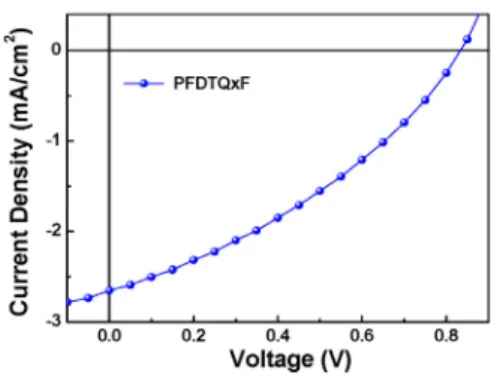
Figure 4. Current density-potential characteristics of the polymer solar cells under the illumination of AM 1.5, 100 mW/cm2.
eV), respectively. The onset potential was 0.75 eV for PFDTQxF. The corresponding HOMO energy level of PFDTQxF is calculated -5.55 eV. The reduction onset value of the PFDTQxF was calculated roughly to be -0.89 V. The corresponding LUMO energy level was determined at -3.91 eV. The electrochemical band gap was determined to be 1.64 eV. The optical band gap of the PFDTQxF was 2.14 eV, which was estimated using the absorption onset at about 574 nm in thin film. The optical band gap is higher than the electrochemical band gap measured by cyclic voltammetry.
3.4. Polymer Photovoltaic Properties
The photovoltaic performances of polymer were investigated in the device structure ITO/PEDOT : PSS (40 nm)/polymer : PC61BM (100 nm)/Al (100 nm), under illumination with AM 1.5G 100 mW/cm2. The current density-voltage (J-V) curve of the device based on PFDTQxF is displayed in Figure 4. BHJ device was produced by spin-coating of 2 % (w/v) ODCB solution of PFDTQxF and PC61BM. The device pre- pared from PFDTQxF with PC61BM (1 : 2) exhibited short-circuit cur- rent density (JSC) of 2.65 mA/cm2, open-circuit voltage (VOC) of 0.84 V, and fill factor (FF) of 0.35, giving a power conversion efficiency (PCE) of 0.78%. The higher VOC was attributed to deeper HOMO en- ergy level of PFDTQxF.
4. Conclusions
We have synthesized new conjugated polymer, PFDTQxF, contain- ing fluorene and 6,7-difluoro-2,3-dihexylquinoxaline units though the Suzuki polymerization with palladium catalyst. PFDTQxF had good solubility, thermal stability and lower HOMO energy level. The onset oxidation potential of the PFDTQxF was calculated roughly to be 0.75 V, which accorded to deeper HOMO energy level of -5.55 eV. The PCE of the photovoltaic device based on PFDTQxF showed 0.78%
with VOC of 0.47 V, JSC of 4.48 mA/cm2, and FF of 0.32, under the illumination of AM 1.5.
Acknowledgements
This work was supported by a Research Grant of Pukyong National University (2015 year).
References
1. H. Y. Chen, S. C. Yeh, C. T. Chen, and C. T. Chen, Comparison of thiophene- and selenophene-bridged donor-acceptor low band-gap copolymers used in bulk-heterojunction organic photovoltaics, J.
Mater. Chem., 22, 21549-21559 (2012).
2. S. Song, Y. Jin, S. H. Park, S. Cho, I. Kim, K. Lee, A. J. Heeger, and H. Suh, A low-bandgap alternating copolymer containing the dimethylbenzimidazole moiety, J. Mater. Chem., 20, 6517-6523 (2010).
3. F. C. Kreb, T. D. Nielsen, J. Fyenbo, M. Wadstrøm, and M. S.
Pedersen, Manufacture, integration and demonstration of polymer solar cells in a lamp for the “Lighting Africa” initiative, Energy Environ. Sci., 3, 512-525 (2010).
4. J. Y. Kim, K. Lee, N. E. Coates, D. Moses, T. Q. Nguyen, M.
Dante, and A. J. Heeger, Efficient tandem polymer solar cells fab- ricated by all-solution processing, Science, 317, 222-225 (2007).
5. M. C. Scharber, D. Muhlbacher, M. Koppe, P. Denk, C. Waldauf, A. J. Heeger, and C. J. Brabec, Design rules for donors in bulk-heterojunction solar cells-towards 10 % energy-conversion ef- ficiency, Adv. Mater., 18, 789-794 (2006).
6. N. Chakravarthi, K. Kranthiraja, M. Song, K. Gunasekar, P. Jeong, S. J. Moon, W. S. Shin, I. N. Kang, J. W. Lee, and S. H. Jin, New alkylselenyl substituted benzodithiophene-based solution-process- able 2D π-conjugated polymers for bulk heterojunction polymer solar cell applications, Sol. Energy Mater. Sol. Cells, 122, 136-145 (2014).
7. S. Xiao, H. Zhou, and W. You, Conjugated polymers of fused bi- thiophenes with enhanced π-electron delocalization for photo- voltaic applications, Macromolecules, 41, 5688-5696 (2008).
8. B. C. Thompson and J. M. J. Frechet, Polymer-fullerene composite solar cells, Angew. Chem., Int. Ed., 47, 58-77 (2008).
9. J. Ha, Y. J. Kim, J. Park, T. K. An, S. K. Kwon, C. E. Park, and Y. H. Kim, Thieno[3,4-c]pyrrole-4,6-dione-based small molecules for highly efficient solution-processed organic solar cells, Chem.
Asian J., 9, 1045-1053 (2014).
10. Y. Yang, R. Wu, X. Wang, X. Xu, Z. Li, K. Li, and Q. Peng, Isoindigo fluorination to enhance photovoltaic performance of do- nor-acceptor conjugated copolymers, Chem. Commun., 50, 439-441 (2014).
11. J. Hai, W. Yu, B. Zhao, Y. Li, L. Yin, E. Zhu, L. Bian, J. Zhang, H. Wu, and W. Tang, Design and synthesis of triazoloquinoxaline polymers with positioning alkyl or alkoxyl chains for organic pho- tovoltaics cells, Polym. Chem., 5, 1163-1172 (2014).
12. H. J. Song, D. H. Kim, E. J. Lee, and D. K. Moon, Conjugated polymers consisting of quinacridone and quinoxaline as donor ma- terials for organic photovoltaics: orientation and charge transfer properties of polymers formed by phenyl structures with a qui- noxaline derivative, J. Mater. Chem. A, 1, 6010-6020 (2013).
13. A. Iyer, J. Bjorgaard, T. Anderson, and M. E. Köse, Quinoxaline- based semiconducting polymers: effect of fluorination on the pho- tophysical, thermal, and charge transport properties, Macromolecules, 45, 6380-6389 (2012).
14. H. C. Chen, Y. H. Chen, C. C. Liu, Y. C. Chien, S. W. Chou, and P. T. Chou, Prominent short-circuit currents of fluorinated qui- noxaline-based copolymer solar cells with a power conversion effi- ciency of 8.0%, Chem. Mater., 24, 4766-4772 (2012).
15. H. C. Chen, Y. H. Chen, C. H. Liu, Y. H. Hsu, Y. C. Chien, W.
T. Chuang, C. Y. Cheng, C. L. Liu, S. W. Chou, S. H. Tung, and P. T. Chou, Fluorinated thienyl-quinoxaline-based D-π-A-type co- polymer toward efficient polymer solar cells: synthesis, character- ization, and photovoltaic properties, Polym. Chem., 4, 3411-3418 (2013).
16. S. Song, H. I. Choi, I. S. Shin, H. Suh, M. H. Hyun, G. D. Lee, S. S. Park, S. H. Park, and Y. Jin, Synthesis and photovoltaic properties of quinoxaline-based semiconducting polymers with flu- oro atoms, Bull. Korean Chem. Soc., 35, 2245-2250 (2014).
17. W. Lee, H. Cha, Y. J. Kim, J. E. Jeong, S. Hwang, C. E. Park, and H. Y. Woo, Amorphous thieno[3,2-b]thiophene and benzothia- diazole based copolymers for organic photovoltaics, ACS Appl.
Mater. Interfaces, 6, 20510-20518 (2014).
18. K. Cao, Z. Wu, S. Li, B. Sun, G. Zhang, and Q. Zhang, A low bandgap polymer based on isoindigo and bis(dialkylth- ienyl)benzodithiophene for organic photovoltaic applications, J.
Polym. Sci. Polym. Chem., 51, 94-100 (2013).
19. S. Cho, J. H. Seo, S. H. Kim, S. Song, Y. Jin, K. Lee, H. Suh, and A. J. Heeger, Effect of substituted side chain on donor-accept- or conjugated copolymers, Appl. Phys. Lett., 93, 263301 (2008).
20. S. Song, H. I. Choi, I. S. Shin, J. Lee, M. H. Hyun, H. Suh, S.
S. Park, S. H. Park, and Y. Jin, Synthesis and properties of co- polymer with carbazole and F-quinoxaline units for OPVs, Mol.
Cryst. Liquid Cryst., 620, 100-106 (2015).