ARTICLE doi:10.1038/nature13480 OPEN
Comprehensive molecular characterization of gastric adenocarcinoma
The Cancer Genome Atlas Research Network*
Gastric cancer is a leading cause of cancer deaths, but analysis of its molecular and clinical characteristics has been complicated by histological and aetiological heterogeneity. Here we describe a comprehensive molecular evaluation of 295 primary gastric adenocarcinomas as part of The Cancer Genome Atlas (TCGA) project. We propose a molecular classification dividing gastric cancer into four subtypes: tumours positive for Epstein–Barr virus, which display recur- rent PIK3CA mutations, extreme DNA hypermethylation, and amplification of JAK2, CD274 (also known as PD-L1) and PDCD1LG2 (also known as PD-L2); microsatellite unstable tumours, which show elevated mutation rates, including muta- tions of genes encoding targetable oncogenic signalling proteins; genomically stable tumours, which are enriched for the diffuse histological variant and mutations of RHOA or fusions involving RHO-family GTPase-activating proteins; and tumours with chromosomal instability, which show marked aneuploidy and focal amplification of receptor tyrosine kinases. Identification of these subtypes provides a roadmap for patient stratification and trials of targeted therapies.
Gastric cancer was the world’s third leading cause of cancer mortality in 2012, responsible for 723,000 deaths
1. The vast majority of gastric cancers are adenocarcinomas, which can be further subdivided into intestinal and diffuse types according to the Lauren classification
2. An alternative system, proposed by the World Health Organization, divides gastric cancer into papillary, tubular, mucinous (colloid) and poorly co- hesive carcinomas
3. These classification systems have little clinical util- ity, making the development of robust classifiers that can guide patient therapy an urgent priority.
The majority of gastric cancers are associated with infectious agents, including the bacterium Helicobacter pylori
4and Epstein–Barr virus (EBV). The distribution of histological subtypes of gastric cancer and the frequencies of H. pylori and EBV associated gastric cancer vary across the globe
5. A small minority of gastric cancer cases are associated with germline mutation in E-cadherin (CDH1)
6or mismatch repair genes
7(Lynch syndrome), whereas sporadic mismatch repair-deficient gast- ric cancers have epigenetic silencing of MLH1 in the context of a CpG island methylator phenotype (CIMP)
8. Molecular profiling of gastric cancer has been performed using gene expression or DNA sequencing
9–12, but has not led to a clear biologic classification scheme. The goals of this study by The Cancer Genome Atlas (TCGA) were to develop a robust molecular classification of gastric cancer and to identify dysregulated pathways and candidate drivers of distinct classes of gastric cancer.
Sample set and molecular classification
We obtained gastric adenocarcinoma primary tumour tissue (fresh fro- zen) from 295 patients not treated with prior chemotherapy or radio- therapy (Supplementary Methods S1). All patients provided informed consent, and local Institutional Review Boards approved tissue collection.
We used germline DNA from blood or non-malignant gastric mucosa as a reference for detecting somatic alterations. Non-malignant gastric samples were also collected for DNA methylation (n 5 27) and expres- sion (n 5 29) analyses. We characterized samples using six molecular platforms (Supplementary Methods S2–S7): array-based somatic copy number analysis, whole-exome sequencing, array-based DNA methy- lation profiling, messenger RNA sequencing, microRNA (miRNA) se- quencing and reverse-phase protein array (RPPA), with 77% of the
tumours tested by all six platforms. Microsatellite instability (MSI) test- ing was performed on all tumour DNA, and low-pass (,63 coverage) whole genome sequencing on 107 tumour/germline pairs.
To define molecular subgroups of gastric cancer we first performed unsupervised clustering on data from each molecular platform (Sup- plementary Methods S2–S7) and integrated these results, yielding four groups (Supplementary Methods S10.2). The first group of tumours was significantly enriched for high EBV burden (P 5 1.5 3 10
218) and showed extensive DNA promoter hypermethylation. A second group was enriched for MSI (P 5 2.1 3 10
232) and showed elevated mutation rates and hypermethylation (including hypermethylation at the MLH1 promoter). The remaining two groups were distinguished by the pres- ence or absence of extensive somatic copy-number aberrations (SCNAs).
As an alternative means to define distinct gastric cancer subgroups, we performed integrative clustering of multiple data types using iCluster
13(Supplementary Methods S10.3). This analysis again indicated that EBV, MSI and the level of SCNAs characterize distinct subgroups (Supplemen- tary Fig. 10.3). Based upon these results from analysis of all molecular platforms, we created a decision tree to categorize the 295 gastric can- cer samples into four subtypes (Fig. 1a, b) using an approach that could more readily be applied to gastric cancer tumours in clinical care. Tu- mours were first categorized by EBV-positivity (9%), then by MSI-high status, hereafter called MSI (22%), and the remaining tumours were distinguished by degree of aneuploidy into those termed genomically stable (20%) or those exhibiting chromosomal instability (CIN; 50%).
Evaluation of the clinical and histological characteristics of these molecular subtypes revealed enrichment of the diffuse histological sub- type in the genomically stable group (40/55 5 73%, P 5 7.5 3 10
217) (Fig. 1c), an association not attributable to reduced SCNA detection in low purity tumours (Supplementary Fig. 2.8). Each subtype was found throughout the stomach, but CIN tumours showed elevated frequency in the gastroesophageal junction/cardia (65%, P 5 0.012), whereas most EBV-positive tumours were present in the gastric fundus or body (62%, P 5 0.03). Genomically stable tumours were diagnosed at an earlier age (median age 59 years, P 5 4 3 10
27), whereas MSI tumours were di- agnosed at relatively older ages (median 72 years, P 5 5 3 10
25). MSI patients tended to be female (56%, P 5 0.001), but most EBV-positive
*A list of authors and affiliations appears at the end of the paper.
cases were male (81%, P 5 0.037), as previously reported
14. We did not observe any systematic differences in distribution of subtypes between patients of East Asian and Western origin (Supplementary Methods S1.8). Initial outcome data from this cohort did not reveal survival dif- ferences between the four subgroups (Supplementary Information S1.7).
EBV-associated DNA hypermethylation
EBV is found within malignant epithelial cells in 9% of gastric cancers
14. EBV status was determined using mRNA, miRNA, exome and whole- genome sequencing, yielding highly concordant results (Supplemen- tary Fig. 9.7). By contrast, we detected only sporadic evidence of H.
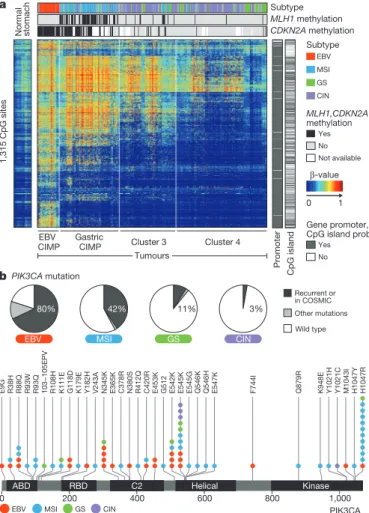
pylori, which may reflect the decline of bacterial counts accompanying the progression from chronic gastritis to subsequent carcinoma, as well as technical loss of luminal bacteria during specimen processing. Unsu- pervised clustering of CpG methylation performed on unpaired tumour samples revealed that all EBV-positive tumours clustered together and exhibited extreme CIMP, distinct from that in the MSI subtype
8, consis- tent with prior reports
15(Fig. 2a). Differences between the EBV-CIMP and MSI-associated gastric-CIMP methylation profiles of tumours mirrored differences between these groups in their spectra of mutations (Fig. 1a) and gene expression (Supplementary Fig. 10.6a). EBV-positive tumours had a higher prevalence of DNA hypermethylation than any cancers reported by TCGA (Supplementary Fig. 4.6). All EBV-positive tumours assayed displayed CDKN2A (p16
INK4A) promoter hypermethylation, but lacked the MLH1 hypermethylation characteristic of MSI-associated CIMP
16. Genes with promoter hypermethylation most differentially silenced in EBV-positive gastric cancer are shown in Supplementary Table 4.3.
We observed strong predilection for PIK3CA mutation in EBV- positive gastric cancer as suggested by prior reports
17,18, with non-silent
PIK3CA mutations found in 80% of this subgroup (P 5 9 3 10
212), including 68% of cases with mutations at sites recurrent in this data set or in the COSMIC repository. In contrast, 3 to 42% of tumours in the other subtypes displayed PIK3CA mutations. PI(3)-kinase inhibition therefore warrants evaluation in EBV-positive gastric cancer. PIK3CA mutations were more dispersed in EBV-positive cancers, but localized in the kinase domain (exon 20) in EBV-negative cancers (Fig. 2b). The most highly transcribed EBV viral mRNAs and miRNAs fell within the BamH1A region of the viral genome (Supplementary Fig. 9.8) and showed similar expression patterns across tumours, as reported separately
19.
Somatic genomic alterations
To identify recurrently mutated genes, we analysed the 215 tumours with mutation rates below 11.4 mutations per megabase (Mb) (none of which were MSI-positive) separately from the 74 ‘hypermutated’
tumours. Within the hypermutated tumours, we excluded from analysis 11 cases with a distinctly higher mutational burden above 67.7 mutations per Mb (including one tumour with an inactivating POLE mutation
20,21) (Supplementary Information S3.2–3.3), because their large numbers of mutations unduly influence analysis. We used the MutSigCV
22tool to define recurrent mutations in the 63 remaining hypermutated tumours by first evaluating only base substitution mutations, identifying 10 sig- nificantly mutated genes, including TP53, KRAS, ARID1A, PIK3CA, ERBB3, PTEN and HLA-B (Supplementary Table 3.5). We found ERBB3 mutations in 16 of 63 tumours, with 13 of these tumours having muta- tions at recurrent sites or sites reported in COSMIC. MutSigCV analysis including insertions/deletions expanded the list of statistically signifi- cant mutated genes to 37, including RNF43, B2M and NF1 (Supplemen- tary Fig. 3.9). Similarly, HotNet analysis of genes mutated within MSI tumours revealed common alterations in major histocompatibility
Age at initial diagnosis
80 70 60
40 90
Males (%) 50
75
50
25 100
0
Number of samples
60
30
0 90 120
GE-junction cardia
Fundus body
Antrum pylorus
diffuse (%)
75
50
25 100
0
EBV MSI GS CIN
CIN (chrom instability) EBV
(EBV-CIMP) EBV
positive
MSI (hypermutated)
GS (genomically stable)
MSI hig h
SCNA high cluster
295
269
205 26
64
58 147
b
c
227 tumours Subtype
Tumour purity TP53 mut.
SCNA high Diffuse MLH1 silencing MSI high CDKN2A silencing PIK3CA mut.
EBV positive 100 50 10 5
Mutations per Mb 1
Chr 1
Chr 22
Copy numberDNA methylationmRNAmicroRNAProtein
EBV MSI GS CIN Tumour purity
Low High Not available
Molecular/clinical features Yes No Not available
Gain
Loss
High
Low
High
Low
High
Low
High
Low
a
Lauren classification
EBV MSI GS CIN EBV MSI GS CIN
Figure 1 | Molecular subtypes of gastric cancer. a, Gastric cancer cases are divided into subtypes: Epstein–Barr virus (EBV)-positive (red), microsatellite instability (MSI, blue), genomically stable (GS, green) and chromosomal instability (CIN, light purple) and ordered by mutation rate. Clinical (top) and molecular data (top and bottom) from 227 tumours profiled with all six platforms are depicted. b, A flowchart outlines how tumours were classified
into molecular subtypes. c, Differences in clinical and histological
characteristics among subtypes with subtypes coloured as in a, b. The plot
of patient age at initial diagnosis shows the median, 25th and 75th percentile
values (horizontal bar, bottom and top bounds of the box), and the highest and
lowest values within 1.5 times the interquartile range (top and bottom whiskers,
respectively). GE, gastroesophageal.
complex class I genes, including B2M and HLA-B (Supplementary Fig.
11.5–11.7). B2M mutations in colorectal cancers and melanoma result in loss of expression of HLA class 1 complexes
23, suggesting these events benefit hypermutated tumours by reducing antigen presentation to the immune system.
Through MutSigCV analysis of the 215 non-hypermutated tumours, we identified 25 significantly mutated genes (Fig. 3). This gene list again included TP53, ARID1A, KRAS, PIK3CA and RNF43, but also genes in the b-catenin pathway (APC and CTNNB1), the TGF-b pathway (SMAD4 and SMAD2), and RASA1, a negative regulator of RAS. ERBB2, a therapeutic target, was significantly mutated, with 10 of 15 mutations occurring at known hotspots; four cases had the S310F ERBB2 muta- tion that is activating and drug-sensitive
24.
In addition to PIK3CA mutations, EBV-positive tumours had fre- quent ARID1A (55%) and BCOR (23%) mutations and only rare TP53 mutations. BCOR, encoding an anti-apoptotic protein, is also mutated in leukaemia
25and medulloblastoma
26. Among the CIN tumours, we ob- served TP53 mutations in 71% of tumours. CDH1 somatic mutations were enriched in the genomically stable subtype (37% of cases). CDH1 germline mutations underlie hereditary diffuse gastric cancer (HDGC).
However, germline analysis revealed only two CDH1 polymorphisms, neither of which is known to be pathogenic. As in the EBV-subtype, in- activating ARID1A mutations were prevalent in the genomically stable
subtype. We identified mutations of RHOA almost exclusively in gen- omically stable tumours, as discussed below.
We analysed the patterns of base changes within gastric cancer tu- mours and noted elevated rates of C to T transitions at CpG dinucleo- tides. We observed an elevated rate of A to C transversions at the 39 adenine of AA dinucleotides, especially at AAG trinucleotides, as reported in oesophageal adenocarcinoma
27. The A to C transversions were prom- inent in CIN, EBV and genomically stable, but as previously observed
27, not in MSI tumours (Supplementary Fig. 3.10).
We identified RHOA mutation in 16 cases, and these were enriched in the genomically stable subtype (15% of genomically stable cases, P 5 0.0039). RHOA, when in the active GTP-bound form, acts through a variety of effectors, including ROCK1, mDIA and Protein Kinase N, to control actin-myosin-dependent cell contractility and cellular motility
28,29and to activate STAT3 to promote tumorigenesis
30,31. RHOA mutations were clustered in two adjacent amino-terminal regions that are pre- dicted to be at the interface of RHOA with ROCK1 and other effectors (Fig. 4a, b). RHOA mutations were not at sites analogous to oncogenic mutations in RAS-family GTPases. Although one case harboured a codon 17 mutation, we did not identify the dominant-negative G17V mutations noted in T-cell neoplasms
32,33. Rather, the mutations found in this study may act to modulate signalling downstream of RHOA.
Biochemical studies found that the RHOA Y42C mutation attenuated activation of Protein Kinase N, without abrogated activation of mDia or ROCK1
34. RHOA Y42, mutated in five tumours, corresponds to Y40 on HRAS, a residue which when mutated selectively reduces HRAS ac- tivation of RAF, but not other RAS effectors
35. Given the role of RHOA in cell motility, modulation of RHOA may contribute to the disparate growth patterns and lack of cellular cohesion that are hallmarks of dif- fuse tumours.
Dysregulated RHO signalling was further implicated by the discov- ery of recurrent structural genomic alterations. Whole genome sequenc- ing of 107 tumours revealed 5,696 structural rearrangements, including 74 predicted to produce in-frame gene fusions (Supplementary Infor- mation S3.7–3.8). De novo assembly of mRNA sequencing data confirmed 170 structural rearrangements (Supplementary Information S5.4a), in- cluding two cases with an interchromosomal translocation between CLDN18 and ARHGAP26 (GRAF). ARHGAP26 is a GTPase-activating protein (GAP) that facilitates conversion of RHO GTPases to the GDP state and has been implicated in enhancing cellular motility
34. CLDN18
GS
EBV MSI CIN PIK3CA
PIK3CA mutation
Recurrent or in COSMIC
Wild type Other mutations
EBV 80%
MSI 42%
GS 11%
CIN 3%
0 200 400 600 800 1,000
E9G R38H R88Q R93W R93Q 103−105EPV R108H K111E G118D K179E Y182H V243A N345K E365K C378R N380S R412Q C420R E453K G512 E542K E545K E545G Q546K Q546H E547K F744I Q879R K948E Y1021H Y1021C M1043I H1047Y H1047R
ABD RBD C2 Helical Kinase
CDKN2A methylation MLH1 methylation Subtype
1,315 CpG sites
EBV CIMP
Gastric
CIMP Cluster 3 Cluster 4
Tumours
CpG island
Promoter
Normal stomach
Yes
Not available No
Yes No MLH1,CDKN2A methylation
MSI GS EBV
CIN Subtype
0 1
β-value
a
b
Gene promoter, CpG island probe
Figure 2 | Molecular characteristics of EBV-positive gastric cancers. a, The heatmap represents unsupervised clustering of DNA methylation at CpG sites for 295 tumours into four clusters: EBV-CIMP (n 5 28), Gastric-CIMP (n 5 77), cluster 3 (n 5 73) and cluster 4 (n 5 117). Profiles for non-malignant gastric mucosa are to the left of the tumours. b, The proportion of tumours harbouring PIK3CA mutation in the molecular subtypes with mutations at sites noted recurrently in this data set or in the COSMIC database marked separately (top). Locations of PIK3CA mutations with the subtype of the sample with each mutation colour-coded (bottom).
b a
–log10(q value) 0
20 60
100 Syn Missense Splice site Nonsense 0.5 2.0
Frame shift In-frame indel Other non-syn
Syn Non-syn
EBV GS CIN
0 4 8 12
Mutations Mutations per Mb
4%
3%
1%
2%
2%
3%
3%
4%
2%
5%
4%
1%
3%
4%
3%
4%
7%
6%
6%
14%
6%
12%
8%
11%
50%
PTPRC ERBB2 EIF2C4 CNGA4 PLB1FAM46D RASA1 SOHLH2 SMAD2 MACF1 CTNNB1 ABCA10 RNF43 BNC2EYA4 BCORAPC MUC6KRAS ARID1A RHOAPIK3CA SMAD4 CDH1TP53
Figure 3 | Significantly mutated genes in non-hypermutated gastric cancer. a, Bars represent somatic mutation rate for the 215 samples with synonymous and non-synonymous mutation rates distinguished by colour.
b, Significantly mutated genes, identified by MutSigCV, are ranked by the
q value (right) with samples grouped by subtype. Mutation colour indicates the
class of mutation.
is a component of the tight junction adhesion structures
36. RNA sequenc- ing data from tumours without whole genome sequencing identified CLDN18–ARHGAP26 fusions in 9 additional tumours, with two more cases showing CLDN18 fusion to the homologous GAP encoded by ARHGAP6 totalling 13 cases with these rearrangements (Supplemen- tary Table 5.6).
The fusions linked exon 5 of CLDN18 to exon 2 (n 5 2) of ARHGAP6, to exon 10 (n 5 1), or to exon 12 (n 5 10) of ARHGAP26 (Fig. 4c). As these fusions occur downstream of the CLDN18 exon 5 stop codon, they appeared unlikely to enable translation of fusion proteins. How- ever, mRNA sequencing revealed a mature fusion transcript in which the ARHGAP26 or ARHGAP6 splice acceptor activates a cryptic splice site within exon 5 of CLDN18, before the stop codon, yielding an in- frame fusion predicted to maintain the transmembrane domains of CLDN18 while fusing a large segment of ARHGAP26 or ARHGAP6 to the cytoplasmic carboxy terminus of CLDN18. These chimaeric pro- teins retain the carboxy-terminal GAP domain of ARHGAP26/6, poten- tially affecting ARHGAP’s regulation of RHOA and/or cell motility.
Furthermore, these fusions may also disrupt wild-type CLDN18, im- pacting cellular adhesion. The CLDN18–ARHGAP fusions were mutu- ally exclusive with RHOA mutations and were enriched in genomically stable tumours (62%, P 5 10
23) (Fig. 4d). Within the genomically sta- ble subtype, 30% of cases had either RHOA or CLDN18–ARHGAP alterations. Evaluation of gene expression status in pathways putatively regulated by RHOA using the Paradigm-Shift algorithm predicted acti- vation of RHOA-driven pathways (Supplementary Fig. 11.4a–c), suggest- ing that these genomic aberrations contribute to the invasive phenotype of diffuse gastric cancer.
SCNA analysis using GISTIC identified 30 focal amplifications, 45 focal deletions, and chromosome arms subject to frequent alteration (Supplementary Figs 2.3–2.9). Focal amplifications targeted oncogenes such as ERBB2, CCNE1, KRAS, MYC, EGFR, CDK6, GATA4, GATA6 and ZNF217. Additionally, we saw amplification of the gene that encodes the gastric stem cell marker CD44 and a novel recurrent amplification at 9p24.1 at the locus containing JAK2, CD274 and PDCD1LG2. JAK2 encodes a receptor tyrosine kinase and potential therapeutic target.
CD274 and PDCD1LG2 encode PD-L1 and PD-L2, immunosuppressant proteins currently being evaluated as targets to augment anti-tumour immune response. Notably, these 9p amplifications were enriched in the EBV subgroup (15% of tumours), consistent with studies showing
elevated PD-L1 expression in EBV-positive lymphoid cancers
37,38. Eval- uation of mRNA revealed elevated expression of JAK2, PD-L1 and PD- L2 in amplified cases (Supplementary Fig. 2.10). More broadly, PD-L1/2 expression was elevated in EBV-positive tumours, suggesting that PD- L1/2 antagonists and JAK2 inhibitors be tested in this subgroup. Focal deletions were identified at the loci of tumour suppressors such as PTEN, SMAD4, CDKN2A and ARID1A. Additional GISTIC analysis on the four molecular subtypes is detailed in Supplementary Figs 2.5–2.6.
Gene expression and proteomic analysis
Our analysis of each of the expression platforms revealed four mRNA, five miRNA and three RPPA clusters (Supplementary Methods S5–S7).
Some expression clusters are similar across platforms (Supplementary Methods S10) and/or have correspondence with specific molecular subtypes. For example, mRNA cluster 1, miRNA cluster 4 and RPPA cluster 1 have substantial overlap and are strongly associated with gen- omically stable tumours, both individually and as a group; the 34 cases with all three assignments were predominantly genomically stable (20/
34, P 5 2 3 10
28). Similarly, mRNA cluster 3, miRNA cluster 2 and RPPA cluster 3 are similar and are associated with the MSI subtype as a group (12/22, P 5 5 3 10
24). However, absolute correspondence bet- ween expression clusters and molecular subtypes was not always seen.
For example, RPPA cluster 3 showed moderate association with both MSI and EBV (P 5 0.018 and P 5 0.038, respectively), and miRNA clus- ters each had similar proportions of CIN (no associations with P , 0.05). Overall, the expression data recapitulate features of the molecu- lar classification, pointing to robustness of this taxonomy.
We analysed mRNA sequence data for alternative splicing events, finding MET exon 2 skipping in 82 of 272 (30%) cases, associated with increased MET expression (P 5 10
24). We also found novel variants of MET in which exons 18 and/or 19 were skipped (47/272; 17%; Sup- plementary Fig. 5.5). Intriguingly, the exons removed by these altera- tions encode regions of the kinase domain.
Through supervised analysis of RPPA data, we observed 45 proteins whose expression or phosphorylation was associated with the four mo- lecular subtypes (Supplementary Fig. 7.2). Phosphorylation of EGFR (pY1068) was significantly elevated in the CIN subtype, consistent with amplification of EGFR within that subtype. We also found elevated ex- pression of p53, consistent with frequent TP53 mutation and aneuploidy in the CIN subtype.
0 5 10 15 20 25 30 35
RHOA CLDN18- ARHGAP CDH1
Fraction altered (%)
GS MSI EBV
CIN Subtype
n = 10 t(3;5)(q22;q31) Use of cryptic
splice site stop Spliced out
AG|GTA ...TAAGT CAG|G
CLDN18
250 370
695
ARHGAP26
RhoGAP SH3
1
Exon 5 Exon 12 Exon 12 3′ UTR Intron 11 Exon 5
stop
GTATT...TAAGTT T CAG|
33′UTRUTRIntrIntronI on 1111
Intron 11 Exon 12
3′ UTR Exon 5
Chr 3 CLDN18
Chr 5 ARHGAP26
R5W Y34C E40KF39C N41K Y42C Y42S L57V D59Y T60K A61D G62R G62EG17E
Other Hotspot 1 Hotspot 2 Effector region
Hydrogen bond RHOA
0 20 40 60 80 100 120 140 160 180
RHOA 15%
CLDN18–ARHGAP 15%
CDH1 26%
Lauren classification
GS tumours
Diffuse Intestinal Mixed Hom. deletion
Gene fusion Somatic mutation
RHOA
ROCK1 GTP
analogue
Other Hotspot 1 Hotspot 2
Hydrogen bond (Effector)
a b
c
d
e
Y42 Y42 D59 D59
Y42 D59
Figure 4 | RHOA and ARHGAP6/26 somatic genomic alterations are recurrent in genomically stable gastric cancer. a, Missense mutations in the GTPase RHOA, including residues Y42 and D59, linked via hydrogen bond (red arc). b, Mutated regions (coloured as in panel a) mapped on the structures of RHOA and ROCK1. c, A schematic of CLDN18–ARHGAP26 translocation is
shown for the fusion transcript and predicted fusion protein. SH3 denotes SRC
homology 3 domain. d, The frequency of RHOA and CDH1 mutations,
CLDN18–ARHGAP6 or ARHGAP26 fusions are shown across gastric cancer
subtypes. e, RHOA mutations and CLDN18–ARHGAP6 or ARHGAP26 fusions
are mutually exclusive in genomically stable tumours.
Integrated pathway analysis
We integrated SCNA and mutation data to characterize genomic alter- ations in known signalling pathways, including candidate therapeutic targets (Fig. 5a, b). We focused on alterations in receptor tyrosine kinases (RTKs) and RAS and PI(3)-kinase signalling. EBV-positive tumours contained PIK3CA mutations and recurrent JAK2 and ERBB2 ampli- fications. Although MSI cases generally lacked targetable amplifica- tions, mutations in PIK3CA, ERBB3, ERBB2 and EGFR were noted, with many mutations at ‘hotspot’ sites seen in other cancers (Supplementary Fig. 11.14). Absent from MSI gastric cancers were BRAF V600E muta- tions, commonly seen in MSI colorectal cancer
39. Although the geno- mically stable subtype exhibited recurrent RHOA and CLDN18 events, few other clear treatment targets were observed. In CIN tumours, we identified genomic amplifications of RTKs, many of which are amen- able to blockade by therapeutics in current use or in development. Re- current amplification of the gene encoding ligand VEGFA was notable given the gastric cancer activity of the VEGFR2 targeting antibody ramucirumab
40. Additionally, frequent amplifications of cell cycle me- diators (CCNE1, CCND1 and CDK6) suggest the potential for thera- peutic inhibition of cyclin-dependent kinases (Supplementary Fig. 11.15).
We compared expression within each subtype to that of the other subtypes, and to non-malignant gastric tissue (n 5 29) (Supplementary Fig. 11.2). We computed an aggregate score for each pathway of the NCI pathway interaction database
41and determined statistical signifi- cance by comparison with randomly generated pathways (Supplemen- tary Methods S11). Hierarchical clustering of samples and pathways (Fig. 5c) revealed several notable patterns, including elevated express- ion of mitotic network components such as AURKA/B and E2F, tar- gets of MYC activation, FOXM1 and PLK1 signalling and DNA damage response pathways across all subtypes, but to a lesser degree in geno- mically stable tumours. In contrast, the genomically stable subtype ex- hibited elevated expression of cell adhesion pathways, including the B1/B3 integrins, syndecan-1 mediated signalling, and angiogenesis- related pathways. These results suggest additional candidate therapeutic targets, including the aurora kinases (AURKA/B) and Polo-like (PLK)
family members. The strength of IL-12 mediated signalling signatures in EBV-positive tumours suggests a robust immune cell presence. When coupled with evidence of PD-L1/2 overexpression, this finding adds rationale for testing immune checkpoint inhibitors in EBV-positive gastric cancer.
Discussion
Through this study of the molecular and genomic basis of gastric can- cer, we describe a molecular classification (Fig. 6) that defines four major genomic subtypes of gastric cancer: EBV-infected tumours; MSI tumours;
genomically stable tumours; and chromosomally unstable tumours. This
–5 0 5
FOXA2/FOXA3 transcription factor networks ARF6 trafficking events
HIF-1-alpha transcription factor network BMP receptor signalling
E2F/targets of cMyc activation FOXM1/PLK1 signalling Aurora A/B signalling
Regulation of retinoblastoma protein p53 pathway
Regulation of telomerase TCPTP Signalling ATM/ATR/BARD1 Fanconi anaemia pathway
VEGFR3 signalling in lymphatic endothelium Beta1/Beta3 integrin cell surface interactions Syndecan-1-mediated signalling Integrins in angiogenesis IL12-mediated signalling events Caspase cascade in apoptosis RANBP2-mediated transcriptional repression GS
EBV
Immune cell signallingCell migration Mitotic pathways
MSI CIN 2%10%
5%
4%
EGFR
8%
9%
2%
0%
FGFR2 5%
0%
11%
12%
JAK2 8%
0%
4%14%
ERBB3 7%24%
5%
12%
ERBB2
8%
0%
3%
0%
MET
9%18%
8%25%
KRAS/NRAS
9%10%
42%
72%
PIK3CA 3%
0%
4%16%
RASA1
Inactivating Activating GENE
CIN GS MSI EBV
7%
2%
25%
20%
PTEN
1%
2%
6%
0%
PIK3R1 MSI
EBV GS CIN
RHOA mutation CLDN18–ARHGAP Fusion
11%
17%
15%
6%
9%
6%
7%
6%
24%
3%
11%
17%
EGFR ERBB2 ERBB3 JAK2/PD-L1/2 FGFR2 MET VEGFA KRAS/NRAS RASA1 PIK3CA PIK3R1 PTEN
RTK-RAS PI3K
10%
Truncating mut. Missense mut. (recurrent or in COSMIC) Missense mut. (all other) Amplification Hom. deletion
a
c b
Figure 5 | Integrated molecular description of gastric cancer. a, Mutations, copy-number changes and translocations for select genes are shown across samples organized by molecular subtypes. Mutations that are recurrent in this data set or in the COSMIC repository are distinguished by colour. Alteration frequencies are expressed as a percentage of all cases. b, Alterations in RTK/RAS and RTK/PI(3)K signalling pathways across molecular subtypes. Red denotes predicted activation; blue denotes predicted inactivation.
c, The heatmap shows NCI-PID pathways that are significantly elevated (red) or decreased (blue) in each of the four subtypes as compared with non-malignant gastric mucosa.
• PIK3CA mutation
• PD-L1/2 overexpression
• EBV-CIMP
• CDKN2A silencing
• Immune cell signalling EBV
• Hypermutation
• Gastric-CIMP
• MLH1 silencing
• Mitotic pathways MSI
GS
• Diffuse histology
• CDH1, RHOA mutations
• CLDN18–ARHGAP fusion
• Cell adhesion CIN
• Intestinal histology
• TP53 mutation
• RTK-RAS activation
Cardia
Fundus
Body
Antrum Pylorus
GE Junction
Figure 6 | Key features of gastric cancer subtypes. This schematic lists some
of the salient features associated with each of the four molecular subtypes of
gastric cancer. Distribution of molecular subtypes in tumours obtained from
distinct regions of the stomach is represented by inset charts.
classification may serve as a valuable adjunct to histopathology. Impor- tantly, these molecular subtypes showed distinct salient genomic fea- tures, providing a guide to targeted agents that should be evaluated in clinical trials for distinct populations of gastric cancer patients. Through existing testing for MSI and EBV and the use of emerging genomic assays that query focused gene sets for mutations and amplifications, the clas- sification system developed through this study can be applied to new gastric cancer cases. We hope these results will facilitate the development of clinical trials to explore therapies in defined sets of patients, ultimately improving survival from this deadly disease.
METHODS SUMMARY
Fresh frozen gastric adenocarcinoma and matched germline DNA samples were obtained from 295 patients under IRB approved protocols. Genomic material and (when available) protein were subjected to single nucleotide polymorphism array somatic copy-number analysis, whole-exome sequencing, mRNA sequencing, miRNA sequencing, array-based DNA methylation profiling and reverse-phase protein arrays.
A subset of samples was subjected to whole-genome sequencing. Initial analysis centred on the development of a classification scheme for gastric cancer. Subsequent analysis identified key features from each of the genomic/molecular platforms, looking both for features found across gastric cancer and those characteristic of individual gastric cancer subtypes. Primary and processed data are deposited at the Data Coordinating Center (https://tcga-data.nci.nih.gov/tcga/tcgaDownload.
jsp); primary sequence files are deposited in CGHub (https://cghub.ucsc.edu/).
Sample lists, and supporting data can be found at (https://tcga-data.nci.nih.gov/
docs/publications/stad_2014/).
Received 21 February; accepted 13 May 2014.
Published online 23 July; corrected online 10 September 2014 (see full-text HTML version for details).
1. Ferlay, J. et al. GLOBOCAN 2012 v1.0, cancer incidence and mortality worldwide.
IARC CancerBase 11, http://globocan.iarc.fr, accessed on January 15, 2014 (2013).
2. Laure´n, P. The two histological main types of gastric carcinoma: diffuse and so- called intestinal-type carcinoma. Acta Pathol., Microbiol. Scand.64, 31–49 (1965).
3. WHO Classification of Tumours of the Digestive System 4th edn (International Agency for Research on Cancer, 2010).
4. Uemura, N. et al. Helicobacter pylori infection and the development of gastric cancer. N. Engl. J. Med. 345, 784–789 (2001).
5. Bertuccio, P. et al. Recent patterns in gastric cancer: a global overview. International J. Cancer 125, 666–673 (2009).
6. Richards, F. M. et al. Germline E-cadherin gene (CDH1) mutations predispose to familial gastric cancer and colorectal cancer. Hum. Mol. Genet.8, 607–610 (1999).
7. Keller, G. et al. Analysis for microsatellite instability and mutations of the DNA mismatch repair gene hMLH1 in familial gastric cancer. International J Cancer 68, 571–576 (1996).
8. Toyota, M. et al. Aberrant methylation in gastric cancer associated with the CpG island methylator phenotype. Cancer Res. 59, 5438–5442 (1999).
9. Tan, I. B. et al. Intrinsic subtypes of gastric cancer, based on gene expression pattern, predict survival and respond differently to chemotherapy.
Gastroenterology 141, 476–485 (2011).
10. Lei, Z. et al. Identification of molecular subtypes of gastric cancer with different responses to PI3-kinase inhibitors and 5-fluorouracil. Gastroenterology 145, 554–565 (2013).
11. Boussioutas, A. et al. Distinctive patterns of gene expression in premalignant gastric mucosa and gastric cancer. Cancer Res. 63, 2569–2577 (2003).
12. Wang, K. et al. Exome sequencing identifies frequent mutation of ARID1A in molecular subtypes of gastric cancer. Nature Genet. 43, 1219–1223 (2011).
13. Shen, R., Olshen, A. B. & Ladanyi, M. Integrative clustering of multiple genomic data types using a joint latent variable model with application to breast and lung cancer subtype analysis. Bioinformatics 25, 2906–2912 (2009).
14. Murphy, G., Pfeiffer, R., Camargo, M. C. & Rabkin, C. S. Meta-analysis shows that prevalence of Epstein-Barr virus-positive gastric cancer differs based on sex and anatomic location. Gastroenterology 137, 824–833 (2009).
15. Matsusaka, K. et al. Classification of Epstein–Barr virus-positive gastric cancers by definition of DNA methylation epigenotypes. Cancer Res. 71, 7187–7197 (2011).
16. Geddert, H., Zur Hausen, A., Gabbert, H. E. & Sarbia, M. EBV-infection in cardiac and non-cardiac gastric adenocarcinomas is associated with promoter methylation of p16, p14 and APC, but not hMLH1. Anal. Cell. Pathol. 33, 143–149 (2010).
17. Lee, J. et al. High-throughput mutation profiling identifies frequent somatic mutations in advanced gastric adenocarcinoma. PLoS ONE 7, e38892 (2012).
18. Sukawa, Y. et al. Alterations in the human epidermal growth factor receptor 2-phosphatidylinositol 3-kinase-v-Akt pathway in gastric cancer. World J.
Gastroenterology 18, 6577–6586 (2012).
19. Strong, M. J. et al. Differences in gastric carcinoma microenvironment stratify according to EBV infection intensity: implications for possible immune adjuvant therapy. PLoS Pathog. 9, e1003341 (2013).
20. The Cancer Genome Atlas Network Comprehensive molecular characterization of human colon and rectal cancer. Nature 487, 330–337 (2012).
21. Cancer Genome Atlas Research Network. Integrated genomic characterization of endometrial carcinoma. Nature 497, 67–73 (2013).
22. Lawrence, M. S. et al. Mutational heterogeneity in cancer and the search for new cancer-associated genes. Nature 499, 214–218 (2013).
23. Bernal, M., Ruiz-Cabello, F., Concha, A., Paschen, A. & Garrido, F. Implication of the b2-microglobulin gene in the generation of tumor escape phenotypes. Cancer Immunol. Immunother. 61, 1359–1371 (2012).
24. Greulich, H. et al. Functional analysis of receptor tyrosine kinase mutations in lung cancer identifies oncogenic extracellular domain mutations of ERBB2. Proc. Natl Acad. Sci. USA 109, 14476–14481 (2012).
25. Grossmann, V. et al. Whole-exome sequencing identifies somatic mutations of BCOR in acute myeloid leukemia with normal karyotype. Blood 118, 6153–6163 (2011).
26. Pugh, T. J. et al. Medulloblastoma exome sequencing uncovers subtype-specific somatic mutations. Nature 488, 106–110 (2012).
27. Dulak, A. M. et al. Exome and whole-genome sequencing of esophageal adenocarcinoma identifies recurrent driver events and mutational complexity.
Nature Genet. 45, 478–486 (2013).
28. Ridley, A. J. et al. Cell migration: integrating signals from front to back. Science 302, 1704–1709 (2003).
29. Thumkeo, D., Watanabe, S. & Narumiya, S. Physiological roles of Rho and Rho effectors in mammals. Eur. J. Cell Biol. 92, 303–315 (2013).
30. Aznar, S. et al. Simultaneous tyrosine and serine phosphorylation of STAT3 transcription factor is involved in Rho A GTPase oncogenic transformation. Mol.
Biol. Cell 12, 3282–3294 (2001).
31. Yu, H. & Jove, R. The STATs of cancer–new molecular targets come of age. Nature Rev. Cancer 4, 97–105 (2004).
32. Palomero, T. et al. Recurrent mutations in epigenetic regulators, RHOA and FYN kinase in peripheral T cell lymphomas. Nature Genet. 46, 166–170 (2014).
33. Sakata-Yanagimoto, M. et al. Somatic RHOA mutation in angioimmunoblastic T cell lymphoma. Nature Genet. 46, 171–175 (2014).
34. Doherty, G. J. et al. The endocytic protein GRAF1 is directed to cell-matrix adhesion sites and regulates cell spreading. Mol. Biol. Cell 22, 4380–4389 (2011).
35. Joneson, T., White, M. A., Wigler, M. H. & Bar-Sagi, D. Stimulation of membrane ruffling and MAP kinase activation by distinct effectors of RAS. Science 271, 810–812 (1996).
36. Tu¨reci, O. et al. Claudin-18 gene structure, regulation, and expression is evolutionary conserved in mammals. Gene 481, 83–92 (2011).
37. Chen, B. J. et al. PD-L1 expression is characteristic of a subset of aggressive B-cell lymphomas and virus-associated malignancies. Clinical Cancer Res 19, 3462–3473 (2013).
38. Green, M. R. et al. Constitutive AP-1 activity and EBV infection induce PD-L1 in Hodgkin lymphomas and posttransplant lymphoproliferative disorders:
implications for targeted therapy. Clinical Cancer Res 18, 1611–1618 (2012).
39. The Cancer Genome Atlas Network Comprehensive molecular characterization of human colon and rectal cancer. Nature 487, 330–337 (2012).
40. Fuchs, C. S. et al. Ramucirumab monotherapy for previously treated advanced gastric or gastro-oesophageal junction adenocarcinoma (REGARD): an international, randomised, multicentre, placebo-controlled, phase 3 trial. Lancet 383, 31–39 (2014).
41. Schaefer, C. F. et al. PID: the pathway interaction database. Nucleic Acids Res. 37, D674–D679 (2009).
Supplementary Information is available in the online version of the paper.
Acknowledgements We are grateful to all the patients and families who contributed to this study and to C. Gunter and J. Weinstein for scientific editing, to M. Sheth for administrative support and to L. Omberg for support with the Sage Bionetworks Synapse platform. This work was supported by the Intramural Research Program and the following grants from the United States National Institutes of Health:
5U24CA143799, 5U24CA143835, 5U24CA143840, 5U24CA143843, 5U24CA143845, 5U24CA143848, 5U24CA143858, 5U24CA143866, 5U24CA143867, 5U24CA143882, 5U24CA143883, 5U24CA144025, U54HG003067, U54HG003079, U54HG003273 and P30CA16672.
Author Contributions The Cancer Genome Atlas Research Network contributed collectively to this study. Biospecimens were provided by the tissue source sites and processed by the Biospecimen Core Resource. Data generation and analyses were performed by the genome-sequencing centres, cancer genome-characterization centres and genome data analysis centres. All data were released through the Data Coordinating Center. The NCI and NHGRI project teams coordinated project activities.
The following TCGA investigators of the Stomach Analysis Working Group contributed substantially to the analysis and writing of this manuscript. Project leaders, A. J. Bass, P. W. Laird, I. Shmulevich; data coordinator, V. Thorsson; analysis coordinators, V.
Thorsson, N. Schultz; manuscript coordinator, M. Sheth; graphics coordinator, T.
Hinoue; DNA sequence analysis, A. Taylor-Weiner, A. Pantazi, C. Sougnez, K. Kasaian;
mRNA analysis, R. Bowlby, A. J. Mungall; miRNA analysis, A. Chu, A. Gordon Robertson, D. Yang; DNA methylation analysis, T. Hinoue, H. Shen, P. W. Laird; copy number analysis, A. Cherniack; protein analysis, J.-S. Lee, R. Akbani; pathway/integrated analysis, N. Weinhold, S. Reynolds, C. Curtis, R. Shen, S. Ng, B. Raphael, H.-T. Wu, Y. Liu, V. Thorsson, N. Schultz; pathology expertise and clinical data, A. Boussioutas, B. G.
Schneider, J. Kim, J. E. Willis, M. L. Gulley, K. Garman, M. Blanca Piazuelo, V. Thorsson, K.
M. Leraas, T. Lichtenberg, J. A. Demchok, A. J. Bass; microbiome analysis, C. S. Rabkin,
M. L. Gulley, R. Bowlby, A. J. Mungall, A. Chu and C. Pedamallu.
Author Information The primary and processed data used to generate the analyses presented here can be downloaded from The Cancer Genome Atlas at (https://
tcga-data.nci.nih.gov/tcga/tcgaDownload.jsp). All of the primary sequence files are deposited in CGHub and all other data are deposited at the Data Coordinating Center (DCC) for public access (http://cancergenome.nih.gov/) and (https://cghub.ucsc.
edu/). Additional sample data and supporting data are available from (https://
tcga-data.nci.nih.gov/docs/publications/stad_2014/). Reprints and permissions information is available at www.nature.com/reprints. The authors declare no competing financial interests. Readers are welcome to comment on the online version of the paper. Correspondence and requests for materials should be addressed to A.J.B. ([email protected]).
This work is licensed under a Creative Commons Attribution- NonCommercial-ShareAlike 3.0 Unported licence. The images or other third party material in this article are included in the article’s Creative Commons licence, unless indicated otherwise in the credit line; if the material is not included under the Creative Commons licence, users will need to obtain permission from the licence holder to reproduce the material. To view a copy of this licence, visit http://creativecommons.
org/licenses/by-nc-sa/3.0
The Cancer Genome Atlas Research Network
Analysis Working Group: Dana-Farber Cancer Institute Adam J. Bass
1; Institute for Systems Biology Vesteinn Thorsson
2, Ilya Shmulevich
2, Sheila M. Reynolds
2, Michael Miller
2, Brady Bernard
2;University of Southern California Toshinori Hinoue
3, Peter W.
Laird
3, Christina Curtis
4, Hui Shen
3, Daniel J. Weisenberger
3; Memorial Sloan Kettering Cancer Center Nikolaus Schultz
5, Ronglai Shen
6, Nils Weinhold
5, David P.
Kelsen
7; BC Cancer Agency Reanne Bowlby
8, Andy Chu
8, Katayoon Kasaian
8, Andrew J. Mungall
8, A. Gordon Robertson
8, Payal Sipahimalani
8; The Eli & Edythe L. Broad Institute Andrew D. Cherniack
9, Gad Getz
9, Yingchun Liu
9, Michael S. Noble
9, Chandra Pedamallu
9, Carrie Sougnez
9, Amaro Taylor-Weiner
9; MD Anderson Cancer Center Rehan Akbani
10, Ju-Seog Lee
10, Wenbin Liu
10, Gordon B. Mills
11, Da Yang
12, Wei Zhang
12; Harvard Medical School Angeliki Pantazi
13, Michael Parfenov
13; University of North Carolina Margaret Gulley
14; Vanderbilt University M. Blanca Piazuelo
15, Barbara G. Schneider
15; Asan Medical Center Jihun Kim
16; University of Melbourne Alex Boussioutas
17; National Cancer Institute Margi Sheth
18, John A. Demchok
18, Charles S. Rabkin
19; Case Western Reserve University Joseph E. Willis
20; University of California at Santa Cruz Sam Ng
21; Duke University Katherine Garman
22; University of Michigan David G. Beer
23; University of Pittsburgh Arjun Pennathur
24; Brown University Benjamin J. Raphael
25, Hsin-Ta Wu
25; Brigham and Women’s Hospital Robert Odze
26; National Cancer Center Hark K. Kim
27; Nationwide Children’s Hospital Jay Bowen
28, Kristen M. Leraas
28, Tara M. Lichtenberg
28, Stephanie Weaver
28; Washington University Michael McLellan
29; Greater Poland Cancer Centre Maciej Wiznerowicz
30, KU Leuven: Ryo Sakai
31Genome Sequencing Center: The Eli & Edythe L. Broad Institute Gad Getz
9, Carrie Sougnez
9, Michael S. Lawrence
9, Kristian Cibulskis
9, Lee Lichtenstein
9, Sheila Fisher
9, Stacey B. Gabriel
9, Eric S. Lander
9; Washington University in St. Louis Li Ding
29, Beifang Niu
29Genome Characterization Centers: BC Cancer Agency Adrian Ally
8, Miruna Balasundaram
8, Inanc Birol
8, Reanne Bowlby
8, Denise Brooks
8, Yaron S. N.
Butterfield
8, Rebecca Carlsen
8, Andy Chu
8, Justin Chu
8, Eric Chuah
8, Hye-Jung E. Chun
8, Amanda Clarke
8, Noreen Dhalla
8, Ranabir Guin
8, Robert A. Holt
8, Steven J. M.
Jones
8, Katayoon Kasaian
8, Darlene Lee
8, Haiyan A. Li
8, Emilia Lim
8, Yussanne Ma
8, Marco A. Marra
8, Michael Mayo
8, Richard A. Moore
8, Andrew J. Mungall
8, Karen L.
Mungall
8, Ka Ming Nip
8, A. Gordon Robertson
8, Jacqueline E. Schein
8, Payal Sipahimalani
8, Angela Tam
8, Nina Thiessen
8; The Eli & Edythe L. Broad Institute Rameen Beroukhim
9, Scott L. Carter
9, Andrew D. Cherniack
9, Juok Cho
9, Kristian Cibulskis
9, Daniel DiCara
9, Scott Frazer
9, Sheila Fisher
9, Stacey B. Gabriel
9, Nils Gehlenborg
9, David I. Heiman
9, Joonil Jung
9, Jaegil Kim
9, Eric S. Lander
9, Michael S.
Lawrence
9, Lee Lichtenstein
9, Pei Lin
9, Matthew Meyerson
9, Akinyemi I. Ojesina
9, Chandra Sekhar Pedamallu
9, Gordon Saksena
9, Steven E. Schumacher
9, Carrie Sougnez
9, Petar Stojanov
9, Barbara Tabak
9, Amaro Taylor-Weiner
9, Doug Voet
9, Mara Rosenberg
9, Travis I. Zack
9, Hailei Zhang
9, Lihua Zou
9; Harvard Medical School/
Brigham & Women’s Hospital/MD Anderson Cancer Center Alexei Protopopov
32, Netty Santoso
13, Michael Parfenov
13, Semin Lee
33, Jianhua Zhang
32, Harshad S.
Mahadeshwar
32, Jiabin Tang
32, Xiaojia Ren
13, Sahil Seth
32, Lixing Yang
33, Andrew W.
Xu
33, Xingzhi Song
32, Angeliki Pantazi
13, Ruibin Xi
33, Christopher A. Bristow
32, Angela Hadjipanayis
13, Jonathan Seidman
13, Lynda Chin
32, Peter J. Park
33, Raju
Kucherlapati
13; MD Anderson Cancer Center Rehan Akbani
10, Shiyun Ling
10, Wenbin Liu
10, Arvind Rao
10, John N. Weinstein
10, Sang-Bae Kim
11, Ju-Seog Lee
11, Yiling Lu
11, Gordon Mills
11; University of Southern California Epigenome Center Peter W. Laird
3, Toshinori Hinoue
3, Daniel J. Weisenberger
3, Moiz S. Bootwalla
3, Phillip H. Lai
3, Hui Shen
3, Timothy Triche Jr
3, David J. Van Den Berg
3; The Sidney Kimmel Comprehensive Cancer Center at Johns Hopkins University Stephen B. Baylin
34, James G. Herman
34Genome Data Analysis Centers: The Eli & Edythe L. Broad Institute Gad Getz
9, Lynda Chin
32, Yingchun Liu
9, Bradley A. Murray
9, Michael S. Noble
9; Memorial
Sloan-Kettering Cancer Center B. Arman Askoy
5, Giovanni Ciriello
5, Gideon Dresdner
5, Jianjiong Gao
5, Benjamin Gross
5, Anders Jacobsen
5, William Lee
5, Ricardo Ramirez
5,
Chris Sander
5, Nikolaus Schultz
5, Yasin Senbabaoglu
5, Rileen Sinha
5, S. Onur Sumer
5, Yichao Sun
5, Nils Weinhold
5; Institute for Systems Biology Ve´steinn Thorsson
2, Brady Bernard
2, Lisa Iype
2, Roger W. Kramer
2, Richard Kreisberg
2, Michael Miller
2, Sheila M.
Reynolds
2, Hector Rovira
2, Natalie Tasman
2, Ilya Shmulevich
2; University of California, Santa Cruz Sam Ng
21, David Haussler
21, Josh M. Stuart
21; MD Anderson Cancer Center Rehan Akbani
10, Shiyun Ling
10, Wenbin Liu
10, Arvind Rao
10, John N.
Weinstein
10, Roeland G. W. Verhaak
32, Gordon B. Mills
11; Brown University Mark D. M.
Leiserson
25, Benjamin J. Raphael
25, Hsin-Ta Wu
25; University of California San Francisco Barry S. Taylor
35Biospecimen Core Resource: The Research Institute at Nationwide Children’s Hospital Aaron D. Black
28, Jay Bowen
28, Julie Ann Carney
28, Julie M. Gastier-Foster
28, Carmen Helsel
28, Kristen M. Leraas
28, Tara M. Lichtenberg
28, Cynthia McAllister
28, Nilsa C. Ramirez
28, Teresa R. Tabler
28, Lisa Wise
28, Erik Zmuda
28; International Genomics Consortium Robert Penny
36, Daniel Crain
36, Johanna Gardner
36, Kevin Lau
36, Erin Curely
36, David Mallery
36, Scott Morris
36, Joseph Paulauskis
36, Troy Shelton
36, Candace Shelton
36, Mark Sherman
36Tissue Source Sites: Buck Institute for Research on Aging Christopher Benz
37; Chonnam National University Medical School Jae-Hyuk Lee
38; City Clinical Oncology Dispensary Konstantin Fedosenko
39, Georgy Manikhas
39; Cureline Olga Potapova
40, Olga Voronina
40, Dmitry Belyaev
40, Oleg Dolzhansky
40; UNC Lineberger
Comprehensive Cancer Center W. Kimryn Rathmell
41; Greater Poland Cancer Centre Jakub Brzezinski
30, Matthew Ibbs
30, Konstanty Korski
30, Witold Kycler
30, Radoslaw Łaz´niak
30, Ewa Leporowska
30, Andrzej Mackiewicz
30, Dawid Murawa
30, Pawel Murawa
30, Arkadiusz Spychała
30, Wiktoria M. Suchorska
30, Honorata Tatka
30, Marek Teresiak
30, Maciej Wiznerowicz
30; Helen F. Graham Cancer Center & Research Institute Raafat Abdel-Misih
42, Joseph Bennett
42, Jennifer Brown
42, Mary Iacocca
42, Brenda Rabeno
42; Keimyung University School of Medicine Sun-Young Kwon
43; International Genomics Consortium Robert Penny
36, Johanna Gardner
36, Ariane Kemkes
36, David Mallery
36, Scott Morris
36, Troy Shelton
36, Candace Shelton
36, Erin Curley
36; Ontario Tumour Bank Iakovina Alexopoulou
44, Jay Engel
45, John Bartlett
46, Monique Albert
46; Pusan National University Hospital Do-Youn Park
47; University of Pittsburgh School of Medicine Rajiv Dhir
24, James Luketich
24, Rodney Landreneau
24Disease Working Group: Memorial Sloan-Kettering Cancer Center Yelena Y.
Janjigian
7, David P. Kelsen
7, Eunjung Cho
48, Marc Ladanyi
48, Laura Tang
48; Duke University Shannon J. McCall
49; Asan Medical Center Young S. Park
16; Yonsei University College of Medicine Jae-Ho Cheong
50; MD Anderson Cancer Center Jaffer Ajani
51; National Cancer Institute M. Constanza Camargo
19Data Coordination Center: SRA International Shelley Alonso
52, Brenda Ayala
52, Mark A. Jensen
52, Todd Pihl
52, Rohini Raman
52, Jessica Walton
52, Yunhu Wan
52Project Team: National Cancer Institute John A. Demchok
18, Greg Eley
18, Kenna R.
Mills Shaw
18, Margi Sheth
18, Roy Tarnuzzer
18, Zhining Wang
18, Liming Yang
18, Jean Claude Zenklusen
18, Tanja Davidsen
53, Carolyn M. Hutter
54, Heidi J. Sofia
54; SAIC-Frederick Robert Burton
55, Sudha Chudamani
55& Jia Liu
551
Department of Medical Oncology and the Center for Cancer Genome Discovery, Dana-Farber Cancer Institute, Boston, Massachusetts 02215, USA.
2Institute for Systems Biology, Seattle, Washington 98109, USA.
3USC Epigenome Center, University of Southern California, Los Angeles, California 90033, USA.
4University of Southern California, Department of Preventive Medicine, USC/Norris Comprehensive Cancer Center, Los Angeles, California 90033, USA.
5Computational Biology Center, Memorial Sloan-Kettering Cancer Center, New York, New York 10065, USA.
6Department of Epidemiology and Biostatistics, Memorial Sloan-Kettering Cancer Center, New York, New York 10065, USA.
7Department of Medicine, Memorial Sloan-Kettering Cancer Center, 1275 York Avenue, New York, New York 10021, USA.
8Canada’s Michael Smith Genome Sciences Centre, BC Cancer Agency, Vancouver, BC V5Z 4S6, Canada.
9The Eli and Edythe L. Broad Institute, Cambridge, Massachusetts 02142, USA.
10Department of
Bioinformatics and Computational Biology, University of Texas MD Anderson Cancer Center, Houston, Texas 77030, USA.
11Department of Systems Biology, University of Texas MD Anderson Cancer Center, Houston, Texas 77030, USA.
12Department of Pathology, University of Texas MD Anderson Cancer Center, Texas 77030, USA.
13
Department of Medicine, Harvard Medical School, Boston, Massachusetts 02215, USA.
14
Department of Pathology and Laboratory Medicine, University of North Carolina-Chapel Hill, Chapel Hill, Chapel Hill, North Carolina 27599, USA.
15Department of Medicine, Vanderbilt University Medical Center, 2215 Garland Avenue, Nashville, Tennessee 37232, USA.
16Department of Pathology, University of Ulsan College of Medicine, Asan Medical Center, Seoul, 138-736, South Korea.
17Sir Peter MacCallum Cancer Department of Oncology, University of Melbourne, East Melbourne 3002, Australia.
18National Cancer Institute, Bethesda, Maryland 20892, USA.
19Division of Cancer Epidemiology and Genetics, National Cancer Institute, Bethesda, Maryland 20892, USA.
20Department of Pathology, Case Western Reserve University, Cleveland, Ohio 44106, USA.
21Department of Biomolecular Engineering and Center for Biomolecular Science and Engineering, University of California-Santa Cruz, Santa Cruz, California 95064, USA.
22Division of Gastroenterology, Department of Medicine, Duke University, Durham, North Carolina 27710, USA.
23Department of Thoracic Surgery, University of Michigan Cancer Center, Ann Arbor, Michigan 48109, USA.
24University of Pittsburgh, Pittsburgh, Pennsylvania 15213, USA.
25Department of Computer Science & Center for Computational Molecular Biology, Brown University, 115 Waterman Street, Providence, Rhode Island 02912, USA.
26
Department of Pathology, Brigham and Women’s Hospital, 75 Francis Street, Boston,
Massachusetts 02115, USA.
27National Cancer Center, Goyang, 410-769, Republic of
Korea.
28The Research Institute at Nationwide Children’s Hospital, Columbus, Ohio 43205, USA.
29The Genome Institute, Washington University, St Louis, Missouri 63108, USA.
30Greater Poland Cancer Centre, Garbary, 15, 61-866, Poznan, Poland.
31KU Leuven, Department of Electrical Engineering-ESAT (STADIUS), Leuven, Belgium.
32
Institute for Applied Cancer Science, Department of Genomic Medicine, University of Texas MD Anderson Cancer Center, Houston, Texas 77054, USA.
33The Center for Biomedical Informatics, Harvard Medical School, Boston, Massachusetts 02115, USA.
34
Cancer Biology Division, Johns Hopkins University, Baltimore, Maryland 21231, USA.
35
Helen Diller Family Comprehensive Cancer Center, University of California-San Francisco, San Francisco, California 94143-0128, USA.
36International Genomics Consortium, Phoenix, Arizona 85004, USA.
37Buck Institute for Research on Aging, Novato, California 94945, USA.
38Chonnam National University Medical School, Gwangju, 501-746, Republic of Korea.
39City Clinical Oncology Dispensary, Saint Petersburg 198255, Russia.
40Cureline, Inc., South San Francisco, California 94080, USA.
41
Departments of Medicine and Genetics, University of North Carolina at Chapel Hill, Chapel Hill, North Carolina 27599, USA.
42Helen F. Graham Cancer Center & Research
Institute, Christiana Care Health System, Newark, Delaware 19713, USA.
43Keimyung University School of Medicine, Daegu, 700-712, Republic of Korea.
44Ontario Tumour Bank - Hamilton site, St. Joseph’s Healthcare Hamilton, Hamilton, Ontario L8N 3Z5, Canada.
45Ontario Tumour Bank - Kingston site, Kingston General Hospital, Kingston, Ontario K7L 5H6, Canada.
46Ontario Tumour Bank, Ontario Institute for Cancer Research, Toronto, Ontario M5G 0A3, Canada.
47Pusan National University Hospital, Busan, 602-739, Republic of Korea.
48Department of Pathology, Memorial Sloan-Kettering Cancer Center, New York, New York 10065, USA.
49Department of Pathology, Duke University, Durham, North Carolina 27710, USA.
50Department of Surgery, Yonsei University College of Medicine, Seoul, 120-752, Republic of Korea.
51