INTRODUCTION
Cervical radiculopathy (CR) is a common pain syn- drome characterized by sensorimotor deficits due to cervical nerve root compression and inflammation [1].
In C5 or C6 radiculopathy, the proximal shoulder girdle muscles are commonly involved and it may be difficult
for the patients to raise their shoulder [1]. The diagnosis of CR is based on clinical findings, imaging studies, and electrodiagnostic testing.
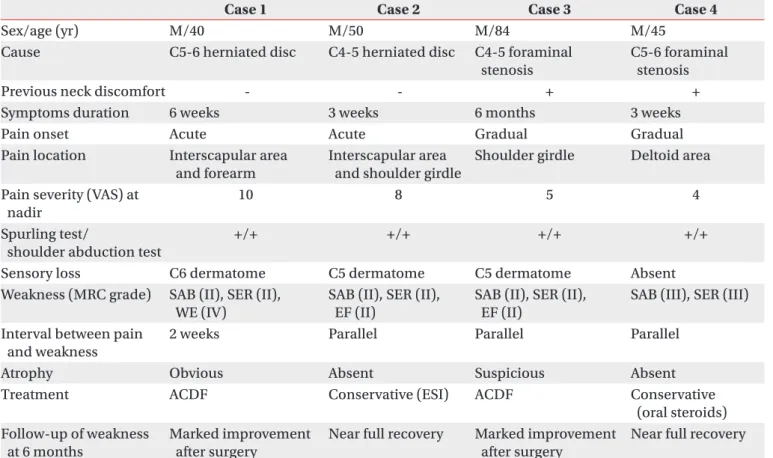
There are some disorders that mimic C5 or C6 radicu- lopathy. Idiopathic neuralgic amyotrophy (INA) is typi- cally characterized by severe pain in the shoulder girdle and subsequent weakness of shoulder girdle muscles [2].
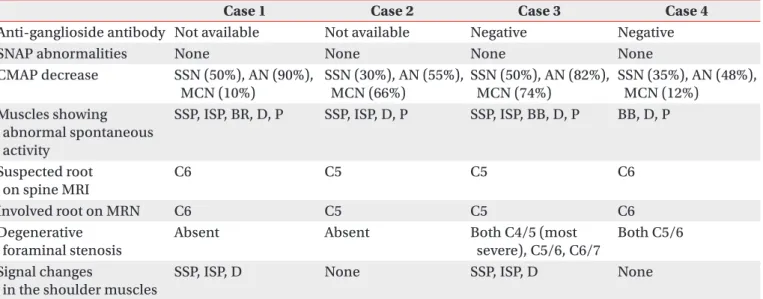
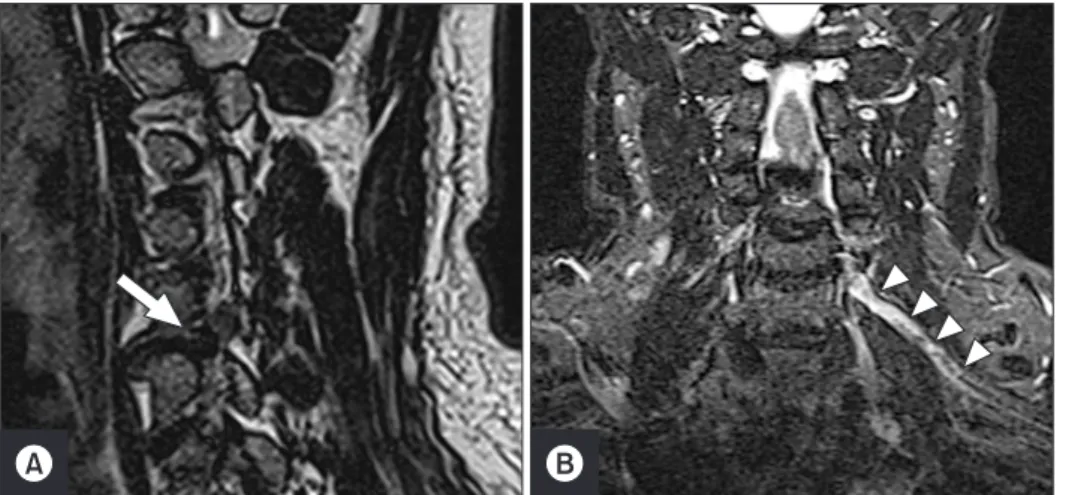
Thus, it is very difficult to distinguish C5 or C6 radicu- lopathy from INA because of similar manifestations. Pre- vious reports suggested that the findings such as thicken- ing and hyperintensity of the brachial plexus on magnetic resonance neurography (MRN) may help in early diagno- sis of INA [3,4].
However, we hypothesized that previous MRN findings suggestive of INA could also be present in C5 or C6 radic- ulopathy patients because nerve root enhancement and
Annals of Rehabilitation Medicine
Ann Rehabil Med 2016;40(2):362-367 pISSN: 2234-0645 • eISSN: 2234-0653 http://dx.doi.org/10.5535/arm.2016.40.2.362
Received July 13, 2015; Accepted August 4, 2015 Corresponding author: Du Hwan Kim
Department of Rehabilitation Medicine, Keimyung University School of Medicine, 56 Dalseong-ro, Jung-gu, Daegu 41931, Korea
Tel: +82-53-250-7477, Fax: +82-53-250-7205, E-mail: ri-pheonix@han- mail.net
This is an open-access article distributed under the terms of the Creative Commons Attribution Non-Commercial License (http://creativecommons.
org/licenses/by-nc/4.0) which permits unrestricted noncommercial use, distribution, and reproduction in any medium, provided the original work is properly cited.
Copyright © 2016 by Korean Academy of Rehabilitation Medicine
Does C5 or C6 Radiculopathy Affect
the Signal Intensity of the Brachial Plexus on Magnetic Resonance Neurography?
Tae Gyu Seo, MD
1, Du Hwan Kim, MD
1,2,3, In-Soo Kim, MD, PhD
4, Eun Seok Son, MD, PhD
51