Kor. J. Hort. Sci. Technol. 29(5):413-419, 2011
자생 수생식물 노랑꽃창포와 창포의 카드뮴 축적 및 내성
이성춘1ㆍ김완순1,2*
1서울시립대학교 자연과학연구소, 2서울시립대학교 환경원예학과
Cadmium Accumulation and Tolerance of Iris pseudacorus and Acorus calamus as Aquatic Plants Native to Korea
Sung Chun Lee1 and Wan Soon Kim1,2*
1Natural Science Research Institute, The University of Seoul, Seoul 130-743, Korea
2Department of Environmental Horticulture, The University of Seoul, Seoul 130-743, Korea
Abstract. This study was conducted to find out the cadmium (Cd) accumulation and tolerance of Iris pseudacorus and Acorus calamus as aquatic plants native to Korea for Cd removal in water. In the range of Cd concentration from 10 μM to 130 μM, the Cd lethal dose 50 (LD50) was 78.5 μM in I. pseudacorus and 47.6 μM in A. calamus. In I. pseudacorus, superoxide dismutase and peroxidase as antioxidants were relatively effective against oxidative stress caused by Cd, while catalase, superoxide dismutase, and polyphenolics were effective in A. calamus. The polyphenolics known as typical antioxidants were not detected in I. pseudacorus. In both species, the Cd accumulation in plants increased with the higher Cd concentration and the longer processing period. Also, the absorbed Cd was accumulated mainly in the roots. The amount of Cd accumulated in the shoot part was maximally 548.1 mg・kg-1 (82.1% to Cd accumulated in the root part) in I. pseudacorus and 121.4 mg・kg-1 (13.7%) in A. calamus, which implied that both species all were enough evaluated as Cd hyper-accumulators based on 0.01% or more Cd accumulation in the shoot. Especially I. pseudacorus showed outstanding ability to move well Cd into the shoots from the roots and high tolerance to Cd stress.
Additional key words: antioxidant, emergent plant, environmental stress, heavy metal, phytoremediation
*Corresponding author: [email protected]
※ Received 10 August 2011; Accepted 24 August 2011.
서 언
식물을 이용한 환경복원방법(phytoremediation)은 화학 약품 등을 이용하는 기존의 복원기술에 비해 경제적이고 친 환경적이며 안전한 기술로 평가 받고 있다(Cunningham and Berti, 1993). 특히 카드뮴(Cadmium, Cd)을 비롯한 중금속으 로 오염된 산업폐수의 경우 수생식물을 이용하여 제거하는 것이 가장 안전하며 효과적인 방법으로 보고되었다(Galiulin et al., 2001). Cd(비중 8.642, 분자량 112.4)은 비필수중금속 으로 다른 효소나 단백질의 황화수소기(-SH)와의 강한 친화 력으로 쉽게 독성을 나타내기 때문에 식물 뿐만 아니라 인간 에게도 유독한 중금속으로 분류된다(Mengel and Kirkby, 1978). 주로 아연 제련, 인산비료 시용, 석탄 연소, 쓰레기 소각, 살충제 사용 등 여러 경로를 통해 발생하며 결국 하천 이나 호수로 유입되어 축적된다. 한편 Cd은 유기화합물과는
달리 무독성 물질로 분해되거나 안정된 화합물 형태로 변환 되지 않고 오랜 기간 생태계 내에 잔류하면서 토양과 수질 을 오염시키며 먹이사슬을 통하여 생물체 내에 고동도로 축 적되어 독성피해를 유발한다(Galiulin et al., 2001).
식물체가 Cd을 비롯한 고농도의 중금속에 노출되면 식물 체 내 산화력이 강한 활성산소종(reactive oxygen species, ROS)이 발생하게 되며 핵산, 단백질, 지질 등의 변성과 광합 성 억제 등 생리적 장해를 유발한다(Halliwell, 2006). 그럼에 도 불구하고 식물체가 지속적으로 생장을 유지할 수 있는 것 은 세포 내 특정 효소나 물질들을 분비하여 ROS를 제거하거 나 중화시킬 수 있는 자기방어체계를 동시에 작동시키기 때문 이다. 이러한 항산화 효소에는 superoxide dismutase(SOD), peroxidase(POD), catalase(CAT) 등이 있으며, 항산화물질 에는 페놀, 카로티노이드 등이 있다(Halliwell, 2006).
최근 중금속을 다량으로 축적할 수 있는 고축적식물(hyper- accumulator)에 대한 관심이 증가하고 있으며, 특히 국내 환경 에 잘 적응하는 자생 수생식물의 경우 외래종보다 환경충격에
대한 내성이 높기 때문에 자생식물을 이용한 phytoremediation 연구가 활발하다(Ebbs et al., 1997). 수생식물 중에서도 부 엽식물이나 침수식물에 비해 뿌리는 물 속 토양에서 자라고 잎과 줄기는 물 위에서 자라는 특성 때문에 생체량이 커서 중금속을 다량으로 축적할 수 있는 정수식물(emergent plants) 에 대한 관심이 집중되고 있다(Galiulin et al., 2001). 노랑꽃 창포(Iris pseudacorus)는 붓꽃과(Iridaceae) 붓꽃속(Iris)의 다년생 정수식물로 유럽원산으로 오래 전에 우리나라에 귀 화되어 우리나라 전역에 분포하고 있어 2006년부터 국가식 물목록위원회 국가표준식물목록(www.nature.go.kr/kpni)에 자생종으로 분류되고 있다. 잎의 길이가 1m 이상으로 생체 량이 크고 다양한 환경 스트레스 조건에서도 적응력이 뛰어 나며, 특히 꽃과 초형의 관상가치가 뛰어나 수생정원에 많 이 이용되는 대표적인 자생식물이다(Lee, 2003). 창포(Acorus calamus)는 천남성과(Araceae) 창포속(Acorus) 다년생 정수 식물로 우리나라 수변 전역에 자생하고 있으며, 생체량 등 외형적으로 노랑꽃창포와 비슷하며 초형이 아름답고 지하 경에 의한 번식이 빠른 것이 특징이다(Lee, 2003). 본 연구 는 관상가치가 뛰어나고 우리나라 수변 전역에서 자생하고 있는 노랑꽃창포와 창포를 대상으로 Cd에 대한 내성과 축 적능력을 조사하여 Cd에 대한 phytoremediation 소재로의 이용가치를 알아보고자 실시하였다.
재료 및 방법
카드뮴 반수치사량(LD50) 조사
노랑꽃창포와 창포의 종자를 버미큘라이트에 파종하여 50일째 plug tray(8 × 16 tray)에 이식하고, 0.1M Hoagland 액(Singh et al., 2006)으로 50일간 수경 육묘하여 식물재료 로 이용하였다. 이 때 노랑꽃창포와 창포의 평균 엽수는 5 매, 평균 초장은 각각 24cm와 8cm이었다. Cd 처리농도는 동일한 Hoagland액에 CdCl2・2.5H2O(Kanto Chemical Co., INC., FW: 228.35)를 이용하여 0, 13, 32.5, 65, 130μM로 조제하였으며, 식물체는 처리농도별로 10주씩 3반복으로 배 치하였다. 실험은 2009년 5월부터 7개월간 서울시립대학교 환경자동제어 유리온실에서 실시하였으며, 중금속 내성반응 연구에서 일반적으로 적용하는 조사기간인 15일을 기준으로 3회 반복실험을 실시하였다(Mittler, 2002). 실험기간 동안 양분결핍이 일어나지 않도록 Cd이 포함된 양액을 매일 교체 하였다. 식물체 치사 판별은 수분 흡수가 더이상 이루어지지 않는 시점으로 하였고 매스실린더를 이용하여 판단하였다.
Cd 처리농도에 따른 치사 개체수를 조사하여 생존율과 반수 치사량(lethal dose 50, LD50)을 계산하였고, 식물 생장량과
엽색(SPAD-502, Minolta Co., Japan)을 조사하였다.
이상의 실험을 통해 얻은 Cd에 대한 반수치사량과 생장 반응을 고려하여 Cd 처리 농도를 반수치사량 이하(0, 10, 25, 50μM)로 조정한 다음, 앞에서 언급한 실험과 동일한 방 법으로 동일한 묘령의 식물체를 이용하여 실험을 실시하였 으며, 이 때 식물체의 항산화 활성 변화와 체내 Cd 축적과 이동 특성을 아래와 같이 조사하였다.
항산화 효소 활성 및 페놀 함량 측정
항산화 효소인 superoxidase dismutase(SOD), peroxidase (POD), catalase(CAT)의 활성을 측정하고자 생체 잎을 0.05g 씩 취하여 액체질소와 추출액[50mM K-Pi buffer(pH 7.0), 1%(w/v) polyvinylpyrrolidone, 0.2mM EDTA]을 넣어서 곱 게 간 다음 15,000rpm(4℃, 20분)으로 원심분리한 후 상징 액을 취하여 1.5mL tip으로 옮겨 조효소액으로 사용하였다.
SOD는 반응혼합액[75μL NBT, 13mM methionine, 0.1mM EDTA, 50mM Pi buffer(pH 7.0), 2μM riboflavin, 50μL 상 징액]을 10분 동안 반응시킨 후 560nm에서의 흡광도를 측 정한 후 NBT 값이 50%로 떨어질 때 소요된 효소의 양으로 계산하였다(Zhang and Kirkham, 1994). POD는 반응혼합액 [10mM Pi buffer(pH 7.0), 20mM guaiacol, 40mM H2O2, 100μL 상징액]을 1분 동안 산화시켜 470nm에서 측정하였 고, CAT는 반응혼합액[50mM Pi buffer(pH 7.0), 15mM H2O2, 100μL 상징액]을 1분 동안 분해시킨 후 UV spectro- photometer(UV2450, Shimadzu Co., Japan)로 240nm에서 측정하였다(Chance and Maehly, 1995).
항산화 물질로 알려진 총 폴리페놀의 함량은 Folin-Denis 법을 응용하여 측정하였다(Velioglu et al., 1998). 건조 후 분쇄한 시료 0.5g을 80% methanol로 24시간 추출한 후 여 과지(Whatman No. 42)를 이용하여 거른 후 추출용액:3차 증 류수:Folin-Ciocalteu’s phenol reagent = 1:3:1 비율로 하여 혼합하였다. 5분 후 Na2CO3 포화용액을 1mL 넣어 실온에서 1시간 방치한 후 640nm에서 흡광도를 측정하였다. Ferulic acid 1mg을 dimethylsulfoxide용액 10mL에 녹여 100ppm의 표준용액을 만든 후 1, 10, 25, 50, 75, 100mg・L-1를 각각 조제한 후 검량선을 구하여 계산하였다.
식물체 카드뮴 분석
식물체를 흐르는 수돗물에 3분간 세척하고 약 10분간 증 류수에 담근 후 뿌리 표면에 단순 흡착된 Cd을 제거하였다.
세척된 식물체를 지상부와 지하부로 구분하여 건조 분쇄한 시료 0.1g을 HNO3:H2SO4:HClO4 = 10:1:4 (v/v)의 비율로 된 분해액으로 분해한 후 여과지(Whatman No. 6)로 여과시
Fig. 1. Changes in plant survival of Iris pseudacorus (A) and Acorus calamus (B) grown hydroponically with respect to the cadmium (Cd) concentration. Vertical bars mean standard error of the means (n = 30).
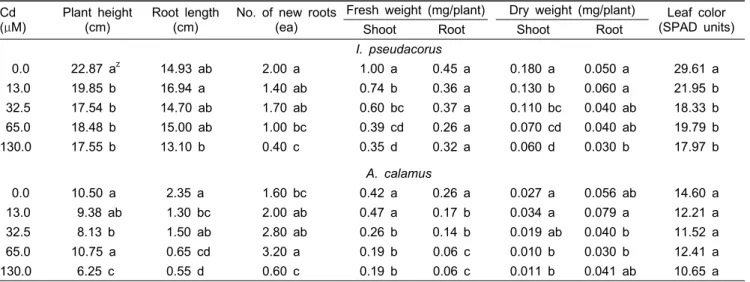
Table 1. Effect of the cadmium (Cd) concentration on the plant growth of Iris pseudacorus and Acorus calamus grown hydroponically for 15 days (n = 30).
Cd (μM)
Plant height (cm)
Root length (cm)
No. of new roots (ea)
Fresh weight (mg/plant) Dry weight (mg/plant) Leaf color (SPAD units)
Shoot Root Shoot Root
I. pseudacorus
0.0 22.87 az 14.93 ab 2.00 a 1.00 a 0.45 a 0.180 a 0.050 a 29.61 a
13.0 19.85 b 16.94 a 1.40 ab 0.74 b 0.36 a 0.130 b 0.060 a 21.95 b
32.5 17.54 b 14.70 ab 1.70 ab 0.60 bc 0.37 a 0.110 bc 0.040 ab 18.33 b
65.0 18.48 b 15.00 ab 1.00 bc 0.39 cd 0.26 a 0.070 cd 0.040 ab 19.79 b
130.0 17.55 b 13.10 b 0.40 c 0.35 d 0.32 a 0.060 d 0.030 b 17.97 b
A. calamus
0.0 10.50 a 2.35 a 1.60 bc 0.42 a 0.26 a 0.027 a 0.056 ab 14.60 a
13.0 9.38 ab 1.30 bc 2.00 ab 0.47 a 0.17 b 0.034 a 0.079 a 12.21 a
32.5 8.13 b 1.50 ab 2.80 ab 0.26 b 0.14 b 0.019 ab 0.040 b 11.52 a
65.0 10.75 a 0.65 cd 3.20 a 0.19 b 0.06 c 0.010 b 0.030 b 12.41 a
130.0 6.25 c 0.55 d 0.60 c 0.19 b 0.06 c 0.011 b 0.041 ab 10.65 a
zMean separation within columns by Duncan’s multiple range test at P = 0.05.
켜 100mL로 정량한 후 희석배수를 늘리면서 원자흡광분석 기(3100, Perkin Elmer, Norwalk, USA)를 이용하여 정량하 였다(RDA, 2003).
통계처리
통계분석용 프로그램인 SAS package(statistical analysis system, version 9.1, SAS Institute Inc.)를 이용하여 ANOVA (analysis of variance) 분석을 실시하였으며 각 처리간의 유 의성은 DMRT 5% 수준에서 실시하였다.
결과 및 고찰
카드뮴 반수치사량(LD50)
Cd에 대한 노랑꽃창포의 반수치사량(LD50)은 130.0μM
에서 11일째 관찰되었다. 생존율은 Cd 농도가 높아질수록 낮아져 13.0μM에서는 100%, 32.5μM에서 83.3%, 65.0μM 에서 56.7%, 130.0μM에서 40.0%까지 감소하였다(Fig. 1).
창포의 경우 반수치사량은 130.0μM에서 9.5일째, 65.0μM 에서 13.5일째 나타났으며, 생존율은 Cd 농도 13.0μM에서 66.7%, 32.5μM에서 60.0%, 65.0μM에서 40.0%, 130.0μM 에서 약 13.3% 정도로 노랑꽃창포보다 Cd 스트레스에 대한 내성이 약한 것으로 확인되었다. 생장량은 노랑꽃창포와 창 포 모두 Cd 농도가 높아질수록 저하되었으며 기존 연구결 과와 일치하였다(Barceló et al., 1988; Singh et al., 2006).
두 종 모두 Cd 농도가 높아질수록 생체중이 감소하였으며, 특히 잎의 황화현상(SPAD value)이 뚜렷하였다(Table 1).
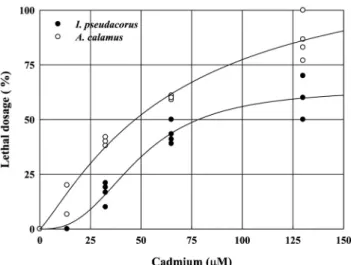
Cd 농도에 따른 생존율(Table 1)을 근거로 Cd에 대한 LD50
을 계산한 결과, 노랑꽃창포는 78.5μM, 창포는 47.6μM로
Fig. 2. Changes in lethal dosage of Iris pseudacorus and Acorus calamus grown hydroponically with respect to the cadmium (Cd) concentration. Vertical bars mean standard error of the means (n = 30).
Fig. 3. Changes in activities of antioxidant enzymes, catalase (CAT), peroxidase (POD), and superoxide dismutase (SOD) of Iris pseudacorus (A, B, and C) and Acorus calamus (D, E, and F) grown hydroponically with the respect to the cadmium (Cd) concentration. Vertical bars mean standard error of the means (n = 5).
나타났다(Fig. 2). 한편 생장반응(Table 1)을 고려할 때 두 종 모두 일정 생장을 유지할 수 있는 한계 농도는 65.0μM 전후로 판단되었다. Cd에 대한 콩의 내성이 40μM, 토마토 16μM이며, 대표적인 카드뮴 내성 야생식물로 알려진 자귀 풀(Aeschynomene indica)과 물피(Echinochloa crus-galli var.
oryzicola)의 내성이 75μM인 것(Ali et al., 2009; Chang et al., 2001; Sandalio et al., 2001)과 비교할 때 노랑 꽃창포와 창포 역시 Cd에 대한 높은 내성을 갖고 있음을 확인할 수 있었다.
항산화 활성 변화
Cd 농도별 처리기간에 따른 항산화 효소들의 활성 변화 를 조사한 결과, 노랑꽃창포의 경우 실험기간 동안 CAT는 거의 활성화하지 않았으나 POD와 SOD는 처리 5일째부터
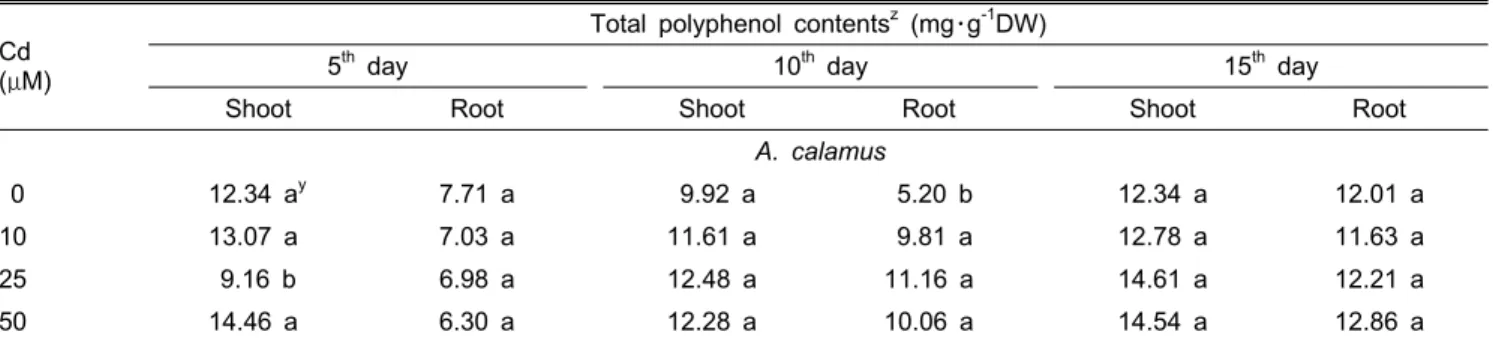
Table 2. Effect of the cadmium (Cd) concentration on the periodic changes in total polyphenol contents of Acorus calamus grown hydroponically for 15 days (n = 5).
Cd (μM)
Total polyphenol contentsz (mg・g-1DW)
5th day 10th day 15th day
Shoot Root Shoot Root Shoot Root
A. calamus
0 12.34 ay 7.71 a 9.92 a 5.20 b 12.34 a 12.01 a
10 13.07 a 7.03 a 11.61 a 9.81 a 12.78 a 11.63 a
25 9.16 b 6.98 a 12.48 a 11.16 a 14.61 a 12.21 a
50 14.46 a 6.30 a 12.28 a 10.06 a 14.54 a 12.86 a
zNot detected in Iris pseudacorus.
yMean separation within columns by Duncan’s multiple range test at P = 0.05.
10일 사이에 현저하게 활성화되었다(Fig. 3). 타래붓꽃(Iris lactea)에서도 Cd 스트레스 조건에서 POD와 SOD가 활성 화되었으며 두 효소 모두 Cd 스트레스에 대한 대표적인 항 산화 효소로 보고되었다(Han et al., 2007). 이것은 노랑꽃창 포에서 POD가 Cd 스트레스를 방어하는 항산화 효소라는 최근 연구보고와도 일치하였다(Zhou et al., 2010). 창포에 서는 오히려 CAT가 활성화되었으며, Cd 50μM을 제외한 모든 Cd 처리구에서 처리 10일째 급격히 증가하였다. POD 의 활성은 노랑꽃창포만큼 크지 않았으나, SOD는 처리기간 이 경과함에 따라 급격히 증가하였다. 따라서 Cd 스트레스 에 대하여 노랑꽃창포에서는 POD와 SOD, 창포에서는 CAT 와 SOD가 주된 항산화 효소로 작용하는 것으로 판단된다.
항산화물질인 폴리페놀 함량을 조사한 결과, 노랑꽃창포 에서는 발견되지 않았으나, 창포에서는 다량이 검출되었다 (Table 2). 창포의 총 폴리페놀 함량은 지하부보다 지상부에 서 많았으며, Cd 처리기간이 길어질수록 증가하였다. 특히 지하부의 경우 처리 5일 경과 시 Cd 처리간 차이가 없었으 나 이후 Cd 농도가 높아질수록 통계적으로 유의하게 증가 하였다. 수생식물인 노랑어리연꽃(Nymphoides peltata)과 수 련(Nymphaeae)의 경우 특수화된 표피 조직에서 polyphenol oxidase에 의해 생성된 폴리페놀이 Cd을 포획하여 식물체 내로의 Cd의 축적 및 무독화를 돕는다는 연구결과가 있었 다(Lavid et al., 2001). 창포에서도 Cd 농도와 처리기간에 따른 폴리페놀의 합성 증가를 통해 폴리페놀이 Cd 독성 방 어와 내성 증진에 직접적으로 관여하고 있음을 확인할 수 있었다.
식물체 내 Cd 축적과 이동성
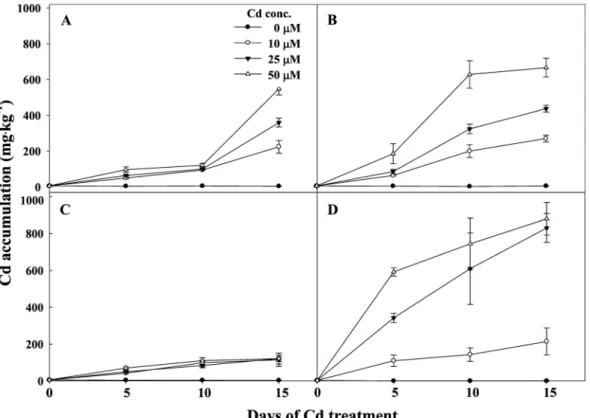
노랑꽃창포와 창포 모두 Cd 처리 농도가 증가하고 기간 이 길어질수록 식물체 내 Cd 축적량이 증가하였다(Fig. 4).
두 종 모두 지상부보다는 지하부 축적이 두드러졌으나 상대
적으로 지상부 축적은 노랑꽃창포에서, 지하부 축적은 창포 에서 높게 나타났다. 노랑꽃창포의 지하부에 축적된 Cd 함 량은 Cd 10μM 처리에서 270.3mg・kg-1, Cd 50μM 처리에서 666.9mg・kg-1, 지상부에 축적된 Cd 함량은 각각 224.3mg・kg-1, 548.1mg・kg-1로 Cd 농도가 10-50μM 범위에서 Cd 축적이 지하부가 지상부의 두 배 정도로 일정하게 나타났다. 하지 만 창포의 지하부에 축적된 Cd 함량은 Cd 10μM 처리에서 217.0mg・kg-1, Cd 50μM 처리에서 882.4mg・kg-1로 4배 이 상 증가하였으나, 지상부에 축적된 Cd 함량은 각각 115mg・kg-1, 121.4mg・kg-1로 농도에 따른 차이를 보이지 않았다. 결국 창포의 경우 지상부보다 지하부에 많은 양의 Cd가 축적되 었는데, 뿌리로부터 흡수된 Cd가 지상부로 잘 이동되지 못 했음을 알 수 있다. 따라서 Cd 체내 이동, 특히 지하부에서 지상부로 이동시키는 능력은 노랑꽃창포에서 우수하였고, 이러한 이동능력은 결과적으로 높은 Cd 농도에서도 식물체 내 Cd 축적을 효과적으로 할 수 있도록 지원함으로써 Cd에 대한 내성을 증진시켰다. 이것은 노랑꽃창포의 Cd 반수치사 량이 창포보다 높았던 것(Fig. 2)으로 확인할 수 있다.
수생식물 Bacopa monnieri 역시 Cd 농도가 높고 처리시 간이 길어질수록 식물체 내 Cd 축적량이 많아졌으며, 미나 리도 생육기간이 지속될수록 식물체 내 중금속 함량이 증가 하였다(Park et al., 2002; Singh et al., 2006). 일반적으로 식물체 내 중금속 농도는 지상부보다 지하부에서 10배 정도 높지만, 고축적식물은 지상부로의 이동이 잘 이루어져 그 차이가 거의 없거나 크지 않은 것으로 알려져 있다(Chaney et al., 1997). 이는 중금속에 대한 내성 기작 중 하나로, 가급 적 많은 양의 중금속을 지하부에서 지상부로 이동 및 분배 시킴으로써 중금속이 지하부에만 축적되어 조기에 독성 피 해가 나타나는 것을 최소화시킨다(Choi and Chiang, 2003).
Cd 이동성이 우수한 노랑꽃창포의 경우 지하부에 대한 지 상부의 Cd 축적률은 Cd 처리 기간이 길어질수록 높아졌다.
Fig. 4. Cadmium (Cd) accumulation in the shoots and roots of Iris pseudacorus (A: shoot, B: root) and Acorus calamus (C: shoot, D: root) grown hydroponically with respect to the cadmium concentration. Vertical bars mean standard error of the means (n
= 5).
미나리에서 지상부의 Cd 축적률은 최대 28%이었으나(Park et al., 2002), 본 실험에서 창포 13.7%에 비해 노랑꽃창포는 82.1%로 현저히 높게 나타났다. Cd을 지상부에 0.01% 이상 축적시킬 수 있는 식물을 Cd 고축적식물(hyper-accummulator) 이라고 정의한다(Chaney et al., 1997). 현재까지 알려진 대 표적인 Cd 고축적식물로 알려진 십자화과 말냉이류 잡초인 Thlaspi caerulescens는 지상부에 평균 100mg・kg-1, 최대 1,000mg・kg-1 정도를 축적할 수 있으며, Cd 농도가 200μM 인 수경조건에서 최대 1,140mg・kg-1까지 축적하였다(Brown and Angle, 1995). 노랑꽃창포와 창포의 지상부 Cd 축적량 은 각각 121.4mg・kg-1, 548.1mg・kg-1으로, 고축적식물의 기 준인 Cd 함량이 지상부의 0.01% 이상이므로 두 종 모두 Cd 고축적식물로 판단되며, 특히 노랑꽃창포는 매우 우수한 Cd 축적식물로 확인되었다.
결론적으로 T. caerulescens를 포함하여 지금까지 알려진 Cd 고축적식물은 대부분 소형 잡초종들로 축적효율은 높으 나 생체량이 작아 식물체가 제거할 수 있는 Cd 총량이 매우 적고, 대부분 관상가치가 낮은 것이 단점이다(Cunningham and Berti, 1993). 본 실험을 통해 우리나라 전역에 자생하며 관상가치가 뛰어나 수생정원용으로 많이 식재되고 있는 노 랑꽃창포와 창포 모두 Cd 고축적식물로 확인되었고, Cd 스 트레스에 대한 내성도 우수한 것으로 나타났다. 두 종간의
Cd 축적능력과 내성 차이는 Cd의 체내 이동성과 항산화 활 성 등 Cd 스트레스 방어기작의 차이로 설명할 수 있으며, 두 종 모두 수질 내 Cd 제거를 위한 phytoremediation 소재 로 이용가치가 매우 높은 것으로 예상된다. 다만 강과 호수 등 식재 대상지의 자연 환경에서는 고온이나 직사광선과 같 은 다양한 산화 스트레스 조건이 존재하므로 실질적인 이용 을 위해서는 자연 서식 환경 조건에서의 실증연구가 필요할 것으로 판단된다.
초 록
국내 자생 수생식물인 노랑꽃창포와 창포를 수질 내 카드 뮴(Cd) 제거용 식물재료로 이용하고자 Cd 축적과 내성을 조사하였다. Cd 농도에 따른 치사율을 근거로 Cd에 대한 반수치사량(LD50)을 계산한 결과, 노랑꽃창포는 78.5μM, 창 포는 47.6μM로 나타났다. Cd 스트레스에 대해 노랑꽃창포 에서는 POD와 SOD, 창포에서는 CAT와 SOD, 폴리페놀이 활성화되었다. 노랑꽃창포에서는 폴리페놀이 측정되지 않 았다. 노랑꽃창포와 창포 모두 Cd 처리 농도가 증가하고 기 간이 길어질수록 식물체 내 Cd 축적량이 증가하였고, 두 종 모두 지상부보다는 지하부 축적량이 현저하게 많았다. 지상 부에 축적된 Cd 함량은 노랑꽃창포 548.1mg・kg-1(지하부 축
적 대비 82.1%) 창포 121.4mg・kg-1(지하부 축적 대비 13.7%) 로 두 종 모두 Cd 고축적식물로 확인되었으며, 특히 노랑꽃 창포가 Cd 축적능력과 내성이 우수하였다.
추가 주요어 : 항산화물질, 정수식물, 환경스트레스, 중금속, 식물환경복원
인용문헌
Ali, C., D.M. Réda, R. Rachid, and B. Houria. 2009. Cadmium induced changes in metabolic function of mitochondrial isolated from potato tissue (Solanum tuberosum L.). Amer. J. Biochem.
Biotechnol. 5:35-39.
Barceló, J., M.D. Vázquez, and C. Poschenrieder. 1998. Structural and ultrastructural disorders in cadmium-treated bush bean plants (Phaseolus vulgaris L.). New Phytol. 108:37-49.
Brown, S.L. and J.S. Angle. 1995. Zinc and cadmium uptake by hyperaccumulator Thlaspi caerulescens grown in nutrient solution. Soil Sci. Soc. Amer. J. 59:125-133.
Chance, B. and A.C. Maehly. 1995. Assay of catalases and peroxidases, p. 764-775. In: S.P. Colwick and N.O. Kaplan (eds.). Methods in enzymology. Vol. 2. Academic Press, New York.
Chaney, R.L, M. Malik, Y.M. Li, S.L. Brown, J.S. Angle, and A.J.M. Baker. 1997. Phytoremediation of soil metals. Biotech- nology 8:279-284.
Chang, J.Y., Y.Y. Chang, B.H. Bae, and I.S. Lee. 2001. A study on the cadmium tolerance of some native herb plants. Korean J. Ecol. 24:309-313.
Choi, M.K. and M.H. Chiang. 2003. Physiological and biochemical responses and heavy metal accumulation of Artemisia princeps and Helianthus annuus in the abandoned zinc mine area for phytoremediation. Kor. J. Hort. Sci. Technol. 12:451-456.
Cunningham, S.D. and W.R. Berti. 1993. Remediation of contami- nated soils with green plants: An overview. In Vitro Cellular Dev. Biol.-Plant. 29:207-212.
Ebbs, S.D., M.M. Lasat, D.J. Brady, J. Cornish, R. Gordon, and L.V. Kochian. 1997. Phytoextraction of cadmium and zinc from a contaminated soil. J. Environ. Quality 26:1424-1430.
Galiulin, R.V., V.N. Bashkin, R.R. Galiulina, and P. Birch. 2001.
A critical review: Protection from pollution by heavy metals-
phytoremediation of industrial wastewater. Land Contamination Reclamation 9:349-358.
Halliwell, B. 2006. Reactive species and antioxidants. Redox biology is a fundamental theme of aerobic life. Plant Physiol.
141:312-322.
Han, Y.L., H.Y. Yuan, S.Z. Huang, Z. Guo, B. Xia, and J. Gu.
2007. Cadmium tolerance and accumulation by two species of Iris. Ecotoxicology 16:557-563.
Lavid, N., A. Schwartz, E. Lewinsohn, and E. Tel-Or. 2001. Phenols and phenol oxidases are involved in cadmium accumulation in the water plants Nymphoides peltata (Menyanthaceae) and Nymphaeae (Nymphaeaceae). Planta 214:189-195.
Lee, T.B. 2003. Coloured flora of Korea. Hyangmunsa, Seoul, Korea.
Mengel, K. and E.A. Kirby. 1978. Principles of plant nutrition.
5th ed. Kluwer Academic Publishers, The Netherlands.
Mittler, R. 2002. Oxidative stress, antioxidants and stress tolerance.
Trends Plant Sci. 7:405-410.
Park, J.S., J.D. Shin, S.S. Han, and D.J. Yoon. 2002. Phytoremediation technology with using water celery (Oenanthe stolonifer DC.) to clean up heavy metals in the contaminated wastewater. Kor.
Environ. Agr. 21:122-129.
Rural Development Administration (RDA). 2003. Methods of soil chemical analysis. National Institute of Agricultural Science and Technology, Suwon, Korea.
Sandalio, L.M., H.C. Dalurzo, M. Gómez, M.C. Romero-Puertas, and L.A. del Río. 2001. Cadmium-induced changes in the growth and oxidative metabolism of pea plants. J. Exp. Bot.
52:2115-2126.
Singh, S., S. Eapen, and S.F. D’Souza. 2006. Cadmium accumulation and its influence on lipid peroxidation and antioxidative system in an aquatic plant, Bacopa monnieri L. Chemosphere 62:
233-246.
Velioglu, Y.S., G. Mazza, L. Cao, and B.D. Oomah. 1998. Anti- oxidant activity and total phenolics in selected fruits, vegetables, and grain products. J. Agric. Food Chem. 46:4113-4117.
Zhang, J. and M.B. Kirkham. 1994. Drought-stress-induced changes in activities of superoxide dismutase, catalase, and peroxidase in wheat species. Plant Cell Physiol. 35:785-791.
Zhou, Y.Q., S.Z. Huang, S.L. Yu., J.G. Gu, J.Z. Zhao, Y.L. Han, and J.J. Fu. 2010. The physiological response and sub-cellular localization of lead and cadmium in Iris pseudacorus L.
Ecotoxicology 19:69-76.