원예과학기술지 19(1):60-65. 2001
이 수려한 秋夕 출하용 중생종 배 ‘新一’ 育成
김휘천1․황해성1․신용억1․신일섭1*․이돈균1․강상조2․천병덕3․문종열4․김정호4
1원예연구소 과수육종과, 2농촌진흥청, 3안성시농업기술센터, 4한국과수협회
Breeding of Middle Season Pear Cultivar ‘Shinil’ with Attractive Appearance for Chuseok Season
Whee-Cheon Kim1, Hae-Sung Hwang1, Yong-Uk Shin1, Il-Sheob Shin1*, Don-Kyun Lee1, Sang-Jo Kang2, Byung-Deok Cheon3, Jong-Youl Moon4, and Jung-Ho Kim4
1Fruit Tree Breeding Divison, National Horticultural Research Institute, RDA, Suwon 440-706, Korea
2Rural Development Administration, Suwon 441-707, Korea
3Anseong-si Agricultural Development and Technology Center, Anseong 456-870, Korea
4Korean Fruit Growers Association, Suwon 440-706, Korea
*corresponding author
ABSTRACT ‘Shinil’ pear cultivar (Pyrus pyrifolia Nakai) which was originated in a cross between ‘Shinko’ (non- patented, released in 1941) and ‘Hosui’ (non-patented, released in 1972) in 1978 was released as a middle season harvest variety. Its usual picking time coincided with ‘Chuseok’ season which is one of the most famous national holiday in Korea. The fruit showed high soluble solids content and good appearance. The cultivar was preliminarily selected in 1991, and its regional adaptability was evaluated in the name of ‘Wonkyo Na-13’ at 9 sites for four years from 1992, and finally selected and named in 1995. ‘Shinil’ is medium in tree vigor like ‘Hosui’ and spreading in tree habit as ‘Niitaka’, a leading cultivar in Korea, and consistently very productive. It has high resistance to black rot caused by Alternaria kikuchiana and pear necrotic spot caused by pear necrotic spot virus. Its full bloom is one day earlier than that of ‘Niitaka’ cultivar and harvest time is September 25 at Suwon area which is 3 days later than that of ‘Hosui’. Fruit is round in shape with a deep medium stalk cavity and medium calyx basin and has attractive light yellow brown skin color. The fruit weight ranges between 300 and 400 g, which is similar to ‘Chojuro’, ‘Shinko’, and
‘Hosui’. Soluble solid content is approximately at the level of 13 14 Brix, which is higher than that of ‘Chojuro’. The flesh is cream-white, very juicy, and light grit with soft and fine texture.
Additional key words: fruit breeding, new cultivar, Pyrus pyrifolia
※ Received for publication 20 February 2001. Accepted for publication 2 March 2001.
서 언
우리 나라에서 재배되고 있는 배는 남방형 동양배(Pyrus pyri- folia Nakai)로서 재배면적이 ’90년 9,058ha에서 ’95년 15,752ha로 급증되고 있다(MAF, 1995). 이는 기후 특성상 우리 나라와 일본 이 유럽, 미국 등에 비해 배 재배하기가 상대적으로 유리하고 세계 농산물 개방에 능동적으로 대처할 수 있는 유망한 과수로 간주되었 기 때문이다. 그간 농촌진흥청 원예연구소에서는 우리 나라의 기후 풍토에 적합한 품종으로 ‘단배’(Hong 등, 1970), ‘黃金배’(Kim 등, 1985), 秋黃배(Kim 등, 1986), ‘榮山배’(Kim 등, 1987), ‘秀黃 배’(Shin 등, 1989), ‘甘川배’(Kim 등, 1991), ‘華山’(Kim 등,
1994) 및 ‘園黃’(Kim 등, 1995)을 육성 발표한 바 있다.
과거 30년간의 통계를 보면 우리 고유 명절인 추석은 9월 상순 에 7%, 9월 중순에 33%, 9월 하순에 35%의 비율로 오는데, 추석 이 9월 20일 이전에 비교적 빨리 올 때 출하할 수 있는 고급 대과 배 품종이 희소하다. 특히, 추석이 9월 10일 내외로 매우 빠를 때 출하 가능한 적숙기 품종은 ‘원황’ 정도이며 9월 20일 내외에는 ‘황 금배’, ‘풍수’ 두 품종으로 극히 제한되어 있다.
따라서 우리 나라에서는 보다 많은 고품질의 추석 출하용 품종이 필요하며 특히 조기 추석출하용으로 9월 상중순에 수확되는 배 품 종의 육성이 요구되는 실정이다. 또한 배 재배가 상대적으로 불리 한 경기 북부(한강 이북) 및 강원 내륙지방에서 재배할 수 있는 고
外觀 秋夕 ‘新一’ 育成
Cultivar
Number of flowers
Petal Number
of stamens
Anther Color of
outer side Size Shape Number Intensity of
red color
Pollen quantity
Shinil 8.6 White Large Ovate 5.3 31 Light Rich
Chojuro (control) 7.0 White Medium Round 5.0 20 Medium Rich
Table 1. Flower characteristics of ‘Shinil’ pear in 1995.
Cultivar Flower bud break Blooming Petal fall
First Full First Full
Shinil Mar. 4 Apr. 25 Apr. 27 Apr. 30 May 5
Chojuro (control) Mar. 4 Apr. 25 Apr. 27 Apr. 30 May 4
Shinko Mar. 4 Apr. 25 Apr. 27 May 1 May 6
Hosui Mar. 5 Apr. 26 Apr. 28 May 2 May 9
Table 2. Date of flowering stage of ‘Shinil’ pear in 1995.
Shinko♀ Open pollenation of Nijisseiki
Shinil Kikusui
Li-14
Hosui♂ Yakumo
Yakumo
Fig. 1. Pedigree of ‘Shinil’ pear.
감미 추석용 품종의 육성이 필요하다.
재료 및 방법
’78년 ‘新興’에 ‘豊水’를 교배하여 얻은 175주의 실생을 대상으로 농사시험연구조사기준(RDA, 1983, 1995)과 International Union for the Protection of New Varieties of Plants(UPOV) 조사기준 (1994)에 따라 花器, 生育 및 果實特性 등을 조사하였다.
환경에 따른 특성의 변이 양상을 알아보기 위하여 ’92년부터 ’95 년까지 원예연구소 시험포장 2곳(수원, 나주)과 도농업기술원 시험 포장 7곳(남양주, 춘천, 청원, 예산, 완주, 대구, 진주) 총 9개 지역 에서 생육 및 과실 특성을 조사하였다.
결과 및 고찰
육성 경위
원예연구소 과수육종과(당시에는 원예시험장 과수1과)에서 ’78년 에 ’신흥‘과 ‘풍수’를 교배하여 얻은 175계통 중 78-29-3이 조중생 고감미 계통으로 유망시되어 ’91년에 1차 선발되었다(Fig. 1). ’92 년부터 ’95년까지 4년간 ‘원교 나-13호’로 9개 지역에서 지역적응 시험을 실시한 결과, 그 특성이 우수하여 ’95년에 최종 선발하여
‘신일’로 명명하였다.
수체 특성
꽃:‘신일’의 花叢當 꽃수와 葯數는 8.7, 31개로 장십랑(대비 품 종)의 7.0, 20개보다 많고 花粉量이 풍부하여 主品種 및 授粉樹 로 이용이 가능하다(Table 1). 개화 직전 꽃잎 색은 백색이며 꽃잎 크기는 다소 큰 편이고 꽃잎 모양은 편원으로 장십랑보다 폭이 넓 다(Fig. 2).
‘신일’의 꽃눈 發芽期는 3월 4일이며 滿開期는 4월 27일로 ‘長 十郞’, ‘신흥’과 같으며 ‘풍수’보다 하루 빠른 경향이었고 落花始 및 落花終은 4월 30일과 5월 5일로 親품종인 ‘신흥’보다 1일, ‘풍 수’보다 2 4일 빨라 개화 진행은 양친보다 빠른 경향을 보였다 (Table 2).
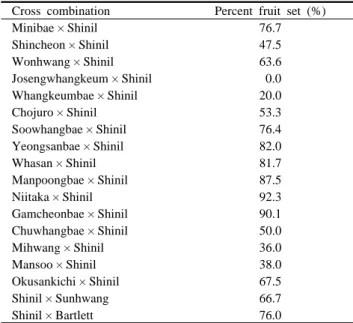
‘신일’과 주요 재배 품종 및 육성 품종과의 交配親和性을 조사한 결과(Table 3), 20.0 92.3%의 着果率을 보여 교배친화성이 인정 되었으며 西洋배인 ‘Bartlett’과도 76%의 높은 受精率을 보였다.
그러나 ‘신흥’이 交配親으로 사용된 ‘早生黃金’과는 교배불친화성 을 보였다.
잎:‘신일’의 잎눈 발아기는 4월 5일로 장십랑보다 다소 빠른 경 향을 보였다. 어린 잎 아랫면에는 털이 없으며 잎 先端은 양친 품 종인 ‘풍수’와 같이 뾰족하지 않은 형태이고 잎 基部는 둥근 모양 으로 장십랑과 같으나 잎 형태는 타원형으로 ‘장십랑’보다 다소 긴 편이며 잎에는 날카로운 鋸齒가 나있다(Table 4).
일년생 가지:길이 및 節間長은 66, 4.5cm로 ‘장십랑’보다 짧았 으며 색은 암자색으로 갈색인 ‘장십랑’과 대비되었다. 皮目數 및 피목 크기는 많고 큰 편이며 腋花芽는 ‘장십랑’보다 다소 적게 착 생하였다(Table 5).
수자, 수세, 단과지 발생 및 내병성:나무 모양은 開張形으로
‘장십랑’보다 直立하는 경향이 강하며 樹勢는 ‘장십랑’정도이고 短 果枝는 잘 발생하는 편이다(Table 6). 耐病性으로는 黑斑病과 배 나무잎검은점병에 강하지만(NHRI, 1994, 1996) 黑星病에는 ‘장십 랑’ 정도로 약하다(Shin 등, 1998).
Cross combination Percent fruit set (%)
Minibae × Shinil 76.7
Shincheon × Shinil 47.5
Wonhwang × Shinil 63.6
Josengwhangkeum × Shinil 0.0
Whangkeumbae × Shinil 20.0
Chojuro × Shinil 53.3
Soowhangbae × Shinil 76.4
Yeongsanbae × Shinil 82.0
Whasan × Shinil 81.7
Manpoongbae × Shinil 87.5
Niitaka × Shinil 92.3
Gamcheonbae × Shinil 90.1
Chuwhangbae × Shinil 50.0
Mihwang × Shinil 36.0
Mansoo × Shinil 38.0
Okusankichi × Shinil 67.5
Shinil × Sunhwang 66.7
Shinil × Bartlett 76.0
Table 3. Cross compatibility between ‘Shinil’ and other cultivars.
Cultivar Leaf bud
break date YLPz
Leaf blade
Shape Apex shape Base shape Incisions of margin
Shinil May 5 Absent Elliptic Acute Rounded Serrate
Chojuro (Control) May 4 Absent Ovate Acute Rounded Crenate
zYLP:pubescence on lower side of young leaf Table 4. Leaf characteristics of ‘Shinil’ pear in 1995.
Cultivar Length
(cm) Color Internode
length (cm)
Number of lenticels
Lenticels size
Number of axillary flower buds
Shinil 66.0 Dark purple 4.5 Many Large Medium
Chojuro (Control) 94.3 Brown 4.9 Medium small Many
Table 5. One-year-old shoot characteristics of ‘Shinil’ pear in 1995.
Cultivar Tree form Tree habit Number of
spurs
Disease
Black spot Pear necrotic spot Scabz
Shinil Spreading Medium Many Resistant Resistant 2.81
Chojuro (Control) Drooping Medium Medium Resistant Resistant 1.05
zEach value represents the mean of inoculated 10 leaves after 49 days. 0:no symptom, 3:abundantly sporulating lesions.
Table 6. Tree characteristics and resistant to diseases of ‘Shinil’ pear.
Fig. 2. Flowers of ‘Shinil’ pear.
Fig. 3. Fruit of ‘Shinil’ pear.
과실 특성
주요 특성:‘신일’의 成熟期는 9월 25일로 풍수와 비슷하며 신흥 보다는 빠르며 果形指數는 0.9로 풍수와 같으나 ‘장십랑’, ‘신흥’보 다 원형이고 봉지를 씌웠을 때 밝은 황갈색으로 착색된다(Table 7, Fig. 3). 과실 크기는 400g 정도로 ‘풍수’보다 작고 ‘장십랑’, ‘신흥’
과 비슷하지만 당도가 14.0oBx로 매우 높고 산미도 적당하며 육질 이 유연다즙하여 식미가 매우 우수하다. 과실 梗窪(과경위치 부위) 의 깊이와 폭, 蔕窪(꽃자리 부위)의 깊이와 폭은 대조 품종, 양친
품종과 같으며 꽃받침은 쉽게 탈락한다. 果心率은 0.43으로 양친 품종의 중간 특성을 보이며 편원형인 ‘장십랑’보다는 다소 높다. 저 장 기간은 다소 짧은 편이다.
Characteristic Cultivar
Shinil Chojuro (control) Shinko Hosui
Ripening time Sep. 25 Sep. 19 Oct. 22 Sep. 22
Shape Round Round oblate Round oblate Round
Fruit shape index (height/diameter) 0.90 0.82 0.86 0.9
Skin color (bagged fruit) Bright yellow brown Flesh yellow brown Bright yellow brown Flesh yellow brown
Weight (g) 401 442 427 472
Soluble solids content (oBx) 14.0 13.4 11.2 13.0
Flesh firmness (kg/5 mmØ) 1.1 1.5 1.3 0.9
Flesh texture Soft, fine Firm, coarse Medium, medium Soft, fine
Flesh juiciness High Medium high High High
Grit Very few medium Medium many Few Few
A cidity as % malate 0.166 0.144 0.189 0.181
Depth of stalk cavity Deep Deep Deep Deep
Width of stalk cavity Medium Medium Medium Medium
Depth of calyx basin Medium Medium Medium Medium
Width of calyx basin Medium Medium Medium Medium
Persistance of calyx Weak Weak Weak Weak
Core shape Broad ovate Broad spindle-shaped Broad ovate Broad spindle-shaped
Core ratio (core width/fruit diameter) 0.43 0.36 0.49 0.41
Number of locules 5 5 5 5
Flesh color White Whitish yellow Yellowish white White
Seed size Medium Large Medium Medium
Seed shape Narrow ovate Ovate Narrow ovate Ovate
Storage life (at 2℃±1) Short Short Medium Short
Table 7. Fruit characteristics of ‘Shinil’ pear and its parents.
Cultivar Year Ripening time
Fruit
shape Skin colorz Fruit wt. (g)
SSCy
(oBx) Acidity Grit FFx Juici- ness Shinil 1992 Sep. 18 Oblate Bright yellow brown 410 14.6 Very low Very few 1.5 High 1993 Oct. 4 Round Flesh yellow brown 480 12.3 Medium Medium 0.7 High
1994 Sep. 23 Round Bright yellow brown 320 15.1 Low Few 1.3 High
1995 Sep. 26 Roundish oblate
Bright yellow brown 395 14.1 Low Few 1.0 High
Avg. Sep. 25 Round Bright yellow brown 401 14.0 Low Few 1.1 High
Chojuro (control)
1992 Sep. 25 Oblate Flesh yellow brown 380 12.9 Very low Medium many
1.8 Low
medium 1993 Sep. 23 Round Flesh yellow brown 570 12.9 Low Medium 1.2 High 1994 Sep. 8 Roundish
oblate
Bright yellow brown 350 13.8 Very low Medium 1.5 High
1995 Sep. 21 Oblate Yellow brown 466 13.8 Low Many 1.5 Medium
Avg. Sep. 19 Round oblate
Flesh yellow brown 442 13.4 Very low low
Medium many
1.5 Medium high
Shinko 1992 Oct. 20 Oblate Bright yellow brown 514 10.5 Low Few 1.2 High
1993 Oct. 20 Round Bright yellow brown 270 11.5 Medium Few 1.1 High
1994 Oct. 24 Round Bright yellow brown 462 11.9 Low Few 1.6 High
1995 Oct. 25 Oblate Bright yellow brown 460 10.9 Medium Few 1.2 High Avg. Oct. 22 Round
oblate
Bright yellow brown 427 11.2 Low medium
Few 1.3 High
Hosui 1992 Sep. 25 Round Flesh yellow brown 450 13.7 Low Very few 1.0 High
1993 Sep. 22 Round Flesh yellow brown 416 12.6 Medium high
Few 0.5 High
1994 Sep. 18 Round Bright yellow brown 462 11.9 Low Few 1.2 High
1995 Sep. 21 Oblate Flesh yellow brown 560 13.6 Low Few 0.8 High
Avg. Sep. 22 Round Flesh yellow brown 472 13.0 Low medium
Few 0.88 High
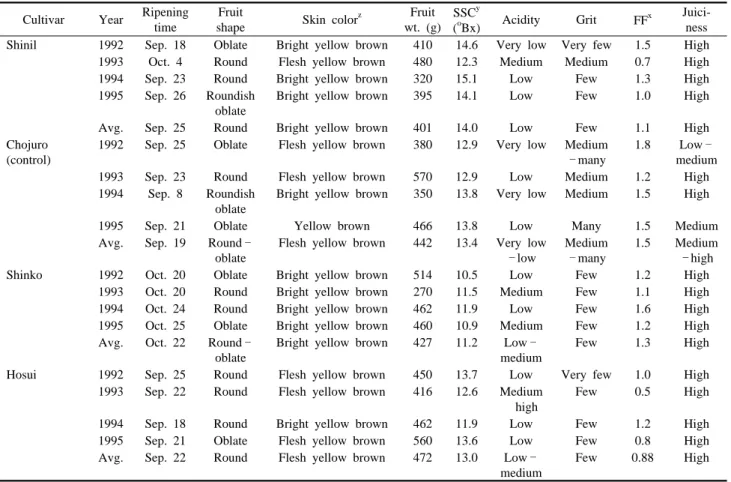
zEvaluated fruits were bagged with double layered, yellow paper bag.
ySoluble solids content.
xFlesh firmness was evaluated with a 5 mmØ plunger.
Table 8. Yearly fruit characteristics and ripening time from 1992 to 1995 at Suwon.
Regions Ripening time
Fruit shape
Skin colorz
Fruit wt.(g)
SSCy
(oBx) Acidity Grit FFx Juiciness
Suwon Sep. 25 Roundish
oblate
Flesh yellow brown 358 14.6 Low Few 1.2 High
Naju Aug. 28 Round Flesh yellow brown 429 13.2 Low Few 0.5 High
Namyangju Sep. 25 Round Bright yellow brown 384 11.2 Medium Few 0.7 High
Chuncheon Sep. 20 Ovate Flesh yellow brown 457 12.0 Low Few 1.1 High
Cheongwon Sep. 20 Round Bright yellow brown 356 14.5 Very low Few 2.0 High
Yaesan Sep. 7 Round Greenish yellow brown 264 14.0 Medium Few 1.4 High
Wanju Sep. 16 Round Bright yellow brown 459 12.6 Low Few 1.7 High
Daegu Sep. 15 Obovate Bright yellow brown 223 14.6 Low Very few 1.2 High
Medium
Jinju Sep. 15 Oblate Bright yellow brown 283 12.1 Low Few 1.0 High
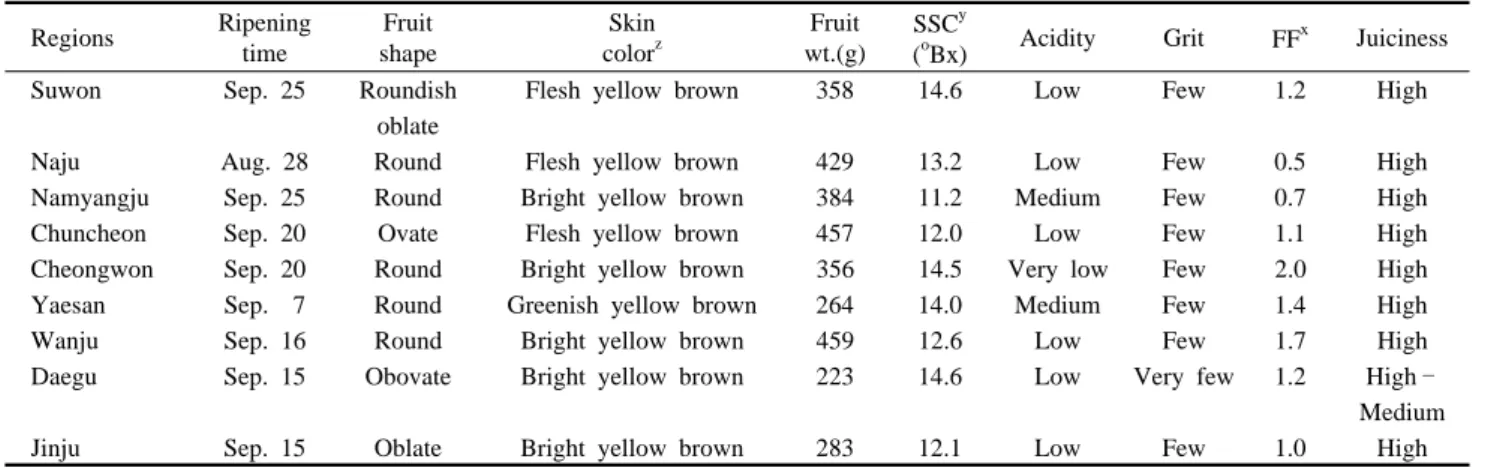
zEvaluated fruits were bagged with double layered, yellow paper bag.
ySoluble solids content.
xFlesh firmness was evaluated with a 5 mmØ plunger.
Table 9. Fruit characteristics of ‘Shinil’ in different regions from 1994 to 1995.
연차별 특성:’92년부터 ’95년까지 5년간 ‘신일’의 과실 특성을 조사하였다(Table 8). 숙기는 연차간 9월 18일 10월 4일로 17일 의 차이가 있었으나 수확시 硬度가 0.7kg/5mmØ로 적정 수확 경 도 1.2 1.5kg/5mmØ보다 낮아 과숙되었을 것으로 판단되는 ’93 년을 제외하면 숙기는 9월 중하순으로 연차간 매우 안정된 성숙 시기를 보인 양친품종 ‘신흥’, ‘풍수’보다는 큰 숙기 차이를 보였으 나 대조 품종인 ‘장십랑’보다는 안정된 성숙 양상을 보였다. 과형은 편원 원으로 원형에 가까웠으며 과피는 밝은 황갈색으로 외관이 수려하다. 양친 품종보다 과실크기는 다소 작고 당도는 높은 특성 을 보였으며 酸味와 石細胞 특성도 양친과 유사하였다.
지역별 과실 특성:지역간 성숙기는 중부지방이 9월 20 28일, 남부지방이 9월 7 16일로 일주일 정도의 차이를 보였으나 국지적 인 기상 및 조사자의 숙기 판단에 따라 많은 차이를 보여 나주는 경도가 0.5kg/5mmØ으로 숙기가 일주일 이상 지난 것으로 판단되 며 청원과 완주는 2.0kg/5mmØ으로 숙기보다 빨리 수확된 것으로 추정된다(Table 9). 과형은 원 편원, 과피색은 선황갈 담황갈로 지역간 큰 차이가 없었으나 과중은 459 223g, 당도는 11.2 14.6oBx으로 다소 큰 변이를 보였다. 모든 지역에서 산미는 낮고 석세포는 적으며 과즙은 풍부한 경향을 보였다.
재배상의 유의점
조기에 철저한 적뢰, 적화 및 적과를 실시하여 대과 생산를 도모 하며 숙기폭이 작아 과숙의 염려가 있으므로 적숙기 10일전부터 육질, 맛 등을 검토하여 수확 적기를 판단한다. 또한 흑성병에 약 하므로 봄에 강우가 많은 해는 전문약제로 철저한 방제를 한다.
유용성
본 품종은 종자산업법에 의하여 ’98년 11월 10일에 출원번호 1988-43호로 품종 출원되어 2000년 3월 28일에 품종보호, 등록되
었다. 현재 한국과수묘목협회에 등록된 모든 회원사에서 구입이 가 능하다.
초 록
園藝硏究所 果樹育種科에서 ’78년에 ’新興‘과 ‘豊水’를 交配하 여 얻은 系統 중 78-29-3이 中生이면서 甘味가 높아 ’91년에 1차 選拔되었다. ’92년부터 ’95년까지 4년간 ‘園交 나-13호’로 9개 지 역에서 地域適應試驗을 실시한 결과, 그 특성이 우수하여 ’95년에 最終 選拔하여 ’新一‘로 命名하였다. 樹勢는 中, 樹姿는 半開張 形이며 短果枝 形成이 잘되어 豐産性이고 배나무잎검은점병과 黑 斑病에 강하여 재배가 용이하다. 滿開期는 ’95년 4월 27일로 長十 郞과 같고 꽃가루가 풍부하며 ‘早生黃金’ 이외의 主要 栽培品種 과 交配親和性으로 授粉樹 품종으로도 좋다. 熟期는 9월 25일로 풍수와 비슷하며 秋夕이 9월 下旬인 해에 유리하다. 果形은 원형 이며 果皮色은 선명한 담황갈색으로 外觀이 수려하고 果重은 370g 내외로 장십랑 정도이며 糖度는 14.0oBx로 장십랑보다 높다.
肉質은 柔軟多汁하고 石細胞가 적어 장십랑과 대비되며 果肉色 은 투명한 白色으로 아름답다.
추가 주요어:과수 육종, 신품종, 동양배
인용문헌
Hong, S.B., Y.H. Kim, S.D. Oh, S.J. Kong, D.K. Lee, and J.C. Lee.
1970. Breeding history and characteristics of new pear variety
‘Danbae’ (Pyrus serotina). Res. Rpt. Off. R. D. A. (Hort.) 13:1-4.
International Union for the Protection of New Varieties of Plants (UPOV). 1994. Guidelines for the conduct of tests for
districtness, uniformity and stability. Japanese pear (Pyrus pyrifolia Nakai)
Kim, W.C., H.S. Hwang, Y.U. Shin, D.K. Lee, S.J. Kang, I.S. Shin, B.D. Cheon, J.Y. Moon, J.H. Kim, and S.B. Kim. 1995.
Breeding of a new lagre sized high-quality pear cultivar
‘Wonwhang’. Res. Rpt. RDA (Hort.) 37(2):471-477.
Kim, W.C., H.S. Hwang, Y.U. Shin, J.Y. Moon, J.H. Kim, and S.J.
Kang. 1994. A new late mid-season pear cultivar, ‘Whasan’ for pear growing across the country. Res. Rpt. RDA (Hort.) 36(1):
469-474.
Kim, Y.S., K.H. Hong, J.B. Kim, M.S. Yiem. U.J. Lee, W.C. Kim, J.H. Kim, S.B. Hong, S.B. Kim, J.Y. Moon, K.Y. Kim, M.D.
Cho, and D.K. Lee. 1986. A new late-season pear cultivar
‘Chuwhangbae’. Res. Rpt. RDA (Hort.) 28(1):57-61.
Kim, Y.S., K.H. Hong, M.S. Yiem, J.B. Kim, U.J. Lee, J.H. Kim, and W.C. Kim. 1987. A new mid-season pear cultivar ‘Yeong- san Bae’. Res. Rpt. RDA (Hort.) 29(1):88-92.
Kim, Y.S., K.S. Hong, Y.U. Shin, W.C. Kim, and J.H. Kim. 1991.
‘Gamcheonbae’, superior quality, large sized pear cultivar for late season. Res. Rpt. RDA (Hort.) 33(3):40-45.
Kim, Y.S., W.C. Kim, K.H. Hong, J.B. Kim, U.J. Kim, S.B. Hong,
J.H. Kim, Y.K. Kim, J.Y. Moon, K.Y. Kim, M.D. Cho, D.K.
Lee, and D.M. Park. 1985. A new mid-season pear cultivar,
‘Whangkeum Bae’ with high soluble solids content and beautiful appearance. Res. Rpt. RDA (Hort.) 27(1):103-106.
Ministry of Agriculture and Forestry (MAF). 1995. Agricultural and forestry statistical yearbook. Seoul.
National Horticultural Research Institute (NHRI). 1994. Annual research report. p. 175-180.
National Horticultural Research Institute (NHRI). 1996. Annual research report. p. 869-879.
Rural Development Admistration (RDA). 1983. Manual for agricul- tural investigation. Suwon.
Rural Development Admistration (RDA). 1995. Manual for agricul- tural investigation. Suwon.
Shin, I.S., I.H, Hyeon, H.S. Hwang, W.C. Kim, and H.M. Cho.
1998. Differences of scab resistance among species and cultivars of pear by simple screening method. Kor. J. Hort. Sci.
Technol. 16:445. (Abstr.)
Shin, Y.U, W.H. Kim, S.J. Kang, J.Y. Moon, and J.H. Kim. 1989.
‘Soowhangbae’, large sized, good quality pear cultivar for mid season. Res. Rpt. RDA (Hort.) 31(4):21-25.