논문 17-42-02-13 The Journal of Korean Institute of Communications and Information Sciences '17-02 Vol.42 No.02 https://doi.org/10.7840/kics.2017.42.2.383
383
※ This work was supported by the project of “Development of marine RF based ad-hoc network for ship” from Ministry of Oceans and Fisheries (MOF), Korea.
First Author : Department of Electronic Engineering, Inha University, [email protected], 학생회원
° Corresponding Author : Department of Electronic Engineering, Inha University, [email protected], 종신회원 논문번호:KICS2018-01-028, Received January 30, 2017; Revised February 6, 2017; Accepted February 16, 2017
Analysis on MIMO Transmit Diversity Techniques for Ship Ad-hoc Network under a Maritime Channel Model in Coastline Areas
Ishtiaq Ahmad, KyungHi Chang° ABSTRACT
For the purpose of providing high data rate real-time services, radio transmission technologies for ship ad-hoc network based on the Recommendation ITU-R 1842-1 are designed. In order to increase the link throughput of real-time services, in this paper, we investigate the performance of the SANET with the spatial transmit diversity techniques are employed. Based on the analysis of the packet error rate and throughput, we select the efficient multiple antenna schemes for SANET to improve the link reliability.
Key Words : ITU-R M.1842-1, Coastline Channel, MIMO, SANET, Link-level Simulation
Ⅰ. Introduction
Recently, there has been a gradual demand in maritime communications for various multimedia services, such as marine video surveillance and underwater video sensing. Without loss of generality, a satellite system is a good candidate for realizing multimedia services, especially for ships that rarely find other neighboring ships. However, when ships can easily locate neighboring ships, a satellite system becomes burdensome due to its remarkably high cost. The ship ad-hoc network (SANET)[1], maritime counterpart of the terrestrial vehicle ad-hoc network, thus needs to provide those
diverse multimedia services in a maritime communications system. ITU-R M.184-1 was released as a recommendation that characterizes very high frequency (VHF) radio systems for data exchange in maritime mobile services[2].
In this paper, we investigate the link performance of SANET associated with several multiple antenna schemes, including, space time block coding (STBC), space frequency block coding (SFBC), cyclic delay diversity (CDD) and beamforming (BF).
However, not all of them can effectively enhance the link performance of the SANET due to the nature of highly correlated maritime wireless channel. According to the analysis of bit error rate (BER), packet error rate (PER) and throughput, we select the efficient multiple antenna schemes to be included in the next generation maritime communication system.
Ⅱ. Maritime Channel Model for SANET
The maritime VHF channel model for both open-sea and coastline areas is referred by Kim[3]
and channel parameters are listed in Table 1.
According to Table 1, we notice that the channel environment on a coastline is a two-path fading channel composed of the first Rician distributed path and the second Rayleigh distributed path. The relative delay of the second path is 5 μs, and its power decay is -3 dB. The mathematical description of a coastline two-path channel model is given as:
(1)
where , and are two independent Rayleigh paths. is used to generated the
The Journal of Korean Institute of Communications and Information Sciences '17-02 Vol.42 No.02
384
Scenario Path Index
Delay
Spread K [dB] Average Relative Power [dB]
Coastline 0 0 10 0
1 5 0 -3
Open Sea 0 0 15 0
Table 1. Maritime channel model.
Rician path via the Rician K-factor. M is the normalization factor for two paths, and is the relative delay of the second path.
Ⅲ. MIMO Transmit Diversity Strategies for SANET
In this section, we discuss the spatial diversity strategies for SANET under a maritime channel model in coastline areas.
3.1 Space Time Block Coding (STBC) For STBC, two successive symbols are formed in one sub-carrier. The 2-by-1 STBC coding scheme is described in Fig.1.
Fig. 1. STBC technique.
3.2 Space Frequency Block Coding (STBC) For SFBC, two successive symbols are located over two different sub-carriers. The 2-by-1 SFBC coding scheme is described in Fig.2.
Fig. 2. SFBC technique.
3.3 Cyclic Delay Diversity (CDD)
CDD is a simple approach to exploit the frequency diversity in MC system. Hence, cyclic shift of the time domain signal corresponds to a frequency-dependent phase shift that can be extende
Parameter Value
Carrier Frequency 2.075 GHz
Bandwidth 100 KHz
Multiple Access TDMA: 4 time slot / 1 TDMA frame
FFT Size 32
Subcarrier Spacing 2.7 KHz Packet Length 64 Symbol
Modulation 16 QAM
Channel Coding Turbo Coding (1/2) Channel Model 2-path Coastline Mobility 55.56 km/h (30 Knots) Channel Estimation 2-D WFE
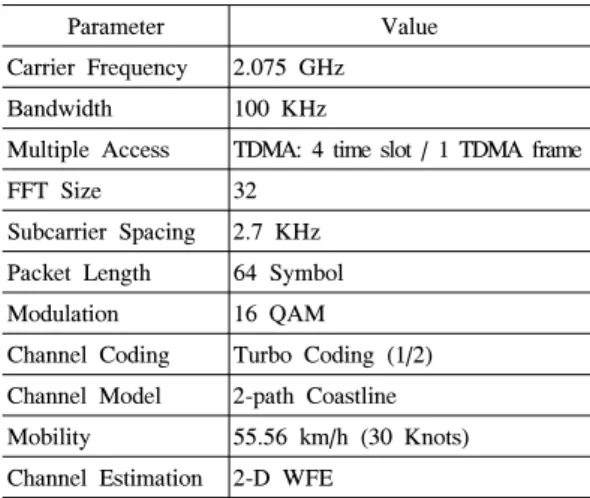
Table 2. Link-level simulation parameters.
extended to more than two transmit antennas with different cyclic shifts for each antenna.
Consequently, the cyclic shift of the first antenna is set to zero and the signal is given as:
(2)
where N is the FFT size and k denotes the sub-carrier index. s(t) and s(k) represent the signals in time and frequency domain, respectively. In other branches, the signals are cyclically shifted by specific shift in time domain. Thus, we have the transmit signal from each branch as:
(3)
3.4 Beam Forming (BF)
Eigenvector beamforming algorithm is widely used to find the channel with maximum gain. Thus, we use the eigenvector BF as the transmitter BF (TxBF) for the SANET system. The weighting vector for the eigenvector TxBF is calculated as:
(4)
where the eigenvector which corresponds tolargest eigenvalue of the channel covariance matrix is selected.
논문 / Analysis on MIMO Transmit Diversity Techniques for Ship Ad-hoc Network under a Maritime Channel Model in Coastline Areas
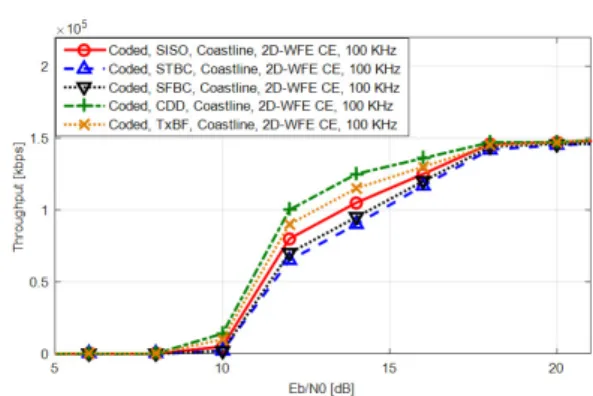
385 Fig. 5. Throughput performance of Tx diversity schemes employing to the SANET system.
Fig. 3. BER performance of Tx diversity schemes employing to the SANET system.
Fig. 4. PER performance of Tx diversity schemes employing to the SANET system.
Ⅳ. Link-level Performance Evaluation for SANET under Coastline Channel Model
In order to analyze the link reliability of the SANET system, the link-level simulations (LLS) are performed to check the BER, PER and throughput performances of various transmission diversity techniques such as STBC, SFBC, CDD and BF under the 2-path Coastline channel model. The simulation parameters are given in Table 2.
From the Fig. 3 and Fig. 4, it can be clearly seen that STBC and SFBC transmit diversity schemes has worst BER and PER performances than SISO scheme while CDD and Eigenvector TxBF schemes improve the BER and PER performances, respectively, under the 2-path coastline channel model
In terms of throughput in Fig. 5, STBC and SFBC transmit diversity schemes are inefficiunder the 2-path Coastline channel model. On the other hand, CDD and TxBF diversity techniques increase
link reliability and achieve throughput gain over SISO in SANET environment. At 12 dB Eb/N0, the CDD and TxBF diversity schemes have 21.9%
and 11.9% throughput gain.
Ⅴ. Conclusions
Based on LLS results, STBC and SFBC are not so efficient to perform under coastline channel model. On the other hand, CDD and BF are efficient schemes to enhance the link reliability as well as capacity under the coastline channel model.
Moreover, CDD and Eigenvector TxBF diversity schemes show a significant PER gain of 1.15 dB and 0.65 dB at the target PER 10-2, respectively.
References
[1] K. H. Jeon, B. Hui, K. H. Chang, and Y. K.
Lim, “Performance analysis of channel compensation and channel coding techniques based on measured maritime wireless channel in VHF-band ship ad-hoc network,” J. KICS, vol. 36, pp. 517-529, May 2011.
[2] Recommendation ITU-R M.1842-1, 5B/780-E, Characteristics of VHF radio systems and equipment for the exchange of data in the maritime mobile service, Nov. 2011.
[3] D. H. Kim, Development of maritime digital VHF system based on ITU-R WP5B M.1842-1, Feb. 2011.