논문 2008-2-8
셀룰러 네트워크의 동적채널에서 빠른 분산 전력 제어 기법의 특성에 대한 연구
A Study on the Characteristics of Fast Distributed Power Control Schemes in Cellular Network under Dynamic Channel
이영대*, 박현숙**
Young-Dae Lee*, Hyun-Sook Park**
Abstract
To address the convergence issue of power control algorithms, a number of algorithms have been developed hat shape the dynamics of up-link power control for cellular network. Power algorithms based on fixed point iterations can be accelerated by the use of various methods, one of the simplest being the use of Newton iterations, however, this method has the disadvantage which not only needs derivatives of the cost function but also may be weak to noisy environment. we showed performance of the power control schemes to solve the fixed point problem under static or stationary channel. They proved goof performance to solve the fixed point problem due to their predictor based optimal control and quadratic convergence rate. Here, we apply the proposed power control schemes to the problem of the dynamic channel or to dynamic time varying link gains. The rigorous simulation results demonstrated the validity of our approach.
Key Words : power control, dynamic channel, link gain, cellular network
*종신회원, 세명대학교 정보통신학과
**종신회원, 동아방송예술대학 방송기술계열 접수일자: 2008.1.20, 수정완료일자: 2008.4.11
Ⅰ. Introduction
The importance of distributed methods for power control has traditionally been fueled by the application to the uplink power control problem in cellular systems. Closed loop power control is used in wireless communication
networks to compensate for fast fading, time varying channel characteristics, and to reduce mobile power consumption.
In CDMA mobile networks, transmit power control is needed to provide each user an acceptable connection by limiting the interference seen by other users. Intrinsically, centralized or distributed power control is essential and important for high capacity cellular radio networks. In recent, many
researchers have investigated a variety of power control algorithms from a different point of view.
Power control can be centralized or distributed. A lot of works have been performed on distributed power control(DPC) because it requires only the desired-path interference measurement made at each base, and relayed to the corresponding mobile.[1]-[4]
In the previous work[5], we showed performance of the presented the DPC algorithms(DPC-I, DPC-II) under static channel. DPC-I and DPC-II showed fast convergence rate comparing with the typical DPC. Especially DCP-II had very rapid convergence rate among them. under stationary link gain channel.
In this work, time varying nature of link gains are considered in the design and evaluation of a closed loop power control on our proposed algorithms.
II. Control Model
2.1 Interference in CDMA Systems We consider uplink direction for a single cell CDMA system with users, designating the transmitted power and SIR for the i th user by
and , respectively. WE denote the background(receiver) noise power within the user's bandwidth by . The interference experienced by the ith user will be designated
, where subscript "-i" indicates the interference depends on the powers of all users except the ith mobile. We use a "snapshot"
model, assuming that all link gains evolve slowly with respect to SIR evolution. In this
problem formulation, the SIR of mobile i is at instant of time k given by
≠
(1)
where, noise power is given as constant in the deterministic power control. The elements
of the gain matrix depends on mobile to base station distance, physical parameters, and coding reaction coefficients.
For the instant tume k, let us assume that each mobile achieves the target SIR as follows.
≧ (2)
If we ignore fast fading, shadow fading, and interference from adjacent cells, the channel gains were determined according to
(3)
Where, is the distance from a mobile station to a base station , and A is a constant gain and the coefficient is usually in the range of 3 to 4 for outdoor communications.
III. The Proposed Power Control Algorithms
3.1. (Jacobi based) Distributed Power Control(DPC or J-DPC)
It was suggested that power control
algorithm can solved with Jacobi fixed point iteration in distributed way as follows.[2]
(4) The above algorithm is well known as DPC(distributed power control). Here, we call it as J-DPC(Jacobi iteration based DPC)
Assuming that transmitted powers are constrained to
≦ ≦ (5)
where, and is the minimum and maximum mobile power, respectively. Then the DPC is changed as DCPC(distributed constrained power control) as follows.
(6)
The DCPC constructs a theoretical back ground of IS-95 CDMA(See Fig. 1) and W-CDMA power control algorithm. The properties of DPC(J-DPC) and DCPC were well known to have slow speed with linear rate of convergence.
3.2 The Proposed Power Control Algorithms
[DPC-I]
The power control algorithm DPC-I, which was previously suggested by us, is based on optimal control theory and it needs one-step predictor on channel variation is described as following equations.[5]
(7)
(8)
≠
(9)
(10)
[DPC-II]
The power control algorithm DPC-II which also suggested previously by us is the accelerated version of DPC-I based on Steffensen iteration. And the iteration procedure only needs initial three power values provided by DPC-I as follows.[5]
⋯
(11)
IV. Simulation
4.1. Simulation Environment
To demonstrate the efficacy of the algorithms developed above, we tested them in a realistic simulation in Matlab. In this section, we discuss the simulation parameters used and the simulation results.
We considered a 2-km square with base station centered at the origin and mobile locations were randomly from a uniform distribution. Power was limited to 600mW
corresponding to the legal limit in the United states. Back ground thermal noise power was set to 0.2mW in the simulations.
We generated random set of 20 users at default, the locations of which are uniformly distributed over a cell(See Fig.1). The initial power for each mobile is randomly chosen from the interval (0,1]mW. The target SIR(Signal to Noise Ratio) was set to 3.918. is set to
, which corresponds to a path loss of 110dB at a distance of 1km.
Fig. 1. A Cellular system model for simulation (One base station, uniformly distributed mobile stations)
4.2 Stationary(Quasi Static) Channel Link Gains
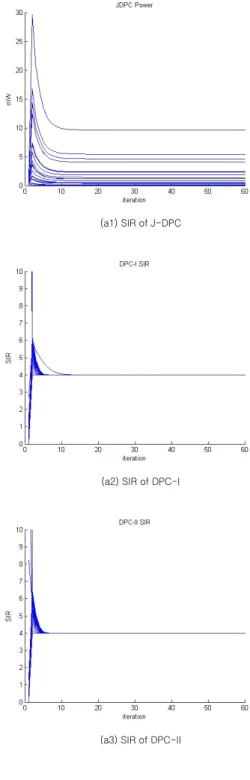
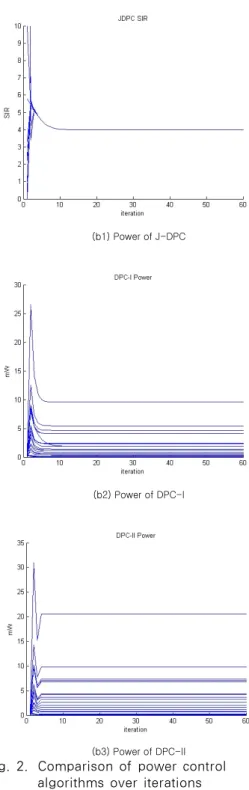
First we consider the static channel with constant link gains. The trace in Fig. 2 represents SIR and power values over the set of mobiles considered in the case of stationary channel gains. Without the sacrifice of the achieved SIR, a significant reduction in computation is observed in our power control schemes DPC-I and DPC-II comparing with the typical Jacobi iteration based DPC (or J-DPC).
That is, DPC-I and DPC-II reached the equilibrium state of SIR and power faster the typical J-DPC and in converges to the solution with a few iterations. However, with the large
of mobiles above thirty, the achievable SIR decreased significantly as shown in Fig. 2.
(a1) SIR of J-DPC
(a2) SIR of DPC-I
(a3) SIR of DPC-II
(b1) Power of J-DPC
(b2) Power of DPC-I
(b3) Power of DPC-II
Fig. 2. Comparison of power control algorithms over iterations
That is, the number of some mobiles whose SIR fell below the minimum SIR increased suddenly. Hence, the outage probability is
defined as the ratio of the number of disconnected users to the number to that of the total number of users in the system.
Accordingly, dropping some of outage mobiles would be necessary to achieve the QoS in case of large users in practice.
When we increased the cell loading to 25 mobiles we found greater improvement in convergence speed, as shown in Fig. 3.
However, for very heavily loaded cells, e.g.
with ≧ , the accelerated methods(DPC-I, DPC-II) some times failed, however for reasonable loading they were very reliable.
(a) SIR variation
(b) Outage probabilities of mobiles.
Fig. 3. Comparison of power controls over the number of mobiles
It is noticeable that the accelerated algorithms are not so much robust as the original fixed point algorithm for very large numbers of mobiles over very heavily loaded cells.
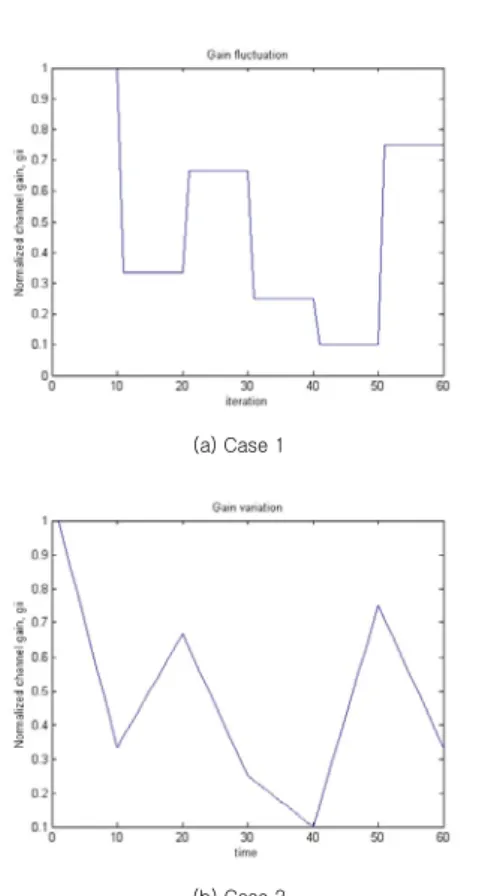
4.3 Dynamic Time Varying Channel Cases Next we consider the dynamic channel with time varying link gains. Two cases are considered:
(Case 1) Channel channing sharply at certain time instants, and
(Case 2) channel changing smoothly like as shown in Fig. 4.
From the Fig. 5, it is clear that the performance of the proposed DPC-II outperforms that of J-DPC and DPC-II performance such as SIR.
(a) Case 1
(b) Case 2
Fig. 4. Channel fluctuations in two cases
Futhermore, using the proposed scheme DPC-II, outage probability is minimized under dynamic chanel compared to DPC-I not to mention the typical J-DPC as shown in Fig. 6.
(a) SIR over time (Case 1)
(b) SIR over time (Case 2)
Fig. 5. Comparison of power control schemes over two cases of dynamic channel
Fig. 6. Average outage probabilities in Case 2
저 자 소 개 이영대(종신회원)
∙1985년 : 서울대 공과대학(학사)
∙1987년 : 서울대 공과대학(석사)
∙1998년 : 서울대 전기공학부 (박사)
∙1999년 ~ 현재 : 세명대 정보 통신 학부 교수
<주관심분야: 이동통신 자원관리, 임베디드 시스템>
박현숙(종신회원)
∙제4권 제1호 참조
∙1997년 ~ 현재 : 동아방송예술 대학 방송기술계열 교수
<주관심분야: 방송기술, 음성인 식 신호처리>
Ⅴ. Conclusion
In this paper, we investigated the properties of the proposed fast power control methods under a stationary channel with fixed link gains and two dynamic channels with varying link gains. Our simulation results indicate the proposed algorithm based on optimal control theory with one step predictor(DPC-I) and the accelerated version of it with Steffenson based iteration (DPC-II) significantly decrease the number of iterations required for convergence.
Nonetheless our further work is needed to enhance the performance of the proposed algorithms because the most acceleration based algorithms are not so robust as original fixed point algorithms. Additional study would be needed to determine why the algorithm fail and to determine limites on number of allowable mobiles or other system parameters that would prevent such failures.
References
[1] Grandhi, S. R. Vijayan, D. Goodman,
"Distributed Power Control in Cellular Radio Systems," IEEE Trans. Communications, Vol.
42, pp. 226- 228, 1994.
[2] Yates, R., "A Framework for Uplink Power Control in Cellular Radio Systems,", IEEE J. on Selected Areas of Communications, Vol. 13, pp.
1341-1347, 1995.
[3] Huang, C. and R. Yates, "Rate of Convergence for Minimum Power Assignment in Cellular Radio Systems," Wireless Network, Vol. 4, 223-231, 1998.
[4] S.-L. Kim and J. Zander, "Optimization Approach to Gradual Removal in a Cellular PCS with Distributed Power Control,"IEEE Trans. Veh. Technol., 1998.A
[5] Y D. Lee, "Distributed Power Optimization Method for CDMA Cellular Mobile Systems Using an Adaptive Search Scheme", 2003, ICCAS