논문 2009-6-24
위성 방송 채널에서 터보 부호화된 OFDM 시스템의 성능 분석
Performance Analysis of OFDM Systems with Turbo Code in a Satellite Broadcasting Channel
김진영*
Jin-Young Kim
요 약 본 논문에서는 위성 방송 채널에서 터보 부호화된 OFDM 시스템의 성능을 분석 및 실험하였다. 성능은
BER로 평가하였고, 위성 채널은 Rayleigh 페이딩과 Rician 페이딩의 조합으로 모델링 된다. 성능 비교를 위해 터보복 호 알고리즘으로 MAP, Max-Log-MAP, SOVA가 사용되었다. 모의실험 결과, Max-Log-MAP 알고리즘이 성능과 복잡 도 측면에서 가장 좋은 성능을 보임을 확인 하였다. 그리고 터보 부호화기의 iterations과 interleaver의 수를 증가시키 면 성능이 향상됨을 알 수 있다. 본 논문의 결과는 OFDM 기반의 위성 방송 시스템의 설계에 활용될 수 있다.
Abstract In this paper, performance of OFDM systems with turbo code is analyzed and simulated in a satellite broadcasting channel. The performance is evaluated in terms of bit error probability. The satellite channel is modeled as a combination of Rayleigh fading with shadowing and Rician fading channels. As turbo decoding algorithms, MAP (maximum a posteriori), Max-Log-MAP, and SOVA (soft decision Viterbi output) algorithms are chosen and their performances are compared. From simulation results, it is demonstrated that Max-Log-MAP algorithm is promising in terms of performance and complexity. It is shown that performance is substantially improved by increasing the number of iterations and interleaver length of a turbo encoder. The results in this paper can be applied to OFDM-based satellite broadcasting systems.
Key Words : Orthogonal Frequency Division Multiplexing, Satellite Broadcasting Channel, Turbo Code
Ⅰ. Introduction
Future communication systems will have to support various kinds of services (such as voice, data, image, etc.) with different quality of service (QOS). To meet these requirements, an efficient modulation is required for high data rate transmission in radio channels such as a land multipath fading channel or a satellite channel. In a radio channel, fading and shadowing are
*정회원, 광운대학교 전파공학부 접수일자 2009.9.26, 수정일자 2009.10.29
main factors which deteriorate system performance.
One of promising techniques for combating multipath fading impairments is OFDM (orthogonal frequency division multiplexing), a kind of multicarrier modulation scheme[1-3]. The basic idea of OFDM scheme is to spread out the effect of fading over many bits. The OFDM scheme has the following attractive features for high speed transmission links: 1) high spectral efficiency, 2) robustness in multipath fading environment, 3) low training overhead, and 4) low complexity compared to equalizer, etc. Furthermore, the
OFDM scheme has scalability of bit rate and bandwidth in that a sufficient subcarrier bandwidth increases robustness to Doppler spread of a radio channel. An appropriate guard time interval avoids ISI (intersymbol interference), thus powerful time-domain equalization is not required. In an OFDM scheme, DFT (Discrete Fourier Transform) is used to multiplex blocks of data symbols over subchannels which are spectrally overlapping yet orthogonal in time. Since symbol period of the OFDM scheme gets larger than channel delay spread, the OFDM scheme is robust in a multipath fading channel.
So, the OFDM has been adopted as a standard for DAB (digital audio broadcasting) and WLAN (wireless local area network) in Europe, and ADSL (asynchronous digital subscriber line) in U.S.A[4-6]. The OFDM scheme can also be used for single frequency network (SFN) applications where all transmitters radiate the same signal on the same frequency.
In the broadcasting field, digital television broadcasting should support digital transmission of HDTV quality video. A raw HDTV data rate up to 1Gbps is compressed to about 18-20 Mbps through source coding technique such as MPEG. The compressed data stream is then transmitted within analog video channel with bandwidth of 6MHz (currently, specifications of U.S.A and Japan), which leads to requirements for high-level modulation scheme[7]. Thus, powerful modulation and channel coding scheme is necessary to support HDTV transmission in a radio channel with fading and shadowing. Single carrier modulation requires power equalization technique to achieve acceptable performance for high data rate transmission of DVB (digital video broadcasting) signals and ISI in a multipath channel. This situation has motivated extensive research on multicarrier modulation, especially, on an OFDM scheme.
So far, many channel coding schemes such Reed-Solomon (RS) code, convolutional code, and their concatenated code have been proposed for OFDM
system to increase reliability of information transmission[4,7]. In recent years, a new error correcting code called `turbo code' has attracted much attention in the channel coding community[8-11]. The term turbo is named after the fact that the decoder uses its processed output as a priori input in the next iteration. The turbo code can provide significant coding gain by utilizing two constituent convolutional codes and an interleaver.
It has been confirmed that the turbo code achieves near Shannon-limit error correcting capability in an AWGN channel[8]. Therefore, it is expected that an application of turbo coding to an OFDM system leads to considerable coding gain.
In general, turbo code consists of two or more constituent codes and an interleaver. The first decoder passes the extrinsic information (a part of the soft output provided by a posteriori probability algorithm) to the next decoding stage. For every iteration process, a single decoding is performed using the observation as well as reliability information delivered by the other decoders that were acting before. The MAP (maximum a posteriori) decoding algorithm is known to be an optimal algorithm for turbo decoding process.
There are also suboptimal algorithms such as SOVA (soft output Viterbi algorithm) or Max-Log-MAP that are less complex.
Satellite broadcasting is very attractive in that it can provide very wide coverage area simultaneously.
Nevertheless, there are many technical problems to be overcome. Among them, efficient coding and modulation schemes are one of the critical issues for successful implementation of broadcasting satellite. In the future broadcasting system, it is expected mobile reception of broadcast signals will be one of challenging issues, for example, reception of HDTV signals on buses, trains, and automobiles through radio channels (especially, through a mobile-satellite channel)[12]. In this situation, the OFDM scheme can be a strong candidate as a modulation scheme due to the above-mentioned advantages. Toward these trends, the OFDM scheme with turbo coding in a satellite channel
deserves attentions from the broadcasting community as well as from channel coding community.
In this paper, performance of a turbo-coded OFDM system is analyzed and simulated in a satellite broadcasting channel. As a modulation scheme, 64-QAM is employed because OFDM/64-QAM is a very strong candidate for satellite broadcasting systems. The performance is evaluated in terms of bit error probability. The satellite channel is modeled as a combination of Rayleigh fading with shadowing and Rician fading channels. And, the concepts and principles of turbo code are introduced, and decoding algorithms are described to help readers understand turbo encoding/decoding procedures more easily.
The simulation results for bit error probability are presented with the following varying parameters: 1) the number of iterations used in the decoding process, 2) interleaver length employed in the turbo encoder, and 3) standard deviation of shadowing to evaluate the effect of satellite channel characteristics on performance.
Finally, the comparative results are shown for the optimal and suboptimal approaches used in the turbo decoding process. For turbo decoding algorithms, the optimal MAP, the suboptimal Max-Log-MAP, and the suboptimal SOVA algorithms are taken into account.
The paper is organized as follows: In Section II, OFDM system, satellite channel model, turbo coding are described. In Section III, bit error probability for OFDM/64-QAM system with turbo coding is derived.
In section IV, optimal and suboptimal turbo decoding algorithms are described. Simulation results are presented in Section V, and conclusions are drawn in Section VI.
Ⅱ. System Model
1. OFDM System Model
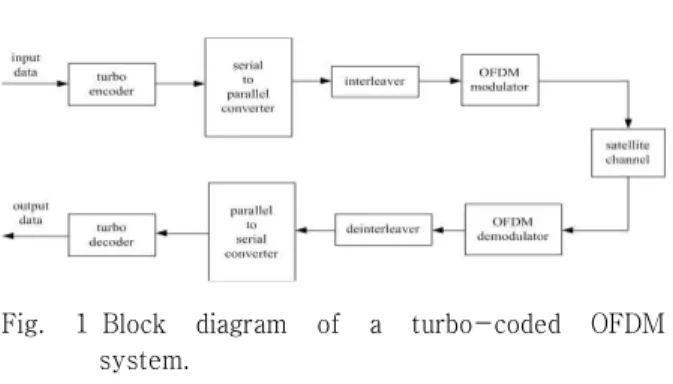
In an OFDM system with turbo coding as shown in Fig. 1, input data sequence is first encoded by turbo encoder and then by QAM encoder. In an OFDM
scheme, a 2m-QAM (quadrature amplitude modulation) is typically used to encode data sequence into phase and magnitude of subcarrier, where mis the number of bits assigned to the subcarrier. The m -bit groupings of data are encoded as complex values defining points in the 2m-QAM constellation. Then, the output of QAM encoder is serial-to-parallel converted. The OFDM scheme allows spectral overlap of adjacent subcarriers using orthogonal property, which results in high spectral efficiency. The subcarrier frequencies are selected to be spaced at symbol rate. The OFDM modulation and demodulation is efficiently done using FFT and IFFT algorithms.
The IFFT output is converted into an a log modulating wave form using D/A (digital-to-analog) converter, and then transmitted.
Fig. 1 Block diagram of a turbo-coded OFDM system.
At the receiver, the recovered baseband signal is sampled and converted to digital form. The FFT is performed to determine phase and amplitude of each subcarrier. For each subcarrier, the transmitted data is estimated through signal point closest to the point corresponding to the received subcarrier. The output of QAM decoder is decoded in the turbo decoder to estimate transmitted m-bit data sequence.
2. Satellite Channel Model
In a satellite communication system, satellites in orbit provide links between terrestrial stations sending and receiving radio signals that suffer from fading and shadowing. The envelope of received signal is given by
r=P∙S, (1)
where Pis fading envelope and S is shadowing envelope. In (1), Ptypically follows Rayleigh or Rician distributions according to presence of direct component.
The probability density function (p.d.f.) of an instantaneous power is given by[13,14]
∞
, (2) where
·
. And is local
mean power, Rf is a Rician factor which is power ratio of direct and diffused components, I0(∙) is zeroth-order modified Bessel function, and fs(s) is p.d.f. of shadowing. It has been known from extensive measurements that fs(s) has a lognormal distribution and is given by[15]
fs(s)=δ(s-1), for unshadowed case, (3)
ln
,
for shadowed case, (4)
where ρ=( ln10)/20 is unit conversion constant, ms is average of shadowing, and σs is standard deviation of shadowing. In a typical satellite channel, msand σsare in the range of -7dB to -16dB and 2dB to 6dB, respectively. If the direct component exists, Rf≠0 and f(p) follows Suzuki-model with Rayleigh- lognormal distribution while if the direct component does not exist, Rf=0 and f(p) follows Loo-model with Rician distribution[15].
3. Turbo Code
To enhance reliability of information bits, many channel coding schemes such as block and convolutional codes have been proposed. To get higher coding gains, their concatenated coding scheme has
been proposed[16]. In a concatenated coding scheme, probability of error decreases exponentially while decoding complexity increases algebraically. In applications requiring higher coding gain such as deep space communications, the concatenated code has attracted much attention as a powerful coding scheme.
The turbo code is a kind of concatenated code which consists of two or more constituent codes. Typically, two recursive systematic convolutional codes are used as the constituent codes.
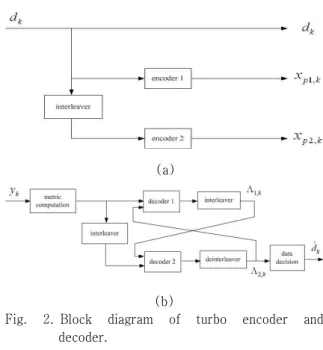
The turbo encoder shown in Fig. 2. (a) is formed by concatenation of two constituent codes in parallel and then by separation two codes by an interleaver. The recursive systematic convolutional code is usually used as a constituent code. The information bits are first encoded by a recursive systematic convolutional code, and then, after passing through an interleaver, are encoded by a second systematic convolutional encoder.
The code sequences are formed by the information bits, followed by the parity check bits generated by both encoders. In Fig. 2. (a), the encoder takes data sequence dkas an input sequence and puts out three components: 1) dk, information bits, 2) xp1,k, parity bit of the first encoder, and 3) xp2,k, parity bit of the second encoder.
(a)
(b)
Fig. 2. Block diagram of turbo encoder and decoder.
The most fundamental idea behind turbo code is interleaver gain by which error performance can be significantly improved through separation of constituent encoders. Thus, an appreciable increase in decoder complexity by increasing interleaver length results in substantial improvement of error performance. Unlike conventional channel coding schemes, turbo code need not trade off code rate or code complexity for increased Euclidean distance between codewords.
In the turbo decoder shown in Fig. 1. (b), the first thing to do is to compute metric. After that, the metric is used in the decoder 1 and decoder 2. The separate two decoders matched to the constituent encoders share soft reliability information in an iterative fashion.
This soft reliability information (also called extrinsic information) is used as a priori information in the next decoding stage. Then, the performance of this iterative decoder gets very close that of ML (maximum likelihood) decoder with far less complexity. The soft outputs are derived from a modified Viterbi decoder, but the optimal soft-output decoder is symbol-by-symbol a posteriori probability (APP) decoder whose outputs are the a posteriori probabilities of the decoded bits.
Ⅲ. Performance Analysis
The OFDM system can be interpreted as a frequency multiplexing method for transmitting K symbols simultaneously using K subcarriers. The symbol sequence is divided into blocks of Ksymbols.
Then, the transmitted signal is given by
exp ,
kT≤t≤(k+ 1)T, (5)
where fc is carrier frequency, fkis frequency of
the kth subcarrier, T=Ts+Tg is sum of symbol duration (Ts) and guard interval (Tg), and Kis the number of subcarriers. At the receiver front-end, the received signal is given by
exp ,
≤ ≤ , (6)
where kk is frequency response of the satellite channel at frequency fc+kfk. After sampling and taking FFT, the output signal of FFT algorithm is given by
zk=hkxk+nk, (7)
where nkis IFFT output of sampled noise. The bit error probability of 64-QAM with Gray mapping in an AWGN channel is given by[17]
,
(8)
where γb=Eb/N0 and erfc(x)= 2π ⌠
⌡
∞
x exp(-u)2du is complementary error function.
For the uncoded case, the bit error probability in a satellite channel is obtained by integrating (9) over the p.d.f. given by (2). For turbo-coded codewords, codeword error probability is upper-bounded by
Pw≤d∑N
=1A(d)P(d), (9)
where Nis block length of turbo codeword,
is the number of codewords with Hamming distance , and is decoding error probability of a codeword with weight d. To get the, we have to perform exhaustive search for a turbo code with fixed interleaver. So, by averaging over all possible interleavers, average weight distribution is obtained by
, (10)
where is the probability that an input codeword with Hamming weight i produces a codeword with Hamming weight [11]. The average upper bounds for word and bit error probabilities are, respectively, given by
Pw,a≤ ∑N
d=dminAa(d)P(d), (11)
Pb,a≤ ∑N
d=dmin
∑Q
i=1
Q pi (d i)P(d), (12)
where dmin is a minimum distance between codewords. To apply for the satellite channel, the turbo decoder should be modified to incorporate the satellite channel characteristics. For the turbo-coded case, the bit error probability is evaluated through simulations using (12).
Ⅳ. Turbo Decoding Algorithms
The turbo decoding algorithm depends on the available information on channel state in the decoder.
The optimum decoding algorithms are based on MAP probability. The MAP algorithm has not been less popular than Viterbi algorithm because it achieves slightly better performance with higher complexity.
Recently, as a decoding algorithm of concatenated
coding scheme, it is gathering spotlights with the increased attentions of turbo code. In a usual concatenated code, some kind of soft information is exchanged between the constituent codes.
In a concatenated code proposed by Forney, the optimum output of inner decoder becomes in the form of APP distribution. To approach the required APP, many suboptimal algorithms have been considered. One of them is SOVA algorithm that is a kind of modified Viterbi algorithm compared to the original Viterbi algorithm. To make implementation easier, the Max-Log-Map algorithm has also been proposed.
Since the optimal MAP decoding algorithm is very complex, so some suboptimal algorithms with less complexity have been proposed[10]. In this paper, the Max-Log-MAP and the SOVA algorithms are considered as the suboptimal approaches.
1. MAP Algorithm
In the MAP algorithm, all the possible paths in the trellis are considered to optimally determine the reliability of information data. The MAP algorithm is computed through modified BCJR algorithm[10]. Empirical evidences suggest that this decoding algorithm performs remarkably well and converges to the optimal decoding solution[9].
It can be noted that turbo decoding process can be regarded as the iterative improvement of APP because the log likelihood ratio is the ratio of APP of each information bit, dk=1 and dk=0. The turbo decoder makes full use of the APP (soft information) generated by the previous MAP decoder as a priori information. The APP is given by
ln
,
(13)
where Skis state of the first encoder at time k, and αk(∙) and βk(∙) are forward and backward
recursion parameters, respectively.
The forward and backward recursion relations of the MAP are, respectively, given by
, (14)
. (15)
The initial conditions are α0(S0)=0 for S0=0 and βN(SN)=1for SN=0. The branch transition probability of MAP decoder is given by
·
, (16)
where zs and zp are systematic and parity information of z, respectively, and ysk and ypk are channel outputs for dkand xp1,k, respectively. In (16), the value q(dk=i Sk,Sk-1) is one for transition from Skto Sk-1, and zero for the other cases. The two outputs, yskand ypk, are used to compute a log likelihood ratio of a posteriori probabilities. This likelihood ratio is then employed to produce a priori probabilities in the following MAP decoder after which a new likelihood ratio is evaluated. This procedure is repeated many times until the bit error probability converges to some low value.
2. Max-Log-MAP Algorithm
In the Max-Log-MAP algorithm, the data decision and soft outputs are based on the best two paths with different distance. The Max-Log-Algorithm can be interpreted as a log domain version of the optimal MAP algorithm. To avoid complicated operations for γi(∙,∙,∙), α(∙), and β(∙), the logarithms of these values are taken in the Max-Log-MAP
algorithm. Then, logarithmic branch transition probability is modified into
ln
ln
.
(17)
3. SOVA Algorithm
In the SOVA algorithm, two paths are considered, but the competing path may not be the best competing path[18]. Usually, the competing path determines reliability of soft information and survives to merge with ML (maximum likelihood) path. In the conventional Viterbi algorithm, the path with the largest metric is selected as a survivor by maximizing, over all the possible paths, the value given by
ln
.
(18)
In the hard decision, the Max-Log-MAP and SOVA algorithms work with the same metric. However, in the soft decision, these two algorithms operate differently.
The SOVA algorithm computes only one competing path at every decoding step. For each information bit, it considers only a survivor of Viterbi algorithm.
Ⅴ. Simulation Results
In this section, we present some simulation results.
For simulation examples, the number of subcarriers K=1024, transmission bandwidth = 8MHz, interleaver length after serial-to-parallel converter = 512×6 symbols, guard interval Tg=16μs, Rician factor Rf=6dB, FFT size =1024, carrier frequency fc=1.625GHz (L-band), satellite altitude = 10354
km (MEO (medium earth orbit) satellite), and Doppler frequency = 30 Hz are assumed. As a turbo scheme, the rate 1/3 turbo code is used. And, as constituent codes, the recursive systematic convolutional codes are employed with code generator polynomials (21,37)8 of octal representation.
For the uncoded and the turbo-coded case, the bit error probability in the satellite channel does not have closed-form. So, as a numerical integration method, Gauss-quadrature rule (GQR) is employed. The complementary error function is related by
erfc(x)=2Q( 2x), (19)
where Q(x)=⌠⌡
∞ x
12π exp(- t22 )dt is tail
integral of standard Gaussian density. For computation of erfc(x), the Q-function (Gaussian tail integral) is used with the form given by
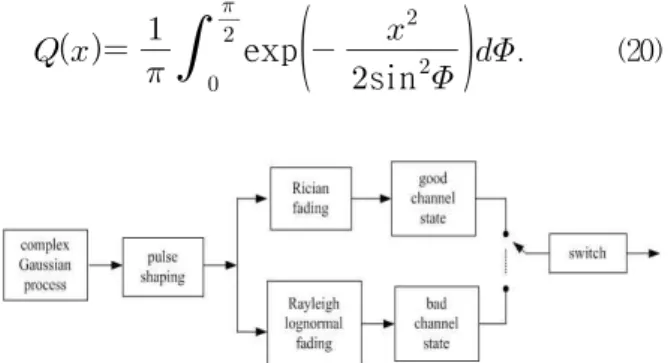
exp sin. (20)
Fig. 3. Satellite broadcasting channel model.
In Fig. 3, satellite channel simulator is shown. In the pulse shaping function, raised-cosine function is used with rolloff factor = 0.5. In this model, the satellite channel is classified into two categories: good and bad channel states[19,20]. The signal is assumed to go through un shadowed Rician fading or a shadowed Rayleigh fading channels for good or bad channel states, respectively. The direct path from a satellite to a mobile user can be blocked by high-rise building or foliages of big trees. In this case, line-of-sight (LOS)
path is not guaranteed, which leads to a Rayleigh fading with shadowing. We call this channel state {\it bad} state of the channel. When the LOS path exists, we call this channel state {\itgood} state of the channel, which is modeled as Rician fading distribution. The fading process is switched between good and bad channel states. This model can be used to describe the satellite channel in various kinds of macroscopic environments (such as rural, suburban, and urban areas).
The p.d.f. of the received envelope of two-state channel model is given by
∞
, (21)
where χ( 0≤χ≤1) is probability that the channel state is in bad state, and fRI(∙)and fRa(∙) are p.d.f.’s of Rayleigh and Rician distribution functions, respectively. In the simulation, channel state parameter
χ=0.3 is assumed.
In Fig. 4, for the optimal MAP decoding algorithm, bit error probability vs. SNR is compared for a different number of iterations. The simulation examples are shown for the standard deviation of shadowing σs=4dB and interleaver length of turbo encoder = 1000. It can be demonstrated that the turbo coding offers considerable coding gains as SNR increases compared with the uncoded case. So, it is confirmed that the turbo coding is very effective to improve performance of OFDM system in a satellite channel. As the number of iterations increases, the performance is more improved through increased coding gain.
However, it should be noted that the number of iterations exceeds some number (for this case, 8), the more iterations offers only marginal coding gain because the soft information is not available any longer after sufficient iterations.
Fig. 4. Bit error probability vs. SNR for a different number of iterations.
In Fig. 5, for the optimal MAP decoding algorithm, bit error probability vs. SNR is compared for a different interleaver length of turbo encoder. The simulation examples are shown for the number of iterations = 2 and σs=4dB. As expected, the performance is significantly improved as the interleaver length of turbo encoder increases. However, increased interleaver length incurs increased complexity. So, in a design of turbo encoder/decoder, trade-off relationship in terms of performance and complexity should be taken into account.
Fig. 5. Bit error probability vs. SNR for a different interleaver length of turbo encoder.
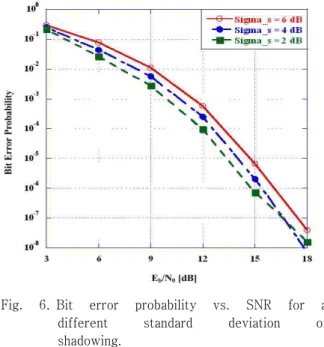
In Fig. 6, for the optimal MAP decoding algorithm, bit error probability vs. SNR is compared for a different standard deviation of shadowing. The simulation examples are shown for the number of iterations = 2 and interleaver length of turbo encoder = 1000. The BER performance is gradually degraded as the standard deviation of shadowing increases. So, from this figure, it is found that propagation conditions such as shadowing are also important factor in determining system performance.
Fig. 6. Bit error probability vs. SNR for a different standard deviation of shadowing.
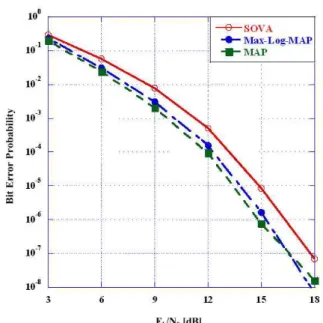
In Fig. 7, bit error probability vs. SNR is compared for different decoding algorithms. The simulation examples are shown for σs=4dB, the number of iterations = 4, and interleaver length of turbo encoder
= 1000. The optimal MAP algorithm achieves better performance compared with suboptimal algorithms such as Max-Log-MAP and SOVA. However, the performance difference between the MAP and the Max-Log-MAP is not significant. Therefore, it can be recommended that the Max-Log-MAP algorithm is better choice than the MAP algorithm in terms of both complexity and performance.
Fig. 7. Bit error probability vs. SNR is compared for different decoding algorithms.
VI. Conclusions
The performance of a turbo-coded OFDM/16-QAM system was analyzed and simulated in a satellite broadcasting channel. The MAP, the Max-Log-MAP, and the SOVA algorithms were chosen and compared in the decoding process. It was confirmed that turbo coding provides considerable coding gains for the OFDM system in a satellite channel. From the simulation results, it was also demonstrated that the Max-Log-MAP algorithm is a suitable choice in terms of performance and complexity. It was confirmed that the performance is substantially improved by increasing the number of iterations and interleaver length of a turbo encoder. These days, the most challenging issue becomes realization of turbo code with more reduced complexity while maintaining the near-optimal performance. Being all the above things considered, it can be concluded that turbo coding is a very promising technique to enhance performance of OFDM system operating in a satellite channel. The results in this paper can be applied to OFDM-based satellite broadcasting systems.
References
[1] J. Y. Kim, MIMO-OFDM Wireless Communication Systems, Intervision, 2008.
[2] G. T. Zhou and P. Liang, "OFDM for optical communications," IEEE J. Lightwave Tenhnol., vol. 27, no. 3, pp. 189-204, Feb. 2009.
[3] H. Taewon, Y. Chenyang, W. Gang, L. Shaoqian, and G. Y. Li, "OFDM and its wireless applications: a survey," IEEE Trans. Veh.
Technol., vol. 58, no. 4, pp. 1673-1694, May, 2009.
[4] H. Sari, G. Karam, and I. Jeanclaude,
“Transmission techniques for digital terrestrial TV broadcasting,” IEEE Commun. Mag., vol.
33, pp. 100-109, Feb. 1995.
[5] M. Sablatash, “Transmission of all-digital advanced television: state of the art and future directions,” IEEE Trans. Broadcasting, vol. 40, pp. 102-121, 1994.
[6] T. O'Leary, “Terrestrial digital audio broadcasting in Europe,” EBU Technical Review, pp. 19-26, 1993.
[7] M. Sehlstedt and J. P. LeBlanc, "A computability strategy for optimization of multiresolution broadcast systems: a layered energy distribution approach," IEEE Trans. Broadcasting, vol. 52, no. 1, pp. 11-20, Mar. 2006.
[8] C. Berrou, A. Glavieux, and P. Thitimajshima,
“Near Shannon limit error-correcting coding:
turbo codes,” in Proc. of IEEE ICC'93, pp.
1064-1070, Geneva, Switzerland, June 1993.
[9] S. Benedetto and G. Montorsi, “Unveiling turbo codes: Some results on parallel concatenated coding schemes,” IEEE Trans. Inform. Theory, vol. 42, pp. 409-428, 1996.
[10] A. Banerjee, F. Vatta, B. Scanavino, and D. J.
Costello, "Nonsystematic turbo codes," IEEE Trans. Commun., vol. 53, no. 11, pp. 1841-1849, Nov. 2005.
[11] B. Vucetic, L. Yonghui, L. C. Perez, and J. Fan,
"Recent Advances in Turbo Code Design and
저자 소개 김 진 영(정회원)
Jin Young Kim (M’95, SM’08) received the B. Sc., M. Sc., and Ph. D. degrees from the School of Electrical Engineering, Seoul National University (SNU), Seoul, Korea, in 1991, 1993, and 1998, respectively. He was Member of Research Staff at the Institute of New Media and Communications (INMC) and at the Inter-university Semiconductor Research Center (ISRC) of the SNU from 1994 to 1998. He was Postdoctoral Research Fellow at the Department of Electrical Engineering, Princeton University, NJ, U.S.A, from 1998 to 2000. He was Principal Member of Technical Staff at the Central Research and Development Center, SK Telecom, Korea, from 2000 to 2001. He is currently Associate Professor at the School of Electronics Engineering, Kwangwoon University, Seoul, Korea. Now, he has his sabbatical leave as Visiting Scientist at the LIDS (Laboratory of Information and Decision Systems), Massachusetts Institute of Technology (M.I.T), MA, U.S.A. His research interests include design and implementation of wireline/wireless multimedia communication systems for applications to spread-spectrum, cognitive radio, ultrawideband (UWB), space communication, optical communication and powerline communication systems with basis on modulation/demodulation, synchronization, channel coding, and detection/estimation theory.
※ 본 연구는 2009년도 광운대학교 연구년의 결과로 수행되었음. (연구년: 2009년 3월-2010년 2월) Theory," Proc. of IEEE, vol. 95, no. 6, pp.
1323-1344, June 2007.
[12] S. Ohmori, H. Wakana, and S. Kawase,Mobile Satellite Communications, Artech House Pub., 1998.
[13] J. Y. Kim and J. H. Lee, “Acquisition performance of a DS/CDMA system in a mobile satellite environment,” IEICE Trans.
Commun., vol. E80-B, no. 1, pp. 40-48, Jan.
1997. (Abstract appeared in the Scanning the Literatures in IEEE Commun. Mag., pp. 16, May 1997.)
[14] R. D. Gaudenzi, A. Guillen, and A. Martinez,
"Performance analysis of turbo-coded APSK modulations over nonlinear satellite channels,"
IEEE Trans. Wireless Commun., vol. 5, no. 9, pp. 2396-2407, Sep. 2006.
[15] C. Loo, “A statistical model for a land-mobile satellite link,” IEEE Trans. Veh. Technol., vol.
34, pp. 122-127, Aug. 1985.
[16] G. D. Forney, Jr., Concatenated Codes, Massachusetts Institute of Technology,1966.
[17] J. G. Proakis, Digital Communications, 4th ed., New York, NY: Mc-Graw-Hill, 2001.
[18] A. Ghrayeb and C. X. Huang, "Improvements in SOVA-based decoding for turbo-coded storage channels,"IEEE Trans. Magnetics, vol. 41, no.
12, pp. 4435-4442, Dec. 2005.
[19] S. Scalise, H. Ernst, and G. Harles,
"Measurement and modeling of the land mobile satellite channel at Ku-band," IEEE Trans.
Veh. Technol., vol. 57, no. 2, pp. 693-703, Mar.
2008.
[20] T. T. Ha, Digital Satellite Communications, Second Edition, McGraw-Hill, 1990.