A Study on
나ie Word Selection for Intelligibility Assessment of Synthesized Speech by Rule
( 규칙 합성음성의 이해성 평가를 위한 단어표 구성에 관한 연구)
Jin-Woo Hong * Soon-Hyob Kim, Seong-Hoon Kang **
*DeDt. of Computer Eng., Kwang Woon Univ.
"Signal Processing Sec., ETRI.
홍 진 우, 김 순 협:* 강 성 훈**
ABSTRACT
As a result ofrecent progress in speech synthesis technkmes,the thosenew services usingnew techniquesare going t0 introduce into the telephone communication system. In setting standards, voice quahty is obvigsly an important criterion. It is very important to deveiope a quality evaluation method ofsynthesized speech 血 the diagnostic asstiss- ment of system algorithm, and faircomparision of assessmentvalues. This paper has described several basic concepts and criterions for intelligibility assessment of synthesized speech by rule based on assessment item, assessment unit, and requirements to word selection. Finally, a method of wordselection and word list to be used in word intelligibility tests was proposed.
요 약
최근에 음성합성 기술이 발전됨에 따라 이러한 기술올 이용한 새로운 통신 서비스가 등장하고 있으며, 그_ 표준 설정에 있어서 음성 품질은 아주 중요한 요인이 된다. 따라서, 시스템 알고리즘의 진단적 평가 및 평가치의 상호 비교를 위해 품질 평자 방법을 개발하는 것은 매우 중요하다. 본 논문에서는 규칙 합성음성의 이해성 평가를 위한 기본적 사항들과 개념을 기술하고, 이해성 평가에 사용되는 단어표를 구성하는 방법과 단어표를 제안하였다.
I. Introduction
Recently, synthesized speechsare developed using various methods according to technical advances and expansions of their application. Therefore, it
is very important toassess the quality of synthesiz ed speech for optimum design and effective com munication network planning.
But articulation and naturalness of synthesized speech by rule are not enough to compare with that of natural speech. In this situation, it is necessary to establish the assessment method counting the quality of synthsized speech by rule,
AStudy on the Word Selection for IntelligibilityAssessment of Synthesized Speech by Rule
23
and then this assessment method can be offered to useful index for investigation and development of synthesized speech through result analysis.
In the case of qualityassessment ofsynthesiz* ed speech, word intelligibilityis used as ameasure, especially in synthesized speech by rule because it has some possibility of quality impairment owed to the sound connection.
This paper described several basic concepts for intelligibility assessment of synthesized speech by rule and proposed 比。method of word selection and word list to be used in intelligibility tests.
II. Establishment of Criterion
A. Assessment It하n
It is noticed that synthesized speech has- the different charatenstics as contrasted with natural speech because of synthesized unit and connection rule. Therefore, when listen to synthesized speech by rule repeatly, intelligibility score is increased That is, learning effect is reflected on intelligibility of synthesized speech.
Also, because the learning effect according to person is different, 나le measurements for intelligi - bility 거ssessment haveto consider following items.
(1) learning effect
(2) personal differences of listening capability
B. Assessment Unit
Assessment unit is. very important factor to implement test and is classified into "syllable", “ word”,and usentence". Each assessment unit is used according to its target and object. Generally, syllable is used for sound articulation, word or sentence is used for intelligibility efficiency. So, we used word for assessment unit.
C. Necessity of Assessment Word
In the c거se of intelligibility assessment, it is
evident that measurement results have great dif
ferences according to selected test words. Hdwever if the selected test words contain word number toomuch, it can be generated that test environ ment andtest time can be very bi홍.Theappropriate word selection andword list, therefore, are required for a reasonable test ofsynthesized speech by rule and that point lead to one of goals in this paper.
DI. Analysis of the Mother Group for Word List Construction
A. Choice of the Mother Group
The mother group must be chosen to construct word li 아s. In this paper, the data base (total 17, 532 words) of "Korean vocabulary frequency inquiry
** was 사losen as a mother group, inquiried into appearance frequency of Korean vocabulary in primary school text, issued to Korea Psycholo
gical Society.
The statistical analysis was made in valid 13, 883 words except derivative words by a suffix, person's names, and names of a place from the mother group.
B. Applicable Attributes to Word List
The criterions to select words in the mother group are introduced to identity word list with a distribution of the mother group's attributes. In this paper, we considered five articles as word attributes, i. e.,
(1) word class (2) word length (3) frequency number (4) anomalous pronounciation
(5) kinds of phoneme in first syllable
C. Statistical Analysis of the Mother Group's Attributes
(1) Classification and Distribution of Attributes
24 The Journal of the Acoustical Society of Korea, Vol.9, No.6 (1990)
Each word attribute is divided again, using basic concept to construct word lists that they have to maintain balanced frequency distribution against the mother group for five attributes proposed.
Namely, each word attribute is classified into several detailed regions by granting characteristics and words are selected from each detailed region so as to identify with frequency distribution of the mother group.
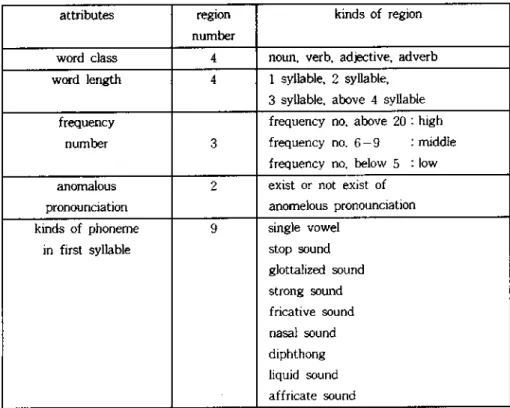
From the viewpoint of this selection method, we decided region numbers of each attribute like Table 1 so that each region can include word number as equally as possible.
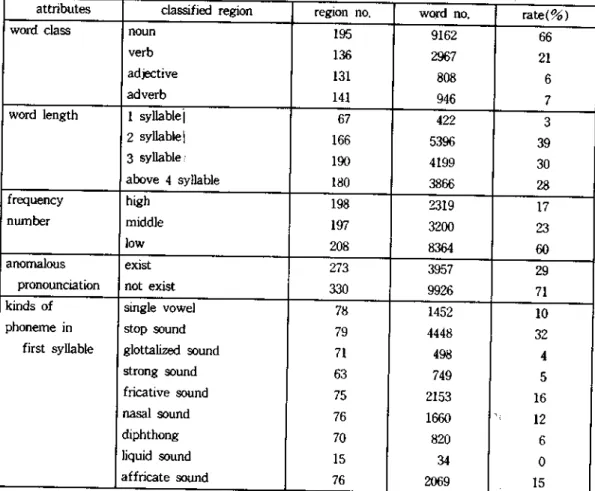
Table 2 shows the analysis results of the moth이 group to each attribute and each region. Total region numbers are 864 (4x4x3x2x9 regions).
(2) Distribution of Word Numbers Included in One Region
Onanalyzing themother group into five attribu tes, word numbers belonging to classified regions
consist of certain frequency distribution. Figure 1 shows how many word numbers in one region are included. The word numbers included in one region are represented by 乂 axis, y axis represents the accumulation of region numbers that word numbers are below the value coping with x 거지s.
In Figure 1, it is shown that the ratio of regions that word numbers of one region are below 30 to total region is 83%.
Fig. 1. Relation of the ratio ofword number to region number
Ta 이 e 1. Classified region number of e거ch attribute
attributes region
number
kinds of region
word class 4 noun, verb, adjective, adverb word length 4 1 syllable, 2 syllable,
3 syllable, above 4 syllable frequency
number 3
frequency no. above 20 : high frequency no. 6 —9 : middle frequency no. below 5 : low anomalous
pronounciation
2 exist or not exist of anomelous pronounciation kinds of phoneme
in first syllable
9 single vowel stop sound glottalized sound strong sound fricative sound nasal sound diphthong liquid sound affricate sound
A Study on theWord Selection forIntelligibility Assessment ofSynthesized Speech by Rule 25
Table 2. Frequency distribution to region of each attribute
attributes classified region region no. word no. rate(%)
word class noun 195 9162 66
verb 136 2967 21
adjective 131 808 6
adverb 141 946 7
word length 1 syllable] 67 422
3
2 syllable| 166 5396 39
3 syllable ; 190 4199 30
above 4 syllable 180 3866 28
frequency high 198 2319 17
number middle 197 3200 23
low 208 8364 60
anomalous exist 273 3957 29
pronounciation not exist 330 9926 71
kinds of single vowel 78 1452 10
phoneme in stop sound 79 4448 32
first syllable glottalized sound 71 498 4
strong sound 63 749 5
fricative sound 75 2153 16
nasal sound 76 1660 12
diphthong 70 820 6
liquid sound 15 34 0
affricate sound 76 2069 15
Additionally, the valid region numbers are 603 because the regionsnot to be included ever a word are 261.
IV. Construction of Word
니st
A. Requirement Condition to Word List
On constructing word list based on the contents as mentioned above, following three items must be considered as requiiement condition.
(1) To reflect directly the characteristics of Korean language being used usually.
(2) To reduce a learning effect to remember words by repeating test if possible.
(3) To make a word list including small size of words, maintaining balance with the mother
group and considering test environment and test condition.
We applied three conditions to word list const
ruction like lo\yer part. First is to construct word list having same features as the mother group for five attributes so that it has the balance as equally
거s possible. Second is to make variable word lists not to fix words within 나】。selected word list.
Third is to utilize word selection method delibera
ting frequency distribution of the mother group and efficient test.
B. Word S리ection Method
Because words for assessment objective are all Korean vocabularies to exist really, words as many as possible must be used for intelligibility test. To
26 The Journal ofthe Acoustical Society of Korea, Vol. 9, No.6 (1990)
take into account of efficient measurement, how ever, it is desirable that global intelligibility can be grasped by the small word number if possible.
A antinomy is arised from this problem.
And then we implemented a process of appling to tradeoff between both issues optimally. Now, think about a method of word selection utilizing frequency distribution of the mothergroup for five attributes. When total word number is AN, word number todesire selection is SN, and word number belonging to certain region is nt the condition for a word to be at least selected in that region can be represented by equation(l).
(SN/AN)x n^l (1)
That is, words are selected into regions to satisfy equation (2).
nW (AN/SN) ⑵
The smaller SN is, in this time, the more the ratio of regions not to be able to select even a word increases. So, approximation goes down from the distibution of the mother group.
,From now, “cover rate of region (BRN/ERN xl00[%])” and **cover rate of word (RAN /AN x 100〔%])” are defined. which express the ratio of regions number (BRN) for each word within a word list to the valid region numbers (ERN=6 03) and the ratio of entire word number (RAN) belonging to this region to total words (AN) each other. It is a nice idea to bring up SN so as to select words from many regions, but the cover rate of region and word makes a saturation state beyond some level of SN. To bring up SN aim lessly, that is, generates a matter of large scale test and a subject not to increase in approximation to the mother group so much as that. This app
earanceis demonstrated from Figure 2 that depicts
the relation between cover rate of word and cover rate of region to SN.
Fig. 2. Cover rate of word and regionto SN
C. Word List Construction
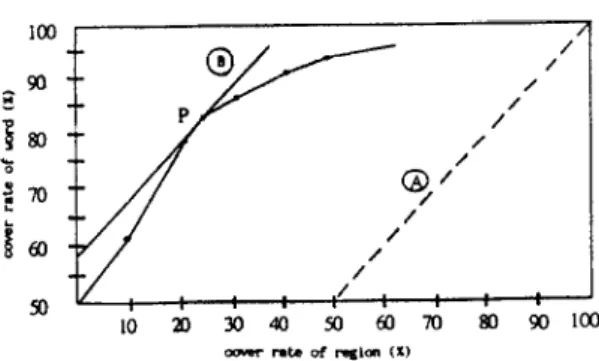
First of all, note that some degree ofrate creates a good efficiency of selection. Figure 3 shows the relation between cover rate of region and cover rate of word to word number selected. If each region has the same number of words, the distri bution draws a dotted line A as in figure 3. But on comparing word distribution with line A dist ribution, we can know that the relation of both is inclined toward one side. In the case of word selection considering of a tradeoff to cover rate of word and region, best fine efficiency is obtained by a P point that straight line B to move parallel with the dotted line A is contacted with distribu- tion curve.
Fig. 3. Relationof cover ratebetween region and word.
In the result, word numbers of a word list are
AStudy on the Word Selection for Intelligibility Assessment of Synthesized Speech by Rule 27
540 from Figure 2 because cover rate of word is about 84% in this P point. This is optimal value of word numbers within a word list to test intel
ligibility assessment.
V. Conclusion
The necessity of the quality assessment for synthesized speech by i■니e cannot emphasize too much, but there are not standard evaluation methods and word lists for assessment in Korea, so far.
This paper has described several basic concepts and criterions for intelligibility assessment of syn- thesized speech by rule, based on assessment item, assessment unit, and requirements to wordselection.
So, it was implemented to do following : to choice the mother group, to give word attributes, to analyze the frequency distribution of the mother group, and to present word selecting conditions.
Finally, we proposed the method of word selec
tion and word list construction for intelligibility measurement.
REFERENCES
1. N. Kitawaki, K. Uoh, and K. Kakehi, "Speech Quality Measurement Methods for Synthesized Speech", Review of ECL, Vol. 29, No. 9-10, Sep. 1981.
2. T. Watanabe, -Intelligibility Assessment of Synthesiz ed Speech Using Word Intelligibility Score", NTT R & D, Vol. 38, No. 10, pp. 1,143〜1,152, 1989.
3. T. Watanabe, H. Nagabuchi, and N. Kitawaki, “A Study on Quality Evalution Method of Speech Syn thesized by Rule",NTT ECL, SP86-11, 1988.
4. N. Higuchi, S. Yamamoto, and T. Shimizu, uEvalu- ation of IntelligibilityandNaturalness of the Synthetic Speech Generated with a Japanese Speech Synthesiz er by Rule", Japan EIC D-口,Vol. J71D- H, No, 8, pp. 1,133〜1,140, Aug. 1989.
5. S. R. Quackenbush, T. P. Barnwell, and M. A. Cle
ments, Objective Meas니rement of Speech Quality, Prentice Hall, 1988.
Hong
▲Jin Woo was born in Yujoo, Korea, on April 15, 1959. He received the B.S., M.S. degree in electronics engineering from the Kwang-Woon University, Seoul, in 1982 and 1984, respectly. Since 1984 he has been with the Transmission Section and the ISDN Technology Depa- System
rtment in ETRI, where he is now a senior member of technical staff. He is currently working toward the Ph.D. degree at Kwang-WoonUniversity from March 1990. His research interests include the ISDN, speech quality assessment, and speech synthesis.
▲Soon Hyob Kim was born m Jeju, Korea, on Dec.
28, 1947. He received the B.S.
degreeinelectricalengineering fromtheWool-San University in 1974, and the M.S., Ph.D.
degree in electronics engine
ering from the Yonsei Univ
ersity, Seoul, in 1976 and 1 983’ respectly. Since 1979 he has been a professor in the Kwang-Woon University. From 1986 to 1 987 he worked for the University of Texas at Austin as a visiting professor. His research interests include the digital signal processing, speech reco
gnition and synthesis, Al, and neural network.
28 The Journal of the Acoustical Society of Korea, Vol. 9, No.6 (1990)
▲Seong Hoon Kang was born in Kwangju, Korea,
■ on June 15, 1956. He received the B.S degree in electronic engineering from the Kwan- gwoon University, in 1981, the M.S degree in electronic engineering from the Yonsei University, in 1983, and the Ph.D. degree in Acoustics from the Kobe Unive
rsity, Japan, in 1987. During the period of April 1987 to August 1987, he was a visiting researcher at the Acoustic Laboratory of YAMAHA Corpo ration, where he was involved with acoustic des
igns, measurements, and subjective assessment of concert Since February halls. 1988 he has been with the
Korean Electronics and Telecommunications Res
earch Institute, as aSenior Researcher. Hiscurrent interests are the transmission quality of telephone network, Electroacoustics, Room Acoustics, and Psychoacoustics.
Dr. Kang isa member of the Acoustical Society of Japan.