http://dx.doi.org/10.7236/JIWIT.2012.12.6.297
JIWIT 2012-6-38
이동 백홀 망에서 Radio Access Network의 성능
Performance for Radio Access Network in mobile backhaul network
박천관
*Chun-Kwan Park
요 약 이동 백홀 망에서
RAN
은 이동통신 기지국을 이동 백홀망에 연결시켜 준다.
이 시스템은 여러 세대의 이동 통신 기술에 따른 인터페이스,
즉 셀 사이트 영역에서는TDM, ATM,
그리고 이더넷,
이동 백홀 영역에서는 이더넷 인터페이스로 구성된다.
조만간에TDM
기반의 이동통신 네트워크는 모두IP/Ethernet
으로 전환될 것이고,
궁극적으로 이더넷 및TDM
트래픽이IP
네트워크를 통하여 전달될 것 이다.
따라서 이들 기술들을 이동 백홀 망으로 전송되기 위하여 각각은 캡슐화가 되어야 한다.
본 논문에서는 각각의 캡슐화,
즉, ATM, MPLS, IP/UDP,
그리고MEF8
에 따른 성능이 측정되었다.
Abstract RAN in mobile backhaul network connects base station to mobile backhaul network. This the interfaces for several generations mobile communication technologies, such as TDM, ATM, and Ethernet in cell site, and then Ethernet in mobile backhaul site. In near future, the mobile communication network will be changed to all IP/Ethernet one, and then ultimately Ethernet and TDM traffics will be transferred through IP network. So these technologies have to be encapsulated for transferring to the mobile backhaul network. The performances are measured for each encapsulation, such as ATM, MPLS, IP/UDP, and MEF8.
Key Words : backhaul, RAN, MEF, PWE, Emulation
*종신회원, 국립목포해양대학교
접수일자 : 2012년 10월 23일, 수정완료 : 2012년 11월 28일 게재확정일자 : 2012년 12월 14일
Received: 23 October 2012 / Revised: 28 November / Accepted: 14 December 2012
*Corresponding Author: [email protected]
Division of Electric and Communication Eng. Mokpo National Maritime University, Korea
Ⅰ. Introduction
These days as the convergence network of both wired and wireless has been appeared, ISP can provide users with the convenient and cheap communication services. The convergence network is not only meant to convergence both wireless and wired networks in one network, but it also includes the diverse connection
interfaces based on all-IP network and can transfer the diverse applications through the network
[2][3][5].
The fast growing packet traffics through the mobile
communication network has promoted to evolve the
existing network to the convergence network based on
all-IP. As 3G and 4G data services are introduced, and
the data traffics have exceeded the voice traffics, the
bottleneck phenomenon is occurred in mobile backhaul
network
[4][5].
As mobile backhaul network connects the mobile communication base stations to BSC/RNC, it has to transfer the bandwidth requirements of the diverse generation technologies, such as 2G, 3G, 4G, and WiMAX. So mobile backhaul network has migrated from TDM/ATM network to all-IP based one via the hybrid of both technologies
[2][3].
As RAN(Radio Access Network) system connects the mobile communication base stations to the backhaul network through T1/E1, Ethernet, and ATM interface in cell site, it can reduce the costs of transport link between BS and BSC/RNC. This also can reduce the number of transport links by sharing the transport links that each generation technology uses individually.
New technologies, such as Wi-Fi, WiMAX, and LTE are natively based on packet switched backhaul network, the pseudowire framework is need to transport the existing services, such as TDM over a packet switched network, such as Ethernet, IP, and MPLS. In this paper, the performance of RAN system, such as the processing performance, delay time for ATM, IP, MPLS, and MEF are measured.
Ⅱ. Mobile backhaul network technologies
Figure 1 shows the overall configuration of mobile backhaul network. The mobile backhaul network is the area from the transmission equipment connecting cell sites to the transport aggregation equipment connecting the central sites. So it can be classified into three sections, such as cell site, backhaul network, and mobile core network. To accommodate the growing diverse applications in mobile backhaul network, it has to be changed from TDM/ATM to packet based networks
[1][2][4].
This architecture is based on all-packet backhaul network. So to support 2G/3G services, this network has to support TDM/ATM emulation service. To support it on packet-based network, it is important to
support QoS similar to TDM/ATM, such as the clock recovery, packet-loss recovery, and real-time mechanisms
[2][3].
Fig 1. Mobile Backhaul Network 그림 1. 이동 백홀 네트워크
The increase in access and edge network transport is forcing service providers to consider other cost effective transport mechanisms. Circuit switched transport mechanisms, such as E1/T1/E3/T3 and SDH/SONET, has been the core of the voice network.
With the evolution of ubiquitous packet networks, there are efforts to transport voice over the packet switched network. Circuit emulation Services over packet networks transport digital trunks such as E1/T1/E3/T3 as well as SDH/SONET circuits over packet networks.
There are challenges in realizing virtual circuits over packet networks, with interfaces satisfying the same performance characteristics as the circuit switched networks
[7][8].
Ⅲ. RAN architecture
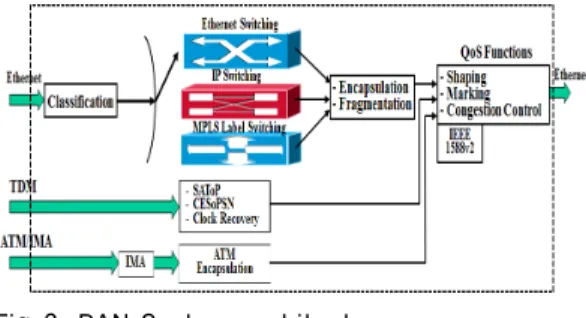
Figure 2 shows RAN system architecture. RAN
system can transfer the traffics through IP/MPLS
transport network, and the traffics of BS also can be
transferred using point-to-point wireless transport
technology (wireless bridge). And it provides QoS
which can the priority according to the traffic
characteristics. Also it connects BS to mobile backhaul
network through T1/E1, Ethernet, and ATM interfaces
in cell site
[6][7].
This RAN system consists of classification, QoS unctions, PWE3, such as payload encapsulation and PSN&physical header. TDM data, which is sensitive to transmission delay time, is transferred through CES in mobile backhaul network. And the rest of data traffics can be transferred through ATM or Ethernet.
SAToP(RFC4553) is suitable for transferring the overall TDM stream without considering framing and DS0 time slots. In the case of TDM stream, RAN ssystem converts the received data stream into the packet of 256 bytes, and inserts SAToP packet header in this packet, and then transfers this packet stream through network. As this provides the simple capsulation service and needs just a few of the general connection items, the installation of SAToP link and the service turn-up are not complicated
[8][9]. CESoPSN(RFC5086)는 provides more bandwidth efficiency than SAToP, and user can choose which time slots (64kbps channel or DS0 channel) they transfer trough PSN. As this is efficient in the bandwidth limited access network, this is reasonable in terms of economy. In RAN, for identifying these DS
0, TDM framing function is needed to find the frame alignment signal and the individual time slot
[8][10].
Fig 2. RAN System architecture 그림 2. RAN 구조
TDM signals force TDM traffics to segment, adapt, and encapsulate at PSN input side. At PSN output side, the reverse operation is done. The adaption is the mechanism that has the payload change to do the proper reconstruction at PSN output side. By using the proper adaption method, TDM signal and timing can reconstruct, and the packet loss can be permitted to a
certain extent. The capsulation function arranges the adapted payload into the packet type that required and then generated by PSN technology.
Ⅳ. RAN system model and performance
Figure 3 shows RAN system model for measurement. it is connected to cell site through T1/E1, or Ethernet, or ATM&IMA interface. And it also is connected to the backhaul network through Ethernet interface.
if mobile base station is connected to the backhaul network, data rate is more increasing, but the cost of connecting Ethernet of gigabit level is more decreasing.
So in the case of installing new backhaul network, IP/Ethernet is selected. But ISPs have to pay high TDM rent costs to maintain hundred thousand BSs which are installed using TDM connections, such as E1, T1, T3, and E3. In fact, the revenue of the existing ISPs is increasing because of the growing number of network for mobile backhaul. So the existing ISPs have adopted the circuit emulation service to change the core network from TDM circuit to the packet based infrastructure while maintaining their own revenue.
Therefore, they can decrease the cost by transferring the signals through the cheaper Ethernet network based on this
[4][5][7].
Classifier classifies the input traffics from input
interfaces, such as TDM, ATM&IMA, and Ethernet,
and then stores the classified traffics in the several
queues, such as flow based queue, class based one, and
VC based one. In ATM interface, the packets are
stored in queue according to VC. In the case of
Ethernet, Frame relay, and HDLC/PPP, the frames are
stored in queue according to flow. In Gigabit Ethernet
and high speed POS interface, the packets are stored in
queue according to class, and this packet is serviced
through the strict priority scheme.
Fig 3. RAN System Model 그림 3. RAN 시스템 모델
Many standards were recently published by IETF PWE3 (Pseudowire Emulation Edge to Edge). PWE3 is the layer 2 VPN that provides the tunnel to emulate the diverse services over PSN(IP, MPLS). In IP/UDP, the encapsulation overheads consists of 14bytes Ethernet header, 20bytes IP header, and 8bytes UDP header. For MPLS, the encapsulation overheads consists of 14bytes Ethernet header, 4bytes MPLS outer label, and 4bytes MPLS inner label. For MEF E-Line, the encapsulation overheads consists of 14bytes Ethernet header, 4bytes outer VLAN tag, and 4bytes inner VLAN tag. In all cases, TDM signals begin with PSN header (IP/UDP&MPLS). These architectures are the standard header applied to PSN technology
[1][2][3].
Fig 4 shows the processing performance of RAN system, which is the results in no encapsulation state.
The whole link bandwidth is 1Gbps, and the throughput is gained according to the packet length with changing the load by 10%, 50%, 90% for this bandwidth.
Fig 4. Processing Performance 그림 4. 처리 성능
Fig 5 shows ATM cell delay in RAN system. This delay is the time when one ATM cell is loaded on
Ethernet frame. The load is the using one of total 1Gbps bandwidths. This delay is gained according to encapsulations, such as IP/UDP, MPLS, and MEF E-line. In this result, MEF-line encapsulation has larger delay than the remaining two ones.
Fig 5. ATM Delay Time 그림 5. ATM 지연 시간
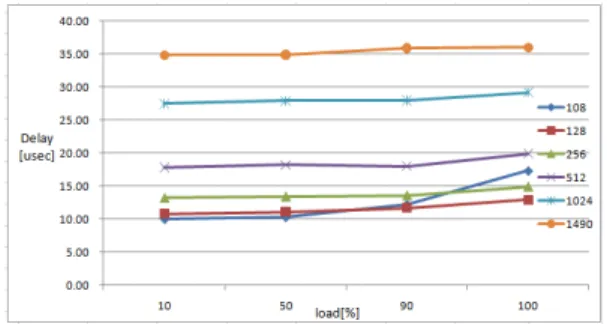
Fig 6 shows the delay of IP packet encapsulated by IP/UDP. The overheads for encapsulation are Ethernet head of 14bytes, IP header of 20bytes, and UDP header of 8bytes. In the case of 64bytes packet, the delay is increased at 90%~100%load. This may be related to the decrease of throughput in this area.
Fig 6. IP delay for IP/UDP 그림 6. IP/UDP에 대한 지연시간
Fig 7 shows the delay of IP packet encapsulated by
MPLS. The overheads for encapsulation are Ethernet
head of 14bytes, MPLS outer label of 4bytes, and
MPLS inner label of 4bytes. The shows the similar
characteristics to IP delay.
Fig 7. IP delay for MPLS 그림 7. MPLS에 대한 IP 지연시간
Fig 8 shows the delay of IP packet encapsulated by MEF E-line. The overheads for encapsulation are Ethernet head of 14bytes, outer VLAN tag of 4bytes, and inner VLAN tag of 4bytes.
Fig 8. IP delay for MEF 그림 8. MEF에 대한 IP 지연시간
Ⅴ. Conclusion
The mobile backhaul network has migrated from TDM/ATM network to all-IP based one via the hybrid of both technologies. So it should accommodate all kind of mobile generation technologies. To support RAN backhaul network based on All-IP, it has to consider the diverse requirements, such as clock synchronization, security, Quality of Service, and OAM.
This paper addresses the performance of RAN based on PSN with the encapsulation of each interface, such as ATM, IP.UDP, MPLS, and MEF. In the near future, the study for mobile backhaul LTE will be done.
Reference
[1] Humair Raza, “A brief survey of radio access network backhaul evolution : part 1”, IEEE Communications Magazine, PP164~171, June 2011.
[2] 홍승우, 류호용, “Technical Trend of Backhual for Fixed Mobile Convergence”, 전자통신동향 분석 제 25권 제6호, PP71~81, Dec. 2010.
[3] Tipmongkolsilp, O; Zaghloul, S; Jukan, A, “The evolution of Celluar hackhaul technologies : Current issues and Future Trend", IEEE Communication Surveys & Tutorials, Issue: 99, PP1~17, 2010.
[4] UTStarcom, “3G/LTE Mobile Backhaul Network MPLS-TP based Solution”, White paper.
[5] NEC Corporation, Mobile backhaul evolution for deploying Mobile Next Generation Networks (Mobile NGN), White paper, Feb. 2007.
[6] White paper, "Metro Ethernet Quality of Service", Alcatel Telecommunication Review, 4
thQuater 2004.
[7] Ran Avital, "Mobile Backhaul Network Migration -Building an Evolution-Ready Backhaul", Ceragon Network, White Paper, 2007.
[8] Huawei Technologies Co., Ltd, “Technical White Paper for PWE3”,
http://www.huawei.com/products/datacomm/pdf/
[9] RFC4553, "Structure-Agnostic Time Division Multiplexing (SAToP)", June 2006
[10] RFC5086, "Structure-aware TDM Circuit Emulation Service over Packet Switched Network (CESoPSN)", July 2005.
[11] BROCADE, "Carrier Ethernet Technologies Comparison",
http://www.trainercomm.com/.../brocade/, Feb. 2010.
[12] NEC Corporation, "Mobile Backhaul Evolution for deploying Mobile Generation Networks (Mobile GEN), White Paper, Feb. 2007.
[13] 3Com Corporation, “Inverse Multiplexing over
ATM”, hppd://www.mtmnet.com/PDF_FILES/.
저자 소개
Chun Kwan Park(평생회원)