접수일자 : 2011년 10월 05일 심사일자 : 2011년 11월 20일 최종완료 : 2011년 12월 17일
*교신저자, E-mail : [email protected]
A new approach for k–anonymity based on tabu search and genetic algorithm
論 文
10-4-3
Cui Run, Hyoung-Joong Kim
*, and Dal-Ho Lee
Abstract
Note that k-anonymity algorithm has been widely discussed in the area of privacy protection. In this paper, a new search algorithm to achieve k-anonymity for database application is introduced. A lattice is introduced to form a solution space for a k-anonymity problem and then a hybrid search method composed of tabu search and genetic algorithm is proposed. In this algorithm, the tabu search plays the role of mutation in the genetic algorithm. The hybrid method with independent tabu search and genetic algorithm is compared, and the hybrid approach performs the best in average case.
Keywords : database, privacy, heuristic, algorithm
I. INTRODUCTION
Sometimes organizations have to publish mi- cro-data for special usages such as statistical analy- sis and health condition research. In order to protect individual privacy, known identifiers (e. g., name or social security number) must be removed.
However, that is not enough. In addition, this process must consider about the possibility of combining certain other attributes with external data to uniquely identify individuals. Such kind of attributes combi- nation, called quasi-identifiers, can also locate the individual because they make up a unique mark to be distinguished. For example, an individual might be re-identified by joining the released data with another (public) database on age, sex, and salary.
The k-anonymity model is just one of the most popular ways to solve the privacy protection problem.
It provides modification to the tuples in the database to remove the quasi-identifiers. It makes sure that
each record is indistinguishable from at least other records. The idea is simple, but it has been proved that how to get k-anonymity property in the database is an NP hard problem. That is, k-anonymity cluster- ing is quite challenging.
Up to now, there are many excellent researches in k-anonymity area [1-5]. Most of them are based on the analysis of the data and try to find some patterns for the data in order to achieve k-anonymity fast. However, for the complexity of the data, there is no “common” model in most cases, which means that information loss is brought in with the pattern achieved higher after the modification applied to the database. To solve the problem above, some self-adoptive methods are invented. One of the effi- cient examples is heuristic algorithm [6-8]. As thek-anonymity is an NP hard problem, heuristic algorithm is quite suitable to be applied in such cases.
However, it is a pity that most of the heuristic includ-
ing genetic algorithm pay attention to the data mod-
ification in record level other than full domain. This
provides more chances for the analysts to get useful
information from the modified records. In such a
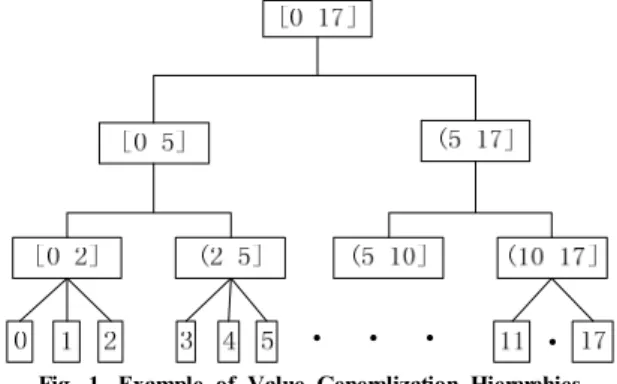
Fig. 1. Example of Value Generalization Hierarchies
kind of method, two similar records can have a high probability to be modified to different internals and such a situation introduces higher distinguishable ability for the two processing records. Full domain consideration is important in k-anonymity problem.
The conception of lattice is introduced into this area in [9] and [10] in order to enhance the full domain modification property. Each node in a lattice in k-anonymity represents a way of modification. With a lattice, how to find a suitable solution has been changed into how to search in the lattice node space to get a suitable node. In [11], the authors provide an efficiency binary search algorithm (OLA) to find the optimal node in lattice space. However, it focuses on lattice space with monotonic property. If the nodes are not monotones, it can also give good solutions but no support in theory.
Based on the previous work mentioned above, we provide a new heuristic search method in lattice sol- ution space; this approach is a combination of tradi- tional tabu search method and genetic algorithm.
It inherits the strong “climbing” ability of tabu search and the multiple start point property of genetic algorithm. We compare the performance of this new approach separately with the tabu search and genetic algorithm. This paper shows our method performs better in most of cases.
Some basic concepts are described as follows:
Quasi-Identifier Attribute Set: A quasi-iden- tifier set Qis a minimal set of attributes in table T that can be joined with external information to re-identify individual record(with sufficiently high- probability) [3].
Equivalence Class: A table T consists of a mul- ti-set of tuples. An equivalence class for T with respect to attributes X1, …, Xdis the set of all tuples in T containing identical values (x1, … , xd) for X1, …, Xd [4].
k-Anonymity Property: Relation T is said to satisfy the k-anonymity property (or to be k-anony- mous with respect to attribute set Q if every count in the frequency set of T with respect to Q is greater than or equal to k [3].
Information Loss: It represents the difference between the original and modified record. There are many different ways to calculate the value of this variable.
In Section II, we explain how to construct a lattice solution space for the database and introduce some necessary preparations such as information loss. In Section III, the details of the hybrid algorithm are shown and in Section IV experiment results are given to compare the new method with other traditional heuristic algorithms such as genetic and tabu method. Finally, we give the conclusion for our work and provide some possible directions on how to im- prove the method in the future.
II. Lattice generation and evaluation matrix
A. Value Generalization Hierarchies
Lattice in the k-anonymity problem is based on the conception of value generalization hierarchies.
It is a tree structure and its internal nodes are inter- vals and its leaves are values appeared in the corre- sponding attribute.
Each value generalization hierarchy is corre- sponding with one of the attributes in the database.
The leaves are really values appeared in this column
and the upper node is interval which can contain
all the values or intervals in its sub-node. All the
interval nodes located in the same height of the tree
are disjoint. Here is an example. Consider the attrib-
ute Age, where the possible values appeared in the
Table. 2. Algorithm: Lattice-Construction
N: the amount of attributes we use in the database.
A
i: the ith attribute in the database. 1≤i≤N.
H
i: the height of the value generalization hierarchy for A
i.
L: the lattice set for solution nodes.
T: temporary set for storing nodes.
Mark: variable to mark the levels of the nodes in lattice
NeighborSet: this set is defined as follows:
for a node [x
1,x
2,…,x
n], we check the node
[x
1-1,x
2,…,x
n], [x
1,x
2-1,…,x
n], …[x
1,x
2,…,x
n-1]. Among these nodes, if one of the values inside is less than 0, we delete it. All the elements remained after checking form the NeighborSetof node checked
Table. 1. Somedefinitions in the paper
column are 1 to 17. The corresponding value general- ization hierarchy is shown inFig. 1.
B. Lattice Generation
Samarati [12] and Sweeney [13] have formulated mechanisms for k-anonymity property using the ideas of generalization and suppression. In their works, they showed basic knowledge about the con- struction witha small scale example. However, in heuristic method, we can process much more attrib- utes at the same time by increasing the size of candi- date solutions easily. The variables we use for the construction of lattice solution space are as follows:
Here we show how to get the lattice of solution space in k-anonymity problem.
1.
⋯
, Mark = 1, assign the Mark value to all the nodes in
2. Find all the nodes with highest level value in . For each node, calculate its NeighborSet and add the set to .
3. IF is not …
a) Mark = Mark + 1,
b) For each Node x in T, find its Neighbor- Set, add the set to , assign the value of Mark to their level value.
c) Go to 2.
4. LSE, add … to 5. END algorithm.
After applying the algorithm above to the attrib-
utes, we can get a solution space in the form of lattice.
C. Suppression
In full domain k-anonymity method, suppression is used to deal with the remained records in small size equivalent classes All these small scale data will be suppressed in one equivalence class to achieve k-anonymity. As the suppression can introduce higher information loss, we must control the percent of the suppression in the full domain data modification. We prefer to use value generalization hierarchies, but we cannot avoid suppression.
D. Evaluation Matrix
There are many different kinds of Information Loss Matrix, but there is no common rule for that.
Thus, users can choose any kind of traditional Information Loss Matrix or design their own method.
In this paper, to achieve a non-monotonic property, we adopt the Discernability Metric (DM) as in Eq.
1, where fiis the size of equivalence classes:
∑
≥
≤
∙ (1) DM value means the distinguishability or the records. If DM is bigger, it represents that we can distinguish data more easily and less information loss occurs. In this case, only few data modification is required.
III. Hybrid method details
Now we will introduce our new search method in the lattice space. This method is a combination of tabu search method and genetic algorithm.
The traditional tabu search has a strong capability of “climbing”. It can jump out of the local optimal solution and has a possibility to achieve the best solution point. However, this climbing capability is highly limited by the starting point of the tabu search.
For some problems of tabu search which gets the
starting point with greedy method, it always shows
that the starting point is optimal. As we use a good
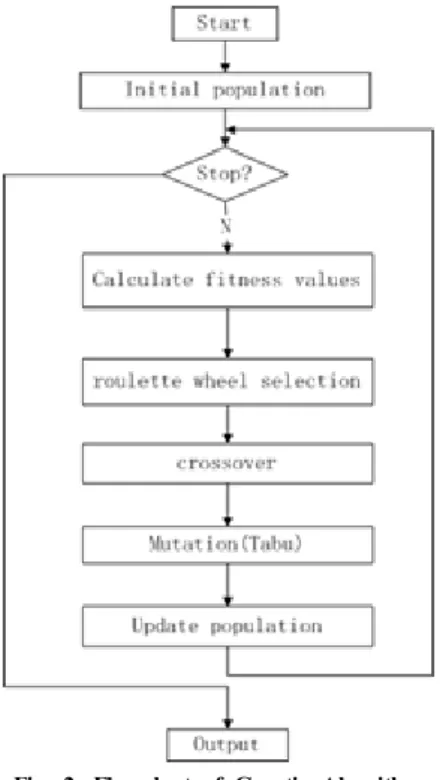
Fig. 2. Flowchart of Genetic Algorithm
Fig. 3. Flowchart of combined method
starting point search strategy, it may limit the chance to achieve the really optimal solution at the same time. For genetic method, it owns a good multiple starting point properties. With the large size of pop- ulations, it can also find a very good solution but with high level of randomness. If you are lucky enough, you will find a much better solution than
you imagine. It cannot produce a stable best or nearly best solution for the problem processing.
In our method, a tabu search is embedded into the traditional genetic algorithm to implement a local search from multiple starting points getting from genetic method. Here, the tabu search performs the role of mutation in the genetic algorithm.
Fig. 2shows the basic framework of the genetic part in our approach and the framework of the tabu part is shown inFig. 3.
In Genetic Algorithm part, the setting for each part is as follows:
Initial solution: We randomly generate an initial population which serves as multiple start points of the whole algorithm within lattice space. A uniform distribution is used in random procedure.
Stop condition: A value of 100 is appointed as the limitation of the cycle time. If it arrives at the limitation, the algorithm will stop and output the best solution node that can be achieved.
Fitness value: Each node in lattice space corre- sponds with a strategy of database modification.
In this paper, DM value becomes larger with less information loss; we can use the inverse of DM value to evaluate the information loss. The fitness is de- fined as follows:
╱ (2) where DM value is defined inEq 1.
Roulette wheel selection: This part is a tradi- tional strategy to choose the candidates with the fitness value. Assuming each node, x, fxis the corre- sponding fitness value. Then, in the selection wheel, it will own a chosen probability Px defined as:
╱∑ (3) Then, we can choose the number of candidates randomly chosen according to the possibility as above.
Crossover: In this part, we randomly choose pairs
from the candidates. Cut the pairs from a random
point between two attributes and exchange the sec-
ond halves of the solutions to get a new pair of
solutions. The procedure will be repeated until we
get enough new candidates.
Update population: After the tabu part, which performs the role of mutations in the genetic algo- rithm, we will get a new group of solutions. The original population will be replaced by a new group of solutions in this step.
The procedures in the tabu search part are shown as follows:
Initial point: In this step, for each node passed by crossover part, the tabu search will deal with it as a starting point and search the local area around it.
Generation limitation check: The circle time will be checked in this procedure. If the limitation is arrived, the tabu part will be ended.
Neighbor Search: The concept of neighbor is defined as follows: For any pair of nodes x and y, we subtract the corresponding attributes values from x to y. If the results are all 0s but only one nonzero integer, x and y are neighbors.
For example, x = [1 2 3], y = [1 3 3], x-y= [0 -1 0], then, x and y are neighbors. In this step, we will produce all the possible neighbors for the nodes we are checking and calculate their fitness values at the same time. The union of neighboring sets from different nodes being checked will be sent to the next step to process it.
Choose Candidates: This procedure will choose the candidates for the circle of the tabu search. There are two kinds of nodes: k-anonymity node and non-k-anonymity node. All thek-anonymity will share a possibility 0.7 and all non-k-anonymity no- des will share the left 0.3. However, among each subclass of nodes, the candidates are equally chosen.
In this step, we always remember the best node solution for k-anonymity. Candidate in the tabu list will not be considered.
Update Tabu list: After the candidate chose, the tabu list will be updated. The new candidates will enter into tabu list. Some nodes in the tabu list will be removed if their living time arrives.
Output: The best solution for the tabu search will be produced.
Ⅳ. Experiment result and analysis
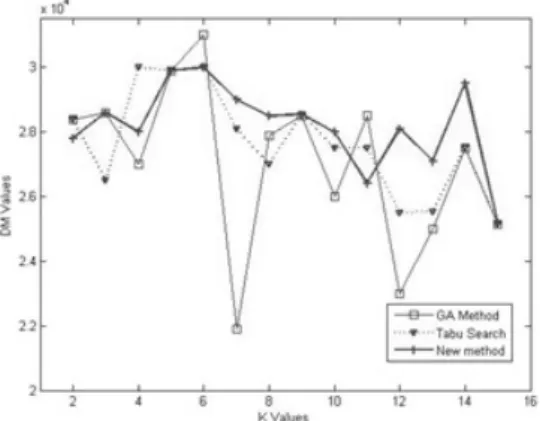
This section evaluates the performance of our new search method for different k values (1 to 15). At the same time we also compute the performance of traditional genetic algorithmand tabu search sepa- ra-tely. The test database is the Pima Indians Diabetes Database, which is consisted of 768 records and 9 attributes.
In genetic part of our method, we set the population size as 20 and the circle time as 20.In tabu part of our algorithm, we set the number of candidates is 20; size of tabu list 6; living time7;circle time 20.In traditional tabu search and genetic algorithm, we adopt the same setting except that the circle time is 300.
We repeat the algorithm for 50 times and get the average results as shown in Fig. 4and Fig. 5 for different databases.
From the analysis of experiment results, we can see that in most the cases, our new approach is better than single tabu search or genetic algorithm.
It has a stable performance than the two methods.
For small values of k, the differences among the three methods are small, but as the increase of k the differences increase at the beginning and de- crease later.
Ⅴ. Conclusion
This paper presents a hybrid search method com- posed of tabu search and genetic algorithm. The experimental results show that the proposed heu- ristic approach is a good method to search for the solutions in lattice space. Even though the method is simple, it achieves better perform than the other two traditional heuristic method.
There are still many things to do in the future
work. We can try to find some efficient aspiration
criterion in the tabu part. Also in the crossover part,
we can replace it with many other kinds of method
such as two point crossover. Since the DM value
Fig. 4. Average performance results for Pima Indians Diabetes Database
Fig. 5. Average performance results for Poker Database