Research Article
Effect of Nitrogen Fertilization Levels and its Split Application of Nitrogen on Growth Characters and Productivity in Sorghum × Sudangrass Hybrids
[Sorghum bicolor (L.) Moench]
Jeong Sung Jung1*, Young-Jin Kim1, Won Ho Kim1, Sang-Hoon Lee2, Hyung Soo Park1, Ki Choon Choi1, Ki-Won Lee1, Tae-Young Hwang1 and Gi-Jun Choi1
1Gassland & Forage Division, National Institute of Animal Science, Rural Development Administration, Cheonan 31000, Republic of Korea,
2Planning & Coordination Division, National Institute of Animal Science, Wanjugun, 1500, Republic of Korea
ABSTRACT
Nitrogen (N) fertilizer management is one of the important aspects of economic production of sorghums in sustainable agriculture. The aim of the study was to evaluate the effects of different N application rates and its split N application methods on productivity, growth characteristics, N accumulation, N use efficiency (NUE), and feed value of Sorghum × Sudangrass hybrids.
Treatments consisted of five N application rates (0, 150, 200, 250, and 300 kg ha 1) and two split N application methods (40%
in basal N, 30% at the growing stage, and 30% after the first harvest vs. 50% in basal N and 50% after the first harvest). Plant height, leaf width, and stem diameter were increased (p 0.05) with increasing N fertility rates at each harvest. Chlorophyll content (expressed as SPAD values) was the highest at a rate of 300 kg N ha 1(first harvest, 46.32; second harvest, 33.09). It was the lowest at zero N (first harvest, 21.56; second harvest, 18.5). Total N, N uptake, and NUE were increased with higher N rates. Split N application had little effect on total N, amount of N uptake, or NUE. Total dry matter yields were the highest (21,715 kg ha 1) at a rate of 300 kg N ha 1. It was the lowest (10,054 kg ha 1) at zero N. Our results suggest that more than 300 kg N ha 1 can improve dry matter yield to be above 116% compared to zero N, thus enhancing the agronomic characters of sorghums. However, no significant effect had been found for split N application. Further work is needed to determine the optimal N levels and the effect of split N application rates.
(Key words : Nitrogen, Sorghum × sudangrass hybrids, Fertilizer, Split application)
. INTRODUCTION
The sorghum × sudangrass hybrid [Sorghum bicolor (L.) Moench] (SSH) is widely cultivated as forage during the summer season all over the world. It considered as promising source for hay, silage and green chop (Ali et al., 2014). SSH has an advantage of fast growth and multicuts, however it has a lower feed value than corn (Kim et al., 2012). SSH is one of the most important summer forage crops together with forage corn widely used to produce silage in the South Korea (Seo et al., 2000). SSH is grown on more than 26,491 hectares with productivity of 397,372 ton in 2014 that approximately 59% of the total land area of summer forage crops in South Korea (MAFRA, 2015).
SSH has renowned for its high production and weed suppression properties, as well as for water-deficit, heat and salinity tolerance (Jung et al., 2015). Also, SSH can be successfully grown with winter forage crops, such as Italian ryegrass (Lolium multiflorum Lam.), forage barley (Hordeum vulgare L.) and rye (Secale cereale) in double cropping systems (Ji et al., 2010).
Nitrogen (N) fertilization is a very essential nutrient to increase productivity and feed values of forage material (Turgut et al., 2005; Worker, 1976). SSH is very sensitive to N fertilization (Gardner et al., 1994). Forage sorghum accumulate great amount of nutrients from soil to meet its high nutrient requirements, making it important to create optimum soil conditions by frequently monitoring. Splitting
* Corresponding author : Jeong Sung Jung, Grassland & Forage Division, national Institute of Animal Science, Rural Development Administration, Cheonan, 31000, Republic of Korea. Tel: +82-41-580-6748, Fax: +82-41-580-6779, E-mail:
and timing of application is considered as a key factor in N fertilizer management to ensure better nutrient distribution by improving N use efficiency (NUE) and lowering N loss (Lopez-Bellido et al., 2006; Marsalis, 2006; Khosla et al., 2000). Therefore, it is important to meet plant needs to improve NUE by suitable N application time and rates (Lopez-Bellido et al., 2006). According to Beyaert and Roy (2005), the best productivity was obtained at N rate of 125kg ha 1, the most economical rates ranging from 83 to 107 kg ha 1. NUE and apparent N recovery (ANR) were improved by two equal applications of N, compared to a single application (Beyaert and Roy, 2005). Studies of BMR (brown mid rib) SSH response to nitrogen rates and application method have shown that the greatest productivity was obtained by N rate of 222 kg ha 1 in split applications, split applications of N was improving productivity and increasing N uptake efficiency (Kilcer et al., 2002). However, there are a lot of conflicting results on the effect of split nitrogen application. Split N application treatment had no effect on yield in the study of wheat response to nitrogen fertilization timing (Alcoz et al., 1993). Also, this strategy increased costs by the second application using ground application equipment and was depend on weather and soil conditions (Prokopy and Widhalm, 2011).
In the past, Korean agriculture had focused on enhancement of soil fertility and high-input agriculture. However, currently it began to focus on environmentally-friendly and sustainable agricultural systems (Moon et al., 2010). Therefore, it is important to optimize the application of N fertilizer levels to increase productivity, but consider economic efficiency and avoid soil pollution (Hirel et al., 2001). Nitrogen compounds are directly absorbed by plants or converted into other compounds by oxidation. If N is not used by roots, it leaches out through the soil into groundwater (Tamme et al., 2009; Brady and Weil, 2008; Liu et al., 2014). However, excess amount of N would be serious threat to the surrounding environment, causing eutrophication, greenhouse effects and acid rain (Liu et al., 2014). Pollution from N fertilization is the main ozone depletion and global warming via N2O emission to the atmosphere (Nadeem et al., 2012; Solomon, 2007).
Much research has been done on optimal N fertilization levels and timing and application method in sorghums.
However, there have been no studies to conclusively prove correlation between N application rates and method of split application. Therefore, the aim of the study was to determine the response of SSH to N fertilization levels and split- application and also to evaluate the influence of these application methods on productivity, growth characteristics, N accumulation, NUE and feed value.
. MATERIALS AND METHODS 1. Experimental site
The field experiment was carried out in 2015 at the experimental plots of Grassland and Forage Division in Cheonan (36°49’0” N, 127°10’ 0” E), Republic of Korea.
Temperature and precipitation were shown in Fig. 1. During the experimental period (May-September 2015), total precipitation was much lower than the 30-year average (343.5 vs. 940.2 mm, respectively), the average temperature was similar to the 30-year average (22.3 vs. 21.7°C, respectively). Soil at the experimental site was clay-loam, slightly alkaline (pH 7.2), medium in available P2O5(253.5 mg kg 1), with higher extractable K (0.80 cmol+kg 1) and medium in organic matter (22.5 g kg 1) (Table 1).
2. Agronomic practices
SSH was the ‘SX-17’ cultivar. Plants were sown in 16 May 2015 at a rate of 40 kg ha 1, and were harvested in double cut on 27 July and 22 September 2015, when forage SSH was at the 50% flowering stage. The application rates
Fig. 1. Mean monthly temperature and precipitation during the growing season (2015) and 30 years average in cheonan.
of the basic fertilizers were in 150kg ha 1 for phosphorus and 150 kg ha 1 for potassium.
3. Experimental design
The experiment was set up in a randomized complete bock design with split-plot design in three independent replications. On the main plot, N (Urea 46%) fertility rates of 0, 150, 200, 250 and 300 kg ha 1 were applied and on the subplot, there were two-split nitrogen application methods (40% in basal nitrogen, 30% in growing stage and 30% after first cut; 50% in basal nitrogen and 50% after first cut). Each plot was 12 m2(3m×4m) with 50cm spacing between rows (6 rows per plot).
4. Data collection
For agronomic trait measurements, ten plants were randomly selected from each plot before harvest. Plant height, leaf width and stem diameter were measured according to the investigation and analysis of research and technology in agriculture (RDA, 2012). Sugar content was measured using a digital refractometer (Atago, Tokyo, Japan) and expressed as °Brix value. The SPAD value was measured with a chlorophyll meter (SPAD 502, Minolta, Japan) and expressed as a mean of 20 measurements for each individual leaf of on each plant. To determine crop productivity, the center two rows in each plot were harvested by hand-cutting.
Sub-samples were collected randomly from the harvested crops to calculate dry matter yield by oven- drying at 70°C for 72 h. Total N content of plants was determined using the Dumas combustion method (ElementarVario Max CN Analyser). The amount of N uptake was calculated as dry matter yield (kg 10a 1) × N concentration of plant. NUE was calculated as [yield at Nx - yield at N0] / [N fertilizer applied
at Nx] × 100 (Beyaert et al., 2005; Guillard et al., 1995).
5. Statistical data analysis
Statistical analyses were performed using SAS System for windows (release 9.2; SAS Institute, Cary, NC, USA). Data were analyzed using PROC GLM (general linear models) procedure and means were separated on the basis of Duncan multiple range test (SAS Institute, 2007). Significances were declared at p 0.05 level.
. RESULT AND DISCUSSION 1. Agronomic characteristics of plants
Plant height is an important indicator of the performance of forage sorghums (Ali et al., 2014). In our experiments, plant height was significantly affected by N application rates, while it was unaffected by split N application. Data presented in Table 2 revealed the effect of N application levels and N split application method on SSH growth.
Plant height from the first and second harvest time increased with the addition of N, but was not affected by split application method. Maximum plant height was 284 cm at a rate of 300 kg N ha 1 and was 267, 261, 247 and 177 cm at 250, 200, 150 and 0 kg N ha 1, respectively in the first harvest (p 0.05). In the second harvest, the highest plant height was 200 cm at a rate of 300 kg N ha 1 and was 195, 177, 165 and 125 cm at 250, 200, 150 and 0 kg N ha 1, respectively (p 0.05). Previous studies show that increasing N fertilizer levels result in taller plants, as N enhances plant growth (Turgut et al., 2005; Rizan et al., 2003; Sher et al., 2016; Gebremariam and Assefa, 2015).
The average leaf width of the first and second harvest increased significantly with increasing N application levels, Table 1. Chemical properties of the soil before experiments during growing seasons
pH (1:5 H2O)
T-N*
(%)
Organic Matter (g kg-1)
Available P2O5
(mg kg-1)
CEC**
(cmol kg-1)
Ex. Cation (cmol+ kg-1)***
K Na Ca Mg
7.20 0.16 22.52 253.50 10.25 0.80 6.99 2.48 0.12
* T-N : total nitrogen.
** CEC : cation exchange capacity.
*** Ex. Cation : expressing cation.
while it was not affected by split-application method (Table 2). N application at a rate of 300 kg ha 1 showed the high leaf width of 5.32 cm, whereas the lowest, 4.58 cm, was obtained at zero N application as 4.58 cm in first harvest (p
0.05). In the second harvest time, the highest leaf width was 4.68 cm at a rate of 300 kg N ha 1 and the lowest, 2.71 cm, was obtained at zero N application, similar to the first harvest. According to Moghimi and Emam (2015), leaf width is in high correlation with leaf area index, which is significantly affected by N rates.
Stem diameter is a good indicator of productivity-related growth in sorghum (Clough et al., 2003). The average stem diameter significantly increased with increasing N application levels both in the first and second harvest. The split application method had no effect in first harvest, but had an effect in the second (Table 2). The significantly highest stem diameter obtained with a rate of 300 kg N ha 1, where lowest, 8.93 mm, with zero application (P 0.05). The results of this experiment were consistent with the results of other studies, i.e., stem diameter increased with increasing N application (Ayub et al., 2002; Afzal et al., 2013; Turgut et al., 2016).
Sugar content (Brix°) is one of the main determining
factors of feed value of forage (Almodares et al., 2006).
The sugar content of plants form the first and second harvest was not significantly affected by N fertilizer levels or split-application ratio (Table 2). This result supported to the previous study (Almodares et al., 2006) showing that brix values were not significantly affected by N levels.
However, Sher et al. (2016) reported that brix values increased with increasing rates of N.
2. SPAD values
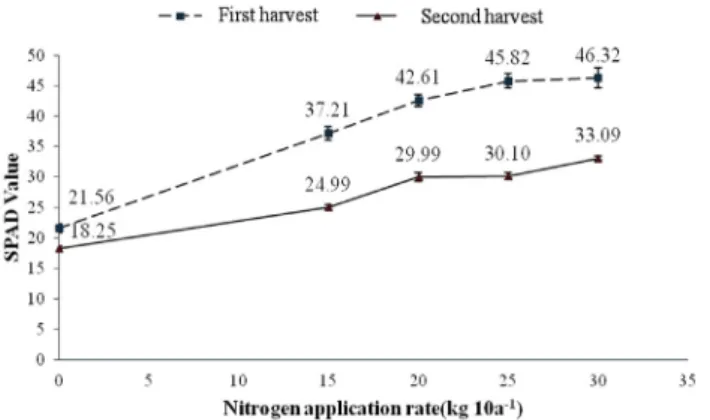
Leaf chlorophyll key indicator of photosynthetic apparatus (Sytykiewicz et al., 2013). Chlorophyll content in leaf was measured as leaf greenness basis (SPAD). The SPAD values are varied by N application. SPAD values of the first and second harvest against the rates of N application are presented in Fig. 2. SPAD values increased with increasing N application rates. The SPAD value was the highest (46.32) at 300 kg N ha 1 and the lowest (21.56) at zero N fertilizer level in the first harvest. In the second harvest, the highest SPAD value was 33.09 at a rate of 300 kg N ha 1 and the lowest was 18.5 at zero N. Buah and Mwinkaara (2009), N fertility levels increased SPAD values, Table 2. Effect of nitrogen rates and split application method on growth charateristics of sorghum × sudangrass
hybrid at Cheonan, Korea, 2015
Item
Plant height
(cm) Leaf width
(cm) Stem diameter
(mm) Sugar content
(Brix°)
1st 2nd 1st 2nd 1st 2nd 1st 2nd
Main effect
N 0 177D0 125D0 4.58C0 2.71C0 8.93E0 5.77C0 4.320 6.3400
N 150 247C0 165C0 5.13B0 4.11B0 9.59D0 9.53AB 6.920 8.3500
N 200 261BC 177B0 5.22AB 4.15B0 10.49C0 9.47B0 6.010 8.2900
N 250 267B0 195A0 5.20AB 4.38AB 11.42B0 9.41B0 6.700 8.0900
N 300 284A0 200A0 5.32A0 4.68A0 12.06A0 9.91A0 5.580 8.7000
Subplot effect
40 : 30 : 30 26300 1810 5.340 4.3100 10.7200 9.40B0 6.29 8.1400
50 : 50 26600 1870 5.120 4.3300 11.0500 9.77A0 6.32 8.5800
Main effect (A) *** *** ** ** *** *** NS NS
Subplot effect (B) NS NS NS NS NS * NS NS
A × B NS NS NS NS NS NS NS NS
Values within a column followed by the same letter are not significantly different at the 5% level, as determined by Duncan’s multiple range test.
* p 0.05; ** p 0.01;***; p 0.001; NS: Not significant.
the highest value being 43.3 at a rate of 120 kg N ha 1 and the lowest at zero N.
3. Evaluation of total N, N uptake and NUE
Total N data for sorghum against N rates and spilt- method of N fertilizer are shown in Table 3. In the first harvest, the total N of plants was influenced by N fertilizer levels and the split application methods. Total N was the
highest at 300 kg N ha 1(1.06%) and the lowest at zero N (0.73%) (p 0.05). According to split application method, 50:50 (50% in basal nitrogen and 50% after first harvest) was higher than 40:30:30 (40% in basal nitrogen, 30% in growing stage and 30% after first cut). In the second harvest, total N of sorghum was affected by N levels, while the split application methods had no effect. Total N was increased with increasing N fertilizer levels. The maximum total N values were obtained at 300 kg N ha 1 (1.00%) and 250 kg N ha 1(0.92%), while the minimum N level was obtained from the zero N treatment (0.67%) in second harvest (p 0.05). These results are in accordance with the findings of Ketterings et al. (2007), who reported that plant N concentration increased with the addition of N fertilizer.
N uptake values are presented in Table 3, showing that it was not significantly affected by N levels in the first and second harvest. In the first harvest, however, N uptake was not influenced by N split application methods in the second harvest. In the first harvest, N uptake of plants was 14.07, 13.20, 10.47, 7.49 and 4.97 kg 10a 1 for rate of 300, 250, 200, 150 and 0 kg N ha 1, respectively (p 0.05) by N Table 3. The amount of nitrogen uptake, total nitrogen and nitrogen use efficiency of sorghum × sudangrass
hybrid at different nitrogen levels and split application method at Cheonan, Korea, 2015
Item
Total nitrogen (%)
Amount of N uptake
(kg 10a-1) NUE1)
1st 2nd 1st 2nd Sum (%)
Main effect
N 0 0.73E0 0.67C0 4.97D0 2.13E0 7.10E0 -00
N 150 0.84D0 0.73BC 7.49C0 3.42D0 10.91D0 25C0
N 200 0.93C0 0.76B0 10.47B0 3.92C0 14.39C0 36B0
N 250 1.03B0 0.92A0 13.20A0 5.85B0 19.05B0 47A0
N 300 1.06A0 1.00A0 14.07A0 7.17A0 21.24A0 48A0
Subplot effect
40 : 30 : 30 0.99A0 0.8400 11.58A0 5.0600 16.65A 4000
50 : 50 0.93B0 0.8700 10.91A0 5.1200 16.03B 3800
Main effect (A) *** ** *** *** *** ***
Subplot effect (B) ** NS * NS * NS
A × B NS NS NS NS NS NS
1)NUE: Nitrogen use efficiency.
Values within a column followed by the same letter are not significantly different at the 5% level, as determined by Duncan`s multiple range test.
* p<0.05; ** p<0.01;***; p<0.001; NS: Not significant.
Fig. 2. Relationships between leaf SPAD values and nitrogen application rates in the first and second harvest during the growing season.
fertilizer levels. However, there were no difference in split application methods of N (p 0.05). For the second harvest, the maximum amount of N uptake was 7.17 kg 10a 1 at a rate of 300 kg N ha 1 and the lowest was 2.13 at a rate of zero N (p 0.05). In total N uptake, 300 kg N ha 1 was greater 199% than zero N and 40:30:30 split application method was better than 50:50 split application method (p 0.05).
NUE was not affected by split-application methods, but was influenced by N application levels. The 40:30:30 split application method did not increase NUE of plants in this experiment. The maximum NUE was 48% at a rate of 300 kg N ha 1 and the lowest was 25% at a rate of 150 kg N ha 1(Table 3). These results were different from Beyaert and Roy (2005), who reported that split N application on sorghum plants increased NUE especially at low N rates, compared to single N application and NUE decreased with increased N fertilization in sorghum. Muchow (1998) reported that NUE of sorghum declined with increasing N and NUE was influenced by soil condition, climate and irrigation. However, Kilcer et al. (2002) found that split- application improved NUE, while the maximum NUE was
obtained at the highest N application level (200 kg ha 1) and the lowest application level was 100 kg ha 1.
4. Productivity of SSH
Productivity of plants was not affected by split-application methods, but it was affected by N application levels. As shown in Table 4, reduced N application reduced the total fresh matter yield. Total fresh matter yield was highest at a rate of 300 kg N ha 1(99,375 kg ha 1) followed by 250 (91,000 kg ha 1), 200 (78,792 kg ha 1), 150 (75,000 kg ha 1) and 0 kg N ha 1(51,500 kg ha 1). Total dry matter yields increased with the supplement of N fertilizer, but were not influenced by split-application methods. Total dry matter yield was 21,715 kg ha 1 at a rate of 300 kg N ha 1 and decreased in the following orders: N 250 (18,661 kg ha 1), N200 (16,445kg ha 1), N150 (13,545 kg ha 1) and N0 (10,054 kg ha 1). Total dry matter yield at 300 kg N ha 1 was 116% greater than at zero N application. Similarly, other studies found that productivity of SSH increases linearly with increasing N levels (Beyaert and Roy, 2005;
Turgut et al., 2005; Ketterings et al., 2007; Sher et al., Table 4. Productivity of sorghum × sudangrass hybrid at different nitrogen levels and split application rate at
Cheonan, Korea, 2015
Items
Fresh matter yield (kg ha-1)
Dry matter yield (kg ha-1)
1st 2nd Total 1st 2nd Total
Main effect
N 0 36,583D 14,917C 51,500D 6,835E 3,218D 10,054E
N 150 52,375C 22,625B 75,000C 8,853D 4,692C 13,545D
N 200 54,833C 23,958B 78,792C 11,255C 5,190C 16,445C
N 250 62,833B 28,167A 91,000B 12,602B 6,059B 18,661B
N 300 69,833A 29,542A 99,375A 14,438A 7,278A 21,715A
Subplot effect
40 : 30 : 30 59,250 25,979 86,667 12,004 5,839 17,340
50 : 50 60,688 26,167 85,417 11,570 5,770 17,843
Main effect (A) *** ** *** *** *** ***
Subplot effect (B) NS NS NS NS NS NS
A × B NS NS NS NS NS NS
Values within a column followed by the same letter are not significantly different at the 5% level, as determined by Duncan’s multiple range test.
* p<0.05; ** p<0.01; ***; p<0.001; NS: Not significant.
2016; Moghimi and Eman, 2015). However, this experiment did not find the most efficient N fertility level point of inflection to determine optimum fertilizer level, because productivity was increased with more applied N. However, N split-application methods did not have any effect. Split- application had a great effect on N efficiency, because uptake efficiency was greatly increased by the second application. Therefore, split application of N could reduce loss of N to the environment and increase productivity (Kilcer et al., 2002). These results are in accordance with the findings of Lopez-Bellido et al. (2006) who reported that the yield and harvest index in wheat were not different from N fertilizer level and split-application treatments except for zero fertilizer level.
. CONCLUSION
This experiment was conducted to evaluate the effects of different N levels and split N application on growth characteristics and productivity. Among the growth characters, plant height, leaf width and stem diameter were increased by N application rates, with the highest values at 300 kg N ha 1 and the lowest at zero N application. Split N application had no influence on growth characters. Sugar content was not influenced by N application rate and split-application methods. In this study, SPAD values, NUE and N uptake were closely related to N fertilizer levels, but split- application rates did not clearly influence SPAD values.
In this experiment, maximum productivity was obtained from a rate of 300 kg N ha 1. Therefore, application of N of more than 300 kg ha 1 is recommended to maintain high level of productivity. However, further work is needed to determine optimal N levels and the effect of split- application rates.
. ACKNOWLEDGEMENT
This work was carried out with the support of
“Cooperative Research Program for Agriculture Science &
Technology Development (Project title: Developing a new cultivation technology of forage crops under current forage production environments, Project No. PJ010284012016)”
Rural Development Administration, Republic of Korea.
. REFERENCES
Afzal, M., Ahmad, A. and Zamir, S. 2013. Performance of multicut forage sorghum under various sowing methods and nitrogen application rates. The Journal of Animal & Plant Sciences.
23:232-239.
Alcoz, M.M., Hons, F.M. and Haby, V.A. 1993. Nitrogen fertilization timing effect on wheat production, nitrogen uptake efficiency, and residual soil nitrogen. Agronomy Journal. 85:1198-1203.
Ali, H.G., Alkhamisi, V.A., Nadaf, S.K. and Al-Bakri, A.N. 2014.
Forage productivity of three introduced sorghum × sudan grass hybrids under irrigation in three arid areas in Oman. Jordan Journal of Agricultural Sciences. 10:716-724.
Almodares, A. and Darany, S.M. 2006. Effects of planting date and time of nitrogen application on yield and sugar content of sweet sorghum. Journal of Environmental Biology. 27:601-605.
Ayub, M., Nadeem, M.A., Tanveer, A. and Husnain, A. 2002. Effect of different levels of nitrogen and harvesting times on the growth, yield and quality of sorghum fodder. Asian Journal of Plant Sciences. 4:304-307.
Beyaert, R.P. and Roy, R.C. 2005. Influence of nitrogen fertilization on multi-cut forage sorghum sudangrass yield and nitrogen use.
Agronomy Journal. 97:1493-1501.
Brady, N. and Weil, R. 2008. Soil colloids: seat of soil chemical and physical acidity. Pearson Education Inc: Upper Saddle River, NJ, USA. p. 311-358.
Buah, S. and Mwinkaara, S. 2009. Response of sorghum to nitrogen fertilizer and plant density in the Guinea Savanna Zone. Journal of Agronomy. 8:124-130.
Clough, A. and Malcolm, N.H. 2003. Stem diameter: A rapid accurate parameter for monitoring growth of sorghum.
Proceedings of the 11th Australian Agronomy Conference.
Gardner, J., Maranville, J. and Paparozzi, E. 1994. Nitrogen use efficiency among diverse sorghum cultivars. Crop Science.
34:728-733.
Gebremariam, G. and Assefa, D. 2015. Nitrogen fertilization effect on grain sorghum (Sorghum bicolor L. Moench) yield. International Journal of Agricultural Research. 10:14-23.
Guillard, K., Griffin, G.F., Allinson, D.W., Rafey, M.M., Yamartino, W.R. and Pietrzyk, S.W. 1995. Nitrogen utilization of selected cropping systems in the US Northeast: I. Dry matter yield, N uptake, apparent N recovery, and N use efficiency. Agronomy Journal. 87:193-199.
Hirel, B., Bertin, P., Quilleré, I., Bourdoncle, W., Attagnant, C., Dellay, C., Gouy, A., Cadiou, S., Retailliau, C. and Falque, M.
2001. Towards a better understanding of the genetic and
physiological basis for nitrogen use efficiency in maize. Plant Physiol. 125:1258-1270.
Ji, H.C., Lee, S.H., Yoon, S.H., Kwon, O.D., Choi, G.J., Kim, W.H., Kim, K.Y. and Lim, Y.C. 2010. Growth, forage production and quality of sorghum, sorghum × sudangrass and sudangrass hybrids at paddy field in southern region of Korea. Journal of The Korean Society of Grassland and Forage Science. 30(2):109-114.
Jung, J.S., Lee, K.-W., Choi, K.C., Ji, H.J., Park, H.S., Kim, W.H., Young, Y.J., Lee, S.H. and Lee, S.H. 2015. Effect of seeding method and pre-emergence herbicides on plant growth and the production of sorghum × sudangrass hybrid. Journal of The Korean Society of Grassland and Forage Science. 35:17-25.
Ketterings, Q.M., Cherney, J.H., Godwin, G., Kilcer, T.E., Barney, P.
and Beer, S. 2007. Nitrogen management of brown midrib sorghum × sudangrass in the northeastern USA. Agronomy Journal.
99:1345-1351.
Khosla, R., Alley, M.M. and Davis, P.H. 2000. Nitrogen management in no-tillage grain sorghum production: I. Rate and time of application. Agronomy Journal. 92:321-328.
Kilcer, T., Ketterings, Q., Katsvairo, T. and Cherney, J. 2002.
Nitrogen management for sorghum sudangrass: how to optimize N uptake efficiency?. What's Cropping Up. 12:6-9.
Kim, J.D., Ko, K.H. and Kwon, C.H. 2012. Effect of heading and BMR types on the agronomic characteristics, forage yield and quality of sorghum × sudangrass hybrid. Journal of the Korean Society of Grassland and Forage Science. 32:293-300.
Liu, C.W., Sung, Y., Chen, B.C. and Lai, H.Y. 2014. Effects of nitrogen fertilizers on the growth and nitrate content of lettuce (Lactuca sativa L.). International Journal of Environmental Research: Public Health. 11(4): 4427-4440.
Lopez-Bellido, L., Lopez-Bellido, R.J. and Lopez-Bellido, F.J. 2006.
Fertilizer nitrogen efficiency in durum wheat under rainfed Mediterranean conditions: Effect of split application. Agronomy journal. 98:55-62.
Marsalis, M.A. 2006. Sorghum forage production in New Mexico (Guide A-332). New Mexico State University Cooperative Extension Service.
Ministry of Agriculture, Food and Rural Affairs (MAFRA). 2015.
Main Statistics in Agriculture, Livestock, and Food.
Moghimi, N. and Emam, Y. 2015. Growth and yield responses of two forage sorghum cultivars to different nitrogen fertilizer rates.
Iran Agricultural Research. 34:39-45.
Moon, Y.H., Kwon, Y.R., Ahn, B.K., Lee, J.H. and Choi, D.C. 2010.
Determination of nitrogen fertilizer recommendation rates
estimated by soil-testing for different types of paddy soils.
Korean Journal of Environmental Agriculture. 29:33-38.
Muchow, R. 1998. Nitrogen utilization efficiency in maize and grain sorghum. Field Crop Research. 56:209-216.
Nadeem, S., Hansen, S., Azzaroli Bleken, M. and Dörsch, P. 2012.
N2O emission from organic barley cultivation as affected by green manure management. Biogeosciences. 9:2747-2759.
Prokopy, L. and Widhalm, M. 2011. Corn split NDST: Determine the feasibility and profitability of using post-planting nitrogen application for corn production. Available from: https://ag.purdue.
edu/extension/ppp/Documents/resources/U2U_PARP_CornSplit NDST_Overview_Oct2015.pdf. Accessed Jul. 2016.
Rizwan, M., Maqsood, M., Rafiq, M., Saeed, M. and Ali, Z. 2003.
Maize (Zea mays L.) response to split application of nitrogen.
International Journal of Agricultural Biology. 5:19-21.
Seo, S., Kim, J. Chung, E., Kim, W. and Kang, W. 2000. Effect of methods and rates of seeding on the forage production and nutritive value of sorghum × sudangrass hybrid grown under application of animal manure. Journal of the Korean Society of Grassland Science. 20:49-54.
Sher, A., Hassan, F.U., Ali, H. and Hassan, W. 2016. Seed rate and nitrogen application effects on production and brix value of forage sorghum cultivars. Grassland Science. 62:119-127.
Solomon, S. 2007. Climate change 2007-the physical science basis:
Working group I contribution to the fourth assessment report of the IPCC Cambridge University Press.
Systems, S.A. 2007. SAS user’s guide, version 9.2. SAS Institute Cary, NC.
Sytykiewicz, H., Czerniewicz, P., Sprawka, I. and Krzyżanowski, R.
2013. Chlorophyll content of aphid-infested seedling leaves of fifteen maize genotypes. Acta Biologica Cracoviensia, Series Botanica. 55:51-60.
Tamme, T., Reinik, M. and Roasto, M. 2009. Nitrates and nitrites in vegetables: occurrence and health risks. Academic Press. Salt Lake City. pp. 307-321.
Turgut, I., Bilgili, U., Duman, A. and Acikgoz, E. 2005. Production of sweet sorghum (Sorghum bicolor L. Moench) increases with increased plant densities and nitrogen fertilizer levels. Acta Agriculturae Scandinavica, Section B-Soil and Plant. 55:236-240.
Worker, J.G. 1976. Sudangrass production in the irrigated deserts of southern California. Leaflet: pp. 7.
(Received August 9, 2016 / Revised September 6, 2016 / Accepted September 6, 2016)