The Overview on the Education and Training Systems of Traditional Medicine
in Asia and the Pacific
Lee, Soojin1 *1)
1Department of Physiology, College of Oriental Medicine, Sangji University
The Overview on the Education and Training Systems of Traditional Medicine in Asia and the Pacific
Lee, Soojin1*
1Department of Physiology, College of Oriental Medicine, Sangji University
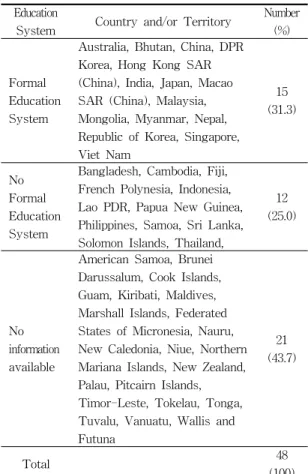
These days, traditional and complementary/alternative medicine (TM/CAM) becomes more upsurging topics of increasing importance and the use and popularity of TM/CAM is rapidly expanding. Since the tradition and situation on TM/CAM of each country is quite different, the concept and system of TM/CAM expressed by different countries shows the variety of range. Some countries recognize TM/CAM as one part of two branches of medical science and have integrated into national health care system. In these countries, education systems for TM/CAM are also well-organized formal education systems, such as the Republic of Korea, DPR Korea, China (including Hong Kong and Macao), and Viet Nam. However, other countries in Asia and the Pacific, still do not have formal and/or informal education system and do not recognize TM/CAM as a kind of health care systems. This paper reviews the current situation of education and training on TM/CAM in the Asia and the Pacific. As a result, fifteen countries (31.3%) of 48 member countries in Asia and the Pacific have formal education systems for TM/CAM, twelve countries (25.0%) do not have formal education system and twenty one countries (43.7%) do not have available information. At least six countries are allocating the curriculum of medical school to the education of both allopathic and traditional medicine. For the proper use and development of TM/CAM, the development of formal education system as well as the integration into the national health care system are needed.
Key words: traditional medicine, complementary and alternative medicine, education system, training
* 교신저자 : 이수진, 상지대학교 한의과대학 생리학교실.
E-mail : [email protected]
투고일 : 2010년 7월23일, 게재확정일 : 2010년 8월11일.
I. Introduction
"Traditional medicine is the knowledge, skills
and practice of holistic health care, recognized and accepted for its role in the maintenance of health and the treatment of diseases. It is based on indigenous theories, beliefs and experiences that are handed down from generation to generation."1) These days the use of traditional medicine and complementary/
alternative medicine (TM/CAM) have been rapidly increasing and widespread. Since World Health Organization (WHO) recognized the importance of traditional medicine as a resource of health care system and traiditional practitioners as health workers, particularly for primary health care at community level, it has been one of the priority issues how to educate, train and maintain traditional medicine practitioners. Moreover, the education system for traditional medicine shows whether the countries recognize traditional medicine as one of medical systems of health care and integrate traditional medicine into national health care system.
Region of Asia and the Pacific includes South-East Asia region and Western Pacific region of WHO. Countries of these regions have the longest history and tradition of traditional medicine and most countries still have TM/CAM system whether it has been well-developed or not. Therefore, the investigation of the traditional medicine situation in these regions can provide good example to understand worldwide situation of TM/CAM and to make future plan to integrate allopathic and traditional medicine. Therefore, in this study, the education and training system in Asia and the Pacific was investigated.
Ⅱ. Materials and Methods
For this study, publications and reports on
traditional medicine and TM/CAM by WHO was reviewed. Mostly published documents and some unpublished documents were reviewed for detailed information. Also personal communications with relevant personnel who have been available for information on TM/CAM. As a result, a total of 28 countries and/or territories among 48 member countries in Asia and the Pacific were the subjects of this study.
Ⅲ. Current situation of education and training system
Human resource development for health care has been a priority consideration for all countries in the world. Most countries except Maldives and some Pacific Islands countries have established medical, nursing and pharmacy schools offering degree and diploma courses in modern and/or allopathic medicine2). However, TM/CAM is still remained untouched in many countries. Since health authorities in many countries became acquainted with the importance of indigenous and traditional medicine to national health care, lots of countries have or are preparing the national policies and/or regulations for TM/CAM.
Moreover the compulsory registration of trained and untrained TM/CAM practitioners was introduced in most countries following the adoption of national traditional medicine policies. However, there remained some countries have no national policy or regulation for TM/CAM and then many unregistered practitioners are still practising TM/CAM.
The variety of each countries is described as follows.
(1) Australia
Traditional Chinese medicine has been practised in Australia since 19th century when Chinese immigrants flowed into the Australian gold fields and the use and popularity are increasing. The first formal education programmes were for acupuncture in 1969 and these days several universities and colleges provide four-year bachelor programmes for acupuncture and some provide postgraduate degrees programmes.
Though traditional medicine education in Australia was focused on acupuncture education in the past, various Chinese medicine programmes in universities and private colleges are provided these days3). The Victoria University of Technology offers degree programmes in traditional Chinese medicine.
There are traditional Chinese medicine programmes for qualified allopathic practitioners and also some programmes to get diplomas4).
(2) Bangladesh
In Bangladesh, Ayurvedic and Unani medicines are widely practised and the Board of Unani and Ayurvedic Systems of Medicine is responsible for maintaining educational standards, arranging for the registration of practitioners and the standardization of Unani and Ayurvedic systems of medicine. There are nine educational institutions; five for Unani and four for Ayurvedic medicine. They provide a four-year programme and diplomas after the completion of the course4).
(3) Bhutan
The root of Bhutanese medical system came from Buddhism and Tibetan traditional medicines and it was introduced in the 16th century. During its early practice, traditional medicine providers were trained in Tibet4).
Formal training for traditional medicine was
recognized officially in 1971 and traditional medical doctor (
drungtsho
) programme was established. The training curriculum was standardized in 1978 and the course provides a five-year institutional training and a six-month internship. During the internship, interns are trained in both allopathic hospitals and traditional medicine hospitals/traditional medicine units for three months each4).(4) Cambodia
There is no officially recognized curriculum incorporating the use of traditional medicines.
To practice traditional medicine, practitioners must be at least 25 years old, went through a three-year apprenticeship, and are received a license by the Minister of Health.
(5) China
Traditional Chinese medicine has co-existed and run parallel with allopathic medicine over the last century and traditional medicine is well integrated into the national health care system.
Ninety five percentage of general hospitals have units for traditional medicine and 50% of rural doctors can provide both traditional and allopathic medicine4).
In 1995, there were 525,000 practitioners for traditional medicine and among them 257,000 were traditional medical doctors who graduated from traditional medical universities, 10,000 were allopathic medical doctors who retrained in traditional medicine, and 83,000 were pharmacists who were specialists in herbal medicines and graduated traditional medical universities. 72,000 were assistants for traditional doctors and 55,000 were assistants for herbal pharmacists. Assistants were trained in traditional medicine secondary schools4). In 2004. there were 433,819 licensed traditional medical doctors and assistant doctors5).
There are also 30 universities and colleges for
traditional Chinese medicine with total enrollment of 40,000. Undergraduate programmes of universities/colleges takes five years and they also provide postgraduate programmes for Master's and Doctorate degrees6). There are 57 secondary schools offer training courses of traditional Chinese medicine for 29,000 students and this schools provides medical personnel for rural and basic units4).
The curriculum of educationl institutes for traditional medicine contains some allopathic medicine as well as traditional medicine6). Allopathic medical schools are allocating time to teach traditional medicine. Ten to twenty percentage of teaching in allopathic medical schools is allocated to traditional medicine and about 30% of teaching in traditional medical schools is allocated to allopathic medicine4).
(6) Democratic People's Republic of Korea (DPR Korea)
Traditional medicine in the DPR Korea has some similarity with other traditional medicine in East Asia, but it has been developed its own uniqueness and now is well integrated into the official health care system4,7).
Traditional medicine is educated at the medical universities in each province and the training course takes seven years. The curriculum is alloted to both traditional medicine and allopathic medicine and the ratio of traditional medicine to allopathic medicine is 7 to 3, and 30% of the curriculum in allopathic medical school alloted to traditional medicine. Therefore, traditional medicine doctors can diagnose and treat with allopathic medicine and allopathic doctors are allowed to practice traditional medicine7-8). The number of doctors of both allopathic and traditional medicine in the DPR Korea is 74,5979).
(7) Fiji
Traditional medicine was handed down from established practitioners to apprentice through oral instruction. There is no formal education system for traditional medicine in Fiji. The lawful practice of acupuncture is registered by the Permanent Secretary for Health and for the registration, applicants must prove their licenses or certificates from United Kingdom, Canada New Zealand, United States, China, Taiwan, Hong Kong SAR. Singapore, the Philippines. There is licensing legislations to regulate educational standards for chiropractic4). (8) Hong Kong Special Administrative Region of China (Hong Kong SAR)
Though traditional Chinese medicine has been widely used in Hong Kong SAR, a registration system for practitioners of traditional Chinese medicine was introduced in 20004). Undergraduate courses for traditional Chinese medicine practice and pharmacy was introduced after Hong Kong's return to China.
(9) India
India government has recognized the codified traditional systems and there are six recognized systems of medicine such as Ayurvdea, Siddha, Unani, yoga, naturopathy and homeopathy. Indian traditional medicine represents a way of health living and has a holistic approach and has spread to East and West and is widely practised in southeastern Asia, especially in Bangladesh, India, Nepal Pakistan, and Sri Lanka10).
Ayurveda education at college level was started about 100 years ago11). At present, through the Central Council of Indian Medicine and the Central Council of Homeopathy, the training of traditional medicine is standardized and regulated. In India, there are a number of medical educational institutions for traditional medicine under the Department of Indian
System of Medicine and Homeopathy. Based on the data by WHO, there are 259 undergraduate colleges for Ayurveda, Siddha, Unani, yoga and naturopathy and 69 colleges among them provide postgraduate educational departments.
Undergraduate education has a five-and-a-half years training course and postgraduate courses offer a three-year course10). There are also the educational facilities for homeopathy and there are at least 96 undergraduate colleges12). About 30% of the educational institutions are run by governments and the remains are run by the private sectors.
The total numbers of registered practitioners for traditional medicine is 611,413 as of 1999.
Among them, the number of practitioners for Ayurveda, Unani, Siddha, naturopathy and homeopathy were 367,528, 41,221, 12,915, 388, and 189,361 each8).
The effort for establishment of Ayurvedic pharmacy and nursing education courses are ongoing10).
(10) Indonesia
Traditional medicine have been recognized in Indonesia since ancient times and its use is gradually increasing. Since 1988, traditional medicine became launched a potential development programme and started to be into the national health system. In line with these efforts, acupuncture became the first integrated system in 199513).
There are four categories of traditional medicine practitioners in Indonesia; herbalist, skilled practitioner, spiritualist and supernaturalist. The skilled practitioners includes traditional birth attendant, circumciser, bonesetter, masseuse, and traditional dentist.
Fourty percent of population uses traditional medicine in Indonesia so traditional medicine is an important medical resources within health
care services8).
There is no formal training or education in Indonesia but the Centre for Traditional Medicine Research, under the Ministry of Health and Social Welfare is providing training in traditional medicine. The Directorate of Selected Community Health Development, also provides traditional programmes in for traditional practitioners of acupressure.
According to the governmental survey, there were 112,974 traditional medicine practitioners in 1990 and this number was increased to 281,492 in 19968). Among them 96.2% use Indonesian indigenous traditional medicine methods114).
(11) Japan
Traditional Chinese medicine was introduced to Japan
via
Korea between the 3rd and 8th centuries, modified by local needs and became Japanese traditional medicine, that is Kampo medicine. In Japan, acupuncture, herbal medicine, moxibustion, Japanese traditional massage and judo therapy are widely practised4,16).In Japan, the medical license is those who graduated allopathic medical schools and there is no restriction to adopt traditional medical practice. This make it possible that the combined use of both allopathic medicine and traditional herbal medicine16). The number of registered allopathic doctors is 268,611 at the end of 19984). Japan Society for Oriental Medicine (JSOM) has operated the medical specialist certification program since 1989 and the number of certified physicians are 2,420 as of March, 2010 among 8,926 of regular members17). There are also 69,236 acupuncturists, 67,746 moxacauterists, 94,655 massage practitioners, 29,087 judotherapists and 125,953 registered pharmacists at the end of
19984).
Toyama Medical and Pharmaceutical University firstly offered a four year postgraduate Doctorate programme in Kampo medicine and also provided the only officially recognized undergraduate kampo medical curriculum for allopathic medical students.
Subsequently other medical schools considered to teach Kampo medicine and then allopathic medical schools are allocating time to teach Kampo medicine since 200318). There are three- or four-year training programmes to be a acupuncturists and moxacauterists4).
(12) Lao People's Democratic Republic Lao traditional medicine dates back to 12th century, when the country was united and traditional Buddhist and Indian medical systems influenced to Lao traditional medicine.
There was training courses on the use of traditional medicine to promote the rational use of traditional medicine in 1996. There is no formal, established education system14). Traditional medicine is now being integrated into the national health system5).
(13) Malaysia
Indian and Chinese traders and migrants brought traditional medicine and the Islam by Indians and Arabs brought their traditional medical system, too. The diverse population in Malaysia has led to the diversity in traditional medical system, so the major systems of medicine practised are including Ayurveda, Siddha, Unani, traditional Chinese medicine, etc.
A Practice Approval Certificate for practitioners who have taken traditional Chinese medicine courses was issued4).
(14) Mongolia
Traditional Mongolian medicine has a history of more than 2,500 years and is rooted in Tibetan and Indian medicine. At present,
traditional medicine plays a growing role in the national health care system and the state policy for the development of Mongolian traditional medicine was approved in 19995). Since 1989, the Department of Traditional Medicine at the national medical university has provided the educational courses to train traditional medical doctors4).
(15) Myanmar
Traditional medicine is based on Ayurvedic concepts and Buddhist philosophy influenced to traditional medicine in Myanmar. There are codified four branches of Myanmar traditional medicine; dhatu, ayurveda, astrology and witchcraft.
The Institute of Indigenous Medicine was established as an educational institution by the Ministry for Health in 1976. It provides a three-year training programme and a one-year internship. The institute also offers a one-year course in primary health care for traditional medicine practitioners who have no certificate or licence4). University of Traditional Medicine, a public university was established in 2002 and accepts 100 students every year5).
(16) Nepal
Nepal's traditional medicine can date back to the use of medicinal herbs of 500 A.D. Now more than 75% of the population use traditional medicine and Ayurvedic medicine is one of the basic national medical systems4).
The Institute of Medicine of Tribhuvon University supervised the formal education for Ayurvedic medicine. There are the subsidiary Ayurveda worker training programme by the Department of Ayurveda under the Council for Technical Training and Vocational Education.
The Ayurvedic medical practitioners are registered by the Ayurvedic Medical Council4).
(17) New Zealand
There is one school for chiropractic and chiropractic has been regulated by law since 19624).
(18) Philippines
Training in traditional medicine for allopathic practitioners is a prime concern in the Philippines so more than 200 Government allopathic physicians have been trained in acupuncture4). However there is no official education system for traditional medicine.
(19) Republic of Korea
Traditional medicine in the Republic of Korea dates back to 4,332 years ago, the Gochosun period and now it is well integrated into national health care system since the Civil Medical Treatment Law in 1951 established a dual system of medical treatment comprised of traditional and allopathic medicine4).
The number of registered traditional medicine doctors was 2,913 at 1979 but it was greatly increased to 17,473 at the end of 2008. The number of registered traditional pharmacist was 1,221 at the end of 200719).
The education system for traditional in medicine was firstly established in 1946 after the release from colonial period by Japan. Since 1948, traditional medical education was conducted in college as a four-year courses20). Since 1964, it has changed a six-year programme consisting of a preparatory two-year programme and a regular four-year programme and during the coursework, students are educated by both the basic subjects of traditional and allopathic medicine.
There are 11 undergraduate colleges to provide a six-year training course and these colleges offer master's and doctorate courses. In 2007, a professional graduate school for traditional Korean medicine was established in Busan
National University, consisting of a four-year master's course. Therefore, there are now 11 undergraduate schools and 1 postgraduate school for traditional medicine with about 4,500 of total enrollment19). There are also three colleges for herbal medicine with about 480 of total enrollment19).
(20) Singapore
About 45% of the population has used traditional medicine in Singapore and traditional Chinese medicine is the most common traditional therapy. Singapore have a standardized six-year part-time training programme for traditional Chinese medicine4).
(21) Sri Lanka
In Sri Lanka, traditional medicine has become an essential part of health care system and Ayurvedic medicine is widely used4).
A WHO/UN Development Programme project for the development of traditional medicine in Sri Lanka was implemented in 1980s and this project brought the development of human resource in traditional and natural medicine sector. This project enhanced the teaching capability and the professional capability of traditional medicine practitioners. The National Institute of Traditional Medicine carries out educational and training programmes for traditional and Ayurvedic practitioners but it does not provide advanced training or postgraduate education yet4,5).
(22) Thailand
Traditional medicines in Thailand is based on Indian and Chinese traditional medicine system and developed as part of the cultural heritage and indigenous knowledge21). Thai traditional medicine includes the use of herbal medicine, herbal saunas, herbal steam baths, hot compresses, traditional massage, acupressure and reflexology. Thai traditional medicine has
spread to other countries and is practised in Cambodia, Lao PDR, and Myanmar4).
The first school for Thai traditional medicine was established at Wat Po in 1957 and the licensed system for graduates was introduced since 1962. The Thai Traditional Medicine Training Centre have provided the programmes in pharmacy, Thai traditional healing, Thai training massage and reflexology since 1997.
The National Institute of Thai Traditional Medicine offers non-formal educational courses in Thai traditional medicine at the primary and secondary school levels4). In 1987, an Ayurvedic college was founded and has provided a three-year training courses in Ayurveda and Thai medicine8).
Allopathic practitioners who want to practice traditional medicine, are required to follow a three-year course of training and instruction with a registered and licensed traditional medicine practitioners and to pass an examination arranged by the Commission for the Control of the Practice of the Art of Healing4).
(23) Viet Nam
Traditional medicine in Viet Nam has a 4,000-years old traditional system. This has been developed based on the ancient knowledge of herbal medicine and has been influenced by Chinese and Indian traditional medicine.
Vietnamese traditional medicines are well integrated into national health care system both primary and secondary health care4,5,22).
There is a faculty system of traditional medicine at medical universities and colleges.
Hanoi medical university has a department of traditional medicine and total three medical colleges have the faculty of traditional medicine4). The Academy of traditional medicine was established in 200523). In addition,
two secondary schools are providing traditional medical technology education24). However, these are not enough to meet the needs of traditional medicine yet.
There are about 1,000 traditional medicine practitioners, who have not received any formal education and 5,000 traditional medical doctors, who have graduated from a department of Hanoi medical university and studied both traditional and allopathic medicines. There are 2,000 assistant traditional medical doctors, and 209 traditional medical pharmacists4).
IV. Discussion and Conclusion
Traditional medicine has played an increasing important role in health care in many Asian Pacific countries. In the last several decades, there has been a global upsurge in the use of TM/CAM. WHO has developed traditional medicine programmes to bring traditional medicine into the mainstream of the national health care system and adopt the 'health for all' strategy25). At present, therefore, TM/CAM plays an increasing important role in health care and health sector reform in worldwide though the safety and efficacy as well as quality control still remains important concerns.
To fulfill the health for all strategy and to solve the concurrent issues on traditional medicine, the establishment of appropriate education and training programmes/systems is one of the priority issues. Therefore, a review of traditional medicine education in Asia and the Pacific will give a key lessons to many countries which want to develop traditional medicine system and integrate traditional medicine into the national health care system.
There are four main categories of traditional medicine/health practitioners26). The first
Education
System Country and/or Territory Number (%)
Formal Education System
Australia, Bhutan, China, DPR Korea, Hong Kong SAR (China), India, Japan, Macao SAR (China), Malaysia, Mongolia, Myanmar, Nepal, Republic of Korea, Singapore, Viet Nam
15 (31.3)
No Formal Education System
Bangladesh, Cambodia, Fiji, French Polynesia, Indonesia, Lao PDR, Papua New Guinea, Philippines, Samoa, Sri Lanka, Solomon Islands, Thailand,
12 (25.0)
No information available
American Samoa, Brunei Darussalum, Cook Islands, Guam, Kiribati, Maldives, Marshall Islands, Federated States of Micronesia, Nauru, New Caledonia, Niue, Northern Mariana Islands, New Zealand, Palau, Pitcairn Islands, Timor-Leste, Tokelau, Tonga, Tuvalu, Vanuatu, Wallis and Futuna
21 (43.7)
Total 48
(100)
category is that the practitioners have receivedtraining in both allopathic and traditional medical systems. The second category is that the practitioners have been trained mainly in traditional medical system though they also have the basic knowledge of allopathic medicine. These two categories are usually the case that this traditional medicine/health practitioners exists in the formal education system. The third category's practitioners only practices traditional medicine. They have no formal training but possess diplomas in some private traditional systems. The forth group includes those practitioners with neither institutional training nor qualifications. They just learn as apprentices with an established traditional health practitioners for several years and then practices traditional medicine26).
Several countries in the Asia and the Pacific have formal education system; Australia, Bhutan, China, DPR Korea, Hong Kong SAR, India, Japan, Macao SAR, Malaysia, Mongolia, Myanmar, Nepal, the Republic of Korea, Singapore, Viet Nam. Among them China (including Hong Kong and Macao), DPR Korea, the Republic of Korea and Viet Nam also integrated traditional medicine into the national health care system24). These countries also have professional traditional medical schools to educate and train traditional medical doctors.
According to their health care system and education system, it is clear that these countries include to the first category.
However, some other countries still are developing the formal education systems as well as national policies and/or regulations.
Bangladesh and Indonesia are categorized in the third group, having informal education system with diplomas and/or qualification.
However it was difficult to divide clearly every
countries to four categories because of the lack of information in education system or lack of recent information.
According to the review of education system, fifteen (31.3%) of 48 member countries in Asia and the Pacific have formal education institutes for TM/CAM. Twelve countries (25.0%) do not have formal education system. Twenty one countries (43.7%) do not have available information (Table 1).
Table 1. Education system by the country and/or territory in Asia and the Pacific
Some countries such as the Republic of Korea24) and China27) have highly developed formal education systems. Some other countries like Australia have a mixed education systems.
In most countries and/or territories there exist formal and/or informal education system for traditional and complementary/alternative medicine and this is owing to this study is conducted about the countries in Asia and the Pacific where the history of traditional medicine is very long and its tradition is well reserved.
In some countries in south pacific area, traditional healers learn healing art by family members or apprenticeship, even in a country there are several levels of education on traditional medicine. There are no standards traditional medicine education and traditional medicine is still a kind of incantation or magic until now.
The understanding of allopathic medicine for traditional medicine practitioners is quite needed at present and converse. Therefore, in many countries, the curriculum is alloted to both traditional medicine and allopathic medicine appropriately. At least six countries such as Bhutan, China, DPR Korea, Japan, the Republic of Korea and Viet Nam are teaching both traditional medicine and allopathic medicine in traditional medical school to understand, diagnose and treat patients using allopathic medical knowledge.
Still there remain many challenges in the area of traditional medicine education. Firstly, the appropriate guidelines for basic traditional medicine education should be established.
Second, the well-developed curriculum for traditional medicine education is also needed.
These are involves establishing the national policy and legislation for the licensing system of TM/CAM and these efforts can make people can trust the qualification and training of TM/CAM providers are adequate. Appropriate education and training system and well-developed curriculum can make TM/CAM
play an essential role in the national health care system.
References
1. World Health Organization Regional Office for Western Pacific. Regional strategy for traditional medicine in the western pacific. Manila, Philippines, World Health Organization Regional office for Western Pacific, pp.1, 2001.
2. Bhakaji B. Gaitonde. Regional overview:
South-East Asia region. WHO global atlas of traditional, complementary and alternative medicine. Kobe, Japan, World Health Organization Centre for Health Development, pp.75-82, 2005.
3. Stephen Myers. Training and human resources capacity building in traditional medicine. International Symposium on Traditional Medicine - Better Science, Policy and Services for Health Development. Kobe, Japan, World Health Organization Centre for Health Development, pp.285-290, 2000.
4. World Health Organization. Legal status of traditional medicine and complementary/
alternative medicine - a worldwide review. Geneva, Switzerland, World Health Organization, pp.129-131, 136-138, 140-143, 147, 149,1 51-155, 158-167, 169-171, 173-174, 2001.
5. World Health Organization Regional Office for South-East Asia and WHO Regional Office for Western Pacific. Health in Asia and the pacific. New Delhi, India.
pp. 468-470, 2008.
6. Xiaopin Wang. Review of traditional Chinese medicine practice in China.
International Symposium on Traditional Medicine - Better Science, Policy and
Services for Health Development. Kobe, Japan, World Health Organization Centre for Health Development, pp.72-73.
7. Thae Sop Choe. Kyoro system of medicine in DPR Korea. Traditional Medicine in Asia. New Delhi, India, WHO Regional Office for South-East Asia, pp.69-74, 2002.
8. P.N.V. Kurup. Current status of traditional medicine in the WHO South-East Asia Region. Proceedings of the international meeting on global atlas of traditional medicine. Kobe, Japan, World Health Organization Centre for Health Development, pp.156-169, 2003.
9. World Health Organization. Core Health Indicators - Democratic People's Republic of Korea [cited 2010 Jun 29] (available at http://apps.who.int/whosis/database/core /core_select_process.cfm? country=prk &
indicators=healthpersonnel)
10. Gandhidas S. Lavekar. WHO global atlas of traditional, complementary and alternative medicine. Kobe, Japan, World Health Organization Centre for Health Development, pp.89-95, 2005.
11. P.N.V. Kurup. Ayurveda. Traditional Medicine in Asia. New Delhi, India, WHO Regional Office for South-East Asia, pp.3-16, 2002.
12. Ram Harsh Singh. Ayurveda in India today. International Symposium on Traditional Medicine - Better Science, Policy and Services for Health Development. Kobe, Japan, World Health Organization Centre for Health Development, pp.75-85, 2000.
13. Lestari Handayani, Haryada Suparto and Agus Suprapto. Traditional system of medicine in Indonesia. Traditional
Medicine in Asia. New Delhi, India, WHO Regional Office for South-East Asia, pp.47-68, 2002.
14. World Health Organization Regional Office for South-East Asia. Bhutan National Health System Profile. New Delhi, India, World Health Orgnization Regional Office for Wouth-East Asia, p.6, 2005.
15. Ketut Ritiasa. Jamu and traditional medicine practices in Indonesia.
International Symposium on Traditional Medicine - Better Science, Policy and Services for Health Development. Kobe, Japan, World Health Organization Centre for Health Development, pp.103-105, 2000.
16. Shinya Sakai, Yutaka Shimada, Nobuyasu Sekiya & Katsutoshi Terasawa.
Perspectives of traditional Oriental medicine in Japan: present and future.
International Symposium on Traditional Medicine - Better Science, Policy and Services for Health Development. Kobe, Japanr Health Development. Kobe, Japan, pp.121-125, 2000.
17. Certified system of Fellow of the Japan Society for Oriental Medicine. Japan Society for Oriental Medicine [cited 2010 Jul 29] (available at http://www .jsom.or.jp/universally/doctor/index.html) 18. JSOM. Education for Kampo Medicine.
The Journal of Kampo, Acupuncture and Integrative Medicine, 1(Special edition):
65-67, 2005.
19. Ministry for Health, Welfare and Family Affairs. Governmental report for Health and Welfare 2008. Ministry for Health, Welfare and Family Affairs. Seoul, Korea, p.500,756, 2009.
20. Woo Yeol Jeong. The brief history of Korean traditional medicine (1899-1999).
Korean Journal of Medical History, 15:169-186. 1999.
21. Chaiporn Pormsingh. Thai traditional medicine as a holistic system of medicine. International Symposium on Traditional Medicine - Better Science, Policy and Services for Health Development. Kobe, Japan, World Health Organization Centre for Health Development, pp.134-139,2000.
22. Tran Van Hien. Vietnamese traditional medicine. International Symposium on Traditional Medicine - Better Science, Policy and Services for Health Development. Kobe, Japan World Health Organization Centre for Health Development pp.159-165, 2000.
23. Chu Quoc Truong. The Model of Integration of Traditional Medicine with Modern Medicine in Hospitals of Traditional Medicine in Vietnam: Present Status and Prospective Plan. Chinese Journal of Integrated Medicine, 14(3):228-231, 2008.
24. Xiaorui Zhang. Traditional medicine worldwide review. International Symposium on Traditional Medicine - Better Science, Policy and Services for Health Development. Kobe, Japan, World Health Organization Centre for Health Development, pp.20-22, 2000
25. World Health Organization. WHO traditional medicine strategy 2002-2005.
Geneva, Switzerland, World Health Organization, 2002.
26. Pyong-Ui Roh and Wang-Keun Yoo.
The overview on the traditional medicine in the Western Pacific Region. Korea
Journal of Oriental Preventive Medical Society, 8(1): 147-153, 2004.
27. Pyoung-Ui Roh, Jae-Woo Kim and Sung-Oh Bin. Traditional medicine in the western pacific region. Korean Public Health Research, 32(1):9-16, 2006.