ABSTRACT
Background and Objectives: Left ventricular hypertrophy (LVH) is associated with poor cardiovascular outcomes. Heavy aortic calcification exacerbates arterial stiffness, which consequently heightens left ventricular (LV) afterload. We assessed the usefulness of aortic calcification for predicting adverse cardiovascular outcomes and to determine whether the relationship, if any, differed as a function of LVH.
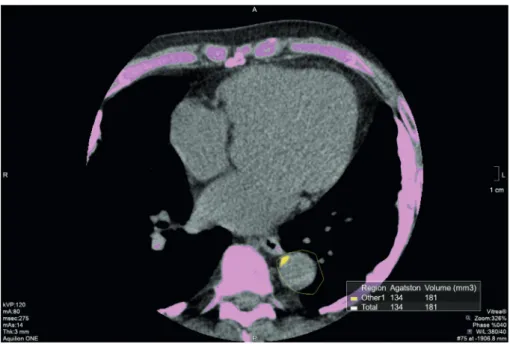
Methods: The analytic sample was comprised of a total of 487 individuals 65 years of age or older. Thoracic aortic calcium score (TACS) was measured by coronary computed tomography, and patients were stratified according to the median (TACS, 446 mm
3). LVH obtained from echocardiography was defined as LV mass index >115 g/m
2for men and >95 g/
m
2for women. Cox regression reporting hazard ratios (HRs) with 95% confidence intervals (CIs) was performed to predict the risk for the composite study endpoint, defined as cardiac death, admission for heart failure, obstructive coronary artery disease (CAD) requiring revascularization, or stroke.
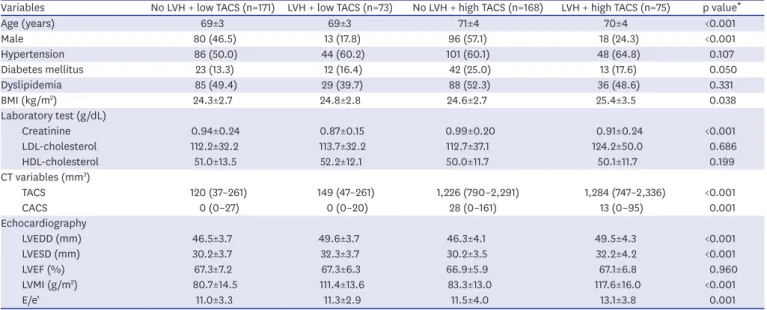
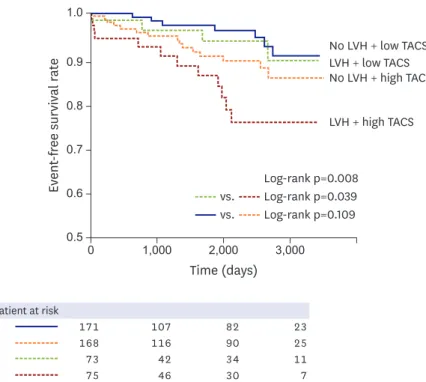
Results: A total of 39 composite events (8.0%) occurred during a median follow-up of 65 months (interquartile range [IQR], 17–89 months). For those with LVH, the concurrent presence of high TACS appeared to be an independent predictor (HR, 4.51; 95% CI, 1.71–
11.88; p=0.002) for the composite study endpoint. Other combined LVH and TACS subgroups were not associated with significant factors for predicting the composite study endpoint (p>0.050, all).
Conclusion: TACS provides robust predictive utility for a composite of cardiovascular events and cardiac death in persons with LVH. This finding was less pronounced in those with a relatively healthy myocardium, defined by the absence of LVH.
Keywords: Left ventricular hypertrophy; Vascular calcification; Prognosis
Original Article
Received: Jan 4, 2017 Revised: Apr 3, 2017 Accepted: Jul 19, 2017 Correspondence to Hyuk-Jae Chang, MD, PhD Division of Cardiology, Severance Cardiovascular Hospital, Yonsei University College of Medicine, 50, Yonsei-ro, Seodaemun-gu, Seoul 03722, Korea.
E-mail: [email protected]
Copyright © 2017. The Korean Society of Cardiology
This is an Open Access article distributed under the terms of the Creative Commons Attribution Non-Commercial License (https://
creativecommons.org/licenses/by-nc/4.0) which permits unrestricted noncommercial use, distribution, and reproduction in any medium, provided the original work is properly cited.
ORCID IDs In-Jeong Cho
https://orcid.org/0000-0002-1209-5129 Hyuk-Jae Chang
https://orcid.org/0000-0002-6139-7545 Sang-Eun Lee
https://orcid.org/0000-0001-6645-4038 Chi Young Shim
https://orcid.org/0000-0002-6136-0136
In-Jeong Cho , MD
1, Hyuk-Jae Chang , MD, PhD
1,2, Sang-Eun Lee , MD
1, Chi Young Shim , MD, PhD
1, Geu-Ru Hong, MD, PhD
1, and Namsik Chung, MD, PhD
11
Division of Cardiology, Severance Cardiovascular Hospital, Yonsei University College of Medicine, Seoul, Korea
2