INTRODUCTION
Endoscopic retrograde cholangiopancreatography (ERCP) has become the first-choice treatment for common bile duct (CBD) disorders and periampullary disease.1,2 Compared with
other endoscopic examinations, ERCP carries a higher poten- tial for complications, ranging from minor events with prompt resolution, such as mild pancreatitis, to major life-threatening risks, such as hemorrhage and severe pancreatitis.3-7 In previ- ous studies, the risk factors for bleeding as a result of ERCP are coagulopathy, liver cirrhosis, renal failure, sphincterotomy, and papillectomy.8-10 In particular, patients with liver cirrhosis have been considered to be at high risk for ERCP-related bleed- ing.11,12 Cirrhosis-associated coagulopathy, liver dysfunction, and gastroesophageal varices may increase the risk of proce- dure-related bleeding in these patients.4
To date, several studies have analyzed the risk of ERCP in patients with liver cirrhosis.11,13-15 However, previous studies re- ported limited sample sizes,12,15,16 small portions of therapeutic ERCPs,14 limited information about the type of procedure or degree of cirrhosis, and substantial heterogeneity in the com- parison group.11,12 Furthermore, the safety of ERCP in liver cir-
Bleeding Complications and Clinical Safety
of Endoscopic Retrograde Cholangiopancreatography in Patients with Liver Cirrhosis
Ji Yeon Kim*, Hee Seung Lee*, Moon Jae Chung, Jeong Youp Park, Seung Woo Park, Si Young Song, and Seungmin Bang
Department of Internal Medicine, Institute of Gastroenterology, Yonsei University College of Medicine, Seoul, Korea.
Purpose: Patients with liver cirrhosis are considered to be at risk for additional adverse events during endoscopic retrograde cholangiopancreatography (ERCP). The present study was designed as a propensity-score matched analysis to investigate wheth- er cirrhotic liver increases the risk of bleeding complications in patients undergoing ERCP.
Materials and Methods: In total, 8554 patients who underwent ERCP from January 2005 to December 2015 were retrospectively analyzed. To adjust for the imbalance between patients with and those without liver cirrhosis, 1:3 propensity score matching was performed according to age and sex.
Results: Liver cirrhosis was identified in 264 (3.1%) patients. After propensity score matching, a total of 768 patients were includ- ed in each of the cirrhotic (n=192) and non-cirrhotic groups (n=576). Post-procedure bleeding (10.9% vs. 4.7%, p=0.003) was more frequently observed in patients with liver cirrhosis than in those without. In multivariate analyses, liver cirrhosis was identified as an independent risk factor associated with post-ERCP bleeding (p=0.003) after further adjustment for prothrombin time, antiplate- let/coagulant, duration of ERCP, and stent insertion. Child-Pugh (CP) class C was found to be associated with an increased inci- dence of post-ERCP bleeding in patients with cirrhosis (odds ratio 6.144, 95% confidence interval 1.320–28.606; p=0.021).
Conclusion: The incidence of post-ERCP bleeding in patients with liver cirrhosis was higher than that in patients without liver cirrhosis. In particular, CP class C cirrhosis was significantly associated with post-ERCP bleeding.
Key Words: Liver cirrhosis, endoscopic retrograde cholangiopancreatography, hemorrhage
pISSN: 0513-5796 · eISSN: 1976-2437
Received: October 29, 2018 Revised: March 5, 2019 Accepted: March 11, 2019
Corresponding author: Seungmin Bang, MD, PhD, Division of Gastroenterology, Department of Internal Medicine, Yonsei University College of Medicine, 50-1 Yon- sei-ro, Seodaemun-gu, Seoul 03722, Korea.
Tel: 82-2-2228-1957, Fax: 82-2-2227-7900, E-mail: [email protected]
*Ji Yeon Kim and Hee Seung Lee contributed equally to this work.
•The authors have no potential conflicts of interest to disclose.
© Copyright: Yonsei University College of Medicine 2019
This is an Open Access article distributed under the terms of the Creative Com- mons Attribution Non-Commercial License (https://creativecommons.org/licenses/
by-nc/4.0) which permits unrestricted non-commercial use, distribution, and repro- duction in any medium, provided the original work is properly cited.
Yonsei Med J 2019 May;60(5):440-445 https://doi.org/10.3349/ymj.2019.60.5.440
rhosis is still controversial because of limited data.11,14 Adler, et al.14 reported that therapeutic ERCP is safe and effective in pa- tients with liver cirrhosis. Meanwhile, however, Inamdar, et al.11 showed that the frequency of ERCP-related bleeding was statistically significant in patients with decompensated liver cir- rhosis. Endoscopic sphincterotomy (EST) or balloon dilatation, which means cutting or dilatation of the sphincter muscle that lies at the juncture of the intestine with the bile ducts, is an es- sential technique in patients who receive ERCP.16-18 Prior to those procedures in cirrhotic patients, recognition and understand- ing of the potential complications of ERCP are important for appropriate patient selection for performing ERCP.
Here, we aimed to investigate the safety of ERCP in patients with liver cirrhosis, focusing on bleeding complications. For the evaluation of bleeding complications of ERCP in patients with cirrhosis, we performed propensity-score matched analy- sis using a retrospective cohort data.
MATERIALS AND METHODS
Patients
A total of 8554 patients had undergone ERCP at an academic tertiary hospital in South Korea between January 2005 and De- cember 2015. Among them, 555 patients were excluded accord- ing to the following exclusion criteria: ERCP for bile duct anas- tomosis site stricture after liver transplantation in the cirrhotic group (n=129); failed cannulation during the procedure (n=
269); only cholangiography without insertion of a guidewire during the procedure (n=93); and papillectomy (n=64). Finally, 264 patients with cirrhosis and 7735 patients without cirrhosis remained.
The demographic, clinical, and laboratory data of the study population were collected from medical records. Medical re- cord data, including sex, age at the time of procedure, etiology of cirrhosis, cardiovascular disease, medication related to bleeding tendency, pre-procedure laboratory values, Child-Pugh (CP) scores at the time of the procedure, ERCP indications, proce- dural details, and procedure-related adverse events, were re- viewed. Liver cirrhosis was diagnosed according to laboratory values, liver biopsies, and the results of imaging studies. If liver histologic information was not available, clinically diagnosed liver cirrhosis was based on following criteria: 1) platelet count of <100000/µL and ultrasonographic findings suggestive of cirrhosis, including a blunted, nodular liver edge accompa- nied by splenomegaly (>12 cm); 2) esophageal or gastric vari- ces; or 3) overt complications of liver cirrhosis, including asci- tes, variceal bleeding, and hepatic encephalopathy.19 The severity of liver cirrhosis was classified according to CP class.
This study was performed in accordance with ethical guide- lines of the 1975 Declaration of Helsinki and approved by the Institutional Review Board of Severance Hospital (IRB num- ber: 4-2016-1090).
Propensity score matching
Propensity score matching was introduced to reduce patient selection bias and the potential confounding biases due to differences between the two patient groups. A biostatistician in the Medical Research Collaborating Center matched the group of the patients with liver cirrhosis to the group of those without liver cirrhosis at a 1:3 ratio using the calculated pro- pensity score by optimal matching methods. To eliminate bias caused by different baseline characteristics, we calculated propensity score based on age and sex. After optimal match- ing, we compared the baseline characteristics. Finally, 768 pa- tients were matched, including 192 patients in the cirrhotic group and 576 patients in the non-cirrhotic group (Fig. 1).
Endoscopic procedure
Patients were sedated with intravenous anesthesia (midazol- am and/or propofol), along with continuous monitoring of blood pressure, heart rate, and oxygen saturation. All patients received intravenous cimetropium bromide for inhibiting duo- denal spasm. A side-viewing duodenal scope (TJF-260; Olym- pus, Tokyo, Japan) was used for ERCP. After the papilla had been examined with the endoscope, selective cannulation of either the CBD or the ventral pancreatic duct was performed.
Once the chosen duct was selectively cannulated, either a cholangiogram or a pancreatogram was obtained fluoroscopi- cally with injection of contrast medium into the duct. Four hours after the ERCP and at 5 a.m. of the next day of the proce- dure, blood chemistry, including serum amylase, lipase, and total bilirubin level; chest radiography; and simple abdominal radiography were performed for evaluating post-ERCP pan- creatitis (PEP), cholangitis, and bowel perforation. To identify post-ERCP bleeding, hemoglobin level and bleeding history were checked. Most of the patients taking medications related to bleeding tendency (such as aspirin, warfarin, clopidogrel,
Fig. 1. Flow diagram of patient selection. ERCP, endoscopic retrograde cholangiopancreatography.
8554 patients had undergone ERCP between January 2005 and December 2015
264 patients with cirrhosis
192 patients with cirrhosis
7735 patients without cirrhosis Excluded (n=555)
• Indication of ERCP for anastomosis site stricture after liver transplantation (n=129)
• Failed cannulation (n=269)
• Only cholangiography (n=93)
• Papillectomy (n=64)
Propensity score matching 1:3
576 patients without cirrhosis
or a new oral anticoagulant) needed to stop the medications for at least until 3 days before the procedure.
Definition and management of complications
Post-sphincterotomy bleeding was defined as immediate bleeding requiring endoscopic or other intervention within 24 hr or delayed bleeding recognized on the basis of clinical evi- dence (such as melena, hematochezia, and hematemesis), with a decrease in hemoglobin level >2 g/dL or the need for blood transfusion within 10 days after ERCP.4 Clinically significant bleeding and its severity were classified as follows: mild bleed- ing was defined as overt bleeding with a decrease of hemoglo- bin level <3 g/dL, without the need for transfusion; moderate bleeding was defined as blood transfusion of 4 units or less without the need for angiographic intervention or surgery; and severe bleeding was defined as blood transfusion of 5 units or more or the need for angiographic or surgical intervention.20 Statistical analysis
Statistical analyses were performed using SPSS software (ver- sion 20.0; IBM Corp., Armonk, NY, USA). Associations involv- ing parametric data were assessed using Student’s t-test. Chi- square (χ2) test was used to compare categorical data, and Student’s t-test was used to compare continuous data. Statisti- cal analysis was performed with the Jonckheere-Terpstra test to determine whether there was a statistically significant trend among independent samples. All two-tailed p values of <0.05 were considered statistically significant.
RESULTS
Patients
After propensity score matching, a total of 192 patients with cir- rhosis (age 59.4±9.5 years) were included in the analysis. The etiologies of cirrhosis were as follows: hepatitis B (n=106, 59.2%), hepatitis C (n=21, 11.7%), and alcoholic (n=28, 15.6%).
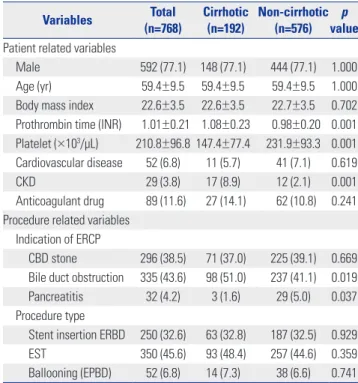
Among 192 patients with liver cirrhosis, 92 (47.9%) had CP classification A, 55 (28.6%) had CP classification B, and 45 (23.4%) had CP classification C. The patient demographic and procedure characteristics are summarized in Table 1. The indi- cations for ERCP were as follows: CBD stone with or without acute cholangitis (n=296, 38.5%), bile duct obstruction (n=335, 43.6%), and pancreatitis (n=32, 4.2%).
ERCP-related bleeding complications
A total of 48 patients had post-ERCP bleeding among the en- rolled patients, and there was a statistically significantly higher rate of bleeding complication in patients with cirrhosis (10.9%
vs. 4.7%; p=0.003). Among the bleeding cases, 32 patients (66.7%) had mild post-ERCP bleeding; 16 patients (33.3%) had mod- erate post-ERCP bleeding (Table 2). Most bleeding events (n=
32, 66.7%) were mild oozing that occurred during the proce-
dure. No cases of massive bleeding occurred. Thirty-two bleeding episodes were controlled with electrical cauteriza- tion with a needle knife and/or hemoclip. No cases needed embolization or surgical management. There was no event of mortality related to bleeding.
Risk factors related to post-ERCP bleeding
Univariate analysis showed liver cirrhosis to be a significant risk factor related to post-ERCP bleeding (p=0.003). Because Table 1. Patient Baseline Characteristics
Variables Total
(n=768) Cirrhotic
(n=192) Non-cirrhotic (n=576) p
value Patient related variables
Male 592 (77.1) 148 (77.1) 444 (77.1) 1.000
Age (yr) 59.4±9.5 59.4±9.5 59.4±9.5 1.000
Body mass index 22.6±3.5 22.6±3.5 22.7±3.5 0.702 Prothrombin time (INR) 1.01±0.21 1.08±0.23 0.98±0.20 0.001 Platelet (×103/µL) 210.8±96.8 147.4±77.4 231.9±93.3 0.001 Cardiovascular disease 52 (6.8) 11 (5.7) 41 (7.1) 0.619
CKD 29 (3.8) 17 (8.9) 12 (2.1) 0.001
Anticoagulant drug 89 (11.6) 27 (14.1) 62 (10.8) 0.241 Procedure related variables
Indication of ERCP
CBD stone 296 (38.5) 71 (37.0) 225 (39.1) 0.669 Bile duct obstruction 335 (43.6) 98 (51.0) 237 (41.1) 0.019 Pancreatitis 32 (4.2) 3 (1.6) 29 (5.0) 0.037 Procedure type
Stent insertion ERBD 250 (32.6) 63 (32.8) 187 (32.5) 0.929
EST 350 (45.6) 93 (48.4) 257 (44.6) 0.359
Ballooning (EPBD) 52 (6.8) 14 (7.3) 38 (6.6) 0.741 ERCP, endoscopic retrograde cholangiopancreatography; ERBD, endoscopic retrograde biliary drainage; EST, endoscopic sphincterotomy; EPBD, endoscop- ic papillary balloon dilation; INR, international normalized ratio; CKD, chronic kidney disease; CBD, common bile duct.
Variables are expressed as mean±standard deviation or n (%).
Table 2. Comparison of Post-ERCP Bleeding between Patients with Cir- rhosis and Those without Cirrhosis
Adverse event Total
(n=768) Cirrhotic
(n=192) Non-cirrhotic (n=576) p value
Bleeding 48 (6.3) 21 (10.9) 27 (4.7) 0.003
Severity 0.555
Mild 32 (66.7) 13 (61.9) 19 (70.4)
Moderate 16 (33.3) 8 (38.1) 8 (29.6)
Severe 0 (0.0) 0 (0.0) 0 (0.0)
Time of bleeding 0.712
Immediate 39 (81.3) 18 (85.7) 21 (77.8)
Delayed 9 (18.8) 3 (14.3) 6 (22.2)
Treatment modality 0.758
Conservative 16 (33.3) 6 (28.6) 10 (37.0) Endoscopic 32 (66.7) 15 (71.4) 17 (63.0) ERCP, endoscopic retrograde cholangiopancreatography.
Variables are expressed as n (%).
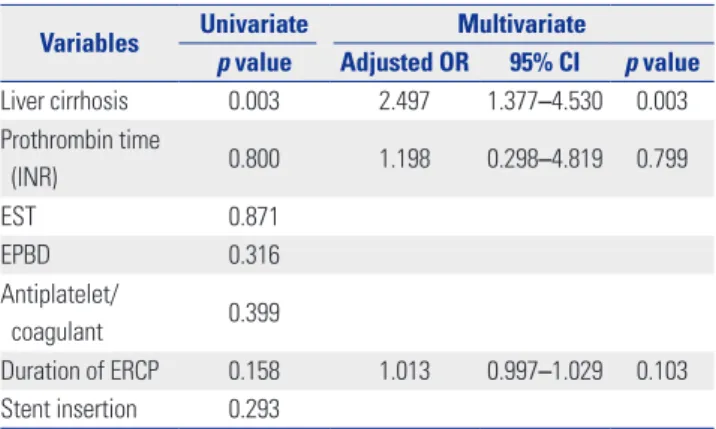
cirrhosis associated coagulopathy may increase the risk of procedure-related bleeding, we performed additional multi- variate analysis. Liver cirrhosis was identified as an indepen- dent risk factor related to post-ERCP bleeding after adjustment for prothrombin time and duration of ERCP (p=0.003) (Table 3).
Procedure types were not independent risk factors for post- ERCP bleeding.
Bleeding complications according to the CP classification
In subgroup analysis, there was a significant difference in the rate of post-procedure bleeding among patients with different CP classifications (Table 4). In multivariate analysis, CP class C was found to be associated with an increased incidence of post-ERCP bleeding in patients with cirrhosis (odds ratio 6.144, 95% confidence interval 1.320–28.606; p=0.021).
Complications according to procedure type
The patients underwent various therapeutic maneuvers dur-
ing ERCP, which were individualized based on indications and intraprocedural findings. Among patients with liver cirrhosis, 93 patients (48.4%) underwent EST; however, there was no sig- nificant difference in the rate of post-ERCP bleeding in patients who underwent biliary sphincterotomy, compared with those who did not have a sphincterotomy (10.8% vs. 11.1%, p=0.561) (Supplementary Table 1, only online). We further analyzed the events of PEP and cholangitis because a high frequency of adverse events, including PEP and cholangitis, occurred in patients with cirrhosis undergoing ERCP. In the present study, there were no significant differences in the occurrences of PEP and cholangitis (p=0.507 and p=0.489) between the cirrhotic and non-cirrhotic groups (Supplementary Table 2, only on- line). In multivariate analysis, stent insertion was found to be associated with increased incidences of PEP and cholangitis (p=0.005 and p=0.029) (Supplementary Tables 3 and 4, only online).
DISCUSSION
In this study, we analyzed our data after propensity score match- ing according to identified variables including sex and age.
We confirmed that patients with liver cirrhosis face a greater risk of experiencing post-ERCP bleeding: liver cirrhosis was an independent risk factor associated with post-ERCP bleeding.
These results were not changed after further adjustment for duration of ERCP, procedure type, and prothrombin time.
Patients with liver cirrhosis are predisposed to developing underlying coagulopathy. Because of poor hepatic synthetic function, these patients have coagulation disorders and low platelet counts, which are risk factors of post-procedure bleed- ing. Zhang, et al.15 reported that post-ERCP bleeding was in- creased in patients with Model for End-stage Liver Disease (MELD) scores >11.5. Similar to previous studies, patients with CP class C cirrhosis experienced significantly more bleeding than those with CP class A or B in this study.
ERCP with sphincterotomy has been considered to pose a higher risk for post-procedure bleeding.4 In a previous study, complications of EST occur in about 10% of patients, and 2–3%
may have a prolonged hospital stay.20 The presence of varices, which can develop in the duodenum in patients with cirrhosis, may increase the risk of bleeding after sphincterotomy. How- ever, in this study, bleeding risk after sphincterotomy did not show any statistically significant difference from the patients with cirrhosis, compared to those without cirrhosis. Regardless of the sphincterotomy, due to a tendency for patients with cir- rhosis to bleed, bleeding complications of ERCP are consid- ered to occur. Accordingly, the rate of bleeding was higher in patients with cirrhosis in this study.
Mariante-Neto, et al.21 and Romano, et al.22 reported that lower levels of creatinine may influence the low prognostic value of MELD score, which is associated post-ERCP bleed- Table 4. Multivariate Analysis of Risk Factors for Post-ERCP Bleeding in
Cirrhotic Patients
Variables Multivariate
Adjusted OR 95% CI p value Child-Pugh class
A 1
B 2.533 0.704–9.112 0.155
C 6.144 1.320–28.606 0.021
Albumin 0.539 0.156–1.867 0.330
Platelet 0.987 0.976–0.999 0.032
CKD 4.757 0.525–43.109 0.165
Anticoagulant drugs 1.690 0.257–11.116 0.585
EST 1.760 0.533–5.817 0.354
EPBD 0.552 0.052–5.889 0.623
ERCP, endoscopic retrograde cholangiopancreatography; OR, odds ratio; CI, confidence interval; CKD, chronic kidney disease; EST, endoscopic sphincterot- omy; EPBD, endoscopic papillary balloon dilatation.
Table 3. Univariate and Multivariate Analysis of Risk Factors for Post- ERCP Bleeding
Variables Univariate Multivariate
p value Adjusted OR 95% CI p value Liver cirrhosis 0.003 2.497 1.377–4.530 0.003 Prothrombin time
(INR) 0.800 1.198 0.298–4.819 0.799
EST 0.871
EPBD 0.316
Antiplatelet/
coagulant 0.399
Duration of ERCP 0.158 1.013 0.997–1.029 0.103 Stent insertion 0.293
ERCP, endoscopic retrograde cholangiopancreatography; OR, odds ratio; CI, confidence interval; INR, international normalized ratio; EST, endoscopic sphincterotomy; EPBD, endoscopic papillary balloon dilatation.
ing, and suggested that sex may have an impact on the prog- nostic value of both MELD and CP scores. Herein, we matched all patients by age and sex. We analyzed the impact of liver cirrhosis on post-ERCP bleeding both without adjustment for platelet/prothrombin time and with it. After all of this, regardless of platelet/prothrombin time, liver cirrhosis was a significant risk factor in this study.
Our study has several limitations. First, the retrospective nature may lead to an inherent selection bias. To overcome this limitation, we performed propensity score matching. This study is based on a cohort from large representative tertiary referral hospitals. Further, we performed additional adjust- ment for platelet, albumin, and prothrombin time to reduce the selection bias. After matching, more than 50% of therapeu- tic ERCPs was performed in this study, and degree of cirrhosis was analyzed. Second, the definition of bleeding events has not been standardized in previous studies.11,13-15,23,24 The num- ber of post-ERCP bleedings may depend on the definition of bleeding associated with a procedure. In this study, we catego- rized the bleeding grade according to the clinical and laborato- ry findings to find the effect of ERCP in patients with cirrhosis.
In conclusion, the incidence of post-ERCP bleeding in pa- tients with liver cirrhosis is remarkably high after diagnostic and therapeutic ERCP. CP classification can be a valuable pre- dictive factor for ERCP-related adverse events, especially in terms of bleeding. Bleeding problems may be related to the formation of a powerful collateral vascular bed in the area of the duodenum due to portal hypertension. In this regard, ther- apeutic ERCP in patients with liver cirrhosis should be used according to absolute indications and with high caution. For diagnostic purposes, minimally invasive methods, such as mag- netic resonance cholangiopancreatography, endoscopic ultra- sound, etc., may be more appropriate.
ACKNOWLEDGEMENTS
Pray for the bliss of dead of Ji Yeon Kim.
AUTHOR CONTRIBUTIONS
Ji Yeon Kim, Hee Seung Lee: data collection, data analysis, study con- ception, and manuscript preparation. Moon Jae Chung: critical revi- sion of manuscript, data quality review. Jeong Youp Park: critical revi- sion of manuscript, data quality review. Seung Woo Park: critical revision of manuscript, data quality review. Si Young Song: critical re- vision of manuscript, data quality review. Seungmin Bang: study con- ception, critical revision of manuscript, overall study supervision. All authors approved the final manuscript.
ORCID iDs
Hee Seung Lee https://orcid.org/0000-0002-2825-3160 Moon Jae Chung https://orcid.org/0000-0002-5920-8549 Jeong Youp Park https://orcid.org/0000-0003-0110-8606 Seung Woo Park https://orcid.org/0000-0001-8230-964X
Si Young Song https://orcid.org/0000-0002-1417-4314 Seungmin Bang https://orcid.org/0000-0001-5209-8351
REFERENCES
1. Adler DG, Baron TH, Davila RE, Egan J, Hirota WK, Leighton JA, et al. ASGE guideline: the role of ERCP in diseases of the biliary tract and the pancreas. Gastrointest Endosc 2005;62:1-8.
2. Sakai Y, Tsuyuguchi T, Sugiyama H, Nishikawa T, Tawada K, Saito M, et al. Current situation of endoscopic treatment for common bile duct stones. Hepatogastroenterology 2012;59:1712-6.
3. Tulassay Z, Zagoni T, Kotrlik J. Complications of endoscopic biliary sphincterotomy. N Engl J Med 1997;336:963; author reply 963-4.
4. ASGE Standards of Practice Committee, Anderson MA, Fisher L, Jain R, Evans JA, Appalaneni V, Ben-Menachem T, et al. Complica- tions of ERCP. Gastrointest Endosc 2012;75:467-73.
5. Andriulli A, Loperfido S, Napolitano G, Niro G, Valvano MR, Spiri- to F, et al. Incidence rates of post-ERCP complications: a system- atic survey of prospective studies. Am J Gastroenterol 2007;102:
1781-8.
6. Masci E, Toti G, Mariani A, Curioni S, Lomazzi A, Dinelli M, et al.
Complications of diagnostic and therapeutic ERCP: a prospective multicenter study. Am J Gastroenterol 2001;96:417-23.
7. Loperfido S, Angelini G, Benedetti G, Chilovi F, Costan F, De Be- rardinis F, et al. Major early complications from diagnostic and therapeutic ERCP: a prospective multicenter study. Gastrointest Endosc 1998;48:1-10.
8. Wilcox CM, Canakis J, Mönkemüller KE, Bondora AW, Geels W.
Patterns of bleeding after endoscopic sphincterotomy, the subse- quent risk of bleeding, and the role of epinephrine injection. Am J Gastroenterol 2004;99:244-8.
9. Nelson DB, Freeman ML. Major hemorrhage from endoscopic sphincterotomy: risk factor analysis. J Clin Gastroenterol 1994;19:
283-7.
10. Freeman ML, Nelson DB, Sherman S, Haber GB, Herman ME, Dorsher PJ, et al. Complications of endoscopic biliary sphincter- otomy. N Engl J Med 1996;335:909-18.
11. Inamdar S, Berzin TM, Berkowitz J, Sejpal DV, Sawhney MS, Chu- tanni R, et al. Decompensated cirrhosis may be a risk factor for adverse events in endoscopic retrograde cholangiopancreatogra- phy. Liver Int 2016;36:1457-63.
12. Li DM, Zhao J, Zhao Q, Qin H, Wang B, Li RX, et al. Safety and ef- ficacy of endoscopic retrograde cholangiopancreatography for common bile duct stones in liver cirrhotic patients. J Huazhong Univ Sci Technolog Med Sci 2014;34:612-5.
13. Lee MH, Tsou YK, Lin CH, Lee CS, Liu NJ, Sung KF, et al. Predictors of re-bleeding after endoscopic hemostasis for delayed post-endo- scopic sphincterotomy bleeding. World J Gastroenterol 2016;22:
3196-201.
14. Adler DG, Haseeb A, Francis G, Kistler CA, Kaplan J, Ghumman SS, et al. Efficacy and safety of therapeutic ERCP in patients with cirrhosis: a large multicenter study. Gastrointest Endosc 2016;83:
353-9.
15. Zhang J, Ye L, Zhang J, Lin M, He S, Mao X, et al. MELD scores and Child-Pugh classifications predict the outcomes of ERCP in cir- rhotic patients with choledocholithiasis: a retrospective cohort study. Medicine (Baltimore) 2015;94:e433.
16. Prat F, Tennenbaum R, Ponsot P, Altman C, Pelletier G, Fritsch J, et al. Endoscopic sphincterotomy in patients with liver cirrhosis.
Gastrointest Endosc 1996;43(2 Pt 1):127-31.
17. Kawabe T, Komatsu Y, Tada M, Toda N, Ohashi M, Shiratori Y, et al. Endoscopic papillary balloon dilation in cirrhotic patients: re- moval of common bile duct stones without sphincterotomy. En-
doscopy 1996;28:694-8.
18. Park DH, Kim MH, Lee SK, Lee SS, Choi JS, Song MH, et al. Endo- scopic sphincterotomy vs. endoscopic papillary balloon dilation for choledocholithiasis in patients with liver cirrhosis and coagu- lopathy. Gastrointest Endosc 2004;60:180-5.
19. Kim DY, Kim SU, Ahn SH, Park JY, Lee JM, Park YN, et al. Useful- ness of FibroScan for detection of early compensated liver cirrho- sis in chronic hepatitis B. Dig Dis Sci 2009;54:1758-63.
20. Cotton PB, Lehman G, Vennes J, Geenen JE, Russell RC, Meyers WC, et al. Endoscopic sphincterotomy complications and their management: an attempt at consensus. Gastrointest Endosc 1991;
37:383-93.
21. Mariante-Neto G, Marroni CP, Fleck Junior AM, Marroni CA, Zan-
otelli ML, Cantisani G, et al. Impact of creatinine values on MELD scores in male and female candidates for liver transplantation.
Ann Hepatol 2013;12:434-9.
22. Romano TG, Schmidtbauer I, Silva FM, Pompilio CE, D’Albuquerque LA, Macedo E. Role of MELD score and serum creatinine as prog- nostic tools for the development of acute kidney injury after liver transplantation. PLoS One 2013;8:e64089.
23. Navaneethan U, Njei B, Zhu X, Kommaraju K, Parsi MA, Varada- rajulu S. Safety of ERCP in patients with liver cirrhosis: a national database study. Endosc Int Open 2017;5:E303-14.
24. Kim KO, Kim TN, Kim SB, Lee JY. Characteristics of delayed hem- orrhage after endoscopic sphincterotomy. J Gastroenterol Hepa- tol 2010;25:532-8.