Willingness to Pay for Hospice Care Using the Contingent Valuation Method
Mee-Ok Kim,
1Kun-Sei Lee,
2Jung-Hoe Kim,
3and Ji-Soo Joo
31Department of Health Policy, Seoul Medical Center, Seoul;
2Department of Preventive Medicine, School of Medicine, Konkuk University, Seoul;
3Health Insurance Review & Assessment Service, Seoul, Korea.
Received: May 3, 2010 Revised: July 27 2010 Accepted: August 11, 2010
Corresponding author: Dr. Kun-Sei Lee, Department of Preventive Medicine, School of Medicine, Konkuk University, Biomedical Science Research Building, 1 Hwayang-dong, Gwangjin-gu, Seoul 143-701, Korea.
Tel: 82-2-2030-7817, Fax: 82-2-2049-6192 E-mail: [email protected]
∙ The authors have no financial conflicts of interest.
© Copyright:
Yonsei University College of Medicine 2011 This is an Open Access article distributed under the terms of the Creative Commons Attribution Non- Commercial License (http://creativecommons.org/
licenses/by-nc/3.0) which permits unrestricted non- commercial use, distribution, and reproduction in any medium, provided the original work is properly cited.
Purpose: It is necessary to develop a proper payment system for more health care facilities to provide hospice and palliative cares. In deciding the proper level of payment for hospice per diem fee, willingness to pay (WTP) may provide one of the critical information. This study was conducted to determine WTP for hospice care and to analyze those factors affecting WTP. Materials and Methods: A con- tingent valuation method with a double-bounded dichotomous-choice model was used. Interview survey was organized and conducted by a survey company from April 4 to 18, 2008. The mean WTP was calculated through an infinite integration of survival functions. Results: The average willingness to pay was found to be 42,240 Korean won (KRW) (USD 35), with the amount becoming higher as hos- pice services were deemed more necessary or where average monthly household income was higher. The amount was also higher among male respondents than fe- males. Conclusion: To compare this WTP with actual cost (32,500 KRW) (USD 27) for hospice care. To facilitate hospice service, hospice specific payment system should be developed. This study provides information regarding the general pub- lic’s preference of hospice service and their WTP for hospice care, and it may be useful in the decision-making process.
Key Words: Hospice, willingness to pay, Per diem payment
INTRODUCTION
Cancer is the leading cause of death in South Korea. According to the most recent data, the number of cancer-related death has been increasing gradually. The cancer mortality increased from 108.6 persons per 100,000 in 1998 to 139.5 in 2008.
68,912 persons, indicating that 28% of total death in 2008 died of cancer.1
Five year survival rate of cancer treatment has been improving. Government re- ported the 5 year survival rate of cancer treatment in 1998-2002 was 46.3%, and it was improved compared to 41.7%2 of the period 1993-1997.
Still, many cancer patients have to face inevitable cancer death. During their ter- minal stage, they encounter a variety of physical and mental problems. Unfortu- nately, many terminal cancer patients may not receive appropriate hospice care,
tem for more health care facilities to provide hospice and palliative cares. Any hospital or clinic can provide hospice care under current fee-for-service system. Hospice cares should be a multidisciplinary team approach. It requires ad- ditional services and other personnels such as social work- ers, program coordinators, patients’ care-givers, and it re- quires more time for emotional care and counseling for patients and their family. Furthermore, some programs such as play therapy and art therapy are necessary for patients and counseling for bereaved family. However, these kinds of cares are not paid by Health Insurance Benefit, because current payment system didn’t permit such cares and pro- gram. Most hospice medical institutions have been operat- ing without proper compensation.10
Since 2007, therefore, the Health Insurance Review and Assessment Service (HIRA) has developed a new hospice payment system, per diem payment system. Tertiary hospi- tal might be paid 184,000 KRW (USD 154) per day, gener- al hospital 86,000 KRW (USD 72), and clinic 76,000 KRW (USD 64).11 Demonstration project started to assess the proper level of payment and to evaluate patients care quali- ty in 2009. In deciding the proper level of payment for hos- pice per diem fee, several aspects such as needs, costs, cost- effectiveness, and budget impact should be considered. In this decision, social acceptance of hospice care and willing- ness to pay might be one of the critical considerations.
This study aimed to identify the perception and willing- ness to pay (WTP) for hospice care among the general pub- lic. Some WTP studies have been conducted when some new services and programs were considered for public pro- gram or health insurance benefit decision. When the U.S.
adopted a program to decrease childhood obesity, a study of WTP confirmed that citizens of New York were willing to pay an additional USD 690 million per year to reduce child- hood obesity by 50%.12 WTP increased as household in- come increased, as well as when there was an increase in the perception of childhood obesity as a growing problem in this study. In Taiwan, a study was performed on WTP for screening for diabetic retinopathy against patients with Type 2 diabetes.13 In Vietnam, a study was done with regards to WTP and the adoption of a local health insurance system.14 Before deciding health insurance benefit and reimburse- ment level, this kind of WTP study can be helpful for deci- sion-makers. It is, therefore, important to identify the pub- lic’s WTP for hospice care services and its preferences, and this study is expected to provide important information for the decision of reimbursement level of hospice care.
even though they use more resources than hospice care:
They receive the traditional acute care in acute hospitals and died there, and medical costs are 45% more during the last year of life compared with that of hospice care pa- tients.3 Another study found that 16.7% of terminal cancer patients were using emergency rooms while some cancer patients were even being left at home alone.4 Many patients in acute hospital setting may receive intensive care and life- sustaining procedures (e.g., mechanical ventilator and re- suscitation) in the last week of life. A study showed that pa- tient-physician discussions about the end of life could reduce unnecessary intensive interventions and costs and increase the quality of death,5 and another study found that 60.7% of total length of stay of the terminal cancer patients is inap- propriate in tertiary hospitals.6 These kinds of unnecessary treatments might not only add a pain to terminal patients, but also increases their and their families’ financial burdens.
Even though hospice care in South Korea started first in the Galbari Clinic in 1965, hospice care system did not de- velop well, and some religious hospitals and clinics provid- ed hospice care in Korea. There was a shortage of hospice care providers: Only 42 secondary and tertiary hospitals, 11 general hospitals, and 9 clinics had been providing hospice.
Even worse, hospice care services showed a great variance, depending on the facilities.7
In the point of view of hospice care service, the goal of hospice care, personnel with appropriate training, educa- tional programs, standard for care, and consulting service to patients’ family members are neither clearly defined nor or- ganized in Korea, compared to the international hospice care standards.8
Stronger financial support for hospice and palliative care through the government and insurance programs would help increase the availability and use of services, especially in Korea.9 Thus, Korean government has developed a vari- ety of programs to increase the provision of hospice cares, and Korean National Cancer Center prepared the guideline,
‘The Hospice and Palliative Care Standard and Provisions provide more systematic hospice and palliative care. Kore- an government started a pilot project to support hospice in- stitutions for terminal cancer patients in 2003. Through this project, the South Korean government provided a total of 1.2 billion KRW (Korean Won) (USD 1 million) to 30 in- stitutions in 2008; however, despite such efforts, only a few hospice institutions have received financial support, since there were 78 hospice medical institutions, as of 2007.
It is, therefore, necessary to develop proper payment sys-
el in survival analysis, a Weibull distribution, was assumed.
The Weibull distribution provides most frequently the best fit of life data. This is due in part to the broad range of dis- tribution shapes, such as the normal, the exponential, the Rayleigh, and sometimes the Poisson and the Binomial, that are included in the Weibull family.18 The mean WTP was calculated through an infinite integration of survival functions (Equation 1), and the expectation was estimated in Equation 2. As price, rather than time, was established in this study, “mean price” would refer to mean survival in the survival analysis. SAS LIFEREG procedure was used.
RESULTS
Socio-demographic characteristics
Distribution of socio-demographic characteristics is shown in Table 1. 65.8% of the respondents were female and 34.2%
were male. The mean age at the time of the survey was 42 years, with 65% of them in their 30s and 40s. Their main res- idential areas were small and mid-sized cities (40.2%), big- ger metropolitan areas (26%) and Seoul, the Capital (21.4%).
Only 12.4% lived in the rural areas. Most of the respon- dents were married (83.2%) and the rest answered in single, windowed, or divorced status (13.4%, 1.8%, 1.6%, respec- tively). 91% of them were found well-educated, having more than 10 years’ education, and only 7.8% received less.
More than half of them answered that they were religious, and about 50% reported their monthly household income between 2.5-4 million KRW (USD 2,000-3,350).
Recognition of hospice care
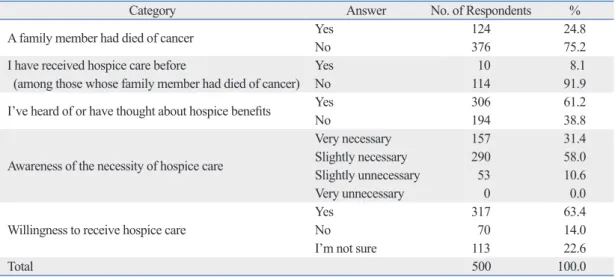
One-quarter (24.8%) of the respondents said that they had one of their family members who had died of cancer. And 8.1% of them said that their family member had received hospice care. When asked what they thought of hospice care, 61.2% of the respondents replied that they had heard of and considered receiving hospice benefits. Although about 90% of the respondents agreed that hospice was necessary, only 63.4% said “Yes” when asked if they were willing to receive it (Table 2).
MATERIALS AND METHODS
For the WTP survey, we followed the guideline and steps which NOAA recommended.15 We developed hypothetical scenario in which terminal cancer patients suffer from both physical and mental pain. In the WTP study, the “payment vehicle” refers to the means of payment by a patient. The payment vehicle is assumed as total cost of both copayment for health insurance scheme (10% of cost sharing for can- cer patients) and out-of-pocket money which is not covered by health insurance benefit. Respondents were encouraged to provide honest answers, in regards with their income and financial status.
A double-bounded dichotomous-choice model was used in this study. If a respondent accepts first bid, then interview- er asks double the price of the first bid, or if he (she) doesn’t accept it, then interviewer asks half the price of the first bid.
It may still be prone to a starting point bias like single bounded model. However, a double-bounded dichotomous- choice model allows for easy response, and provides a high response rate, consequently enhancing statistical efficiency.
Several bids were determined through a pilot survey of 44 random subjects. We set the number of bid price to nine based on the pre-test, and collected the WTP with open-ques- tion in the pre-test and used 10-90 percentiles of distribution of answers as nice. Among them, a bid was randomly select- ed and suggested to the respondent. Alberni recommended that four to six or fewer bids should be maintained, since the provision of too many bids could reduce the coupling of the model.16 In South Korea, where the response of “No-No” is relatively high, eight to 10 bids have been recommended.
Therefore, this study set the number of bid prices to nine:
10,000 (USD 8), 20,000 (USD 17), 30,000 (USD 25), 40,000 (USD 34), 50,000 (USD 42), 70,000 (USD 59), 90,000 (USD 75), 110,000 (USD 92), and 140,000 KRW (USD 117).
A total of 500 people (age≥20 years) were sampled ran- domly from Seoul, five other metropolitan cities, seven small and mid-sized cities, and three counties. Preliminary studies were conducted on March 31 and April 1, 2008. Education and training were provided to interviewers for a better under- standing of both study design and hospice service. Interview survey was organized and conducted by a survey company from April 4 to 18, 2008.
A survival analysis was performed to analyze interval censored data using a double-bounded dichotomous choice questionnaire.17 To calculate mean WTP, a parametric mod-
∞ t
Mean WTP =
∫
exp(
--(
--)
γ)
-- (Equation 1) 0 e
E(T) = Γ
(
1 + --1)
ϴ --- (Equation 2) γTable 1. Demographic and Social Distribution of Respondents
Category Classification No. of Respondents %
Gender Male 171 34.2
Female 329 65.8
Age
20 yrs 56 11.2
30 yrs 137 27.4
40 yrs 190 38.0
50 yrs 83 16.6
60 yrs or older 34 6.8
Mean±standard deviation: 42.69±10.67
Region
Small and mid-sized city 201 40.2
Metropolitan area 130 26.0
Seoul 107 21.4
County resident 62 12.4
Marital status
Married 416 83.2
Single 67 13.4
Widowed 9 1.8
Divorced 8 1.6
Education
Elementary school or less 13 2.6
Middle school 26 5.2
High school 232 46.4
Undergraduate school 216 43.2
Graduate school or higher 13 2.6
Religion
Christian 130 26.0
Buddhist 117 23.4
Roman catholic 52 10.4
No religion 201 40.2
Gross monthly household income
Less than 1 million KRW (USD 836) 20 4.0
1-1.49 million KRW (USD 836-1,253) 11 2.2
1.5-1.99 million KRW (USD 1,254-1,671) 37 7.4
2.0-2.49 million KRW (USD 1,672-2,088) 48 9.6
2.5-2.99 million KRW (USD 2,089-2,506) 81 16.2
3.0-3.49 million KRW (USD 2,507-2,924) 57 11.4
3.5-3.99 million KRW (USD 2,925-3,342) 100 20.0
4.0-4.49 million KRW (USD 3,343-3,760) 47 9.4
4.5-4.99 million KRW (USD 3,761-4,178) 48 9.6
5.0 million or more KRW (USD 4,179-) 51 10.2
Total 500 100.0
Table 2. General Recognition of Hospice Care
Category Answer No. of Respondents %
A family member had died of cancer Yes 124 24.8
No 376 75.2
I have received hospice care before Yes 10 8.1
(among those whose family member had died of cancer) No 114 91.9
I’ve heard of or have thought about hospice benefits Yes 306 61.2
No 194 38.8
Awareness of the necessity of hospice care
Very necessary 157 31.4
Slightly necessary 290 58.0
Slightly unnecessary 53 10.6
Very unnecessary 0 0.0
Willingness to receive hospice care
Yes 317 63.4
No 70 14.0
I’m not sure 113 22.6
Total 500 100.0
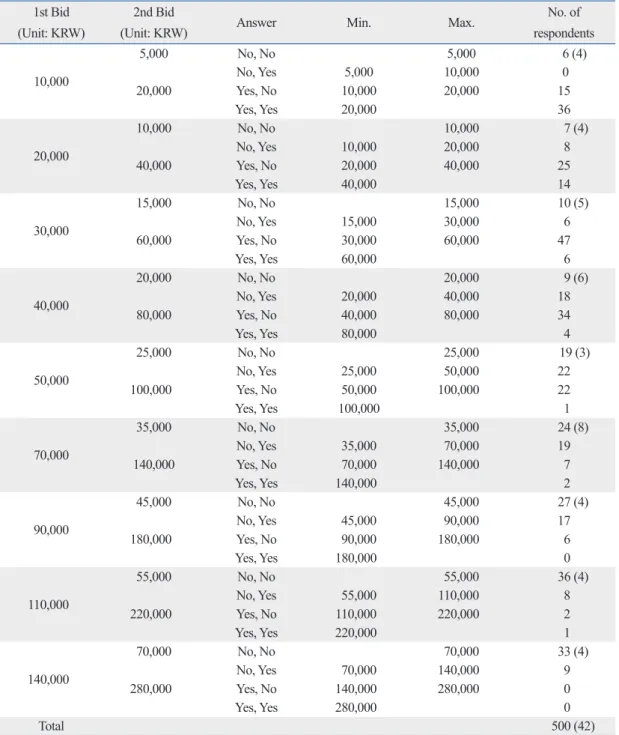
no WTP for either of the bid prices, 42 people responded “0 KRW” for WTP, while 129 respondents indicated willing- ness to pay some price, however, they refused to pay be- cause of two bid price were higher than they expected.
In Table 3, the figure in the parentheses in the “No. of Respondents” column refers to the number of respondents who never had a WTP, and refused to pay both bids. Among a total of 500 subjects, 42 respondents (8.4%) who had zero WTP were distributed regardless of response to the first bid, and some such respondents were found in every group.
Distribution of WTP responses
The distribution of WTP responses on nine bid prices is shown in Table 3. The range of WTP (maximum and mini- mum) was collected from the answer to the two bids. The minimum value alone existed among those who were will- ing to pay both bid prices, while the maximum value was found only among those respondents who had no intention to pay them.
As the bid increased, the number of respondents with no WTP increased as well. Among 171 respondents who had
Table 3. Distribution of WTP Responses 1st Bid
(Unit: KRW)
2nd Bid
(Unit: KRW) Answer Min. Max. No. of
respondents
10,000
5,000 No, No 5,000 6 (4)
No, Yes 5,000 10,000 0
20,000 Yes, No 10,000 20,000 15
Yes, Yes 20,000 36
20,000
10,000 No, No 10,000 7 (4)
No, Yes 10,000 20,000 8
40,000 Yes, No 20,000 40,000 25
Yes, Yes 40,000 14
30,000
15,000 No, No 15,000 10 (5)
No, Yes 15,000 30,000 6
60,000 Yes, No 30,000 60,000 47
Yes, Yes 60,000 6
40,000
20,000 No, No 20,000 9 (6)
No, Yes 20,000 40,000 18
80,000 Yes, No 40,000 80,000 34
Yes, Yes 80,000 4
50,000
25,000 No, No 25,000 19 (3)
No, Yes 25,000 50,000 22
100,000 Yes, No 50,000 100,000 22
Yes, Yes 100,000 1
70,000
35,000 No, No 35,000 24 (8)
No, Yes 35,000 70,000 19
140,000 Yes, No 70,000 140,000 7
Yes, Yes 140,000 2
90,000
45,000 No, No 45,000 27 (4)
No, Yes 45,000 90,000 17
180,000 Yes, No 90,000 180,000 6
Yes, Yes 180,000 0
110,000
55,000 No, No 55,000 36 (4)
No, Yes 55,000 110,000 8
220,000 Yes, No 110,000 220,000 2
Yes, Yes 220,000 1
140,000
70,000 No, No 70,000 33 (4)
No, Yes 70,000 140,000 9
280,000 Yes, No 140,000 280,000 0
Yes, Yes 280,000 0
Total 500 (42)
The figure in parenthesis refers to the number of respondents who never had a WTP, among those who had answered “No-No”.
to Korea, introduced the hospice care since 1990 and 1995, respectively. The Japanese Ministry of Health, Labor, and Welfare has strongly supported the provision of specialized palliative care services, and palliative care units have been covered by National Medical Insurance since 1990. Provid- ed that the relevant palliative care units are certified, the hospital is reimbursed at the rate of 37,800 yen (US $344) per patient per day by the health insurance system.19
The Department of Health in Taiwan has taken a proac- tive role in the development of hospice care programs since 1995. The feasibility of a hospice home care program was pilot-tested in the reimbursement scheme from July 1996.
Even though the coverage and payment for this program were limited, it was the Taiwanese government’s first initia- tive that directed health care resources toward end-of-life care for cancer patients. Hospice home care is paid at a fixed rate per visit (from US $42 to US $48, depending on the amount of time spent on the single home visit) in 2004.
Inpatient hospice care is reimbursed at a per diem rate of US $142.20
Representative and recognition of hospice
Compared with the national statistics, the distribution of subject’s age, gender, education, religion was different. The age distribution of general population of age 20s group, 30s, 40s, 50s, and above 60 in 2005 were 21.0%, 23.5%, 23.0%, 14.7% and 17.9%, respectively.21 The age distribution of our subjects of 20s, 30s, 40s, 50s, and above 60s were 11.2%, 27.4%, 38.0%, 16.6%, 6.8%, respectively. Relatively, more 30s and 40s age groups were recruited in the sample. In the distribution of gender, the ratio of male and female in 2005 in Korea was 49.9% and 50.1%, respectively. The ratio of male and female in our study was 34.2% and 65.8%, respec- tively. The distribution of elementary and middle school in 2005 National data was 30.3%, however, data of our sam- ple was 7.8%. We recruited more educated people.
In this study, male comprised 34.2%, and gender was sig- nificantly associated with WTP. Male had more WTP than female. The education level is the important proxy of social economic status, and the education level might be related with economic status. The higher income group showed more WTP in this study, In this case, the level of WTP might be overestimated because the subjects with higher educa- tion level were sampled than the general population. While interpreting the results, it should be careful not to generalize this result.
However, the sample subjects knew well what the hos- When asked why they had no intention to pay, the major
reason was “to spend time with family at home” (31.0%), followed by “due to financial burden” (21.4%) and “I don’t think hospice care is necessary” (16.7%). The 10 respon- dents who said that the “government should pay all hospice costs” or “I dislike this kind of hypothetical question” were excluded from this analysis, as they had failed to properly express a preference regarding hospice service.
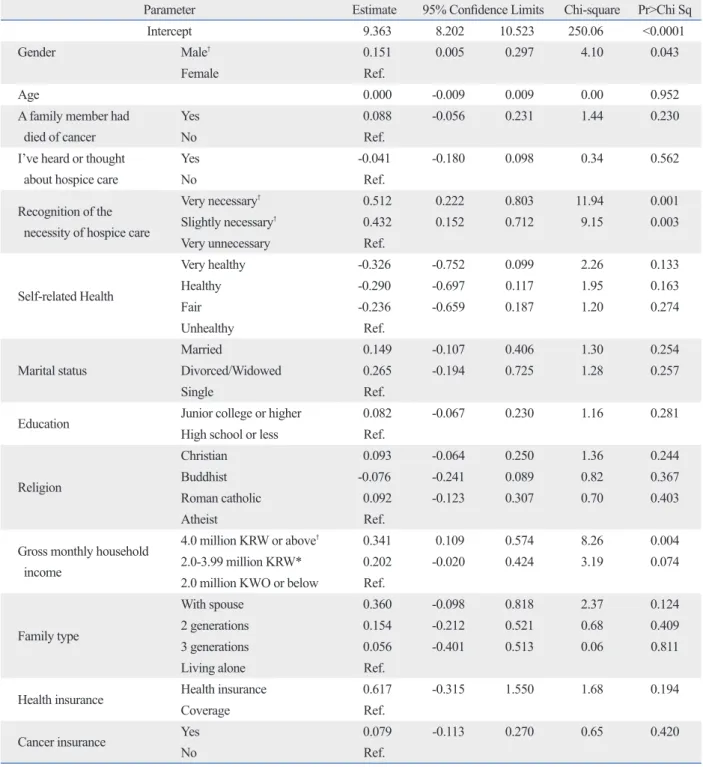
Analysis of estimated WTP and determinant factors To avoid the influences of covariance, we used an estimated value from a basic model that is free of the influence of cova- riance. When a survival analysis (no covariates) was con- ducted, the scale parameter (θ) and shape parameter (γ) were 50,588 and 1.6704, respectively, with statistical significance (Table 4). By applying these figures to Equation 2, a mean WTP (45,193 KRW) (USD 38) was acquired. This mean WTP (45,193 KRW) (USD 38) was calculated from 458 re- spondents who expressed the preference. When we included 32 respondents among 42 ones who had zero WTP, the esti- mated WTP for hospice service was found to be 42,240 KRW (USD 35) [45,193×(458/490)]. As described above, 10 respondents were excluded because they had failed to ex- press their preferences. To identify the factors that influence WTP, an analysis was conducted with covariance. The re- sults are shown in Table 5. Among the independent variables,
“gender,” “awareness of the necessity of hospice care,” and
“gross monthly household income” were statistically signifi- cant. When asked about “the necessity of hospice care,”
those who had stronger need for hospice service appeared to have larger WTP. In the relation with gross monthly house- hold income, the WTP of the “4.0 million KRW (USD 3,350) or above” group was higher than that of the “2.0 million KRW (USD 1,672) or below” group (p=0.004). In the “2.0- 3.99 million KRW (USD 1,672-3,349)” group, results were significant at a level of 10% (p=0.074). In gender, male re- spondents showed greater WTP than females (p=0.043). In other parameters (e.g., age, a family member had died of cancer, awareness of hospice care, self-related health, marital status, education, religion, cancer insurance, etc.), did not show statistically significant influence on WTP.
DISCUSSION
Hospice in other countries
Japan and Taiwan, which have cultural background similar
Table 4. Estimation Result of Survival Analysis, without Covariance
Parameter Estimate 95% confidence limits Chi-square Pr>Chi Sq
Intercept 10.8315 10.7656 10.8673 10.3848 <0.0001
Scale 0.5987 0.0278 0.5466 0.6556
Weibull scale 50,588 1,700 47,362 54,032
Weibull shape 1.6704 0.0775 1.5252 1.8294
Log Likelihood: -483.211.
Table 5. Result of Survival Analysis, with Covariance
Parameter Estimate 95% Confidence Limits Chi-square Pr>Chi Sq
Intercept 9.363 8.202 10.523 250.06 <0.0001
Gender Male† 0.151 0.005 0.297 4.10 0.043
Female Ref.
Age 0.000 -0.009 0.009 0.00 0.952
A family member had died of cancer
Yes 0.088 -0.056 0.231 1.44 0.230
No Ref.
I’ve heard or thought about hospice care
Yes -0.041 -0.180 0.098 0.34 0.562
No Ref.
Recognition of the necessity of hospice care
Very necessary† 0.512 0.222 0.803 11.94 0.001
Slightly necessary† 0.432 0.152 0.712 9.15 0.003
Very unnecessary Ref.
Self-related Health
Very healthy -0.326 -0.752 0.099 2.26 0.133
Healthy -0.290 -0.697 0.117 1.95 0.163
Fair -0.236 -0.659 0.187 1.20 0.274
Unhealthy Ref.
Marital status
Married 0.149 -0.107 0.406 1.30 0.254
Divorced/Widowed 0.265 -0.194 0.725 1.28 0.257
Single Ref.
Education Junior college or higher 0.082 -0.067 0.230 1.16 0.281
High school or less Ref.
Religion
Christian 0.093 -0.064 0.250 1.36 0.244
Buddhist -0.076 -0.241 0.089 0.82 0.367
Roman catholic 0.092 -0.123 0.307 0.70 0.403
Atheist Ref.
Gross monthly household income
4.0 million KRW or above† 0.341 0.109 0.574 8.26 0.004
2.0-3.99 million KRW* 0.202 -0.020 0.424 3.19 0.074
2.0 million KWO or below Ref.
Family type
With spouse 0.360 -0.098 0.818 2.37 0.124
2 generations 0.154 -0.212 0.521 0.68 0.409
3 generations 0.056 -0.401 0.513 0.06 0.811
Living alone Ref.
Health insurance Health insurance 0.617 -0.315 1.550 1.68 0.194
Coverage Ref.
Cancer insurance Yes 0.079 -0.113 0.270 0.65 0.420
No Ref.
*Significant at a significance level of 10%.
†Significant at a significance level of 5%.
Log Likelihood: -457.263.
other factors. Income level is an important factor in WTP.24 In other WTP study on the treatment of MI, WTP was found to be significantly high in high-income group.25 In a study to specify treatment location preferences and willingness to pay to obtain treatment in patients’ preferred locations. There was a tendency towards respondents with lower incomes be- ing willing to pay slightly less for their preferred treatment location than those with the highest incomes.26
Surveyed WTP can predict actual value in market. The mean WTP was 42,240 KRW (USD 35) per day in our study.
We compared the WTP with actual cost for hospice care, and Health Insurance Review & Assessment Service (HIRA) conducted a survey to collect the costs of hospice care.11 The average daily cost hospice (i.e., legal benefit) was 112,433 KRW (USD 10) under the fee-for-service system. There were differences among hospital levels. The average daily cost at a third level hospital was 174,553 KRW (USD 146), 132,789 KRW (USD 111) at a general hospital, 72,320 KRW (USD 60) at a hospital, 74,895 KRW (USD 63) at a long- term care hospital, and 71,944 KRW (USD 60) at a clinic.
The average daily cost that insurance benefit did not cover was 21,260 KRW (USD 18) (range, 0-77,231 KRW). If pa- tients have to pay legal copayment (10% of average daily cost, 11,243 KRW (USD 9) and cost uncovered by health in- surance beyond (21,260 KRW) (USD 18), then the sum of both costs is approximately 32,500 KRW (USD 27).
According to an another study that examined medical costs (include third party charges and copayment) for pa- tients who died in 2003, the hospice per diem cost was 151,000 KRW (USD 126).27 If the insurance coverage ex- cluding co-payment for coverage exclusion is set at 150,000 KRW (USD 125), the out-of-pocket payment (20%) would be 35,000 KRW (USD 29) based on these results. And if the per-diem co-payment for coverage exclusion was assumed to be 20,000 KRW (USD 17), the out-of-pocket payment would be 55,000 KRW (USD 46).
Since hospice patients’ medical costs, as found in the aforementioned studies, did not match the payment vehicle of this study, it is difficult to make direct comparisons. Ac- cording to a study by Lee,11 the combination of the co-pay- ment (10,000-20,000 KRW) (USD 8-17) and co-payment for coverage exclusion (20,000-40,000 KRW) (USD 17-34) was similar to the out-of-pocket payment (30,000-60,000 KRW) (USD 25-50), considering 10% of the out-of-pocket payment.
This study has some strengths. First, we used methods that can overcome limitations in the WTP methodology. In pice care was, and they thought that hospice care was nec-
essary for terminal cancer patients. This awareness and pos- itive attitude were prerequisite for the WTP survey. While only 8.1% of the respondents had experienced hospice care, they had positive attitude on the hospice. 61.2% of respon- dents knew the benefit of hospice care and 89.4% of re- spondents had said that hospice care was necessary. Fur- thermore, 63.4% responded that they were willing to use hospice services in the future. Although the survey sample did not represent national demographic features and hos- pice services were not commonly provided in the hospitals, they recognized hospice care, and had positive attitudes and intentions to use hospice care, suggesting that the study subjects were apt for the WTP survey.
On the validity of WTP method
To test the validity, especially construction, of WTP study, an income elasticity test and scope test are often used.22 In WTP studies, except for some inferior goods, most of goods have positive income elasticity. Since a significant increase in WTP was observed as income was increased in this study, it can be said that this study had positive income elasticity. These kinds of validity were done in other WTP studies. When a social insurance was introduced in China, the elasticity was evaluated based on the income elasticity for WTP.23 WTP was high among the groups with the highest incomes in the WTP study for the introduction of a child- hood obesity control program.12
The scope test assesses whether WTP increases as more goods are supplied.21 The scope test can be positive if re- spondents’ WTP is higher when the more services or bene- fits are made available. In our study, however, the scope test was not conducted, because the benefit of hospice care has not yet been recognized. Therefore, expanding the scope of hospice care is difficult to respond.
Determinants and WTP
In the analysis of related factors on the WTP, as more pa- tients felt that they were in need of hospice service and the gross monthly household income increased, men were found to be more willing to pay for hospice service. Because we could not find any articles for the WTP studies for hos- pice care, we can compare other factors. However, we could identify that the economic status was commonly important factor in WTP studies. In the study for the WTP for a new therapy for menopausal women, the level of copayment was predicted to have a negative impact on WTP compared with
ingness at the close end of life.
Fifth, this study has also limitation on the methodology.
The method of WTP, such as a scenario, sample design, and process of interview, may affect the result of study. And as- sessing the value of unfamiliar product may reduce the reli- ability. We tried to avoid the bias in designing the study.
However, hospice care was still not familiar to the respon- dents. Some of them might have difficulty to understand the product (hospice care), thus making bias to address their willingness to pay.
Policy implications
This study has some significant implication for hospice care. First, although hospice care is currently available in the present fee-for-service system, there are no hospice spe- cific fee scheme. To facilitate hospice service, hospice spe- cific payment system should be developed. In this study, we found that general populations had high awareness, neces- sity, and WTP for hospice care. Therefore, it is reasonable to develop hospice specific fee scheme.
Second, this study can be useful in determining a pay- ment level for hospice services. Although hospice care is currently available in the present fee-for-service system, there are great differences in quantities, quality, and pro- gram. The level of WTP can be acceptable for health insur- er, because the level of WTP is close to that of inpatients cancer costs and the results of survey.11
Conclusion
The need for Hospice care has increased gradually. Howev- er, under the current fee-for-service system, there are many obstacles in providing hospice services. Hospital managers are reluctant to provide hospice care because of low pay- ment and high costs. Payment system for hospice should be changed, and the fee level should be adjusted according to the resource and efforts. Timely and proper information is essential for policy-makers to make decisions. The critical information should give answers to the questions on effec- tiveness, cost-effectiveness, and taxpayers’ willingness to pay for the program.13
This study will, therefore, provide useful information on the decision for hospice care. Some criteria for health insur- ance benefit, such as necessity of that benefit, clinical effec- tiveness, cost-effectiveness, other alternative cares, budget impact and political and social issues, should be consid- ered. Suppliers, patients, and the general public, as well as the government and insurers are all important key stake- terms of research subjects, this study conducted a sample
survey across the entire nation, and subjects were the gen- eral public, not patients or their families. Instead of tele- phone surveys, a face-to-face survey was conducted. Also, to reduce WTP bid bias, we followed the recommendation of the NOAA panel.
Second, this study had timely been conducted. Korean government started pilot-project for the per diem payment system for hospice and set the standard of a hospice facility.
Therefore, it can be readily applied in the implementation of government policy.
Third, this study is expected to provide important informa- tion on the decision for the level of reimbursement and co- payment for the hospice care. In deciding the reimbursement level for health insurance benefit services, the resource level should better be based on the resources used. However, it will not be possible for every health insurance benefit care to analyze the resources based relative value. There was a little difference between actual payment from patients, which was the sum of copayment and not covered by out-of pocket pay- ment, and the level of WTP which this study showed.
This study has also some limitations. First, when the re- search subjects were compared to the national mean in terms of age, gender, education, religion, and other data, there were difference in the distribution between study subjects and gen- eral population. The sample in this study could not adequate- ly represent the whole of the population, therefore, close at- tention should be paid when analyzing the results.
Second, some subjects didn’t show any WTP response (8.4%). Even they were only small fraction of study sub- jects, they may have negative attitudes for the WTP for the hospice. This study didn’t estimate how these people may impact on the WTP.
Third, people may have different preference for a hospi- tal; they usually prefer tertiary, university hospitals. The levels of payment which are under demonstration project differ among the types of hospitals. We could not reflect this different preference to identify the WTP.
Fourth, there will be difference between WTP and real sit- uation. In the present study, we could identify the preference and willingness to payment for the hospice care, however, many patients and their families still tend not to choose hos- pice care, and they usually treat cancer in an acute care set- ting in the last minutes. It may not be easy for hospice care to be the replacement of the acute cancer treatment in large hospitals, and there may be the gap between the WTP and real situation. People may act differently against their will-
12. Cawley J. Contingent valuation analysis of willingness to pay to reduce childhood obesity. Econ Hum Biol 2008;6:281-92.
13. Shih HC, Chou P, Chen SJ, Liu JH, Lee FL, Liu CM, et al. A community-based study of the willingness to pay associated with screening for diabetic retinopathy among type 2 diabetes in Kin- men, Taiwan. J Epidemiol 2007;17:186-93.
14. Lofgren C, Thanh NX, Chuc NT, Emmelin A, Lindholm L. Peo- ple's Willingness to pay for health insurance in rural Vietnam. Cost Eff Resour Alloc 2008;6:16.
15. Arrow KR, Solow PR. Portney EE. Leamer R. Radner, Schuman H. Report of the NOAA(National Oceanic and Atmospheric Ad- ministration) panel on contingent valuation. Federal Register 1993;58:4601-14.
16. Alberini A. Optimal Designs for Discrete Choice Contingent Valu- ation Surveys: Single-bound Double-bound and Bivariate Models.
Journal of Environmental Economics and Management 1995;28:
287-306.
17. Hong SK. Economic Valuation of Yeido Park: Application of Double-Bounded Dichotomous Choice Contingent Valuation Method. Journal of Korean Institute of Landscape Architecture 1998;26:90-103.
18. Abernethy RB. The New Weibull Handbook: Reliability & Statis- tical Analysis for Predicting Life, Safety, Survivability, Risk, Cost and Warranty Claims. 4th ed. Florida: RB. Abernethy; 2000.
19. Miyashita M, Morita T, Hirai K. Evaluation of end-of-life cancer care from the perspective of bereaved family members: the Japa- nese experience. J Clin Oncol 2008;26:3845-52.
20. Tang ST, Chen ML, Huang EW, Koong SL, Lin GL, Hsiao SC.
Hospice utilization in Taiwan by cancer patients who died between 2000 and 2004. J Pain Symptom Manage 2007;33:446-53.
21. Statistics Korea. 2005 Report on the Population and Housing Cen- sus 2006. Available at http://www.kostat.go.kr/nso_main/nsoMain- Action.do?method=search&catgrp=nso2009&catid1=k09___0000
&catid2=k09i__0000&forward=search. Accessed 2010. 4. 5.
22. Smith R, Abel Olsen J, Harris A. A review of methodological is- sues in the conduct of willingness-to-pay studies in health care: is- sues in the analysis and interpretation of WTP data. In centre for Health Program Evaluation Working Paper 86. West Heidelberg.
Monash University. 1999.
23. Bärnighausen T, Liu Y, Zhang X, Sauerborn R. Willingness to pay for social health insurance among informal sector workers in Wu- han, China: a contingent valuation study. BMC Health Serv Res 2007;7:114.
24. Rasch A, Hodek JM, Runge C, Greiner W. Determinants of will- ingness to pay for a new therapy in a sample of menopausal-aged women. Pharmacoeconomics 2009;27:693-704.
25. Yasunaga H, Ide H, Imamura T, Ohe K. Analysis of factors affect- ing willingness to pay for cardiovascular disease-related medical services. Int Heart J 2006;47:273-86.
26. Marra CA, Frighetto L, Goodfellow AF, Wai AO, Chase ML, Ni- col RE, et al. Willingness to pay to assess patient preferences for therapy in a Canadian setting. BMC Health Serv Res 2005;5:43.
27. Choi KS, You CH, Lee KH, Kim CY, Heo DS, Yun YH. Compari- son of Medical Care Cost between Hospice Care and Convention- al Care in the Last Year of life. Korean Journal of Health Policy and administration 2005;15:1-15.
holders in the decision-making process for health insurance benefit. Since this study provides information regarding the general public’s preference of hospice service and their WTP for hospice care, it may be useful in that decision- making process.
ACKNOWLEDGEMENTS
This study was supported by a grant from the National R&D program for Cancer Control, Ministry for Health and Welfare, Republic of Korea (Study No: 0720610)
REFERENCES
1. Korea National Statistical Office. 2008 Annual Report on the Cause of Death Statistics. 2009.
2. Ministry of Health. Brief Report on the Statistics of National Can- cer Registry in 2009. Available at http://www.mohw.go.kr/. Ac- cessed 2010. 03. 05
3. Kui Son Choi, Chang Hoon You, Kyoung Hee Lee, Chang Yup Kim, Dae Seog Heo, Young Ho Yun. Comparison of Medical Care Cost between Hospice Care and Conventional Care in the Last Year of life. Korean J. of Health Policy & Administration 2005;15:1-15.
4. Yun YH, Heo DS, Jeon HY, Yoo TW, Kim YY, Huh BY. Behavior patterns of health care utilization in terminal cancer patients. J Ko- rean Acad Fam Med 1998;19:445-51.
5. Zhang B, Wright AA, Huskamp HA, Nilsson ME, Maciejewski ML, Earle CC, et al. Health care costs in the last week of life: asso- ciations with end-of-life conversations. Arch Intern Med 2009;
169:480-8.
6. Yun YH, Heo DS. Problems of terminal cancer patient's admission to a university hospital. J Korean Acad Fam Med 1996;17:294-304.
7. Kun-Sei Lee, Jisoo Joo, Jung-hoe Kim, Keon-Yeop Kim. Current status and challenge of hospice palliative care in Korea. Korean Journal of Hospice and Palliative Care 2008;11(4):196-205. [Arti- cle in Korean]
8. Lee SW, Lee EO, Ahn HS, Heo DS, Kim DS, Kim HS, et al. [De- velopment in the National Hospice Care Service in Korea]. Tae- han Kanho 1997;36:49-69.
9. Glass AP, Chen LK, Hwang E, Ono Y, Nahapetyan L. A cross-cul- tural comparison of hospice development in Japan, South Korea, and Taiwan. J Cross Cult Gerontol 2010;25:1-19.
10. Hwang NM, No IC. Institutionalization of hospice care for the management of terminal patients. Korea Institute for Health and Social Affairs. 1995.
11. Lee KS, Kim JH, Joo JS, Kim SM, Park JH, Kim HS, et al. A study on the hospice payment development of the payment system for hospice services and of the quality control system, and design- ing of pilot program. 2008.
A Part of WTP Questionnaire for Hospice service C. Willingness to pay for hospice service
Let me describe a hypothetical situation. After carefully listening, please, answer the question.
Now, you are suffering from terminal cancer. You had tried chemotherapy and radiation therapy, but they were not effective. Even, cancer cells are metastasized to bones. A doctor tells you that the chemotherapy is no use any more and you could live several more months, at most.
Now, you experience repetitive and severe pain, swelling of body parts, nausea, vomiting, and respiratory difficul- ty. Also, anxiety for death makes you depressed and difficult to have sleep.
Hospice service helps you be relieved from pain and various symptoms, and gives solutions for mental and spiri- tual problems through team approach by physicians, nurses, social workers, the clergy, and volunteers. Since in the hospice wards, nurses as many as in intensive care units, and full-time physicians work together, which condition is distinct from that of general wards. You and your family could get counseling and participate in various programs such as music therapy, art therapy, and tea party.
If you are in financial problems, you could get various information from social workers or be introduced to com- munity resources. In addition, you get religious service as you want. These services are also available to your family, and will help them recover from sorrow and loss after your death.
Hospice is not an additional service to the conventional hospital treatment, but an alternative medicine.
When you use hospice service, how much are you willing to pay for a day? (You should decide the amount of money within your income or asset limits).
Q6. Then, are you willing to pay (first suggested amount) won per day for such service?
□ 1) Yes → (go to Q7) □ 2) No → (go to Q8)
Q7. Then, are you willing to pay (second suggested amount) won per day for such service?
□ 1) Yes → (go to Q11) □ 2) No → (go to Q11))
Q8. Then, are you willing to pay (secondarily suggested amount) per day for such service?
□ 1) Yes → (go to Q11) □ 2) No → (go to Q9)
Q9. Then, are you never willing to pay even 1 won for such service?
APPENDIX
Interviewer First suggested amount Won/day
Interviewer Second suggested amount Won/day
Interviewer Second suggested amount Won/day
□ 1) No, never willing to pay → (go to Q10) □ 2) Yes, willing to pay → (go to Q11)
Q10. What is the most important reason why you are never willing to pay? Please, choose the most appropriate one out of the following options → (go to Q12)
□ 1) I cannot afford such service
□ 2) I want to get treatment by the time of death
□ 3) I want to stay at home with my family
□ 4) I think that hospice service is unnecessary
□ 5) All the costs should be paid by the government
□ 6) I don’t like to assume such hypothetical conditions.
□ 7) others ( )
Q11. Then, what is the maximum amount of money per day you are willing to pay for hospice?
(won /day)