Embryo, Seed coat and Pericarp Development in Abeliophyllum distichum Nakai (Oleaceae): A Rare and Endemic Plant of Korea
Balkrishna Ghimire, Mi Jin Jeong, Go Eun Choi, Hayan Lee, Kyung Mee Lee, Cheul Ho Lee and Gang Uk Suh*
Plant Conservation Division, Korea National Arboretum, Pocheon 487-829, Korea
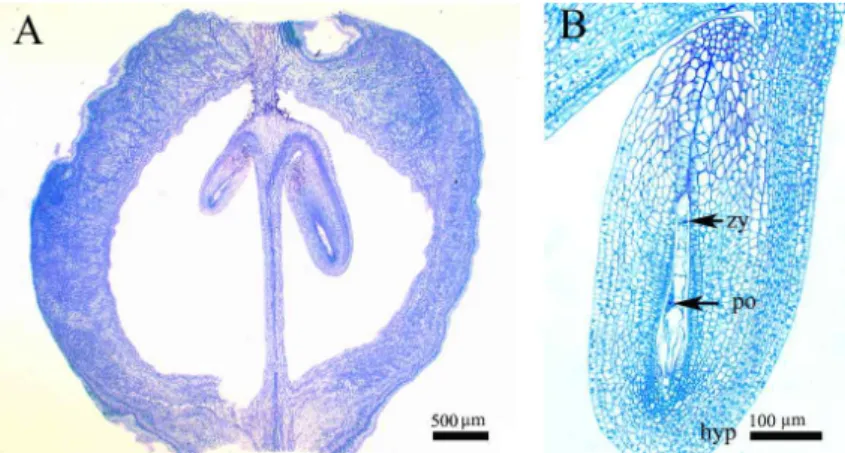
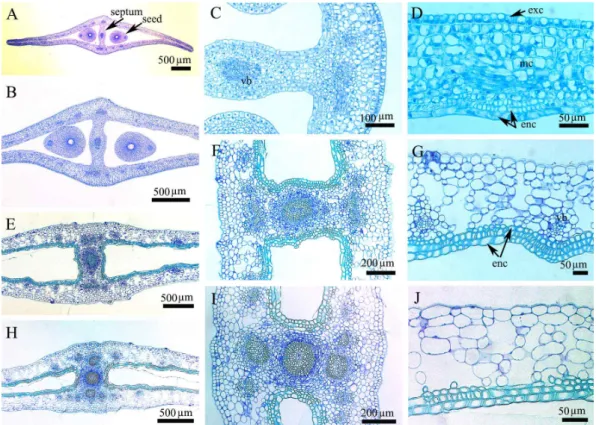
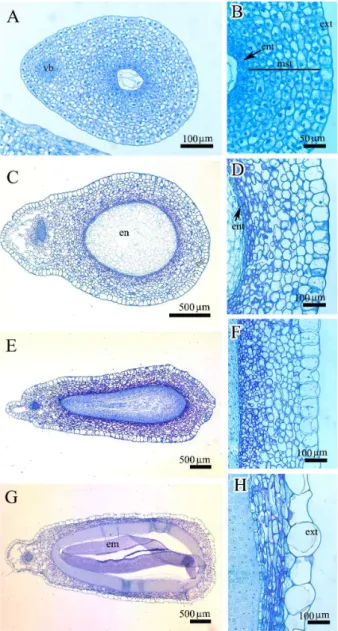
Abstract - Abeliophyllum distichum is a monotypic taxon of Oleaceae and endemic to Korea. A comprehensive study on embryogeny and fruit and seed coat ontogeny in Abeliophyllum was carried out via microtome and light microscopy. The fertilization occurs during mid– to late April and embryo matures by early July. The embryo development follows the general fashion from globular embryo – transition embryo – heart shaped embryo – torpedo embryo – walking-stick embryo to mature embryo. The pericarp clearly differentiates into three histological zones: exocarp, mesocarp, and endocarp. The young seed comprises 10-12 cells thick seed coat and the mature seed coat comprises an exotesta, 6-8 mesotesta and an endotesta. Any crystals, phenolic-like compounds, idioblasts, and the sclereids are not found in pericarp as well as seed coat.
An overall development confirms Solanade type of embryogenesis in Abeliophyllum. The endocarp becomes more prominent in mature fruit and all the layers of endocarp are highly lignified. On the basis of mechanical layer the seed coat is of exotestal type.
Key words - Abelophyllum distichum, Embryogeny, Pericarp, Seed coat
*Corresponding author. E-mail : [email protected]
ⓒ 2015 by The Plant Resources Society of Korea
Introduction
Abeliophyllum distichum Nakai (Oleaceae) commonly known as ‘White Forsythia’ is a monotypic genus and endemic to Korea. The plant with beautiful pale pink or white flowers grows as an under-story shrub in mixed deciduous woodland, often under Pinus densiflora, Quercus myrsinaefolia and Q.
acutissima (Kim and Maunder, 1998). It is closely allied to Forsythia but differing in having flattened broadly winged fruits in contrast with capsular fruits of Forsythia. The first description of this plant was made by Nakai (1919) who had collected it in the Chinsen hills, lies in middle part of Korean peninsula. The populations of this plant are only found in three localities in central Korea although several more meanwhile extinguished populations have been recorded (Kim and Maunder, 1998). Natural populations of the taxon are geographically isolated from each other and have been critically affected by human collection and environmental disturbances (Kang et al., 2000). The restricted geographical
distribution and apparent rarity were commented upon by Cotton (1948): ‘Its distribution was confined to an exceedingly small area; if it had not been brought into cultivation it was not only species but also genus which might easily have become extinct’. Despite Cotton’s fears (1948) Abeliophyllum has not become extinct; however it is close to extinction and qualifies for the IUCN Category of ‘Critically Endangered’, indicating a high risk of extinction in the near future (Kim and Maunder, 1998). Now, Abeliophyllum is cultivated in a number of Korean collections including the Chollipo Arboretum, Hantaek Botanic Garden, Keechungsan Botanic Garden, Kwanak Arboretum, Korea National Arboretum (previously named as Kwangnung Arboretum), and the Milim Botanic Garden (Anonymous, 1991). Anti-inflamatory and anti-oxidant chemicals has been reported from the leaf and flower extract of A. distichum (Ahn and Park, 2013; Park et al., 2014).
On the basis of cladistic analysis of Korean Oleaceae Lee and Park (1982) reported that Abeliophyllum closely related with Fontanesia and is believed to have originated from the same ancestor (monophyly). Kim et al. (2000) compared nuclear ITS sequence data of Abeliophyllum with closely
Original Research Article