위성/지상 통합망에서의 계층적 부호화방식에 대한 고찰
상평평*, 김수영* 종신회원
Evaluation of a Layered Coding Scheme for Integrated Mobile Satellite Systems
Pingping Shang*, Sooyoung Kim* Lifelong Member
요 약
본 논문에서는 통합이동위성시스템에서 계층적 부호화 방식의 성능과 효용성에 대한 평가 결과를 제시한다. 통합이동위성시스템의 주 요 서비스는 멀티미디어 방송 및 멀티캐스팅 서비스가 될 것이다. 통합이동위성시스템에서, 위성과 보조지상장치는 고품질의 서비스를 제공하기 위하여 서로 협력적으로 동작하도록 되어 있다. 계층적 부호화 방식은 수신기에서 채널의 샅애에 적응할 수 있도록 하는 일종 의 수신기에 의해 주도되는 적응형 방식이다. 본 논문에서는 터보부호화 방식을 이용한 계층적 부호화 방식을 소개하고 여러 가지 시나 리오에서의 성능을 평가하며, 그 효용성에 대하여 논할 것이다. 본 논문에서 제시된 성능 평가 결과 및 분석 내용은 향후 효율적인 통 합이동위성시스템을 설계하는데 활용될 수 있을 것이다.
Key Words:layered coding, integrated mobile satellite systems, turbo codes.
ABSTRACT
This paper evaluates the performance and effectiveness of a layered coding scheme for an integrated mobile satellite systems, where the main target services are multimedia broadcasting and multicasting services (MBMS).
In this integrated system, the satellite and complementary ground components (CGC) cooperate to provide high quality services. A layered coding scheme is a receiver driven adaptive schemes which adapts to the channel condition at the receiver. In this paper, we introduce a layered turbo coding scheme, and evaluates the performance in various scenarios, and discuss its effectiveness. The demonstrated results in the paper can be utilized in order to design an efficient integrated mobile satellite system, in the future.
*전북대학교 전자정보공학부 디지털통신시스템연구실 ([email protected], [email protected]), 교신저자 : 김수영
※ 이 논문은 2009년도 정부(교육과학기술부)의 재원으로 한국연구재단의 지원을 받아 수행된 기초연구사업임(No. 2009-0088286) 접수일자 : 2011년 9월 21일, 수정완료일자 : 2011년 12월 2일, 최종게재확정일자 : 2011년 12월 15일
I. Introduction
The satellite can provide the best and most comprehensive coverage for low-density populations, while the terrestrial network or the ground component can provide the highest bandwidth and lowest cost coverage for high-density populations in urban environments [1].
International Telecommunication Union (ITU) defined ‘an integrated Mobile Satellite Service (MSS) system’ as a system employing MSS and a ground component where the ground component is
complementary to and operates as part of the MSS system and, together with the satellite component, provides an integrated service offering [2]. In such systems, the ground segment is controlled by the satellite resource and network management system.
Further, the ground component uses the same designated portions of the frequency band as the associated operational MSS system. An integrated system provides a combined (integrated) single network that uses both a traditional MSS link and terrestrial transmission paths to serve mobile end-users. With proper network planning and control of both the space and terrestrial segments of the
system, the operators can use the assigned spectrum extensively and efficiently to provide indoor and outdoor coverage in urban, suburban, rural, and remote areas, including direct satellite service to small handsets.
A typical integrated system comprises one or more multi-spot beam satellites and a nation-wide or regional ensemble of terrestrial cell sites, where both terrestrial and space components communicate with mobile terminals using a common set of MSS frequencies. The global ‘umbrella’ coverage is supplied by the satellite systems, mainly based on geostationary earth orbit (GEO) satellites.
MSS systems can provide ubiquitous connectivity through their wide-area coverage characteristics and offer instant and reliable communications within their coverage area, while terrestrial-based networks have their strength and traditional role in providing high capacity communication networks in suburban and urban areas, including inside buildings.
Multimedia broadcasting and multicasting services (MBMS) is a broadcasting service that will play an important role in future mobile system. We can expect an integrated scenario where the satellite cooperates with the terrestrial segment to provide mobiles users with MBMS service. Due to the unidirectional nature of MBMS, downlink strategies should be focused on improving the performance.
Recently, various cooperative transmit diversity techniques have been proposed for these integrated networks, using repeaters as the ground components with appropriate signal processing capabilities. In these schemes, the user terminal with multi-path signals from the satellite and terrestrial components can achieve spatial and time diversity gains. As the name transmit diversity indicates, these techniques are basically driven at the transmitter.
On the other hand, there are some techniques driven at the receiver, and these are hierarchical modulation and layered coding techniques. In these methods, the receiver operates adaptively by itself without any control commands. The hierarchical modulation is one of the most popular adaptive schemes that can be applied to MBMS applications [3], and the purpose of this adaptability is to allow the service quality to be upgraded for a new terminal while maintaining backward compatibility. On the other hand, the layered coding scheme is used to compensate channel impairments adaptively at the
receiver [3]. In this scheme, a receiver selects a suitable demodulation/decoding scheme for the channel condition without any knowledge of the channel quality information (CQI) from the return link.
In this paper, we investigate a layered coding techniques which can be applied to integrated satellite and terrestrial systems. We first introduce the architecture for integrated mobile satellite service (MSS) for MBMS. Next, we propose a layered coding technique and develop it to cooperative ways so that it can be effectively utilized in integrated systems.
This paper is organized as follows. Section II describes the system model of layered coding scheme for integrated mobile satellite systems. In addition, the integrated satellite and terrestrial network architectures where cost-effective MBMS can be provided will be discussed. Section III presents the proposed layered coding scheme for integrated mobile satellite systems. Section IV presents the performance simulation result. Finally, we draw conclusions in section V.
Ⅱ. System model
1. Integrated mobile satellite system for MBMS Recently, the ITU defined the concept of an integrated MSS system, as a system employing MSS and a complementary ground components (CGC) where the ground component is complementary to and operates as a part of the MSS system and, together with the satellite component, provides an integrated service offering [2]. In such systems, the CGC is controlled by the satellite resource and network management system. Further, the CGC uses the same designated portions of the frequency band as the associated operational MSS system.
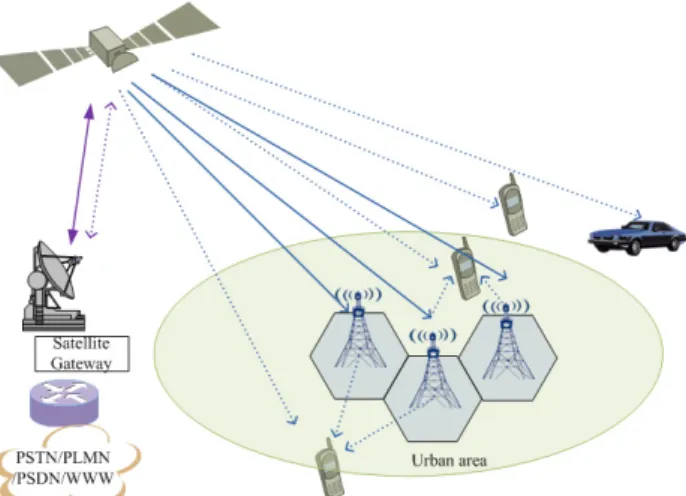
Figure 1 shows the system architecture of an integrated satellite-terrestrial network which designed to provide MBMS in a cooperative way. In this network, a satellite in the geostationary orbit (GEO) and an ensemble of CGCs are deployed. The main purpose of these CGCs is to relay the satellite signal to the users who are not in prevailed line of sight (LOS) condition, such as in urban areas.
The main purpose of these CGCs is to relay the satellite signal to the users who are not in prevailed
line of sight (LOS) condition, such as in urban areas.
Fig. 1. An architecture of integrated mobile satellite system providing MBMS
2. Layered coding scheme for satellite system
In MBMS, coding may be designed to address the worst case fading condition. The receiver can choose to operate either with the symbols encoded using the high rate code, or with the symbols encode using the low rate code, according to the required BER and the received SNR. The layered coding scheme was proposed in [4] with serially concatenated turbo codes, and demonstrated performance improvement. It is used to compensate channel impairments adaptively at the receiver. A receiver selects a suitable demodulation/decoding scheme for the fully concatenated codes, so that it can produce a large coding gain. A receiver in the mild channel condition selects a decoding scheme for a simple outer code only and, thus, reduces the decoder complexity [1].
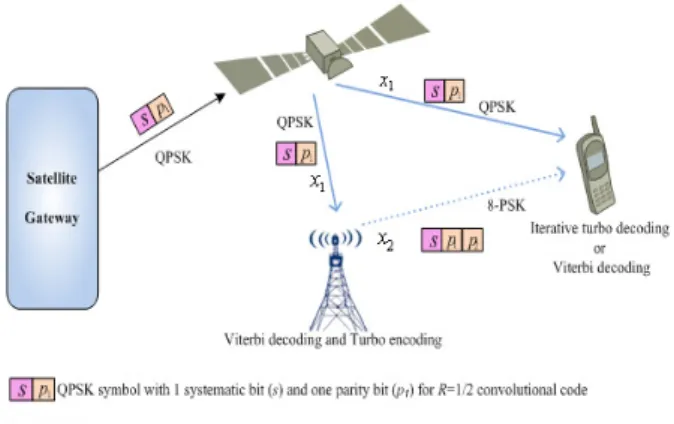
Figure 2 illustrate an example of the layered coding scheme. As shown in Fig. 2, the user terminal can use a suitable demodulation/decoding scheme according to the channel condition. A user in good channel condition detects a QPSK symbol, consisting of one parity bit and one systematic bit, from a received symbol, and estimates the original information by using a single step decoder such as the Viterbi decoder for Encoder 1 [4]. On the other hand, the user terminal in bad condition detects a 8-PSK symbol consisting of two parity bits and one systematic bit, and estimates the original information using an iterative decoder such as turbo decoder.
An efficient layered coding scheme with block turbo codes (BTC) which may produce various
combinations with -ary modulation was introduced in [5]. In this scheme, the BTC consists of multidimensional product codes that can be separated into lower dimensional codes and operate in different ways. The user terminal can choose to operate either with the symbols encode using the high code rate BTC (lower dimensional code), or with the symbols encoded using the low code rate BTC code (high dimensional code) according to the required bit error rate (BER) and the received signal to noise ration (SNR).
Fig. 2. The structure of the layered coding scheme
Ⅲ. The proposed layered coding scheme
Although receiver diversity may achieve high performance gain, it is impractical to implement multiple receive antennas at a small user terminal.
Considering this, based on the advantage that the CGC can provide low cost coverage in high-density population areas, the CGC should have additional encoding capability rather than merely being used as a frequency converter and amplifier, and the user terminal should have decoding capability.
Furthermore, we need a delay compensation algorithm in order to make the signals from the satellite and the CGC arriving at the same time to the user terminal.
In the proposed scheme, we utilize the advantages of the CGC, which relay the satellite signal to the user terminal, and applied the layered coding scheme to the transmit part. At the CGC, we may increase the modulation to higher order in order to transmit more information. It can viewed as hierarchical modulation applied to channel coding schemes.
Hierarchical modulation scheme consist information bits in a basic layer and an enhancement layer [3].
The user terminal can receive the symbols from
basic layer and enhancement layer, then the user terminal can demodulate with high order demodulation scheme to recover the information bits in both basic and enhancement layer, or at least detect QPSK symbol with the basic layer, which is depended on the channel condition of the user terminal.
Figure 3 shows one of the system architecture where the proposed scheme is utilized. As shown in figure 3, the satellite and the CGC component an integrate system for MBMS. In this scenario, the satellite and CGC may cooperate to transmit signals, and the CGC have a signal processing capability to re-process signals rather than being a simple amplifier. By applying this idea to integrated satellite system employing CGC, a lower order modulation symbol with basic layer is transmitted through the satellite. After receiving the satellite signal at the CGC, enhancement layer information is added and the symbol is transformed to a higher order modulation symbol. By this way, the signal transmitted to the satellite will not have serious nonlinearity problem caused by traveling wave tube amplifier (TWTA) at the satellite transponder.
Therefore, the user terminals can use a suitable demodulation/decoding scheme.
Fig. 3. The proposed layered coding scheme
According to Fig. 3, the satellite and CGC transmit different parity symbols in a rate-compatible punctured turbo code. The satellite transfers QPSK modulation symbol which is consisted of a systematic bit and a parity bit . Consequently, a punctured code with rate is formed. At the CGC, after receiving the QPSK symbols, additional parity information bit is added and form 8-PSK
symbol with code rate of . As shown in Fig. 3, the satellite transmits an encoded signal which modulated by QPSK, , to the CGC and the user terminal in the ground. After the CGC received the signal , the other one parity bit is added and transform the received signal to a 8-PSK modulated signal , then retransmits it to the user terminal Fig. 1. Simultaneously, the user terminal will receive the same signal which directly transmitted from the satellite. The received signal at the user terminal can be represented by,
, (1) where, , are the signals transmitted from the satellite and the CGC separately. and are the channel between the satellite to the user terminal, and the channel between the CGC to the user terminal. is independent and identically distributed (i.i.d.) complex Gaussian variables. Subsequently, the user terminal can detect the received signal depending on the channel condition, the user can detected using QPSK demodulation scheme and extract two bits consisting of one systematic bit and one parity bit. Then, a decoder for the rate
turbo code is employed. On the other hand, the user can detect the received symbol with 8-PSK demodulation scheme and extract one systematic bit and two parity bits. Then, a decoder for the rate
turbo code is employed. In the situation when both QPSK and 8-PSK modulation signals received, we can still detect, at least QPSK symbol with rate
code.
Ⅳ. Performance evaluation and discussion
This section presents the performance simulation results of the proposed layered coding scheme. The performance of the proposed cooperative techniques can be varied depending on the signal availability and its detection scheme at the user terminal. We use a duo-binary turbo code specified as forward error correction (FEC) schemes in the IEEE 802.16 standard with an information block size of
symbols, i.e bits. The encoder generates
symbols with the code rate of the mother code,
for the information with symbol length of . The Max-log-MAP algorithm was used as an iterative
- Modulation Demodulation Code
rate
QPSK QPSK QPSK
QPSK 8-PSK 8-PSK
-
decoding algorithm, and the maximum iteration
number is limited to eight.
Figure 4 shows the BER comparison of the proposed scheme over a Rayleigh fading channel.
Comparing to the conventional scheme, i.e., the CGC directly retransmits the symbols received from the satellite without additional information. Therefore, the performance of the conventional scheme and the proposed scheme are different depending on the modulation schemes of and denoted by symbol, i.e., and .
Fig. 4. Performance comparison of the proposed scheme and conventional turbo coded QPSK schemes
Table I shows main parameters for and . In scheme , we transmit an information bit and a parity bit in a QPSK symbol , in this case, the code rate is . In , we transmit an information bit and two parity bits in an 8-PSK symbol with the code rate is . Clearly, in these two schemes, the modulation scheme of which transmitted from the satellite is fixed. The user terminal can demodulate the received symbols with high order demodulation scheme, i.e., 8-PSK demodulation scheme.
Table 1. Layered coding scheme employing 2 operating modes
On the other hand, CGC can provide low cost
power than the satellite. For this reason, in our simulation schemes, we compare and with various power ratio in order to see the advantage of the proposed scheme. As shown in Table 2, where
denotes the power ratio of the satellite to that of the CGC. and are the power of the satellite and CGC, respectively, and . According to Fig. 4, when , cannot obtain any channel gain compared with . Nevertheless, it is easier to increase the power of the CGC.
Assuming we increase the power of CGC to 10 or 100 times of the satellite, the user terminal can obviously enjoy better performance as shown in Fig, 4.
Table 2. Power distribution for two operating modes
V. Conclusion
In this paper, we evaluated the performance of a layered coding scheme which can be applied to an integrated satellite and terrestrial system. We first introduced a system configuration of the integrated satellite and terrestrial system where we can apply the layered coding scheme with turbo codes. The CGC add additional information and retransmit to the user terminal. By this way, the user terminal can achieve either performance gain due to signal diversity or complexity reduction by adapting to the received signal quality. The simulation results investigated in this paper demonstrate that the proposed scheme may be effectively utilized for economic service provision for mobile satellite systems.
참 고 문 헌
[1] Sooyoung Kim, "A Evaluation of cooperative techniques for hybrid/integrated satellite systems,'' Proceedings of IEEE ICC, 2011.
[2] ITU-R WP4B, "Annex 12 to Working Party 4B, Chairman's Report on the twenty sixth meeting,'' Document 4B/85, 27 May 2009.
[3] H. Jiang, P. A. Wilford,, "A hierarchical modulation
for upgrading digital broadcast systems,'' IEEE Transactions on Broadcasting, vol. 51, no. 2, Jun.
2005, pp. 223-229.
[4] A. Levissianos, G. Metaxas, N. Dimitriou, A.
Polydoros, "Layered coding for satellite-plus- terrestrial multipath correlated fading channels,'' Int. J. Satell. Commun. Network, vol. 22, 2004, pp. 485-502.
[5] S. Ryoo, S. Kim, and D. S. Ahn, "Layered coding with block turbo codes for broadcasting and multicasting services,'' Proceedings of IEEE Vehicular Technology Conference, fall, 2006.
저 자 상 평 평 (Pingping Shang)
2008년 7월:중남민족대학교 컴퓨터공학 학사졸업 2010년 8월:전북대학교
전자공학과 석사졸업 2010년 8월~현재:전북대학교
전자공학과 박사과정
<관심분야> 오류정정부호화방식, 이동/위성통신 전송방식
김 수 영(Sooyoung Kim) 종신회원 1990년 2월:한국과학기술원 전기 및 전자공학과 학사졸업 1990년~1991년:ETRI 연구원 1992년:Univ. of Surrey, U.K 공학석사
1995년:Univ. of Surrey, U.K 공학박사
1994년~1996년:Research Fellow, Univ. of Surrey, U.K
1996년~2004년:ETRI 광대역무선전송연구팀장 2004년~현재:전북대학교 전자공학부 부교수
<관심분야> 오류정정부호화방식, 이동/위성통신 전송방식