https://doi.org/10.22643/JRMP.2018.4.2.73
Synthesis and biological evaluation of tricarbonyl technetium labeled 2-(4-chloro)phenyl-imidazo[1,2-a]pyridine analog (
99mTc- CB257) as a TSPO-binding ligand
Ji Young Choi1,2, Jae Ho Jung2, In Ho Song2, Byung Seok Moon2, Byung Chul Lee2,3,*, Sang Eun Kim1,2,3,*
1Department of Transdisciplinary Studies, Graduate School of Convergence Science and Technology, Seoul National University, Seoul 08826, Republic of Korea.
2Department of Nuclear Medicine, Seoul National University College of Medicine, Seoul National University Bundang Hospital, Seongnam 13620, Republic of Korea
3Center for Nanomolecular Imaging and Innovative Drug Development, Advanced Institutes of Convergence Technology, Suwon 16229, Republic of Korea
Received: December 12, 2018 / Revised: December 19, 2018 / Accepted: December 21, 2018 Correspnding Author : Prof. Byung Chul Lee,
Department of Nuclear Medicine, Seoul National University Bundang Hospital, 82, Gumiro 173 Beongil, Bundanggu, Seongnam 13620, Republic of Korea, Tel: +82-31-787-2956, Fax: +82-31-787-4072, E-mail: [email protected]
Prof. Sang Eun Kim,
Department of Transdisciplinary Studies, Graduate School of Convergence Science and Technology, Seoul National University, Gwanggyo-ro 145, Yeongtong-gu, Suwon-si, Gyeonggi-do 16229, Republic of Korea, Tel: +82-31-787-7671, Fax: +82-31-787-4018, E-mail: [email protected]
Copyright©2018 The Korean Society of Radiopharmaceuticals and Molecular Probes
In our previous study, tricarbonyl 99mTc-labeled TSPO-binding ligand, named 99mTc-CB256, having positively charge (+1) was investigated but did not show promising results in in vivo environment despite of a nanomolar binding affinity for TSPO. Because the overall positively charge of 99mTc-CB256 would likely interrupt its target protein uptake, we herein designed the neutral tricarbonyl-99mTc labeled TSPO-binding ligand (99mTc-CB257, 1). 99mTc-CB257 was prepared by the facile incorporation of the [99mTc(CO)3]+ into a N-(hydroxycarbonylmethyl)- 2-picoly moiety in CB257. The radiochemical yield of 99mTc-CB257 after HPLC purification was 54.1 ± 2.4%
(decay corrected, n = 3). The authentic Re-CB257 (2) was synthesized by using (NEt4)2[Re(CO)3Br3] in 69.0%
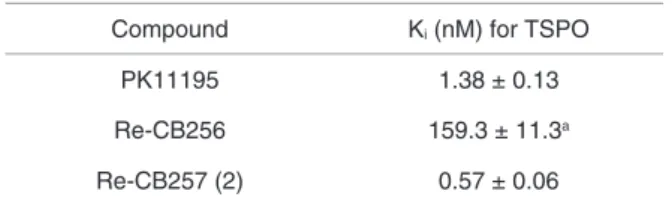
yield. The binding affinity of 2 for TSPO was measured in leukocyte and showed approximately 280 times higher than that observed for the positively charged (+1) ligand, Re-CB256 (Ki = 0.57 ± 0.06 nM versus 159.3
± 8.7 nM, respectively). Our results indicated that 1 can be considered potentially as a new SPECT radiotracer for TSPO-rich cancer and provides the foundation for further in vivo evaluation related with abnormal TSPO- overexpression environments.
ABSTRACT
Key Word: Translocator protein (TSPO), Tricarbonyltechnetium-99m, SPECT
Introduction
중추신경계의 미세아교세포(microglial cell)는 신경계의 활성화, 항상성 유지에 기여하며, 알츠하이머병, 파킨슨병, 헌팅턴 등의 다양한 퇴행성 신경계 질환, 뇌경색 또는 뇌손 상 그리고 뇌 감영 등의 질환에서 미세아교세포의 활성화 밀
접하게 관련되어 있음이 알려져 있다. 세포의 성장, 사멸, 스 테로이드의 합성 등의 생물학적 과정에 주요한 역할을 담당 하는 미토콘드리아의 외막에 존재하는 막 관통 단백질인 18 kDa 전이체 단백질(translocator protein, TSPO)의 발현증 가는 특별히 활성화된 미세아교세포(activated microglial) 에서 주로 관찰되고 있다(1,2). 또한, 최근 발표된 논문에 의
하면 뇌, 간, 유방, 전립선 암 등의 특정 종양에서도 TSPO의 발현이 정상세포와 달리 높게 분포하고 있어, 종양을 표적으 로 하는 영상 바이오마커로 이용될 수 있다. 따라서, 다양한 의료용 방사성동위원소가 표지 된 TSPO 선택적 타겟 방사성 추적자는 중추 신경계 질환의 진단 뿐만 아니라 종양의 진단, 나아가 치료용으로도 응용이 가능하다(3,4).
1984년, TSPO 평가를 위한 양전자방출단층촬영(Positron Emission Tomography, PET)용 방사성추적자로 C-11(반 감기 20.4분)이 표지 된 [11C]PK11195가 최초로 개발되었다 (5). 하지만, [11C]PK11195는 짧은 반감기, 비특이적 결합, 그 리고 낮은 신호대잡음비(signal to noise ratio)의 문제점으 로 인하여 널리 사용하기에는 한계가 있다(6,7). 그 결과 지 난 30여년간 TSPO 영상화를 위한 새로운 방사성추적자가 개 발되어 왔으며, 대표적으로 [11C]DAA1106, [11C]PBR28, [18F]
Fluoromethyl-PBR28, [18F]CB251, [18F]FPBR28 등의 화 합물이 보고되었다(8-12).
하지만 현재까지 보고된 TSPO를 표적 하는 방사성추적 자는 대부분 PET용 방사성동위원소를 이용하였으며(13,14).
단일광자방출단층촬영(Single photon emission computed tomography, SPECT)용 방사성추적자 개발 연구는 소수에 불과하다. 대표적으로 SPECT 영상에 이용되는 방사성동위 원소인 99mTc은 사이클로트론 및 관련 부대시설 없이 발생기 로부터 쉽게 용출하여 사용이 가능한 장점이 있으며, 제조 및 영상 획득 측면에서도 효율적인 6시간의 적당한 반감기를 가 지고 있다. 또한, 다양한 Tc-99m 표지 방법 중에서 트리카 르보닐기를 이용한 표지 방법은 높은 화학적 안정성과 함께 작은 사이즈로 인해 화학적, 생물학적 특징 변화가 적다는 이 점도 갖고 있다(15,16). 또한 PET용 TSPO 진단의약품과는 달리 Tc-99m로 표지 된 TSPO 표적 진단의약품은 주기율 표에서 7B족에 속해있는 치료용 방사성동위원소 Re-188과 Re-186으로 치환이 가능하여, TSPO 발현이 특이적으로 높 은 종양의 경우 진단과 치료를 동시에 실현할 수 있는 기회 를 제공할 수 있다. 이러한 배경을 바탕으로 본 연구팀은 이 전 연구 결과에서 특이적으로 TSPO에 결합하며 메탈이 결합 할 수 있는 di-(2-picolyl)amine기를 가진 imidazopyridine 기반 TSPO 표적 방사성추적자(CB256)를 보고한 바가 있다 (17-19). 99mTc-CB256은 +1가의 양전하를 가진 화합물로써 in vitro 실험에서 nM 수준의 결합친화도를 보여주었다(19).
하지만 TSPO 과다발현 질환모델에서 SPECT를 이용한 in
vivo 영상 획득 실험 결과, 진단용으로 쓰이기에 유의미한 결 과를 보여주진 못하였다. 이에 본 연구에서는 화합물의 전하 에 따라 결합친화도 및 체내 분포가 달라질 수 있음이 보고한 바가 있어(20) 체내에서 이상적인 분포와 함께 결합친화도를 증진 시키기 위한 목적으로 전하를 띄지 않은 방사성추적자,
99mTc-CB257를 고안하였다(Figure 1). Rhenium-185/187 또는 technetium-99m 표지방식은 99mTc-CB256과 동일한 트리카르보닐기를 사용하였으며, 이의 합성과 TSPO에 대한 결합친화도를 평가 및 비교하고자 한다.
Materials
1. 장비 및 시약
모든 시약은 Sigma-Aldrich (St. Louis, MO, USA) 와 TCI (Tokyo, Japan) 제품을 구입하여 특별히 명시되 지 않는 한 추가 정제 없이 사용하였다. 화합물의 분석에 사용된 1H-NMR은 Varian 400 MR (400 MHz, Agilent Technologies, Santa Clara, CA, USA)을 이용하였으며, Electrospray mass spectrometry (ESI-MS)는 Agilent 6130 Series (Agilent Technologies, Santa Clara, CA, USA)를 사용하였다. 고성능액체크로마토그래피(High Performance Liquid Chromatography, HPLC)는 semi- preparative column (Waters, Xterra RP18, 10 μm, 10 x 250 mm)을 이용하고, UV 검출기 (254 nm) 및 gamma- ray 검출기(Biocan)가 장착 된 Agilent 1220 infinity 시스 템을 사용하였다. 전개 용매는 HPLC용 용매(J. T. Baker, U.S.A.)를 사용하였으며 HPLC 분리 전 membrane 필터 (Whatman, 0.20 μm, GE Healthcare, U.S.A)를 이용하 여 정제 후 사용하였다. HPLC 분리 시 사용된 용매 조건은 60% CH3CN-H2O (including 0.1% trifluoroacetic acid) Figure 1. Structure of 99mTc- or Re-CB256 and 99mTc- or Re-CB257
이며, 유속은 3 mL/min 속도로 분석하였다. Na99mTcO4는
99Mo/99mTc 용출기(Samyoung Unitech Co., Ltd., Korea) 로부터 용출하여 fac-[99mTc(CO)3(H2O)3]+를 합성 후 표 지 하였으며, 비방사성동위원소 Re이 도입된 기준물질은 [NEt4]2[ReBr3(CO)3]를 사용하여 알려진 방법과 유사한 조 건에서 합성하였다(21,22). 최종 전구체 중간물질인 CB254 는 이탈리아 University of Bari “Aldo Moro”의 Nunzio Denora 교수로부터 제공받아 사용하였다.
2. 전구체(CB257, 3) 합성
CB254 (60 mg, 0.12 mmol)가 녹여져 있는 tetrahydrofuran (6 mL)에 N-(2-carboxylmethyl)-N-(2-pyridinylmethyl)- 1,1-dimethylethylester-glycine, potassium carbonate (26 mg, 0.12 mmol), K2CO3 (16 mg, 0.12 mmol)를 가하였다.
혼합물을 상온에서 18시간 동안 교반 후 dichloromethane 과 증류수(30 mL, v/v = 1:1)를 첨가하고 유기층을 추출하 였다. 분리된 유기층을 sodium sulfate anhydrous로 소량 의 물을 제거 한 후 flash column chromatography (10%
EtOAc/hexane)를 이용, 분리, 정제하였다. 얻어진 화합물 (50 mg, 0.08 mmol)를 trifluoroacetic acid:CH2Cl2 (2 mL ,v/v = 1/2)에 녹였다. 혼합물을 상온에서 4시간 동안 교반 후 감압 조건 하에서 용매를 제거하였다. 최종물질은 flash column chromatography (40% EtOAc/hexane)로 분리하 였으며, 무색의 용액 형태(10 mg, 71%)로 얻었다. 1H-NMR (400 MHz, CDCl3) õ 10.6 (s, 1H), 8.49 (d, J = 8.0 Hz, 1H) 8.17 (d, J = 8.0 Hz, 1H), 8.01 (d, J = 8.0 Hz, 1H), 7.89 (d, J = 8.0 Hz, 1H), 7.69 (d, J = 8.0 Hz, 2H), 7.46 (d, J = 8.0 Hz, 2H), 7.30 (t, J = 4.0 Hz, 1H), 7.09-7.08 (m, 1H), 6.80 (t, J = 6.0 Hz, 1H), 4.09 (s, 4H), 3.63 (s, 2H), 3.42 (s, 2H), 3.29 (t, J = 8.0 Hz, 2H), 3.13 (t, J = 8.0 Hz, 2H), 1.56-1.46 (m, 4H), 0.86-0.73 (m, 6H); MS (ESI) m/z calcd. for [C31H35ClN6O4 + H]+: 591.2; found:
591.4 (100%).
3. Re-CB257 (2) 합성
CB257 (3, 3 mg, 5 μmol)을 메탄올 1 mL에 녹인 후 (Net4)2[ReBr3(CO)3] (5.7 mg, 7.5 μmol)을 첨가하였다. 혼 합물을 80 °C에서 1 시간 동안 교반 후에 감압 하에서 용매 를 제거한 후 prep-HPLC를 이용하여 분리 정제하였다(TR
= 16.2분, 3 mg, 69 %). 1H-NMR (400 MHz, CDCl3) õ 8.82 (d, J = 8.0 Hz, 1H), 8.17 (d, J = 8.0 Hz, 1H), 8.01 (d, J = 8.0 Hz, 1H), 7.91 (t, J = 8.0 Hz, 1H), 7.56 (d, J
= 8.0 Hz, 1H), 7.51-7.41 (m, 4H), 6.91 (t, J = 8.0 Hz, 1H), 5.35 (d, J = 8.0 Hz, 1H), 4.65-4.53 (m, 3H), 4.06 (s, 2H), 3.95-3.91 (m, 2H), 3.31 (t, J = 8.0 Hz, 2H), 3.15 (t, J = 8.0 Hz, 2H), 1.56-1.49 (m, 4H), 0.88-0.77 (m, 6H); MS (ESI) m/z calcd. for [C34H34ClN6O7187Re ]+: 861.1; found 861.2 (100%);for [C34H34ClN6O7185Re ]+859.1;
found 859.2 (39%).
4. 99mTc-CB257 (1) 합성
보고된 방법에 따라 합성된 [99mTc(H2O)3(CO)3]+ (0.25 mL, ~370 MBq)(21,22) 용액에 메탄올(0.25 mL)에 녹여 진 화합물 3 (1 mg, 1.6 μmol)을 첨가하였다. 혼합물을 80
°C에서 20분 간 반응하고 상온으로 식힌 후 15 mL의 증류수 로 희석하였다. 희석된 용액을 C18 light Sep-Pak 카트리 지에 흡착하고 5 mL 증류수로 씻어준 후, 90% MeOH/H2O (2 mL)로 용출하였다. 용출한 용액은 prepative-HPLC 시 스템을 이용하여 목적화합물을 분리, 정제하였다(TR = 15.8 분). 얻어진 용액은 다시 증류수(15 mL)로 희석한 후 C18 Light Sep-Pak 카트리지에 흡착, 5 mL 물로 씻어준 후, 90% EtOH/H2O (2 mL)로 용출하였으며, 생리식염수를 이 용 10% EtOH/saline 이하로 맞춰 사용하였다. 최종 분리된
99mTc-CB257은 기준물질 Re-CB257 (2)과 HPLC에 동시 주입한 후 약 1분 차이를 두고 용출됨을 확인하였다. 총 합성 시간은 90분 소요되었으며, 방사화학적 수율은 54.1 ± 2.4%
(n = 3), 방사화학적 순도는 >99%이었다.
5. TSPO 결합친화도 평가
사람의 혈청에서 분리한 백혈구는 50 mL의 헤파린첨가 혈액(heparinized blood)으로부터 림프구 분리 배양기를 사 용하여 피콜-하이팩 농도구배(Ficoll-Hypaque gradient) 를 이용하여 원심 분리한 백혈구는 동결 보존하였다. 분석 전날에 세포를 해동하고, 동량의 버퍼(50 mM의 HEPES, pH 7.4)로 희석한 후 균질화하며, 4 °C에서 15분간 20,000 g로 원심 분리하였다. 얻어진 백혈구를 2.4 mL의 완충액에 재현탁하여 -70 °C에서 보존하며, 단백질 농도는 브래드포 드(Bradford) 분석법을 사용하여 계산하였다. 체외결합도는
백혈구(100 μL의 재현탁 막)를 100 μL의 방사성리간드([3H]
PK11195, Specific activity: 83.4 Ci/mmol), in 1 x PBS)와 억제 시험으로 화합물 2 (0.124-10,000 nM) 및 0.07 nM의 방사성리간드([3H]PK11195) 50 μL를 함유하는 반응 혼합물 1 mL를 실온에서 30분간 반응하였다. Cell havester를 사용 하여 2회 세척한 후 결합방사능 양을 베타카운터로 측정한 후 결합친화도(Ki) 값을 계산하기 위해 PRISM 소프트웨어를 사 용하였으며, 비선형 분석을 실시하여 획득하였다.
Results and discussion
TSPO에 결합하는 중성의 99mTc-표지 CB 화합물 유도체를 합성하기 위해, 기존의 CB256의 99mTc 표지 포켓에서 한 개의 2-picolyl 기를 N-methly acid기로 바꿈으로써 트리카르보 닐 Tc-99m이 도입 시 생기는 전하를 없앴다. 전구체 CB257 (3)을 합성하기 위해 CB245에 N-(2-carboxylmethyl)-N- (2-pyridinylmethyl)-1,1-dimethylethylester-glycine, potassium carbonate를 첨가하고 N-alkylation을 통하여 합성하였다. Technetium과 Rhenium 원소는 같은 족 화합 물로 화학적 성질이 유사하여 99mTc-CB257 (1)과 비교하기 위한 기준 물질로서 Re-CB257 (2)을 합성하였다. 전구체 인 CB257을 녹인 메탄올 용액에 [Net4]2[ReBr3(CO)3]를 첨 가한 후 80도에서 가열하면서 반응 진행 정도를 HPLC로 모니터링를 이용하여 확인하였다. 기준물질 2의 합성반응은 HPLC에서 CB257 (TR = 4.5 min)의 피크가 사라질 때까지 진행하였으며, 머무름시간 16.2분에서 69%의 수율로 분리 하였다. 최종적으로 얻어진 2는 NMR과 LC-MS로 구조를 확인하였다. 99mTc이 표지 된 1 화합물은 알려진 방법에 따
라 99mTcO4-와 CO 가스를 이용, fac-[99mTc(H2O)3(CO)3]+를 합성한 후 CB257이 메탄올에 녹아있는 용액에 첨가하였다.
혼합액을 80도에서 20분간 가열한 후 고성능액체크로마토 그래피를 이용하여 분리, 정제하였다. 총 합성시간은 약 90 분 소요되었으며, 방사화학적 수율은 54.1 ± 2.4% (n = 3, decay-corrected), 방사화학적 순도는 99% 이상이었다. 기 준 물질로 합성한 2과 1은 분석용 고성능액체크로마토그래 피에 동시 주입한 후 분석함으로써 최종 목적 화합물을 확인 하였으며, 2과 1의 머무름 시간은 각각 8.27분과 7.59분에 용출되었다(Figure 2, HPLC conditions: column (Xterra RP18, 5 μm, 4.6 x 250 mm), 254 nm, 60% CH3CN/0.1%
TFA, flow rate: 1 mL/min).
TSPO에 대한 결합친화도는 사람 혈청에서 TSPO가 높게 발현되어 있는 것으로 알려진 백혈구를 추출하여 측정하였 다. 경쟁물질로 [3H]PK11195를 사용하였으며, Re-CB257 (2)의 결합친화도는 Table 1에 요약하였다. 전하를 띄지 않 은 Re-CB257의 TSPO에 대한 결합친화도는 0.57 ± 0.06 nM로 PK11195 (1.38 ± 0.13 nM) 보다 약 2배 높은 결합 친화도를 보여주었으며, +1의 양전하를 가진 Re-CB256에
Scheme 1. Synthesis of CB257 (3), 99mTc- (1) and Re-CB257 (2). Reagents and conditions: a) (i) N-(2-carboxylmethyl)-N-(2-pyridinylmethyl)-1,1-dimethylethylester-glycine, Figure 2. Coinjection HPLC profile of 99mTc-CB257 (1) and Re-CB257 (2). (A) gamma-ray spectrum. (B) UV spectrum (254 nm).
비해 약 280배의 높은 결합친화도를 보여주었다. 이는 di- (2-picolyl)amine을 가진 Re-CB256이 PK11195 보다 낮 은 결합친화도를 보여준 것과 전혀 다른 결과이다(19). Re- CB256의 경우, di-(2-picolyl)amine로 인해 생기는 입체 장애(steric hindrance) 때문에 결합친화도가 떨어지는 것 으로 추측 할 수 있다. 본 연구의 결과는 선행 연구의 결과를 뒷받침하는 것으로 di-(2-picolyl)amine 구조를 입체 장애 가 적은 구조로 바꾼 결과, 결합친화도가 증진된 것으로 예측 되며, 더불어 Re-CB256은 양전하를 가지고 있는 구조이고 Re-CB257은 전하가 없는 구조로서 전하에 따라 TSPO의 결 합친화도에 영향을 줄 수 있다는 것을 보여준다. 결과적으로 기존의 다른 바이오마커 관련 연구와 같이 전하에 따라 결합 친화도 및 체내 분포에 영향을 준다는 결과와 일치하는 결과 라 할 수 있다. 이는 추후 TSPO 방사성추적자 개발 또는 최 적화 과정시 금속 방사성동위원소 기반 방사성추적자를 디자 인 할 경우 고려되어야 하는 중요한 요소 중에 한가지 사항이 될 수 있을 것으로 보인다.
Conclusion
본 연구에서는 전하를 달리한 Tc-99m 표지 TSPO 방사성 추적자(99mTc-CB257, 1)를 높은 방사화학적 수율 및 순도로 합성하였다. 트리카보닐 레늄이 표지된 CB257은 기존 양전 하를 가진 Re-CB256 보다 약 280배 높은 TSPO 결합친화 도를 보여주었으며 PK11195와 유사한 결합친화도를 확인할 수 있었다. 이러한 in vitro 결과는 기존 CB256의 구조를 최 적화한 CB257이 TSPO 표적 방사성추적자로서 보다 우수할 것으로 예측되며, TSPO 과다 발현 질환모델에서 SPECT 영 상 결과가 기대된다.
Acknowledgments
This study was funded by the Ministry of Health & Welfare and the Korean Research Foundation grants (HI14C-1072, HI16C0947 and NRF-2018M2A2B3A02071842).
References
1. Papadopoulos V, Baraldi M, Guilarte TR, Knudsen TB, Lacapère JJ, Lindemann P, Norenberg MD, Nutt D, Weizman A, Zhang MR. Translocator protein (18 kDa): New nomenclature for the peripheral-type benzodiazepine receptor based on its structure and molecular function. Trends Pharmacol Sci 2006;27:402–
409.
2. Rupprecht R, Papadopoulos V, Rammes G, Baghai TC, Fan J, Akula N, Groyer G, Adams D, Schumacher M.
Translocator protein (18 kDa) (TSPO) as a therapeutic target for neurological and psychiatric disorders. Nat Rev Drug Discov 2010;9:971–988.
3. Austin CJD, Kahlert J, Kassiou M, Rendina LM, The translocator protein (TSPO): A novel target for cancer chemotherapy. Int J Biochem Cell Biol 2013;45:1212–
1216.
4. Zheng J, Boisgard R, Siquier-Pernet K, Decaudin D, Dollé F, Tavitian B. Differential expression of the 18 kDa translocator protein (TSPO) by neoplastic and inflammatory cells in mouse tumors of breast cancer.
Mol Pharm 2011;8:823–832.
5. Camsonne R, Crouzel C, Comar D, Mazière M, Prenant C, Sastre J, Moulin MA, Syrota A. Synthesis of N-[11C]methyl, N-(methyl-1-propyl)(chloro-2-phenyl)-1-isoquinoleinec arboxamide-3 (PK11195): a new ligand for peripheral benzodiazepine receptors. J Labelled Comp Radiopharm 1984;21:985–991.
6. Shah F, Hume SP, Pike VW, Ashworth S, McDermott J.
Synthesis of the enantiomers of [N-methyl-11C]PK11195 and comparison of their behaviours as radioligands for PK binding sites in rats. Nucl Med Biol 1994;21:573–581.
Compound Ki (nM) for TSPO
PK11195 1.38 ± 0.13
Re-CB256 159.3 ± 11.3a
Re-CB257 (2) 0.57 ± 0.06
Table 1. Affinity (Ki/nM) of 2 for TSPO by using the separated leukocytes in human blooda.
a) Reference 19. Corresponding values for PK11195 and Re-CB256 are also reported for comparison.
7. Petit-Taboué MC, Baron JC, Barré L, Travère JM, Speckel D, Camsonne R, MacKenzie ET. Brain kinetics and specific binding of [11C]PK 11195 to omega 3 sites in baboons: positron emission tomography study. Eur J Pharmacol 1991;200:347-351.
8. Doorduin J, Klein HC, de Jong JR, Dierckx RA, de Vries EF. Evaluation of [11C]DAA1106 for imaging and quantification of neuroinflammation in a rat model of herpes encephalitis. Nucl Med Biol 2010;37:9−15.
9. Zhang MR, Kida T, Noguchi J, Furutsuka K, Maeda J, Suhara T, Suzuki K. [11C]DAA1106: radiosynthesis and in vivo binding to peripheral benzodiazepine receptors in mouse brain. Nucl Med Biol 2003;30:513−519.
10. Imaizumi M, Briard E, Zoghbi SS, Gourley JP, Hong J, Fujimura Y, Pike VW, Innis RB, Fujita M. Brain and whole-body imaging in nonhuman primates of [11C]PBR28, a promising PET radioligand for peripheral benzodiazepine receptors. NeuroImage 2008;39:1289−1298.
11. Moon BS, Kim BS, Park C, Jung JH, Lee YW, Lee H-Y, Chi DY, Lee BC, Kim SE. [18F]Fluoromethyl- PBR28 as a potential radiotracer for TSPO: Preclinical comparison with [11C]PBR28 in a rat model of neuroinflammation. Bioconjugate Chem 2014;25:442- 450.
12. Perrone M, Moon BS, Park HS, Laquintana V, Jung JH, Cutrignelli A, Lopedota A, Franco M, Kim SE, Lee BC, Denora N. A novel PET imaging probe for the detection and monitoring of translocator protein 18 kDa expression in pathological disorders. Sci Rep 2016;6:20422.
13. Le Fur G, Perrier ML, Vaucher N, Imbault F, Flamier A, Benavides J, Uzan A, Renault C, Dubroeucq MC, Guérémy C. Peripheral benzodiazepine binding sites: Effect of PK11195, 1-(2-chlorophenyl)-N-(1- methylpropyl)-3-isoquinolinecarboxamide I. In vitro studies. Life Sci 1983;32:1839–1847.
14. Imaizumi M, Briard E, Zoghbi SS, Gourley JP, Hong J, Fujimura Y, Pike VW, Innis RB, Fujita M. Brain and
whole-body imaging in nonhuman primates of [11C]
PBR28, a promising PET radioligand for peripheral benzodiazepine receptors. NeuroImage 2008;39:1289–
1298.
15. Schibli R, Netter M, Scapozza L, Birringer M, Schelling P, Dumas C, Schoch J, Schubiger PA. First organometallic inhibitors for human thymidine kinase:
Synthesis and in vitro evaluation of rhenium(I)- and technetium(I)-tricarbonyl complexes of thymidine. J Organomet Chem 2003;668:67–74.
16. Lee BC, Kim DH, Lee JH, Sung HJ, Choe YS, Chi DY, Lee KH, Choi Y, Kim BT. 99mTc(CO)3-15-[N- (Acetyloxy)-2-picolylamino]pentadecanoic acid: A potential radiotracer for evaluation of fatty acid metabolism.
Bioconjug Chem 2007;18:1332–1337.
17. Denora N, Margiotta N, Laquintana V, Lopedota A, Cutrignelli A, Losacco M, Franco M, Natile G.
Synthesis, characterization, and in vitro evaluation of a new TSPO selective bifunctional chelate ligand. ACS Med Chem Lett 2014;5:685–689.
18. Margiotta N, Denora N, Piccinonna S, Laquintana V, Lasorsa FM, Franco M, Natile G. Synthesis, characterization, and in vitro evaluation of new coordination complexes of platinum(II) and rhenium(I) with a ligand targeting the translocator protein (TSPO).
Dalton Trans 2014;43:16252–16264.
19. Choi JY, Iacobazzi RM, Perrone M, Margiotta N, Cutrignelli A, Jung JH, Park DD, Moon BS, Denora N, Kim SE, Lee BC. Synthesis and evaluation of tricarbonyl 99mTc-Labeled 2-(4-chloro)phenyl- imidazo[1,2-a]pyridine analogs as novel SPECT imaging radiotracer for TSPO-rich cancer. Int J Mol Sci 2016;7:1085
20. Schottelius M, Rau F, Reubi JC, Schwaiger M, Wester HJ. Modulation of pharmacokinetics of radioiodinated sugar-conjugated somatostatin analogues by variation of peptide net charge and carbohydration chemistry.
Bioconjugate Chem 2005;16:429−437.
21. Alberto R, Schibli R, Egli A, Schubiger AP. A novel
organometallic aqua complex of technetium for the labeling of biomolecules: Synthesis of [99mTc(OH2)3(CO)3]+ from [99mTcO4]- in aqueous solution and its reaction with a bifunctional ligand. J Am Chem Soc 1998;120:7987–7988.
22. Schibli R, Katti KV, Volkert WA, Barnes CL. Novel coordination behavior of fac-[ReBr3(CO)3]2-with
1,3,5-triaza-7-phosphaadamantane (PTA). Systematic investigation on stepwise replacement of the halides by PTA ligand. Phase transfer studies and X-ray crystal structure of [NEt4][ReBr2((PTA)(CO)3], [ReBr(PTA)2(CO)3], and [Re(PTA)3(CO)3]PF6. Inorg.
Chem. 1998;37:5306–5312.