1. Introduction
Korea has transformed itself from a poor, agrarian nation into one of the fastest-growing industrialized economies in the world. The country’s phenomenal growth has been achieved as a result of the successful implementation of forward-looking economic strategies initiated in the 1960s. Korea adopted policies that initially
emphasized growth in manufacturing and exports, and then gradually adopted market and foreign investment liberalization programs.
Rural development is more than agricultural development (Schutjer, 1991). Recently, there is the shift from an agrarian model based on the productivist paradigm to a new rural development paradigm in which the role of the multi-functional farming activity is of central significance (Banks &
* Resercher, Rural Development Administration
** Professor, College of Hotel and Tourism, Kyunghee University
*** Resercher, Jeonbuk Development Institute
Rural Community Development and Policy Challenges in South Korea
Duk-Byeong Park*·Yoo-Shik Yoon**·Min-Soo Lee***
Abstract : Current rural development polices in Korea consist of three programs, namely:
integrated rural community development, rural tourism development, and community- based industry development. Within these areas, national and local policies have often concentrated on trying to encourage ‘bottom-up’ development revolving around the commodification of cultural or amenity resources. In important ways, the three categories of rural development programs are more of a community development program than an economic development program. In Korea, it is true to say that governmental decision- making is slowly being influenced in terms of community, self-reliance and self-help, which are gradually creeping into the discussion on rural development. I suggest that the planning process itself had to include broad public participation and partnership and bottom-up approaches, not merely the product of a planning office or consulting firm.
Keywords : rural community development, development policy
Marsden, 2000; Boonstra, 2006; Herbert-Cheshire, 2000; Lee, 2003; Park, 2006; Theodori, 2001; Van der Platt & Barrett; Van der Ploeg et al., 2000).
Rural Korea has been experiencing a period of significant changes in recent decades driven by a range of socio-economic, environmental, and political factors (Korea Rural Economic Institute, 2006). Until the 1960s, Korea had been a typical agrarian country. Almost half of its GNP was contributed by the agriculture sector and over 50 percent of the total population was engaged in agriculture. The situation was, however, completely changed with the rapid development of the national economy, which was primarily initiated by an economic development plan.
As with many other countries, Korea’s agricultural sector has contributed greatly to the economic development of the nation through the provision of food, feeds, supply of labors, and capitals to the non-agricultural sectors; as well as through the preservation of environment and Korean traditional culture. The economic functions of rural areas have also undergone significant change, with primary agriculture contributing a declining share to employment and GNP. At the same time, the primary and associated industries have experienced pronounced structural changes.
The agricultural structure in Korea shifted from small to large farm size, and the changing consumer patterns resulted in decreasing rice areas and continuously increasing livestock areas. The large diversity in rural areas ranges from remote rural areas suffering from depopulation and decline to peri-urban areas, which are under increasing pressure from urban centers. Processes of commodification and specialization in an increasingly globalized and competitive market
environment also characterize it.
This paper aims to explore the new trends in rural community development and policy challenges in Korea. It includes the history of rural community development in Korea, current rural community development programs, and challenges for rural development policies. Behind the new debate on rural development are the notions of individual and community responsibility, and
‘partnership approach’ and ‘bottom-up’ techniques that mobilize the skills and resources of the local community.
2. History of Rural Community Development in Korea
In the history of Korea, there have been numerous attempts by the government to promote rural development, for example, the expansion of irrigation during the Yi dynasty and the New Rural Construction after the World War II (Turner, Hesli, Bark, & Yu, 1993). However, rural community development in Korea is traditionally marginal rather than occupied. Even long history; it has been one of the subcategories of agricultural development. It means that rural community development policy is one of main national development policies.
In 1950’s, the beginning stage of the agricultural extension program, priority was given to technical guidance for agricultural improvement. In 1958, the Ministry of Infrastructure and Rehabilitation launched the Community Development Program that was the first systemized program for modernizing after World War II (So, 2007). As the society developed and became diversified,
furthermore, the domain of extension has steadily expanded. The field of social guidance in terms of home improvement for women, rural youth guidance and integrated rural development has gradually emerged as another important segment of the extension program.
Community development matured in Korea in the 1960s with the rise of place-based policies (mostly antipoverty programs), professional training programs and degrees, and formal organization with community self-reliance, however, have their roots in earlier intellectual sources (Chung & Dong, 1982).
In 1970, the leadership in Korea instituted the Saemaul Undong (new community movement) to upgrade the standard of living for the rural population. It was a pure Korean way of community development program that was initiated by the political will of the top national leadership in order to escape from poverty (Choe, 2005; Han, 1997). By encouraging self-help, diligence, and cooperation, as well as establishing a mixture of incentives and sanctions, the movement stimulated various community-wide projects, such as the construction of roads, bridges, and irrigation systems. Many meetings in every village were also created in order to develop infrastructure that would improve the economy of the community. The Saemaul movement, along with the growth of communication networks and the transportation system, greatly improved living standards in most villages in South Korea.
The Saemaul Undong which was implemented nationwide since the early 1970’s is a comprehensive socio-economic development fit for the traditional Korean culture and way of life. The background of the Movement lies in balanced
national progress by narrowing the income gap between the urban sector and rural community.
Due to rapid industrialization by dint of successful execution of the consecutive 5-year economic development plans initiated in 1962, the rural sector has relatively lagged behind in comparison to the urban society.
The Movement is not a mere physical development program concentrating on construction of huge factories or harbors but a comprehensive social development movement emphasizing human development. The income- earning project launched in 1974 brought a marked rise in farm income. According to Chung & Dong (1982), the average farm household income of
$740 in 1972, the year the Movement was introduced, grew to $3,847 in 1980, the increase was 5 times. Such a rise in farm income has resulted in improvement of the living standard and afforded reinvestment in pursuance of higher earnings.
Figure 1 shows us how dominant policy paradigms and key program have been changed.
From 1950s and early 1990s, dominant policy paradigm of rural community development is extension education, integrated rural development, and industrialization. In late 1990s, the paradigms have been changed to partnership, community participation, networking, and empowerment.
According to changing policy paradigms, Key programs have also been changed to the New Revitalization, Integrated Village Development, Small Business Formation, and Rural Tourism.
The Korean government took an active part in implementing policies and programs to improve living standards in rural communities. In this model each community was the locus of an independent
development project that required specific technical skills for success, and the community developer was the specialist responsible for bringing these skills.
In 2008, the new administration made the big ministry merged the ministry of agricultural and forestry and the ministry of fishery effectively to enhancing farmers and fishery income and job creations and to integrate rural development policies (Ministry of Food, Agriculture, Forestry and Fishery, 2008).
3. New Trends of Rural Community Development Programs in Korea
A new paradigm of multi-dimensional rural community development advocates a broader
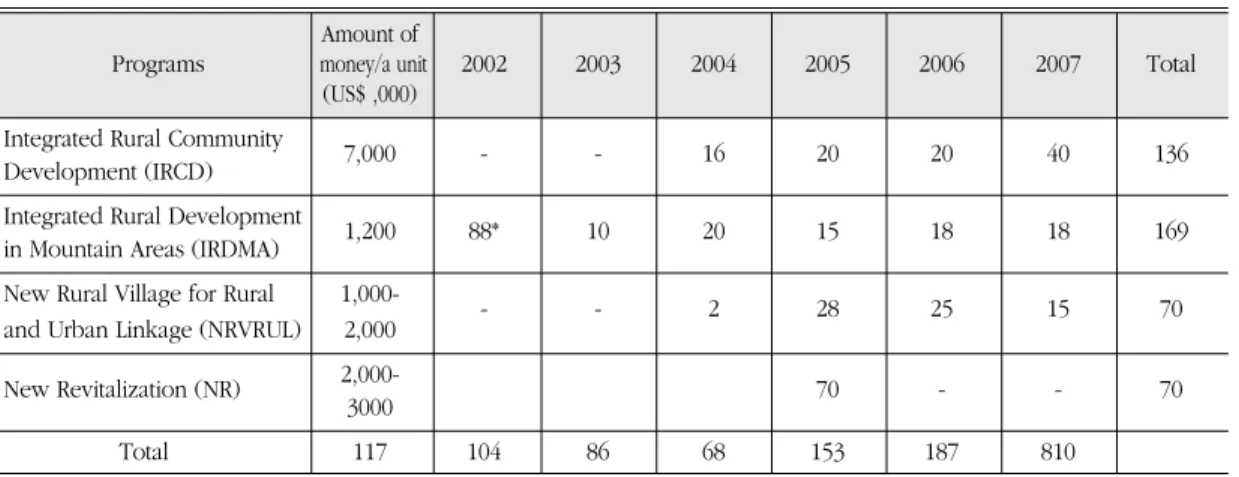
concept of rurality where rural is no longer the monopoly of the farmer. The new rural development programs were enacted into law as part of the Quality of Life, Education and Rural Community Development Act of 2004 (Ministry of Agriculture and Forestry, 2004). By means of the Act, 16 Integrated Rural Community Development (IRCD), 2 New Rural Village for Rural and Urban Linkage (NRVRUL), and New Revitalization (NR) have been authorized. Current rural development policies consist of three programs, namely:
integrated rural community development, rural tourism, and community-based industrial development. Within these areas, national and local policies have often concentrated on trying to encourage ‘bottom-up’ development revolving around the commodification of local cultural resources.
There are six programs: Rural Traditional Theme Figure 1 Dominant Policy Paradigm and Key Programs
Village (RTTV), Green Rural Experience Village (GREV), Integrated Rural Development (IRD), Beautiful Village (BV), Fishery Experience Village (FEV), and Integrated Rural Development in Mountain Areas (IRDMA). Each program has two or three measures and these have been implemented since 2002. Within these areas, national and local policies have often concentrated on trying to encourage ‘bottom-up’ development revolving around the commodification of local cultural resources.
1) Integrated Rural Development
The policy shift towards integrated rural development reflects the complex linkages and interactions within the system of overall rural development (Kostov & Linarrd, 2004). Typically, integrated rural development suggests a territorial or area-based strategy through which sectoral policies and instruments may be integrated at the point of implementation (Shortall & Shucksmith, 2001). There are four policy measures that are the Integrated Rural Community Development (IRCD), Integrated Rural Development in Mountain Areas (IRDMA), New Rural Village for Rural and Urban Linkage (NRVRUL), and New Revitalization (NR).
The Integrated Rural Community Development (IRCD) in Korea is implemented at the national level and developed by the Ministry of Agriculture and Forestry. The IRCD project was launched in 2004. The objective of IRCD program is to improve and strengthen the living conditions in the region, the keywords being cooperation, partnership, and entrepreneurship. IRCD initiative directs development efforts at local community level projects with the aim of strengthening the capacity
of local actors in a ‘bottom-up’ approach.
In important ways, the IRCD is more of a community development program than economic development programs. Applications for IRCD designations have been competitive and had to be supported by comprehensive and long-term strategic plans for development. The MAF selected 16 areas in 2004, and 20 areas in 2005. The characteristics of IRCD are ‘bottom-up’ approaches and community participation. Average number of people in each area is 1,235. Each project covers an average area of 1,736 hectares with an average number of 484 householders.
The planning process itself had to include broad public participation, and not merely the product of a planning office or consulting firm. In effect, the application procedure constituted a significant process of community development, and communities that took the process seriously found themselves mobilized for action and in possession of a plan that can be implemented. Recognizing the value of this planning process and the interest of sustaining the progress made by the 16 Round I applicants, MAF designated most successful applicants as the Best Village and provided them with special financial and technical assistance to implement parts of their strategic plans.
After designation, communities were required to develop performance benchmarks for their strategic plans. MAF was required by the authorizing legislation to monitor community progress, and in cases of insufficient process, they could de-designate IRCDs. This benchmarking process was difficult for communities to complete.
Benchmarking was not only new to them, but to MAF officials as well. To help expedite operations by the IRCDs, MAF authorized communities to
begin immediate draw down of funds for administrative costs. This enabled communities to establish the organizations that would implement their strategic plans and hire the staff who would do the community’s business.
The Ministry of Government Administration and Home Affair (MOGAHA) launched the New Revitalization (NR) in 2005. Unique to its initiatives, the NR has major features that make it a very different program. Designated NRs receive block grants that can be used for a wide range of purposes. Although an existing block grant program has been employed to fund Round I (2005-2007), eligible uses of these funds have included virtually anything that might fall into a comprehensive community and economic development program.
It is an approach to development that enables low-income people in rural areas to improve their communities through active involvement in decision-making and project implementation. The New Revitalization initiatives are in many ways an
experiment in promoting the development of some of Korea’s neediest communities. Not only does it contain two significantly different funding packages, it is also novel in terms of local control over objectives and implementation methods, flexibility of the block grant funds, and self- evaluation mechanism. While the experiment has recently started, it is by no means too early to learn from its lessons. After designation, communities were required to develop performance benchmarks for their strategic plans. Communities were asked to develop work objectives for the next two years.
The future rural development policy focuses on three key areas: agri-food economy, environment, and broader rural economy and population. The new generation of rural development strategies and programs will be built on improving the four axes, namely; axis 1, on the quality of life in rural areas and diversification of the rural economy; axis 2, on the environment and the countryside; axis 3, on the competitiveness of agriculture. The program
Table 2. Integrated rural community development programs in Korea (number of village)
Amount of
Programs money/a unit 2002 2003 2004 2005 2006 2007 Total
(US$ ,000) Integrated Rural Community
7,000 - - 16 20 20 40 136
Development (IRCD) Integrated Rural Development
1,200 88* 10 20 15 18 18 169
in Mountain Areas (IRDMA)
New Rural Village for Rural 1,000-
- - 2 28 25 15 70
and Urban Linkage (NRVRUL) 2,000 New Revitalization (NR) 2,000-
70 - - 70
3000
Total 117 104 86 68 153 187 810
Notes: * is total number of nominated villages from 1995 to 2002.
Source: Ministry of Agriculture and Forestry (2007). Plans for Improving Quality of Life and Rural Development. Gacheon: MAF.
sites were selected following two calls for applications, on the basis of a two-step procedure.
First, a regional pre-selection with a thorough technical evaluation, and secondly, the final decision made by a national selection committee composed of institutional and socio-economic partners as well as national associations. A national selection committee who meets four times and conducts an actual field inspection a year approves the cooperation projects.
This is an essential part of the Korean agricultural and rural development model. The policy is based on: 1) multi-functional nature of agriculture, farms not just acting as sites of food production but also potentially providing a range of services and functions; 2) multi-sectoral and integrated approach to the rural economy favoring increases in various activities, sources of income and employment, and protection of the rural heritage; 3) flexible support for rural development, based on subsidiarity and decentralization, with consultation at regional, local, and partnership level; and 4) transparency in drawing up and managing programs based on simplified and more accessible legislation.
Although evidence suggests that the discourses of self-help have not been adopted into Korean government policies to the extent that they have in other advanced countries, it is true such thinking is slowly influencing government decision-making;
notions of community, self-reliance, and self-help gradually creep into discourses of regional and rural development.
2) Rural Tourism Programs
It is widely recognized that Korean agriculture
has the capacity to produce a broad range of so called ‘non-importables’ or ‘public goods’ such as beautiful landscapes and natural values. The expansion of rural tourism is a trend that is common to most countries in most of the advanced countries. During the past few decades, it has become a common challenge for both developed countries and developing ones to deal with the declining socio-economies in rural areas.
Rural tourism has frequently been taken as a complementary tool for economic and social regenerations in rural areas (Briedenhann &
Wickens, 2004; Canoves, Villarino, Priestley, &
Blanco, 2004; Fleischer & Felsenstein, 2000;
MacDonald & Jolliffe, 2003). More rural communities in Korea are developing their tourism potential as a means of diversifying their local economy. Farming alone is no longer a sustainable way of life for many farm families. High costs and a low value placed on most farm products necessitate off-farm employment for most farm families. There is undoubtedly a growing interest in tourism and its potential to help local communities in many parts of rural Korea.
Rural tourism has grown rapidly, but has also encountered many problems common to other outward-oriented development strategies, including: reinforcement of socioeconomic and spatial inequalities, environmental destruction, and rising cultural alienation. To avoid such problems, institutional mechanisms need to be created to encourage community participation in tourism planning. Appropriateness of tourism strategies ought to be measured according to the changing conditions and interests of each host community;
and tourism-led development should always conform to the long-term interests of the popular
majority instead of the short-term goals of an elite minority (Park, 2006).
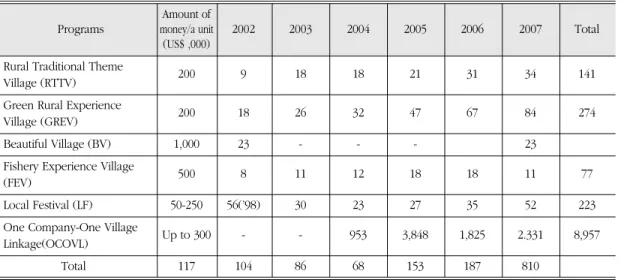
The RTTV and GREV are two main projects that focused on rural tourism development. Four hundred fifteen rural villages in rural amenity- based areas have been developing resources. Rural community people have differentiated those tourism projects from other kind of rural development projects before. Undoubtedly, rural tourism is one option where farm families can stay on the farm and have additional income. There is an important consideration for sustainable rural tourism development. Hopefully, a balance is achieved where rural families can still keep their sense of community, heritage and traditional family values. One fascinating program is the One Company One Village Linkages (OCOVL). The program started in 2004 and initiated by the Korea Agricultural Cooperative Federation (KACF). So far, 8,957 villages have agreements to link rural villages
with companies located in urban areas.
More rural communities in Korea are developing their tourism potential as a means of diversifying their local economy. There is undoubtedly a growing interest in tourism and its potential to help local communities in many parts of rural Korea.
The contribution of tourism to rural development can include: 1) revitalizing and reorganizing local economies, and improving the quality of life; 2) supplementing income for farming, craft, and service sectors, although most types of diversification render a relatively small contribution to average farm business income; 3) opening up the possibility of new social contacts, especially in breaking down the isolation of remoter areas and social groups; 4) providing opportunities to re- evaluate heritage and its symbols, ‘nature’
resources of landscape and the accessibility of open space, and the identity of rural places; 5) assisting policies on environmental, economic, and
Table 3. Rural tourism programs in Korea (number of village)
Amount of
Programs money/a unit 2002 2003 2004 2005 2006 2007 Total
(US$ ,000) Rural Traditional Theme
200 9 18 18 21 31 34 141
Village (RTTV) Green Rural Experience
200 18 26 32 47 67 84 274
Village (GREV)
Beautiful Village (BV) 1,000 23 - - - 23
Fishery Experience Village
500 8 11 12 18 18 11 77
(FEV)
Local Festival (LF) 50-250 56(’98) 30 23 27 35 52 223
One Company-One Village
Up to 300 - - 953 3,848 1,825 2.331 8,957
Linkage(OCOVL)
Total 117 104 86 68 153 187 810
Notes: * is total number of nominated villages from 1995 to 2002.
Source: Ministry of Agriculture and Forestry (2007). Plans for Improving Quality of Life and Rural Development. Gacheon: MAF.
social sustainability; and 6) helping to realize the economic value of specific quality-based production of foodstuffs, as well as of unused and abandoned buildings, unique scenery, spaces and culture.
3) Community Traditional Industry Development
In an increasing globalized food economy, local food initiatives are promoted as more sustainable alternatives than rural industrial programs such as industrial park programs, both for small-scale producers and ecological conscious consumers.
The new focus on rural development policy implies moving from agricultural-based rural development to broader cultural-based rural development. The community-based industry is a kind of strategy indicative of an advanced liberal form of rule governing through the community.
The geographical indication was set up by the Korean national government to promote sustainable economic development.
The endogenous development strategies have been born more from the inside than by the forces of the modernization paradigm. Endogenous development approaches (Hinrichs, 2003; van der Ploeg, Renting, Brunori, Knickel, Mannnion, Marsden, Roest, Guzman, and Ventura, 2000;
Turluin, 2003) hold that mobilizing and generating knowledge is the critical input to development, that agglomeration of interacting actors are the sources of much of this knowledge, and that economic proximity is necessary for knowledge pools that it makes sense to target public investments to places
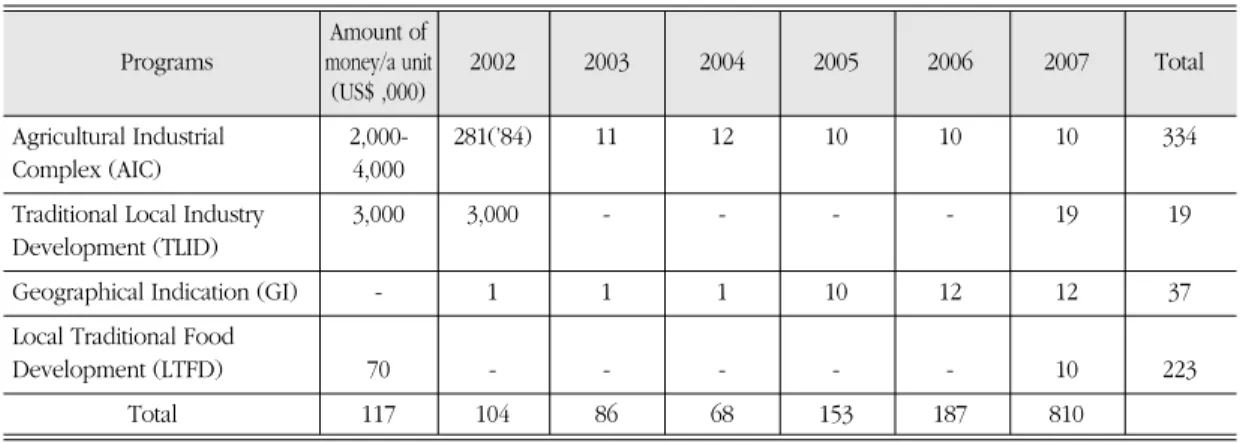
According to a survey on geographical indications by the Korea Intellectual Property Organization (KIPO) and Korea Intellectual Property Right Company (KIPRC), there are 342 specialty products on 70 items. Those are in categories on specialty food and handicrafts. The specialty foods are pine nuts, grape, rice, ginseng, potato, bean curd, pine mushroom, kimchi, tarrfy, dried walleye pollack, noddle, and spirits
KIPO aims to encourage diverse agricultural
Table 3. Rural tourism programs in Korea (number of village)
Amount of
Programs money/a unit 2002 2003 2004 2005 2006 2007 Total
(US$ ,000)
Agricultural Industrial 2,000- 281(’84) 11 12 10 10 10 334
Complex (AIC) 4,000
Traditional Local Industry 3,000 3,000 - - - - 19 19
Development (TLID)
Geographical Indication (GI) - 1 1 1 10 12 12 37
Local Traditional Food
Development (LTFD) 70 - - - - - 10 223
Total 117 104 86 68 153 187 810
Source: Ministry of Agriculture and Forestry (2007). Plans for Improving Quality of Life and Rural Development. Gacheon: MAF.
production, to protect product names from misuse and imitation, and to help consumers by giving them information concerning the specific characteristics of products. This is also to help Korean regions improve their relative economic performance.
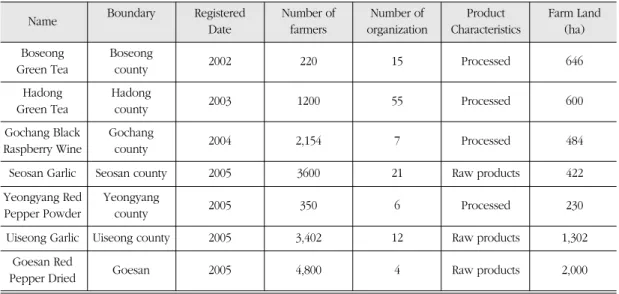
The national law on geographical indications started in 1999. The Bosung Green Tea is first item and the second item is Hadong Green Tea(2000).
And the Gochang Black Raspberry Wine is third item registered at the KGIS. Since 2000, seven geographical indication products have been registered. The items registered were two kinds of green tea (Boseng Green Tea and Hadong Green Tea), wine, garlic, and pepper.
The new focus on rural development policy implies moving from agricultural-based rural development to broader place-based rural development. In the past, public policies have
tended to focus on rural areas en bloc treating them as homogenous, with uniform problems and similar opportunities. Such an approach no longer reflects the reality of diversity among rural areas.
All are rural areas with low population density and significant agricultural land use. Their development patterns are, however, significantly different. As a result, governments are increasingly recognizing the need for a more locally tailored or “territorial”
approach.
Motivated by budget constraints, public concerns, and restrictions imposed by international trade agreements, Korea is beginning to re- examine the role of agriculture in promoting rural development. One strategy for overcoming the declining farm economy and farm financial crisis has been economic diversification. Local communities have tried to develop new businesses to help offset the loss of farm jobs and associated
Table 4. Geographical indication products in Korea.
Name Boundary Registered
Date
Number of farmers
Number of organization
Product Characteristics
Farm Land (ha) Boseong
Green Tea
Boseong
county 2002 220 15 Processed 646
Hadong Green Tea
Hadong
county 2003 1200 55 Processed 600
Gochang Black Raspberry Wine
Gochang
county 2004 2,154 7 Processed 484
Seosan Garlic Seosan county 2005 3600 21 Raw products 422
Uiseong Garlic Uiseong county 2005 3,402 12 Raw products 1,302
Yeongyang Red Pepper Powder
Yeongyang
county 2005 350 6 Processed 230
Goesan Red
Pepper Dried Goesan 2005 4,800 4 Raw products 2,000
Note: The data from author’s field survey from September 2004 to April 2005.
Source: Ministry of Agriculture and Forestry (2007). Plans for Improving Quality of Life and Rural Development. Gacheon: MAF.
economic activity. A growing interest in specialty foods, regional gastronomy, healthier eating, and the promotion of local identity has seen growth of food tourism as an important element in embedding rural tourism within local economic back-linkage.
In rural areas, entrepreneurs have been frequently bypassed by developments because of social or geographical isolation. Empowerment occurs when they discover that they have within themselves the power to achieve great results. As the process unfolds, their capabilities expand, their partnerships enrich, and their self-confidence grows.
According to Korea’s experiences on facilitating and registering geographical indications, there were several recommendations for enhancing community economic development and revitalization as follows (Park and Kim, 2007).
First, national and local policies have often concentrated on trying to encourage “bottoms-up”
development revolving around the commodification of local cultural resources. The system of geographical boundary to protect intellectual property rights should be more flexible because in some cases intellectual property rights is obscure and many counties have their own property rights.
Second, it is necessary for trademarks to restrict their terms of protection to establish geographical indications. It is because geographical indication is not quality certification but protecting intellectual property rights. Moreover, it has been shown that the qualification of applicants had to expand not only organization but also individuals living in their areas. Advanced countries with geographical indications such as France and Italy are not
exclusive for people who live in their local areas.
Third, it was emphasized that the certification of quality was divided into Protected Geographical Indication (PGI) and Protected Designation of Origin (PDO) to differentiate product quality and nurturing community-based industry. At present, Korea’s geographical indication is only PGI, not PDO. If PDO is available, consumers’ trust in products with geographical indications will increase. An appellation of origin is a special kind of geographical indication, used on products with specific quality that is exclusively or essentially due to the geographical environment in which the products are produced. The concept of geographical indication encompasses appellations of origin.
Fourth, to develop geographical indications product with local character, community people need to organize and control the process of production. Working with the principle of empowerment, the local community is seen as an important source of knowledge and ability that can be used in development. This is a bottoms-up locally based approach. Such approach requires a process that builds on local strength and promotes community participation and leadership, as well as ownership of both the problems and the solutions.
Fifth, there is social responsibility that will ensure that the benefits go to the farmers and to those who are most in need, including the involvement of the community in planning, the empowerment of villagers in the development of tourism enterprises, and the creation of systems to ensure the equitable distribution of profits.
Sixth, it is assumed that endogenous development and entrepreneurship are latent in rural areas and that specific measures to encourage
them are needed in order to bring out local dynamics of business creation and development.
Community empowerment is one of the important things to be achieved to be successful in community-based business. Even though the firms have registered their geographical indication products in the Ministry of Agriculture and Forestry (MAF), they have not been successful in their business because of the insufficient willingness and belief to empower their communities.
4. Future Rural Community Development Policy
What is new in rural community development is the emergence of a loose collection of approaches we call catalytic development, that are likely to lead to more effective community development practice in rural places. The emphasis is on leveraging local resources and networks to find local solutions in regional and global exchanges that expand capacity and investments. The new community developer does not entirely abandon locality-centered development practices, but is no longer the technician. Instead, the developer’s goal is to mobilize the capacity of local groups and organizations to achieve expanded objectives.
There are four axes to sustain rural communities.
Under axis 1, a range of measures will target human and physical capital in the agriculture, food, and forestry sectors promoting knowledge transfer and innovation and quality production.
Axis 2 provides measures to protect and enhance natural resources, as well as preserving high nature value farming and forestry systems, and cultural
landscapes in Korea’s rural areas. Axis 3 helps to develop local infrastructure and human capital in rural areas to improve the conditions for growth and job creation in all sectors and the diversification of economic activities. Axis 4, based on these experiences, introduces possibilities for innovative governance through local-based and
‘bottom-up’ approaches to rural development.
Rural development is multi-facetted in nature. It unfolds into a wide array of different and sometimes interconnected practices. Among them are landscape management, the conservation of new nature values, agri-tourism, organic farming, and the production of high quality and region- specific products. Other activities being increasingly adopted by family farms include innovative forms of cost-reduction, direct marketing, and the development of new activities such as integrating care-activities into the farm.
In Korea these could be achieved by: 1) strengthening the agricultural and forestry sectors through promotion of high-quality agricultural products; 2) improving the quality of life in rural communities - includes enhancing the competitiveness of rural areas and creating new sources of income for farmers and their families; 3) preserving the environment and rural heritage in Korea, and to do so through promotion of environment-friendly agriculture.
Most researchers have understood that the shift to rural development as a response to the cost- price squeeze experienced in modernized agriculture can be understood as an expression of survival strategies of farm families throughout Korea. Farmers in more marginal areas, with less potential for modern agriculture, have survived and sometimes prospered following farm
household survival strategies, based on local and particular opportunities and constraints.
Helping impoverished communities to move from hopelessness to self-confidence may require some form of external intervention to provide the incentive and direction to start moving the community in a positive direction. Beyond that, however, it is essential to empower the community and for governments and other organizations to provide technical and financial assistance in support of the community’s goals, as reflected in its strategy and work plan.
Rural development initiatives, designed to attract businesses and cultural institutions to the countryside, were also included in the plan along with welfare program for rural people in fields such as health care and off-farm job training. Policy measures included in the recent structural adjustment plan are generally less distorting forms of support to the sector than the market-based interventions which have been dominant to date in the Korean approach to agricultural policy.
Empower is no mere catchword, however, it is an approach to development that enables low- income community people to improve their communities through active involvement in decision-making and project implementation. It replaces the ‘do for’ or ‘do to’ approach to governing by implementing a ‘do with’ model. It is helpful to think about empowerment as a process.
One way to conceive the process is like a staircase.
Communities in poverty often find themselves mired in hopelessness about the possibility of improving the incomes and living conditions of their community people.
Community development agency is vital to protecting, retaining, and maintaining rural
communities (Brennan & Luloff, 2007). The role of the community development agency in the rural community and the economic development processes need to be better understood in Korea and other industrialized countries. This is particularly critical where extra local development has threatened and eroded rural cultures and economics.
In essence, rural development policy measures are a new paradigm and development model for agricultural and rural areas in Korea. It is one that is strongly rooted in the practices of farm family households that has been gaining importance in national and local policy discourses in Korea. A more theoretical view of the increasing number of farm households that are providing ‘new’ services to society and addressing new demands is expressed in the concept of multi-functionality.
According to Quality of Life, Education and Community Development Act in 2004, rural development activities in Korea are directed at multiple objectives. Often, these various objectives are not recognized by rural development policy makers and practitioners and are competing with some other nation development program related with other ministry. This complicates the development of consistent research-based and educational programs. The three major objectives guiding rural development are: (1) growth in local domestic output-income generation, (2) employment creation, and (3) improvement in income distribution within a limited geographical region. In addition, some rural development proponents suggest that the major objectives of rural development should be non-economic goals, such as “quality of life,” which give primacy to environmental quality. Other proponents suggest
that the “empowerment” of local citizens is the most appropriate goal for rural development activities that require local people and institutions to develop the capacity to manage rural development.
In the future the creation and evolution of food supply chains are one key dimension in the new patterns of rural development now emerging in Korea. Korean government has policies for the agricultural and rural development: 1) raising young and competent beginner-farmers with advanced knowledge and management skills; 2) stabilizing farmers’ income by the government introducing direct payment program for environment-friendly farming and for environment conservation program; 3) securing food safety by introducing new program and strengthening monitoring system in distribution process; 4) enhancing rural living conditions by provision of more benefits to the rural people such as benefit package that includes health insurance, education support, and day care; and 5) developing rural community as a lively place that has job opportunities, rural diversification, and maintain rural beauties that attracts not only rural but also urban dwellers.
5. Conclusion
In Korea it is true to say that governmental decision-making is slowly being influenced by thinking in terms of community, self-reliance and self-help, which are gradually creeping into rural and rural development discussions. It is the complex institutional setting of rural development
that makes it a multi-actor process. Within rural development programs, mechanisms of social exclusion also occur and policy programs at times are used by local elites to restore their legitimacy or in the interests of clientelism. It is challenging that the planning process itself had to include broad public participation, and not merely the product of a planning office or consulting firm.
This is an essential part of the Korean agricultural and rural model. The policy is based on: 1) multi-functional nature of agriculture, with farms not just acting as sites of food production, but potentially providing a range of services and functions; 2) multi-sectoral and integrated approach to the rural economy favoring increases in various activities, sources of income and employment, and protection of the rural heritage;
3) flexible support for rural development, based on subsidiarity and decentralization, with consultation at regional, local and partnership level; and 4) transparency in drawing up and managing programs, based on simplified and more accessible legislation.
In important ways, the three categories of rural development programs are more of a community development program than an economic development program. It showed that the size of areas served was too small to secure access to funding, to implement projects jointly and to pool resources. Applications for the Integrated Rural Community Development and the Rural Traditional Theme Village designations were competitive and had to be supported by comprehensive and long- term strategic plans for development. There is also social responsibility on how to ensure that the benefits go to farmers who are most in need, including the involvement of the community in
planning, the empowerment of villagers in the development of tourism enterprises, and creation of systems to ensure the equitable distribution of profits.
Many rural development programs in Korea have a linear understanding of the relationship between economic and social development, with one leading to the other. Separating responsibilities for social and economic goals calls into question the extent to which such initiatives can be regarded as integrated rural development at all.
The presence of a key individual, the role of local authorities and the existence of Korea national policy and programs started as major factors influencing the emergence of partnerships.
Considering the subsequent development of partnerships, the existence of regional policies or programs, the role of local community, and also the role played by the local authorities were the most important elements cited.
This new rural development policy constitutes a coherent and long-term framework guaranteeing the future of rural areas and promoting the maintenance and creation of employment. In effect, the application procedure should have been constituted a significant process of community development, and communities that took the process seriously found themselves mobilized for action and in possession of an implementable plan. It is clear farm families, depend on employment and income generated by a complex mix of interacting economic activities. In short, good practice in rural development includes: an integrated, territorial approach, sensitive to the diversity of rural circumstances is needed to ensure regionally balanced development and territorial cohesion.
To conclude, integrated rural development that pursues an approach emphasizing animation, capacity-building, community involvement and partnership became the orthodoxy after 2000. The various elements within this processes that are partnerships, community involvement, animation, facilitation, and strategic planning have been elaborated elsewhere and are not unproblematic.
Rural community development through empowerment must be based on processes of social “animation”, “facilitation” and “capacity building” so as to overcome the widespread sense of apathy and powerlessness which is characteristic of many disadvantaged rural areas.
References
Banks, J. and Marsden, T., 2000, “Integrating Agri- environment Policy, Farming Systems and Rural Development: Tir Cymen in Wales.”, Sociologia Ruralis 40(4), pp.466-480.
Boonstra. W. J., 2006, “Policies in the Polder: How Institutions Mediate between Norms and Practices of Rural Governance.”, Sociologia Ruralis 46(4), pp.299-317.
Brennan, M. A. and Luloff, A. E., 2007, “Exploring Rural Community Agency Differences in Ireland.”, Journal of Rural Studies 23, pp.52-61.
Briedenhann, J. and Wickens, E., 2004, “Tourism Routes as a Tool for the Economic Development of Rural Areas: Vibrant Hope or Impossible Dream?”, Tourism Management 25(1), pp.71-79.
Canoves, G., Villarino, M., Priestley, G. K., and Blanco, A., 2004, “Rural Tourism in Spain: An Analysis of Recent Evolution.”, Geoforum 35, pp.755-769.
Choe, C. S., 2005, Key Factors to Successful Community Development The Korean Experience. Integration
of Endogenous Culture Dimension into Development. IDE Discussion Papers. No. 039.
Chiba, Japan: Jetro.
Chung, Y. B. and Dong Y.-M., 1982, Agricultural Extension Services in Korea. Suwon: Office of Rural Development.
Fleischer, A. and Felsenstein, D., 2000, “Support for Rural Tourism: Does It Make a Difference?”, Annals of Tourism Research 27, pp.1007-1024.
Gu, J., 2006, “Challenges for the New Revitalization Program.”, Rural Policy Journal 18 (summer), pp.
25-37.
Han, S.-B., 1997, The Role of Endogenous Culture in Socio-Economic Development of Korea. Integration of Endogenous Cultural Dimension into Development. New Delhi, India: Indira Gandhi National Centre for the Arts.
Herbert-Cheshire. L., 2000, “Contemporary Strategies for Rural Community Development in Australia: A Governmentality Perspective.”, Journal of Rural Studies 16, pp.203-215.
Hinrichs, C. C., 2003, “The Practice and Politics of Food System Localization.”, Journal of Rural Studies 19, pp.33-45.
Korea Rural Economic Institute (KREI)., 2006, Challenges for Future Rural Community in Vision 2030. Seoul:
KREI.
Kostov, P. and Lingard, J., 2004, Integrated Rural Development: Do We Need a New Approach?
Others 0409006, EconWPA. Belfast, Nothern Island:
Queen’s University. http://ideas.repec.org/s/wpa/
wuwpot.html
Lee, A., 2003, “Community Development in the Ireland.”, Community Development Journal 38(1), pp.48-58.
MacDonald, R. and Jolliffe, L., 2003, “Cultural Rural Tourism, Evidence from Canada.”, Annals of Tourism Research 30(2), pp.307-322.
Ministry of Agriculture and Forestry (MAF)., 2003, Statistical Yearbook of Agriculture and Forestry.
Gacheon: MAF.
Ministry of Agriculture and Forestry (MAF)., 2005, Statistical Yearbook of Agriculture and Forestry.
Gacheon: MAF.
Ministry of Agriculture and Forestry (MAF)., 2007, Statistical Yearbook of Agriculture and Forestry.
Gacheon: MAF.
Ministry of Agriculture and Forestry (MAF)., 2004, Quality of Life, Education and Community Development Act. Gacheon (www.maf.go.kr).
Ministry of Agriculture and Forestry (MAF)., 2005, Five Years Plans for Improving Quality of Life and Rural Community Development. Gacheon: MAF.
Ministry of Agriculture and Forestry (MAF)., 2007, Plans for Improving Quality of Life and Rural Development. Gacheon: MAF.
Ministry of Food, Agriculture, Forestry and Fishery (MIFAFF)., 2008, Plans for Improving Quality of Life for Farmer and Fishery and Rural Development.
Gacheon: MIFAFF.
Park, D.-B., 2006, Rural Tourism Development as a Government Oriented Rural Development Programme in Korea: Case Study of Darengeui Village. Coherence of Agricultural and Rural Development Policies. Paris: OECD.
Park, D.-B. and Kim, S.-G., 2007, “Exploring Geographical Indications for Enhancing Micro- business as a Community-based Industry in Rural Korea.”, Journal of Food System 14(2), pp.16-26.
Schutjer, W. A., 1991, “Rural Development and Extension.”, Journal of Extension, 29(1), pp. 1-6.
http://www.joe.org/199spring/tp1.html
Shortall, S. and Shucksmith, M., 2001, “Rural Development in Practice: Issues Arising in Scotland and Northern Ireland.”, Community Development Journal 36(2), pp.122-133.
So, S.-Y., 2007, Direction for Rural Development Policy and Countermeasure of Community People.
Unpublished Technical Paper at http://www.krdf.
or.kr/
Terluin, I. J., 2003, “Differences in Economic
Development in Rural Regions of Advanced Countries: An Overview and Critical Analysis of Theories.” Journal of Rural Studies 19, pp.327-344.
Theodori, G., 2001, “Community and Community Development in Resource-Based Areas: Operational Definitions Rooted in an Interaction and Perspective.”, Society and Natural Resources 18, pp.661-669.
Turner, J. E., Hesli, V. L., Bark, D. S., and Yu, H., 1993, Village Astir: Community Development, Tradition, and Change in Korea. Westport, CT: Praeger.
Van der Platt, M. and Barrett, G., 2006, “Building Community Capacity in Governance and Decision Making.”, Community Development Journal 41(1), pp.25-36.
Van der Ploeg, J. D. Renting, R., Brunori, G., Knickel, K.,
Mannnion, J., Marsden, T., Roest, K., Guzman, E. S., and Ventura F., 2000, “Rural Development: From Practices and Policies Towards Theory.”, Sociologia Ruralis 40 (4), pp.391-408.
교신: 윤유식, 서울 동대문구 회기동 경희대학교 호텔관 광대학, mobile: 010-5112-3523, e-mail: ysyn@khu.
ac.kr
Correspondence: Yoo-Shik. Yoon, Professor, College of Hotel and Tourism, Kyunghee University, Heekidong, Dongdaemun-Gu, Seoul, 130-710, South Korea, mobile: 010-5112-3523, e-mail: ysyn@
khu.ac.kr
최초투고일 2008년 11월 17일 최종접수일 2008년 12월 10일
한국 농촌지역개발과 정책과제
박덕병*·윤유식**·이민수***
요약`: 한국의 농촌지역개발 정책은 종합농촌개발, 농촌관광개발, 향도산업개발의 세 가지 사업으로 구성되어 있다. 이러한 방향에서 중앙정부와 지방정부는 농촌문화와 농촌어메니티와 연계된 상품화를 위한 상향식 개발방법을 촉진시키는데 초점을 두어왔다. 이상의 세 가지 농촌개발정책은 경제개발정책 이상의 지역사회개발정책에 초점을 두고있다. 정부는 농촌개발정책의 담론을 지역사회, 자료, 자립에 바탕을 두도록 느리지만 변화시키고 있다. 이러한 계획과정은 단순히 전문기간이나 컨설팅회사에 의해서가 아니라 더 넓은 공 공참여, 파트너십, 상향식으로 이루어지도록 해야한다.
주요어: 농촌지역개발, 농촌개발정책
한국경제지리학회지 제11권 제4호 2007(600~617)
* 연구원, 농촌진흥청
** 교수, 경희대학교, 호텔관광대학
*** 연구원, 전북발전연구원