DOI: http://dx.doi.org/10.7316/KHNES.2012.23.5.429
수소 가압형 기계적 합금화법으로 제조한 MgHx-Nb2O5 산화물 복합 재료의 수소화 특성 평가
이나리ㆍ이수선ㆍ홍태환†
한국교통대학교 신소재공학과
Evaluations of Hydrogen Properties of MgH
x-Nb
2O
5Oxide Composite by Hydrogen Induced Mechanical Alloying
NARI LEE, SOOSUN LEE, TAEWHAN HONG†
Korea National University of Transportation, 50 Daehak-ro, Chungju-si, Chungbuk, 380-702, Republic of Korea
Abstract >> Mg and Mg-based alloys are regarded as strong candidate hydrogen storage materials since their hydrogen capacity exceeds that of known metal hydrides. One of the approaches to improve kinetic is addition of metal oxide. In this paper, we tried to improve the hydrogenation properties of Mg-based hydrogen storage composites. The effect of transition metal oxides, such as Nb2O5 on the kinetics of the Magnesium hydrogen absorption kinetics was investigated. MgHx-5wt.% Nb2O5 composites have been synthesized by hydrogen induced mechanical alloying. The powder fabricated was characterized by X-ray diffraction (XRD), Field Emission-Scanning Electron Microscopy (Fe-SEM), Energy Dispersive X-ray (EDX), BET and simultaneous Thermo Gravimetric Analysis / Differential Scanning Calorimetry (TG/DSC) analysis. The Absorption / desorption kinetics of MgHx-5wt.%
Nb2O5 (type I and II) are determined at 423, 473, 523, 573 and 623 K.
Key words : Hydrogen storage alloy (수소저장합금), Mechanical alloying (기계적 합금화법), Hydride (수소화물), Kinetics(반응속도)
†Corresponding author : [email protected]
[ 접수일 : 2012.7.31 수정일 : 2012.8.27 게재확정일 : 2012.10.26 ] Copyright ⓒ 2012 KHNES
1. Introduction
Hydrogen energy will be used instead of coal and petroleum in the near future, but obstructing factors must first be solved, such as cost efficiency, social infrastructure and stability. In hydrogen related research hydrogen storage is an most important projects for hydrogen economical society. One of the key tech-
nologies is to develop high-performance hydrogen storage materials. Gasification or liquefaction of hydrogen storage were not more stable than hydrogen storage in metal. For hydrogen storage, metallic hydrides with a high storage capacity are preferred to the com- pressed or liquid hydrogen, due to high volumetric capacity, safety and convenience. However, many pro- blems need to be resolved: weight per hydrogen capacity, high operating temperature, slow kinetics and the initial activation process1). In particular, mag- nesium hydride is one of the most attractive materials
because that is directly combined from the reaction of Mg with hydrogen and reaches a high hydrogen capacity (7.6 wt.%). Moreover, it is environmentally benign, abundant, inexpensive and easy to handle. However, for pure magnesium, its high operating temperature, high thermodynamic stability of MgH2 (-75 kJ/mol) and slow kinetics prevent it from being used for practical applications2).
Several ways have been reported to enhance the sorption kinetics of magnesium-based hydrides including particle size reduction by high energy ball milling3) and Carbon addition4). A successful route remains the addition of transition metals5-8), oxides9), halides10-11), carbides and nitrides12). Among the transition metals, oxides act as a good catalyst and enable MgH2-based composites to decrease the operation temperatue, im- proving the hydrogen absorption/desorption properties by adding a transition metal oxide, for example, Nb, V or Fe. Metal oxide materials have a catalytic effect on the research12,13). Especially, W. Oelerich, et al13) reported that hydriding/dehydriding properties of nano- crystalline MgH2 improved through 0.05 wt.% transition metal oxide addition (CuO, Mn2O, Cr2O3, Fe3O4 and V2O5). The kinetics of MgH2-0.05 wt.% transition metal oxide composites was faster than MgH2 without catalysts.
However, it is not yet clear what the mechanism of catalysis for oxides is, and which oxides are most effective. One of the empirical rules claims better efficiency for oxides, in which metal atoms have multiple valence states12,13). In this work, the transition metal oxide should have a positive effect on the hydriding/
dehydriding reaction of nanocrystalline Mg. Inves- tigations concerning the absorption properties of nano- crystalline MgHx with and without Nb2O5 catalyst on different temperature experiments are presented which improves to hydrogenation properties of MgHx-Nb2O5
composites by mechanical alloying.
2. Experimental Procedure
Magnesium ingot (3 N) was fabricated to chips using a drilling machine. Hydrogen induced mechanical alloying (HIMA) was carried out in a Fritsch P5 planetary ball mill with a ball to chips weight ratio of 40:1 under 2 MPa hydrogen atmosphere and being milled for up to 48 hours. The nanocrystalline magnesium hydride powder was synthesized by mechanical alloying with 5 wt.% Nb2O5 and then milled for up to 24 hours.
Nb2O5 (type I, 1 μm, 3 N, Semiconductor Material Co.) were premilled to get through high energy mill that was fabricated to nano-structured Nb2O5 (type II).
Premilling was carried out with a zirconia-ball to Nb2O5 powder ratio of 10:1 in a zirconia vessel and then milled for up to 30 minutes. MgHx and MgHx- 5 wt.% Nb2O5 (type I , II) composites synthesis were characterized as XRD, BET, SEM/EDX and TG/
DSC. The kinetic properties of MgHx and MgHx-5 wt.% Nb2O5 composites were performed at 423, 473, 523, 573 and 623 K under 3 MPa hydrogen atmosphere for an hour, respectively, using a volumetric Sievert’s apparatus.
3. Results and Discussions
3.1 Analysis of MgHx and MgHx-5wt. % Nb2O5
composites
Fig. 1 shows XRD patterns of Nb2O5 (type I and II), MgHx and MgHx-5wt.% Nb2O5 (type I and II) com- posites. XRD patterns of as-received Nb2O5 (type I) only compared with Nb2O5 that was milled for 30 minutes (type II). When the XRD patterns of premilled Nb2O5
(type II) was composed of highly sharp and broad peaks which is assumed like amorphous/nano- structured Nb2O5. To get amorphous/nano- structured Nb2O5, milling should be performed for longer than 30 minutes.
Fig. 1 The XRD patterns of Nb2O5 (a) and MgHx-5 wt.%
Nb2O5 (type I and II) (b) composites (■; Nb2O5, ●; MgH2,
○; Mg)
Table 1 Results of BET on MgHx and MgHx-5 wt.% Nb2O5
(type I and II) composites as, BET
(m2/g)
Total pore volume cm3/g)
Average pore diameter (nm)
MgHx 4.2571 0.0021 1.9760
MgHx-5 wt.%
Nb2O5 (type I) 4.5901 0.0024 2.0655 MgHx-5 wt.%
Nb2O5 (type II) 5.2490 0.0027 2.0719
Fig. 2 BET analysis of MgHx and MgHx-5 wt.% Nb2O5 (type I and II)
XRD patterns of MgHx exhibits mainly the peaks corresponding to the MgH2 phase with a small quantity of pure Mg. The results of XRD indicated that there was no apparent reaction between the Nb2O5 (type I and II) powder and the MgHx during HIMA. The XRD peaks of Nb2O5 added to the magnesium hydrides, MgHx-5 wt.% Nb2O5 (type I and II) did not show any shift in XRD peak positions. The MgHx peaks remained sharp and strong intense, due to the polycrystalline MgH2. On the contrary, XRD patterns of MgHx-5 wt.% Nb2O5 (type I and II) showed broad MgH2 peaks, of which intensity decreased with MgH2 concentration that was like-amorphous / nano-structured MgH2 when 29° and 36°. Simultaneous to the Nb2O5 (type I and II) addition, the MgH2 diffraction peaks broadened, and their intensity decreased, indicating a significant
particle size reduction and modification of the micro- structure of the magnesium hydride. Results showed such evolution was dependent on the morphology and/or surface area of MgHx and MgHx-5 wt.% Nb2O5
(type I and II), as it was stronger for MgHx-5 wt.%
Nb2O5 (type I) as compared to the MgHx-5 wt.%
Nb2O5 (type II). Indeed, the BET of MgHx (Fig. 2) increased from 4.3 to 4.6 and 5.2 m2/g for MgHx-5 wt.% Nb2O5 (type I) and MgHx-5 wt.% Nb2O5 (type II) composites, respectively. If the MgHx-5 wt.% Nb2O5
composite has increasing surface area, maybe it will continue to improve hydrogenation properties, because hydrogen diffusion generates at the grain boundary14).
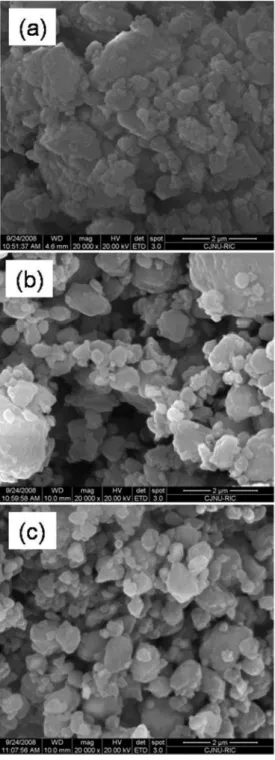
High energy milling can also induced particle size reduction which could influence kinetics. Therefore, the powder obtained was investigated by SEM. Respec-
Fig. 3 SEM morphologies of MgHx (a), MgHx-5 wt.% Nb2O5
(type I) (b) and MgHx-5 wt.% Nb2O5 (type II) (c) composites
Fig. 4 TG (a) / DSC (b) analysis of MgHx and MgHx-5 wt.%
Nb2O5 (type I and II) composites
tive micrographs (Fig. 3) indicated that the particle size of MgH2 effectively decreased during HIMA. After
48 hours of milling, particle sizes in the range of 30 nm to 15 μm are observed for MgHx (Fig. 3(a) and (b)). If milled with Nb2O5, the average particle size appeared smaller, i.e. more nanometric particles could be imaged (c). Fig. 3 presented the distribution of MgHx and MgHx-5 wt.% Nb2O5 (type I and II) particle size as determined by the analysis of the Fe-SEM images. For MgHx, the particle size distribution was observed 30 nm to 2 μm.
With the Nb2O5 addition, the distribution was 30 nm to 15 μm. The Nb2O5 particles, with an average initial size of 3 μm, were also broken upon milling into particles with a large size distribution. Especially,
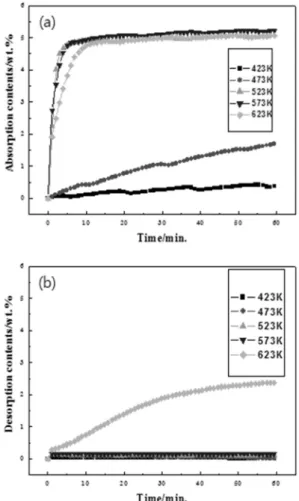
Fig. 5 Absorption profile of MgHx under 3 MPa (a) and desorption profile of MgHx under vacuum (b) composites
distribution of MgHx, in the mass, was larger than MgHx-5 wt.% Nb2O5 (type I and II) composites.
The hydrogen desorption properties of composites synthesized can be deduced from TG/DSC profiles.
As can be seen in Fig. 4, there was almost no difference in the thermal behavior among the three samples. The main decomposition reaction started at around 682 K on MgHx and decreased the initial temperature. Therefore, the effects of Nb2O5 was de- creasing the operating temperature and increasing dehydrogenation quantity through a change in the initial temperature and mass loss quantity. A mass loss quantity of MgHx and MgHx-5 wt.% Nb2O5 (type I and II) showed 0.1, 0.24 and 0.38 mg, respectivly.
The reaction enthalpy, ΔH, was decreasing which easily happens in the endothermic reaction15). Respec- tively, the ΔH of MgHx and MgHx-5 wt.% Nb2O5
(type I and II) were calculated -1234, -1196 and -1056 J/g. The mass loss quantity was increasing and ΔH was decreasing during HIMA.
3.2 Hydrogenation/dehydrogenation of MgHx and MgHx-5 wt. % Nb2O5 (type I and II) composites
Fig. 5 (a) shows absorption curves for a sample of milled MgHx without Nb2O5 at 423, 473, 523, 573 and 623 K under 3 MPa hydrogen atmosphere. As can be clearly seen, the absorption rate was faster when the temperature was increased.
The hydrogen capacities of MgHx was measured 0.37 wt.% at 423 K, 1.69 wt.% at 473 K, 5.08 wt.%
at 523 K, 5.22 wt.% at 573 K and 5.06 wt.% at 623 K. The absorption profile of MgHx at 423 and 473 K, were observed non-activated reaction slope. For sufficient absorption to occur, more than 1 hour is needed with low operating temperature. The desorption of MgHx was only presented at 623 K and kinetics
was very slow, see Fig. 5 (b). The desorption was not clear reaction which needs more time and a high operating temperature.
The absorption rate between the initial time and 4 minutes of the set point reaches 0.00029 wt.%/s at 423 K, 0.00088 wt.%/s at 473 K, 0.01954 wt.%/s at 523 K, 0.01891 wt.%/s at 573 K and 0.01425 wt.%/s.
The fastest absorption kinetics showed at 473K. How- ever, the absorption properties of magnesium hydride had very slow kinetics at low operating temperatures.
The hydrogen capacities of MgHx-5 wt.% Nb2O5
(type I) composites was measured 2.01 wt.% at 423 K, 3.49 wt.% at 473 K, 3.81 wt.% at 523 K, 3.79
Fig. 6 Absorption profile of MgHx-5 wt.% Nb2O5 (type I) under 3 MPa (a) and desorption profile of MgHx-5 wt.%
Nb2O5 (type I) under vacuum (b) composites
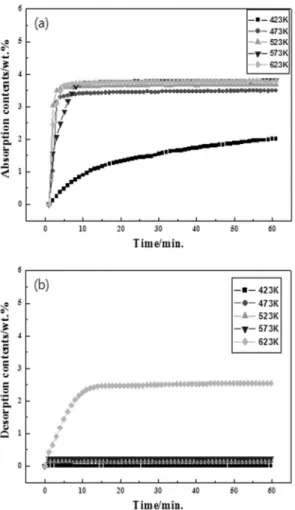
Fig. 7 Absorption profile of MgHx-5 wt.% Nb2O5 (type II) under 3 MPa (a) and desorption profile of MgHx-5 wt.%
Nb2O5 (type II) under vacuum (b) composites.
wt.% at 573 K and 3.79 wt.% at 623 K (see Fig. 6 (a)). The absorption rate was clearly faster with the addition of Nb2O5, especially at 473 K. However, hydrogen capacities had lower MgHx-5 wt.% Nb2O5
(type I) composites than MgHx. The absorption rate between the initial time and 4 minutes of the set point reached 0.00196 wt.%/s at 423 K, 0.01383 wt.%/s at 473 K, 0.01496 wt.%/s at 523 K, 0.01188 wt.%/s at 573 K and 0.1521 wt.%/s at 623 K. The best temperature was 523 K in hydrogen capacity and the best hydrogen storage rate was 623 K in kinetics.
Fig. 6 (b) shows the desorption of MgHx-5 wt.% Nb2O5
(type I) composite, that only showed the desorption reaction at 623 K. The desorption quantity was 2.5 wt.% when 623 K, but that was a very small quantity to compare with the hydrogen capacity.
Therefore, the high surface area of Nb2O5 should have a positive effect on the hydrogen diffusion which was improve to hydrogenation/dehydrogenation pro- perties16).
Fig. 7 (a) shows the absorption profile of MgHx-5 wt.% Nb2O5 (type II) composites. The absorption rate of MgHxx-5 wt.% Nb2O5 (type II) composites was measured 0.00433 wt.%/s at 423 K, 0.01541 wt.%/s
at 473 K, 0.01691 wt.%/s at 523 K, 0.01704 wt.%/s at 573 K and 0.0123 wt.%/s, and the hydrogen capacities of MgHx-5 wt.% Nb2O5 (type II) composites were 2.77 wt.% at 423 K, 3.84 wt.% at 473 K, 4.17 wt.%
at 523 K, 4.30 wt.% at 573 K and 4.25 wt.% at 623 K when between the initial time and 4 minutes and between the initial time and 5 minutes, respectively.
The hydrogen capacities of MgHx-5 wt.% Nb2O5
(type II) composites was more than MgHx-5 wt.%
Nb2O5 (type I) composites and improving kinetics of MgHx. Fig. 7 (b) shows the desorption profile of MgHx-5 wt.% Nb2O5 (type II) composites. The hydrogen desorption quantity was 2.72 wt.% which was more than MgHx and MgHx-5 wt.% Nb2O5 (type I) com- posites at 623 K, but more time is needed and tem- perature should be higher than 623 K.
4. Conclusion
In this report was preformed evaluation of hydro- genation properties on MgHx-5 wt.% Nb2O5 (type I and II) composites in the temperature ranges of 423, 473, 523, 573 and 623 K under 3 MPa hydrogen atmosphere. The kinetics of MgHx was found to be very slow. Hydrogenation/dehydrogenation kinetics of MgHx was improved by addition of Nb2O5 (type I and II). However, MgHx-5 wt.% Nb2O5 (type I and II) composites was decreased hydrogen capacity more than MgHx. Especially, hydrogenation/dehydrogenation kinetics of MgHx-5 wt.% Nb2O5 (type II) composite was improved more than MgHx-5 wt.% Nb2O5 (type I) composite due to increasing surface area of Nb2O5
(type II).
Therefore, Hydrogenation properties was improved to addition of Nb2O5 and the high surface area of Nb2O5 (type II) was increased the hydrogen storage rate without decreasing hydrogen capacities. However, the mechanism of catalysis is not yet clear. Further
experimentation is necessary to determine the catalyst mechanism.
Acknowledgement
The research was supported by a grant from the Academic Research Program of Korea National Uni- versity of Transportation in 2012.
References
1. G. Barkhordarian, T. Klassen, R. Bormann, “Fast hydrogen sorption kinetics of nanocrystalline Mg using Nb2O5 as catalyst”, Scripta Materialia, Vol.
49, 2003, pp. 213-217.
2. V. Bhat, A. Rougier, L. Aymard, G. A. Nazri, J.
M. Tarascon, “Enhanced hydrogen storage property of magnesium hydride by high surface area Raney nickel”, Int. J. Hydrogen Energy, Vol. 32, 2007, pp. 4900-4906.
3. A Zaluska, L. Zaluski, Jo Strom-Olsen, “Synergy of hydrogen sorption in ball-milled hydrides of Mg and Mg2Ni”, J. Alloys Compd., Vol. 289, 1999, pp. 197-206.
4. R. Janot, L. Aymard, A. Rougier, G. A. Nazri, J. M. Tarascon, J. Mater. Res., Vol. 18, 2003, pp.
1749-1752.
5. J. L. Bobet, E. Akiba, B. Darriet, “Study of Mg-M (M=C0, Ni and Fe) mixture elaborated by reactive mechanical alloying: hydrogen sorption properties”, Int. J. Hydrogen Energy, Vol. 26, 2001, pp. 493-501.
6. G. Liang, J. Huot, S. Boily, A. van Neste, R.
Schulz, “Hydrogen storage in mechanically milled Mg-LaNi5 and MgH2-LaNi5 composites”, J. Alloys and Compd., Vol. 297, 2000, pp. 261-265.
7. C. X. Shang, M. Bououdina, Y. Song, Z. X. Guo,
“Mechanical alloying and electronic simulations of (MgH2+M) systems (M=Al, Ti, Fe, Ni, Cu and Bn) for hydrogen storage”, Int. J. Hydrogen Energy,
Vol. 29, 2004, pp. 73-80.
8. J. Huot, J. F. Pelletier, L. B. Lurio, M. Sutton, R. Schulz, “Investigation of dehydrogenation mech- anism of MgH2-Nb nanocomposites”, J. Alloys and Compd., Vol. 348, 2003, pp. 319-324.
9. M. W. Jung, J. H. Park, K. W. Cho, K. -I. Kim, J. H. Choi, S. -H. Kim, T. -W. Hong, “Hydro- genation properties of MgHx-V2O5 composites by hydrogen induced mechanical alloying”, Trans.
of the Korean Hydrogen and New Energy Society, Vol. 21, 2010, pp. 58-63.
10. S. Deleda, A. Borissova, C. Poinsingnon, W. J.
Botta, M. Dornheim, T. Klassen, “H-sorption in MgH2 nanocomposites containing Fe or Ni with fluorine”, J. Alloys Compd., Vol. 404-406, 2005, pp. 409-412.
11. A. R. Yavari, A. LeMoulec, F. R. deCastro, S.
Deledda, O. Friedrichs, W., J. Botta, G. Vaughan, T. Klassen, A. Fernandez, A. Kvick, “Improve- ment in H-sorption kinetics of MgH2 powders by using Fe nanoparticles generated by reactive FeF3
addition”, Vol. 52, 2005, pp. 719-724.
12. W. Oelerich, T. Klassen, R. Bormann, “Com- parison of the catalytic effects of V, V2O5, VN and VC on the hydrogen sorption of nanocrystalline Mg”, J. Alloys Compd., Vol. 322, 2001, pp. L5- L9.
13. W. Oelerich, T. Klsssen, R. Bormann, “Metal oxides as catalysts for improved hydrogen sorption in nanocrystalline Mg-based materials”, J. Alloys Compd., Vol. 315, 2001, pp. 237-242.
14. Kyeong-Il Kim, Tae-Whan Hong, “The hydro- genation behaviors of V-xAl [x=1, 5 wt.%] com- posites by mechanical alloying”, Trans. of the Korean Hydrogen and New Energy Society, Vol.
22, 2011, pp. 81-88.
15. Kyeong-Il Kim, Young-Sung Kim, Tae-Whan Hong,
“Hydrogenation properties on MgHx-Sc2O3 Com- posites by mechanical alloying”, Trans. of the Korean Hydrogen and New Energy Society, Vol.
21, 2010, pp. 81-88.
16. J. F. Pelletier, J. Huot, M. Sutton, R. Schulz, A.
R. Sandy, L. B. Lurio, S. G. J. Mochrie, “Hydrogen desorption mechanism in MgH2-Nb nanocomposites”, Phys. Rev. B, Vol. 63, 2001, p. 521.